.webp)

%20(1).webp)






.webp)
A tech startup branding agency helps founders turn complex products into a brand buyers understand, trust, and remember.
In 2026, that means more than a logo, color palette, or AI-generated brand kit. It means clear positioning, a scalable visual identity, a conversion-ready website, and product design that feels consistent from first visit to signup.
This guide shows how to build a tech startup brand identity with AI tools and expert design. You’ll learn what to define first, what to automate, what to protect, and when to bring in a professional team.
A tech startup branding agency helps software companies define their positioning, messaging, visual identity, website brand experience, pitch deck design, and product-facing brand system. The goal is to make a complex product easier to understand, trust, and buy.
A basic startup brand kit can cost a few thousand dollars, while a complete tech branding package with strategy, logo, guidelines, website direction, and product UI alignment can cost much more. The final cost depends on research depth, deliverables, timeline, and whether website design or development is included.
Use AI tools for research, brainstorming, moodboards, naming ideas, and early design exploration. Hire expert designers when the brand needs to be original, legally safer, investor-ready, scalable, and consistent across website, app, sales, and product experiences.
A strong tech startup brand identity should include positioning, value proposition, messaging framework, logo system, color palette, typography, visual style, brand guidelines, pitch deck styling, website design direction, and product UI rules.
With AI-assisted research and expert design, a focused startup brand identity can often be completed in 3 to 5 weeks. Larger projects that include website design, product UI, stakeholder workshops, and detailed brand guidelines may take longer.
A startup should invest in professional branding before a major launch, funding round, enterprise sales push, product redesign, or website rebuild. It is also worth doing when competitors look similar and the company needs stronger differentiation.
Tech startup branding has changed quickly. Today, any founder can use an AI logo maker, AI brand kit generator, or design tool to create logos, colors, layouts, and taglines in minutes.
That speed is useful. It helps teams explore ideas faster, compare creative directions, and avoid starting from a blank page.
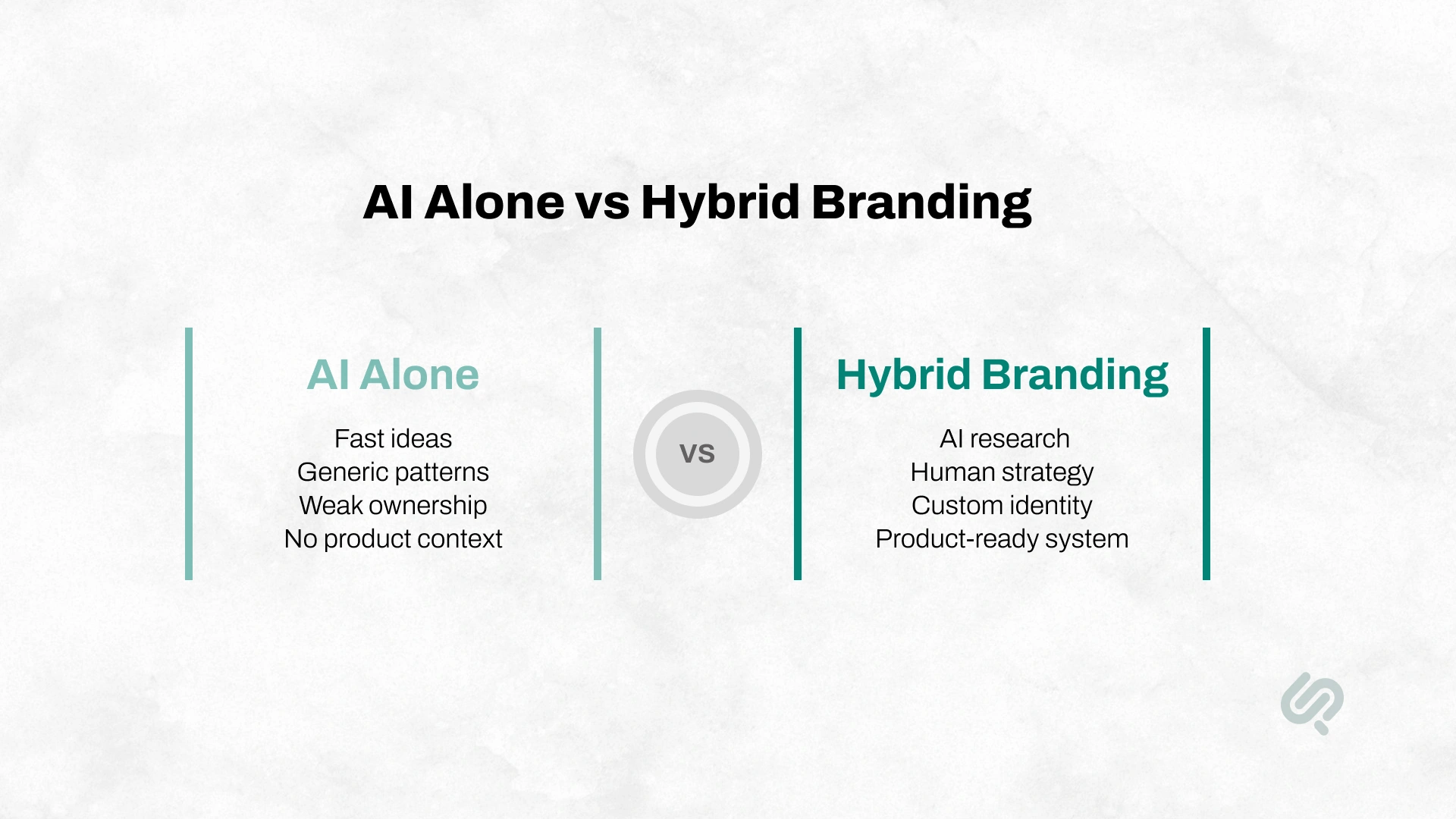
But AI alone is not enough to build a serious startup brand. Most AI-generated brand identities have the same problems:
This is why the best approach is hybrid. Use AI for speed, research, brainstorming, and early exploration. Use expert designers and strategists for positioning, originality, usability, and final execution.
For a tech startup, branding has to do more than look modern. It has to make the product easier to understand, help buyers trust the company, and support the website, app, pitch deck, and sales process.
Inconsistent branding is not just a design problem. It creates confusion across marketing, sales, product, and customer support.
When every team uses different colors, messages, visuals, or pitch decks, buyers start receiving mixed signals. That makes the startup feel less mature, even when the product is strong.
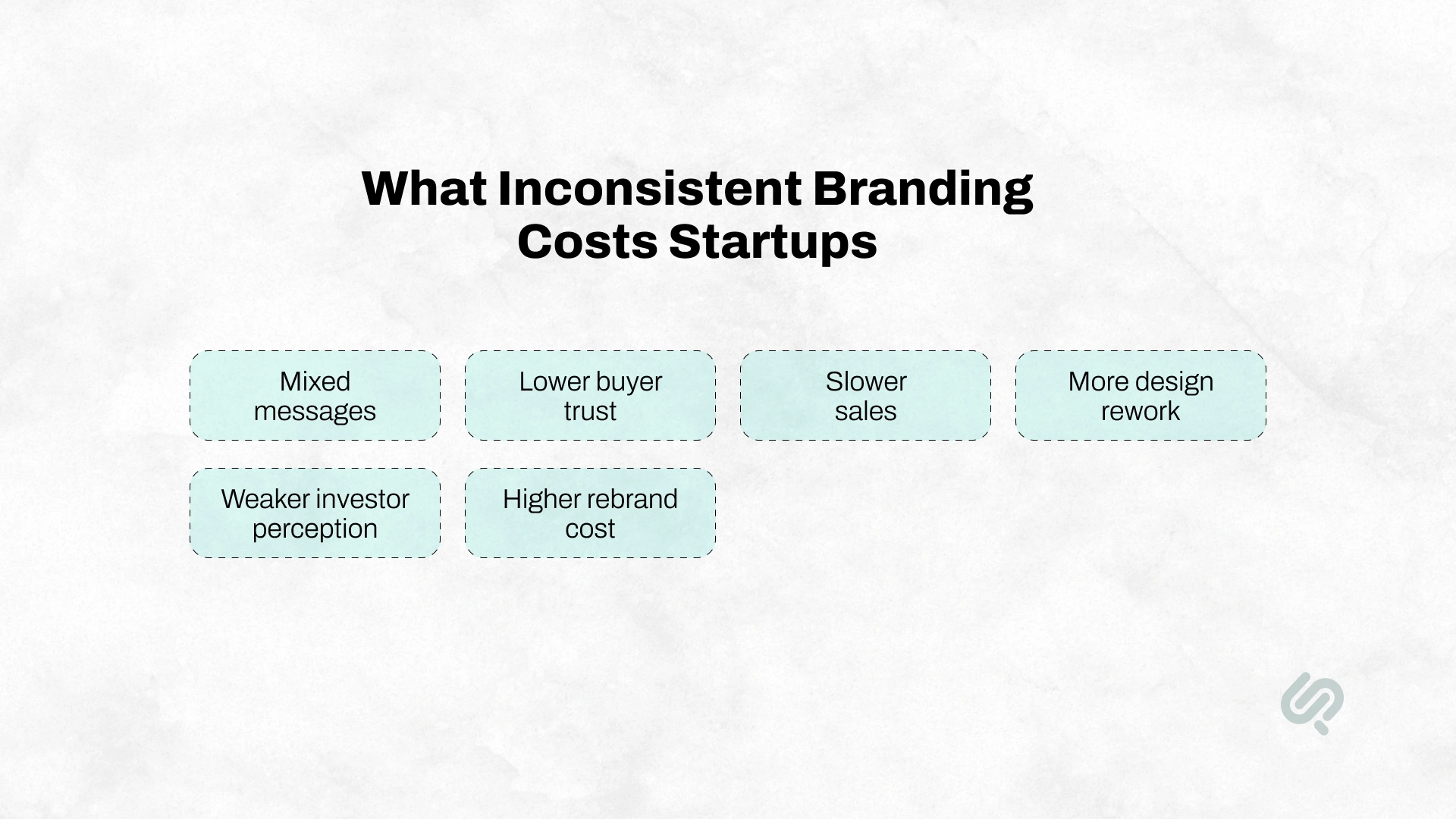
Common signs of inconsistent branding include:
This creates business problems such as:
For tech startups, consistency matters even more because buyers are often evaluating trust, security, clarity, and execution quality before they book a demo.
Edelman’s 2025 Brand Trust research found that trust is now as important as quality and price in buying decisions. (1)
A clear brand system helps every team move faster. Marketing knows what to publish. Sales knows what to present. Designers know what to create. Developers know how the product interface should look and feel.
The result is a brand that feels consistent from first impression to product experience.
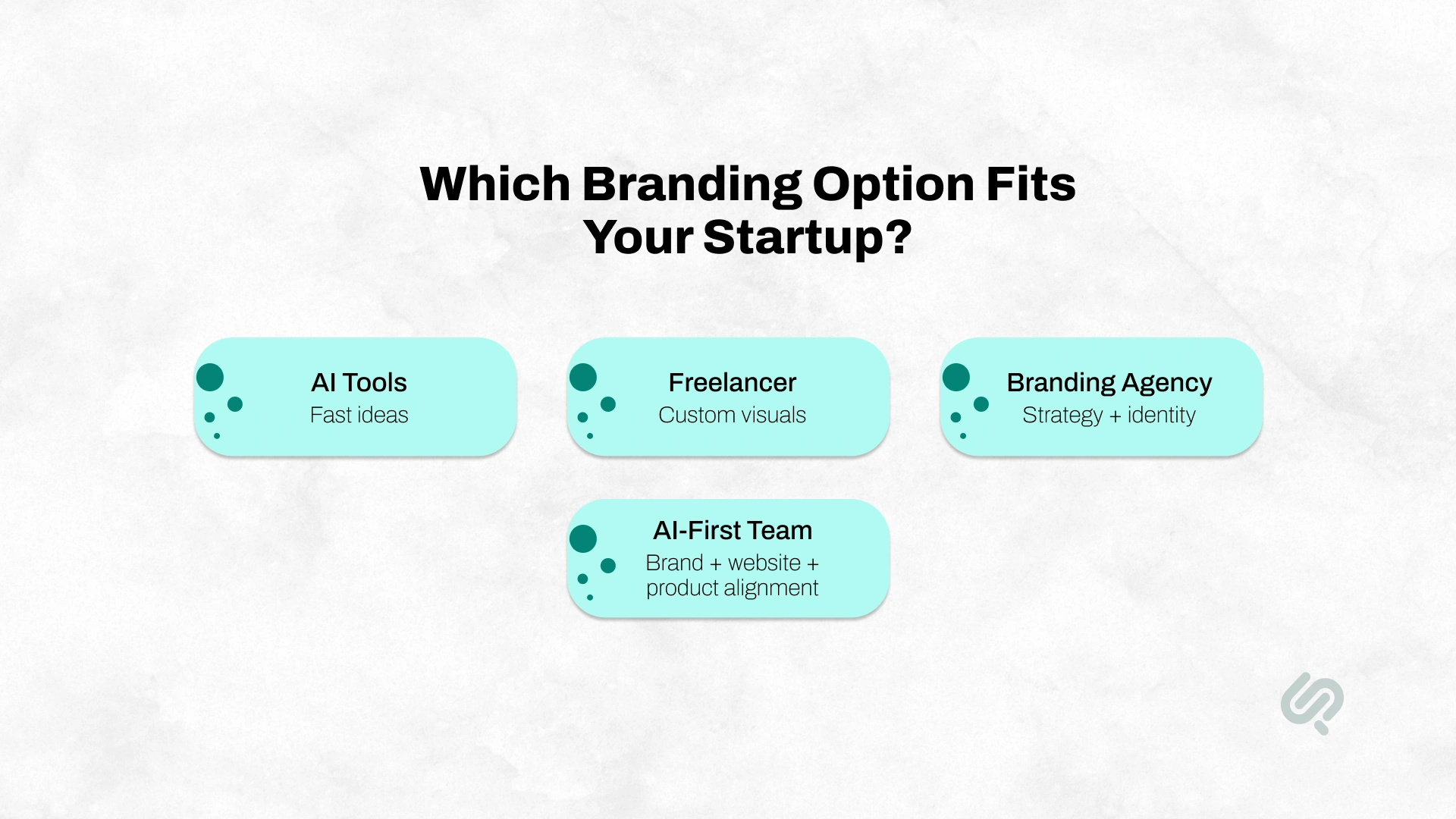
There is no single “best” way to build a startup brand. The right choice depends on your stage, budget, launch timeline, and how much trust your product needs to earn.
AI tools are useful when you need fast ideas. Freelancers can help when you already know what you want. A tech startup branding agency is better when your brand needs to support investor conversations, enterprise buyers, product UX, and long-term growth.
For a tech startup, the biggest mistake is treating branding as a standalone design task. Your brand has to work across your website, product dashboard, mobile app, pitch deck, sales pages, emails, and investor material.
A strong branding approach should answer:
AI can speed up the early work. Expert design turns that early work into a brand system your business can actually use.
You do not need a full agency on day one if you are still testing a rough idea. At that stage, AI tools and simple design assets may be enough.
You should hire a tech startup branding agency when your brand starts affecting sales, funding, trust, or product adoption.
The best time to invest is when:
This is especially important for SaaS, fintech, AI, healthtech, cybersecurity, logistics, and B2B platforms. In these markets, buyers are not only judging how your brand looks. They are judging whether your company feels reliable, secure, mature, and clear enough to trust.
A professional team can help connect:
That is where branding becomes more than design. It becomes a business growth tool.

Before you open any visual design software or type prompts into an AI image generator, you need to know exactly who you are and why your product matters.
This foundational work is called your brand positioning strategy. If you do not fix your positioning first, your visual identity design will have no strategic foundation.
Your tech startup needs to answer three questions immediately:
In 2026, the tech sector is moving away from abstract, over-complicated technical explanations. Instead, buyers favor clarity.
Your brand positioning should establish a clear personality, whether that is an analytical, secure expert for fintech or an approachable, highly automated coworker for productivity tools.
You can use advanced prompts with large language models to speed up this research phase significantly.
Try collecting public customer reviews, forum threads, or industry complaints about your competitors, feed them into an AI tool, and look for structural gaps in the market.
Actionable Prompt Example:
"Act as an expert market researcher specializing in B2B SaaS. Analyze these 20 competitor reviews from G2 and Capterra. Identify the top 3 customer pain points regarding product complexity, and suggest a unique brand personality that positions my new analytics startup as the simple, human-centric alternative."
Your messaging framework guides how you speak to clients, venture capital investors, and future employees. A complete framework includes:
A study reveals that tech businesses with highly consistent brand messaging across all digital channels see a 20% growth in overall brand equity compared to inconsistent competitors. (2).
In 2026, your brand does not only need to be understood by humans. It also needs to be clear enough for Google, AI search tools, and LLMs to explain correctly.
When someone searches your startup, compares vendors, or asks an AI tool for recommendations, your brand information should be easy to extract.
Your startup should clearly define:
This matters because buyers increasingly use AI tools to research companies, compare options, and summarize brand reputation. If your messaging is vague, AI tools may describe your startup poorly or group you with the wrong competitors.
To make your brand more LLM-friendly, add clear and consistent language across:
Avoid clever but unclear messaging. A simple sentence like “We help fintech teams automate KYC workflows with secure AI agents” is stronger than a vague line like “We are redefining the future of digital innovation.”
LLMs reward clarity. Buyers do too.
Your visual identity system is how your business looks to the world. In this step, we use a hybrid workflow: AI generates rapid ideas, and human designers refine them into professional, scalable assets.
Tech startups often default to standard corporate blues, deep grays, or neon greens. While these colors feel safe, they make it hard to catch a user's eye.
Tools like Coolors or Huemint use machine learning to generate vast color combinations based on your chosen brand personality.
When choosing your typography system, prioritize legibility across different screen resolutions. Pair a bold, character-rich header font (for your website brand identity) with a clean, standard sans-serif font for your product branding and dashboard interface text.
An AI logo maker is an excellent place to start when brainstorming. It can help you visualize layout ideas, icon placements, and text balances within minutes. However, raw AI-generated logos possess major production flaws that can slow down a growing startup:
A professional design agency takes those early generated concepts and crafts a custom logo system.
This system ensures your mark is fully original, legally clear, and split into multiple formats: a primary logo, a stacked secondary logo for tight vertical spaces, and an icon-only favicon version.
Mujtaba Sheikh, Head of development and design at Phaedra Solutions, shares his thoughts:
“AI can generate fifty brand directions in an afternoon, but that does not mean any of them are right for the business. For a tech startup, the strongest brand is the one that works across the website, SaaS dashboard, mobile app, pitch deck, and product roadmap without losing clarity.”
AI logo makers are useful for early ideas, but they should not be treated as the final brand identity for a serious tech startup.
The U.S. Copyright Office states that works produced by a machine without human creative control may lack human authorship for copyright registration. (3)
The main risk is not that AI logos look bad. The real risk is that they can look too similar to other generated designs. Many AI tools are trained on large pattern libraries, so the output often uses common shapes, icons, and visual styles.
This can create problems when you need to:
A safer approach is to use AI for inspiration, then let human designers refine the final direction. Expert designers can adjust the concept, rebuild the vector files, check similarity, improve scalability, and create a complete logo system.
A proper logo system should include:
For tech startups, the final logo should not only look clean. It should be usable, ownable, scalable, and easy to recognize.
Once your visuals and messaging are set, you must document them clearly. Brand guidelines ensure that every internal employee, freelance writer, product manager, and external ad agency creates content that looks and feels the same.
Data from a brand report by Marq shows that consistent brand presentation across all platforms can increase revenue by up to 23%. (4)
If your social media looks completely different from your website dashboard, your startup risks losing customer trust.
Your brand identity guidelines should contain clear rules for every physical and digital touchpoint:
You can use an AI brand guidelines generator or a collaborative digital workspace to build the initial structure of this system. Tools like Brandpad or organized templates can lay out your chapters quickly.
Once the structure is built, have your design professional input the exact design rules, live asset download links, and contextual examples to turn it into a true single source of truth for your entire company.
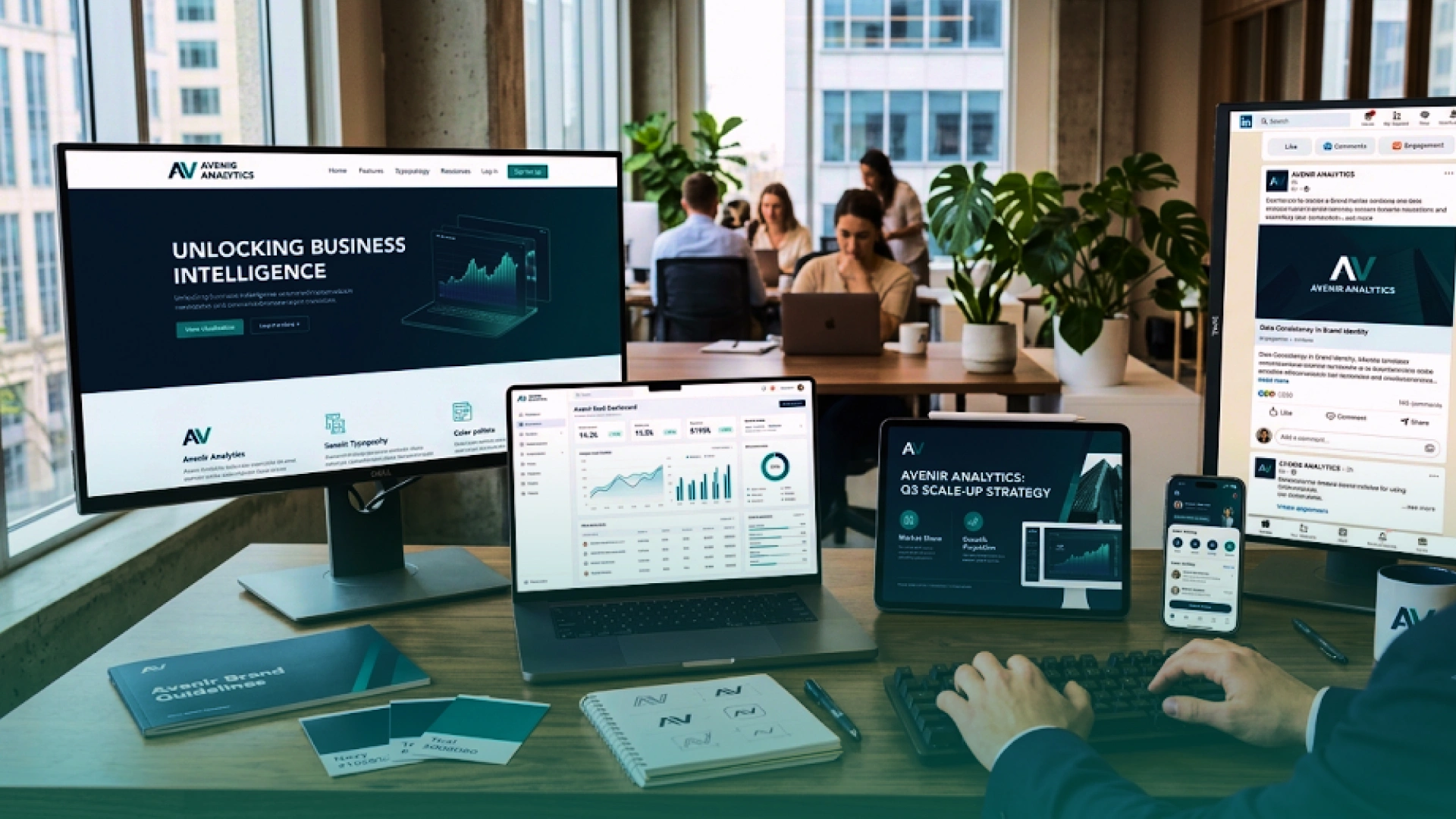
A startup brand identity does not live in an isolated design file. It must work smoothly across your entire digital and physical business ecosystem.
For early-stage tech companies, your pitch deck is often the very first place your brand identity goes to work.
Venture capitalists and angel investors review hundreds of presentations a week. When choosing the right presentation platform for the job, exploring best alternatives to Beautiful.ai can help teams find an option that fits their branding and pitch deck requirements. A clean, custom pitch deck design that aligns perfectly with your core brand identity shows investors that your team is meticulous, professional, and serious about execution.
Your marketing website is your virtual storefront and your primary lead generation engine. It needs to load exceptionally fast, explain your technical solution in simple words, and use your brand colors strategically to lead visitors naturally toward your main software demo or signup buttons.
The branding experience should never stop after a user hits the "Sign Up" button. Your product branding, inside your web app, mobile software user interface, or cloud dashboard, must use the same typography, icon styles, and tone of voice as your public marketing site.
This tight connection creates a smooth user experience, lowers user friction, and increases software retention.
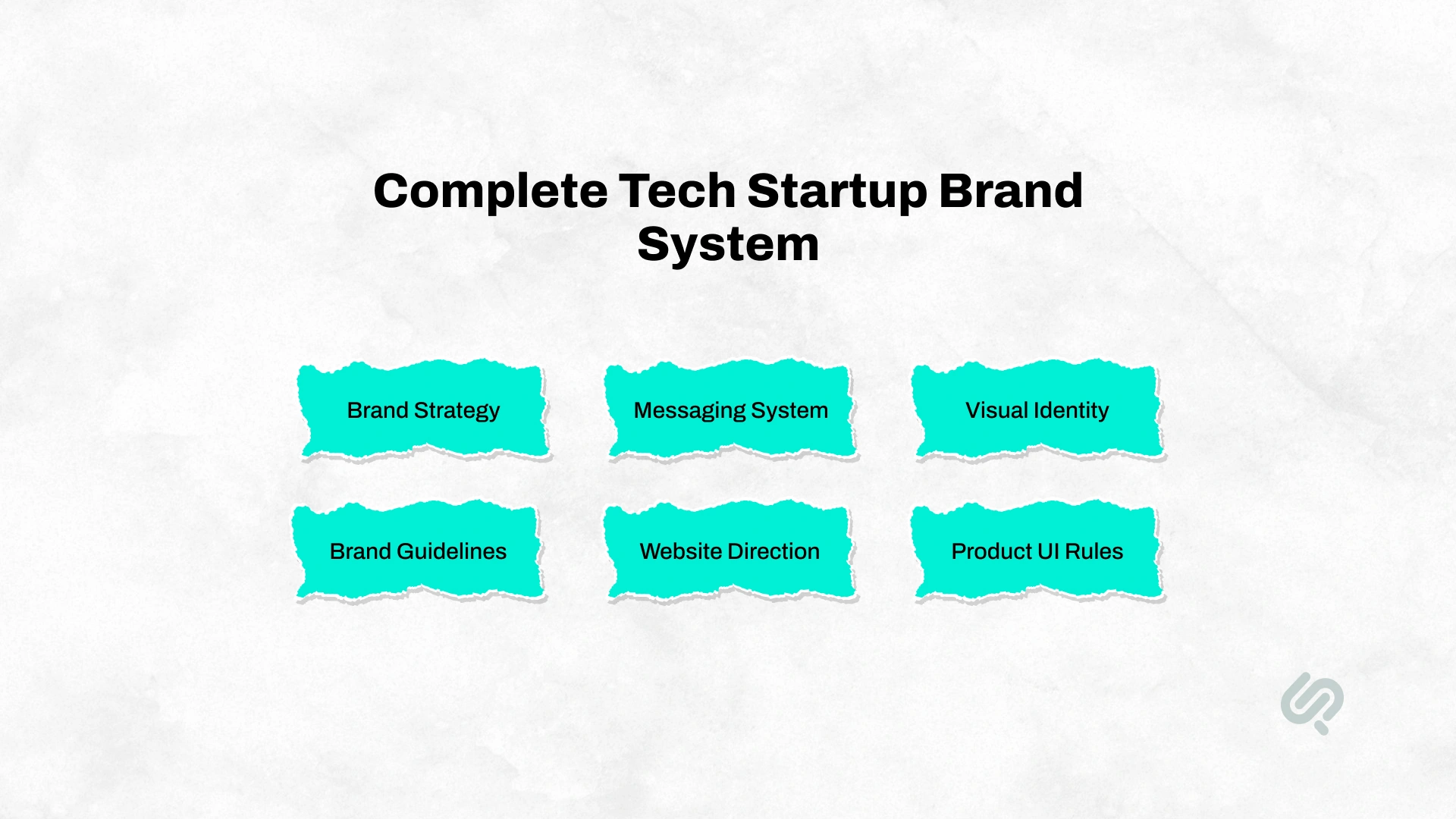
A professional branding package should give your startup more than a logo. It should give your team a clear system for how the company looks, sounds, and shows up across every buyer touchpoint.
A complete tech startup branding package should include:
This defines the business foundation of your brand.
It should include:
This explains how your startup communicates.
It should include:
This defines how your startup looks.
It should include:
This keeps the brand consistent as your team grows.
It should include:
For tech startups, branding should connect directly to the digital product experience.
Your package should define:
This is where many startup brands become weak. The marketing site looks polished, but the product experience feels disconnected. A strong brand system prevents that gap.
A leading client in the ecommerce industry needed more than a standard ecommerce website. The brand already had a strong product line in sustainable energy, but its online presence needed to reflect its positioning, explain a wide product range clearly, and support growth in a competitive market.
Phaedra Solutions helped develop an ecommerce platform that connected the brand’s values with a user-friendly digital experience. The work focused on creating a website that looked professional, supported product discovery, and helped the client strengthen its position in the sustainable energy market.
Your brand identity should make your product easier to understand, pitch, fund, and sell. Phaedra Solutions’ AI-first branding services help tech startups define their positioning, messaging, visual identity, pitch deck direction, website brand experience, and product-facing design rules.
Our AI-first process uses AI-assisted research, rapid ideation, competitor analysis, and senior human design judgment to move faster without creating a generic brand. The result is a startup brand that feels clear, scalable, investor-ready, and consistent across your website, product, sales, and marketing.
Book a free AI-first branding consultation to plan your startup brand identity and launch direction.



Ameena is a content writer with a background in International Relations, blending academic insight with SEO-driven writing experience. She has written extensively in the academic space and contributed blog content for various platforms.
Her interests lie in human rights, conflict resolution, and emerging technologies in global policy. Outside of work, she enjoys reading fiction, exploring AI as a hobby, and learning how digital systems shape society.