














The top forward deployed engineering companies in 2026 include Palantir, Phaedra Solutions, OpenAI's Deployment Company, HatchWorks AI, Distyl AI, AWS, Deloitte, and specialist FDE providers for areas such as cloud, enterprise integrations, and computer vision.
Forward deployed engineers work closely with a client's real systems, users, and workflows to move AI or complex software from discovery into production.
This guide compares 15 providers based on engineering depth, production ownership, specialization, platform dependence, pricing visibility and overall buyer fit.
Leading options include Palantir, Phaedra Solutions, OpenAI's Deployment Company, HatchWorks AI, Distyl AI, AWS, Deloitte and Tredence. The best choice depends on whether you need a vendor-neutral engineering partner, a platform-specific FDE team or a technical specialist.
Choose a vendor-neutral FDE partner that can work across multiple AI models, clouds, applications and data systems. Phaedra Solutions, HatchWorks AI, Tredence, CHI Software, Uvik and Digital Scientists are examples to evaluate.
Hire externally when you need experienced engineers quickly or only have a few complex deployments. Build internally when forward deployment will become a permanent part of your product or customer-delivery model.
Ask what will reach production, who will write the code, whether the provider depends on one platform, who owns the technical assets and how your internal team will operate the system after the engagement.
Not exactly. Staff augmentation describes how talent is sourced, while forward deployed engineering describes how the engineer works. An FDE can be hired through staff augmentation but should still take hands-on responsibility for discovery, implementation, deployment and real-world outcomes.
These are starting points, not universal winners. Your technology stack, project scope, and level of platform commitment should determine the shortlist.
Before we get into the specifics, here’s a quick look at the 15 top forward deployed engineering companies you shoud look at:

HatchWorks AI has made forward deployed engineering central to its AI delivery model. Its FDEs identify high-value AI opportunities, connect models to data and workflows, build production systems and transfer reusable patterns back to internal teams.
Its strongest fit is AI-focused work including agents, RAG, workflow automation, AI-native products, evaluation, monitoring and governance. The company is also active across OpenAI, Anthropic, Google Cloud and Databricks partnerships.
Choose HatchWorks when:
The main problem is getting AI into production rather than wider application or legacy modernization.

Phaedra Solutions combines forward deployed engineering with AI, web and mobile product engineering, backend development, cloud, DevOps, QA and legacy modernization. That makes it a strong fit when the main challenge crosses several technical layers rather than ending with model integration.
Its vendor-neutral approach also gives buyers flexibility across AI models, custom applications and existing enterprise systems.
Phaedra's AI-first delivery process uses tools and agents such as Claude and Cursor across research, prototyping, development, testing and documentation while senior engineers remain responsible for architecture and production decisions.
Phaedra Solutions has already applied this type of cross-functional engineering on an AI cloud surveillance platform that combined OpenAI-powered search, computer vision, IP-camera and access-control integrations, web and mobile interfaces, AWS, Docker, CI/CD and production testing.
Choose Phaedra Solutions when:
You want to hire a forward deployed engineer who can move between AI, software, integrations, infrastructure, and existing products without locking the project to one technology vendor.

Distyl combines forward-deployed engineers and researchers with a strong focus on owning business outcomes from discovery through deployment and continuous improvement. Its public work includes production AI across healthcare, telecom, manufacturing, insurance and other large-enterprise environments.
The company is especially relevant when AI needs governance, evaluation, security and deep enterprise context from the beginning.
Choose Distyl when:
The AI initiative is strategically important and directly linked to measurable operating or financial outcomes.

Deloitte combines forward deployed engineers with industry specialists, business consultants, governance, cybersecurity, and enterprise-change capabilities.
That breadth is particularly useful when production AI cannot be separated from compliance, business-process redesign or organizational adoption.
Choose Deloitte when:
Engineering is only one part of a larger enterprise transformation and procurement, governance and regulatory complexity matter almost as much as the technical build.

Tredence differentiates its FDE practice through domain knowledge. Its model combines engineering with an understanding of the business decisions being automated, such as retail planning, supply-chain operations and industry-specific workflows.
The practice is platform-agnostic and works across AWS, Google Cloud, Microsoft, Databricks, Snowflake and frontier AI providers.
Choose Tredence when:
Deep industry and data knowledge are as important as AI engineering capability.

CHI Software provides forward deployed engineering across AI, software development, enterprise integrations, data engineering, cloud, DevOps and MLOps.
Its model emphasizes engineers working inside the customer's systems, including repositories, infrastructure and operational workflows, rather than delivering recommendations from outside. CHI also emphasizes vendor-neutral delivery and knowledge transfer.
Choose CHI when:
The project is stuck because AI, software, data and infrastructure problems need to be solved together.

Uvik takes a technical, engineering-led approach to forward deployment. Its engineers work in customer environments on RAG pipelines, agentic systems, MCP, APIs, data platforms and production support.
The commercial model is particularly transparent compared with most firms on this list because Uvik publishes standard staffing rate bands.
Choose Uvik when:
You already understand the business problem and need senior engineers to implement it inside an existing Python, data or AI stack.

Digital Scientists treats forward deployed engineering as an implementation service rather than strategy consulting or standard staff augmentation.
Its approach starts with the workflow itself, then integrates AI, data, business rules, human review, governance, and measurement around that process. Healthcare is a particularly strong specialization.
Choose Digital Scientists when: you want to prove AI value in one real workflow before expanding across the organization.

Oxagile offers explicit forward deployed engineering services for projects where architecture, integrations and deployment risks need to be solved alongside implementation.
Its broader engineering capabilities include software development, AI, cloud, QA and DevOps, with particular depth in video, OTT, connected TV and streaming technology.
Choose Oxagile when:
Complex software architecture, integrations or video technology make the deployment harder than the AI model itself.

Palantir is the reference point for forward deployed engineering. Its Forward Deployed Software Engineers work directly with customers to understand difficult operational problems and build solutions using Palantir technology. Palantir describes the role as the original blueprint for engineers working side by side with customers rather than building from a detached product roadmap.
Choose Palantir when:
The deployment is highly complex, operationally important, and Palantir Foundry, Gotham, or AIP already fits your technology strategy.

OpenAI launched the OpenAI Deployment Company to embed engineers inside organizations and help redesign workflows around frontier AI. Its Enterprise Frontier Program pairs FDEs with customer teams to design architectures, operationalize governance, and run agents in production.
OpenAI also announced an agreement to acquire Tomoro, which would add approximately 150 experienced FDEs and Deployment Specialists to the organization.
Choose OpenAI when:
OpenAI is already central to your AI strategy and direct access to frontier-model deployment expertise matters more than model neutrality.

AWS created a dedicated Forward Deployed Engineering organization to embed engineers directly with customers and co-develop production agentic AI systems. AWS says the model is designed to compress deployments from months to days while leaving customers able to operate and extend what was built.
Choose AWS when:
Your infrastructure and AI strategy are already heavily AWS-based and direct hyperscaler engineering access is valuable.
Incepta specializes in deploying enterprise platforms and connecting them to real workflows, APIs and AI systems.
Its published process includes a 1-to-2-week discovery sprint, a 4-to-6-week innovation sprint and longer embedded engagements. It says functional MVPs can often be produced within the first three weeks of an appropriate FDE cycle.
Choose Incepta when:
Salesforce, MuleSoft, Agentforce or enterprise integration is already central to your architecture.

Plainsight is one of the clearest specialist FDE options. Its engineers assess video data, pipelines and feasibility, select and integrate models, build custom filters and support production rollout.
The company also states that customers retain ownership of work delivered during the FDE engagement.
Choose Plainsight when:
The core challenge is computer vision rather than broad enterprise AI or application development.

DoiT applies forward deployed engineering to cloud operations rather than general software development. Its FDEs work directly with engineering teams to implement fixes across cost, reliability, Kubernetes, security, incident response and AI infrastructure.
DoiT explicitly positions its engineers as hands-on implementers rather than a ticket-based support team.
Choose DoiT when:
Cloud infrastructure is the main reason your AI or software deployment is difficult.
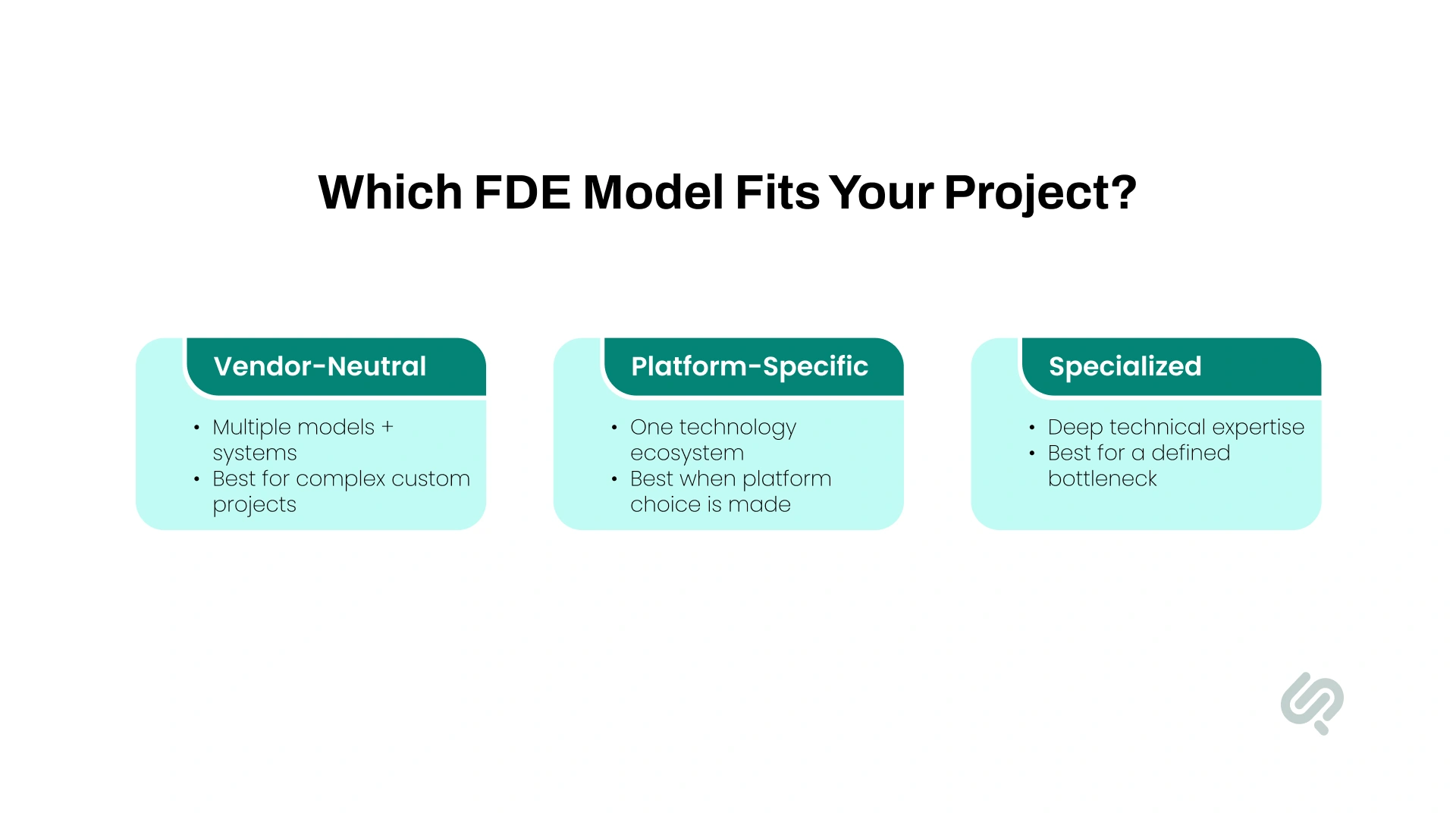
Not every FDE provider sells the same type of engagement. Buyers should first decide which of these three models they need.
These providers can work across several AI models, cloud platforms, applications, databases, and legacy systems.
They are usually the better choice when:
Examples include Phaedra Solutions, HatchWorks AI, Distyl AI, Deloitte, Tredence, CHI Software, Uvik, Digital Scientists and Oxagile.
These engineers primarily help customers deploy technology from the company that employs them.
Palantir, OpenAI, and AWS are major examples.
Choose this model when you have already committed to the provider's ecosystem and want engineers with deep direct access to that platform.
Specialist providers make sense when you already know where the deployment bottleneck sits.
Examples include:
The better buying question is therefore not simply "Who has the best FDEs?"
It is: "Which FDE model fits the system we are trying to put into production?"
We evaluated providers based on criteria that matter when a business is actually preparing to hire forward deployed engineers.
This ranking prioritizes buyer usefulness rather than company size alone.
Start with the problem preventing the project from reaching production.
You have already committed to Palantir, OpenAI, AWS or another major platform and want engineers with direct expertise in that ecosystem.
Your project spans multiple models, clouds, applications, legacy systems or integrations and architecture decisions still need to be made.
You already know the bottleneck is computer vision, Salesforce, cloud infrastructure or another narrow technical area.
Then ask every shortlisted provider:
"Do not hire an FDE because the title sounds senior. Hire one when you need an engineer who can understand the business problem, work inside the real system, and stay accountable until something useful is live."
— Abubakar Shams, Staff Augmentation Lead, Phaedra Solutions
The rapid growth of forward deployed engineering has also created a naming problem.
Practitioners disagree about where FDE ends and professional services, consulting or solutions engineering begins. Reddit discussions around the role show both sides: some practitioners see FDE as a distinct engineering function that writes production code and feeds field learning into product development, while others argue that companies sometimes use the label for work previously called professional services.
There is another useful lesson from those discussions: good forward deployed work is not always performed by someone whose job title is literally "Forward Deployed Engineer." Some companies use titles such as deployment engineer, applied AI engineer, or customer engineer for similar work.
Practitioners also note that an engineer can be effectively forward deployed while working remotely if they are deeply embedded in the customer's workflows, systems, and technical decisions.
For buyers, the title matters less than the operating model.
Before accepting an FDE proposal, check whether the engineer will:
If those responsibilities are missing, you may be buying conventional consulting or staff augmentation under a newer label.
AI adoption is no longer the main challenge. Production adoption is.
McKinsey's 2025 State of AI survey found that 88% of respondents said their organizations regularly used AI in at least one business function, but only about one-third said their organizations had begun scaling AI across the enterprise. (1)
The hiring market reflects the same shift. The Financial Times reported that forward deployed engineer job listings increased by more than 800% between January and September 2025, as AI companies expanded customer-embedded engineering teams. (2)
That gap is driving investment in embedded AI engineering. OpenAI launched its Deployment Company in May 2026 and announced an agreement to acquire Tomoro, which would bring approximately 150 experienced Forward Deployed Engineers and Deployment Specialists into the new organization. (3)
AWS followed on June 30, 2026, with a $1 billion investment in a dedicated Forward Deployed Engineering organization designed to embed thousands of engineers with customers. Reuters also reported that demand for FDE roles grew roughly 42-fold from 2023 to 2025. (4)
For buyers, the question is shifting from "Which AI model should we test?" to "Who can make this work reliably inside our business?"
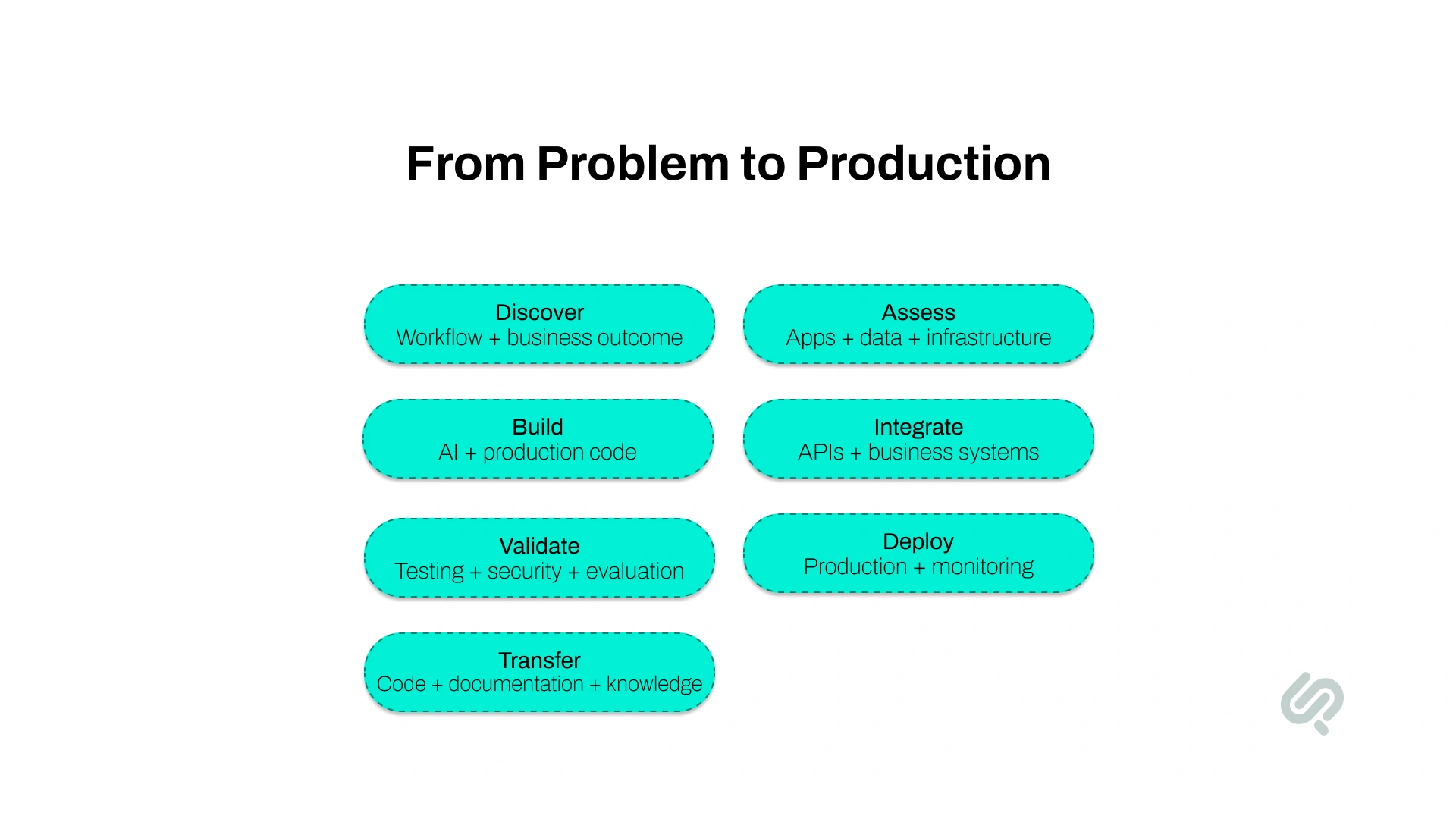
A strong FDE engagement combines technical delivery with direct exposure to the business problem.
Typical responsibilities include:
The important difference is ownership. A genuine FDE does not simply recommend what another engineering team should build.
A focused FDE project can reach a meaningful production milestone in a few weeks, while enterprise deployments may continue for several months.
Public provider models show the range:
Do not judge proposals only by total duration.
Ask instead: What will be live and measurable after the first 30, 60 or 90 days?
There is no standard FDE price because providers use very different commercial models.
Most companies on this list do not publish FDE rates. Distyl discusses outcome-based pricing, DoiT packages FDE access around its wider cloud platform relationship, and large providers such as Deloitte, AWS, OpenAI and Palantir generally use custom enterprise agreements.
Uvik is one of the few providers publishing transparent engineering rate bands, with standard senior staff augmentation generally listed at $50 to $99 per hour and some engagements starting around $25,000. Specialist AI roles can vary from those standard bands.
When comparing FDE proposals, evaluate:
A lower hourly rate is not necessarily cheaper if your internal team still has to coordinate several vendors and own the difficult production decisions.
The right provider depends more on your environment than on the size of the company.
Choose a platform-led FDE team when your platform decision is already made. Choose a vendor-neutral partner when the solution must cross AI, applications, data, infrastructure and existing systems. Choose a specialist provider when one technical bottleneck is clearly holding the deployment back.
Before signing a large engagement, ask every provider to define one measurable production outcome, the team responsible for it and what your organization will own when the work is finished.
For companies that want a vendor-neutral embedded engineer rather than a platform-specific deployment team, Phaedra Solutions provides forward deployed engineering talent through its staff augmentation model.
Book a free call with us and let’s help you make your pick



Ameena is a content writer with a background in International Relations, blending academic insight with SEO-driven writing experience. She has written extensively in the academic space and contributed blog content for various platforms.
Her interests lie in human rights, conflict resolution, and emerging technologies in global policy. Outside of work, she enjoys reading fiction, exploring AI as a hobby, and learning how digital systems shape society.