












The forward deployed engineer vs software engineer difference comes down to what the engineer is expected to own. A software engineer typically builds reusable product capabilities for many users. An FDE (forward deployed engineer) works closer to a specific customer or business problem and can own more of the path from discovery and integration to production adoption.
For businesses, the right choice depends on where the uncertainty sits.
A software engineer primarily builds reusable product or platform capabilities. A forward deployed engineer works closer to a specific customer or business problem and may own discovery, integration, implementation, deployment, and production adoption.
Hire a software engineer when the requirements and roadmap are already clear. Consider an FDE when the business problem is still ambiguous, deployment depends on complex integrations, or technical decisions require direct customer and operational context.
Yes. A genuine FDE is an engineer. FDEs can build production applications, integrations, data pipelines, infrastructure, automation, AI workflows, and other systems required to deliver the intended business outcome.
Sometimes. Strong coding skills are only part of the role. FDE work can also require technical discovery, stakeholder communication, integration breadth, changing requirements, and fast decisions inside an unfamiliar customer environment.
No. Forward deployed engineering can support enterprise software, data, cloud, integration, modernization, and other complex technology projects. AI has increased demand because production AI often requires close coordination between workflows, data, infrastructure, users, security, and engineering.
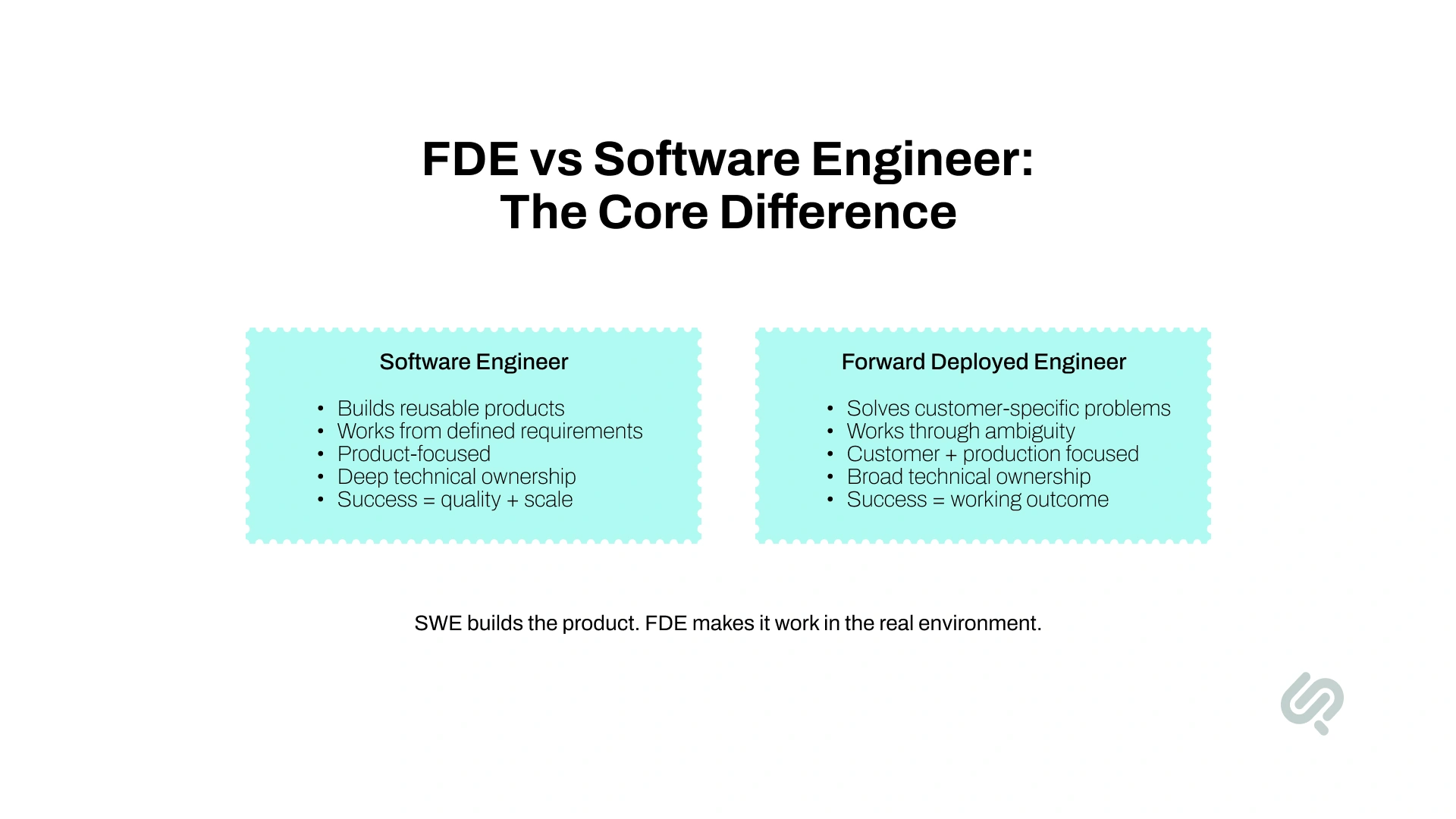
Both roles write production code, but their ownership, customer interaction, and delivery scope can be very different.
The distinction matters because two engineers may use the same programming languages, frameworks, cloud platforms, and development practices while being accountable for very different parts of the delivery process.

The biggest difference appears in where ownership starts and where it ends.
A traditional software engineer usually owns a defined part of a product or technical system.
That can include:
The work usually follows an established product roadmap, engineering backlog, architecture plan, or technical requirement.
This model works well when the business already knows what needs to be built and needs strong engineering capacity to build and maintain it.
A forward deployed engineer can start before there is a clean engineering ticket.
The FDE may first need to understand:
From there, the FDE can design the solution, write production code, build integrations, coordinate deployment, solve problems during rollout, and transfer ownership once the system is stable.
For example, a request to "connect our AI assistant to internal customer data" may turn into work across identity management, permissions, APIs, retrieval, evaluation, audit logging, infrastructure, and user workflows.
That breadth makes forward deployed engineering useful when a business problem cannot be cleanly handed from one specialist team to another.
Forward deployed engineer has become a popular title, especially around AI companies, but businesses should look closely at what the role actually owns.
Some FDE positions involve substantial production engineering. Others lean more heavily toward implementation, technical consulting, support, or customer success.
The better hiring question is: What will this engineer be accountable for once they are inside our environment?
A strong FDE should usually be able to handle several parts of the delivery process:
OpenAI’s current FDE role, for example, covers work from early prototypes to stable production and expects engineers to embed with customer teams, write production-grade code, guide adoption, remove delivery blockers, and feed lessons from deployments back into reusable tools and product development. (1)
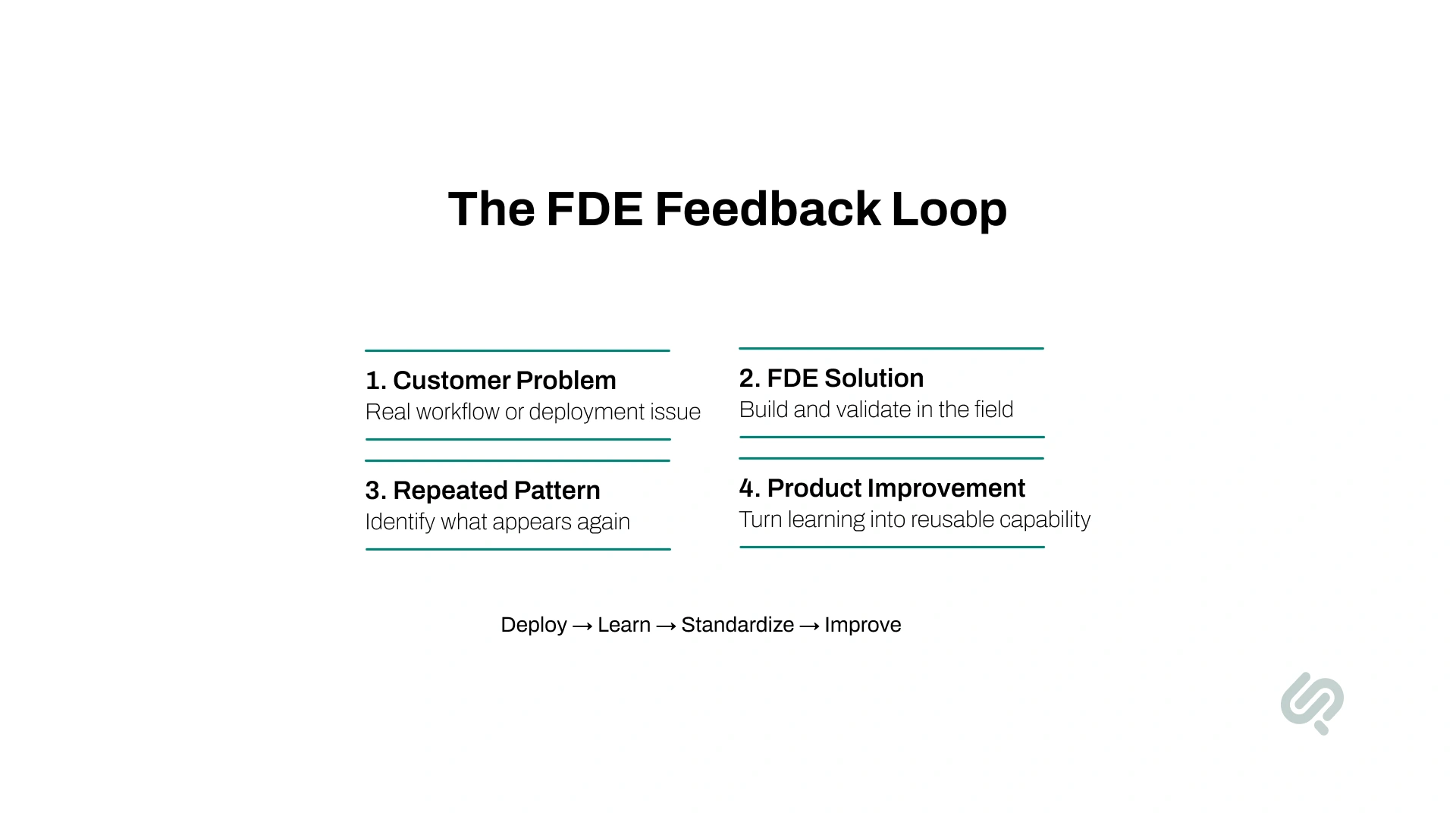
Good FDE work should create value beyond one deployment.
When an engineer sees the same customer problem repeatedly, that knowledge should flow back into the product or engineering organization.
A useful pattern looks like this: Customer problem → field solution → validated pattern → reusable product capability
This prevents customer-specific engineering from turning into an expanding collection of one-off fixes.
Repeated integration work might become a shared connector. A frequently requested workflow could become part of the core product. A manual deployment process might become reusable automation.
"The value of an FDE appears when the engineer can remove uncertainty from the delivery process. If all the important decisions have already been made, additional software engineering capacity may be the better investment."
Abubakar Shams, CEO & Business Strategy Lead, Phaedra Solutions
Both roles require strong software engineering fundamentals. The difference is usually the balance between technical depth, technical breadth, customer communication, and business context.
Forward deployed engineer skills tend to be broad because the engineer must adapt to different customer environments, infrastructure, workflows, and technical stacks.
Common skills include:
One project may involve legacy APIs, on-premise data, and old authentication systems. Another may combine cloud infrastructure, an LLM, enterprise identity, third-party APIs, and a new application interface.
An FDE needs enough technical range to understand how those pieces affect one another and where deeper specialist support is required.
Software engineers can create more value through technical depth and long-term system knowledge.
An experienced software engineer may spend years improving one codebase, distributed system, product architecture, backend platform, mobile application, or infrastructure layer.
Important skills commonly include:
An embedded engineer or FDE usually needs to absorb new business and technical context quickly. A traditional software engineer can often spend more time improving a stable system over repeated development cycles.
Neither skill profile is inherently stronger. They solve different delivery problems.
Both engineers may spend significant time writing code. The difference is where the work comes from and who they interact with while solving it.
A forward deployed engineer may move between customer conversations and hands-on engineering throughout the same project.
Their work can include:
The schedule can change as new information appears.
An undocumented API, security restriction, data-quality problem, or workflow dependency may change what the engineer needs to build that week.
A traditional software engineer usually works within a more established product development process.
Their work may include:
The software engineer generally has more continuity with the product and codebase. The FDE tends to have more exposure to changing customer environments and delivery constraints.
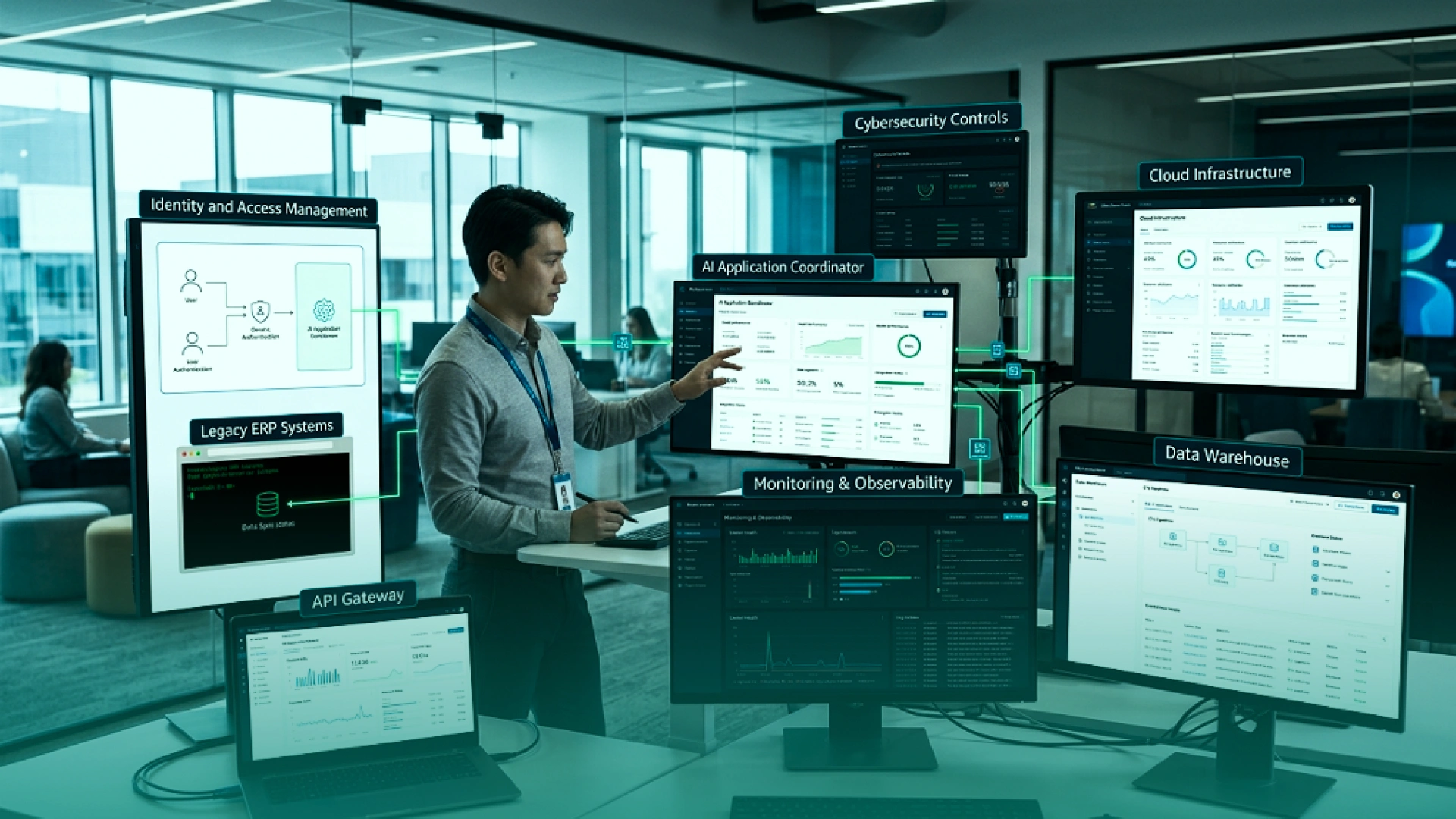
Forward deployed engineers can work on many types of technology projects. Their recent growth is closely tied to AI because enterprise AI deployments often cross several technical and operational boundaries at once.
McKinsey's 2025 State of AI research found that 88% of respondents said their organizations regularly use AI in at least one business function, yet only around one-third said their organizations had begun scaling AI programs. (2)
Moving an AI system from pilot to production can involve:
The ownership gets difficult when every part belongs to a different person or department.
The market is responding. Reuters reported in June 2026 that AWS committed $1 billion to a new organization centered on forward deployed AI engineers. LinkedIn data cited by Reuters showed demand for FDE and similar roles had increased 42-fold from 2023 to 2025. AWS also said the engineers would embed with customer teams and write production-level code. (3)
This helps explain why the forward deployed AI engineer model has gained attention.
AI prototypes can be created quickly. Making them work inside real business systems usually requires much more than model selection.
An FDE is useful when the work contains expensive uncertainty. That does not make forward deployed engineering the right model for every difficult software project.
A traditional software engineer is usually the better choice when:
For example, a company with a defined backlog of frontend improvements, API work, bug fixes, and performance tasks probably does not need an FDE. Strong software engineers can execute that work directly.
An FDE becomes more useful when engineers would otherwise spend significant time discovering what a requirement actually means, coordinating several stakeholders, investigating unfamiliar systems, or solving deployment problems that were invisible during planning.
Ask: Can this work be turned into clear engineering tickets before the engineer starts?
If the answer is mostly yes, traditional software engineering may be enough.
If the engineer needs to understand and refine the problem while working inside the customer or business environment, an FDE may be a better fit.
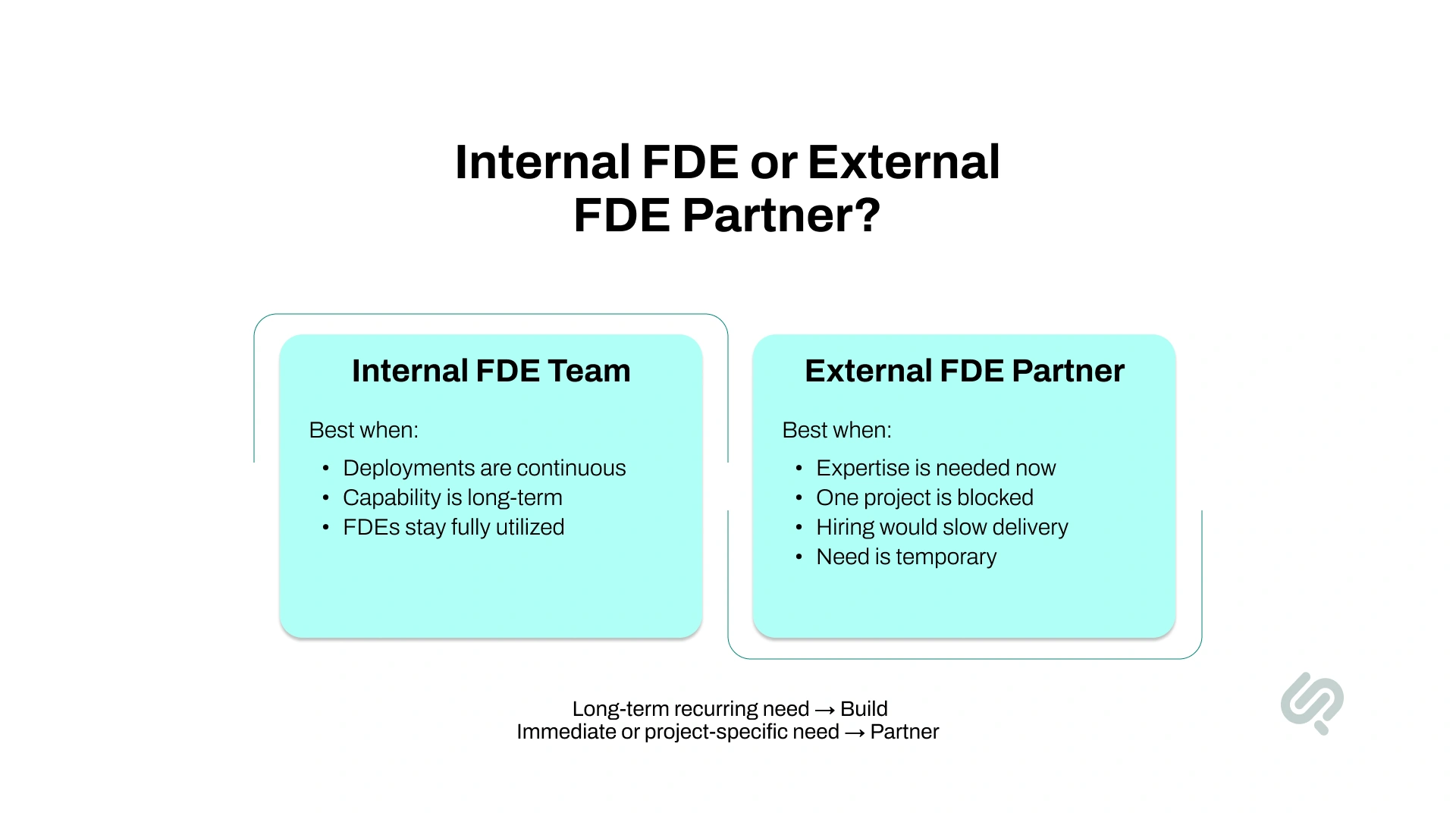
Once a company decides it needs forward deployed engineering, the next question is whether that capability should become permanent headcount.
Both models can work. The right choice depends largely on how often the business encounters complex deployment problems.
An internal team makes sense when:
The hiring profile can be difficult to find because FDEs need a combination of production engineering ability, technical breadth, customer communication, and business judgment.
An external forward deployed engineering partner can make more sense when:
An external FDE should still work inside the company's existing engineering process rather than operating as a disconnected vendor.
The engagement should also define how knowledge will be transferred. Code ownership, architecture decisions, documentation, deployment processes, and operational responsibility should have clear internal owners before the FDE leaves.
FDE performance should be connected to the delivery problem the engineer was brought in to solve.
Useful measures include:
Businesses should also look for reusable value.
That is where field engineering can create value beyond a single customer engagement.
A lower-cost engineer can become the more expensive option if the project still requires separate people for discovery, integration planning, stakeholder coordination, deployment, and production troubleshooting.
Hiring an FDE also makes little financial sense when those responsibilities are already handled effectively by the existing team.
The useful comparison is the total cost and time required to reach a stable production outcome.
The salary comparison varies considerably by seniority, company, geography, customer responsibility, and technical scope.
Current OpenAI postings illustrate the overlap. Its Seattle FDE role lists compensation of $162,000 to $280,000 plus equity, while a current U.S. full-stack software engineering position lists $153,000 to $385,000 plus equity. (4)
These are different positions rather than equivalent jobs, but the ranges show why title alone is a poor basis for estimating engineering cost.
For a hiring decision, compare the role against the actual delivery bottleneck.
Software engineer
Often a better long-term investment when the business needs:
Forward deployed engineer
Often a better investment when the business needs:
External FDE or FDE staff augmentation
Can make sense when the company needs senior delivery capability without waiting to recruit and build an internal forward deployed engineering function.
The better buying question is:
Which role removes the current bottleneck with the least delivery time, coordination, and unnecessary overhead?
Phaedra Solutions developed an AI-powered cloud surveillance platform that brought together IP cameras, access-control systems, web and mobile applications, OpenAI-powered search, face detection, tracking, analytics, AWS infrastructure, Docker, CI/CD, performance testing, and security testing. Delivery depended on several technical layers working together inside a real operating environment rather than one isolated software feature.
In a formal FDE model, an embedded senior engineer could own the path across customer workflows, device and data constraints, integration decisions, AI behavior, infrastructure, production rollout, and feedback from real users. Specialist engineers could still support areas requiring deeper expertise, while the FDE maintains ownership of the wider production outcome.
That is the type of environment where broader technical ownership can reduce handoffs between business teams, software engineers, AI specialists, cloud engineers, and integration teams.
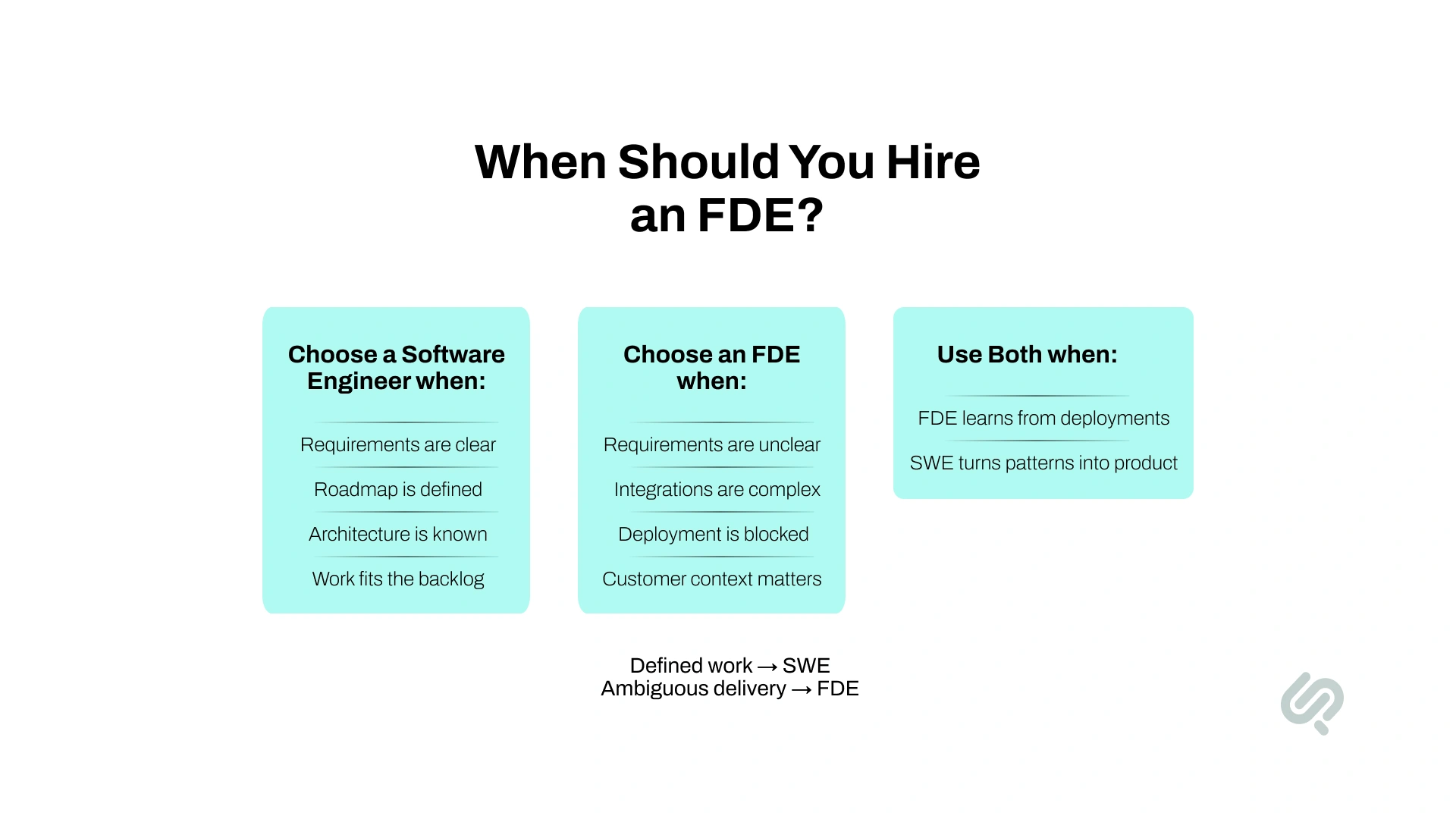
The best choice depends on where the project is getting stuck.
Software engineers are usually the better investment when product leadership, architecture, requirements, and delivery processes are already working well.
Typical examples include:
The business needs engineering execution more than additional discovery.
Consider an FDE when the engineer must understand the environment before the team can confidently decide what to build.
Common signs include:
The value comes from reducing the gap between understanding the problem and delivering the working solution.
Enterprise software and AI products often benefit from FDEs and traditional software engineers working together.
The FDE can solve deployment-specific problems and identify patterns in the field.
The core software engineering team can decide which of those patterns should become shared product features, reusable infrastructure, standard integrations, or permanent architecture.
That creates a useful cycle:
Deploy → learn → standardize → improve the product → deploy again
The goal is to solve the customer's immediate problem without turning every deployment into a separate version of the product.
If your project needs more than additional coding capacity, Phaedra Solutions can provide senior engineers through its IT staff augmentation services who work alongside your existing product, engineering, cloud, data, or AI teams.
A forward deployed engineer can be useful when the work involves unclear requirements, enterprise integrations, legacy systems, AI deployment, customer-specific workflows, or a difficult path from prototype to production.
Need an engineer who can work from an unclear business problem through production? Book a free consultation to discuss your project.



Ameena is a content writer with a background in International Relations, blending academic insight with SEO-driven writing experience. She has written extensively in the academic space and contributed blog content for various platforms.
Her interests lie in human rights, conflict resolution, and emerging technologies in global policy. Outside of work, she enjoys reading fiction, exploring AI as a hobby, and learning how digital systems shape society.