














A forward deployed engineering team works inside your existing engineering organization to solve complex technical problems, contribute production code, and help move important initiatives from discovery to deployment. Forward deployed engineers use your current repositories, tools, workflows, and delivery processes while collaborating directly with developers, product, DevOps, data, security, and business teams.
The model can support AI projects, enterprise integrations, legacy modernization, workflow automation, data platforms, and other technically complex initiatives. AI has accelerated demand for forward deployed engineers, but the role itself is broader than AI.
A forward deployed engineer joins your existing development process rather than creating a separate one. They work in your repositories, sprints, code reviews, architecture discussions, testing, and deployment workflows while taking ownership of difficult technical problems.
They can investigate requirements, design solutions, write production code, review pull requests, debug integrations, participate in releases, and resolve dependencies across teams. The exact responsibilities depend on the initiative.
No. Internal engineers retain their product, system, and business knowledge. The forward deployed engineer adds senior technical ownership, specialist experience, and focused execution around a complex initiative.
Traditional staff augmentation usually adds capacity against defined work. A forward deployed engineer can also help determine what should be built, challenge requirements, coordinate technical dependencies, and take an agreed outcome through production.
Consider one when a high-value initiative is blocked by unclear requirements, difficult integrations, cross-team dependencies, production issues, or missing specialist expertise despite having an existing engineering team.
Forward deployed engineers embed into the technical environment your team already uses rather than operating through a separate outsourced delivery process.
That can mean using the same repositories, communication channels, sprint process, CI/CD pipelines, staging environments, pull-request rules, monitoring systems, and deployment workflows as your internal developers.
The main difference is the scope of ownership.
An internal engineer may own a product area, platform service, infrastructure component, or data system. A forward deployed engineer is often brought in when an initiative crosses several of those boundaries and no single existing role has the time, expertise, or authority to connect them.
Their work can cover:
The engineer still works within your technical standards and internal controls. They add focused ownership around the initiative rather than creating a second engineering organization beside yours.
Companies often add forward deployed engineers when an important initiative spans more systems and teams than one internal role can reasonably own.
A product engineer may own the application. DevOps manages infrastructure. Data teams maintain pipelines. Security controls access. Product defines priorities. Business teams understand how the workflow operates in practice.
When one initiative depends on all of them, technical ownership can become fragmented.
AI projects make this problem especially visible. A model can work well during testing while the production system still struggles because:
But the same problem exists outside AI. Legacy modernization, ERP integrations, cloud migrations, workflow automation, data platforms, and complex SaaS implementations can all become stuck at the boundaries between teams and systems.
The market is moving toward this embedded model. Reuters reported in June 2026 that AWS committed $1 billion to an organization centered on forward deployed AI engineers. The same report cited LinkedIn data showing demand for forward deployed and similar roles had increased 42-fold between 2023 and 2025. (1)
The demand is increasingly for engineers who can connect technical execution across those boundaries and remain involved until the system works in the real environment.
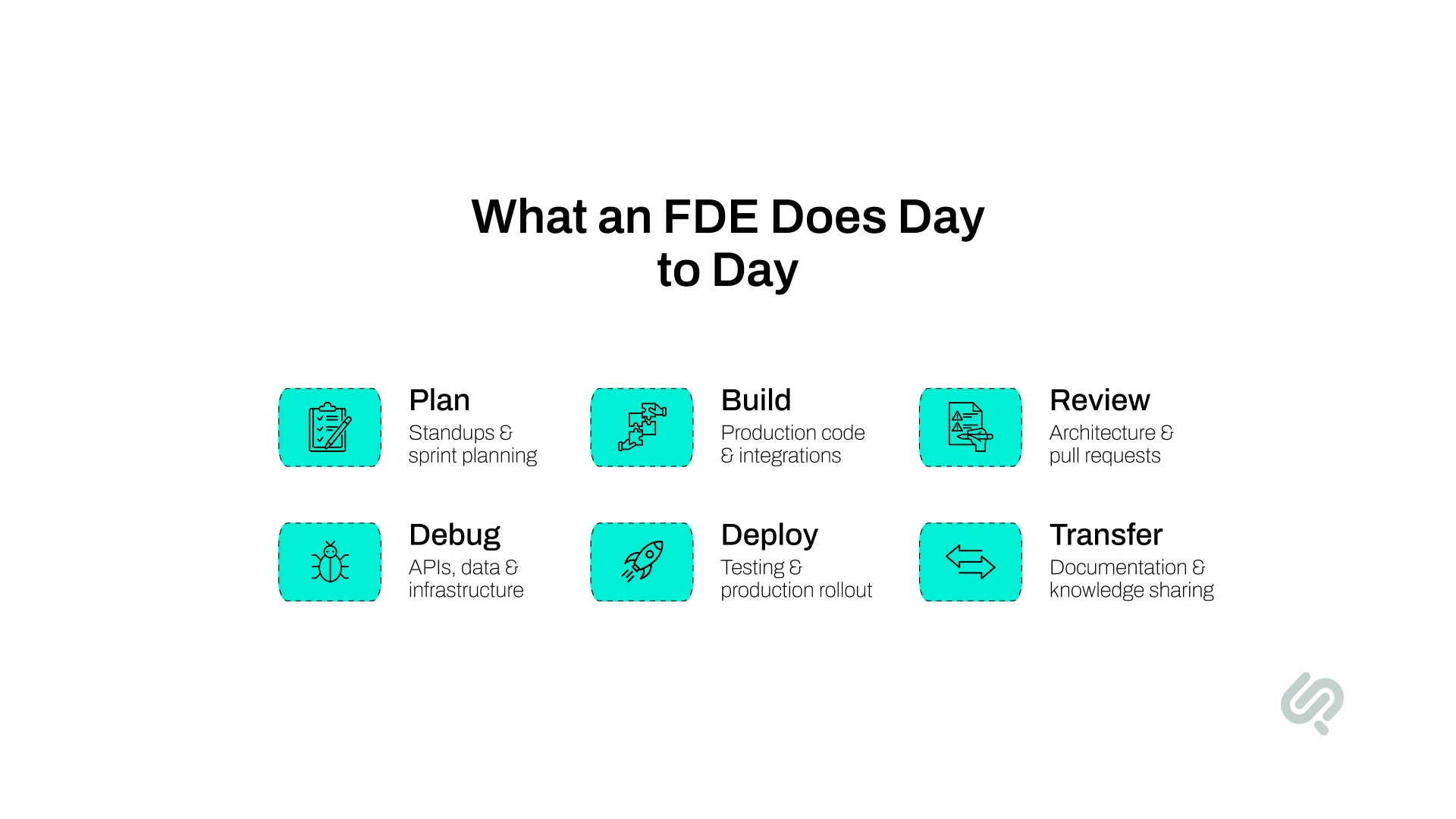
A forward deployed engineer works much like an embedded senior engineer. Their schedule depends on the project, but the work usually combines hands-on engineering with direct access to the people, systems, and workflows involved in the problem.
During a typical week, they may:
This close working model helps the engineer identify issues that may never appear in a backlog ticket, including undocumented business rules, unusual customer workflows, integration edge cases, and production constraints.
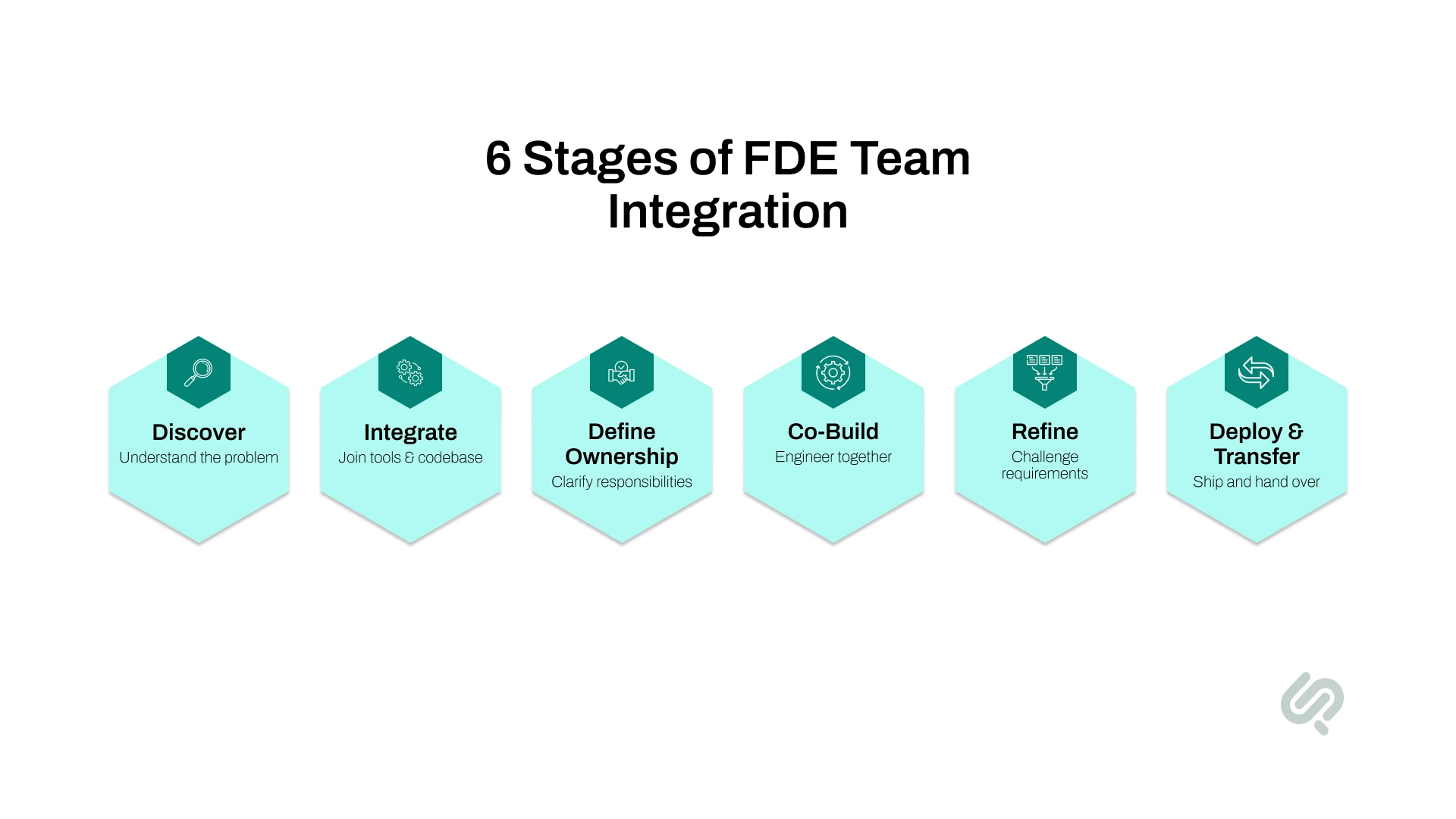
Good FDE team integration starts before development begins.
The engineer first needs to understand how your company makes technical decisions, how software reaches production, who owns the systems involved, and which constraints cannot be changed.
OpenAI's current description of its own forward deployed engineering role covers a similar lifecycle: discovery, technical scoping, system design, build, production rollout, adoption, and reusable patterns that can support future deployments. (2)
A typical engagement can be understood through six stages.
A forward deployed engineer starts with the problem and expected outcome before treating the backlog as the complete specification.
Technical discovery may include:
This gives the engineer enough context to challenge requirements when the proposed implementation does not match the underlying problem.
It also reduces the chance of your development team spending several sprints building against incomplete assumptions.
Effective FDE team integration means using the engineering systems your team already relies on rather than creating a parallel delivery process.
Depending on the engagement, the engineer may work inside:
Code access should follow the same controls applied to other engineers working in your environment.
Before development begins, define:
The engineer should work within the engineering system your team already trusts. If they recommend changing an internal standard, the tradeoff should be discussed and documented rather than introduced without context.
Embedded engineering becomes difficult when everyone is involved but nobody knows who owns the final decision.
The FDE and internal team should agree early on who owns discovery, implementation, reviews, deployment, existing systems, and production support.
The exact split will differ by engagement.
What matters is making technical ownership visible before development speeds up.
A forward deployed engineer should work directly with internal developers rather than disappearing into a separate delivery process.
Collaboration can include:
Consider a SaaS company adding an AI agent.
Internal engineers may continue owning authentication, billing, customer accounts, infrastructure, and the core product.
The forward deployed engineer could focus on:
For a non-AI project, the same pattern could apply to a difficult payment integration, legacy migration, cloud transformation, or cross-platform workflow.
The existing team brings deep product and organizational context. The FDE brings focused delivery ownership around the initiative.
A forward deployed engineer can participate in your backlog and sprint process without treating every ticket as a fixed specification.
Suppose a backlog item says: “Add AI search to customer records.”
Before implementing it, the engineer may ask:
Those answers may change the architecture before unnecessary work is built.
This is one reason companies use forward deployed engineers for technically ambiguous initiatives. The engineer can help shape the solution while remaining part of the same planning and delivery process as the internal team.
The work continues after the feature or system has been built.
A forward deployed engineer should help move the agreed scope through testing, release, production monitoring, and early operational issues.
That can include:
Production use often exposes assumptions that were invisible during development.
Those lessons should feed back into the implementation while the engineers who will eventually own the system remain involved.
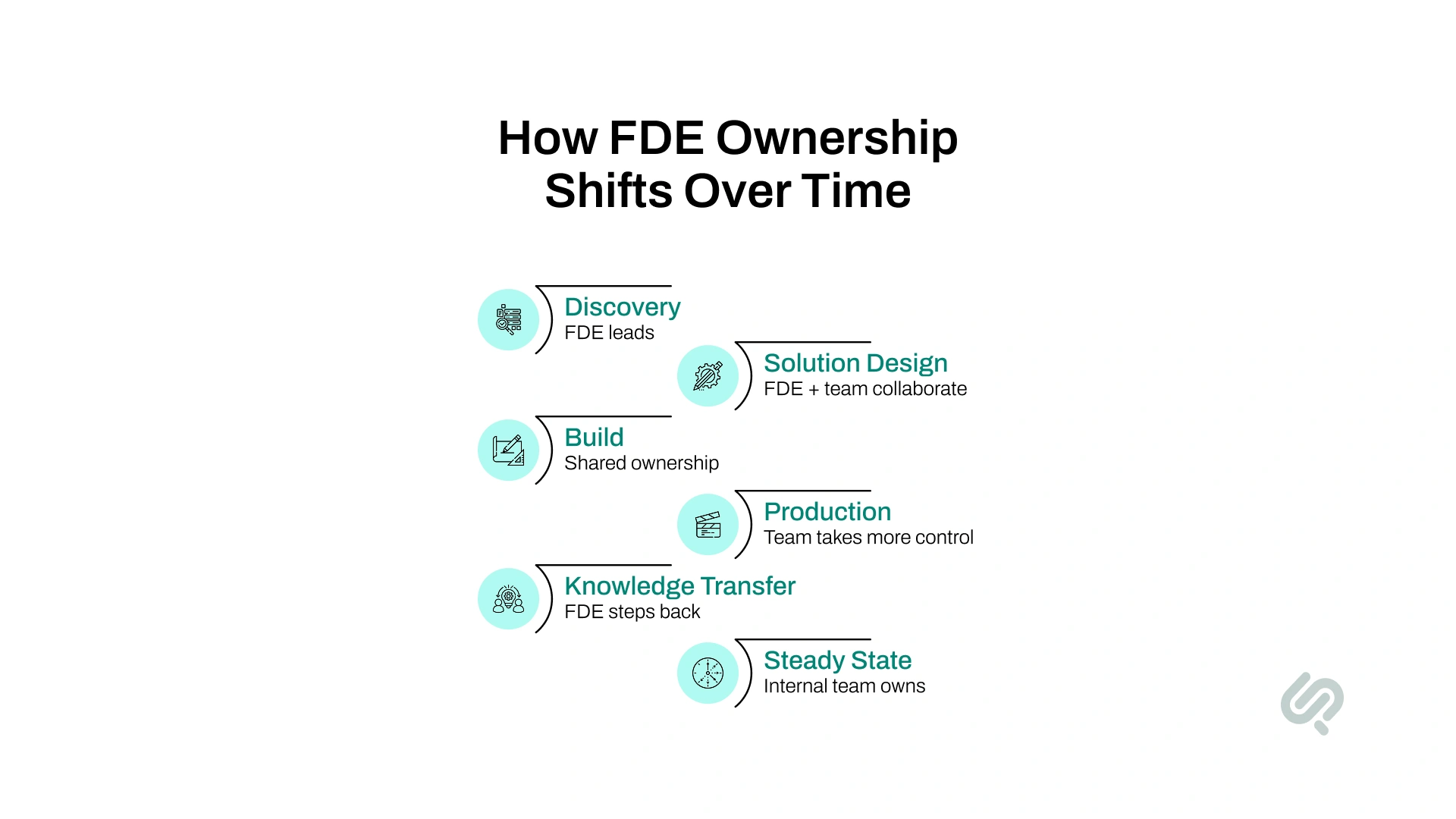
A forward deployed engineering team should increase the capability of your internal team over time. Responsibility typically shifts as the problem becomes clearer, the system reaches production, and internal engineers gain enough context to operate it themselves.
The timeline depends on the project.
The underlying principle is more important: knowledge transfer should happen while the work is being done.
AWS describes this transition in its own FDE model as customer engineers moving from observers to co-builders and eventually independent operators. Its June 2026 announcement also states that customer self-sufficiency is designed into the engagement rather than being treated as an afterthought. (3)
“A forward deployed engineer should leave your engineering team more capable than they found it. Good engagements create clearer ownership, faster decisions, and enough shared knowledge for the internal team to keep moving once the engineer steps back.”
— Abubakar Shams, CEO & Business Strategy Lead, Phaedra Solutions
Forward deployed engineers and traditional staff augmentation can both place outside engineers inside your team, but companies usually hire them for different problems.
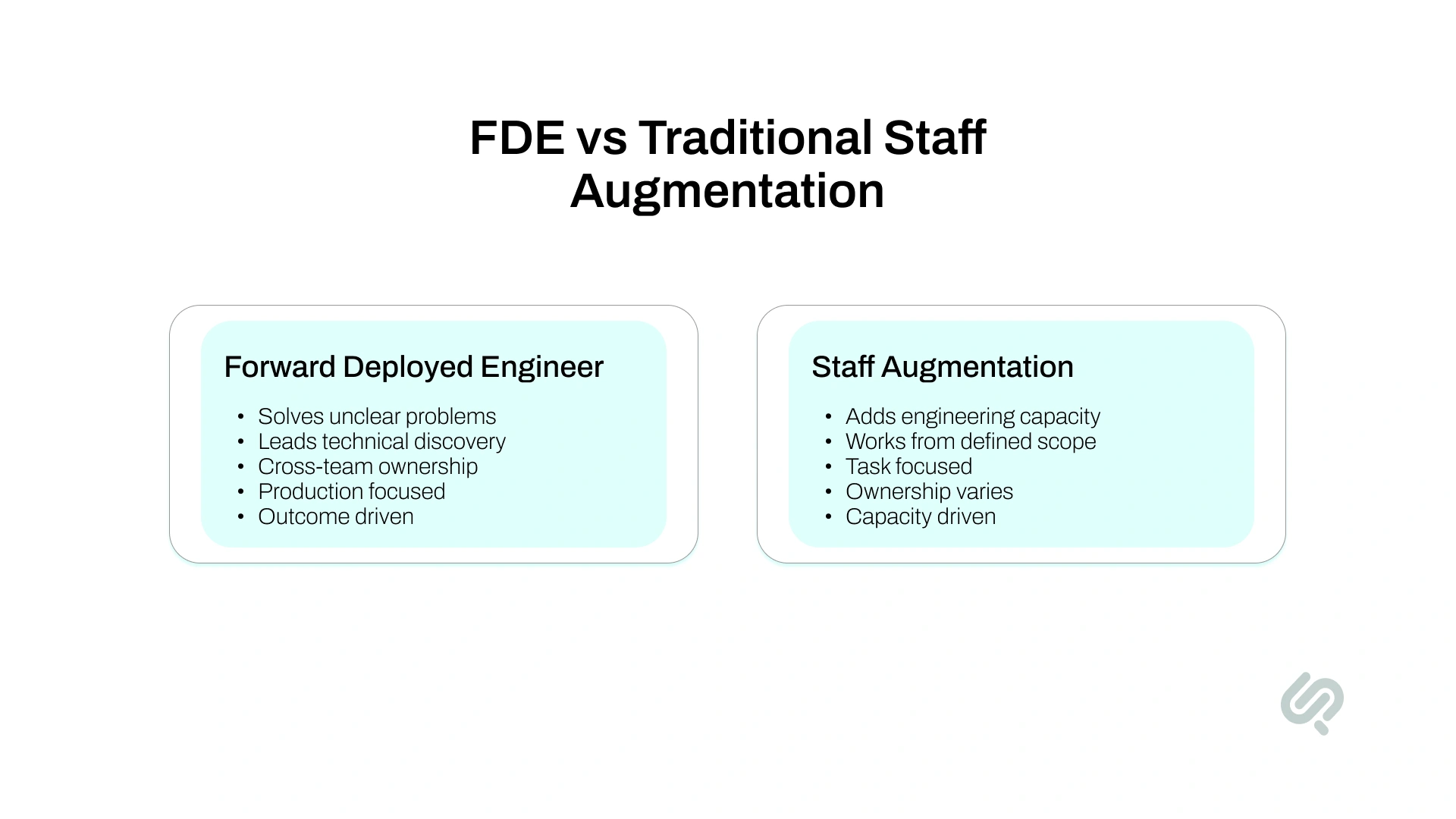
If your architecture is final, requirements are clear, and you mainly need additional developers to work through an established backlog, conventional staff augmentation may be enough.
A forward deployed engineer becomes more useful when the requirement itself still needs investigation, several systems or teams must be coordinated, or someone needs to own the path from technical discovery through production.
This shift is also visible among large IT services companies. Reuters reported in July 2026 that TCS plans to build a group of up to 8,900 forward deployed engineers as it moves further toward embedded AI implementation and integration work. (4)
As the role becomes more popular, the title alone tells you very little. Companies should evaluate how the engineer will work, what they can own, and how much access they will have to the actual problem.
Before hiring a forward deployed engineering team, ask whether the engineer will:
Also ask what the engineer will not own.
Production access, product roadmap authority, security approval, people management, and long-term operational responsibilities should be defined before the engagement begins.
If the role mainly involves completing assigned tickets against fully defined specifications, conventional staff augmentation may be enough.
If the project requires discovery, technical judgment, cross-system problem solving, and production ownership, the forward deployed model is a stronger fit.

Complex engineering initiatives rarely belong to one technical team.
Forward deployed engineers often work across several groups to keep architecture, implementation, security, deployment, and the real business workflow aligned.
The FDE acts as a technical connection point when one initiative crosses several areas of ownership.
Internal teams remain responsible for their domains while the engineer helps keep the shared outcome moving.
Phaedra Solutions developed an AI Cloud Surveillance Platform that connected existing IP cameras and access-control systems with AI-powered monitoring, search, analytics, cloud infrastructure, and user-facing applications. The project required engineering across AI, existing hardware, integrations, backend systems, infrastructure, security, QA, and operational workflows.
For a company approaching a similar initiative with a forward deployed engineer, the engineer could embed with existing engineering and operations teams, identify the highest-risk integration points, coordinate technical decisions across AI and infrastructure, and take ownership of getting the assigned scope into production. Internal engineers would remain involved throughout so architecture decisions, deployment knowledge, and operational context stayed inside the organization.
Even an experienced engineer can struggle when the engagement model is poorly defined.
The most common problems include:
Many of these issues can be prevented before development begins by defining access, authority, responsibilities, success metrics, and the expected ownership transition.
Knowledge transfer should happen continuously.
Internal engineers should participate in design reviews, pull requests, debugging, releases, architecture discussions, and operational decisions throughout the engagement.
By the time the FDE reduces involvement, your team should understand:
Documentation should support that knowledge rather than replace direct collaboration.
Useful handoff assets may include:
A good embedded engineering engagement leaves your internal team with more capability and context than it had when the work started.
If your developers understand the product but a high-value initiative is still blocked by unclear ownership, difficult integrations, evolving requirements, or missing specialist expertise, a forward deployed engineering team can add senior technical ownership without replacing your existing developers.
Through Phaedra Solutions' staff augmentation services, you can hire a senior forward deployed engineer who works inside your existing repositories, sprints, communication channels, code-review process, and technical environment.
A Phaedra Solutions forward deployed engineer can support:
Your internal engineers retain their product and system ownership while the FDE focuses on moving the agreed initiative forward.
Have an initiative that needs senior embedded ownership? Book a free forward deployed engineer consultation.



Ameena is a content writer with a background in International Relations, blending academic insight with SEO-driven writing experience. She has written extensively in the academic space and contributed blog content for various platforms.
Her interests lie in human rights, conflict resolution, and emerging technologies in global policy. Outside of work, she enjoys reading fiction, exploring AI as a hobby, and learning how digital systems shape society.