
.webp)
.webp)
.webp)
.webp)









.webp)
On a balance sheet, legacy software can look like a fully depreciated, cost-effective asset. The licensing is predictable, the team knows how to use it, and the capital expenditure is long forgotten. But this is often a financial illusion.
The hidden costs of legacy systems go far beyond annual software licenses.
Outdated applications quietly drain cash through bloated maintenance cycles, manual employee workarounds, security vulnerabilities, compliance exposure, and missed revenue. For mid-market CFOs and business leaders, keeping these systems alive is rarely a cost-saving decision. It is a high-risk operational expense that actively erodes EBITDA and suppresses company valuation.
In plain terms: legacy system maintenance costs are the sum of everything you can see on an invoice plus everything you cannot (ost productivity, blocked AI readiness, increased security premiums, and an inability to scale).
This breakdown gives you the financial framework to quantify that exposure and act on it.
The hidden costs include manual workarounds that drain staff hours, emergency developer support, system downtime, security breach exposure, failed integrations with modern platforms, and blocked digital transformation initiatives. These costs rarely appear as a single line item, which is exactly what makes them dangerous to a CFO's budget.
A typical mid-market company carries $500,000 to $1 million or more in annual legacy-related leakage once maintenance, downtime, manual labor, and compliance risk are fully quantified. The Pegasystems/Savanta study found firms spend an average of $56 million per year on legacy maintenance alone at enterprise scale.
As software ages, vendor support ends, security patches require custom coding, and engineers who understand the system retire or leave. The shrinking talent pool drives up contractor rates. Meanwhile, the cost of connecting legacy databases to modern tools compounds year after year.
Legacy tools force finance, operations, and customer support teams to spend hours daily on manual data reconciliation, CSV exports, duplicate data entry, and error correction. This is dead labor cost that does not appear on a software invoice.
Modernization becomes the financially smarter choice when your annual combined cost of maintenance, downtime, manual labor, and security risk approaches or exceeds 50% of what a modern replacement would cost, or when legacy infrastructure is blocking AI adoption, new revenue lines, or M&A readiness.
Yes. A phased legacy system modernization strategy (auditing the system, stabilizing high-risk components, wrapping core databases in APIs, and migrating workloads to the cloud incrementally) eliminates the all-or-nothing risk while preserving working capital.
Legacy software is any information technology system, programming language, or application architecture that is outdated yet still critical to daily business operations. This does not refer only to 30-year-old mainframes. In today's market, legacy software includes:
A useful rule of thumb: if your team has built workarounds to compensate for what the software cannot do natively, you are already paying the hidden costs of a legacy system.
Finance leaders delay software upgrades for rational reasons. The system still works, the internal team knows it inside out, and avoiding a major upfront investment protects short-term cash flow. On paper, it looks like fiscal discipline.
The problem is how legacy costs are reported, or rather, how they are not. The true cost of maintaining legacy systems never appears as a single line item. Instead, it is scattered invisibly across:
A CFO reviewing individual budget lines sees manageable numbers. What they rarely see is the combined total, which, for a typical mid-market business, frequently runs to $500,000–$1 million per year once every cost category is accounted for.
"The data makes it very clear: organizations that delay modernization aren't saving money. They're deferring a cost that compounds every quarter."
— Khawar Qayyum, Digital Transformation Head, Phaedra Solutions
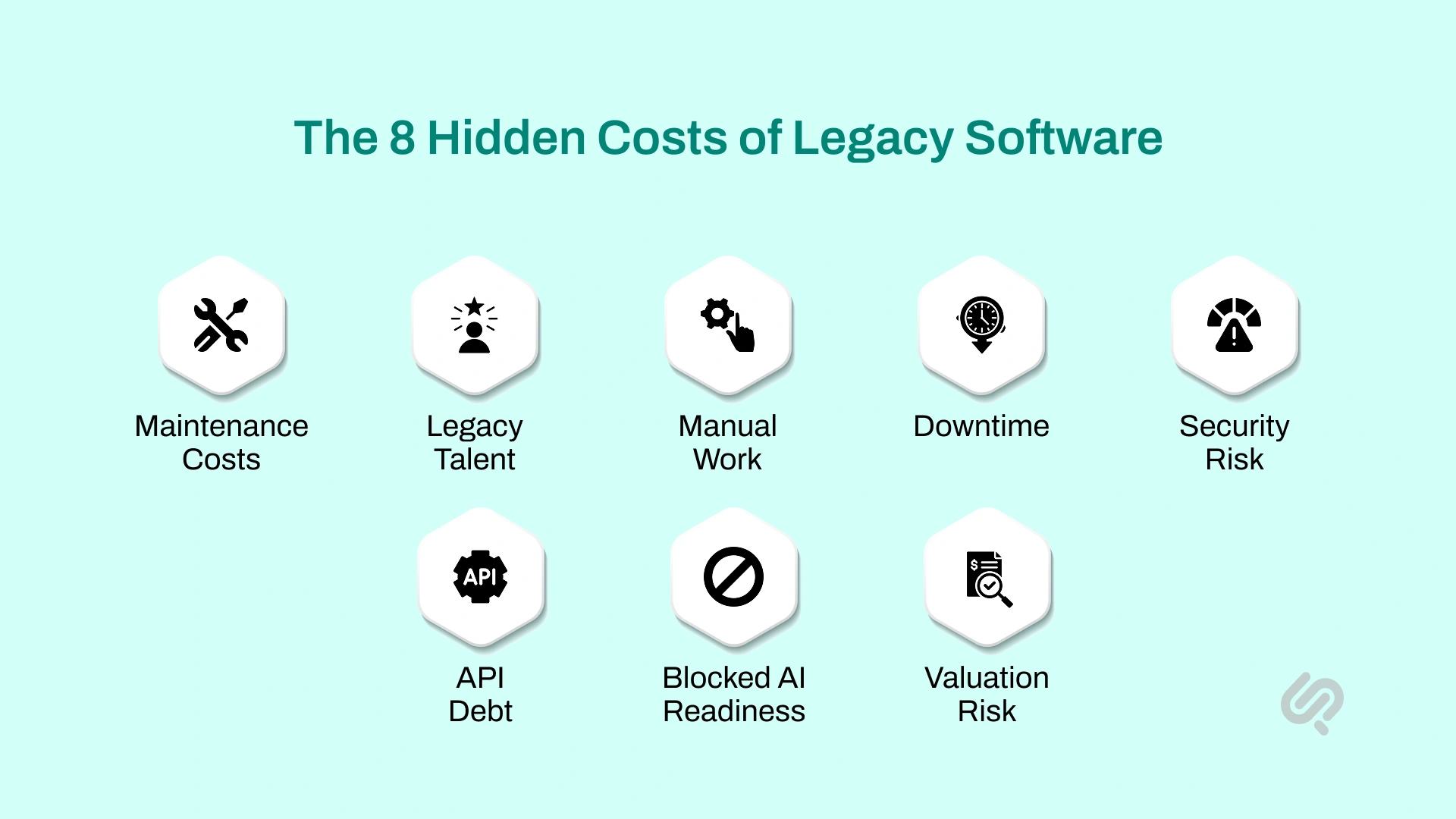
To accurately evaluate the hidden costs of legacy systems, business leaders must look past the IT department bill and assess the broader operational and financial toll.
As software ages, keeping it functional requires more effort. Emergency bug fixes, custom security patching, and maintaining specialized server environments cause infrastructure costs to climb every year.
According to research by Pegasystems and Savanta, enterprise IT departments lose an average of $370 million annually to technical debt, with legacy maintenance alone consuming an average of $56 million per year per firm. (1)
Legacy system infrastructure costs often include on-premises server maintenance that cloud-native systems have long since eliminated.
When software relies on older coding languages or obsolete frameworks, finding qualified engineers becomes both difficult and expensive.
As the talent pool shrinks, market rates rise. Your organization becomes dependent on a few highly paid specialists or costly external agencies (a critical operational vulnerability if a key team member leaves or retires).
When software cannot automatically share data across systems, people bridge the gap manually. Employees spend hours downloading CSV files, reconciling financial reports across disconnected platforms, and re-entering the same data into multiple systems.
This productivity drain is one of the most underreported legacy system indirect costs. It rarely appears on an IT invoice, but it shows up directly in payroll and in delayed financial closes.
Legacy systems are inherently fragile. A single database crash can halt manufacturing lines, freeze e-commerce checkouts, or lock customer service agents out of accounts for hours. Beyond immediate technical debt cost, system downtime leads to lost revenue, missed SLA commitments, and long-term customer churn.
Research estimates that IT downtime costs organizations an average of $5,600 per minute (2). For legacy-dependent businesses, this risk is constant and uninsured.
Outdated applications often lack support for modern security protocols including multi-factor authentication and advanced encryption. When a vendor stops issuing security patches, the system becomes an open target.
The financial consequences are severe. The IBM Cost of a Data Breach Report calculated the average global cost of a data breach at $4.44 million (3).
Regulatory fines for GDPR, HIPAA, or PCI-DSS violations compound these costs further. Legacy software that handles sensitive data but cannot meet current compliance standards is a liability that belongs on any CFO's risk register.
The 2024 "Midnight Blizzard" cyberattack on Microsoft (where attackers gained access to executive email accounts by exploiting a legacy test account) is a high-profile reminder that legacy system security risks are not hypothetical (4). They are actively exploited.
Modern corporate strategies depend on interconnected software ecosystems. Legacy systems, however, lack native APIs. Connecting an old application to a modern logistics platform, payment gateway, or CRM requires complex, fragile middleware that is expensive to build, prone to breaking during updates, and requires ongoing developer oversight.
Every new integration point added to a legacy system increases what engineers call "API debt" — the cumulative cost of keeping custom connectors operational as surrounding platforms evolve.
Every dollar spent maintaining legacy infrastructure is a dollar not spent on competitive growth. But the deeper cost is strategic: legacy architecture severely limits a company's ability to adopt AI-powered workflows, machine learning, and automation.
If your core systems cannot connect to modern AI tooling, you are not just falling behind — you are funding your own obsolescence.
If you plan to pursue a corporate sale, merger, or private equity investment, your tech stack will face rigorous due diligence. Sophisticated buyers look closely at software infrastructure. A disorganized, outdated IT architecture raises post-acquisition cost flags, reduces buyer confidence in financial reporting accuracy, and can result in lower valuation multiples or deal restructuring.
This is one of the most commercially consequential hidden costs of legacy systems, and one that CFOs preparing for any exit or fundraising event cannot afford to ignore.
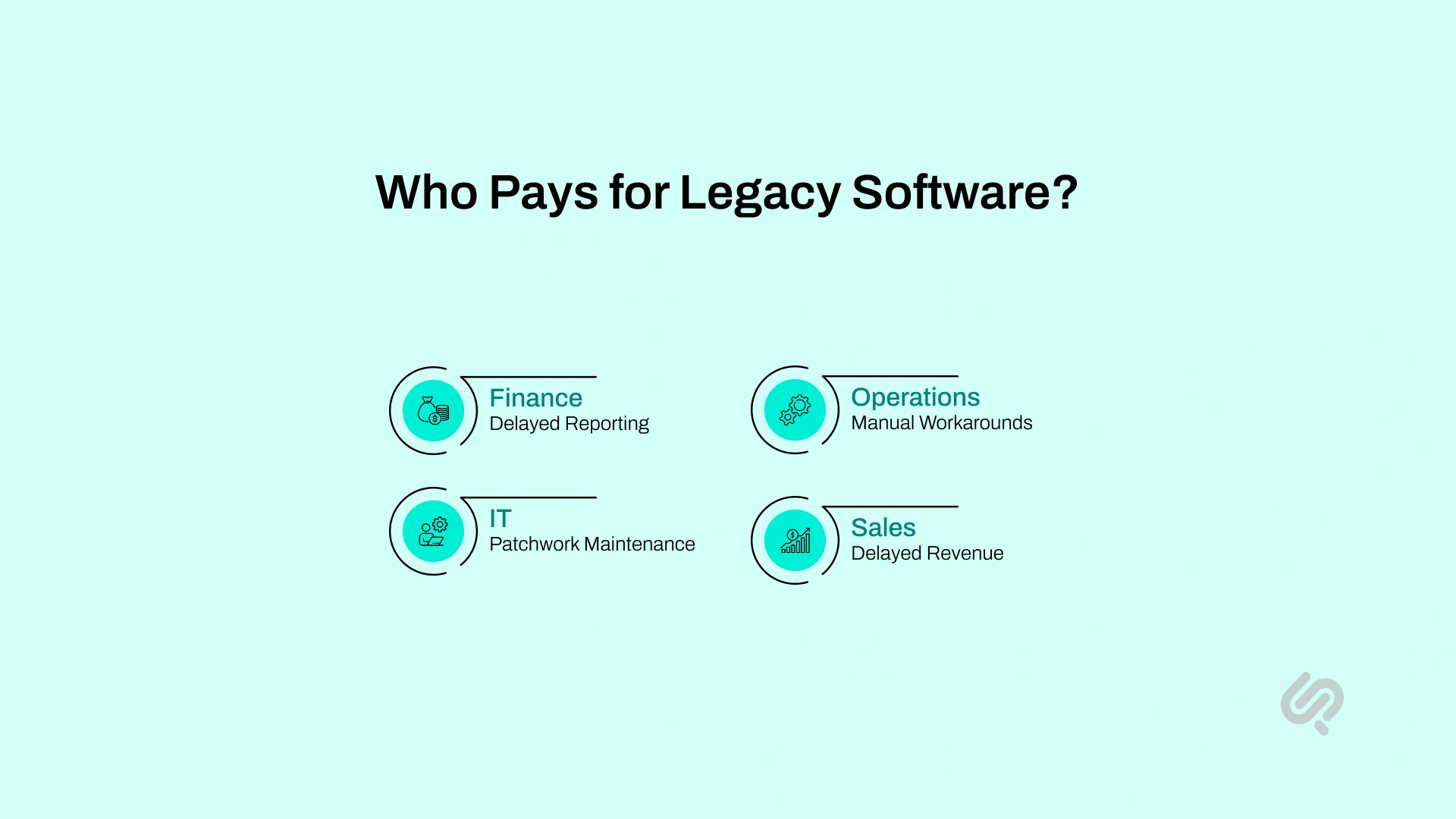
The hidden costs of legacy systems do not land equally across a business. Different departments absorb different parts of the burden, which is exactly why the true total is so easy to miss when reviewing a single budget.
When a CFO adds the hidden burden across all four departments, the cost of maintaining legacy systems moves from a line item to a strategic problem. That is the conversation this breakdown is designed to start.
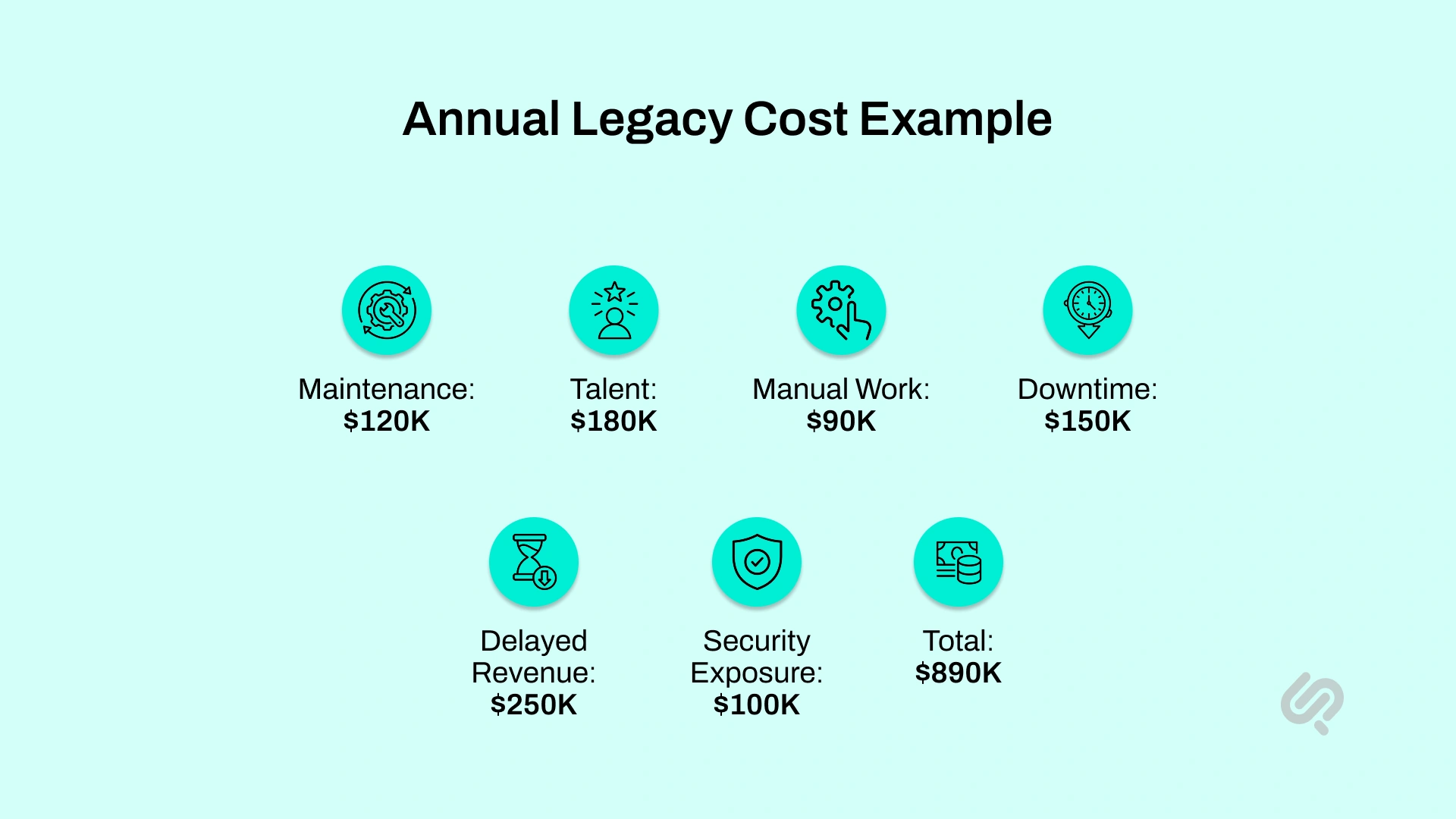
Once you add up what each department is absorbing, the numbers become hard to ignore. Here is how a typical mid-market company's annual legacy-related leakage breaks down when fully quantified:
Figures represent typical mid-market company estimates. Actual costs vary by industry, system complexity, and operational scale.
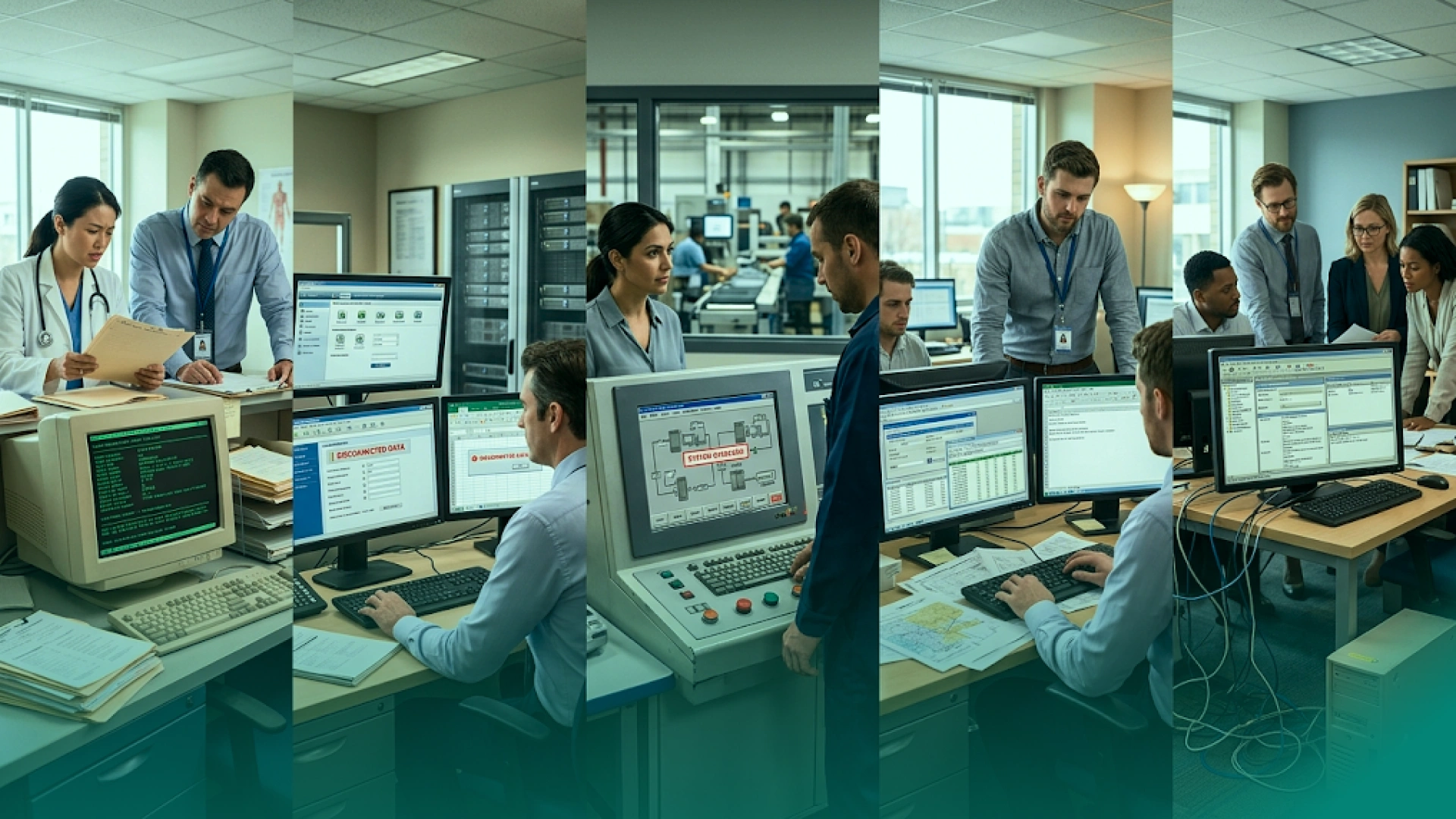
The hidden costs of legacy systems are not the same across every sector. Industry context — regulatory requirements, integration complexity, data sensitivity — determines how fast those costs compound and how severe the consequences of inaction are.
For businesses operating in any of these sectors, legacy system security vulnerabilities and compliance gaps carry direct financial penalties and, in some cases, reputational damage that is harder to quantify and longer to recover from.
Before deciding whether to modernize, it helps to see the full financial picture side by side.
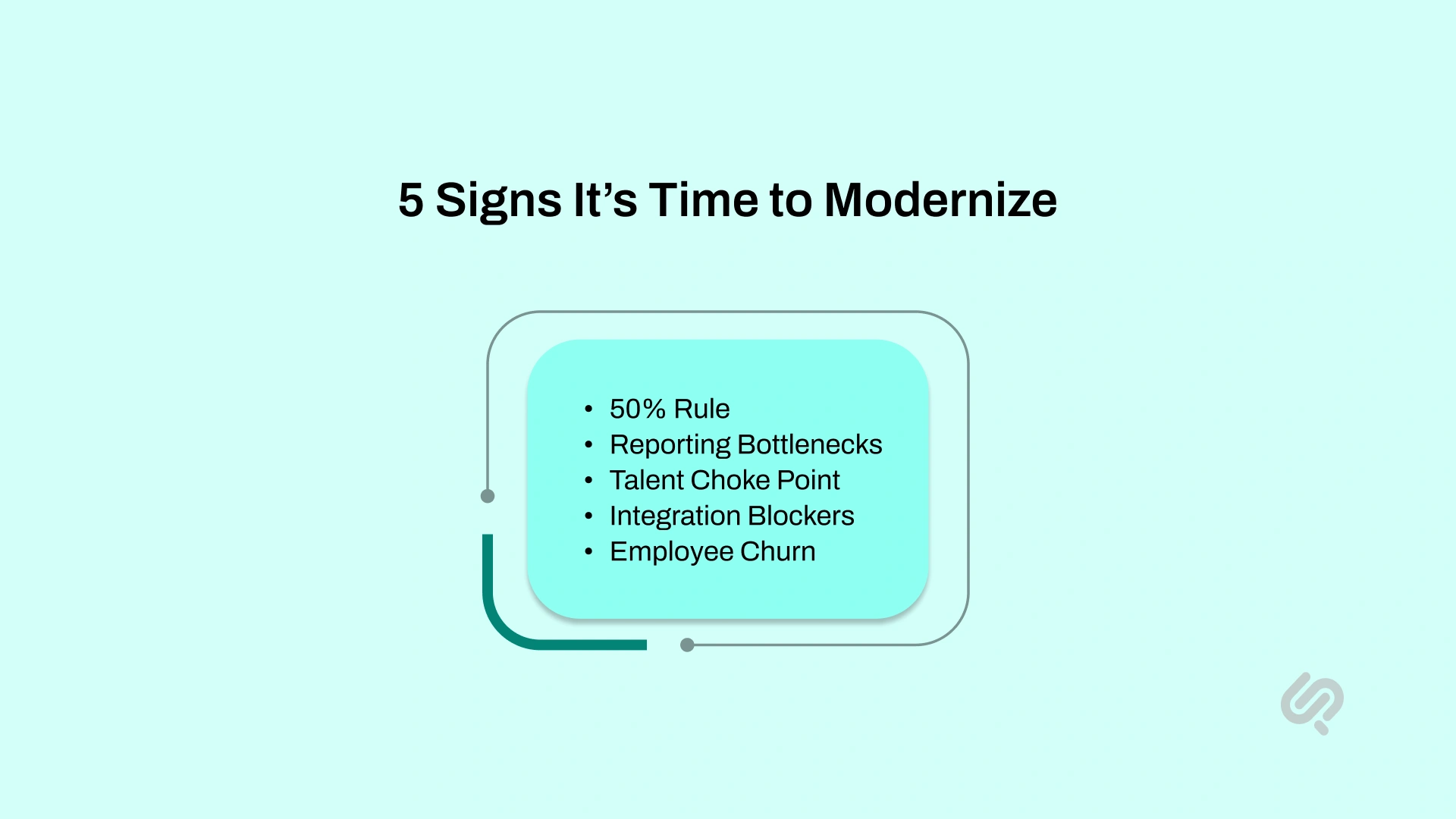
There is a financial tipping point in every legacy system's lifecycle where the annual cost of keeping it running exceeds the amortized cost of replacing it. The challenge is that this point is rarely obvious from the inside.
Use these five indicators as a practical decision framework. The more boxes you check, the stronger the business case for acting now rather than next year.
If your annual support, infrastructure, and emergency bug-fixing spend is approaching 50% or more of the projected cost of a modern replacement, you are in the danger zone. You are paying near-replacement cost every year, and getting a depreciating asset in return.
Closing the monthly books or producing regulatory submissions takes weeks because data has to be manually extracted, reconciled, and formatted from disconnected systems. This is not a people problem, it is a systems problem, and it will not improve without architectural change.
Your core systems depend on one or two engineers who understand them deeply. When those people retire or leave, you lose the institutional knowledge required to maintain the system safely. Finding replacement talent for legacy languages costs more each year, and the pool shrinks further each year.
Your engineering team regularly reports that they cannot connect core systems to modern platforms (CRM tools, cloud infrastructure, payment gateways, or AI services). Every quarter you delay a product launch or a partner integration because the legacy stack cannot support it is a quarter of measurable revenue lost.
This one rarely makes it onto a CFO's legacy cost worksheet, but it should. Staff turnover linked to frustration with outdated tools is a well-documented problem.
Replacing a mid-level operations or finance employee costs 50–200% of their annual salary. If legacy systems are contributing to churn, that cost belongs in your calculation.
If two or more of these signals are present, the question is no longer whether to modernize. It is how to do it without disrupting operations. The next section covers exactly that.
Review these questions to assess your company's financial exposure:
If you answered yes to two or more, your organization is likely carrying significant, quantifiable legacy system risk.
A US-based healthcare company approached Phaedra Solutions with a legacy lab management application that was becoming increasingly difficult to scale. The platform handled essential workflows — patient test bookings, progress tracking, doctor requests, and result viewing — but as usage grew, it became slower, riskier to release, and costly to maintain.
Rather than forcing a high-risk full rebuild, Phaedra Solutions began with a structured software risk assessment and targeted the highest-impact modernization areas first. The team rebuilt the database and backend, modernized the web layer with React/Next.js, and introduced DevOps automation through CI/CD pipelines.
The results: 40% faster performance, 50% fewer release-related issues, 25% reduction in support tickets, and 10–15% lower infrastructure spend (while operations continued uninterrupted throughout). For CFOs, the lesson is straightforward: phased legacy modernization delivers measurable financial returns without blank-check risk.
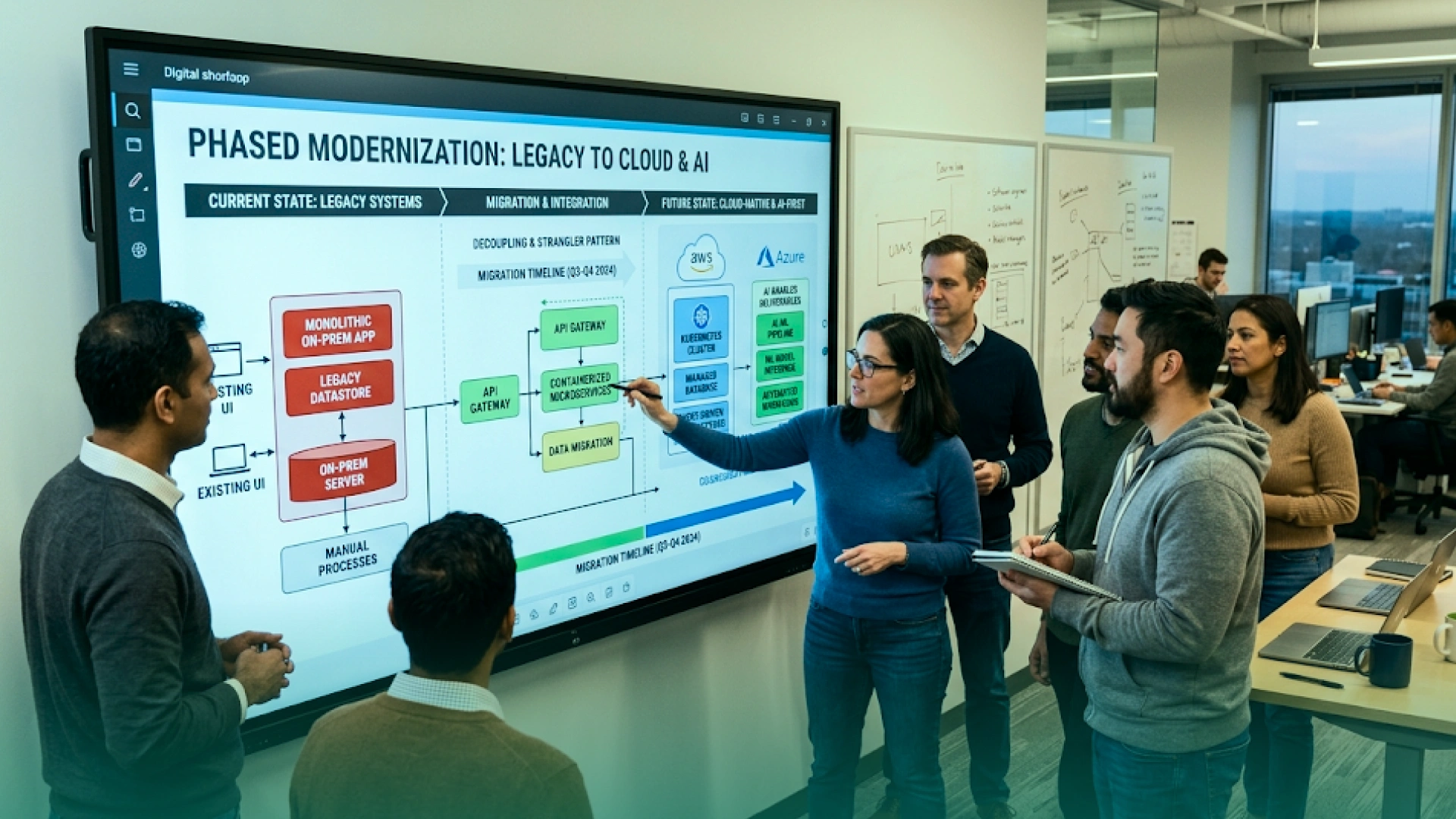
The fear of a failed, over-budget modernization project is the number one reason CFOs defer the decision. That fear is legitimate. Poorly planned rewrites do fail.
But the alternative is not the status quo. It is a structured, phased approach that reduces risk at every stage.
Here is how organizations modernize successfully without disrupting operations or writing a blank check:
Before spending a pound or a dollar on development, commission a structured audit of your current system. A proper audit identifies:
This audit becomes the business case document your leadership team needs to approve the investment.
Address the highest-risk components first (the parts most likely to fail, cause a breach, or block compliance). This is not full modernization; it is targeted risk reduction that buys time and reduces exposure while the broader roadmap is planned.
If your core database is reliable but the application around it is fragile, developers can build a modern API layer over the existing system. This immediately unlocks integration with modern platforms — cloud tools, CRMs, payment gateways, AI services — without touching the underlying data layer. It is often the fastest and lowest-risk first move.
Once stabilized and connected, migrate individual high-impact modules to modern architecture one at a time. As legacy hardware is decommissioned during this process, organizations should also engage IT asset disposition services to ensure retired equipment is securely wiped, recycled or resold in compliance with data protection regulations. Start with the components that are costing the most — the billing engine, the reporting layer, the customer-facing portal. Each migration delivers measurable ROI that funds the next phase.
Most organizations are carrying $500,000 to $1 million or more in annual legacy-related costs they have never fully quantified. The hidden costs of legacy systems are not theoretical. They are sitting in your payroll, your IT budget, your compliance exposure, and your pipeline of delayed product launches.
The first step is knowing your number.
At Phaedra Solutions, we specialize in legacy modernization services for mid-market businesses. Using an AI-first delivery methodology, we move faster and cost less than traditional agencies — delivering structured, phased modernizations that protect business continuity and return measurable value at every stage.
Book a legacy modernization consultation and we will help you quantify your current exposure, identify your highest-risk components, and map a realistic path to modernization.
The hidden costs of legacy systems compound silently — in overtime hours, missed integrations, rising insurance premiums, and strategic opportunities your business cannot pursue because its infrastructure cannot keep up. Waiting is not a neutral decision; it is a recurring financial drain with an accelerating cost curve.
At Phaedra Solutions, we specialize in legacy application modernization that turns technical debt into measurable financial returns. Using an AI-first delivery methodology — combining Claude, Cursor, and GitHub Copilot — our engineering team moves faster and costs less than traditional agencies, delivering 30% to 80% efficiency gains depending on project scope.
Whether you need a structured software architecture audit to understand your current exposure, or a full phased modernization roadmap to eliminate it, we design practical, low-risk engagements that protect business continuity while rebuilding your foundation for growth.
Stop letting outdated software suppress your margins. Contact Phaedra Solutions today for a legacy modernization consultation and get a clear picture of what your current systems are really costing you.



Ameena is a content writer with a background in International Relations, blending academic insight with SEO-driven writing experience. She has written extensively in the academic space and contributed blog content for various platforms.
Her interests lie in human rights, conflict resolution, and emerging technologies in global policy. Outside of work, she enjoys reading fiction, exploring AI as a hobby, and learning how digital systems shape society.