


.webp)
.webp)
.webp)











Agile is used by over 70% of organizations to build better products faster, and with fewer surprises.
Instead of following a fixed plan, Agile project management teams break work into short, focused sprints and adapt based on feedback. It’s fast, flexible, and built for real collaboration.
In this beginner-friendly guide, we’ll break down exactly what Agile project management is, how it works, what makes it different from traditional methods, and how teams use it to deliver better results.
We’ll also cover the roles, tools, and principles that drive successful Agile projects, without the fluff.
Agile project management is a flexible way of planning and delivering work in small, fast cycles. Instead of following a long, fixed plan, teams adapt quickly based on real feedback.
It’s rooted in agile software development, where continuous improvement and strong collaboration help teams move faster with fewer mistakes.
Agile keeps everyone aligned, reduces risk, and helps products reach users sooner.
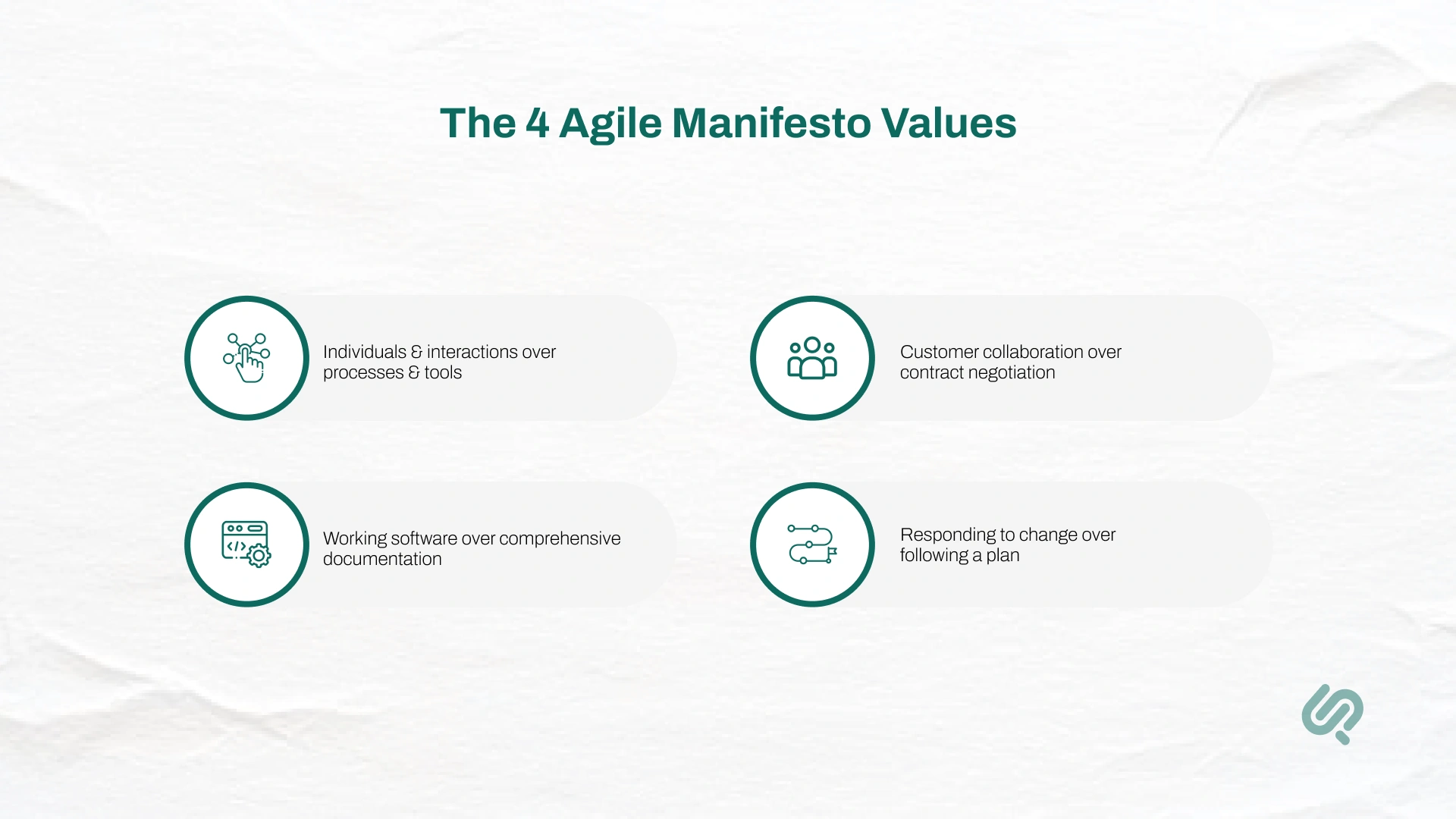
Agile is built on the Agile Manifesto, created in 2001(1) to guide how teams should work in fast-moving, unpredictable environments. It introduces four core values that shape how modern teams plan, collaborate, and deliver work:
These values are supported by 12 Agile principles that provide practical guidance on how teams should work. They include:
Together, the four values and twelve principles create a framework centered on flexibility, collaboration, and customer focus. The impact is clear, 93% of teams using Agile report higher customer satisfaction, thanks to faster delivery and more relevant features (2)
At its core, Agile succeeds because it trusts the team, encourages shared ownership, and creates an environment where communication and continuous improvement drive better outcomes.
Agile began as a response to slow, rigid development methods that couldn’t keep up with changing user needs.
Early software teams realized they needed faster cycles, customer feedback, and stronger collaboration to deliver better results. This led to the Agile Manifesto in 2001, which formalized the agile methodology definition and shaped how modern teams plan, build, and iterate today.
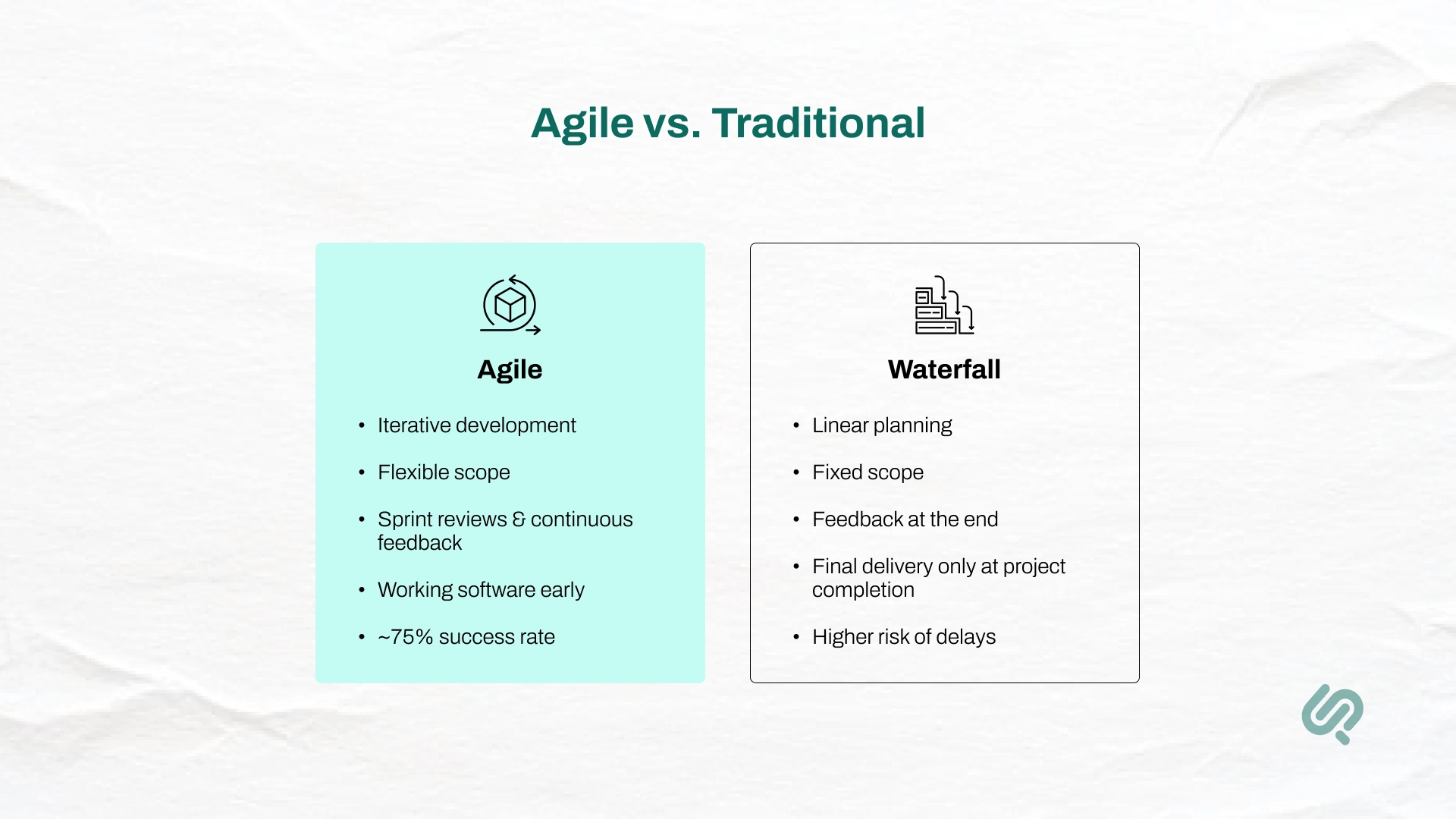
Understanding the difference between Agile and the traditional Waterfall model is key to choosing the right project management framework.
Below is a breakdown of how Agile stands apart and why it’s become the preferred choice for modern software development teams.

Agile project management thrives on a clear, collaborative team structure that supports adaptability and continuous delivery.
Built around strong cooperation, often described as another word for teamwork, Agile ensures everyone moves in the same direction.
One of the most widely used frameworks, Scrum, defines specific roles that help agile teams stay organized and focused during each sprint.
These roles include the Product Owner, Scrum Master, Development Team, and Stakeholders, all working together to plan, execute, and improve work across the agile development cycle.
The Product Owner is responsible for setting the product vision and prioritizing features in the product backlog.
They ensure that every sprint focuses on delivering the most valuable outcomes to the business and its users.
The Product Owner plays a key role in maintaining alignment between the team and customer needs, making real-time agile planning a core part of the agile process.
The Scrum Master supports the team by facilitating meetings, removing blockers, and promoting agile practices across the project lifecycle.
Rather than managing tasks directly like in traditional project management, the Scrum Master acts as a coach, helping the team stay focused and continuously improve.
This role is central to building an agile mindset and ensuring sustainable development.
The Development Team is a cross-functional group of developers, designers, testers, and other specialists.
These teams are self-organizing, meaning they decide how best to accomplish their sprint goals without micromanagement.
Agile principles encourage this autonomy, allowing teams to adapt quickly and deliver working software in small, frequent increments.
Stakeholders and users also play an important part in agile project management. They participate in sprint reviews and provide regular customer feedback on what’s been delivered.
This real-time customer collaboration helps the team stay aligned with expectations and adjust direction when needed.
It’s one of the reasons agile delivery is known for improving customer satisfaction and responsiveness.
Unlike traditional frameworks, where a single project manager oversees everything, Agile spreads responsibilities across roles.
The Scrum Master and Product Owner share leadership, promoting a more democratic, team-driven approach.
This shift away from top-down control supports motivated individuals, faster decision-making, and greater ownership of the work.
Agile teams are designed to be cross-functional. Each team includes all the necessary skills to complete a feature from start to finish, eliminating handoffs and avoiding delays common in siloed structures.
This setup not only boosts delivery speed but also encourages deeper collaboration, technical excellence, and alignment with agile principles.
In short, the agile project framework is built to support flexibility, accountability, and meaningful results.

Agile project management is not a single method; it's a collection of agile frameworks and agile methodologies, each designed to support fast, flexible, and customer-focused delivery.
These frameworks help teams follow the agile development cycle, manage sprints, improve collaboration, and deliver working software in small, frequent increments.
Below are the most widely adopted Agile methods used across modern software development teams.
Scrum is the most widely used agile project framework, adopted by nearly 87% of Agile teams. It’s built around short, time-boxed iterations called sprints (1–4 weeks). (3)
Scrum provides a structured approach using defined roles (Scrum Master, Product Owner), ceremonies (sprint planning, daily standups, sprint review, sprint retrospective), and artifacts (product backlog, sprint backlog, increment).
Teams using Scrum focus on continuous improvement, frequent inspection, and adaptability, making it ideal for complex software development projects that require constant change.
Kanban is a lightweight, visual agile methodology that uses a Kanban board to map work stages such as To Do, Doing, and Done.
Instead of fixed sprints, Kanban emphasizes continuous workflow, limiting work-in-progress, and eliminating bottlenecks.
It is especially useful for teams that deal with ad-hoc requests, support tickets, or rapid-fire tasks, and helps improve cycle time without rigid planning.
Extreme Programming (XP) is a technical, engineering-driven Agile approach used primarily in fast-moving software teams. It includes intensive practices such as:
XP focuses heavily on quality and technical excellence, key principles of Agile. Because iterations are short, teams can adapt rapidly while ensuring stable, reliable code.
Lean software development focuses on reducing waste, optimizing flow, and delivering maximum value with minimal overhead.
It keeps teams focused on efficiency, speed, and customer value.
Dynamic Systems Development Method (DSDM) is another structured agile delivery methodology with defined phases like feasibility, prototyping, design/build, and implementation. DSDM adds more governance for teams that need discipline and agility across the entire project lifecycle.
Feature-Driven Development (FDD) is an iterative approach centered around building features in short cycles. Teams plan, design, and build features one by one, using continuous feedback and customer input.
FDD works well for large systems with clearly defined modules and functionality.
Large organizations use the Scaled Agile Framework (SAFe), Spotify’s Agile model, or other enterprise-level approaches to coordinate work across multiple teams. SAFe introduces concepts such as:
SAFe remains the most popular option for scaling Agile across hundreds or thousands of employees.
Every Agile methodology follows a similar Agile lifecycle, which includes planning, execution, review, and continuous improvement.
This lifecycle keeps teams aligned, flexible, and focused on delivering working software throughout the entire project.

Every agile project begins with a clear product vision and a high-level roadmap that outlines major releases or feature milestones.
Unlike traditional planning, this roadmap remains adaptable as new insights emerge.
All requirements, user stories, and potential features are captured in a prioritized product backlog.
The Product Owner reviews and updates the backlog continuously based on customer feedback and evolving business needs. This makes Agile highly responsive to change.
Before development begins, teams hold release planning to define which features will be included in upcoming releases. Instead of fixed long-term plans, Agile focuses on short-term, high-value increments.
Work is divided into short cycles called sprints.
During sprint planning, the team selects user stories from the product backlog and commits to finishing them within the sprint timeframe. This keeps the agile project predictable and measurable.
Every day, the team holds a brief stand-up meeting to discuss progress, blockers, and priorities.
These meetings support constant communication and transparency, helping teams identify issues early in the agile development cycle.
At the end of each sprint, teams hold:
These practices support continuous improvement, one of the core agile principles.
Agile teams often integrate CI/CD pipelines to automatically build, test, and deploy code.
This supports fast releases and reduces technical risks, ensuring that each iteration produces potentially shippable software.
Adobe highlights that these steps, roadmaps, backlogs, sprints, daily scrums, reviews, and retrospectives enable efficient iterative development and ensure teams adapt quickly to change.
Modern Agile teams rely on dedicated tools to stay organized, track progress, and maintain alignment across the project lifecycle.
Tools such as Jira, Azure DevOps, Asana, and Trello help teams manage backlogs, user stories, Kanban boards, and sprints.
According to industry surveys, more than 300,000 companies use Jira as their primary agile project management tool. (4)
Slack, Microsoft Teams, and Confluence help teams communicate in real time.
These tools support Agile values by enhancing “individuals and interactions” across distributed or hybrid teams.
Digital Kanban boards in Jira, Trello, or Azure Boards help teams visualize workflow and limit work-in-progress. Many in-office teams also use physical boards for instant visibility.
Tools like Jenkins, GitLab CI, and GitHub Actions automate builds, tests, and deployments, supporting continuous delivery and fast feedback loops.
Agile project management tools also track key metrics like sprint burndown charts, cycle time, and team velocity. These metrics help teams inspect and adapt, improving accuracy and predictability.
Adopting the agile methodology brings clear, measurable benefits across the entire project lifecycle. Agile improves delivery speed, product quality, team collaboration, customer satisfaction, and overall project success, while reducing risks and delays.
Below are the most important advantages supported by real industry data.
Agile works in short, focused agile sprints, enabling teams to deliver smaller increments of working software in weeks instead of months.
This iterative development speeds up time-to-market and improves responsiveness as priorities or requirements change.
Research shows that organizations using Agile experience faster, more flexible delivery cycles than those relying on traditional project management.
Agile teams achieve significantly better results due to continuous improvement and short planning cycles.
Studies like PMI’s show that teams using Agile have an average 75.4% project success rate, outperforming predictive (Waterfall) methods.
Early risk detection and iterative planning reduce the chance of large-scale project failure.
Agile emphasizes teamwork, communication, and shared ownership—key factors that boost motivation and engagement.
Because Agile teams are self-organizing and cross-functional, members feel more empowered and aligned with goals.
According to a survey conducted by VersionOne, 94% of organizations reported using agile development methodologies in their software development projects.
Additionally, 45% of respondents cited better project visibility and 44% reported improved team productivity as key benefits of agile development. (5)
Agile improves product quality by embedding testing, reviews, and customer feedback into every sprint.
Teams catch defects early rather than waiting until the end of the project, reducing rework and improving stability. Prioritizing working software over heavy documentation ensures more focus on building clean, reliable features.
Agile is built around continuous customer collaboration and frequent delivery of working increments.
Regular feedback ensures the product evolves in the right direction instead of relying on outdated assumptions. As a result, 93% of organizations using Agile report a significant increase in customer satisfaction.
Agile breaks the project into small, manageable pieces, making it easier to identify and resolve issues early.
Adaptive planning keeps the agile project framework stable even when business needs shift or unexpected challenges arise. This incremental approach makes Agile one of the safest and most predictable ways to manage complex projects.
Even experienced teams, agile project managers, and leaders in agile program management often misunderstand what Agile can and can’t do.
These myths slow teams down, create false expectations, and lead to poor execution. Here are the most common misconceptions, and the truth behind them.
Many believe Agile teams jump straight into work without structure, but planning is still essential, just done in shorter, more flexible cycles. Agile plans evolve as teams learn, reducing risk instead of eliminating planning.
Agile is widely used beyond engineering teams, in marketing, design, operations, and product. The core value is adaptability, making it useful anywhere rapid feedback and collaboration matter.
Agile doesn’t remove documentation; it removes wasteful, outdated documentation. Teams still create essential documents that support clarity, knowledge transfer, and alignment.
Agile helps teams move faster, but speed comes from discipline, clear priorities, and focused teams—not the framework alone. Without these, Agile can still stall like any other process.
Scrum is one framework within Agile, not a replacement for it. Agile includes many practices, Kanban, XP, Lean, and more, that teams choose based on their project needs.
Agile has structure, roles, ceremonies, backlogs, and review cycles. The difference is that the structure is lighter, adaptable, and designed to support continuous improvement.(
Adopting Agile requires not just new processes, but the right mindset, tools, and habits. These best practices help teams get the most from the agile project framework.
The growth of agile project management over the last decade has transformed how organizations plan, build, and deliver products.
Agile is no longer limited to software teams; it has expanded across industries, departments, and even government agencies.
The following trends highlight why Agile has become the dominant project management framework worldwide
Agile has moved far beyond traditional software development. Today, roughly 86% of software development teams use Agile practices, and adoption continues to rise across engineering, R&D, product teams, marketing, and HR.
Even government sectors have embraced the agile methodology. By 2017, nearly 80% of U.S. federal IT projects were using Agile or iterative approaches, up from only 10% in 2011.
This shift shows how valuable Agile is for managing complex projects and responding quickly to changing priorities.
Organizations that adopt Agile consistently report better outcomes. Industry surveys show that Agile teams achieve around a 75% project success rate, significantly higher than teams relying solely on traditional methods.
Additionally, 59% of Agile practitioners say Agile improves team collaboration, productivity, and alignment with business goals.
These strong results demonstrate why Agile has become the preferred approach for modern project management and software development processes.
Among the many Agile methodologies, Scrum remains the most widely used. Reports show that about 63% of Agile teams rely on Scrum for sprint-based planning and delivery.
Other team-level approaches like Lean and Kanban are also commonly adopted for visual workflow management and continuous flow.
At the enterprise level, the Scaled Agile Framework (SAFe) leads adoption, used by roughly 26% of organizations that scale Agile across multiple teams and departments.
Agile adoption has also accelerated the use of modern agile project tools. According to surveys, Jira remains the top choice, used by about 62% of Agile teams for backlog management, Kanban boards, sprint planning, and reporting.
Other popular tools include:
Agile is rapidly spreading into non-technical departments as companies realize the value of iterative work, faster delivery, and stronger teamwork.
Studies show that 86% of marketing teams plan to adopt Agile methods to improve productivity, campaign agility, and team engagement.
HR, finance, and operations teams are also adopting agile practices to streamline workflows and increase flexibility.
Agile project management has become the go-to approach for teams that want to work faster, stay flexible, and deliver real value without waiting months for results.
Its focus on short cycles, teamwork, continuous improvement, and customer feedback makes it ideal for modern projects where change is constant.
Whether you’re building software, managing a product, or handling cross-department initiatives, Agile helps teams stay aligned, reduce risk, and adapt quickly when priorities shift.
With proven success rates, higher team morale, and better customer satisfaction, Agile isn’t just a methodology; it’s a mindset that helps organizations work smarter, not harder.
For beginners, starting small, learning the principles, and building the right habits will set the foundation for long-term Agile success.


1. https://agilemanifesto.org/
2. https://www.parabol.co/blog/why-agile-is-here-to-stay/
3. https://www.parabol.co/blog/how-many-companies-use-scrum/
4. https://www.atlassian.com/software/jira/guides/getting-started/who-uses-jira
5. https://moldstud.com/articles/p-what-are-some-key-principles-of-agile-development

Ameena is a content writer with a background in International Relations, blending academic insight with SEO-driven writing experience. She has written extensively in the academic space and contributed blog content for various platforms.
Her interests lie in human rights, conflict resolution, and emerging technologies in global policy. Outside of work, she enjoys reading fiction, exploring AI as a hobby, and learning how digital systems shape society.