













Healthcare data systems are often fragmented and difficult to manage.
In most countries, patient records are stored separately in hospitals, labs, and clinics, with each organization keeping its own database.
This lack of connection makes it hard for doctors to get a complete picture of a patient’s health, slows down care, and increases costs.
On top of that, traditional databases are vulnerable to cyberattacks, putting sensitive patient data at risk.
This is where blockchain technology in healthcare comes in. Blockchain is a decentralized and tamper-proof ledger that securely records every update or transaction.
Each change in a patient’s health records can be traced, verified, and shared only with authorized parties.
By creating a single source of truth, blockchain makes data sharing safer, more transparent, and more reliable.
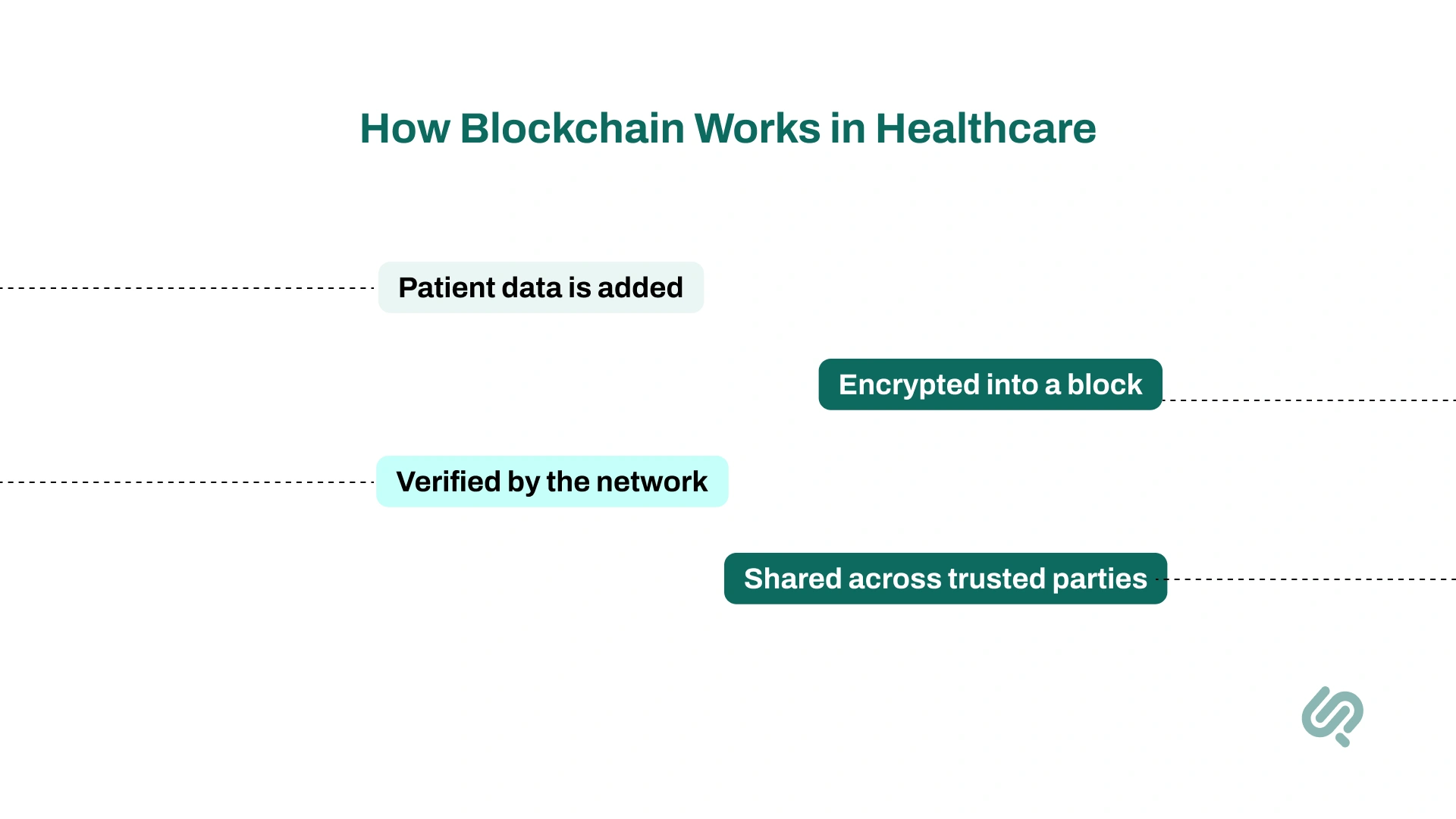
Blockchain in healthcare works like a shared, tamper-proof record book used by hospitals, clinics, insurers, and regulators.
Instead of each keeping separate databases, everyone accesses a single secure ledger that updates in real time, ensuring accuracy, transparency, and trust.
Here’s how it works in practice:
Compared to traditional hospital databases, blockchain offers:
In short, blockchain builds a trust layer for healthcare, keeping data accurate, private, and verifiable while allowing authorized access when and where it’s needed most.
Blockchain isn’t just a theory; it’s already being applied across multiple areas of the healthcare industry.
From securing patient records to tracking pharmaceuticals, here are the most important blockchain applications in healthcare that are making a real impact.

One of the most important blockchain applications in healthcare is creating a secure and unified system for medical records.
Instead of fragmented files at different hospitals, blockchain connects them under a single patient identity. This ensures continuity of care and builds trust in the accuracy of records.
Key Points:
Managing patient consent is complex today, with multiple forms and unclear access rights.
Blockchain simplifies this by giving patients a secure digital identity to control who sees their data and when. Every access is logged permanently, improving accountability.
Key Points:
Clinical trials require trustworthy data for regulators and researchers.
Blockchain secures trial information from start to finish, preventing manipulation or selective reporting. This builds confidence in results and makes audits easier.
Key Points:

Counterfeit drugs are a global threat, and supply chains are often opaque.
Blockchain creates a transparent, end-to-end record of every medicine’s journey, from production to pharmacy shelves. This protects patients and ensures compliance.
Key Points:
Processing insurance claims is slow and expensive, with high risks of fraud.
Blockchain can automate the entire process using smart contracts, saving time and money for both insurers and healthcare providers.
Key Points:
Wearables and medical devices generate valuable health data, but it needs to be trusted.
Blockchain secures these data streams, ensuring they haven’t been altered, and supports real-time monitoring with automated alerts.
Key Points:
Hospitals spend weeks verifying doctor credentials and licenses. Blockchain speeds this up by storing verified provider identities on a secure ledger.
This reduces fraud and simplifies staff onboarding.
Key Points:
Blockchain can motivate patients to stay engaged with their care.
By using token systems, patients can earn rewards for healthy behaviors or for sharing their data securely in research projects.
Key Points:
While blockchain is still emerging in healthcare, several countries, hospitals, and pharma have already tested it in the real world.
These pilots and live systems are real-world examples of blockchain that show how it moves from theory to practice, and the results are promising.
Estonia is considered a pioneer in blockchain technology in healthcare.
Since 2016, the country has used blockchain to protect electronic health records (EHRs) for its 1.3 million citizens (5)
Every time a record is viewed or updated, the system logs the event on-chain, creating a permanent audit trail. This ensures citizens know their data is safe and has not been altered.
Key Points:
The MediLedger Project in the U.S. is one of the most advanced blockchain pilots in the pharmaceutical sector.
Backed by companies like Pfizer, McKesson, Gilead, and Walmart, it uses a permissioned blockchain to track prescription drugs. This system helps meet regulatory requirements under the U.S. Drug Supply Chain Security Act and reduces the risk of counterfeit drugs.
Key Points:
Hospitals are also testing blockchain on a smaller scale. For example, Toronto’s University Health Network (UHN) worked with IBM to build a patient-controlled health records app.
Patients could grant or revoke access via a mobile app, and every action was recorded on the blockchain. Similarly, Massachusetts General Hospital (MGH) partnered with MediBloc to share imaging and research data securely.
Key Points:
New experiments are moving toward decentralized health wallets. These apps give patients control of credentials like vaccination status, test results, or lab reports, which they can share securely.
During the COVID-19 pandemic, blockchain was tested for vaccine tracking, digital health passports, and test result certification. Consortia like TruMed are now building apps for secure patient data exchange.
Key Points:
Beyond pilots, some projects now provide measurable results.
Estonia’s eHealth system reports near-zero undetected tampering since blockchain was added to log patient record access. The MediLedger consortium proved that returned drugs can be verified end-to-end on-chain, helping meet FDA requirements.
These metrics show that blockchain pilots are moving beyond theory and delivering real value in the healthcare industry.
Blockchain brings real, measurable value to the healthcare industry.
From stronger data protection to cost savings and better patient care, here are the benefits of blockchain in healthcare that matter most.
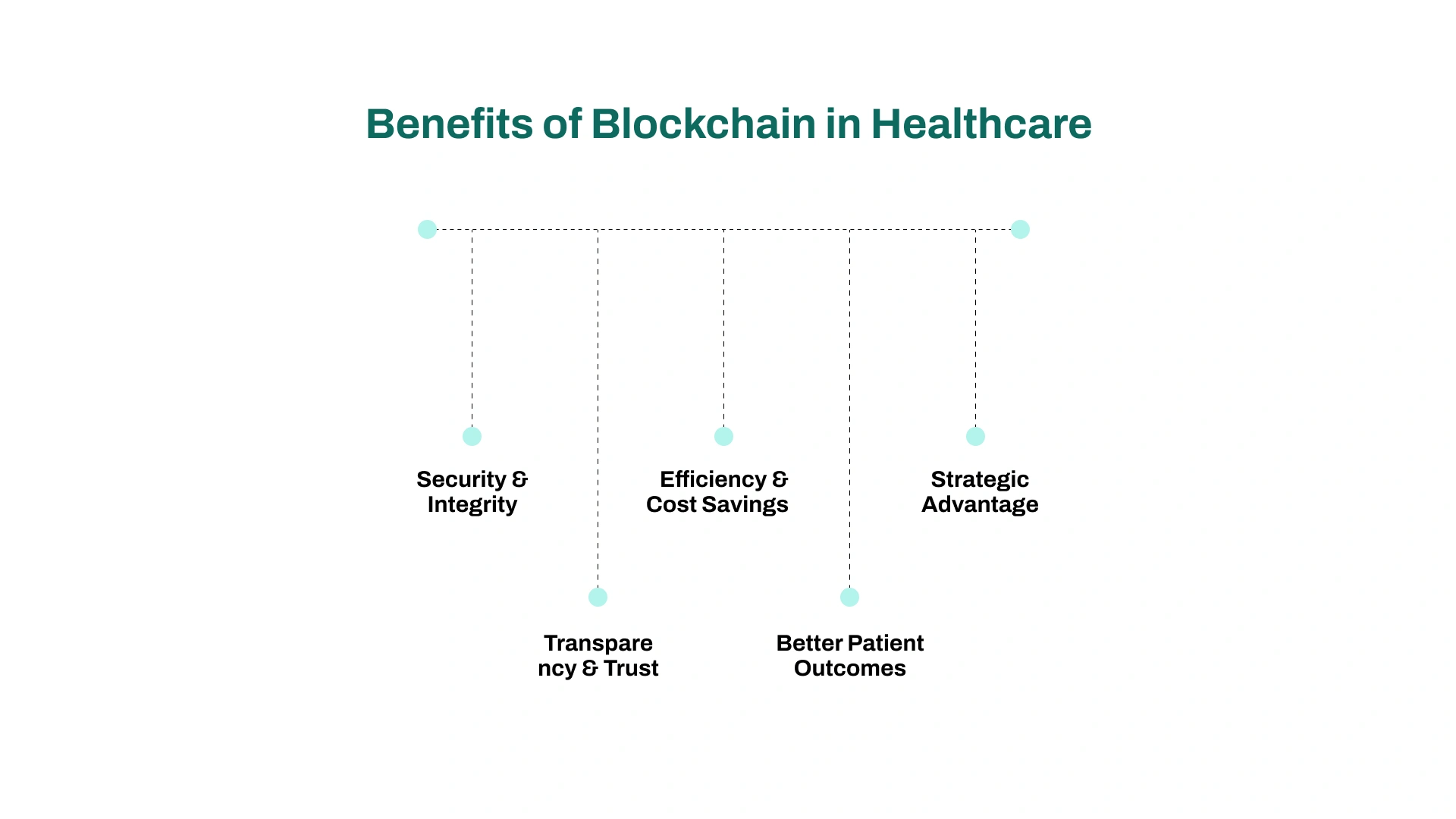
Blockchain Security is one of the biggest benefits of healthcare. Because every update is encrypted, time-stamped, and linked to the previous one, it’s nearly impossible to tamper with records unnoticed. This drastically reduces fraud and makes breaches easier to detect.
Blockchain gives everyone, patients, providers, and insurers, the same reliable view of healthcare data. This transparency builds trust and makes it clear who accessed what, when, and why.
Manual processes like claims verification and medical audits drive up costs. Blockchain’s automation, powered by smart contracts, reduces waste and speeds up routine tasks.
When doctors have access to accurate, up-to-date records, patients receive better care. Blockchain ensures data completeness and helps prevent mistakes caused by missing information.
Early adopters of blockchain in the healthcare industry gain both compliance benefits and a competitive edge. Hospitals, insurers, and governments can position themselves as leaders in secure and patient-centered care.
Healthcare struggles with several long-standing issues, from fragmented patient data to costly administrative overhead.
These challenges not only slow down care but also raise security and trust concerns. Below are the main problems where blockchain can make a clear difference.
Patient information is scattered across hospitals, labs, and insurers, making it difficult for doctors to access a complete health history.
This fragmentation slows down care and creates duplicate records. Blockchain helps unify data under a single, trusted identity.
Cyberattacks on hospitals are rising, and traditional systems can be tampered with.
Blockchain creates an immutable record where every update is securely linked and time-stamped, making unauthorized edits obvious.
The global average cost of a healthcare data breach reached USD 4.45 million in 2023 making it one of the most expensive industries for cyberattacks (2)
Different hospitals often use different systems, making electronic health records (EHRs) hard to exchange.
Blockchain can provide a single source of truth with common standards that improve care coordination.
Billing and insurance claims create delays and high costs. With blockchain, smart contracts can automate verification and payments, cutting out waste and fraud.
The pharma supply chain is global and vulnerable to fake or diverted drugs. Blockchain in supply chain tracks every step, ensuring authenticity and improving drug traceability.
Clinical trial data must be accurate and tamper-free for regulatory approval. Blockchain secures trial results, timestamps every entry, and builds trust in research.

Patients usually have little control over who sees their records. Blockchain introduces self-sovereign identity, where patients control access and permissions.
Implementing blockchain in the healthcare industry requires more than just choosing the right technology; it calls for a step-by-step approach.
From identifying where blockchain adds real value to managing change across organizations, here are the practical steps to get started.
The first step is deciding whether blockchain is really the right tool.
Many healthcare problems can be solved with traditional databases, but blockchain shines when multiple parties need to share information securely and trust each other’s updates.
Think about situations where transparency, auditability, and interoperability are crucial.
Not all healthcare data belongs on the blockchain. Medical images, lab scans, and continuous device telemetry are too large and sensitive.
That’s why most projects use a hybrid model: blockchain records references and permissions, while the heavy files stay in secure databases.
This approach balances privacy, compliance, and scalability.
Choosing the right platform sets the foundation for success.
Healthcare projects usually prefer permissioned networks because they meet compliance needs while still allowing collaboration.
The decision depends on speed, privacy, and governance needs. Often, forming a consortium spreads costs and builds trust among stakeholders.
Without consistent standards, blockchain records are useless across institutions.
Healthcare has established frameworks that should guide integration, making sure every provider interprets data the same way.
Mapping records to formats like HL7 FHIR avoids confusion and enables interoperability between EHR systems.
Blockchain networks work only if everyone agrees on how they are managed. This isn’t just technical, legal, and organizational.
Governance defines who joins, how decisions are made, and how disputes are resolved. Strong governance ensures fairness and keeps one player from dominating the network.
Healthcare is heavily regulated, so privacy cannot be an afterthought.
Blockchain’s immutability can conflict with rules like GDPR’s “right to be forgotten,” so solutions must be designed carefully from the start.
Hybrid models, encryption, and advanced privacy-preserving techniques are key.
Jumping straight to nationwide or multi-hospital systems is risky. It’s smarter to begin with a small pilot, measure results, and refine the solution before scaling.
Early pilots give proof points that help convince more partners to join later.
The success of any blockchain solution depends on people using it, not just the technology. Training, communication, and user-friendly design are essential.
Clinicians, patients, and regulators all need to understand how the system benefits them and how to use it effectively.
Blockchain and AI are powerful on their own, but when combined, they can unlock even greater possibilities in healthcare.
Blockchain ensures data integrity and security, while AI turns that trusted data into meaningful insights and predictions. Together, AI and blockchain in healthcare create smarter, safer, and more transparent healthcare systems.
The future of blockchain in healthcare is moving quickly from small-scale pilots to large-scale adoption.
With growing investments, evolving regulations, and new technologies converging, blockchain is set to transform how medical data, supply chains, and patient interactions are managed.
The future of blockchain in healthcare looks promising. What started as small research pilots is now moving into real-world adoption across hospitals, pharma companies, and government health systems.
As technology matures, blockchain will shift from being an experimental add-on to a core layer of digital healthcare infrastructure, powering everything from secure patient data exchange to transparent clinical trials.
A major trend is the rise of patient data wallets. These let individuals carry cryptographic proofs of their health records, lab results, or vaccinations in a digital wallet and share them selectively.
Some start-ups already provide blockchain-based vaccine passports and mobile health vaults, putting interoperability directly in the patient’s hands.
Government agencies are exploring how blockchain fits into healthcare law. In the U.S., projects funded by the ONC and FDA are studying compliance frameworks.
In Europe, regulators are testing how immutable audit trails can align with privacy rules like GDPR.
At the same time, standards bodies like HL7 are developing specifications (e.g., FHIR for Blockchain) that will make plug-and-play adoption easier.
Future healthcare will be shaped by multiple technologies working together. With 5G and IoT, more medical devices will generate real-time data that blockchains can secure.
Edge computing and AI will add intelligence to this flow, while blockchain ensures data quality and provenance.
Advances in scalability, sharding, and layer-2 solutions will also help handle high data volumes.
Blockchain is transforming healthcare and business alike. Beyond securing patient data, it’s driving transparency, automation, and trust across industries.
From blockchain for business workflows to protecting creators through blockchain in intellectual property, this technology is proving its versatility.
As it merges with AI and IoT, blockchain is evolving into a core layer of digital infrastructure powering secure, intelligent, and transparent systems for the future.


1. https://www.healthcareitnews.com/news/why-ehr-data-interoperability-such-mess-3-charts
2. https://www.ibm.com/think/insights/cost-of-a-data-breach-healthcare-industry
3. https://www.foreseemed.com/blog/clinical-interoperability-in-healthcare
4. https://www.who.int/news-room/fact-sheets/detail/substandard-and-falsified-medical-products
5. https://e-estonia.com/blockchain-healthcare-estonian-experience
6. https://www.mordorintelligence.com/industry-reports/blockchain-market-in-healthcare

Ameena is a content writer with a background in International Relations, blending academic insight with SEO-driven writing experience. She has written extensively in the academic space and contributed blog content for various platforms.
Her interests lie in human rights, conflict resolution, and emerging technologies in global policy. Outside of work, she enjoys reading fiction, exploring AI as a hobby, and learning how digital systems shape society.