


.webp)
.webp)
.webp)









You’re here because you keep hearing about the Agile project management methodology, but what you really want to know is: how does this actually help my projects ship faster with less chaos?
Maybe your current process is stuck in long timelines, surprise scope changes, and endless status meetings that don’t move work forward.
Agile promises speed, flexibility, and collaboration, but most explanations are either too theoretical or too tool-focused to help you do anything different on Monday morning.
This guide breaks down the Agile project management methodology in plain language.
What it is, how it works in sprints, where Scrum and Kanban fit in, and how to use it on real projects (not just in textbooks).
You’ll see concrete examples from software, marketing, and enterprise teams, along with step-by-step guidance you can apply to your own roadmap, backlog, and delivery process.
The agile project management methodology definition is as follows:
‘A flexible, iterative approach that breaks work into small, time-boxed cycles called sprints, rather than following a single, linear plan.’
Each sprint includes planning, execution, and review, enabling teams to deliver progress frequently and respond quickly to change.
Instead of delivering everything at once, Agile teams release work in incremental steps. They prioritize a dynamic backlog of customer-driven tasks, completing high-value items first.
Regular reviews at the end of each sprint help teams adjust based on real-time feedback, leading to faster and more relevant results.
The Agile lifecycle follows a repeatable cycle that enables teams to plan, build, review, and improve their work continuously.
This approach supports early and continuous delivery, encourages customer collaboration, and keeps Agile projects aligned with changing needs. Here’s how a typical Agile sprint unfolds:
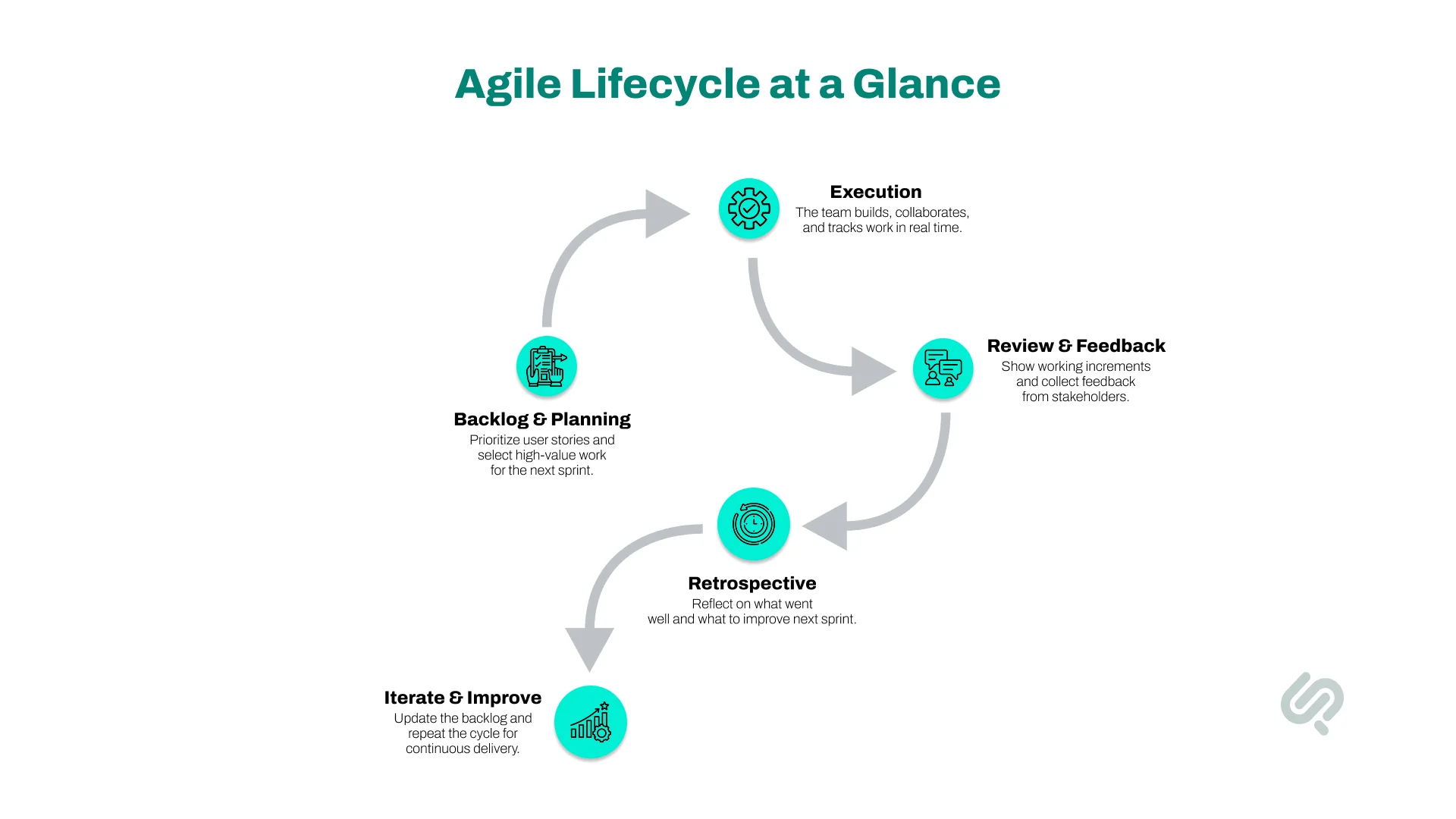
The process begins with a product backlog, a prioritized list of user stories, features, or tasks. During sprint planning, the project team selects the highest-priority items they believe they can complete in the next sprint, based on capacity and business value.
Once planning is complete, the team begins the sprint. This is the execution phase, where developers, designers, and other team members work on assigned tasks.
At the end of the sprint, the team delivers a potentially usable or “shippable” product increment, whether that’s a feature, improvement, or fix.
After the review, the team holds a retrospective to reflect on how the sprint went.
These honest conversations drive continuous improvement and help the team refine both their process and collaboration practices.
The Agile lifecycle follows a repeating loop: plan → do → review → improve. With each sprint, teams refine their process, deliver more value, and respond to evolving customer needs.
This iterative development model enables agility, especially in software development projects or other complex projects with shifting scopes.
Throughout this lifecycle, Agile supports:
The Agile Manifesto is the foundation of the Agile project management methodology. It outlines four core values and twelve guiding principles that shape how Agile teams plan, collaborate, and deliver work.
These values encourage teams to stay flexible, customer-focused, and continuously improving, especially in fast-changing environments like software development or other complex projects.
Agile is built on four simple but powerful values:
These values guide project managers, scrum teams, and stakeholders to focus on delivering value rather than sticking to outdated plans or bureaucratic processes.
Beyond the values, the Agile Manifesto includes 12 Agile principles that support better project outcomes. These 12 principles are:
Together, these principles create a culture of iterative development, collaboration, and ongoing learning that aligns with the broader goals of project success and customer satisfaction.
When comparing the Agile project management methodology to traditional approaches like Waterfall, the differences in mindset, process, and outcomes are significant.
Each method has its strengths, but Agile is becoming the preferred choice for modern, fast-moving teams.
The Waterfall model is a linear project management software approach where all project stages, such as planning, design, development, testing, and deployment, are mapped out from the beginning.
Each phase must be completed before moving to the next, with minimal flexibility for change.
In contrast, Agile project management embraces change and uncertainty. Work is delivered in small, iterative cycles (called sprints), allowing software teams and other cross-functional teams to test assumptions, gather customer feedback, and pivot as needed.
Start with a clear vision for your project. In one or two sentences, write what you want to achieve and who it’s for. Then turn that vision into a few measurable outcomes (e.g., “launch MVP in 3 months,” “reduce support tickets by 20%”).
Next, decide who will be part of your Agile team: Product Owner, Scrum Master or Agile lead, and the core delivery team (developers, designers, QA, marketers, etc.).
This gives you a simple agile project management methodology overview: clear vision, clear outcomes, clear team.
Now choose how your team will actually work day to day. Most teams start with Scrum or Kanban.
If you want time-boxed sprints with defined roles and ceremonies, pick Scrum — this is the classic agile Scrum project management methodology.
If you prefer continuous flow without fixed sprints, Kanban is simpler: you just move tasks across a board (To Do → In Progress → Done). Either way, you’re picking the project management methodology that fits your team’s style.
List everything you might need to build in a product backlog: features, fixes, improvements, and content. Write them as simple user stories and sort them by priority.
Then set up a basic Agile board in your tool of choice (Jira, Trello, Asana, ClickUp, etc.) with columns like To Do, In Progress, In Review, Done. Together, your backlog, team, and board form a simple agile project management methodology diagram in practice: ideas flow from backlog → board → done, in a way everyone can see.
Choose a sprint length (2 weeks is a good start) and pick a realistic set of backlog items to complete in that time. Agree on a clear sprint goal, so everyone knows what “success” looks like at the end.
During the sprint, hold quick daily check-ins (stand-ups) where each person shares what they did, what they’ll do next, and what’s blocking them.
At the end, demo the work to stakeholders. This is your first real agile project management methodology example: you planned a small slice, built it, showed it, and got feedback.
After the sprint demo, run a short retrospective with the team. Ask three simple questions: What worked well? What didn’t work well? What should we change next sprint?
Pick one or two improvements and actually apply them in the next sprint (shorter stand-ups, clearer stories, smaller tasks, etc.). This inspect-and-adapt loop is where the agile project management methodology really shines: you’re not just improving the product, you’re improving how you work.
Once one team is comfortable, you can bring more teams into Agile gradually. Let new teams reuse the same basic patterns: vision, backlog, board, sprints, review, retro.
Introduce light cross-team syncs and a shared roadmap so everyone sees how their work connects. Over time, your organization moves from “one Agile team” to “many Agile teams” using a shared project management methodology, but each team still keeps enough freedom to adapt Agile to how they work best.
There are several well-known Agile frameworks and agile methods that teams can choose from based on their project type, team size, and workflow.
Below are some of the most widely used methodologies in the world of agile project management.

Scrum is by far the most popular Agile framework, used by around 87% of Agile teams (1).
It’s built around fixed-length development cycles known as sprints, typically lasting 1 to 4 weeks. Each sprint follows a set rhythm and includes:
Key roles in Scrum include the Product Owner (who manages the product backlog), the Scrum Master (who facilitates the process), and a cross-functional development team. Scrum helps teams stay focused, organized, and adaptable in delivering working software quickly.

Kanban is another popular Agile method, used by about 56% of Agile teams. It’s all about visualizing work and improving flow.
Teams use a Kanban board with columns like To Do, In Progress, and Done to manage tasks. Unlike Scrum, Kanban doesn’t use time-boxed sprints; instead, work moves through the board continuously.
Kanban also introduces work-in-progress (WIP) limits, which prevent teams from taking on too much at once. This leads to smoother workflows and faster turnaround, especially for teams handling ongoing or unpredictable tasks.
Lean originates from Toyota’s manufacturing process and emphasizes eliminating waste, improving flow, and delivering only what’s necessary. In Agile, Lean promotes efficient development through simplicity, fast decision-making, and minimal overhead.
Extreme Programming (XP) is a software-focused Agile method that enhances code quality through practices like:
XP is ideal for teams that need technical excellence and fast feedback in high-change environments like software development projects.
Agile is flexible, and teams often adapt it to suit their needs. Other Agile methodologies include:
Many organizations also use hybrid models, blending Agile frameworks with traditional project management methods to support both flexibility and structure, especially in complex projects or regulated industries.
Adopting the Agile project management methodology offers a wide range of benefits that directly impact team performance, customer satisfaction, and overall project success.
Backed by real-world data, here’s how Agile delivers results:
Agile’s flexibility allows teams to adapt quickly and stay aligned with evolving user needs. This adaptability contributes to better outcomes across industries:
By focusing on working solutions, quick feedback loops, and iterative development, Agile reduces the risk of misaligned goals and poor user experiences.
Agile supports early and continuous delivery by breaking work into short, focused cycles. This structure enables teams to ship features faster and react to change with confidence.
This speed is especially critical in software development projects, where agility can mean the difference between market leadership and missed opportunity.
Staying on budget is a major challenge in traditional project environments. Agile helps manage costs more effectively through ongoing planning and scope control.
This benefit is especially useful in complex projects where traditional methods often fall short.
Agile promotes frequent communication, shared ownership, and cross-functional teamwork. These principles not only improve collaboration but also boost team motivation and trust.
Involving stakeholders throughout the process also enhances alignment, accountability, and shared success.

Whether you're managing a small Agile team or running multiple projects across departments, there are tools tailored to every workflow.
There are many online Agile project management software options available to support different team needs:
These tools help Agile teams follow the Agile method more consistently while improving visibility and collaboration across the project team.
Not every tool is built the same. According to industry data, 40% of project managers select software based on core Agile model features like task boards, sprint metrics, and status tracking.
Here’s what to consider:
A good Agile tools setup should match your development process, reduce friction, and improve project execution at every stage.
Large organizations often juggle dozens of Agile initiatives at once. That’s where Agile project portfolio management software comes in.
Tools like Jira Advanced Roadmaps, Planview, and VersionOne (Digital.ai) allow teams to:
These solutions are ideal for enterprise-level project managers looking to manage complexity across multiple agile projects while maintaining visibility into portfolio-wide performance.
Some teams use lean and Agile project management software that blends different approaches. Tools like Kanbanize and LeanKit combine Kanban board simplicity with lean principles to improve flow and eliminate waste.
Traditional platforms like Microsoft Project have also evolved.
Many now offer Agile features like sprint planning modules and hybrid workflow support, allowing teams to combine linear project management software Agile features with more modern practices.
Agile project management isn’t limited to software development. It’s used across industries and team types.
Below are a few agile examples that show how it works in different real-world scenarios:
Imagine a startup building a mobile app. The development team uses Scrum, one of the most popular Agile frameworks. Here’s how it works:
Over time, this iterative development approach results in faster releases, better alignment with user needs, and higher customer satisfaction.
Agile isn’t just for IT. A marketing team planning a content campaign can also use Agile methods, specifically Kanban, to manage their work.
This setup helps the team respond quickly to changes, avoid overload, and ensure timely, targeted content delivery, hallmarks of a successful Agile project.
Larger organizations often apply Agile project management practices to digital transformation efforts. For example:
This method helps reduce risk, improve usability, and deliver results faster—far more efficiently than traditional project management methods.
A retail company needed a modern inventory system to replace scattered spreadsheets. Phaedra Solutions used Scrum to apply the Agile methodology project management approach in small, predictable cycles.
We translated the project goals into a clear backlog of user needs, such as:
Then, we worked in short two-week sprints to deliver the most valuable features first.
Throughout each sprint, designers, developers, and QA collaborated closely, following simple agile project management methodology steps: plan the sprint, build the feature, test it, demo it, and then refine the backlog based on feedback.
At the end of each sprint, the client reviewed working features, shared insights, and adjusted priorities. This flexibility is the biggest difference in the agile vs Waterfall comparison, Agile lets the product evolve as the client learns more, instead of locking everything up front.
This approach resulted in a clean, easy-to-use inventory system tailored to real business needs.
Full Case Study Here: Inventory Management Software Case Study – Phaedra Solutions
A growing company wanted to improve its customer support workflows without going through a long, disruptive rebuild. Instead of a big, rigid overhaul, the team used a simple Agile project management methodology to make steady improvements.
They created a backlog of internal enhancements, better ticket routing, clearer response templates, faster approval steps, and new dashboard ideas—and used a Kanban-style board to visualize progress.
Work moved continuously from To Do → In Progress → Done, allowing the team to focus on finishing small pieces that made an immediate difference.
Every week, the team reviewed what changed, gathered feedback from support agents, and updated priorities. This lightweight, iterative approach helped them solve problems faster, reduce delays, and create smoother internal workflows.
It’s a clear example of how Agile methodology project management isn’t just for software. Small, continuous steps can transform everyday operations more effectively than a traditional, all-at-once process.
Many teams struggle with Agile implementation. Not because Agile itself is flawed, but because it’s often misunderstood or applied inconsistently.
Below are common challenges that can derail Agile projects, especially when Agile Values and Agile Methods are overlooked.
One of the most common issues is “doing Agile” without being Agile. Teams might hold Scrum meetings or use popular Agile Tools like JIRA, but fail to adopt the core Agile Values such as trust, collaboration, and continuous improvement.
Successful Agile transformation requires support from the top. Yet, 62% of executives admit Agile “has no implications” for them, and 32% lack top-management support (Runn.io).
While iterative development allows teams to adapt quickly, some worry that Agile doesn’t provide enough room for long-term architecture or strategic planning.
Agile promotes lighter documentation and regular meetings like stand-ups, retrospectives, and sprint planning sessions. However:
Applying Agile at scale is a whole different challenge. Large organizations often struggle with:
Frameworks like SAFe (Scaled Agile Framework), Disciplined Agile Delivery, or even custom Agile Frameworks can help—but without strategic alignment and proper tooling, scaling efforts often stall.
As organizations grow, applying the Agile project management methodology across multiple teams, departments, or products becomes more complex.
This is where Agile at scale comes in, helping companies maintain speed, alignment, and flexibility even in large, multi-team environments.
To coordinate many Agile teams working on large or interconnected solutions, companies often adopt structured Agile frameworks designed specifically for scale, such as:
These frameworks create additional layers of planning and collaboration so work remains synchronized.
Team-level sprints roll up into larger program increments, which then align with portfolio-level roadmaps. This ensures visibility across all levels of the organization, from individual developers to executive leadership.
Agile portfolio management ensures that multiple Agile projects stay aligned with business goals. Organizations use roadmapping tools, quarterly planning events, and cross-team coordination to prioritize work based on strategic value.
For example, an executive steering committee might review Agile project roadmaps every quarter to:
This creates a balance between long-term strategy and Agile’s short-term adaptability.
At scale, strong metrics are essential. Teams use data-driven insights to maintain alignment, track progress, and manage risk. Common scaling metrics include:
Enterprise dashboards aggregate sprint data from multiple teams, giving leadership real-time visibility into delivery trends, potential bottlenecks, and forecasted outcomes, without compromising Agile’s adaptability.
Modern Agile Tools now include advanced modules designed for large organizations. These tools help unify strategy, execution, reporting, and team collaboration.
Popular enterprise-level solutions include:
These platforms help organizations manage dependencies, track portfolio-wide progress, and coordinate work across hundreds or even thousands of team members.
The Agile project management methodology has transformed the way modern teams plan, build, and deliver projects.
By emphasizing collaboration, flexibility, and continuous improvement, Agile empowers organizations to adapt quickly, align with customer needs, and reduce the risks associated with rigid, traditional project management methods.
Whether you're using Scrum, Kanban, Lean, or a hybrid approach, Agile provides a framework that supports iterative development, frequent feedback, and a focus on high-value work.
From small teams to enterprise-level operations, Agile offers a proven path to project success, backed by real-world results like faster delivery, higher customer satisfaction, and stronger cross-team collaboration.
As organizations scale and the demand for speed and innovation grows, understanding and applying Agile principles becomes essential.



Ameena is a content writer with a background in International Relations, blending academic insight with SEO-driven writing experience. She has written extensively in the academic space and contributed blog content for various platforms.
Her interests lie in human rights, conflict resolution, and emerging technologies in global policy. Outside of work, she enjoys reading fiction, exploring AI as a hobby, and learning how digital systems shape society.