






.webp)






.webp)
As AI rises to popularity, two different but equally powerful technologies are grabbing most of the attention among the many types of AI: Generative AI and Predictive AI.
Such is their popularity that one of the hottest debates in the AI world today is: Is generative AI better or is predictive AI better?
Being the proud winners of multiple AI awards, we decided to weigh in on this discussion and give our views regarding generative AI vs predictive AI.
Both rely on machine learning and vast datasets, yet their purposes are fundamentally different. Generative AI is designed to create brand-new content, whether it's text, images, audio, or code-based on learned patterns.
In contrast, the predictive AI definition centers around using past and real-time data to forecast future trends, behaviors, or events.
The impact of both is also immense. For example, over 65% of businesses are not using generative AI regularly. At the same time, predictive AI is also powering billions of decisions daily.
In this article, we’ll break down what is generative AI vs predictive AI, the key concepts behind generative AI vs predictive AI, explore the core characteristics and real-world use cases of each, and clarify the major differences between the two.
Generative AI refers to artificial intelligence systems that can create new content, such as text, images, videos, music, or even software code, based on patterns learned from existing data.
Unlike traditional rule-based AI, generative models are trained to mimic and remix what they’ve seen, producing entirely original outputs in response to a prompt.
Think of it as a digital creator: instead of pulling from a fixed database, it generates fresh results like an artist painting from imagination or a writer drafting a new story.
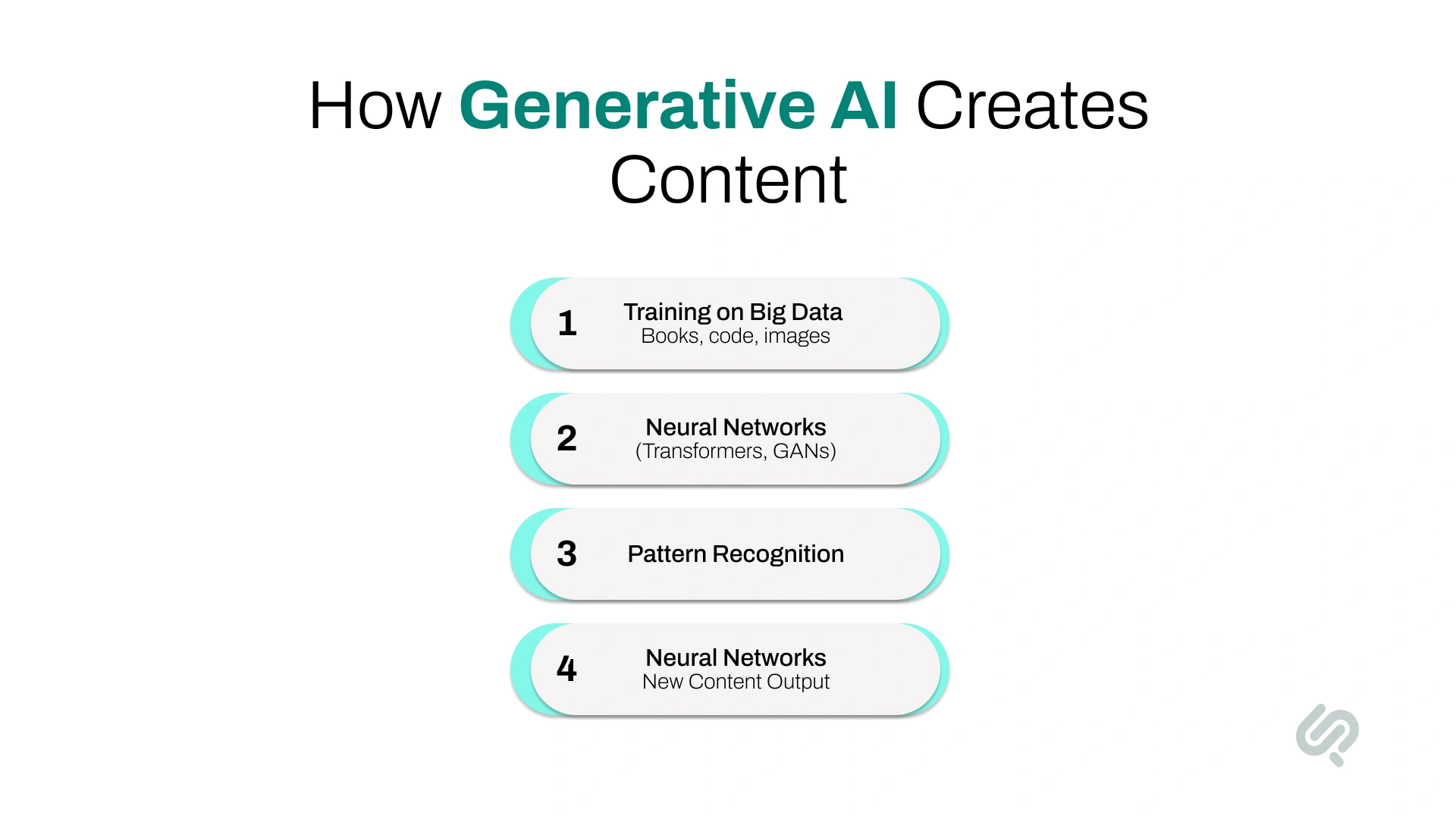
Most generative AI models are powered by deep learning and trained on massive datasets (sometimes billions of samples). Here's how they typically work:
(A) Massive Training Data
Models learn from enormous datasets, like all of Wikipedia, open-source code, or millions of images, to recognize patterns in language, visuals, sound, or behavior.
(B) Neural Network Architecture
At the core are deep learning neural networks, especially transformer models like GPT-4, which are designed to understand context and relationships in sequential data.
(C) Sequence Prediction
These models generate content one step at a time, for instance, predicting the next word in a sentence or the next pixel in an image, until a full output is formed.
(D) Transformer Models
The backbone of tools like ChatGPT and Bard, transformers use self-attention mechanisms to process large chunks of input data efficiently.
(E) Generative Adversarial Networks (GANs)
Used mainly for image generation, GANs consist of two networks (a generator and a discriminator) that compete with each other to produce increasingly realistic visuals.
(F) Diffusion Models
Now state-of-the-art in visual generation, diffusion models (used by Midjourney and DALL·E 3) start with noise and gradually refine it into high-quality images based on a text prompt.
(G) Variational Autoencoders (VAEs)
These models compress data into a latent space and then sample from it to generate new but similar content. Ideal for tasks like music or handwriting generation.
Generative AI systems have unique traits that set them apart from other AI models, especially predictive systems.
These features define how generative models learn, behave, and create value across industries.
Generative AI models like GPT-4 are trained on massive datasets, often hundreds of billions of words, images, or other content formats.
This vast exposure enables them to generate human-like text or photorealistic visuals. Compared to predictive AI, which can often work with smaller, domain-specific datasets, generative AI demands massive, diverse inputs to perform well.
The core strength of generative AI is its ability to output original content based on patterns it has learned, not simply regurgitate or analyze existing data.
For example, given a prompt like “Design a futuristic vehicle,” a generative model can produce an entirely new image that never existed before.
In the LLM vs generative AI discussion, it's important to understand that large language models (LLMs) like GPT-4 are a subset of generative AI, but not all generative models are language-based.
This adaptability has made generative AI tools widely adopted across industries; 92% of Fortune 500 companies are experimenting with gen AI tools, particularly via OpenAI’s platforms.
Despite their capabilities, generative AI systems are notoriously difficult to interpret. With billions of parameters and nonlinear decision processes, it’s hard to trace why a specific output was generated.
For example, if an AI model “hallucinates” false facts in a generated article, we often can’t pinpoint the cause. This is a major concern in high-stakes domains like law or medicine.
Let’s explore generative AI vs predictive AI examples across industries and examples of how they are used.
These are some of the use cases of generative AI,
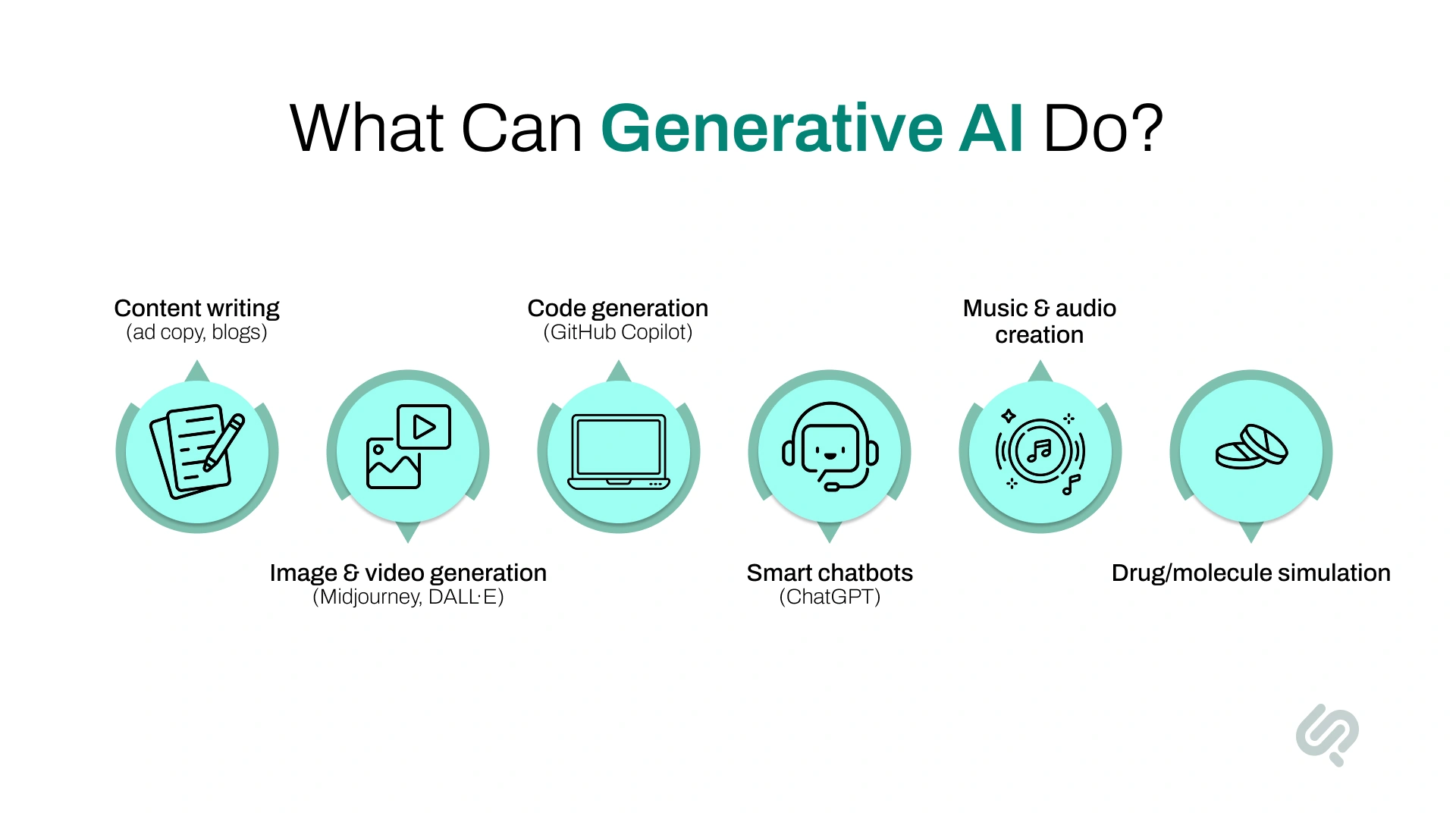
Generative AI Tools like ChatGPT and GPT-4 help marketers, writers, and developers generate high-quality written content in seconds.
Example: Marketing departments now use generative AI for tasks like writing ad copy, blogs, and product descriptions.
Tools like DALL·E 3, Midjourney, and Stable Diffusion convert simple text prompts into stunning images or videos.
Example: Game studios and advertisers use generative AI to quickly prototype visual assets, saving time and budget.
Platforms like GitHub Copilot assist developers by auto-completing or generating code from plain language instructions.
Example: Developers using AI coding tools complete tasks up to 55% faster (1).
In the debate of conversational AI vs generative AI, it's worth noting that while many conversational agents are powered by generative models, not all generative AI is used for real-time conversations.
LLM-powered chatbots, unlike traditional scripted bots, can understand context and respond naturally.
Example: Meta’s LLaMA-based assistants provide dynamic, intelligent answers across various industries.
In finance and healthcare, where real data may be scarce or sensitive, generative AI models simulate synthetic datasets.
Example: JPMorgan uses synthetic financial scenarios to stress-test algorithms without exposing real customer info.
Researchers use generative AI to propose candidate molecules for drug development.
Example: Gen AI has helped design entirely new compounds, shrinking discovery timelines by months.
Generative models can produce music, screenplays, voiceovers, and even deepfake content.
Example: Musicians and content creators use tools like Suno and AIVA to compose original tracks in minutes.
Generative AI offers transformative advantages across industries by enabling machines to create content, ideas, and solutions with minimal human input.
From boosting productivity to accelerating innovation, its benefits are reshaping how businesses operate and compete.
Generative AI can produce text, images, code, and designs in seconds, streamlining workflows for marketers, developers, and creators.
It enables hyper-personalized content at scale, like tailored product recommendations, emails, or ad creatives, boosting engagement and conversions.
Generative tools support brainstorming by offering novel ideas, designs, or approaches that humans might not consider.
By automating creative tasks, businesses can reduce production costs for writing, design, or customer support content.
Generative AI lowers barriers for individuals or small teams to create professional-quality content without expert skills.
While generative AI opens new creative frontiers, it also introduces a set of ethical, legal, and technical challenges.
Understanding these risks is crucial for responsible adoption and long-term trust in AI-driven systems.

Models like GPT can generate plausible but incorrect or misleading content, which is risky in domains like healthcare or news.
Generative models may unintentionally reproduce or remix copyrighted material from their training data, raising legal and ethical issues.
If the training data contains societal biases, AI outputs may reflect or even amplify them, leading to unfair or harmful content.
AI-generated media can be weaponized for scams or misinformation (e.g., deepfakes), posing security threats and undermining trust.
Generative AI outputs can be unpredictable, and it’s often difficult to trace how or why a specific output was generated.
Predictive AI is a branch of artificial intelligence focused on analyzing existing data to forecast future outcomes or classify events.
Unlike generative AI, which creates new content, predictive AI identifies patterns in historical or real-time data and projects what’s likely to happen next.
Think of it as your data-powered analyst, whether it’s forecasting demand, detecting fraud, or anticipating customer behavior, predictive AI brings data-driven foresight to the table.
At its core, predictive AI uses machine learning and statistical models to turn past data into future insights.
A predictive language model like those used in spam filtering or email categorization analyzes sentence patterns to forecast likely next words or classification outcomes.
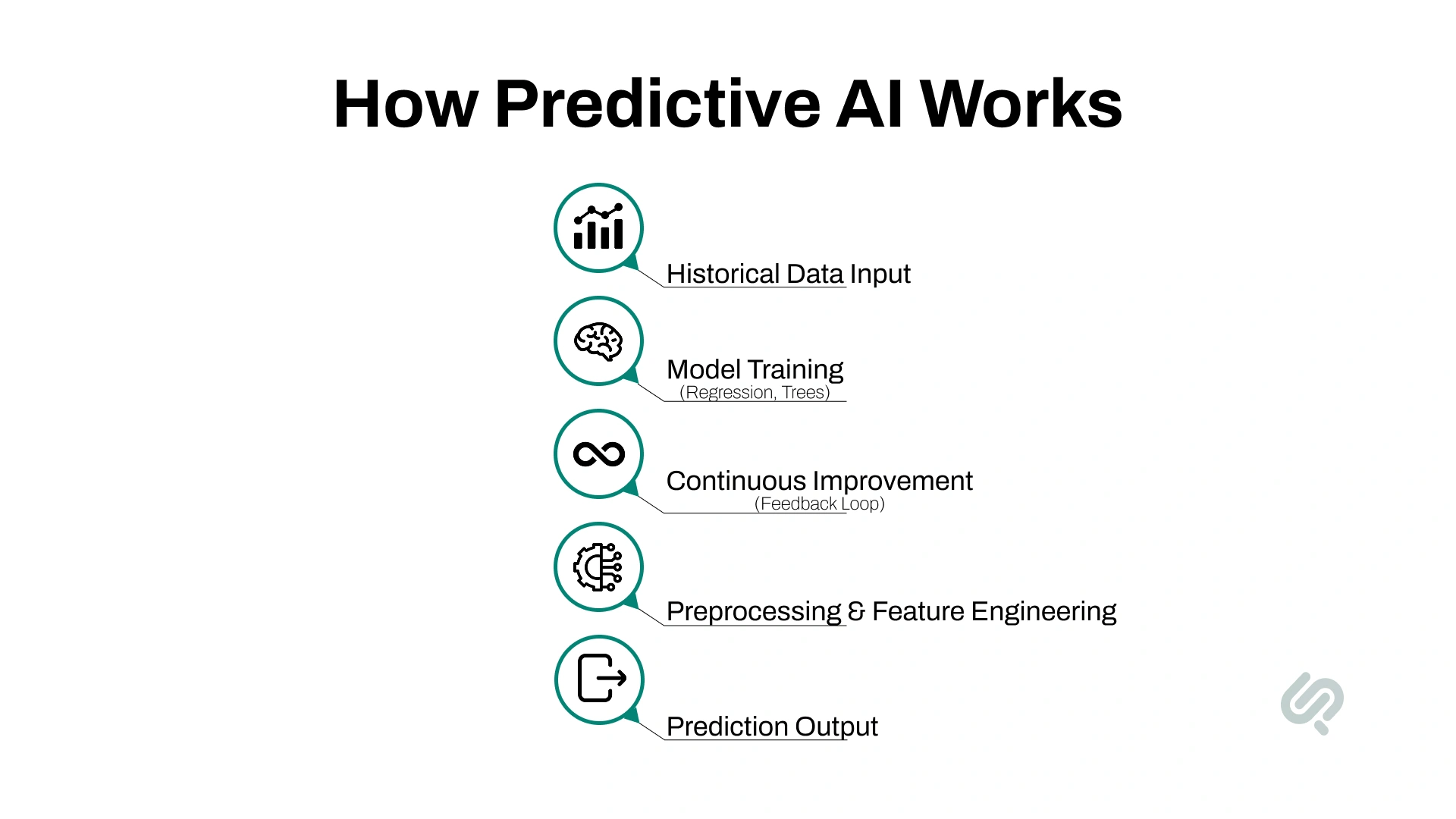
Here’s how the process generally works:
(A) Input Historical Data
Predictive AI starts by ingesting relevant past data, like customer purchase history, sales records, or website clicks. This data must be labeled (with known outcomes) for supervised learning.
(B) Preprocessing and Feature Engineering
Data scientists clean, structure, and transform raw data into a usable format. This may include selecting the most important variables (features) and handling missing or noisy entries.
(C) Model Training
The system is trained using algorithms that learn correlations between inputs and outcomes. Common techniques include:
(D) Making Predictions
Once trained, the model can take new inputs and output predictions — such as the likelihood of churn, a future sales figure, or whether an email is spam.
(E) Continuous Learning
Many predictive models improve over time by retraining with fresh data. This keeps the system relevant as conditions evolve (e.g., market shifts or customer behavior changes).
5 key features of predictive AI are:
Predictive AI relies on structured historical datasets, such as transaction logs or sensor data, and may include real-time inputs for more dynamic applications (like live fraud detection or traffic forecasts). Data quality is essential: accurate predictions start with clean, relevant data.
Predictive models provide answers, not content. These could be:
This output supports decisions, from who to target in a marketing campaign to when to restock inventory.
Predictions come with confidence levels. A system might say there’s a 72% chance a user will unsubscribe, not a guarantee, but a strong signal.
These probability scores help businesses prioritize action and manage risk more effectively.
With access to more data and outcomes, predictive AI continuously improves. Feedback loops (e.g., tracking actual customer churn) allow models to recalibrate and boost accuracy over time.
Compared to generative models, predictive AI tends to be easier to interpret. Especially in models like logistic regression or decision trees, it’s possible to trace how input variables influenced the prediction.
This makes predictive AI better suited to industries like finance or healthcare, where explainability is critical.
Predictive AI is the engine behind many business-critical decisions today. From anticipating market shifts to preventing equipment failure, it enables data-driven strategies that reduce risk and improve efficiency.
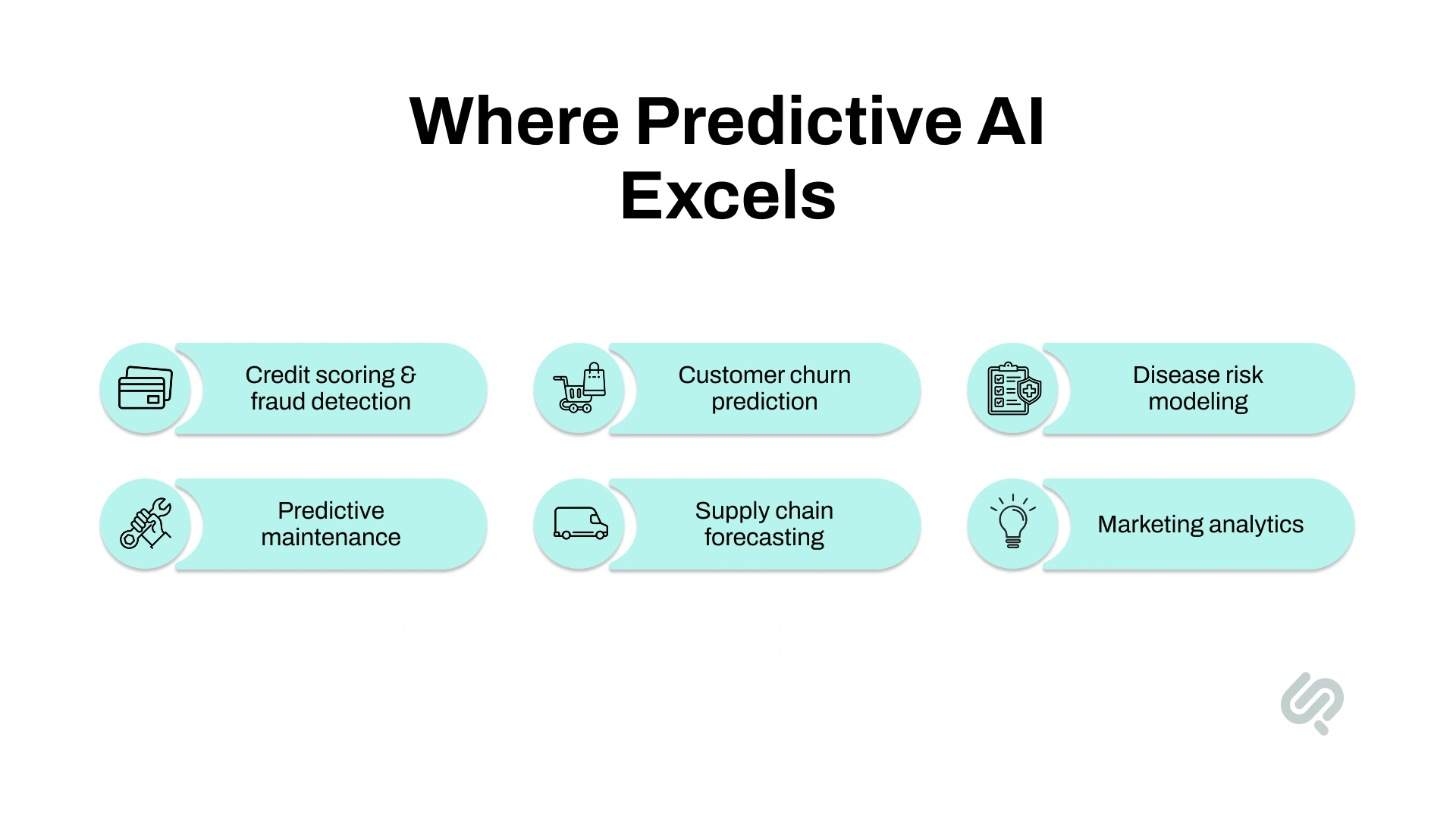
Here are the most impactful applications of predictive AI across industries:
Retailers and manufacturers use predictive AI to forecast product demand based on historical sales and external factors like weather or seasonality.
Everyday tools like autocomplete or predictive text in messaging apps are powered by predictive AI, which analyzes previous input to suggest the next likely word or phrase.
Banks use predictive AI for credit scoring, fraud detection, and financial forecasting.
Some companies are now exploring predictive maintenance using generative AI, simulating equipment behavior under future conditions for proactive planning.
Predictive AI is transforming early detection and personalized medicine.
From delivery timing to fuel efficiency, predictive AI reshapes global logistics.
Predictive AI safeguards IT infrastructure by spotting anomalies before they cause problems.

Predictive AI empowers businesses to make smarter, data-driven decisions by analyzing historical and real-time data.
Its ability to forecast outcomes enhances operational efficiency, reduces risks, and improves strategic planning across industries.
Predictive AI enables highly accurate forecasting in areas like sales, demand, and inventory management, helping organizations plan proactively.
By analyzing behavior patterns, predictive models can anticipate customer needs, personalize offerings, and reduce churn.
It identifies high-risk scenarios (e.g., loan defaults, equipment failures, or fraud) before they escalate, allowing for timely intervention.
Predictive systems streamline processes such as staffing, inventory stocking, and maintenance scheduling, reducing waste and saving time.
These models improve over time with new data, leading to increasingly accurate and optimized decisions.

Despite its powerful advantages, predictive AI comes with challenges that must be addressed to ensure ethical, accurate, and unbiased use.
Organizations must be aware of these risks to maintain accountability and fairness in AI-driven outcomes.
If training data is biased or unbalanced, predictions may reinforce existing inequalities, especially in lending, hiring, or policing.
Heavy dependence on predictive systems can reduce human oversight and lead to blind trust in incorrect or outdated predictions.
Using sensitive historical data (like health or financial records) raises concerns around data privacy, especially under strict regulations like GDPR or HIPAA.
Complex models such as neural networks may lack transparency, making it difficult to explain or justify predictions in regulated environments.
Users may wrongly interpret probabilistic outputs (e.g., “70% chance of churn”) as certainties, leading to misguided business decisions.
When comparing generative AI vs predictive AI differences, the biggest distinction lies in purpose: one creates, the other forecasts.
While both rely on advanced machine learning and neural networks, they solve very different problems, and choosing the right one depends on your business goals.
To illustrate the distinctions, we’ve also included a generative AI vs predictive AI diagram summarizing the key differences
While generative AI focuses on creation, the opposite of generative AI is predictive AI, which aims to analyze and forecast rather than generate new data.
Even though both may use neural networks, predictive models offer decision support, while generative models produce content.
Predictive AI is ideal where factual precision is critical (finance, healthcare), while generative AI thrives in design and ideation.
In short, generative AI mimics human-like creativity; predictive AI delivers data-driven decisions.
In regulated industries, predictive AI models are preferred for compliance and auditability.
In an e-commerce company:
Together, they optimize the customer journey. Predictive AI decides what to show, and generative AI decides how it’s shown.
At Phaedra Solutions, we’re proud to be recognized as an award-winning AI agency, having earned accolades for innovation and impact across multiple industries.
Backed by a team of 25+ seasoned AI professionals, we've successfully delivered over 200 AI-driven projects in the past year, ranging from enterprise-grade applications to custom AI integrations.
Our experience spans diverse domains like healthcare, finance, retail, and manufacturing, empowering organizations to scale with precision and creativity.
Our AI expert, Hammad Maqbool, had this to say when asked about the ‘Generative AI vs Predictive AI’ debate:
“Generative and predictive AI both bring immense value, but generative AI is accelerating innovation faster. Its ability to create and simulate in real time gives businesses a competitive edge that predictive models alone can’t match.”
So, for those wondering which of these they should prioritize at the start, it’s generative AI.
Generative AI and predictive AI are not competing forces. They’re complementary pillars of modern artificial intelligence.
Generative AI shines in creativity, generating fresh content, ideas, and simulations. Predictive AI excels in foresight, uncovering patterns in data to forecast outcomes and guide smarter decisions.
Forward-thinking enterprises are also applying generative AI for predictive analytics, blending simulation with forecasting to stress-test future scenarios.
Understanding the difference between generative AI and predictive AI is critical for applying the right tool to the right task.
Whether you're building a recommendation engine, drafting marketing content, or optimizing operations, these AI types unlock distinct value.
Looking ahead, the future of AI lies in synergy. As AI systems evolve, we’ll see more integrated solutions, using predictive models to analyze trends and generative models to act on them.
Businesses that utilize both will be better equipped to anticipate change and creatively respond to it.



Ameena is a content writer with a background in International Relations, blending academic insight with SEO-driven writing experience. She has written extensively in the academic space and contributed blog content for various platforms.
Her interests lie in human rights, conflict resolution, and emerging technologies in global policy. Outside of work, she enjoys reading fiction, exploring AI as a hobby, and learning how digital systems shape society.