

.webp)


.webp)
.webp)
.webp)







Offshore software development means hiring a software team in another country to build, maintain, or scale your product. Companies use it to access skilled talent faster, control delivery costs, and expand engineering capacity without growing local headcount.
A strong offshore software development company like Cleveroad or Phaedra Solutions can help you ship faster, fill skill gaps, and build with more flexibility. A weak one can create delays, rework, security concerns, and long-term technical debt.
This guide explains what offshore software development is, how it compares with nearshore and onshore models, when it makes sense, and how to choose an offshore development partner without taking unnecessary risk.
It provides remote software delivery from another country, often covering development, QA, DevOps, maintenance, and team scaling so your business can build faster without expanding local headcount.
To access talent faster, scale delivery capacity, reduce hiring pressure, and improve cost efficiency.
No. The bigger value is often speed, flexibility, and access to specialized skills.
When your goals, ownership, communication process, and quality standards are clear.
Weak QA, vague pricing, poor communication, unclear IP terms, and vendors that overpromise.
Begin with a paid discovery sprint, pilot, or clearly scoped first phase before a long-term engagement.
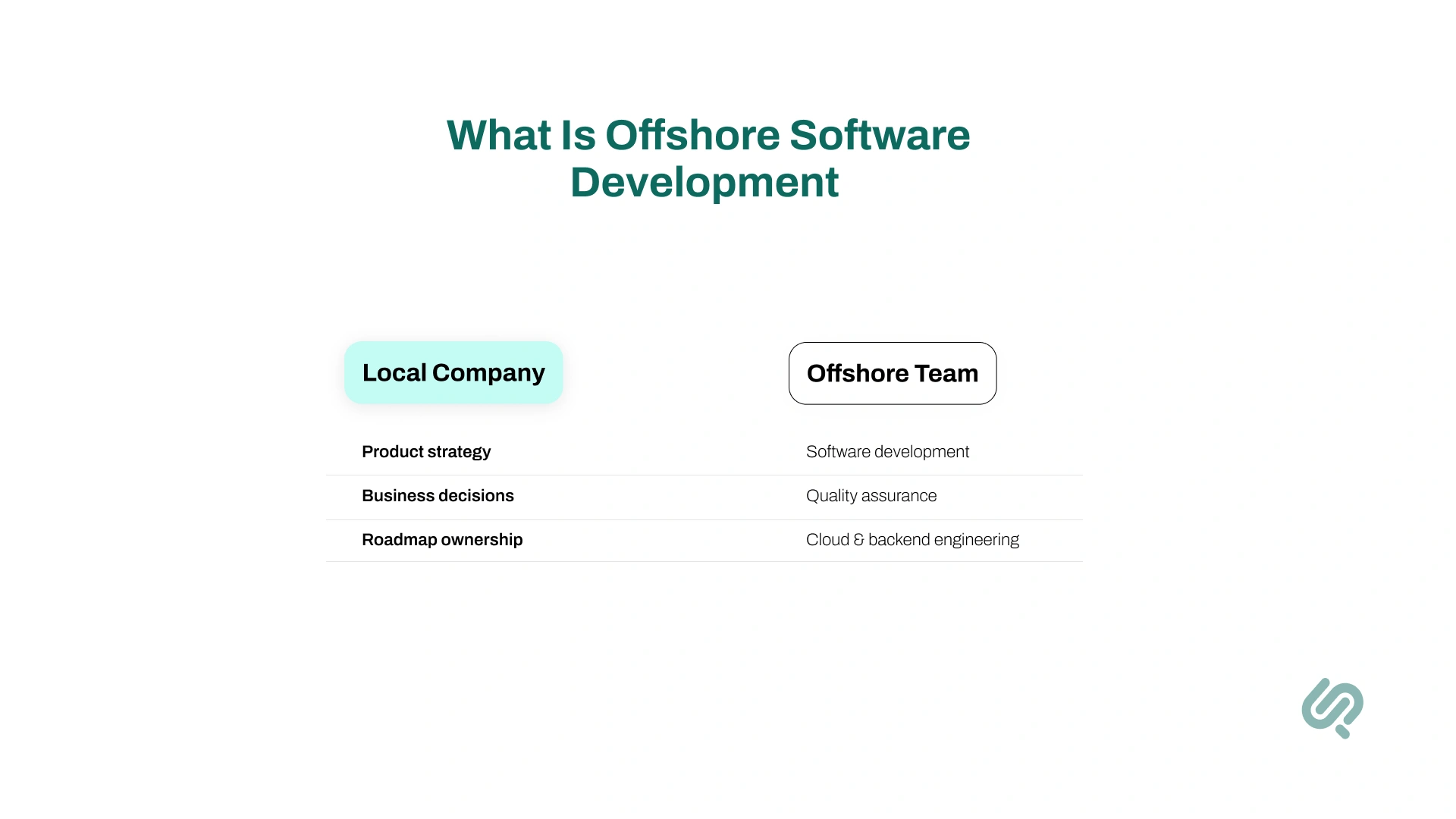
Offshore software development is the practice of hiring a software team in another country to build, maintain, or improve software.
Businesses usually work with an offshore software development company when they need to scale faster, access skilled developers, reduce hiring pressure, or improve delivery flexibility without building a larger in-house team.
This model is commonly used for:
Here is a simple example:
A startup wants to launch a new SaaS product but does not want to spend months hiring locally. Instead, it partners with an offshore software development company to handle product development, QA, and release support while the internal team stays focused on roadmap, users, and growth.
Offshore software development is not just remote coding. Done well, it is a structured delivery model that helps companies build software with more speed, flexibility, and access to global engineering talent.
Offshore software development is attractive in 2026 because companies need more than lower cost. They need faster team setup, broader technical skills, and a delivery model that helps them ship without long local hiring cycles.
With 92% of Global 2000 companies using IT outsourcing, partnering with the right offshore outsourcing software development company has become a standard approach for building and scaling modern software. (1)
The strongest offshore software development companies help businesses solve four common problems at once: hiring delays, skill gaps, delivery pressure, and cost control.
Hiring locally can take months, especially when you need niche skills. Offshore software development gives businesses faster access to engineers across backend, frontend, mobile, QA, DevOps, cloud, and AI.
This helps teams:
A good offshore software development company can reduce total delivery cost while still maintaining strong engineering standards.
The real value is not just lower rates. It is the ability to:
Product needs change. Offshore development gives businesses a more flexible way to add or reduce capacity without rebuilding the whole team structure each time.
That may include:
Modern offshore software development services often go beyond coding. Many companies now rely on offshore partners for the full delivery cycle, including discovery, design, development, QA, deployment, and post-launch support.
That makes offshore development especially useful for:
When the process is strong, offshore delivery can improve responsiveness and reduce wasted time between work cycles. Teams can move faster when handoffs, documentation, and sprint planning are handled properly.
Offshore development is most attractive when it is treated as a long-term delivery strategy, not just a cheaper way to hire developers.
Before choosing a development partner, it’s important to understand how offshore, nearshore, and onshore models differ.
Each option offers distinct trade-offs in cost, collaboration, scalability, and talent access. The table below breaks down these differences to help you quickly identify which model best fits your business needs.
Offshore software development is not the right choice for every business. It works best when you need more than lower costs. The real value usually comes from faster scaling, access to broader technical talent, and a delivery model that helps your team move without long local hiring cycles.
In these situations, a nearshore or hybrid model may be the safer starting point.
A) Choose offshore if:
You want the best balance of cost efficiency, scalability, and access to global software talent. Offshore is often the best fit for SaaS products, long-term platform development, startup product builds, and companies that need a reliable external engineering partner.
B) Choose hybrid if:
You want local or in-house product leadership, but need offshore execution capacity. A hybrid software development model works well when you want tighter control over priorities, stakeholder communication, and planning while still benefiting from offshore development services.
C) Choose nearshore if:
You need stronger real-time collaboration, more time-zone overlap, and easier day-to-day coordination. Nearshore is often a better fit for collaboration-heavy projects where frequent live sessions matter.
Offshore development works best when it is treated as a structured delivery partnership, not just a cheaper hiring shortcut.
Offshore software development works best when it is run like a structured delivery system, not a loose handoff to a remote vendor. A strong offshore software development company does more than assign developers. It helps set delivery rules, communication rhythms, QA ownership, sprint structure, and release accountability from the start.
A typical offshore software development process looks like this:
1. Discovery and alignment.
The first step is to define what is being built, why it matters, what success looks like, and what the first milestone should cover. This is where product goals, technical scope, business constraints, and delivery risks should be clarified early.
2. Team setup and delivery model.
The right team is assembled based on your product stage and technical needs. That may include developers, QA engineers, a project manager, DevOps support, and design input. Some companies start with a pilot team. Others begin with a dedicated software development team from day one.
3. Sprint planning and workflow setup.
Before development starts, both sides align on project tools, backlog structure, reporting cadence, meeting rhythm, overlap hours, and approval flow. This is what makes offshore software development manageable at scale.
4. Build, test, and report.
Work is delivered in sprints, not vague long phases. Features are built, tested, reviewed, and documented continuously. A good offshore software development company keeps stakeholders updated with clear progress, blockers, and next steps.
5. Release, support, and improve.
Once features go live, the work does not stop. The team handles bug fixing, performance improvements, release support, and future iterations based on product priorities.
For offshore software development to work, ownership must stay clear.
Your team should own:
Your offshore development partner should own:
Offshore delivery usually breaks down when ownership is vague. It works when both sides know who decides, who builds, who tests, and how success is measured.
You do not need to offshore the full product from day one. Many companies start with one delivery area, validate the partner, and then expand the scope once the workflow proves reliable.
A modern offshore software development company can support far more than coding alone.
Common services businesses offshore include:
Build internal tools, customer-facing platforms, enterprise applications, SaaS products, and web systems with an offshore software development team.
Offshore teams often handle frontend, backend, APIs, admin panels, and mobile apps in one delivery stream.
For startups and new product ideas, offshore software development services are often used to build an MVP faster without hiring a full local team.
Manual testing, test automation, regression testing, performance testing, and release QA are commonly offshored because they require process discipline and specialized coverage.
An offshore software development services company may also manage CI/CD, cloud infrastructure, deployment workflows, monitoring, and environment stability.
Some offshore partners also support wireframes, product thinking, user flows, and interface design before development begins.
Offshore software development is also used for bug fixing, feature improvements, technical debt cleanup, and long-term support after launch.
Many companies now offshore API integrations, cloud data pipelines, AI features, automation workflows, and system modernization projects.
The safest approach is usually to start with one clear workstream, not everything at once. That gives you a better way to test delivery quality before expanding the engagement.
Offshore software development cost depends on more than the hourly rate. The real cost changes based on team shape, delivery model, system complexity, communication needs, and how much ownership the offshore partner is expected to take.
The most common offshore pricing models are:
1. Dedicated development team
This works best when you need long-term product development, ongoing releases, and a stable team that grows with your roadmap. It usually gives the best balance of speed, continuity, and control.
2. Staff augmentation
This model works when you already have product and engineering leadership in place but need extra developers, QA engineers, DevOps specialists, or designers to extend internal capacity.
3. Time and material
This is often the safest model when requirements may evolve. You pay for actual time and resources used, which makes it easier to adapt scope as the product changes.
4. Fixed price
This works best for tightly scoped projects with clear deliverables, limited uncertainty, and stable requirements. It is less flexible when priorities change often.
5. Paid discovery sprint or pilot
This is often the smartest starting point. It helps both sides validate fit, process, communication, and technical quality before a larger commitment.
The biggest factors that change offshore software development cost are:
A low rate does not always mean a lower total cost. Cheap offshore development often becomes expensive when quality is poor, onboarding is slow, and rework keeps stacking up.
When comparing offshore software development companies, ask three questions:
That is a far better buying lens than the hourly rate alone.
Choosing an offshore partner is a business-critical decision.
The right offshore software development company helps you ship faster, scale with confidence, and avoid long-term technical debt. The wrong one leads to delays, quality issues, and hidden costs.
To choose the right partner, evaluate offshore teams using the factors below (the same criteria trusted by high-growth companies that succeed with software development outsourcing).
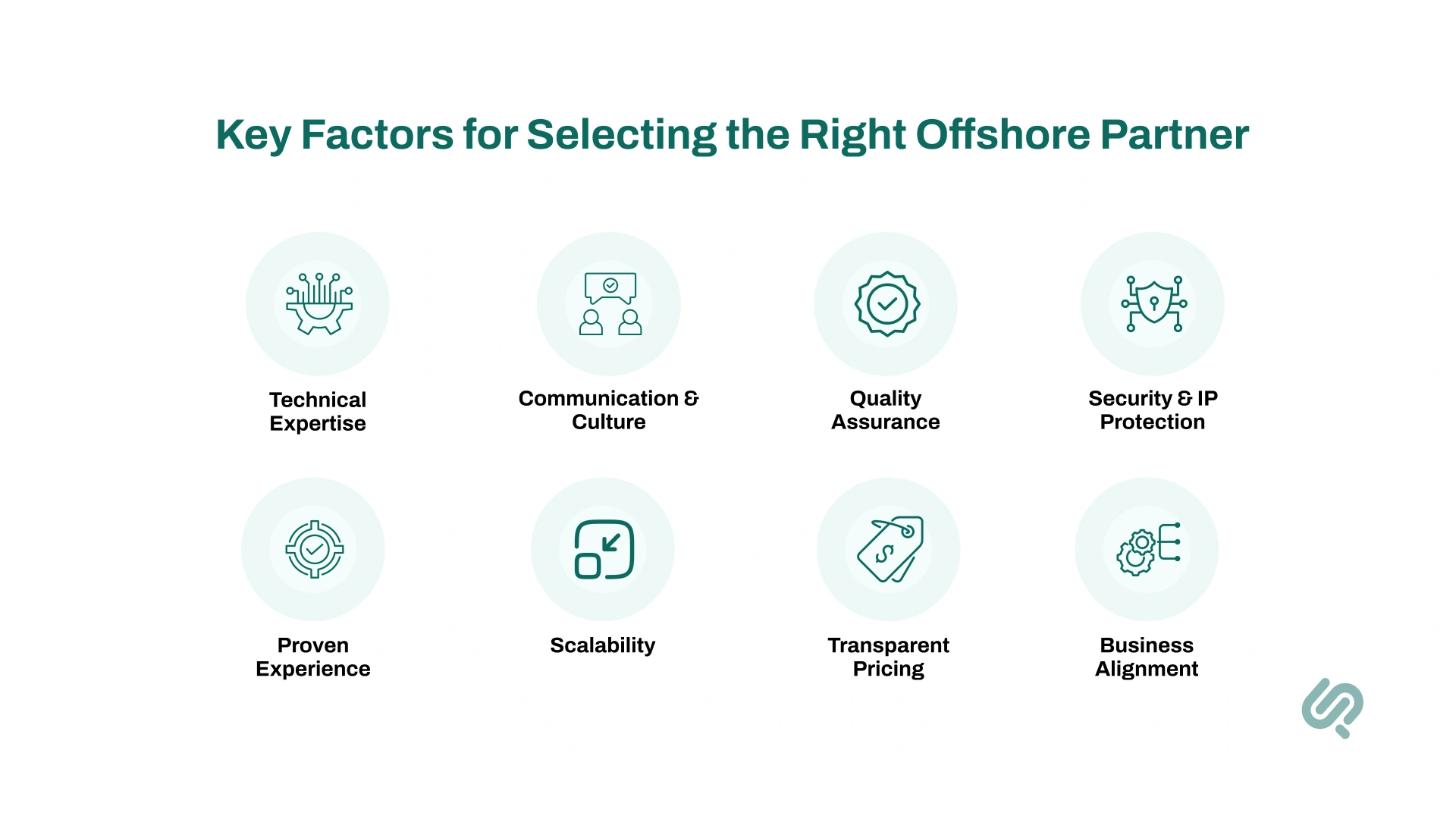
Technical capability is the foundation of any successful offshore engagement. A strong partner must go beyond writing code and demonstrate the ability to design, build, and scale real-world systems.
A reliable offshore software development services company should show experience across multiple technologies, architectures, and product types, especially those aligned with your business goals.
What to look for:
Offshore development succeeds or fails on communication. Even technically strong teams struggle without clear expectations, consistent updates, and cultural alignment.
A dependable offshore outsourcing software development company should feel like a natural extension of your internal team, not a disconnected third party.
What to look for:
Quality should be built into the process from day one. Strong offshore partners adhere to disciplined development practices that minimize defects and enhance long-term maintainability.
An agile offshore software development company prioritizes iteration, testing, and feedback throughout the application development lifecycle, not just at delivery.
What to look for:
Outsourcing requires trust. You are sharing sensitive data, source code, and intellectual property; security must be non-negotiable.
A professional offshore partner treats data protection and IP security as core responsibilities, not contractual formalities.
What to look for:
A partner’s past work is one of the strongest indicators of future success. Experienced companies have already solved the problems you’re about to face.
A credible Offshore Software Development Company should be able to demonstrate consistency, reliability, and client trust.
What to look for:
Your product and business will evolve. The right offshore partner must scale with you, without slowing momentum.
Strong providers offer flexible engagement models and can quickly assemble or adjust a dedicated software development team as needs change.
What to look for:
Cost is important, but value is what matters. The cheapest quote often leads to rework, delays, and higher long-term costs.
A mature offshore partner focuses on outcomes, efficiency, and ROI, not just billable hours.
What to look for:
The best offshore engagements turn into long-term partnerships. These partners think beyond delivery and help shape product decisions.
A high-quality partner acts as a global technology consulting partner, not just a delivery team.
What to look for:
Do not evaluate an offshore software development company based on sales messaging alone. Use a structured review process that helps you check technical depth, communication quality, delivery discipline, and long-term fit.
Request 2 to 3 case studies, shipped products, or portfolio examples that match your type of project.
Look for:
General software experience is not enough. You need to know whether the offshore development company has solved problems like yours before.
Ask about experience with:
Do not rely only on the sales team. Speak with the tech lead, project manager, and at least one developer or delivery lead.
This helps you assess:
Good offshore software development companies have a clear process for discovery, estimation, sprint planning, change requests, and backlog management.
You want to see:
Ask how they run sprints, track progress, manage blockers, report updates, and define release readiness.
A strong answer should include:
The way a company communicates during evaluation is usually the same way it will communicate during real delivery.
Pay attention to whether they:
Do not assume QA is already built into the engagement. Ask exactly what testing is included and who owns quality.
Check for:
Before signing anything, review how the offshore company handles code ownership, access control, environments, and confidentiality.
Ask about:
You need to know who is dedicated, who is shared, and what happens if someone leaves the project.
This protects you from:
The safest way to evaluate an offshore software development company is through real work. A short pilot, discovery sprint, or tightly scoped first phase gives you a much better read than a pitch deck ever will.
Do not evaluate an offshore software development company based on sales messaging alone. Use a structured review process that helps you check technical depth, communication quality, delivery discipline, and long-term fit.
Offshore software development can create major advantages, but only when the delivery model is managed properly. Most offshore failures come from weak process, weak ownership, or weak communication, not from the offshore model itself.
Here are the main risks to watch for and how to reduce them early.
If the scope is vague, offshore teams end up building against assumptions.
How to reduce it:
Start with a clear backlog, success metrics, delivery priorities, and approval flow. Use a discovery sprint if needed.
If updates are inconsistent, blockers stay hidden too long, and trust drops fast.
How to reduce it:
Agree on overlap hours, meeting rhythm, reporting format, and escalation paths before development starts.
If testing is treated as an afterthought, bugs appear late, and rework grows.
How to reduce it:
Make QA part of the delivery plan from day one. Ask who owns test coverage, regression checks, and release readiness.
You are sharing code, systems, access, and business logic. That requires discipline.
How to reduce it:
Confirm NDA terms, IP ownership, access controls, code repository rules, and environment security before kickoff.
Some vendors rotate people across projects too often, which hurts continuity and delivery speed.
How to reduce it:
Ask who is full-time, who is shared, and what happens if a key team member leaves.
Time-zone gaps become a problem when workflows depend on live decisions all day.
How to reduce it:
Use structured handoffs, clear documentation, and a few dependable overlap hours instead of trying to match full workdays.
The goal is not to remove all risk. The goal is to make offshore software development predictable enough that risk is visible, owned, and manageable.
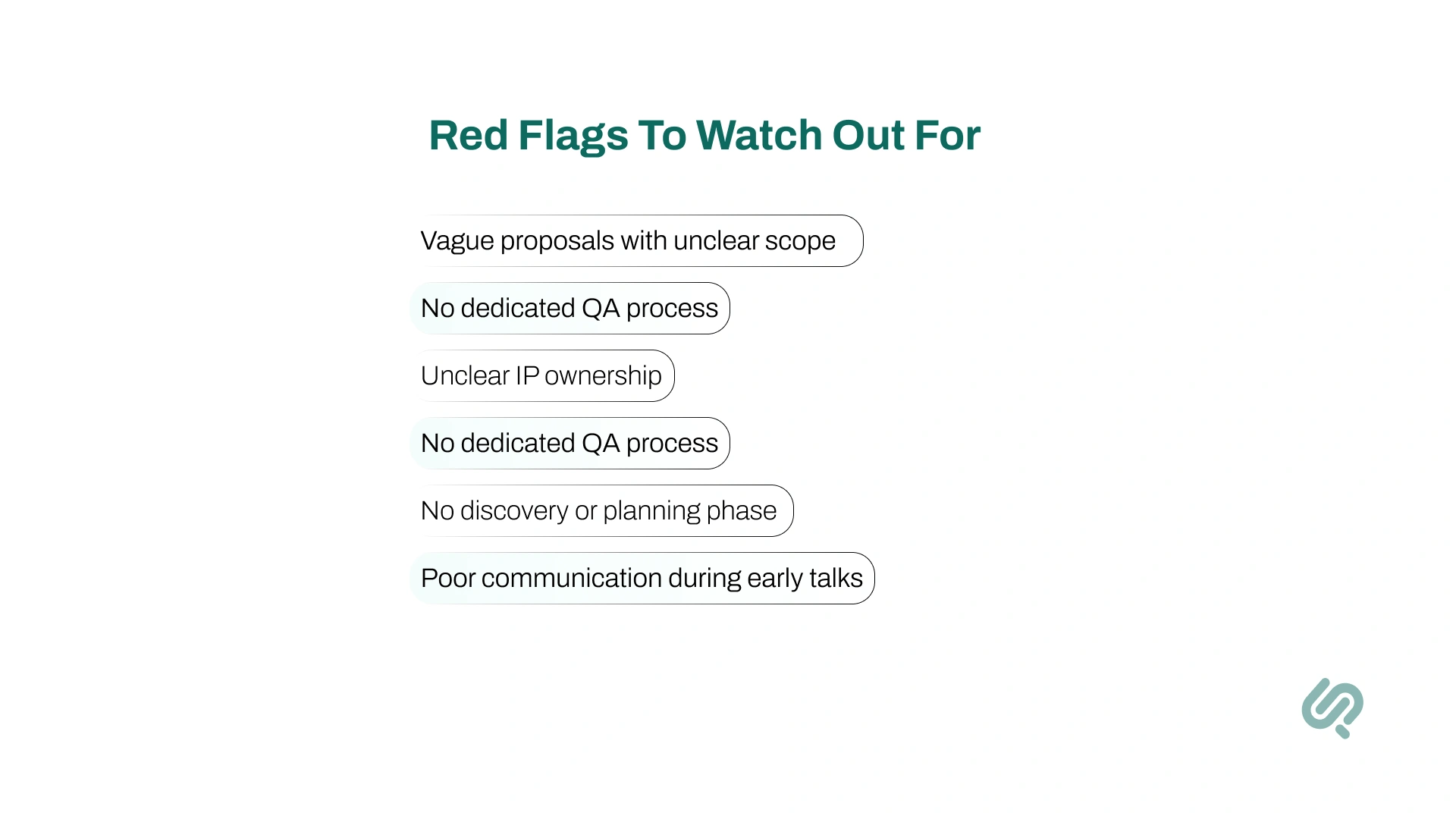
Not all offshore vendors are worth the risk.
Spotting warning signs early can save months of delays, rework, and unexpected costs. Below are common red flags CTOs and founders should never ignore.
Major warning signs to watch for:
If a vendor avoids transparency or rushes you into a contract, treat that as a serious signal. A professional offshore outsourcing software development company will welcome due diligence and detailed discussions.
When buyers compare offshore software development companies, the right choice usually depends on product type, region, budget, time-zone needs, and delivery maturity. A safer way to present this section is as a shortlist, not a universal ranking.
Here are 10 offshore software development companies that are frequently included in recent 2026 offshore and outsourcing shortlists:
Do not choose from this list based on brand name alone. Shortlist vendors based on:
That is how you find the right offshore software development company for your product, not just a popular one.
If you are looking for an offshore software development company, the best next step is simple: choose a partner that can build reliably, communicate clearly, and scale with your product.



Ameena is a content writer with a background in International Relations, blending academic insight with SEO-driven writing experience. She has written extensively in the academic space and contributed blog content for various platforms.
Her interests lie in human rights, conflict resolution, and emerging technologies in global policy. Outside of work, she enjoys reading fiction, exploring AI as a hobby, and learning how digital systems shape society.