













Every product you buy, from coffee beans to car parts, travels through a long, complex web of suppliers, shippers, and retailers.
Yet most supply chains still run on outdated systems that can’t guarantee where things came from or who touched them along the way.
That’s where blockchain technology in the supply chain comes in, giving every item a verified digital trail from origin to destination.
Think of it as a truth machine for global trade. No lost paperwork, no hidden tampering, no guessing who’s responsible when delays happen.
With blockchain in the supply chain, every transaction is transparent, traceable, and tamper-proof.
Blockchain technology in the supply chain is a shared, digital ledger that records every transaction or event across the logistics process.
Unlike traditional systems, where data can be altered or hidden, blockchain is tamper-evident and decentralized.
That means manufacturers, suppliers, carriers, and retailers all see the same version of the truth.
In short, blockchain gives supply chain partners a secure and transparent way to track goods and share information.
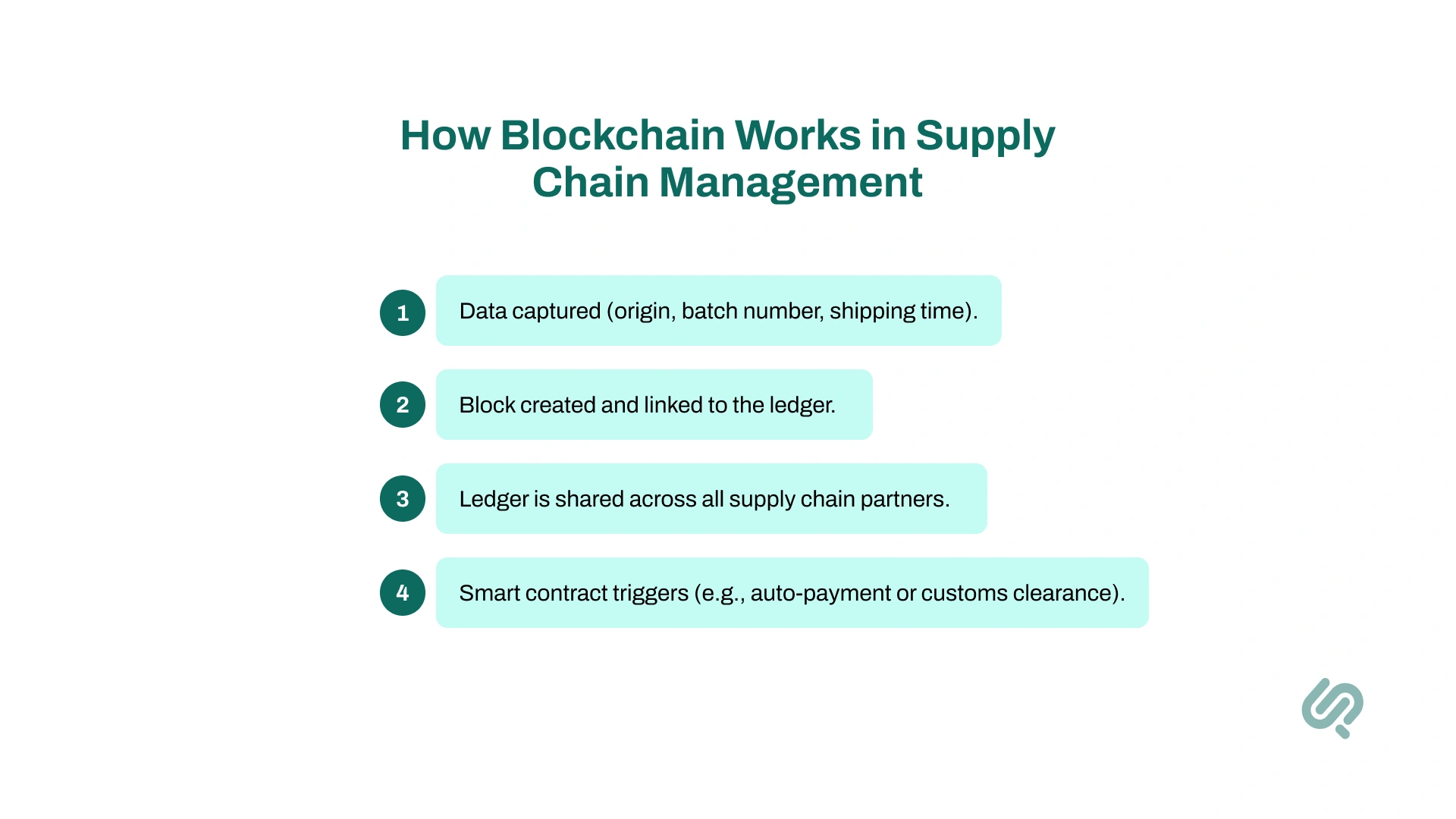
Blockchain stores information in “blocks” that are securely linked together. Each block might include details like product origin, batch number, or shipping time.
Once added, the block becomes part of a distributed ledger that no one can change. This guarantees data integrity across the entire supply chain.
Smart contracts make blockchain even more powerful. These are self-executing agreements that automatically trigger when certain conditions are met. For example:
By combining automation with transparency, blockchain in supply chain management does more than store data; it actively streamlines logistics operations and reduces human error.
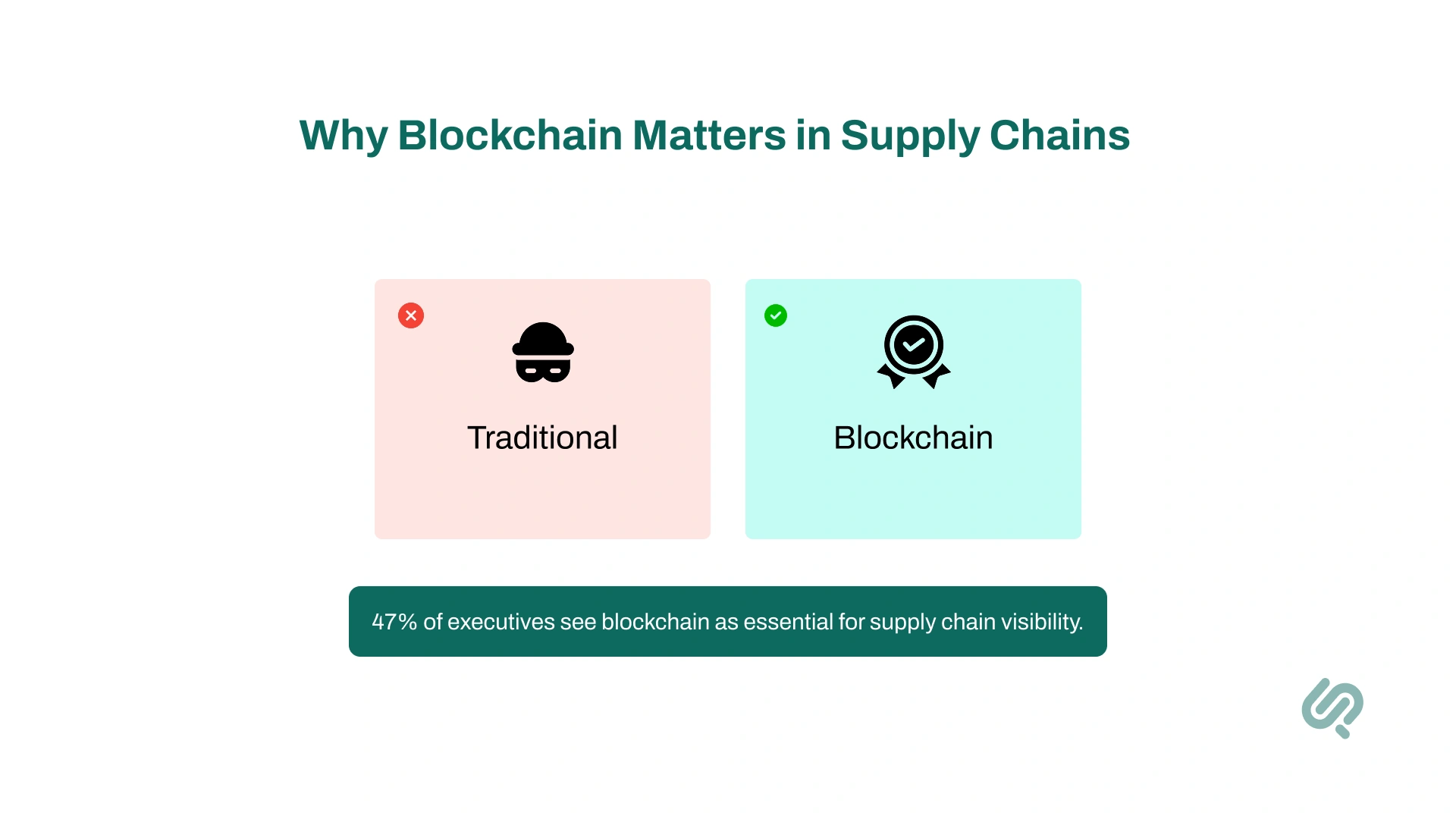
Blockchain in supply chain logistics addresses security challenges by creating a trusted, real-time record of every step.
This improves collaboration between partners and builds resilience in the face of disruptions.
Executives see this potential too. Industry research shows that 47% of companies consider blockchain essential for supply chain visibility and automation. (1)
This confidence reflects real-world results like Walmart reducing the time to trace mangoes from seven days to just 2.2 seconds. (2).
Let’s look at the key benefits of blockchain in supply chain management:
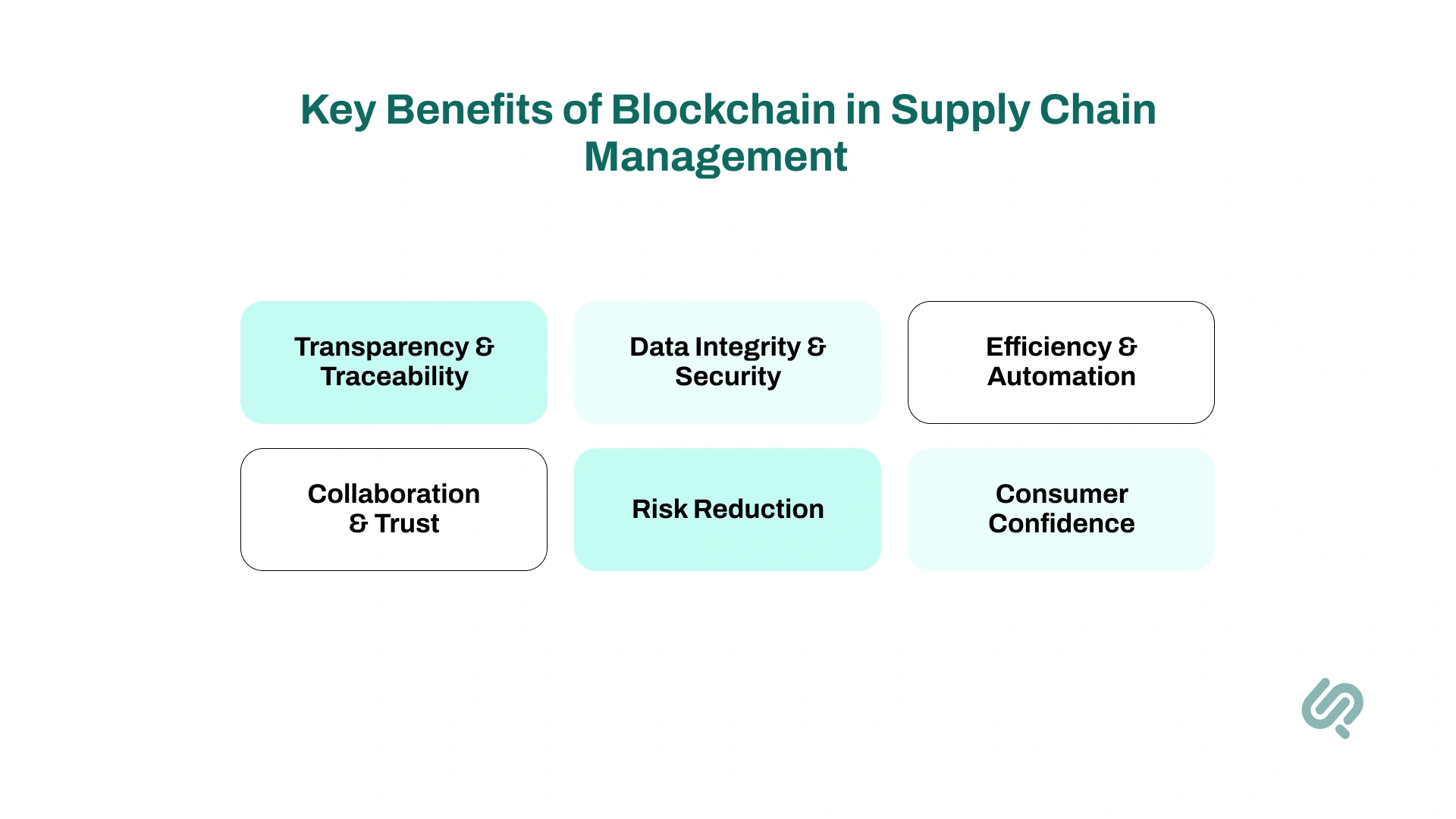
One of the biggest benefits of blockchain in the supply chain is visibility. Every participant, whether it’s the supplier, manufacturer, shipper, or retailer, accesses the same immutable records.
This means information no longer sits in silos. Instead, companies can trace a product’s journey all the way from raw material to the store shelf in seconds.
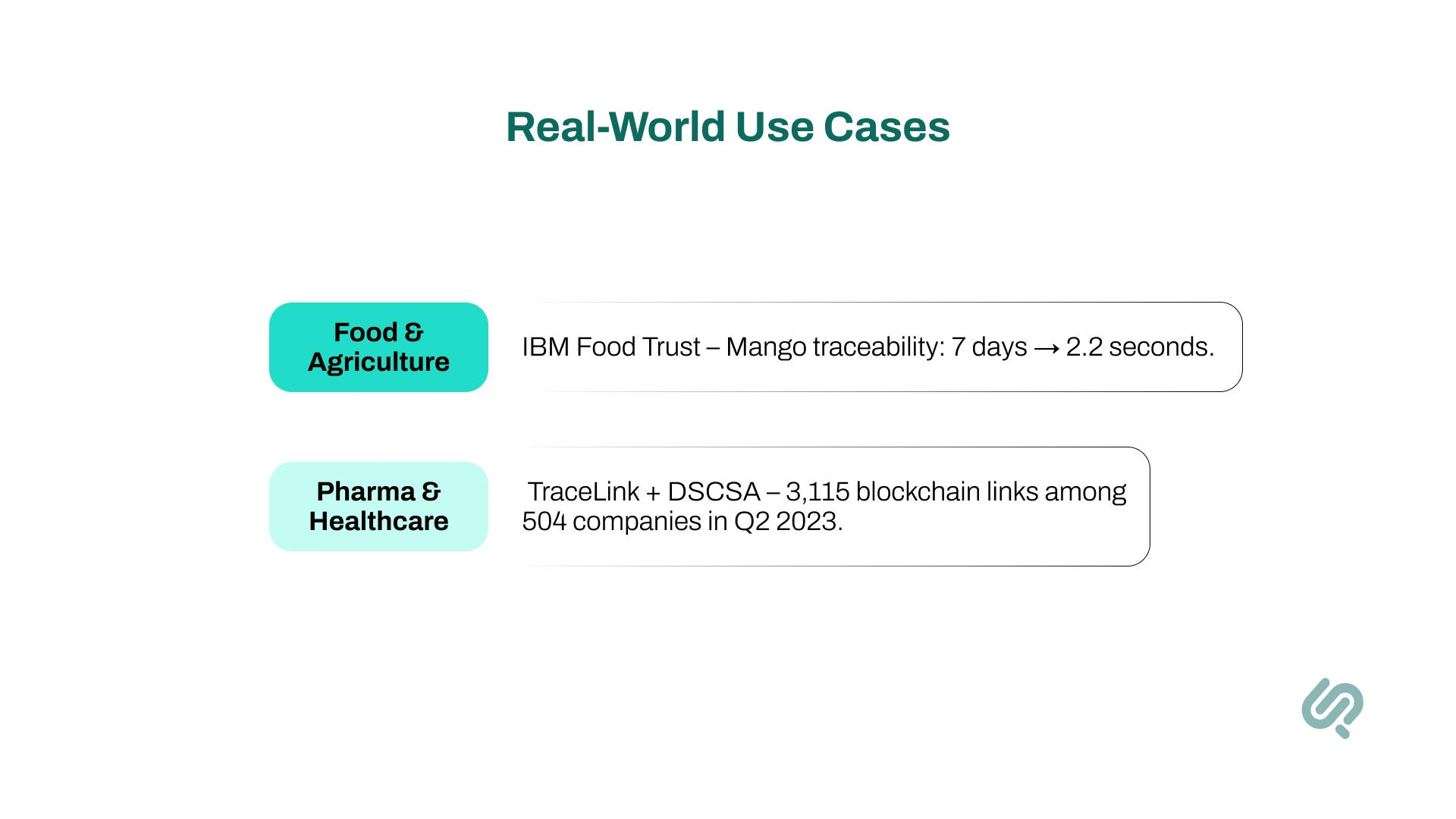
A real-world example shows the power of this. Walmart used blockchain to track mangoes from store to farm in just 2.2 seconds, compared to the seven days it used to take. That speed is critical for recalls, food safety, and quality control.
Beyond efficiency, traceability builds consumer trust. Customers can be confident about where their food, clothes, or medicine comes from. It also supports ethical sourcing and compliance, giving businesses a stronger reputation in the global market.
Another key advantage of blockchain in supply chain logistics is the way it secures information.
Data on the blockchain is locked using cryptographic hashing and consensus mechanisms. Once a shipment log, certificate, or transaction detail is recorded, no single party can change it. This makes the entire record tamper-proof and auditable.
Because all participants can independently verify the data, disputes are reduced and fraud becomes much harder. The decentralized ledger also provides an extra layer of protection against cyberattacks.
Sensitive supplier or customer data can’t be quietly altered or deleted. For companies that deal with high-value goods or complex networks, this improved security is a game-changer.
Traditional supply chains involve endless paperwork, manual approvals, and constant back-and-forth between partners. Blockchain helps break that cycle by digitizing processes and automating routine tasks.
Smart contracts can handle many of these actions on their own, whether it’s releasing payment when delivery is confirmed or automatically updating customs records once forms are submitted.
This level of automation cuts down on human error, reduces delays, and helps companies respond faster to changes. Real-time blockchain data enhances inventory management and load planning, while also ensuring warehouse operations run smoothly.
In practical terms, businesses save money by reducing overhead, avoiding stockouts, and streamlining procurement, manufacturing, and logistics. In short, blockchain in supply chain management creates a faster, leaner, and more cost-effective operation.
One of the strongest blockchain applications in the supply chain is its ability to reshape collaboration. In a blockchain network, no single party owns or controls all the records. Instead, everyone relies on the same shared ledger. This “trustless” environment makes it possible for companies to work together safely, even if they don’t fully trust each other.
Because every order, shipment time, and condition report is visible to all stakeholders, disputes are minimized. If there’s a delay, the record shows exactly when and where it happened.
Smart contracts add another layer of trust by automatically enforcing agreements without relying on an intermediary. The result is fewer errors, smoother deliveries, and stronger long-term relationships across supply chain partners.
Modern supply chains face constant risks, such as natural disasters, political changes, supplier failures, or even sudden demand shifts. Blockchain provides the visibility companies need to respond quickly.
If a shipment goes missing or a supplier fails, all parties can see the disruption instantly and take corrective action. This makes the supply chain ecosystem far more resilient.
Transparency also helps with compliance and sustainability. For example, companies can track Scope 3 emissions across their networks or prove that no forced labor was used in sourcing materials.
Since blockchain is decentralized, there’s no single point of failure. That shared responsibility fosters a more robust supply chain that can withstand challenges and adapt faster to change.
Another critical benefit of blockchain in supply chain logistics is the boost in consumer trust. With blockchain, every product can carry a digital certificate of authenticity.
Shoppers can verify whether their coffee really is fair trade, or whether the diamonds they buy are conflict-free.
This level of transparency strengthens brand reputation and reassures customers that they are making ethical choices.
Regulators also gain from this clarity. In industries like food or pharmaceuticals, blockchain records can quickly prove compliance with safety standards and track batches for recall if needed.
For companies, this means fewer legal risks and easier reporting. By demonstrating both ethical sourcing and regulatory compliance, businesses not only meet accountability demands but also gain a competitive edge in the marketplace.
Let’s look at some interesting supply chain blockchain implementation examples in different industries:
Food supply chains are among the most sensitive and complex.
Multiple steps, farming, processing, packaging, shipping, and retail, create room for contamination, fraud, and delays.
That’s why blockchain in the agriculture and food supply chain market is gaining traction: it provides a permanent, shared record of each handoff from farm to fork, so answers arrive in seconds, not days.
IBM Food Trust, used by Walmart, Nestlé, Dole, Tyson, and Unilever, records each stage of produce handling on a permissioned ledger (Hyperledger Fabric).
What this enables:
In a global market, blockchain technology in supply chain logistics is becoming increasingly important. Many retailers now require suppliers to upload product data to blockchain platforms.
The result: less waste and fraud, and higher consumer trust. Shoppers can scan a QR code to see exactly where food came from and how it was handled. Greater transparency, security, and efficiency are reshaping how food reaches our tables.
Counterfeit and compromised drugs are a severe risk.
Blockchain applications in supply chain management make end-to-end drug tracking possible from raw compounds to the pharmacy shelf, so every stakeholder sees the same trusted data.
TraceLink built a blockchain-enabled network to support the FDA’s Drug Supply Chain Security Act (DSCSA), allowing medication tracking across complex, global chains. Practitioners report using TraceLink daily to verify shipment legitimacy.
In the second quarter of 2023, TraceLink created 3,115 network links among 504 companies as part of its DSCSA compliance campaign. (3)
Pharma leaders like Pfizer and Merck pilot blockchain to capture batch data, shipment history, and compliance, giving regulators auditable trails that reduce fraud and simplify inspections.
What this enables:
By improving transparency, security, and accountability, blockchain in supply chain logistics is redefining how medicines are manufactured, shipped, and delivered, protecting patients and strengthening the integrity of pharmaceutical networks.
Automotive and electronics rely on complex multi-tier supply chains where small errors cause big delays.
Blockchain gives each part, from raw material to finished component, an immutable provenance and maintenance history tied to its lifecycle.
Ford traces cobalt for EV batteries on blockchain to ensure ethical sourcing and avoid conflict minerals.
Toyota and others pair blockchain with IoT sensors to log conditions for sensitive parts (e.g., semiconductors, aircraft components), preventing failures, strengthening quality control, and creating a permanent audit trail.
Key benefits in this sector:
Combining blockchain with IoT keeps parts flowing while cutting waste and downtime. It builds accountability across suppliers, stabilizes production schedules, and supports safer, higher-quality products, exactly what modern supply chain management demands.
Retail supply chains are under constant pressure to prove product authenticity and visibility.
Today’s shoppers expect to know that what they buy is genuine, safe, and responsibly sourced. Blockchain in supply chain management gives retailers a way to deliver that trust.
Retail giants like Walmart, Kroger, and Carrefour allow customers to scan QR codes and view the full journey of food products.
Luxury houses such as Louis Vuitton and Prada use blockchain to guarantee authenticity and fight counterfeiting. Even Amazon has filed a blockchain patent to verify goods sold online.
Practical Benefits:
By integrating blockchain into their operations, retailers are strengthening customer loyalty, reducing losses from counterfeit goods, and ensuring more accurate, demand-driven inventory systems.
The logistics industry still relies heavily on paper-based processes like bills of lading and customs forms.
This creates delays, disputes, and inefficiencies. Blockchain replaces those outdated systems with digital records that provide real-time visibility across global cargo routes.
The TradeLens platform, developed by IBM and Maersk, connects more than 30 ports and customs authorities. In pilot programs, it cut paperwork dramatically and allowed carriers to share shipment updates instantly.
Companies like DHL and FedEx are also testing blockchain through the Blockchain in Transport Alliance (BiTA).
Key Advantages:
For logistics providers, blockchain reduces costs, speeds up international trade, and strengthens transparency. It turns slow, paperwork-heavy processes into efficient digital workflows that benefit everyone involved.
Procurement and finance are often slowed by manual approvals, reconciliation errors, and long payment cycles.
Blockchain automates these processes, creating a secure and transparent workflow for global transactions.
BHP Billiton tested blockchain to automate supplier invoices, reducing turnaround times and accelerating payments. Banks and insurers have joined blockchain consortia like we.trade and Marco Polo, which use shared ledgers to streamline cross-border trade and prevent fraud in letters of credit.
Practical Benefits:
By integrating blockchain into procurement and trade finance, businesses can cut costs, reduce fraud, and build more reliable financial relationships across supply chain partners.
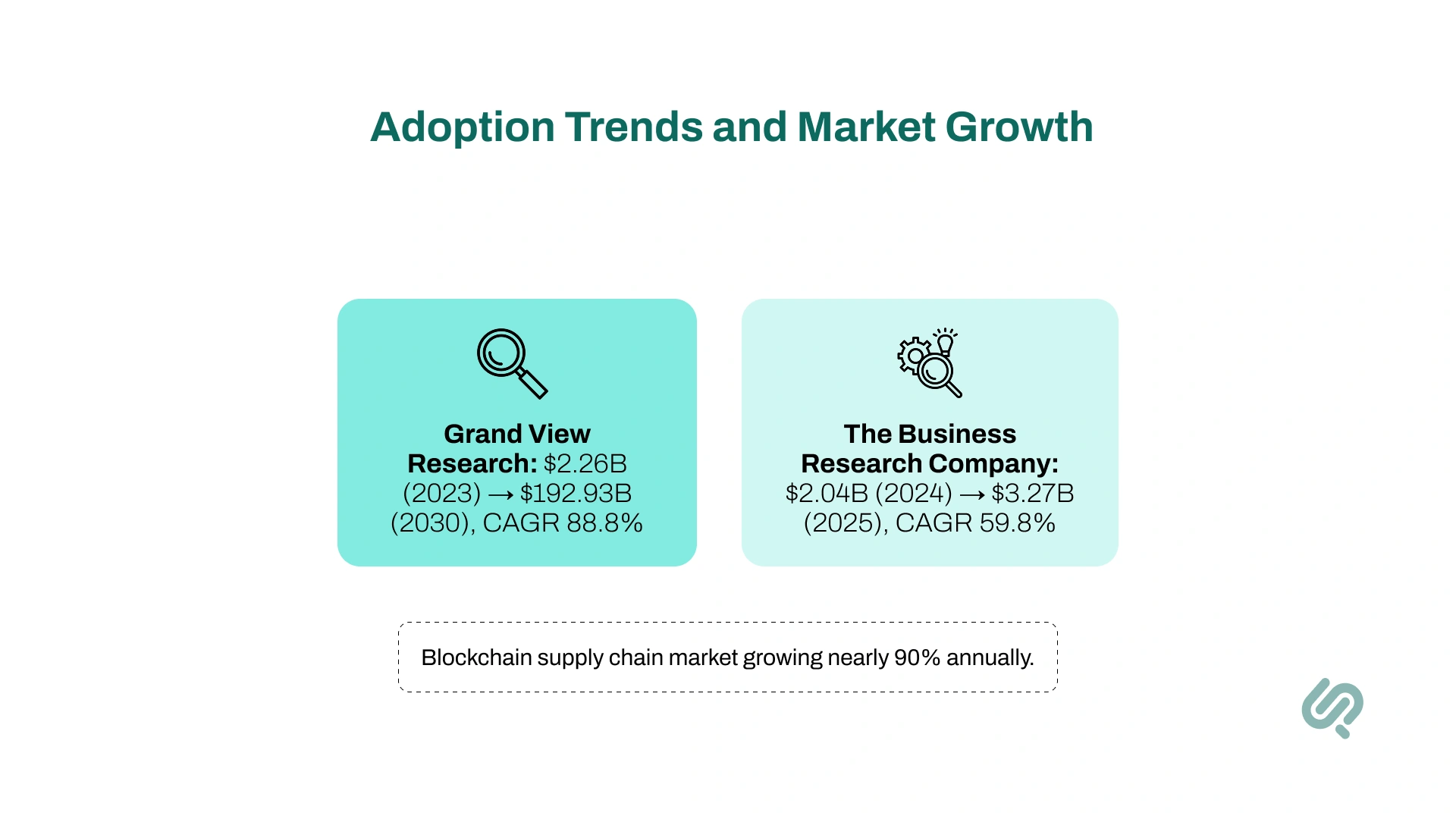
The blockchain supply chain market is expanding at an incredible pace.
According to Grand View Research, the market was worth about $2.26 billion in 2023 and is expected to skyrocket to $192.93 billion by 2030, that’s an annual growth rate of nearly 89% (4).
Another report from The Business Research Company predicts growth from around $2.04 billion in 2024 to $3.27 billion in 2025, a massive 59.8% increase in just one year.
These numbers highlight one thing clearly: companies are investing heavily in blockchain as they race to digitize and modernize their supply chain operations.
Blockchain is moving from small pilot projects to real-world implementation.
Fortune 500 companies in logistics, retail, and manufacturing are already on board. For example:
Analysts from Gartner and McKinsey predict that by 2025, most global supply chains will be using some form of blockchain solution.
As adoption grows, standards are becoming critical. Groups like GS1 (known for barcodes) and ISO are incorporating blockchain-based IDs. Industry collaborations are also shaping the future:
These efforts show that blockchain is no longer an experiment but is becoming an integral part of the digital supply chain ecosystem, supported by global standards and strong industry partnerships.
There are some problems with blockchain in supply chain logistics that need to be addressed:
Most supply chains already rely on large ERP or warehouse management systems (WMS). Adding blockchain on top of these isn’t always simple.
Data must be captured correctly at the source; otherwise, the old “garbage in, garbage out” problem still applies. Another hurdle is getting all partners to follow the same standards, such as GS1 or EPCIS.
Without consistency, blockchain networks can stall. In fact, Gartner reports that many blockchain projects struggle not because of the technology itself, but because integration with legacy systems is so complex.
Blockchain is designed for openness, but supply chains handle sensitive data like pricing, trade secrets, and even personal information.
Public blockchains may expose too much, which is why many companies turn to permissioned networks or add privacy layers such as private channels and encryption.
The real challenge is balance: giving enough visibility for traceability and compliance, while still protecting competitive or confidential information
Public blockchains like Bitcoin or Ethereum can only process a handful of transactions per second, which is far too slow for global supply chains handling millions of events.
Even private blockchains face scaling challenges when every pallet, shipment, or sensor reading has to be logged.
To make blockchain practical at scale, companies need solutions such as batching transactions or using faster consensus methods. Without this, performance bottlenecks could limit adoption.
Different countries treat blockchain data differently. Some regulators may not yet recognize a blockchain record as legally binding proof.
Others impose strict data sovereignty rules that conflict with decentralized systems. Companies exploring blockchain must make sure their systems comply with financial, environmental, and privacy laws like GDPR.
Until legal frameworks catch up, this uncertainty remains one of the bigger roadblocks.
Setting up and running a blockchain network isn’t cheap. Businesses face upfront expenses for development and deployment, plus ongoing costs for storage and computing.
For some, the return on investment (ROI) isn’t clear yet.
There’s also the issue of energy usage, though new models like proof of authority or delegated proof of stake are helping reduce costs and make blockchains more energy-efficient.
Finally, blockchain adoption isn’t just about technology; it’s about people. Supply chains involve multiple partners, and no single company “owns” the blockchain.
That means shared governance, new processes, and training are essential. Many employees and partners need time to understand and trust the system.
A recent survey even found that 57% of executives see a lack of understanding as a major barrier to adoption. Overcoming this requires clear communication, education, and leadership buy-in.
The future of logistics will be defined by blockchain-enabled transparency, automation, and real-time data exchange.
Here are the top 5 blockchain applications businesses should focus on building by 2026 to stay ahead in global supply chain innovation:
What It Does:
Tracks every shipment, handoff, and document on a tamper-proof blockchain ledger — ensuring full transparency and authenticity from origin to delivery.
Why It’s Innovative:
Eliminates shipment fraud and data manipulation, offering trusted, real-time visibility across logistics partners.
What It Does:
Automates customs declarations and international trade documents using blockchain-verified smart contracts that trigger clearances when all requirements are met.
Why It’s Innovative:
Reduces clearance times and human errors by using blockchain as a single source of truth for compliance validation.
What It Does:
Combines blockchain’s transparency with predictive analytics to forecast disruptions, supplier risks, or inventory shortages.
Why It’s Innovative:
Merges blockchain-backed data integrity with real-time forecasting, helping businesses make proactive, data-driven decisions.
What It Does:
Uses blockchain-based tokens for instant supplier payments, automating settlements once delivery is verified on-chain.
Why It’s Innovative:
Eliminates manual invoicing, speeds up cash flow, and builds trust through verified digital transactions.
What It Does:
Tracks environmental metrics, like emissions, sourcing, and recycling data, across the entire supply chain, recorded immutably on blockchain.
Why It’s Innovative:
Supports ESG reporting and responsible sourcing by providing verifiable proof of sustainable practices.
The future of blockchain in procurement and supply chain is defined by speed, transparency, and smarter automation.
As companies using blockchain in supply chains mature, they’re setting new standards for efficiency and trust across industries.
IoT + AI + blockchain for business enables real-time tracking, smart contract automation, and predictive analytics for better logistics decisions.
Cross-industry systems for blockchain in logistics and supply chain improve interoperability and global data sharing across sectors like agriculture and manufacturing.
A key blockchain in supply chain example, assets like invoices and containers are tokenized for instant payments and automated insurance settlements.
Blockchain in the retail supply chain ensures verified carbon credits, ethical sourcing, and ESG compliance through transparent, on-chain audit trails.
By the late 2020s, the top blockchain development trends predict mainstream adoption across sectors, from blockchain in healthcare and blockchain in intellectual property to finance, all strengthened by enhanced blockchain security frameworks.
Blockchain is quickly reshaping modern supply chain logistics.
By providing a secure, transparent digital ledger, it helps companies achieve end-to-end traceability, reduce fraud, and streamline operations.
Real-world examples from Walmart, tracing produce in seconds, to Maersk digitizing container records show just how transformative this technology can be.
Yes, there are challenges like integration and scalability, but the momentum is undeniable.
With the market expected to grow exponentially and industry leaders already on board, blockchain is moving from hype to real impact.
For businesses, adopting blockchain now means building supply chains that are not only more efficient and cost-effective but also more resilient, ethical, and trusted.



Ameena is a content writer with a background in International Relations, blending academic insight with SEO-driven writing experience. She has written extensively in the academic space and contributed blog content for various platforms.
Her interests lie in human rights, conflict resolution, and emerging technologies in global policy. Outside of work, she enjoys reading fiction, exploring AI as a hobby, and learning how digital systems shape society.