

.webp)
.webp)
.webp)
.webp)









AI is transforming how businesses operate, but not all AI systems work the same way. Two of the most common approaches are generative AI and machine learning (ML).
Many people search for AI vs machine learning vs generative AI because the terms are related but represent different layers of intelligence, from broad AI to learning systems, to content-generating systems.
A McKinsey survey found that 88% of organizations are using AI in at least one business function, up from 78% the year before, showing rapid enterprise adoption (1).
Machine learning focuses on learning from existing data to find patterns, make predictions, and support decisions. Generative AI builds on these techniques to create new content, including text, images, audio, and code.
The rise of tools like ChatGPT has made this distinction more important than ever.
While machine learning remains the foundation behind systems like fraud detection, recommendation engines, and predictive analytics, generative AI continues to open new possibilities in content creation, customer support, and automation.
This guide breaks down generative AI vs machine learning in clear terms. Let’s discuss what each is, how they work, where they’re used, and how they differ.
Machine learning and generative AI are both part of artificial intelligence and often use similar technologies like neural networks and large datasets. However, they are built for different goals.
Machine learning focuses on understanding data to make predictions and decisions.
Generative AI focuses on using data to create new content.
In simple terms, machine learning is about predicting, while generative AI is about creating.
This distinction is often described as ‘generative AI vs traditional AI’, where traditional AI focuses on rules and predictions, and generative AI focuses on creating new content.
Understanding these machine learning vs generative AI differences helps organizations choose the right approach for each business problem.
The table below provides a clear machine learning vs generative AI comparison across purpose, output, data type, and business use cases.
Generative AI is a branch of artificial intelligence that focuses on creating new content, such as text, images, audio, code, or synthetic data, based on patterns learned from existing data.
Unlike traditional machine learning systems that analyze data to make predictions or classifications, generative AI systems generate data.
They can write paragraphs, create images, compose music, summarize documents, or simulate scenarios, often in ways that feel human-like and creative.
This often leads to confusion between machine learning vs LLMs vs generative AI, where machine learning is the broad learning method, LLMs are a specific type of model, and generative AI is the application layer that creates content.
Some types of Generative AI include Generative Adversarial Networks (GANs), Variational Autoencoders (VAEs), and Transformer-Based Models (LLMs).
Usage of generative AI in businesses nearly doubled from 33% in 2023 to 65% in 2024, and the global market is growing at more than 40% CAGR through 2032. (2)
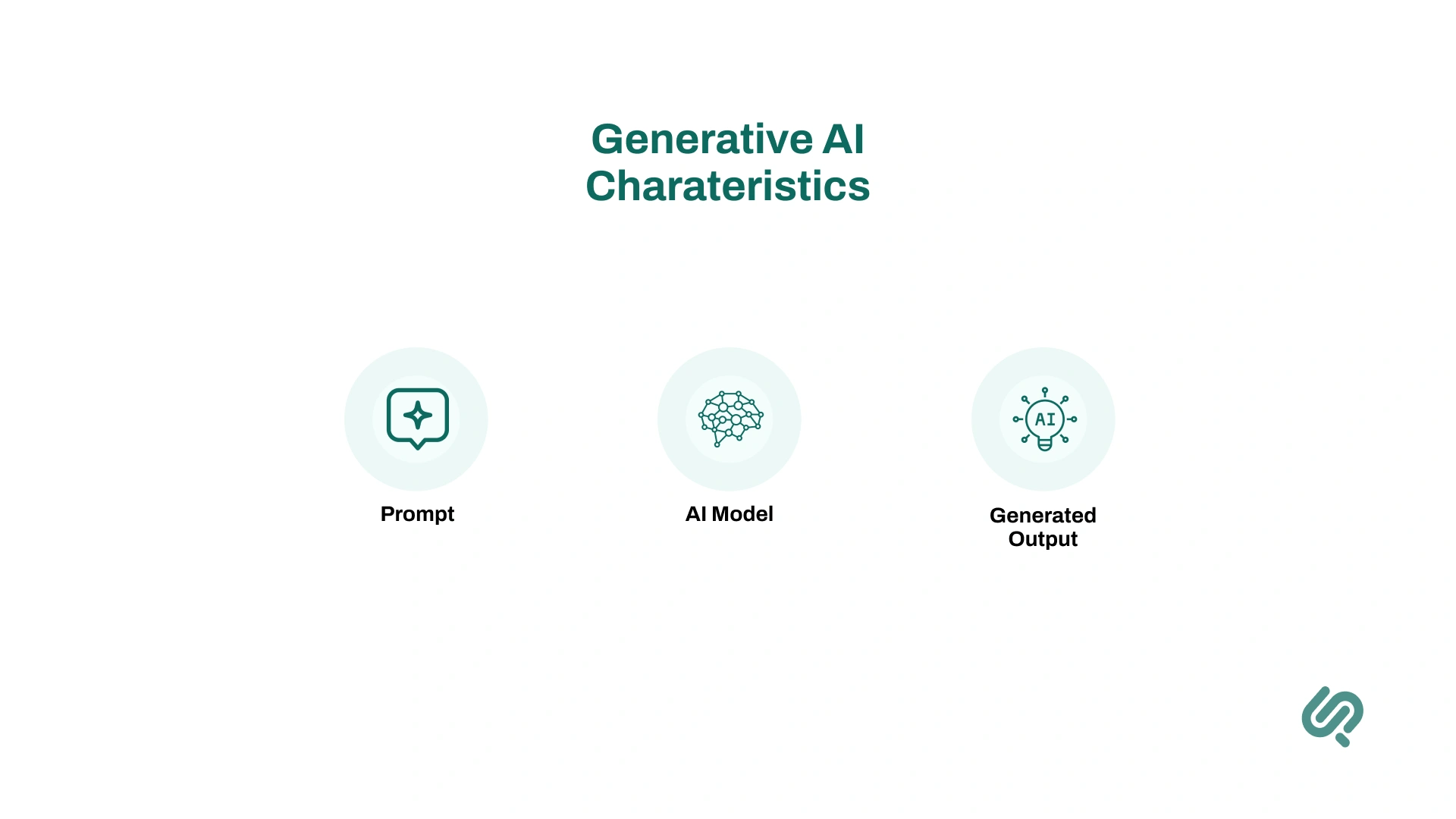
The defining feature of generative AI is that it produces new content rather than predictions.
Examples:
For instance, given a few example paintings, a generative model can create a new painting in a similar artistic style, something a traditional ML model cannot do.
Generative AI systems are trained on large datasets containing text, images, or audio. During training, they learn the underlying structure and relationships in that data, such as grammar, visual patterns, or stylistic elements.
However, generative AI does not invent knowledge from nothing. It can only generate outputs based on what it has learned. This means its creativity is limited by the scope and quality of its training data.
Generative AI relies on complex deep learning models, including:
These models use multi-layered neural networks to capture subtle patterns across massive datasets, enabling them to produce outputs that appear intelligent, fluent, or visually convincing.
Generative AI works through user prompts, instructions or inputs that guide what the system should generate.
Examples:
The quality of the output depends heavily on the clarity and structure of the prompt, which is why prompt engineering has become an important skill.
Generative AI models sometimes produce outputs that are incorrect, misleading, or fabricated a phenomenon known as AI hallucination. They may also reflect biases present in their training data.
This makes validation, oversight, and responsible use critical, especially in regulated industries like healthcare, finance, and law.
How Does Generative AI Work?
This section explains how generative AI works in practice, from training on large datasets to generating outputs from prompts.
The model is trained on massive collections of data, such as books, websites, articles, or images, to learn how content is structured.
For example, an LLM learns language by predicting the next word in a sentence based on previous words. Over time, it learns grammar, meaning, tone, and style.
The model builds an internal representation of how data looks and behaves, such as how sentences are formed or how visual elements combine into objects.
When a user provides a prompt, the model uses what it learned to generate a new output that fits that context.
Example:
Prompt: “Once upon a time in a distant galaxy…”
Output: The model continues the story with a coherent narrative.
User feedback (ratings, corrections, preferences) can be used to fine-tune the model so that future outputs become more helpful, accurate, and aligned with expectations.
Generative AI has grown rapidly because it can do something traditional AI could not: create new content.
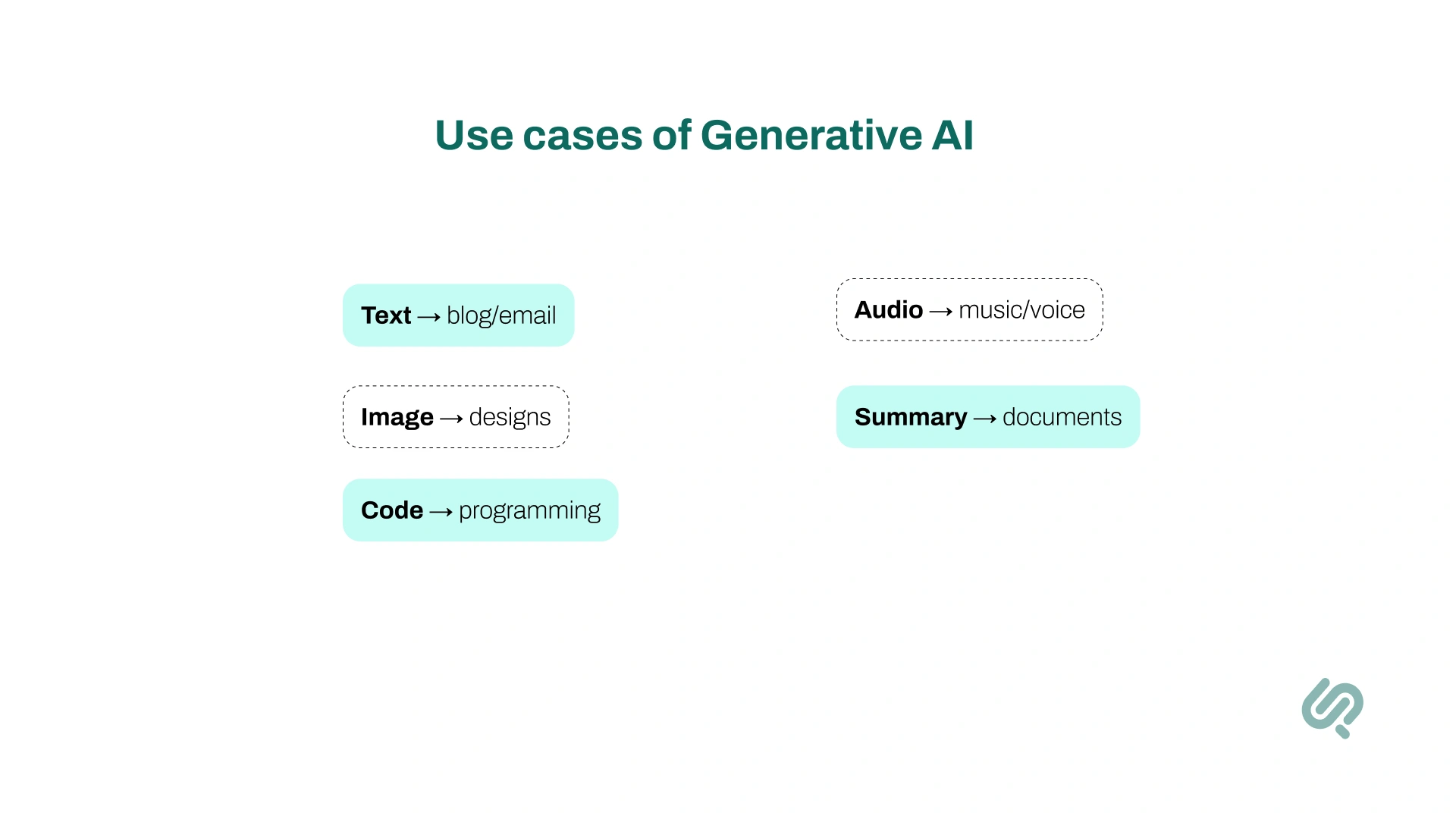
Instead of only analyzing data, generative AI systems can generate text, images, audio, code, and even synthetic data, making them valuable across marketing, design, engineering, healthcare, and more.
Below are the most important generative AI use cases, with simple examples for each.
Synthetic data is also used to simulate rare events that don’t appear often in real datasets.
Pharmaceutical companies use generative models to suggest new chemical structures that may lead to effective drugs.
Game developers use it to generate characters, dialogue, and storylines dynamically.
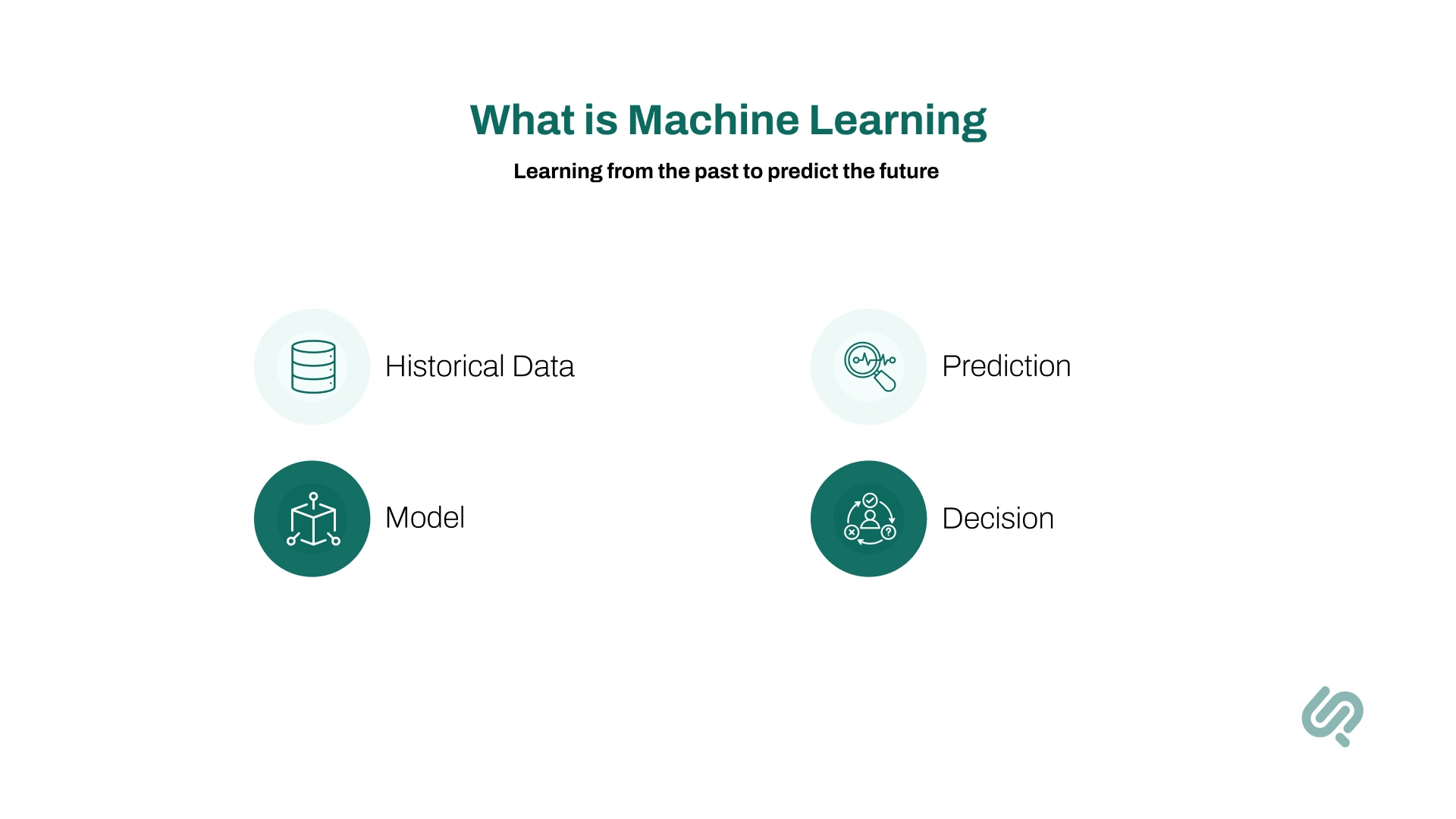
Machine learning is a branch of artificial intelligence that enables systems to learn from data and improve their performance over time, without being explicitly programmed for every rule or decision.
Instead of following fixed instructions, a machine learning system looks at historical or training data, identifies patterns in that data, and then uses those patterns to make predictions or decisions on new, unseen data.
This is what allows machine learning to support tasks like fraud detection, recommendation systems, demand forecasting, and image recognition.
In simple terms, machine learning teaches computers to learn from experience, much like humans do, but at a much larger scale and speed.
The global machine learning market is projected to grow from $113.10 billion in 2025 to $503.40 billion by 2030, showing strong long-term demand. (3)
The defining feature of machine learning is that it learns patterns from existing data instead of being explicitly programmed with rules.
During training, the model analyzes large datasets, often labeled to understand the relationship between inputs and outputs.
Examples:
Machine learning does not start with built-in knowledge; its performance depends on the quality, relevance, and volume of training data it receives.
Machine learning is designed to predict, classify, or optimize, not to generate new content.
It answers questions like “What is likely to happen?” or “Which category does this belong to?” rather than creating text, images, or designs.
Examples:
This makes machine learning ideal for analytical and operational tasks where accuracy and consistency matter more than creativity.
Machine learning relies on mathematical and statistical models that learn from data by minimizing error and improving performance over time.
These AI algorithms form the mathematical foundation behind most modern machine learning systems
Common approaches include:
These models continuously adjust internal parameters during training to better fit the observed data.
Once trained, machine learning models can operate automatically and in real time, making decisions across millions of data points without human intervention.
Examples:
This ability to automate decisions at scale is what makes machine learning powerful for enterprise and high-volume systems.
Machine learning models are only as good as the data they are trained on. If the training data is biased, incomplete, or outdated, the model’s predictions will reflect those problems.
This is why effective machine learning systems require:
Ongoing oversight ensures that models remain accurate, fair, and aligned with real-world changes.
At a high level, machine learning works by continuously learning patterns from data and refining its predictions over time.
The process starts with gathering relevant data, such as customer behavior, transaction records, images, or sensor data. This data is cleaned, structured, and prepared so the algorithm can process it effectively.
There are several machine learning techniques, but the two most common are
▶️ (A) Supervised Learning
Learns from labeled data where the correct answer is known. It trains by comparing predictions to actual results and improving accuracy over time.
Example: Learning to detect tumors from labeled medical scans.
Used for: Classification and prediction.
▶️ (B) Unsupervised Learning
Learns from unlabeled data and finds patterns on its own. It groups or organizes data without predefined categories.
Example: Segmenting customers based on behavior.
Used for: Clustering and pattern discovery.
During training, the model makes predictions, compares them to the correct answers (if available), calculates the error, and then adjusts itself to reduce that error. This process repeats many times until the model’s performance stabilizes.
Once trained, the model can be used on new data it has never seen before, such as predicting which customers are likely to churn, whether a transaction is fraudulent, or what product a user is most likely to buy.
Deep learning is a subset of machine learning that uses multi-layered neural networks to model complex patterns in data.
It is especially powerful for handling unstructured data such as images, audio, and text.
Deep learning has enabled major advances in:
Because deep learning models can automatically learn feature representations, they often outperform traditional statistical models on complex tasks.
Machine learning depends heavily on data quality. If the data is incomplete, biased, or inaccurate, the model’s predictions will reflect those problems. This is why the phrase “garbage in, garbage out” applies strongly to ML.
To keep models accurate over time, organizations must:
In practice, this means that successful machine learning initiatives require just as much investment in data collection, cleaning, and governance as in the algorithms themselves.
Machine learning is already deeply embedded in many everyday products and business systems. It helps organizations analyze large amounts of data, identify patterns, and make smarter decisions at scale.
These examples show how AI vs machine learning in real life plays out across finance, healthcare, retail, and manufacturing.
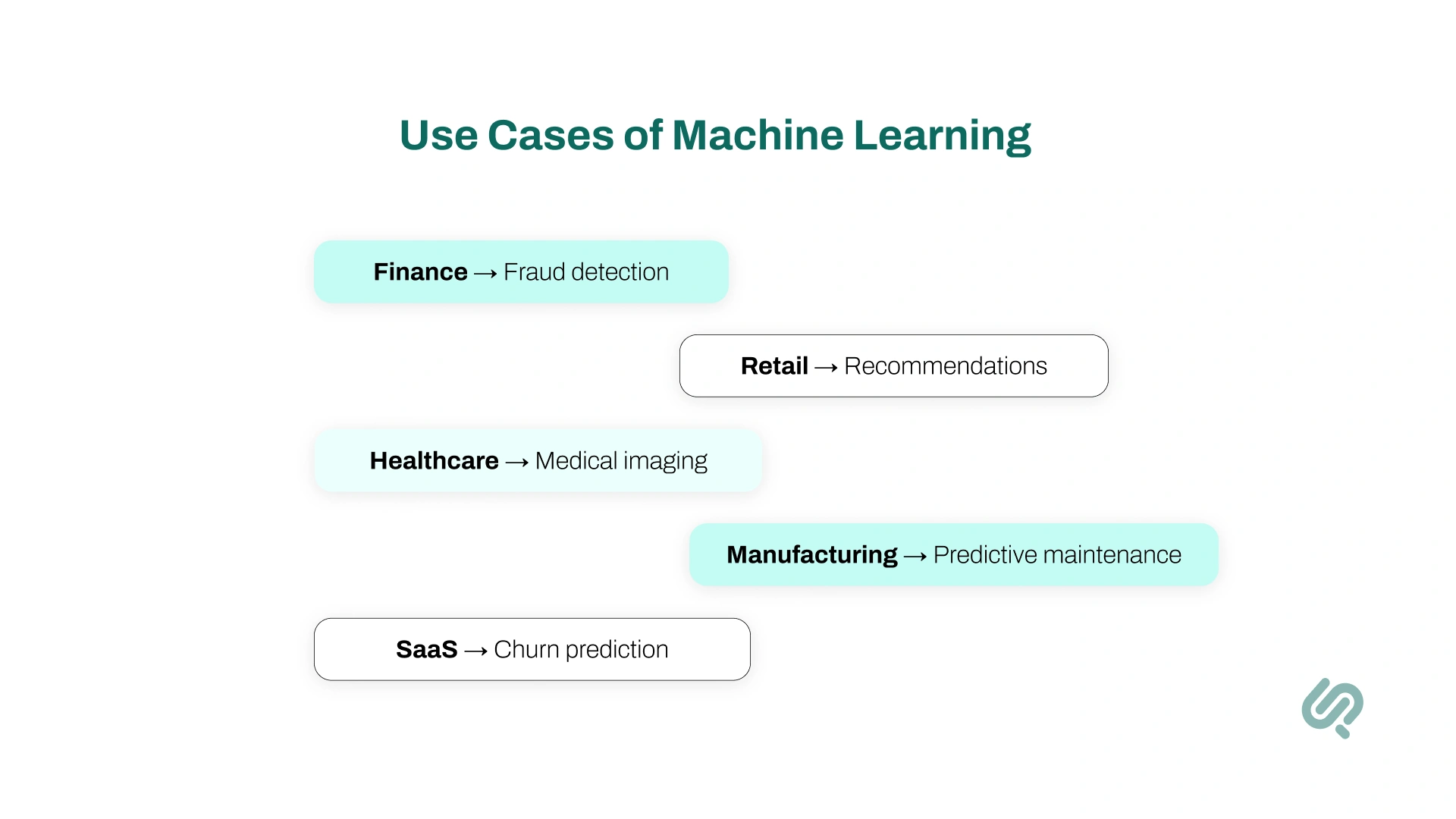
When a sudden high-value transaction appears from another country, the system flags it immediately and sends a verification alert to the customer, preventing potential fraud before money is lost.
When a new scan is uploaded, the system highlights areas that resemble known tumor patterns, helping radiologists detect cancer earlier and more accurately.
Machine learning and generative AI are most effective when used together as part of a single intelligent system.
Machine learning provides the analytical foundation by learning from historical data to detect patterns, predict outcomes, and optimize decisions.
Generative AI builds on those insights to create usable outputs such as text, explanations, designs, and automated responses. Together, they enable systems that move seamlessly from data to decision to action.
In real workflows, this looks like:
This layered approach improves automation, speed, and adoption. Machine learning handles scale and accuracy, while generative AI handles interaction and execution.
Rather than replacing each other, they form two complementary layers (intelligence and expression), that together power the next generation of autonomous and human-centered AI systems.
How predictive intelligence and creative AI are converging, scaling, and reshaping business, technology, and work.
The future of AI will not be driven by machine learning or generative AI alone, but by how they work together to analyze, create, and act. Below are the most important generative AI and machine learning trends shaping what comes next.

AI systems are becoming more integrated, combining prediction and creation in a single workflow.
AI is evolving from tools that respond to prompts into systems that can take initiative.
This evolution is often framed as machine learning vs generative AI vs agentic AI, where ML predicts, generative AI creates, and agentic AI acts autonomously.
AI will become a core layer across nearly every industry.
The AI ecosystem will balance scale with efficiency.
As AI becomes more powerful, trust and control become critical.
AI will not replace humans; it will reshape how humans work.
To sum up, machine learning and generative AI are both essential but serve distinct purposes.
Machine learning remains the backbone of predictive analytics, automation, and decision support, powering systems like fraud detection, recommendation engines, and demand forecasting.
Meanwhile, generative AI opens up new possibilities in content creation, design, and conversational experiences, enabling businesses to generate text, images, audio, and code at scale.
The most successful AI strategies don’t choose one over the other. They combine machine learning’s analytical strength with generative AI’s creative power to drive innovation and operational impact across functions.
Despite rapid adoption, many organizations are still in early stages of scaling AI effectively, which highlights the importance of strategic investment, data quality, governance, and human oversight in realizing real business value.



Ameena is a content writer with a background in International Relations, blending academic insight with SEO-driven writing experience. She has written extensively in the academic space and contributed blog content for various platforms.
Her interests lie in human rights, conflict resolution, and emerging technologies in global policy. Outside of work, she enjoys reading fiction, exploring AI as a hobby, and learning how digital systems shape society.