












The UAE’s Agentic AI government plan is a two-year framework to move 50% of UAE government sectors, services, and operations to autonomous AI systems by 2028. Announced by Sheikh Mohammed bin Rashid Al Maktoum on April 23, 2026, the plan aims to make the UAE the first government in the world to operate at this scale through Agentic AI.
This is not a small technology update. It is a shift from digital government to AI-powered government, where intelligent systems can analyze, decide, execute, and improve services in real time.
For UAE businesses, the message is clear: AI is moving from support tool to operating partner. Companies that still depend on manual workflows, disconnected systems, and slow customer response will feel the gap quickly.
At Phaedra Solutions, we help UAE companies turn AI ambition into working AI agents, connected workflows, and measurable business outcomes. Here is what the announcement means and how your business can prepare.
The UAE’s Agentic AI government plan is a two-year initiative to move 50% of government sectors, services, and operations to autonomous AI systems by 2028. These systems will support execution, decision-making, service delivery, and real-time process improvement.
The plan was announced on April 23, 2026, by Sheikh Mohammed bin Rashid Al Maktoum. It was launched under the directives of UAE President Sheikh Mohamed bin Zayed Al Nahyan.
Agentic AI refers to AI systems that can plan, decide, take action, use tools, complete workflows, and improve results with limited human input. Unlike a chatbot, an AI agent can move work forward instead of only answering questions.
The UAE wants to make government services faster, more proactive, more efficient, and more responsive. The plan also supports the country’s wider goal of becoming a global leader in AI-powered government.
It means customer expectations will rise. UAE businesses will need faster service delivery, smarter automation, connected systems, AI-ready data, and practical AI agents that can support real workflows.
The best starting points are customer support, sales follow-ups, CRM updates, finance reporting, HR support, compliance checks, document review, logistics alerts, and internal approvals.
Start by choosing one repetitive workflow, cleaning the data behind it, connecting the right systems, building a small AI agent proof of concept, adding human review, and measuring the results before scaling.
The announcement can be understood through a few core facts: the timeline, the scale, the goal, and how the UAE plans to implement it.
Sheikh Mohammed bin Rashid Al Maktoum announced that the UAE will move 50% of government sectors, services, and operations to Agentic AI within two years. The goal is to redesign government policies, processes, and procedures around autonomous AI systems that can act proactively, improve service delivery, and support faster decision-making.
The rollout will be phased across ministries and federal entities, with continuous performance and impact assessment. The plan also includes AI training for federal employees, showing that the UAE is treating Agentic AI as both a technology shift and a workforce transformation.
Agentic AI is AI that can plan, decide, and take action to complete a goal.
For example, a normal chatbot may answer a customer’s delivery question. An AI agent can check the order in the ERP, find the delay, notify the logistics team, send the customer an update, update the CRM, and flag the issue if the same delay keeps happening.
That is the real difference.
Agentic AI is not just about giving smarter answers. It is about connecting AI to tools, data, systems, and business rules so work can happen faster with the right human controls.
This shift is already becoming part of enterprise technology. Gartner predicts that by 2028, 33% of enterprise software applications will include Agentic AI, up from less than 1% in 2024. It also predicts that 15% of day-to-day work decisions will be made autonomously through Agentic AI by 2028. (2)
For UAE businesses, this makes the government’s direction even more important. The same model now shaping public services will also shape private-sector expectations: faster decisions, automated workflows, connected systems, and AI that does more than wait for a prompt.

The biggest change will be how people experience services.
Instead of opening a portal, finding the right form, submitting information, waiting for review, and following up manually, residents may increasingly request an outcome and let AI-powered systems handle the steps behind the scenes.
For example, an autonomous government service could:
This matters for businesses because customer expectations do not stay inside government portals.
When people get faster, more proactive services from public entities, they start expecting the same from banks, real estate companies, healthcare providers, logistics firms, insurers, and retailers.
That is why the UAE’s Agentic AI government plan is not only a public-sector milestone. It is a signal that customer experience across the UAE is moving toward speed, automation, and outcome-based service delivery.
This announcement did not come out of nowhere.
The UAE has spent more than two decades building the digital foundation for this shift. It moved from e-government to smart government, mobile-first public services, digital identity, electronic payments, national AI strategy, and large-scale digital talent development.
By 2015, many federal services were already available through digital channels, supported by electronic payments and UAE PASS. UAE PASS now has more than 13 million users, making it a major foundation for trusted digital access across government services. (1)
This matters because Agentic AI needs more than a model. It needs:
The new phase moves beyond digitizing forms and portals. It is about redesigning work itself so AI can analyze, decide, act, and improve in real time.
For businesses, the message is clear: if the government is redesigning operations around AI, private companies cannot limit AI to chatbots, dashboards, or small experiments. They need systems that are ready for automation, integration, and real execution.
This is also where a clear digital transformation roadmap helps companies connect AI goals with systems, people, governance, and measurable outcomes.

The UAE’s Agentic AI government plan shows that AI is becoming part of how services, decisions, and operations are managed.
For businesses, this creates four major shifts.
When government services become more proactive and AI-powered, customers will expect the same speed from private companies.
Banks, real estate firms, healthcare providers, logistics companies, retailers, and insurers will all face higher expectations for response time, personalization, and resolution speed.
Email-based approvals, spreadsheet tracking, manual reporting, and disconnected tools already slow teams down.
In an AI-enabled market, these gaps become even more expensive. Competitors using AI agents for business can respond faster, reduce manual errors, and keep work moving without waiting for every task to be handled by a person.
Many companies have AI ideas. Fewer have the systems needed to execute them.
To use Agentic AI well, businesses need clean data, connected tools, clear workflow rules, secure access controls, and measurable outcomes. Without that foundation, AI becomes another experiment instead of a business advantage.
Hammad Maqbool, head of AI & machine learning at Phaedra Solutions, explains why AI readiness matters more than AI ambition:
“Agentic AI does not reward companies with the biggest AI ambition. It rewards companies with clean data, connected systems, and clear workflows. If your business process is messy, an AI agent will not fix it; it will simply expose the gaps faster.”
The UAE has made AI training a national priority, with every federal employee set to receive AI training as part of the new model.
Private companies should think the same way. Customer support, sales, finance, HR, compliance, operations, and product teams will all need practical AI fluency, not just basic awareness.

UAE companies do not need to automate everything at once. The best starting point is one clear workflow where an AI agent can save time, reduce errors, or improve customer experience.
AI agents can classify tickets, answer common questions, retrieve customer history, route complex cases, and trigger follow-ups.
Example: A Dubai real estate company can use an AI agent to check a buyer inquiry, pull property details, update the CRM, notify the sales team, and send the next-step email.
AI agents can qualify leads, update CRM records, draft follow-ups, and detect high-intent prospects before deals go cold.
Example: When a lead downloads a brochure, an AI agent can score the lead, assign it to the right salesperson, prepare a personalized follow-up, and remind the team if no action is taken.
AI workflow automation can collect data, prepare reports, flag anomalies, and surface missing information before closing cycles.
Example: A finance team can use an AI agent to compare invoice data with payment records, highlight unusual expenses, and prepare a weekly cash flow summary.
AI agents can support onboarding, policy questions, leave requests, document generation, and internal approvals.
Example: A new employee can ask about policies, documents, laptop setup, leave rules, and onboarding steps, while HR only handles exceptions.
AI agents can extract clauses, flag missing information, summarize risk points, and support audit preparation.
Example: A UAE fintech company can use an AI agent to review KYC documents, flag incomplete records, and prepare compliance teams for review.
AI agents can monitor schedules, detect delays, optimize routes, and alert teams before issues reach customers.
Example: A delivery company can use an AI agent to track driver schedules, notify customers of delays, and suggest alternative routes.
AI agents can support QA testing, bug triage, release notes, backlog analysis, and sprint planning.
Example: An engineering team can use AI agents to group similar bugs, suggest priority levels, generate release notes, and identify sprint risks faster.
Agentic AI works best when the business foundation is ready. Before building AI agents, companies should check six things.

AI agents depend on accurate, structured, and searchable data. If records are outdated, incomplete, or scattered across spreadsheets, the agent will struggle to produce reliable results.
AI agents need secure access to the tools your team already uses, such as CRMs, ERPs, databases, support platforms, internal apps, and cloud systems.
Without integration, the agent can only suggest actions. With integration, it can help complete them.
Before you automate a process, document how it works.
Define:
AI agents should never have unlimited access to business systems. They need role-based permissions, restricted data access, audit logs, and approval layers for sensitive actions.
High-risk workflows still need human oversight. This is especially important for finance, compliance, legal, HR, customer communication, and sensitive data handling.
Track the value before and after implementation.
Useful KPIs include:
This is important because most companies are still early in their AI agent journey. McKinsey’s 2025 State of AI report found that 62% of organizations are experimenting with AI agents, but no more than 10% are scaling them in any individual business function. (3)
Agentic AI is powerful because it can act. That is also why it needs stronger governance than a normal chatbot or reporting dashboard.
A business AI agent may read customer records, update CRM fields, send emails, trigger approvals, review documents, or flag compliance risks. Without clear rules, the same speed that makes AI useful can also create mistakes, security gaps, or accountability issues.
Before UAE businesses scale AI agents, they should define:
This is where many AI projects fail. Gartner predicts that more than 40% of Agentic AI projects will be canceled by the end of 2027 because of rising costs, unclear business value, or weak risk controls.
Security is another major concern. IBM’s 2025 Cost of a Data Breach Report found that 63% of organizations lacked AI governance policies, and 97% of organizations that reported an AI-related security incident lacked proper AI access controls. (4)
The lesson is simple: the best AI agents are not the most autonomous. They are the most useful, controlled, measurable, and secure.
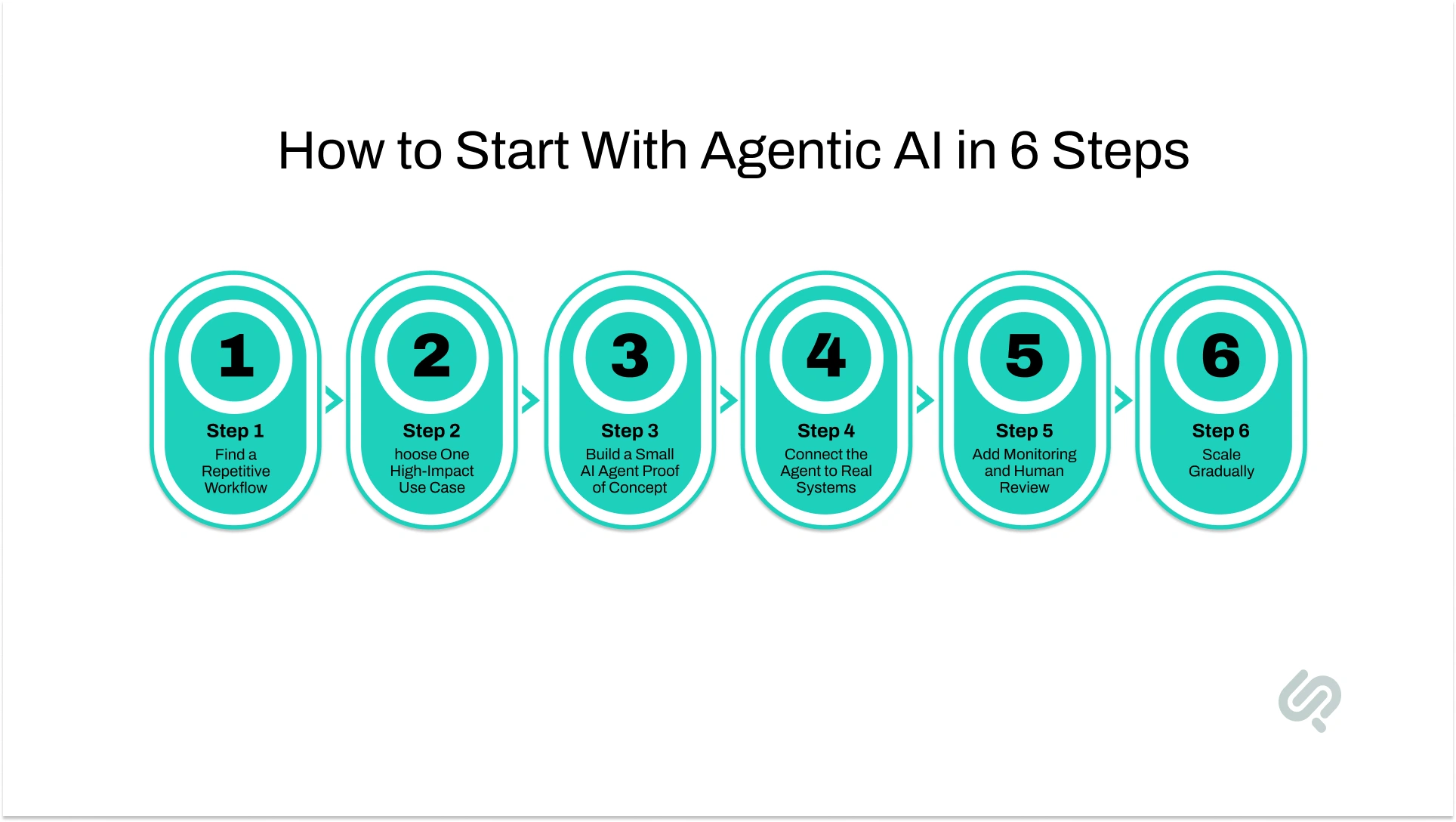
You do not need to rebuild your entire business around Agentic AI on day one. Start with one workflow. Prove the value. Then scale what works.
Andrew Ng, founder of DeepLearning.AI, has also highlighted the importance of workflows over hype (5):
“I think AI agent workflows will drive massive AI progress this year — perhaps even more than the next generation of foundation models.”
That is exactly where UAE businesses should focus first: not on building the most complex AI system, but on finding one workflow where an AI agent can plan, act, review, and improve the outcome.
Start with tasks your team handles again and again.
Good examples include:
High-frequency workflows usually show ROI faster because even small time savings add up quickly.
Do not start with five AI ideas at once.
Pick one workflow where an AI agent can clearly save time, reduce errors, improve response speed, or remove repetitive manual work.
Before investing in a full system, test the idea with a focused AI proof of concept.
This helps validate:
Agentic AI becomes useful when it connects with your actual tools.
That could include your CRM, ERP, support platform, database, cloud system, internal dashboard, or business application.
This is what allows the AI agent to take real action, not just generate text.
AI agents should not run without visibility.
Track outputs, review decisions, manage exceptions, and add approval steps where needed. Human-in-the-loop controls help keep the system safe, accurate, and aligned with your business rules.
Once one workflow delivers measurable results, expand to related processes.
The first successful AI agent becomes your blueprint for future automation.
Phaedra Solutions built an AI-powered social media content pipeline that turns a topic, niche, audience, tone, and goal into ready-to-review video content. Instead of manually researching, scripting, designing, editing, and preparing posts, the workflow moves from idea to script, visuals, video, and platform-ready content in minutes.
The system includes automated topic discovery, content generation, multi-platform publishing support, approval steps, and feedback loops. It shows what Agentic AI can do for businesses: connect multiple tasks, reduce manual effort by 80–90%, keep teams in control, and help work move from idea to execution faster.
Agentic AI can create real value, but only when it is built on the right foundation. If companies rush into automation without fixing workflows, data, security, and governance, AI can create more confusion instead of more efficiency.
AI will not fix a broken process by itself.
If approvals are unclear, ownership is messy, or teams follow different steps for the same task, automation will only make the confusion move faster.
Before building an AI agent, map the workflow first.
AI agents depend on the data behind them.
If customer records are outdated, reports are incomplete, or systems are disconnected, the agent may miss context, give weak recommendations, or take the wrong next step.
AI agents should not have open access to sensitive systems.
Start with limited permissions, clear approval layers, audit logs, and human review for high-risk actions. Expand access only when the agent proves reliable.
The safest path is to start small.
One focused AI agent with measurable results is better than five unfinished pilots. Start with one workflow, prove ROI, and then expand.
Agentic AI is not just a smarter chatbot.
A chatbot answers. An AI agent acts. It can connect to tools, update systems, trigger workflows, monitor results, and escalate issues when needed.
Businesses that understand this difference will build systems that do more than talk. They will build systems that help work move faster.
The UAE’s Agentic AI government plan shows where the market is heading: faster services, connected systems, smarter workflows, and AI that can do more than answer questions.
But your business does not need to automate everything at once.
The best next step is to choose one high-impact workflow and turn it into a working AI agent. That could be customer support, lead follow-up, document review, reporting, internal approvals, compliance checks, or any repetitive process that slows your team down today.
Through our AI agent development services, Phaedra Solutions helps UAE businesses design and build custom AI agents that connect with real workflows, business systems, and measurable outcomes.
We help you define the use case, connect the right tools, add human review, and build an AI agent that can support real execution, not just generate answers.
Start with one workflow. Prove the value. Then scale what works.
Ready to explore your first AI agent?
Book an AI Agent Development Consultation with Phaedra Solutions and identify the best workflow to automate first.



Ameena is a content writer with a background in International Relations, blending academic insight with SEO-driven writing experience. She has written extensively in the academic space and contributed blog content for various platforms.
Her interests lie in human rights, conflict resolution, and emerging technologies in global policy. Outside of work, she enjoys reading fiction, exploring AI as a hobby, and learning how digital systems shape society.