

.webp)


.webp)
.webp)
.webp)






AI automation in healthcare means using AI, RPA, machine learning, and connected workflow systems to reduce manual work across billing, claims, scheduling, EHR documentation, prior authorization, and patient communication.
For healthcare leaders, the value is simple: fewer admin bottlenecks, fewer errors, faster operations, and more time for patient care.
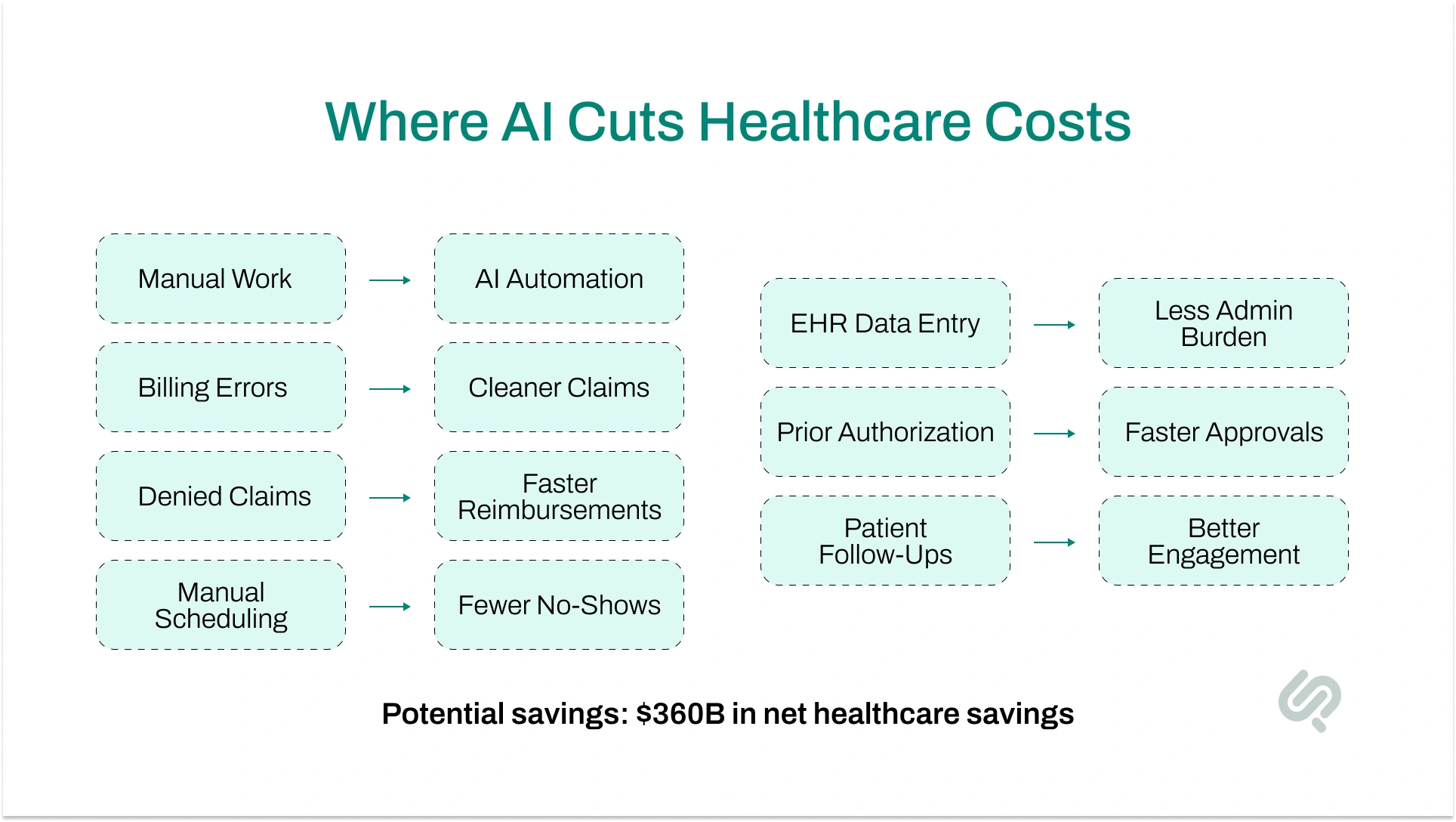
Healthcare is one of the most expensive industries to run, and much of that cost comes from work that does not directly involve treatment: billing errors, repeated paperwork, denied claims, manual scheduling, data entry, and staff burnout.
That is why hospitals, clinics, payers, and digital health companies are now using healthcare workflow automation to cut costs by 40–80% in specific workflows, depending on process volume, complexity, integrations, and data quality.
This guide breaks down where the savings come from, which workflows are being automated, what implementation really costs, and how to choose the right automation path for your healthcare organization.
AI automation in healthcare means using AI, RPA, machine learning, and workflow automation to handle repetitive healthcare tasks such as billing, claims processing, scheduling, EHR documentation, prior authorization, and patient follow-ups.
AI reduces healthcare costs by cutting manual admin work, lowering billing errors, reducing claim denials, improving staff productivity, decreasing no-shows, and speeding up reimbursement cycles.
The best workflows to automate first are high-volume, repetitive, and easy to measure. Common starting points include medical billing automation, claims processing, patient scheduling, prior authorization, EHR data entry, and appointment reminders.
The cost of AI in healthcare depends on workflow complexity, system integrations, compliance needs, and solution type. Small tools may cost tens of thousands per year, while custom enterprise automation can range from $75K to $500K+.
AI automation can be HIPAA-compliant if the system protects PHI, uses secure access controls, includes audit logs, encrypts data, and the vendor signs a Business Associate Agreement when required.
RPA handles fixed rule-based tasks. AI workflow automation understands data, documents, and patterns. Agentic AI in healthcare can complete multi-step workflows, such as checking insurance, scheduling a visit, updating the EHR, and sending patient reminders.
Healthcare teams are under pressure from every side: rising admin costs, staff shortages, billing delays, denied claims, patient access issues, and clinician burnout.
That is why hospitals, clinics, payers, and digital health companies are turning to healthcare workflow automation. The goal is not to replace doctors, nurses, or admin teams. The goal is to remove repetitive work that slows care and increases cost.
The biggest automation opportunities are usually around:
McKinsey has projected that AI, machine learning, and deep learning could create up to $360 billion in net healthcare savings. CAQH also found that the U.S. healthcare industry could save $18.3 billion by moving administrative transactions to fully electronic workflows. (1)
This is why AI in healthcare administration is becoming a boardroom priority. The clearest ROI is not only in advanced clinical AI. It is in reducing the daily admin waste around care.
AI automation in healthcare works by connecting healthcare systems, patient data, admin tasks, and clinical workflows so teams spend less time on manual work and more time on care.
Most healthcare automation solutions work in three layers.
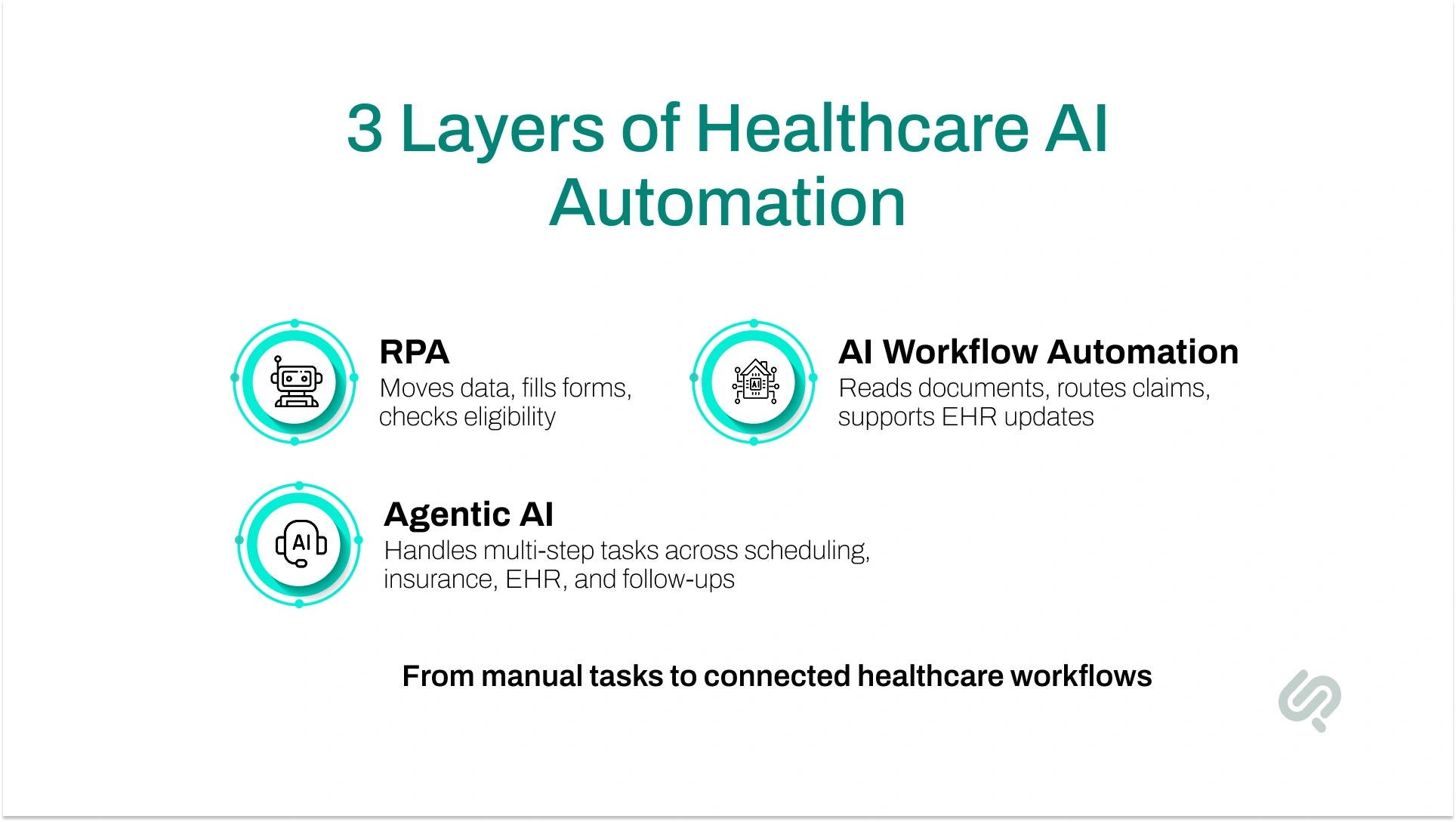
Robotic process automation in healthcare handles repetitive, rule-based tasks that staff typically handle manually.
RPA bots can:
This is often the first step because it gives quick wins with lower risk.
The next layer uses AI, machine learning, OCR, and NLP to read, understand, and process healthcare documents.
This helps with:
This is where healthcare automation benefits become easier to measure: fewer errors, faster processing, cleaner claims, and less rework.
The most advanced layer includes conversational AI in healthcare, AI chatbots, and agentic AI workflows.
These systems can support multi-step tasks such as:
For example, an AI agent could help a patient reschedule an appointment, verify insurance, update the EHR, and send a confirmation without staff handling every step manually.
Not every healthcare workflow should be automated at once. The best starting point is a workflow with high volume, high manual effort, clear rules, and measurable cost impact.
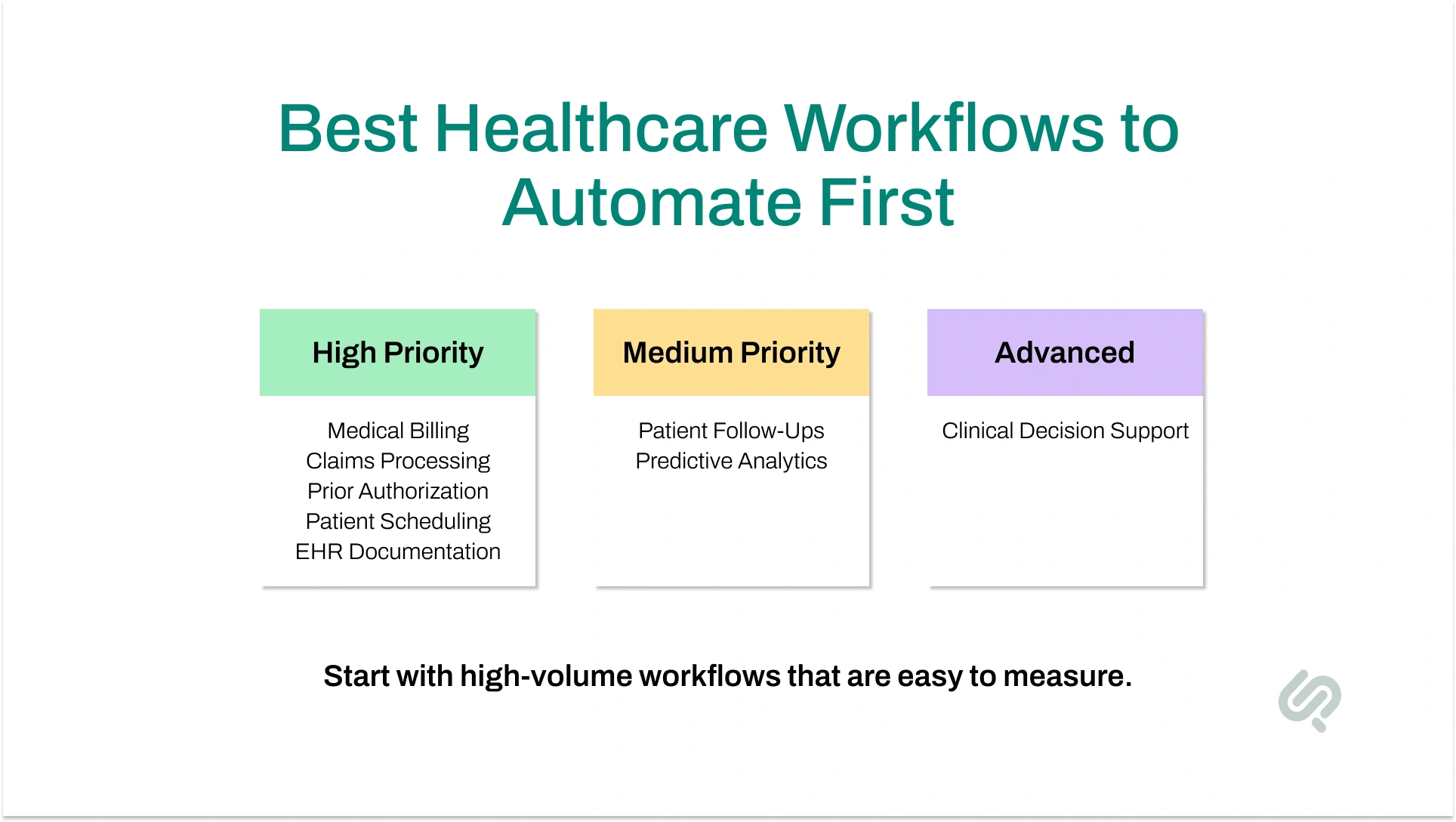
Use this simple priority model:
For most healthcare organizations, the safest first step is not a massive AI transformation project. It is a focused pilot in one workflow where ROI can be tracked within weeks or months.
A good first project should answer three questions:
If the answer is yes, that workflow is a strong candidate for automation.
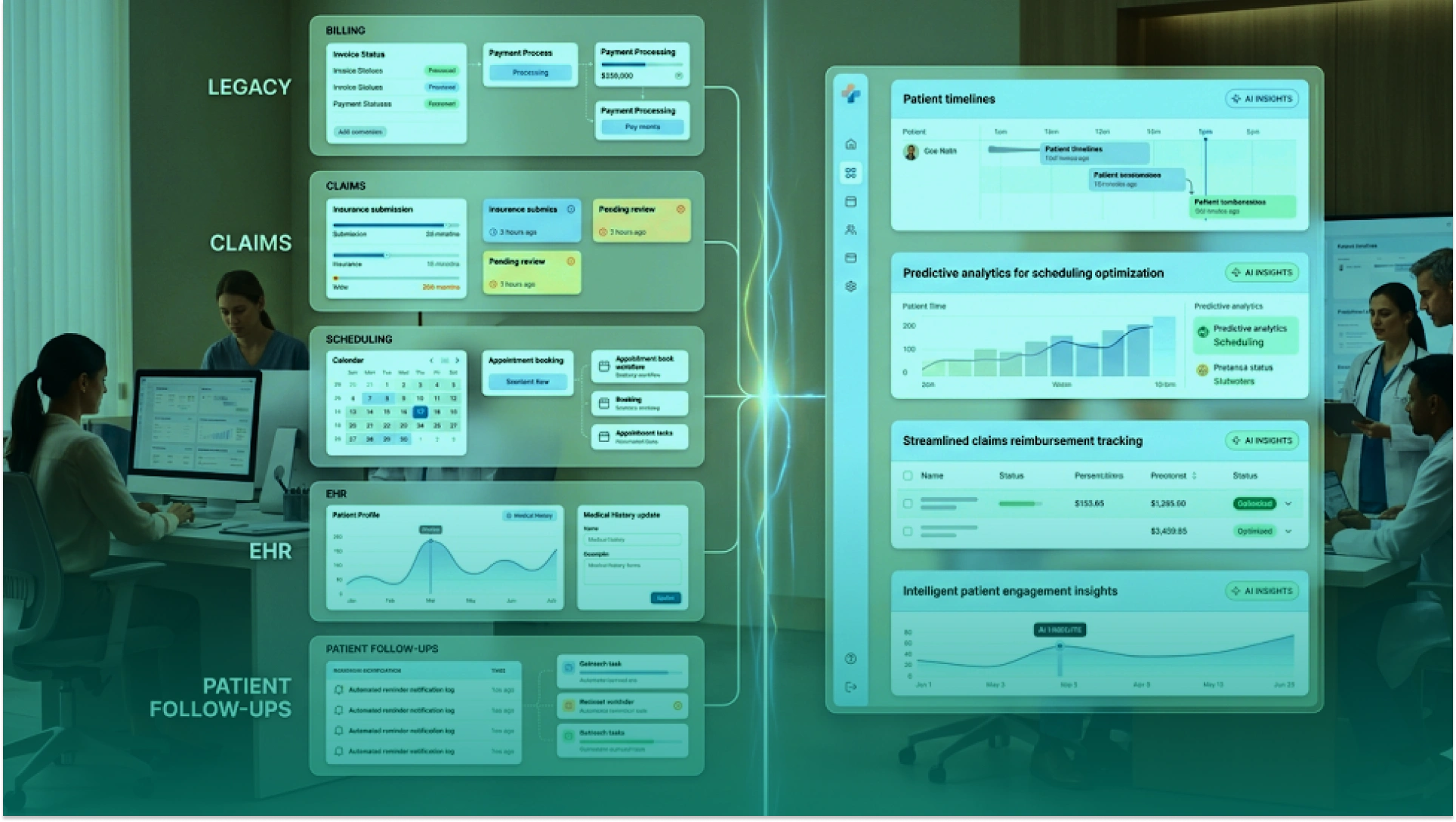
Healthcare teams are already using AI to reduce admin pressure, improve patient access, and cut operational waste.
From medical billing automation to AI in EHR automation, these healthcare automation solutions are helping hospitals, clinics, and payers save money while improving speed and accuracy.
Below are 7 high-impact workflows where AI is already creating measurable value.
Manual billing is one of the biggest cost drivers in healthcare administration. Every missed code, incomplete form, or delayed eligibility check can lead to claim denials and lost revenue.
With medical billing automation, AI tools can:
According to the CAQH 2023 Index Report, fully automating the medical billing workflow could save the US healthcare system $16.3 billion per year. (2)
Medical coding is time-consuming, detail-heavy, and highly prone to human error. A single wrong or missing code can delay payment, trigger a denial, or create compliance risk.
Modern medical coding automation tools use AI and NLP to read clinical notes and suggest ICD-10, CPT, and HCPCS codes in real time. This helps coding teams work faster without sacrificing accuracy.
AI coding tools can support:
In documented deployments, AI-powered coding assistants have reported 30–50% productivity gains and 15–25% accuracy improvements. (3)
Claims processing is one of the most manual and expensive workflows in healthcare. A single claim may pass through several people, systems, and review steps before it is approved or denied.
AI in claims processing helps automate this process by checking claims before submission, detecting duplicate billing, identifying fraud patterns, and routing clean claims for faster approval.
AI can help teams:
Patient scheduling still depends heavily on phone calls, front desk staff, and manual follow-ups. This creates delays for patients and unnecessary workload for healthcare teams.
Automated patient scheduling systems allow patients to book, cancel, and reschedule appointments through web, text, or chatbot support, without waiting on hold.
These systems can:
Electronic Health Records were meant to simplify documentation, but for many providers, they have created more administrative burden. Doctors spend hours each day updating records, writing notes, entering data, and searching through patient files.
AI in EHR automation helps reduce this burden by using AI scribes, automated data entry, and intelligent documentation tools.
AI can support:
Deloitte reported that AI tools reducing EHR burden could give physicians back 1–2 hours per day. This is one of the clearest healthcare automation benefits, because it directly improves provider productivity and reduces burnout. (4)
Prior authorization is one of the most frustrating workflows in healthcare. It slows down treatment, increases admin workload, and creates stress for both patients and providers.
AI can simplify prior authorization by checking requirements, auto-filling forms, attaching clinical documentation, tracking submission status, and learning from past approval patterns.
AI automation can help:
Patient engagement often drops after the appointment ends. Staff rarely have enough time to follow up with every patient, send reminders, answer common questions, or manage chronic care check-ins manually.
AI-driven patient engagement uses conversational AI in healthcare, SMS bots, voice assistants, and AI chatbots in healthcare to keep patients connected between visits.
These tools can help with:
Healthcare organizations are already using AI to reduce admin workload, improve documentation, and speed up operational workflows.
CAQH found that the U.S. healthcare industry could save $18.3 billion by moving more administrative transactions to fully electronic workflows (5). This supports the business case for automating eligibility checks, prior authorization, claims, attachments, and payments.
The Permanente Medical Group reported that ambient AI scribes saved Northern California physicians the equivalent of 1,794 working days in one year. This shows how documentation automation can reduce workload and improve physician-patient communication. (6)
Claims, eligibility checks, and prior authorization are strong automation starting points because they are repetitive, rules-heavy, and expensive to manage manually.
These examples show where AI automation creates the clearest ROI: fewer manual steps, faster admin workflows, and less staff burden.
Most healthcare automation reduces current waste. AI predictive analytics in healthcare helps prevent future costs before they happen.
It can help healthcare teams forecast:
For example, instead of reacting to a missed appointment, AI can predict which patients are most likely to miss one and trigger reminders, transport support, or follow-up outreach earlier.
This makes predictive analytics a strong next step after basic workflow automation is already working.
Generative AI in healthcare is useful when teams need to summarize, draft, explain, or process large amounts of healthcare content.
It can support:
The value is not just faster writing. The value is less documentation burden, clearer patient communication, and fewer repetitive admin steps.
For sensitive workflows, human review should stay in place before anything is sent, submitted, or added to the medical record.
The cost of AI in healthcare depends on the workflow, data quality, number of integrations, compliance requirements, and whether the solution is SaaS-based, custom-built, or hybrid.
Here is a practical cost range:
The lowest-cost option is usually a single-purpose SaaS tool. The highest-value option is often custom workflow automation that connects multiple systems and removes manual work between them.
For example, a scheduling tool may reduce calls. But a connected workflow can handle scheduling, intake, reminders, eligibility checks, and follow-ups together.
That is where the ROI becomes stronger.
Healthcare teams usually have three options when adopting automation.
For many healthcare organizations, the best approach is hybrid.
Use proven tools where they fit. Then build custom automation around the gaps between your EHR, billing system, claims platform, scheduling tool, and patient communication channels.
The goal is not to replace every system. The goal is to connect the systems you already use and remove the manual work between them.

Healthcare automation isn't without friction. Here are the most common challenges organizations face — and the honest reality of how to handle them:
Most healthcare organizations run on legacy EHR systems (Epic, Cerner, Meditech) that were not built for easy API integration. Connecting AI tools to these systems takes time and technical expertise.
Reality: Modern healthcare AI vendors have pre-built connectors for the major EHR systems. Ask any vendor specifically about their Epic/Cerner integration record before signing a contract.
In one healthcare modernization project, Phaedra Solutions helped a US-based lab management platform fix the legacy foundation before scaling automation. The team rebuilt key backend and database layers, modernized the web app with React/Next.js, and added CI/CD pipelines — resulting in 40% faster performance, 50% fewer release-related issues, and smoother lab workflows.
Clinical and administrative staff often fear that automation means job cuts. This creates adoption resistance that can kill even a well-designed implementation.
Reality: The most successful deployments frame automation as removing tasks people hate (data entry, insurance phone calls) rather than removing jobs. Staff buy-in improves when they see automation taking the most tedious parts of their day.
AI systems are only as good as the data they're trained on. If your EHR is full of inconsistent, incomplete, or duplicate records, automation will surface and amplify those problems.
Reality: A data quality audit should be the first step of any AI implementation project. Most vendors can help with this — but it needs to be budgeted for.
Any AI tool handling Protected Health Information (PHI) must be HIPAA-compliant and typically requires a Business Associate Agreement (BAA) with the vendor.
Reality: All reputable healthcare AI vendors operate with HIPAA compliance as a baseline. Always verify before signing, and involve your compliance officer early.
Before choosing any healthcare automation solutions provider, confirm the basics.
Ask:
This matters most for workflows involving protected health information, such as AI in EHR automation, AI in claims processing, patient communication, billing, coding, and prior authorization.
A successful healthcare automation project should not start with tools. It should start with workflow clarity.
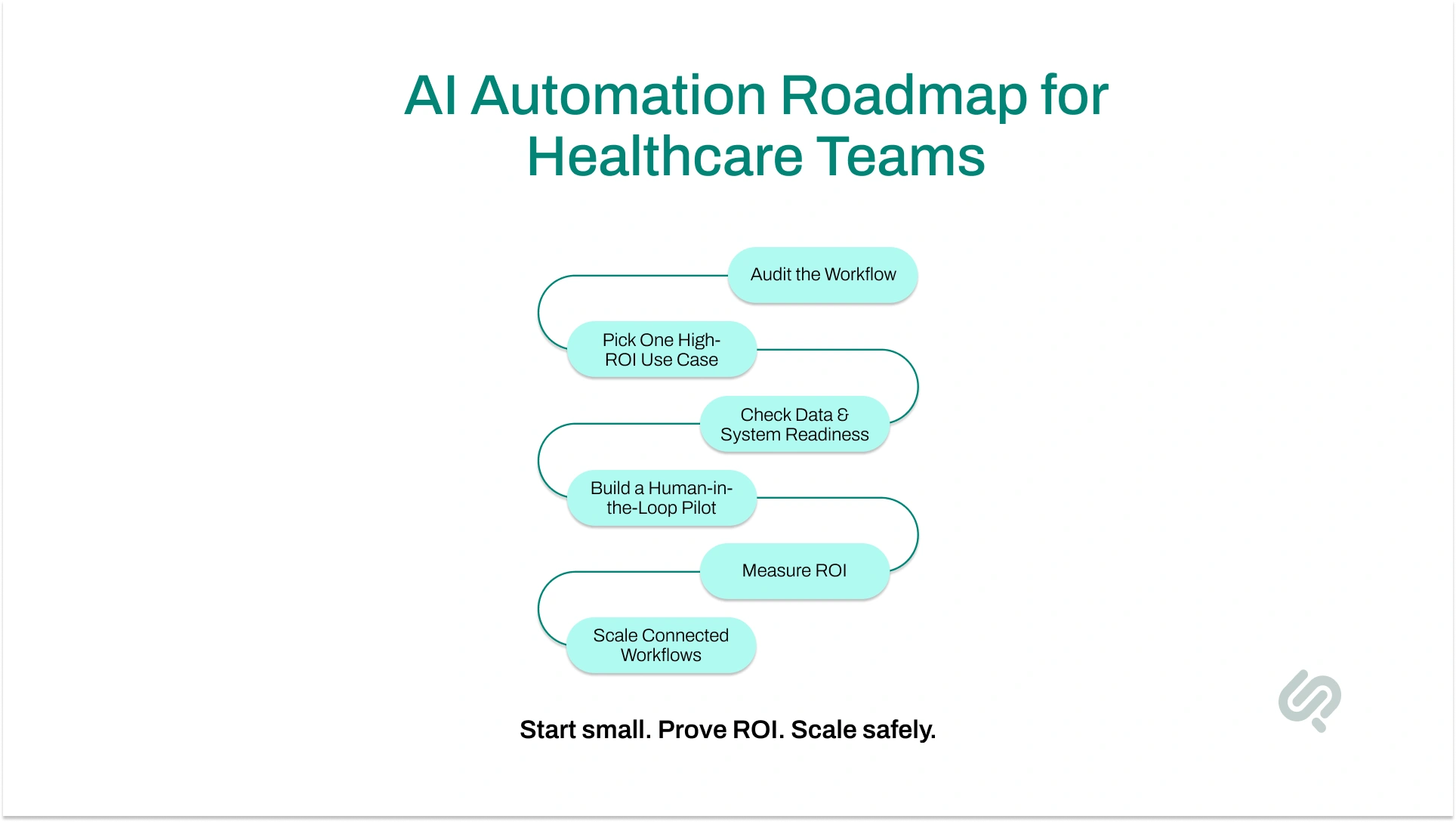
Map the current process from start to finish.
Look at:
This helps you find the biggest cost leaks before choosing any tool.
Start with one workflow, not ten.
Strong first use cases include:
A focused pilot is easier to test, easier to manage, and easier to prove.
Before development begins, review your systems and data quality.
Check:
If your data is messy, automation will expose the problem faster. A readiness audit helps avoid delays later.
AI should support healthcare teams, not operate blindly.
Keep human review for sensitive workflows such as:
As AMA CEO John Whyte, MD, MPH, has said, healthcare AI should be designed to “enhance—not replace—physicians.”
That is the right mindset for healthcare automation: AI handles repetitive work, while people stay in control of important decisions.
Track simple business metrics from day one.
Useful metrics include:
The goal is not just to “use AI.” The goal is to prove measurable operational improvement.
Once one workflow proves ROI, expand into connected workflows.
For example:
This is how digital health automation moves from a small pilot to a scalable operating model.
The biggest healthcare savings usually come from the workflows your team repeats every day: billing checks, claim follow-ups, prior authorization, patient scheduling, EHR updates, intake forms, and patient communication.
Phaedra Solutions helps healthcare teams build AI workflow automation services that reduce manual work, connect existing systems, and create measurable cost savings without disrupting patient care.
We help you:
As Hammad Maqbool, Head of AI at Phaedra Solutions, puts it:
“The safest ROI in healthcare AI comes from reducing the friction around care — billing errors, scheduling delays, claims follow-ups, and repetitive data entry. AI should not replace clinical judgment. It should remove operational waste so healthcare teams can spend more time with patients.”
If you want to see where automation can reduce costs in your healthcare operations, start with a free 30-minute call.


1. https://www.mckinsey.com/featured-insights/quote-of-the-day/june-18-2024
2. https://www.caqh.org/blog/2023-caqh-index-report-reveals-transformative-forces
3. https://www.fortegrp.com/insights/ai-coding-assistants
4. https://www.soapnoteai.com/soap-note-guides-and-example/healthcare-ai-trends-2026/
5. https://www.caqh.org/hubfs/43908627/drupal/2024-01/2023_CAQH_Index_Report.pdf
7. https://www.ama-assn.org/practice-management/physician-health/national-physician-burnout-survey

Ameena is a content writer with a background in International Relations, blending academic insight with SEO-driven writing experience. She has written extensively in the academic space and contributed blog content for various platforms.
Her interests lie in human rights, conflict resolution, and emerging technologies in global policy. Outside of work, she enjoys reading fiction, exploring AI as a hobby, and learning how digital systems shape society.