

.webp)


.webp)
.webp)





If you are planning to hire an AI development company in 2026, the real question is not just cost. It is speed, control, talent, risk, and ROI.
AI is now on the business roadmap. Leadership teams expect faster automation, smarter products, and measurable results. But building AI is not the same as hiring a few developers. You need data engineering, model strategy, AI testing, cloud deployment, security, and ongoing optimization.
For most businesses, hiring an AI development company is the faster and lower-risk way to launch an AI proof of concept, workflow automation system, chatbot, prediction model, or AI-powered product feature.
Building an in-house AI team makes more sense when AI is your core product, your data is highly sensitive, or long-term model ownership is a competitive advantage.
This guide compares both options clearly so you can decide whether to outsource AI development, build in-house, or use a hybrid model that gives you speed now and ownership later.
Hire an AI development company if you need faster delivery, specialized AI expertise, or a first AI project launched without long hiring delays. Build in-house if AI is your core product, your data is highly sensitive, or long-term AI ownership is critical.
The biggest benefit is speed. You get access to AI engineers, data experts, cloud specialists, and delivery teams without spending months recruiting and onboarding an internal team.
Usually, yes for the first project or first year. A focused AI development company engagement may cost $150K–$450K, while a full in-house AI team can cost $1.5M–$2.5M in year one when salaries, tools, cloud, benefits, and management are included.
An in-house AI team makes more sense when AI is your main product, your models create long-term competitive advantage, or your business needs full control over sensitive data, research, and product decisions.
For many businesses, the best model is hybrid. Start with an AI development company to launch faster and prove ROI, then build internal AI ownership as the system becomes more strategic.
Check case studies, data engineering skills, AI deployment experience, security practices, pricing clarity, ownership terms, and post-launch support. A good AI partner should explain the business case, not just the technology.
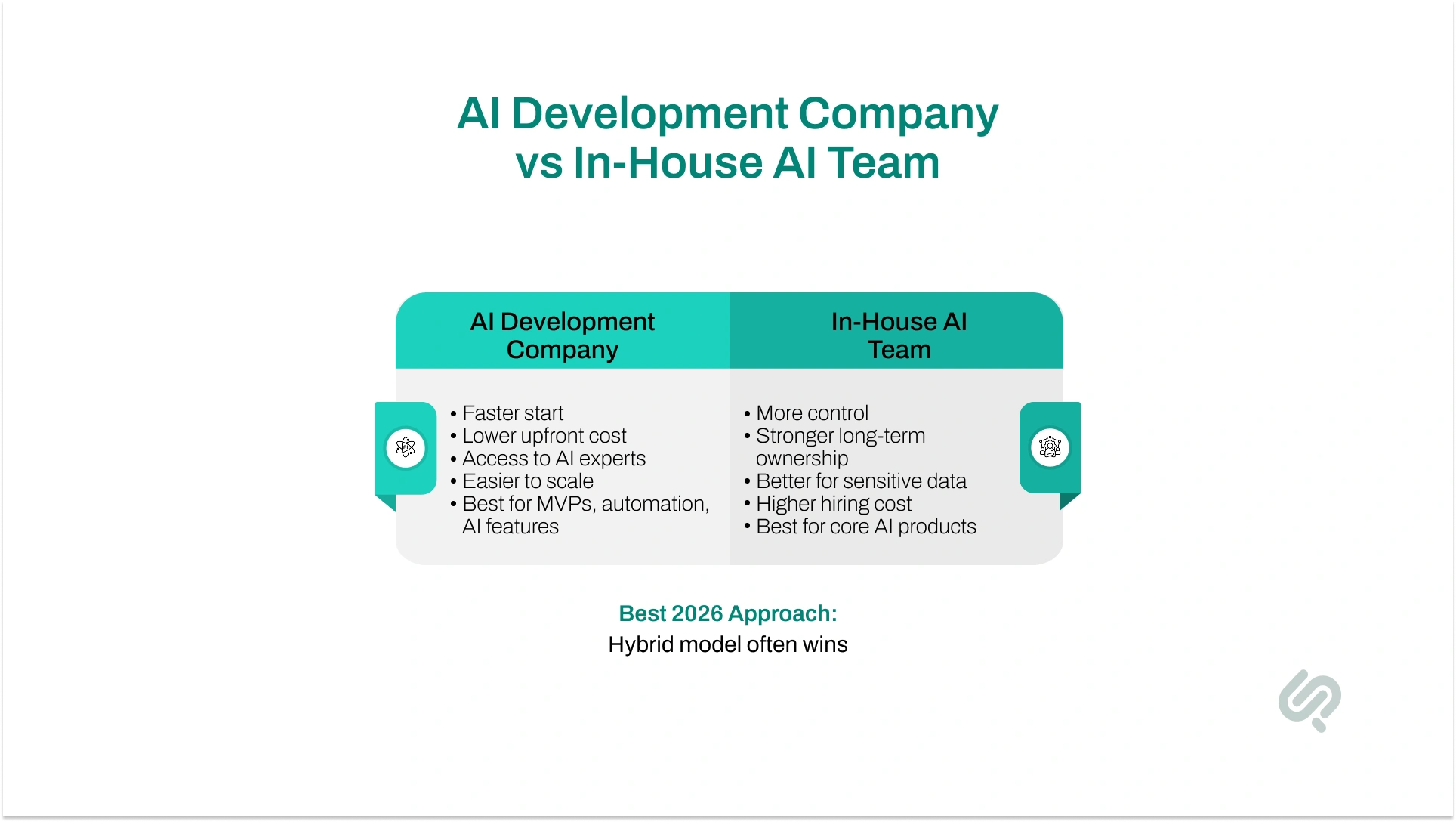
For most businesses in 2026, the best path is not fully outsourced or fully in-house. Start with an AI development company to move faster, prove ROI, and reduce hiring risk, then build internal AI ownership as the system becomes more strategic.

You should hire an AI development company when your business needs AI results faster than your internal team can hire, train, and build.
This is usually the better option when you want to launch an AI proof of concept, automate business workflows, add AI features to an existing product, or test AI ROI before building a full internal team.
You should consider an external AI partner if:
For many businesses, the smartest first step is not hiring five full-time AI specialists. It is choosing one high-value use case, building it with an experienced AI partner, measuring the result, and then deciding whether to scale externally, internally, or with a hybrid model.
Hiring an AI development company can help you move faster and control costs. But in-house AI still makes sense when AI is central to your business.
An internal AI development team is usually better when:
The simple rule: choose in-house AI when long-term ownership matters more than short-term speed.
Deloitte’s State of AI in the Enterprise found that 65% of companies treating AI as a core competitive differentiator prefer building internal AI capabilities instead of relying fully on vendors. (1)
If AI supports your product, outsourcing may be faster. If AI is your moat, in-house ownership may be worth the cost.
Building an in-house AI team sounds simple until you start hiring.
Real AI development needs more than one AI engineer. You may need ML engineers, data engineers, backend developers, MLOps experts, cloud support, QA, security, and product leadership.
That creates three big challenges:
This is why many companies use outsourcing as one of their fastest AI talent shortage solutions.
When you hire an AI development company, you get access to a complete AI development team without waiting months to recruit one. You can start with a focused use case, test ROI, and then decide if building internal AI capacity makes sense later.
In-house AI is still valuable when AI is core to your product. But if your main goal is speed, validation, or workflow automation, an external AI partner can help you move faster with less hiring risk.
Most companies underestimate in-house AI costs because they only count salaries.
But a real AI development team needs more than one AI engineer. You also need data engineering, cloud infrastructure, security, product leadership, testing, and ongoing model maintenance.
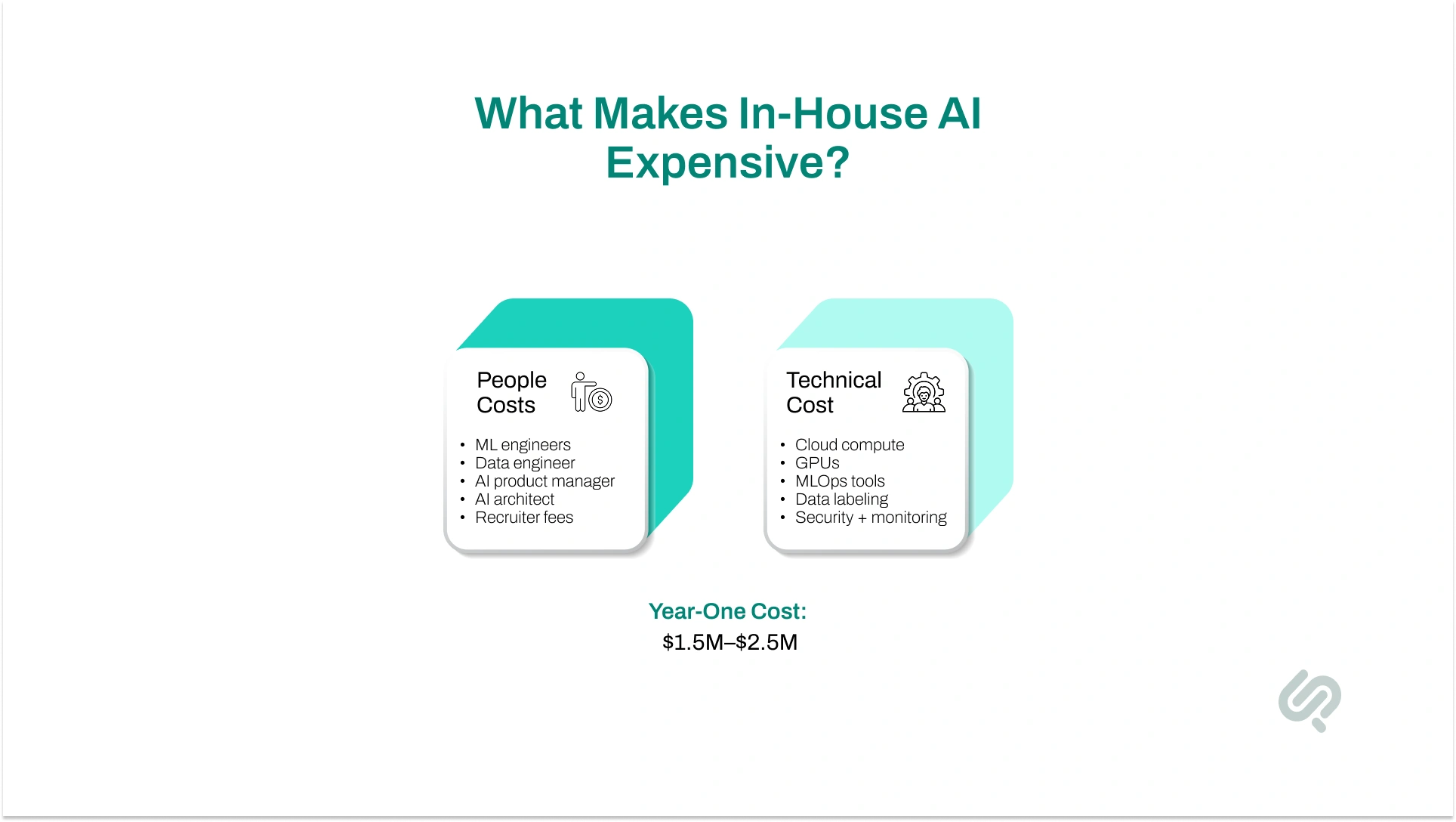
A basic in-house team may include:
That alone can bring people costs close to $900K–$1.2M before infrastructure.
Then come the technical costs:
You also need to add benefits, taxes, onboarding time, management overhead, and possible delays from hiring gaps or turnover.
So the real AI implementation cost breakdown is not just “Can we hire AI developers?” It is “Can we fund, manage, and retain a full AI team long enough to get results?”
For many businesses, a 4–5 person in-house AI team can cost $1.5M–$2.5M in year one.
That does not mean in-house AI is wrong. It makes sense when AI is core to your product, your data is highly sensitive, or long-term ownership matters most.
The cost to hire an AI development company depends on the project scope, data quality, integrations, timeline, and level of customization.
Most AI development services are priced in three ways.
This works best when the scope is clear.
Use this model for defined projects like:
It gives you better budget control, but less flexibility if the scope changes later.
This works best when the project may evolve.
You pay for the actual time used by AI engineers, data experts, developers, designers, and QA teams. This model is useful when you are still testing the use case, improving the data, or building the AI product in stages.
It gives more flexibility, but it needs clear project management to control costs.
This works best when you need long-term AI development support.
A dedicated team can include AI engineers, data engineers, backend developers, QA, DevOps, and a project lead. It gives you access to a full AI development team without hiring full-time employees.
A complex AI system with integrations, data pipelines, monitoring, and deployment may cost $300,000–$450,000+.
This is why the AI implementation cost breakdown matters. You are not just paying for a model. You are paying for planning, data work, engineering, testing, deployment, and support.
For many businesses, outsourcing AI development is cheaper than building a full team first because it removes months of hiring, onboarding, team setup, and trial-and-error.
The smarter path is often simple: start with an AI development partner, prove the use case, measure ROI, and then decide whether to scale internally.
Most AI cost comparisons focus on monthly spend. But speed can matter just as much as cost.
If your competitor launches an AI-powered feature in Q2 and you launch in Q4 because you spent months hiring, you lose more than time. You lose customer feedback, market learning, revenue opportunities, and competitive momentum.
That is why speed is a major factor in the in-house vs outsourced AI development decision.
An experienced AI development company usually brings:
An in-house team may be better for long-term ownership, but it often starts from scratch. The team must learn your business, data, systems, and AI goals while also building the technical foundation.
That can slow the AI development timeline.
IBM’s Institute for Business Value reports that 77% of businesses cite slow AI implementation as a top obstacle to realizing AI ROI (2)
When you hire an AI development company, you are not just paying for development. You are paying to reduce delays, avoid common mistakes, and move from AI planning to execution faster.
Before you hire an AI development company, make sure the proposal explains more than just price and timeline.
A strong AI proposal should clearly show what will be built, how it will work, how risks will be managed, and what your business will own after launch.
Your proposal should include:
A weak proposal usually focuses only on features. A strong proposal explains the full path from business problem to production AI system.
This is one of the most important parts of AI development partner selection because it protects your budget, timeline, and long-term ownership.
AI should not be built just because it sounds advanced. It should solve a real business problem.
Before you invest in AI development services, define what success looks like. This helps you avoid vague AI projects that look impressive but do not create measurable value.
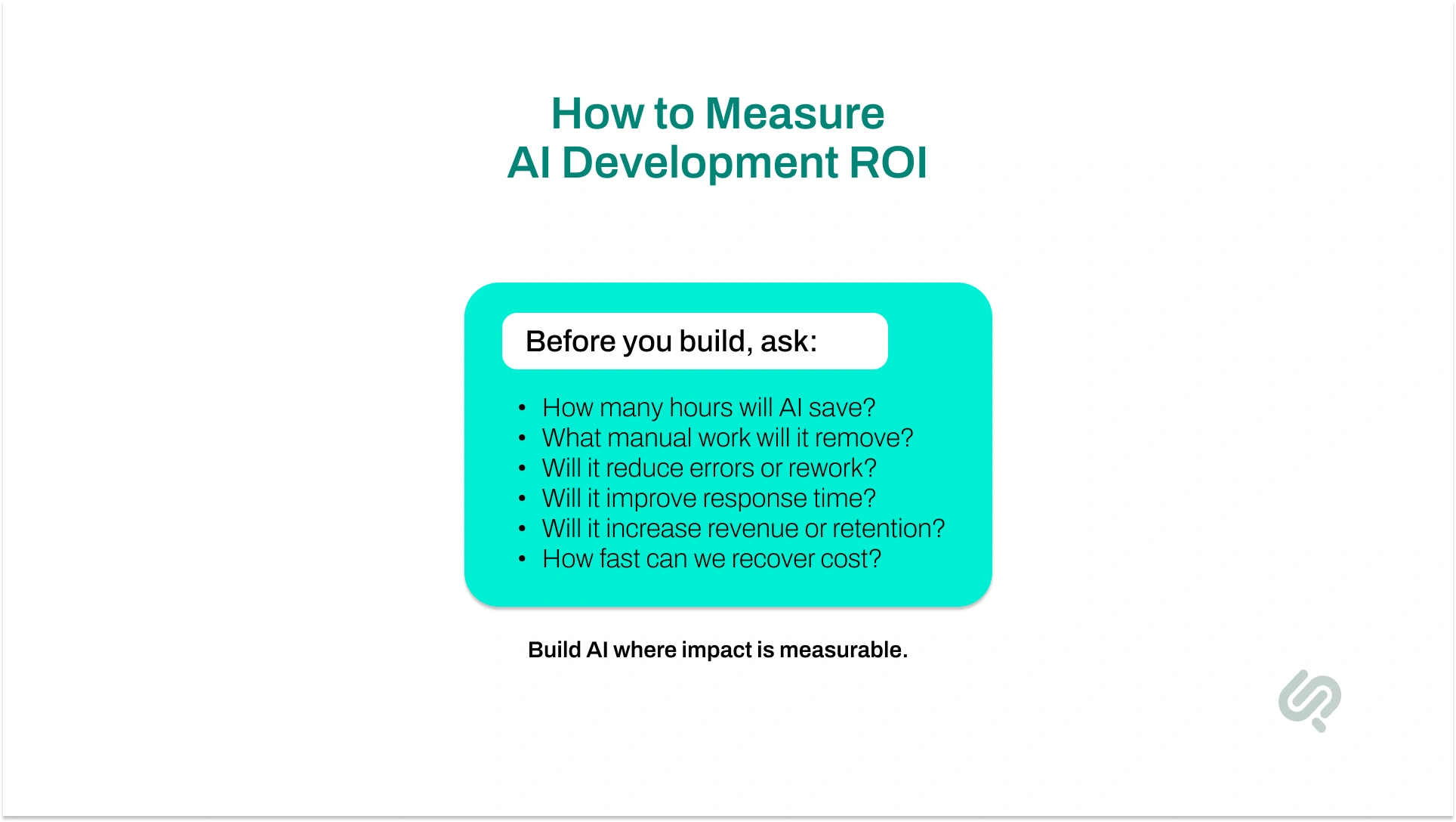
Ask these questions before development starts:
For example, an AI workflow automation project may create ROI by reducing manual research, data entry, claim checks, report generation, or customer follow-ups.
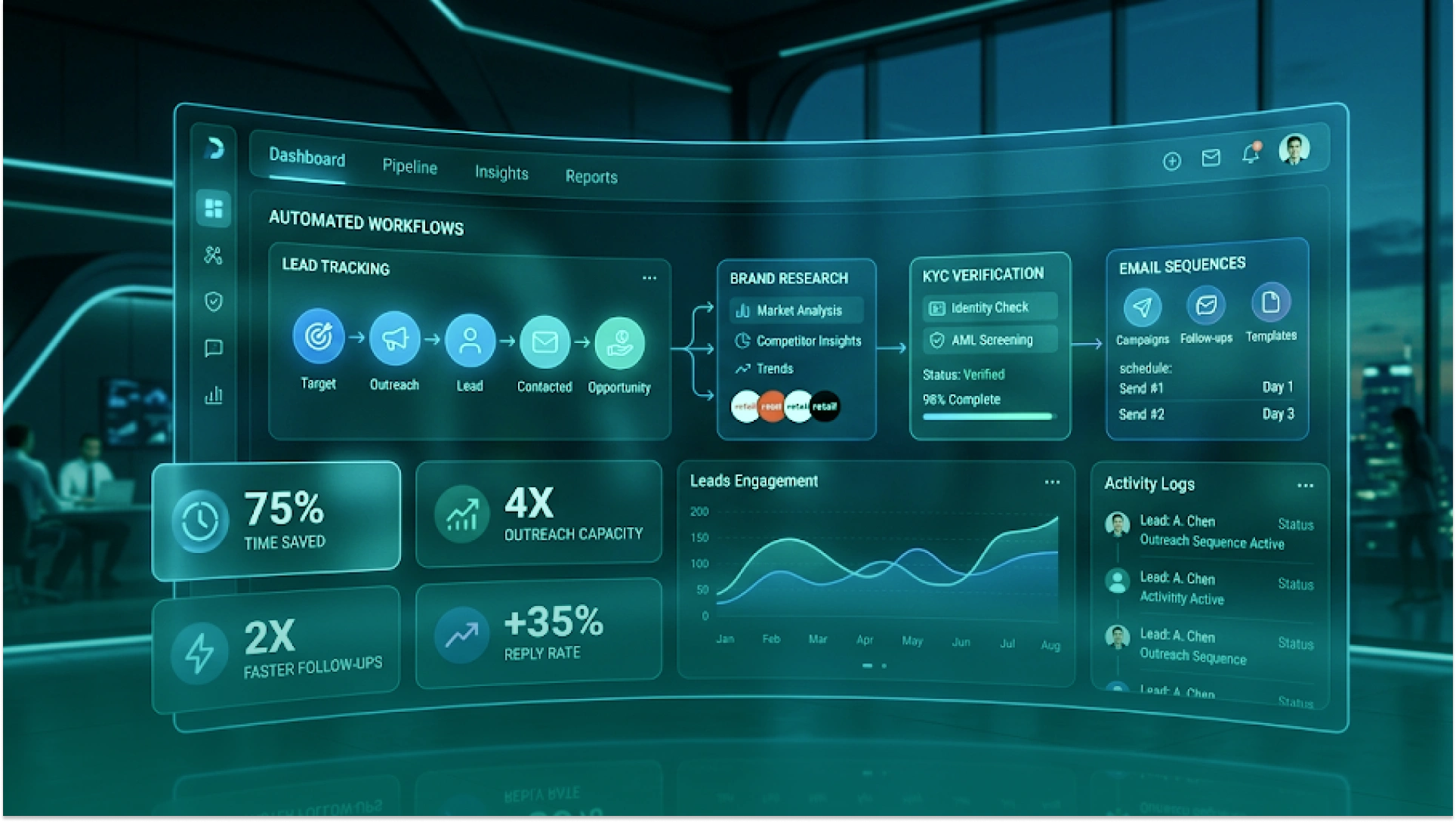
An AI product feature may create ROI by improving onboarding, personalization, recommendations, search, or user engagement.
The goal is simple: build AI where the business impact is clear. A good AI development partner should help you connect the technical build to real business outcomes before writing a single line of code.
In 2026, the smartest companies are not choosing only in-house or only outsourced AI development.
They are using a hybrid model.
A small internal team owns AI strategy, data governance, vendor selection, and production oversight. An external AI consulting company or development partner handles execution, including model development, integrations, testing, deployment, and MLOps setup.
After launch, the internal team takes more ownership. They monitor performance, manage risks, retrain models, and make sure the system keeps supporting business goals.
This model works because it gives you speed without losing control. You can move faster with an experienced partner while slowly building internal AI knowledge.
That is why hybrid makes sense. Even if you outsource development, your business still needs internal people who can guide the strategy, ask the right questions, and own the results.
The in-house vs outsourced AI development decision becomes easier when you stop thinking in theory and answer practical business questions.
Use these five questions to decide which model fits your company.
If AI is the product, build internal capability over time.
For example, if you are building an AI healthcare platform, fraud detection engine, trading model, or proprietary recommendation system, your AI models are part of your competitive advantage.
But if AI supports your product, like adding automation, chat, search, document processing, or workflow intelligence, hiring an AI development company can help you move faster without building a full team first.
Your data should guide your development model.
If your data is clean, accessible, and not heavily regulated, outsourced AI development is often easier to manage.
But if your system uses patient records, financial data, legal files, government data, or proprietary training datasets, you may need stronger internal control. In some cases, a hybrid model works best: the partner builds inside your approved environment while your team controls access, compliance, and governance.
Many companies want an internal AI development team, but few can attract and retain the right people quickly.
If you cannot compete on salary, technical brand, infrastructure, or long-term AI career growth, building in-house may take longer than expected.
In that case, outsourcing can act as one of the fastest AI talent shortage solutions. You get access to AI engineers, data experts, and deployment specialists without waiting months to recruit them.
A one-time AI project is usually better outsourced.
Examples include:
But if the AI system keeps learning from live data, supports core product decisions, and evolve for years, you should plan for internal ownership over time.
That does not mean you must build everything internally from day one. You can start with an external partner, prove the value, then bring more ownership in-house.
This question often reveals the right answer.
If a six-month delay affects revenue, investor confidence, customer retention, or competitive position, outsourcing may be the smarter first move. A strong partner can shorten the AI development timeline and help you launch faster.
If the timeline is flexible and AI is a long-term strategic investment, you may have more room to build an internal team slowly.
Not every company offering AI development services can build production-ready AI systems.
Some teams can build a demo, but they may not understand data pipelines, AI testing, cloud deployment, security, monitoring, or long-term model performance.
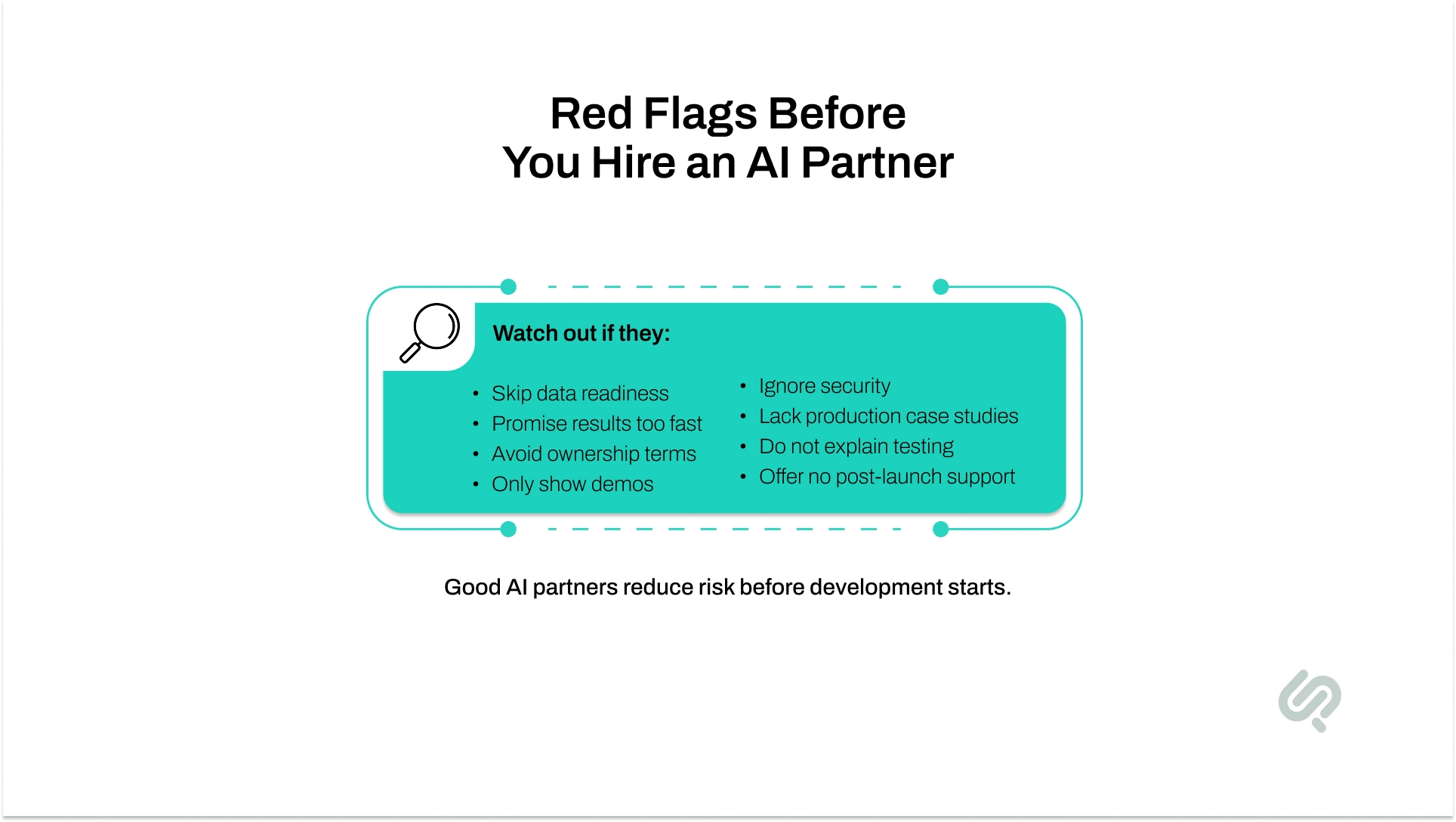
Before you hire an AI development company, watch for these red flags:
A good AI partner should help you reduce risk before development begins. They should explain what is realistic, what data is needed, what could go wrong, and how the project will move from idea to production.
The wrong AI decision can waste months of work and a large part of your budget.
Avoid these common mistakes before choosing between an AI development company and an in-house team.
Do not start with “we need AI.”
Start with a specific problem, such as reducing manual work, improving response time, automating documents, predicting demand, or improving customer experience.
An in-house AI development team only makes sense if you have ongoing AI work.
If you only need one AI proof of concept, automation workflow, or product feature, outsourcing is usually faster and more cost-effective.
AI projects fail when the data is messy, incomplete, scattered, or hard to access.
Before development starts, check where your data lives, how clean it is, who can access it, and whether it is usable for AI.
Cheap AI development services can become expensive later if the team lacks real production experience.
Always check case studies, technical depth, deployment process, security approach, and ownership terms.
AI systems need monitoring, retraining, testing, and updates after launch. A good AI project plan should include post-launch support from day one.
Traditional software development teams build manually first and add AI later.
An AI-first development services partner works differently. AI is part of the product, but it is also part of how the product is planned, designed, built, tested, and improved.
This means the team can use AI tools, reusable frameworks, automation, AI-assisted coding, AI-supported QA, and faster prototyping methods to reduce manual development effort.
An AI-first delivery model can help businesses:
This does not mean AI replaces skilled engineers. It means skilled engineers use AI tools to work faster, make better decisions, and reduce avoidable delays.
Depending on the project size, complexity, and readiness, an AI-first delivery model can help reduce development time, cost, or team effort by 30% to 80%.
“The companies that win with AI are not always the ones with the biggest teams. They are the ones that choose the right use case, prepare their data properly, and build with deployment in mind from day one.”
— Hammad Maqbool, Head of AI, Phaedra Solutions
Choosing between an AI development company and an in-house AI team is only the first decision. The bigger challenge is turning your AI idea into a working system that improves speed, cost, efficiency, or customer experience.
That is where Phaedra Solutions helps.
Our AI development services are built for businesses that want to move from AI strategy to production faster. We help you identify the right use case, assess your data readiness, design the AI architecture, build the solution, integrate it into your existing systems, and measure results after launch.
We can help you build:
You do not need to hire a full AI team before proving the business case. Start with the right AI development partner, launch a focused use case, measure ROI, and scale from there.
Book a Free AI Development Consultation.
Talk to Phaedra Solutions about your AI goals, timeline, data readiness, and budget. We will help you understand what is realistic, what to build first, and what it may take to launch.



Ameena is a content writer with a background in International Relations, blending academic insight with SEO-driven writing experience. She has written extensively in the academic space and contributed blog content for various platforms.
Her interests lie in human rights, conflict resolution, and emerging technologies in global policy. Outside of work, she enjoys reading fiction, exploring AI as a hobby, and learning how digital systems shape society.