

.webp)


.webp)
.webp)





If you are wondering how to choose an AI development company, start with one simple rule: do not judge vendors by demos alone.
Judge them by their real AI experience, data security process, technology stack, pricing clarity, success metrics, and ability to support the system after launch.
The right AI development partner can help you build AI agents, workflow automation systems, predictive tools, and enterprise AI solutions that solve real business problems. The wrong partner can leave you with a costly prototype, unclear ownership, hidden costs, and no measurable ROI.
This guide gives you a practical framework for AI development company selection, including the 8 questions to ask before signing, red flags to watch for, vendor evaluation criteria, and a buyer checklist you can use before choosing your AI software development services partner.
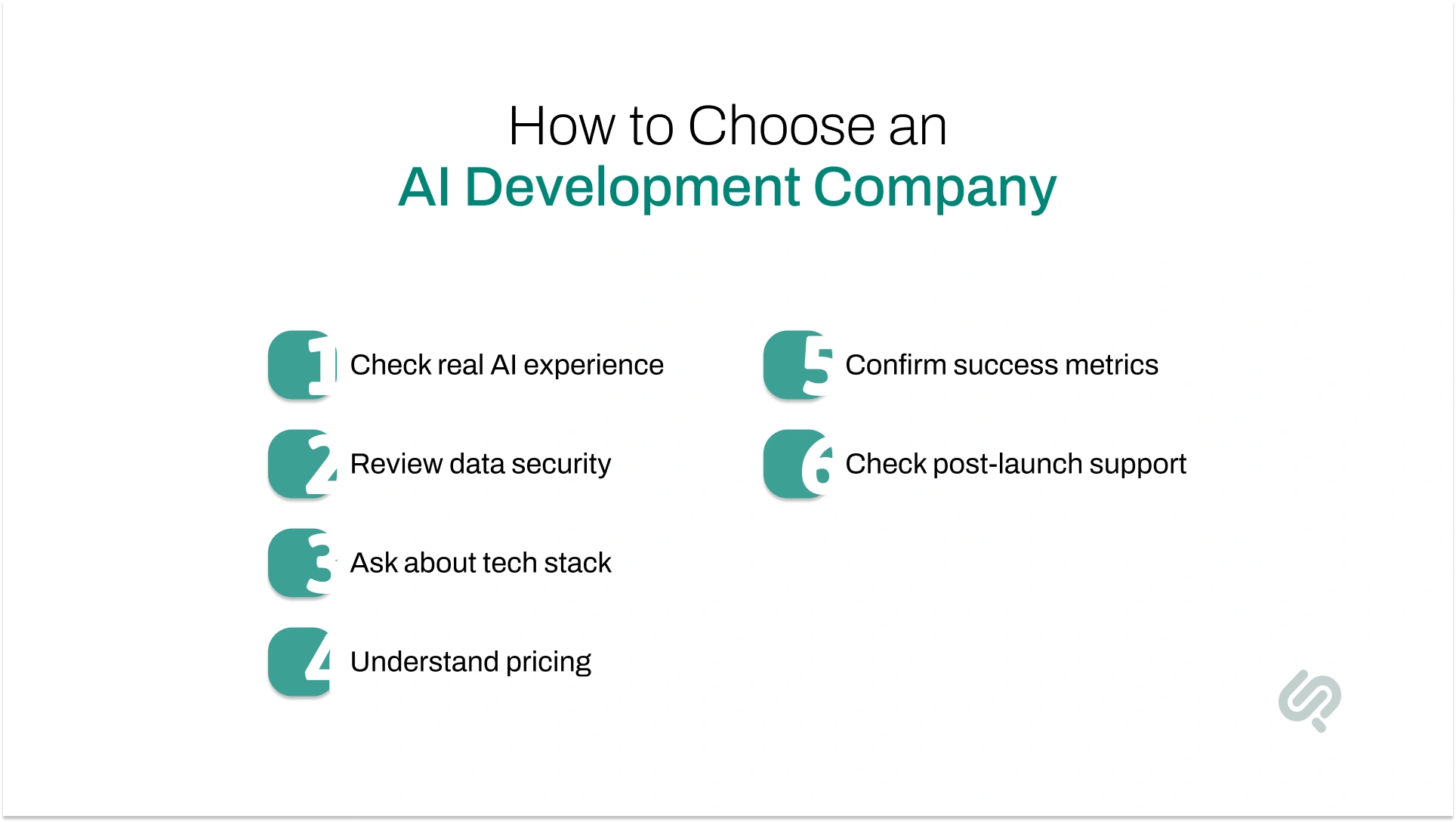
Choose an AI development company by checking its real project experience, technical skills, data security process, pricing structure, and post-launch support. The right partner should explain how they will take your AI idea from business problem to working product.
Look for proven AI expertise and experience, clear communication, a strong AI technology stack, ethical AI practices, and measurable business results. A good partner should understand your workflows, data, users, and growth plans before suggesting a solution.
Ask them to explain their model selection, data pipeline, cloud setup, testing process, deployment plan, and AI model performance metrics. Strong companies can explain technical choices in simple business language.
Ask about their AI project portfolio, technology stack, data privacy process, pricing model, success metrics, delivery team, IP ownership, and post-launch support. These questions help you see whether the company can build and maintain real AI solutions.
AI development cost depends on project scope, data quality, integrations, model complexity, compliance needs, and support. A simple AI feature may cost far less than a full enterprise AI solution with custom workflows, cloud setup, security, and ongoing monitoring.
Major red flags include vague case studies, unclear pricing, no data security process, no production examples, tool-first recommendations, and no post-launch support plan. Be careful if a company promises results before reviewing your data or business goals.

AI projects rarely fail because “AI does not work.” They fail because the wrong use case was chosen, the data was not ready, the risks were ignored, or the system never moved from demo to real business use.
Gartner reported that at least 30% of GenAI projects would be abandoned after proof of concept by the end of 2025 because of poor data quality, weak risk controls, rising costs, or unclear business value (1). Gartner also notes that some GenAI deployment approaches can carry costs from $5 million to $20 million, depending on scope and approach.
That is why partner selection matters. You are not just hiring someone to build an AI model. You are choosing the team that will define the use case, review your data, design the architecture, manage risk, measure performance, and support the solution after launch.
A weak partner can waste months on a product that never reaches production. A strong partner helps you validate the idea, control cost, reduce risk, and build an AI system your team can actually use.
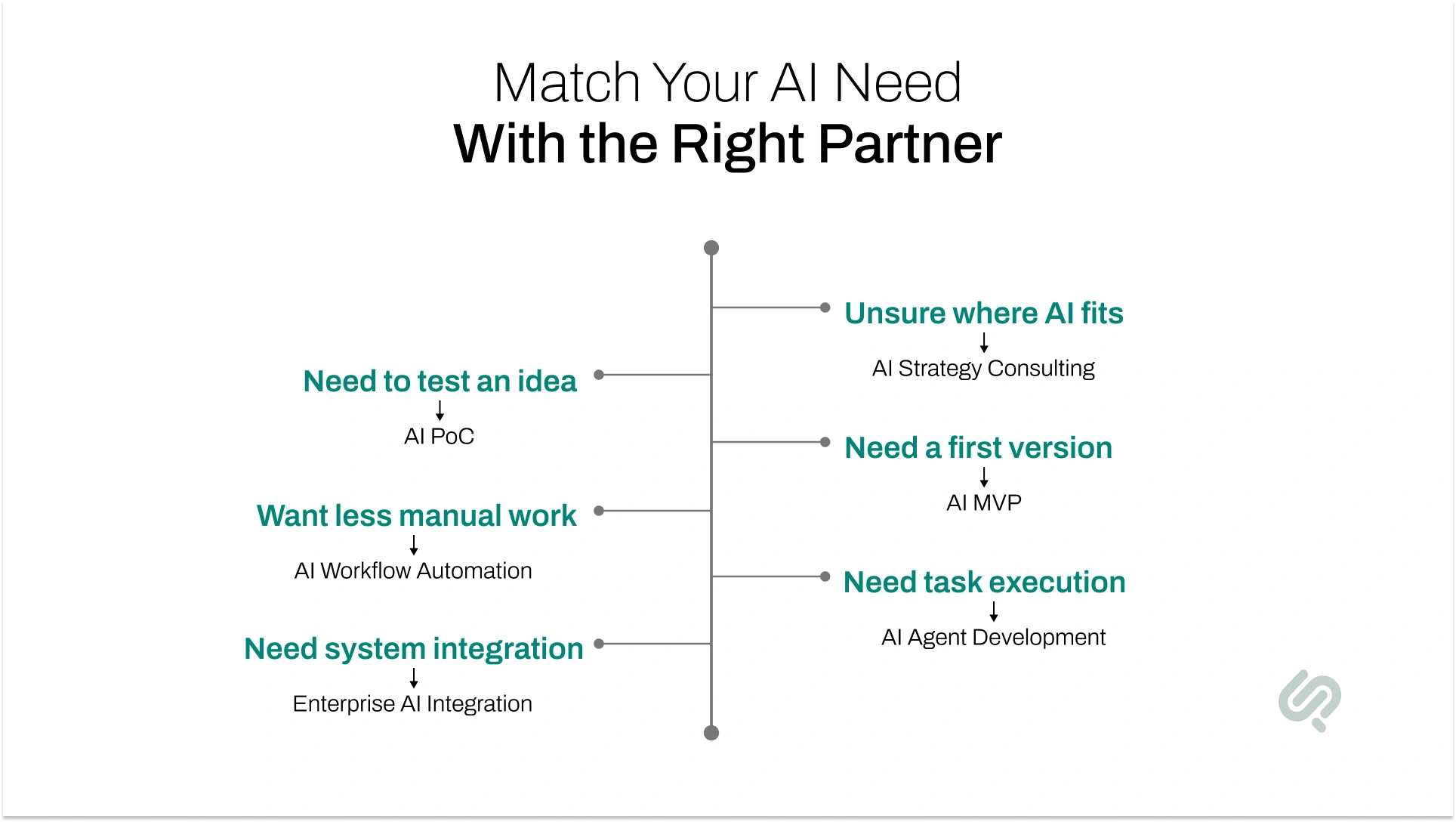
Not every AI project needs the same type of partner. Some companies need AI strategy consulting. Some need a quick AI PoC. Others need full AI software development services to build AI agents, workflow automation systems, or enterprise AI integrations.
Before you contact vendors, get clear on what you need.
This step matters because many companies sell AI as one general service. A serious software development partner will first understand your use case, data, users, risks, and success metrics before recommending the build path.
Ask yourself:
If you cannot answer these clearly yet, start with discovery or strategy before full development.
Before you sign with any AI development company, use these questions to look beyond sales claims and polished demos. The goal is to find a partner that can build secure, useful, and production-ready AI systems.
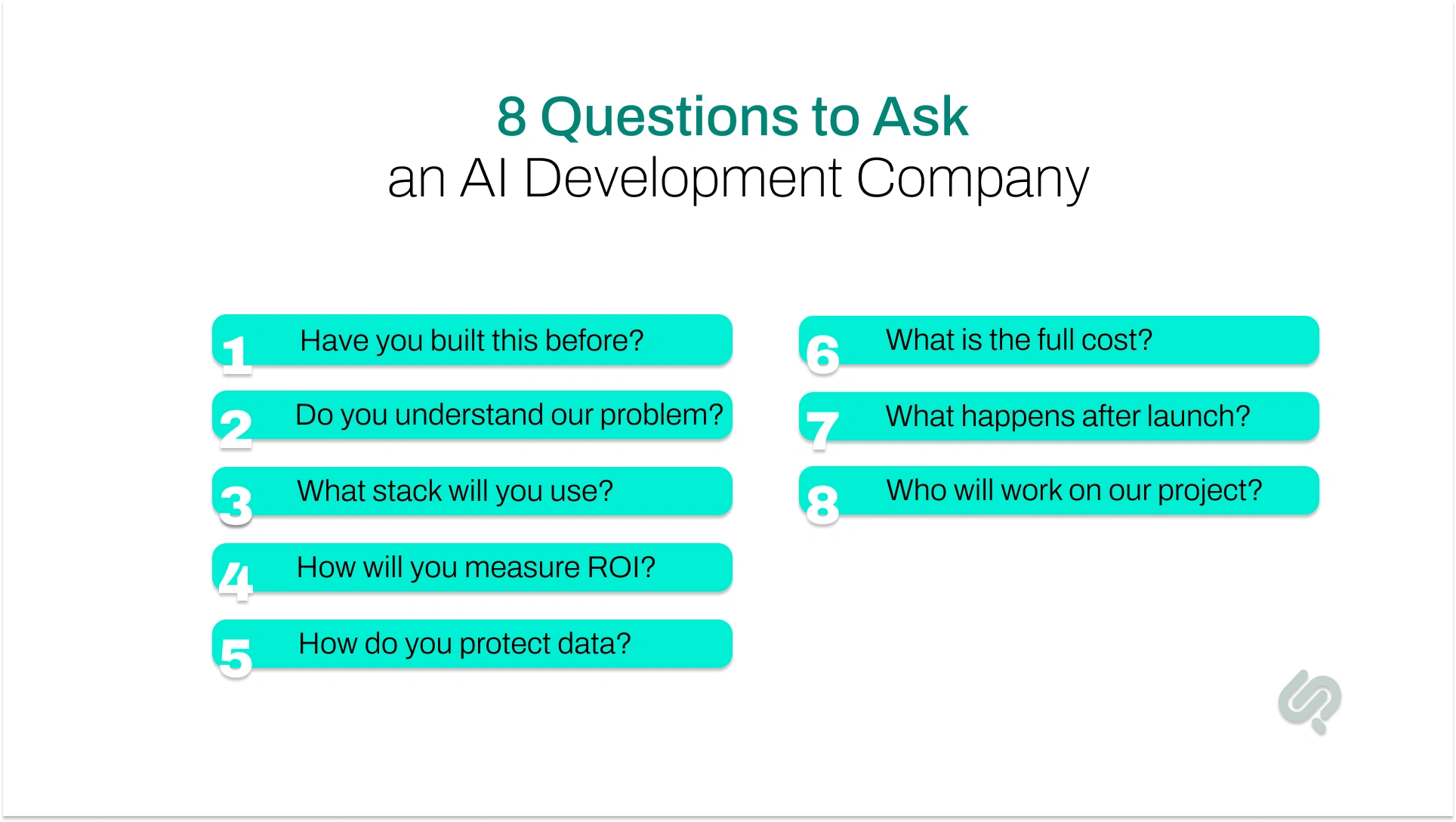
Start with their real experience.
A credible AI partner should be able to show an AI project portfolio with deployed projects, real users, and measurable outcomes. Do not settle for screenshots, mockups, or simple demos.
Ask:
A strong portfolio should show business impact, such as:
Weak answer:
“We have built many AI tools.”
Strong answer:
“We built an AI workflow system for a similar business, connected it with their CRM, automated manual research, and reduced team review time by 40%.”
The best partner does not just prove they know AI. They prove they understand your type of business problem.
Example:
Phaedra Solutions built an AI-powered business development workflow for a PR agency, turning a manual cold outreach process into an automated pipeline. The system used AI research, KYC checks, investor mapping, RAG personalization, and multi-channel messaging to increase output from 12–15 personalized emails per week to 45–50 personalized emails per day, creating a 4X efficiency boost.
A weak AI vendor starts with tools. A strong AI partner starts with the business problem.
Before recommending a model, platform, or architecture, the company should ask about:
This is especially important for AI agents and automation systems. If the vendor does not understand the workflow, the AI agent may automate the wrong task, create more review work, or fail when real exceptions appear.
Ask:
“What would make this AI project not worth building?”
A mature partner should be honest about where AI can help, where simple automation is enough, and where the project needs more discovery first.
This is one of the most important parts of AI company evaluation criteria because it shows whether the company thinks like a delivery partner or just a vendor.
Do not hire the company with the longest tool list. Hire the company that can explain why a certain stack fits your use case.
When you review the AI technology stack, ask them to explain:
Weak answer:
“We use the latest AI tools.”
Strong answer:
“We will test model options against your use case, compare accuracy, latency, cost, and security, then recommend the stack that gives the best balance of performance and maintainability.”
Also ask:
“Can this solution switch models or providers later without rebuilding everything?”
This protects you from being tied to one model, one vendor, or one cloud setup. It also improves the long-term scalability of AI solutions.
AI success is not just model accuracy. A model can perform well in testing and still fail if users do not adopt it, if it is too slow, or if it costs too much to run.
A serious AI partner should define both AI model performance metrics and business KPIs before development begins.
Ask:
A strong partner connects AI performance to business value. A weak partner only talks about technical scores.
AI systems often process sensitive business data, customer data, internal documents, financial records, or private workflows. That makes security and governance a core part of vendor selection.
IBM’s 2025 Cost of a Data Breach Report says the global average cost of a data breach was $4.4 million. IBM also found that 63% of organizations lacked AI governance policies to manage AI or prevent shadow AI. (2)
Ask these questions:
This matters most for healthcare, fintech, insurance, government, HR, legal, and enterprise AI solutions, where privacy, compliance, and trust are part of the buying decision.
A trustworthy partner should treat data security as part of the build, not as a late-stage checklist.
Do not only ask for the development cost. Ask for the full AI pricing and cost structure.
AI projects often include costs that are not visible in the first quote.
Ask:
A low quote can become expensive if it excludes cloud usage, LLM calls, integrations, monitoring, and retraining. The right partner should show you the build cost, running cost, and support cost before you sign.
AI development does not end when the system goes live.
Data changes. User behavior changes. Prompts need updates. Models can drift. Business rules evolve. New risks appear after real users start using the system.
Ask:
A strong AI partner treats launch as the start of improvement, not the end of the project.
This is especially important for AI agents, customer-facing AI tools, workflow automation systems, and enterprise AI integrations where reliability matters every day.
The team that sells the project is not always the team that builds it. Before signing, ask who will actually work on your AI project.
You should know:
This matters because AI projects need more than developers. A strong AI partner should bring together AI engineers, data specialists, software architects, QA, DevOps, and product leadership.
Ask:
“Can we meet the senior people who will be involved before we sign?”
If the company cannot clearly explain the delivery team, project ownership, and communication structure, treat that as a warning sign.
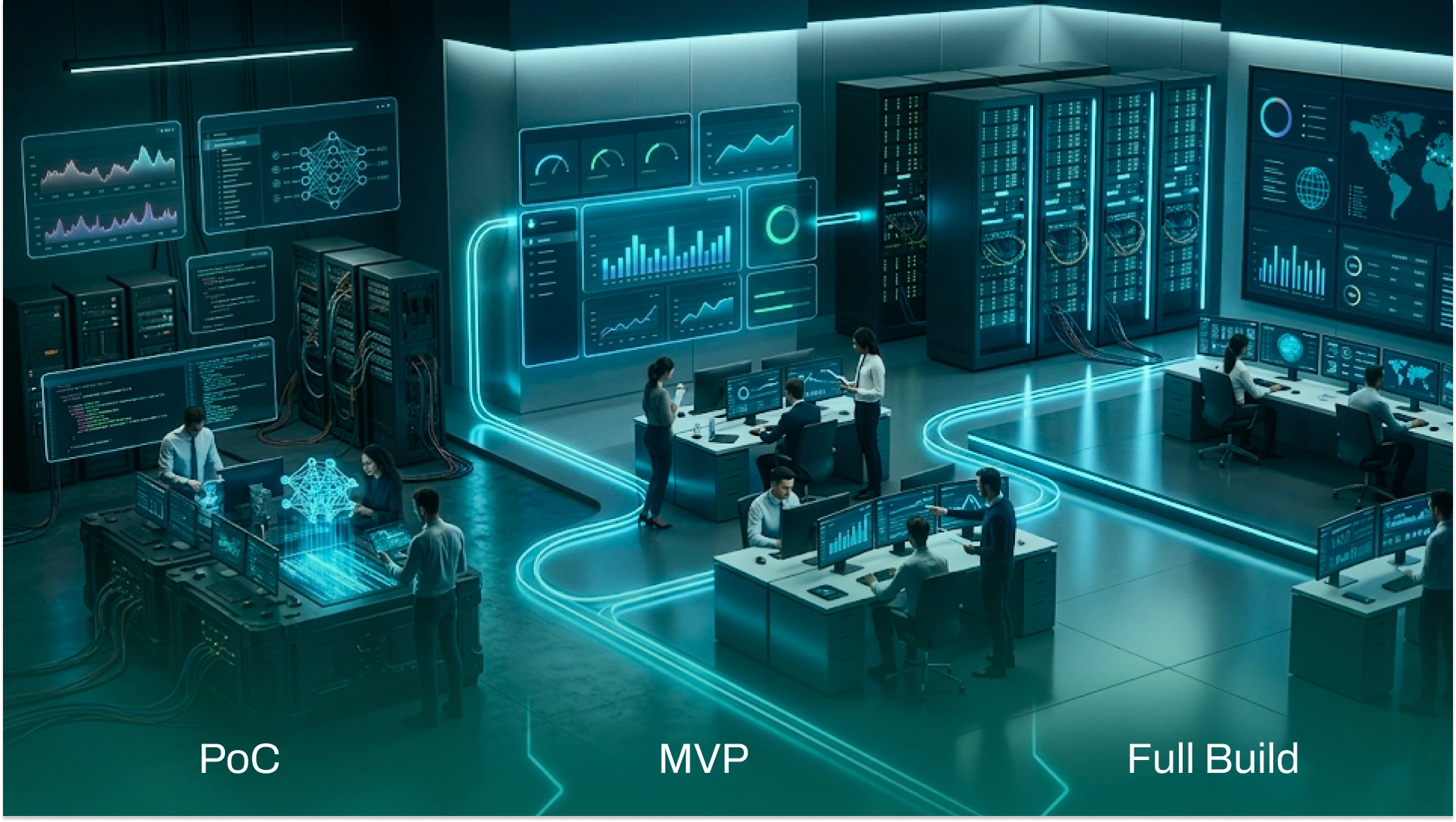
One of the biggest mistakes companies make is jumping into full AI development too early.
Not every AI idea is ready for a full build. Sometimes the safer path is to test the use case first, then move toward production once the data, workflow, and value are clear.
Start with an AI PoC if:
Start with an AI MVP if:
Move to a full AI build if:
A good AI development company will not push the biggest project first. They will recommend the safest path based on your data maturity, business value, risk level, and budget.
Even if a company sounds confident, watch for these warning signs before you sign.
A demo can look impressive, but real AI success depends on data, users, integrations, security, and monitoring.
Ask for deployed case studies, real outcomes, and client references.
Be careful if a company starts with a model, platform, or framework before asking about your workflow.
Your business problem should shape the solution, not the other way around.
AI performance depends on data quality, access, structure, and governance.
If a company gives you a plan before reviewing your data reality, the project is already at risk.
AI costs continue after launch.
If the vendor cannot explain cloud hosting, API usage, data preparation, monitoring, retraining, and support costs, you may face budget surprises later.
For new AI use cases, a PoC or MVP is often the safer first step.
Be careful if a company pushes a large build before testing feasibility.
You should know who owns the code, model configuration, prompts, datasets, workflows, documentation, and deployment environment before the contract begins.
AI systems need monitoring, updates, and improvement after launch.
If the company has no clear support process, you may be left with a system that slowly becomes less useful.
A strong partner should explain technical decisions clearly.
If every answer is vague, overcomplicated, or unclear, the project will be harder to manage.
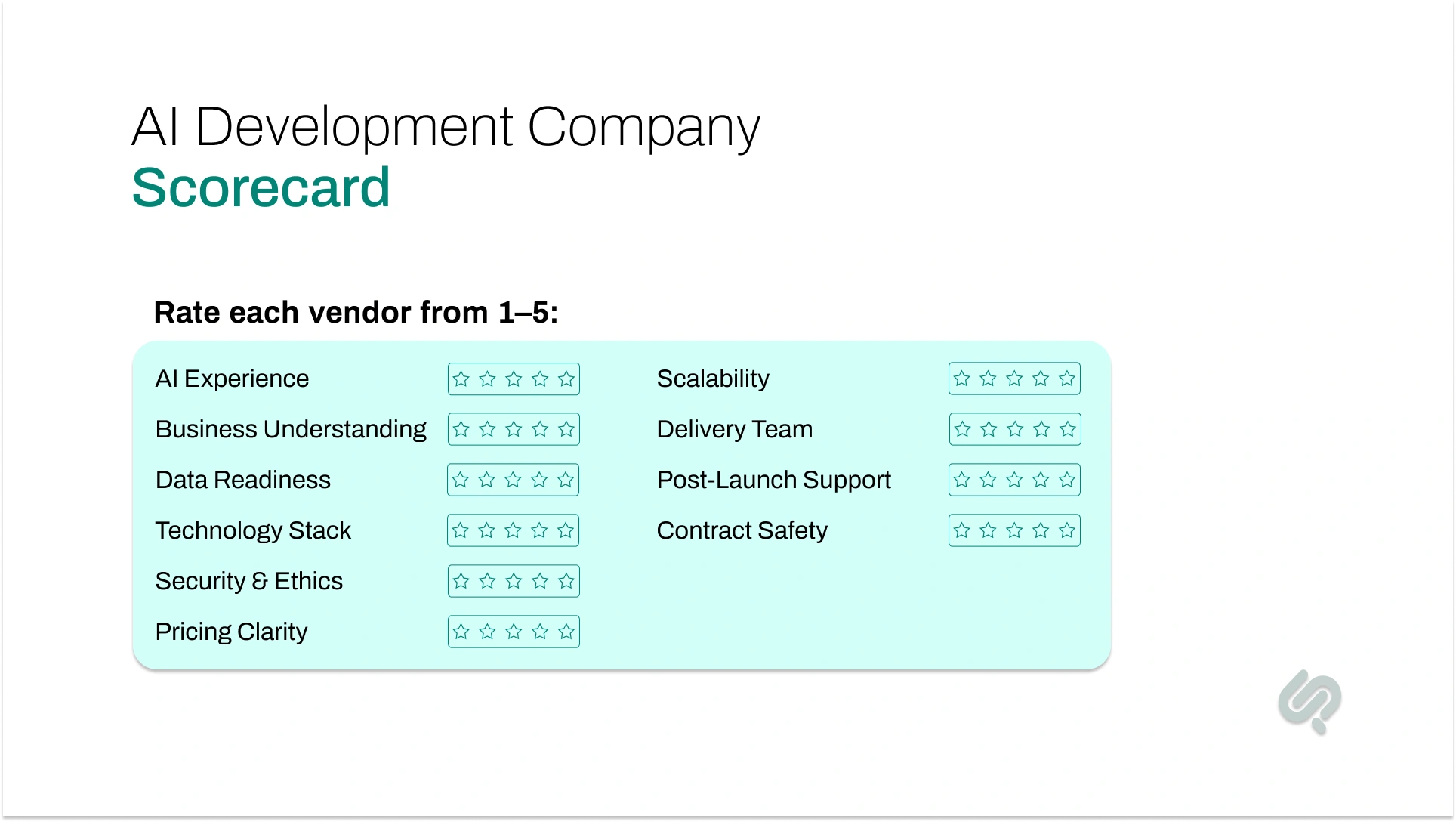
Use this scorecard to compare vendors before your final decision.
Score each company from 1 to 5 in every category.
A strong AI partner should score well across most areas. But do not ignore serious gaps in data security, pricing clarity, ownership, or post-launch support. One weak area can create major problems later.
A strong AI development company should help you build AI systems that improve real business workflows, not just isolated AI features.
Common examples include:
AI agents can handle multi-step tasks such as research, lead qualification, ticket routing, document review, internal support, and workflow execution.
AI workflow automation helps reduce repetitive work across sales, operations, support, finance, HR, and compliance.
Enterprise AI solutions connect AI with your CRM, ERP, helpdesk, databases, analytics tools, and internal systems.
Predictive AI helps businesses forecast demand, detect risk, personalize experiences, and make faster decisions.
Custom AI apps are useful when off-the-shelf tools cannot match your workflows, data, users, or business rules.
A good partner should help you choose the right build path based on your use case, data, budget, and long-term goals.
Choosing an AI development company is easier when you know what you need to build, what your data can support, and what the safest first step should be.
Phaedra Solutions provides AI software development services for businesses that want to build AI agents, workflow automation systems, custom AI applications, and enterprise AI solutions without wasting months on unclear experiments.
Our AI-first development approach helps teams:
As Hammad Maqbool, Head of AI at Phaedra Solutions, says:
“The right AI partner should not start by asking which model you want to use. They should start by asking what business problem is worth solving, what data is available, and how success will be measured after launch.”
If you are exploring an AI project, book a free call and start with one clear next step.



Ameena is a content writer with a background in International Relations, blending academic insight with SEO-driven writing experience. She has written extensively in the academic space and contributed blog content for various platforms.
Her interests lie in human rights, conflict resolution, and emerging technologies in global policy. Outside of work, she enjoys reading fiction, exploring AI as a hobby, and learning how digital systems shape society.