

.webp)


.webp)
.webp)
.webp)






.webp)
When businesses start evaluating a new app build, the first question is usually: how long will this take? Today, the AI software development timeline looks very different from what it did just a few years ago, and understanding that gap matters before you hire a development partner.
AI-enabled development uses tools like GitHub Copilot, Cursor, and Claude across planning, coding, testing, and delivery to eliminate the repetitive manual work that historically stretched timelines. In the right project, this compresses the full build cycle by 30–50% without removing expert oversight or cutting corners on quality.
In this guide, you'll see where AI saves the most time, what realistic timelines look like by project type, and what separates a genuine AI-first development partner from one that just mentions AI in its pitch.
Most standard builds, mobile apps, SaaS platforms, MVPs — take 30–50% less time with AI-assisted development. An MVP that traditionally took 4–5 months can be delivered in 8–12 weeks by an experienced AI-first team.
An AI-powered MVP typically runs 8–12 weeks from scoping to launch: discovery and scoping in 5–8 days, active development in 6–8 weeks, and testing and launch in 1–2 weeks. Timelines vary based on feature complexity and third-party integrations.
30–50% faster for most standard projects. On specific tasks like test generation or code review, speed gains can exceed 55%. The biggest savings come from compressing multiple phases simultaneously — not just the coding phase.
No. AI handles predictable, repetitive tasks. Developers still own architecture, security, business logic, integrations, and final code review. AI changes where their time goes — not whether they're needed.
Yes, especially for MVPs. Shorter sprints, faster time to market, and lower cost per feature mean a lean AI-first team can often outpace a larger traditional team without sacrificing quality.
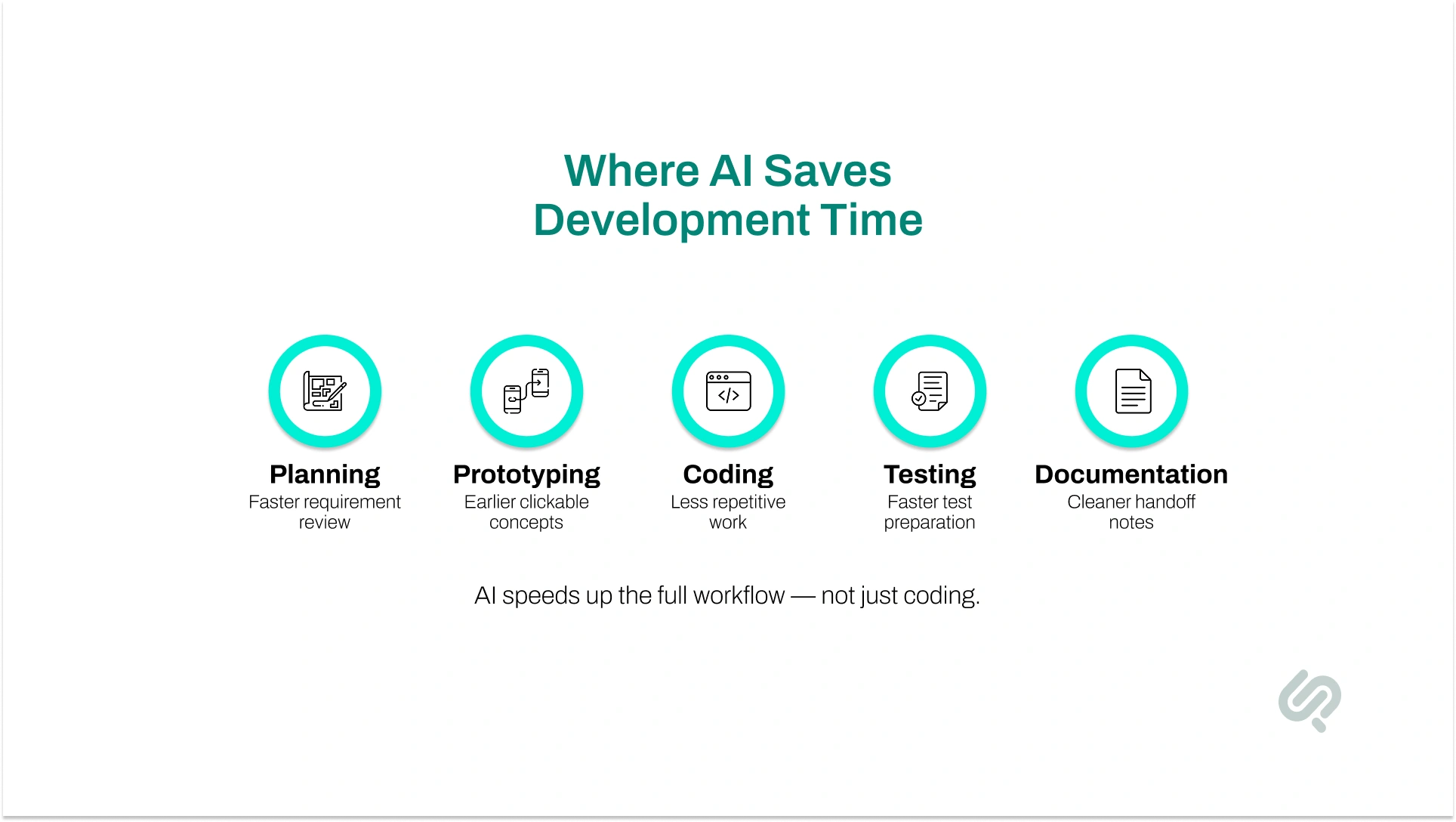
AI saves time in app development because it reduces manual effort across the full delivery cycle. The biggest mistake businesses make is assuming AI only helps developers write code faster.
That is only one part of the gain.
A shorter AI software development timeline usually comes from 5 areas: planning, prototyping, coding, testing, and documentation.
Poor requirements are one of the biggest reasons software projects slow down. If the team starts with unclear user roles, missing workflows, vague feature lists, or undefined integrations, every sprint becomes slower.
AI helps by quickly reviewing product briefs, grouping requirements, identifying missing details, and turning rough ideas into structured user stories or technical notes.
This does not replace product strategy. It gives the team a faster starting point. Senior product and engineering leads still need to decide what matters, what should be removed, and what is realistic for the first release.
Traditional prototyping can take days or weeks when business teams, designers, and developers go back and forth on early ideas.
AI-assisted prototyping helps teams create first-draft screens, user flows, and clickable concepts faster. This gives stakeholders something real to review earlier in the process.
The benefit is not just speed. It is clarity. When users and decision-makers can see the product early, they catch gaps sooner, approve direction faster, and reduce expensive redesign later.
A large part of software development is repetitive but necessary work: authentication flows, dashboards, form validation, CRUD screens, API endpoints, admin panels, and reusable UI components.
AI coding tools are useful here because these patterns are common and well understood. GitHub’s Copilot research found that developers using Copilot completed a coding task 55% faster than developers who did not use it, although this was measured in a controlled task environment rather than a full production project. (1)
That distinction matters. AI can accelerate specific coding tasks, but full project timelines still depend on scope, integrations, review cycles, QA, stakeholder approvals, and deployment complexity.
Testing is one of the most overlooked timeline drivers in app development. It is not enough to build features quickly. Every feature must be tested across user roles, devices, browsers, edge cases, and integration points.
AI helps QA teams generate test cases, regression scenarios, edge-case lists, and release checklists faster. It can also help developers write unit tests as they build instead of waiting until the end of the sprint.
This improves speed and coverage, but it does not remove the need for QA engineers. Human testers still need to validate business-critical flows, usability issues, security-sensitive paths, and real-world behavior.
Documentation usually slows down because teams leave it until the end. AI changes that by helping generate API documentation, technical notes, inline comments, release notes, and onboarding guides while the product is being built.
This is one of the strongest areas for AI efficiency. McKinsey found that generative AI can reduce time spent on code documentation by 45–50%, which is higher than the savings seen in many coding tasks. (2)
For business teams, better documentation means fewer handoff issues, easier maintenance, faster onboarding for new developers, and less dependency on one person’s memory after launch.
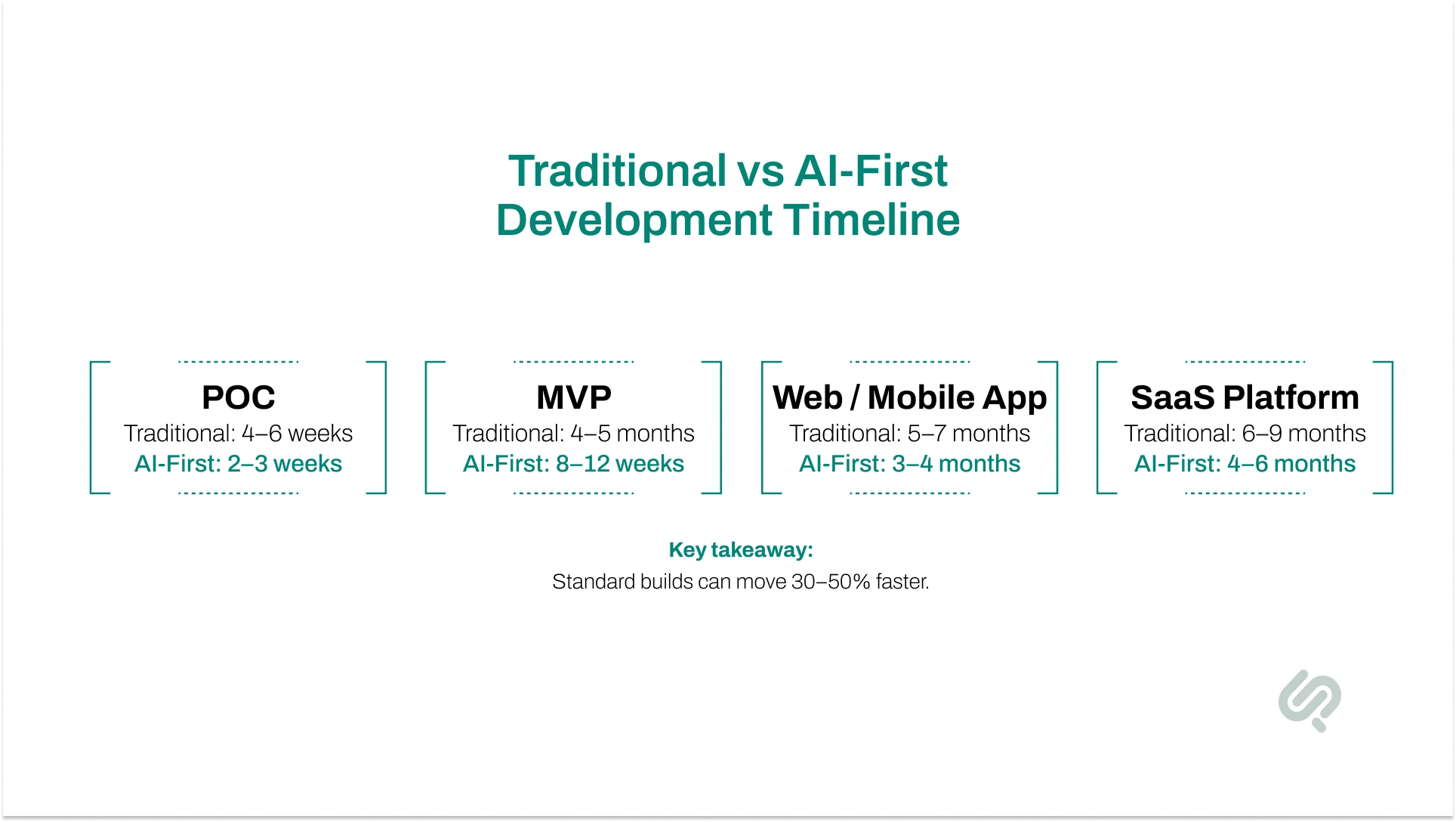
One of the most important questions to answer before starting a build: how long will my specific project take?
The answer depends on scope, complexity, and integrations — but here's what a realistic AI app development timeline looks like across common project types:
Where AI saves the most time:
Projects with standard feature sets — authentication flows, dashboards, CRUD operations, API integrations — see the biggest gains. Highly custom or research-intensive builds still benefit, just at a smaller percentage, because AI is most effective on predictable implementation work.
Two things that affect these numbers most:
At Phaedra Solutions, our AI-first engineering workflows have reduced development timelines by 30–80%, depending on project size and complexity — from faster MVPs to significantly compressed legacy modernizations.
A faster AI software development timeline does not mean rushing the build or skipping review. It means compressing the phases that usually slow app development down: scoping, prototyping, repetitive coding, test preparation, documentation, and release support.
These ranges are realistic for a standard MVP or mid-sized app build. More complex products with legacy systems, compliance, real-time data, or heavy integrations will take longer.
This stage turns a business idea into a clear build plan. In a traditional process, teams spend days reviewing notes, defining features, writing user stories, estimating scope, and finding missing requirements.
AI helps speed up this work by supporting:
This does not replace product strategy. It gives product managers, designers, and engineers a faster starting point. The team can define the MVP scope earlier, remove unclear features faster, and reduce the risk of building the wrong product.
Early design alignment often slows the build before development even starts. Teams discuss flows, wait for first drafts, review screens, request changes, and repeat the same cycle.
AI-assisted prototyping shortens that loop. It helps teams create early screen concepts, user flows, clickable prototypes, UI copy, and reusable component ideas faster.
The business value is simple: stakeholders see the product direction earlier. That means faster approvals, fewer abstract discussions, and less redesign once development begins.
This is where AI-assisted coding creates the biggest visible time savings.
AI tools help developers move faster on repetitive but necessary work such as:
McKinsey found that generative AI can help software engineers develop code 35–45% faster, refactor code 20–30% faster, and complete code documentation 45–50% faster. The same research also notes that the benefit is much smaller for high-complexity tasks, where time savings can drop below 10%. (2)
That is why AI works best when it supports skilled engineers. It speeds up predictable implementation work, but senior developers still own architecture, security, product logic, performance, scalability, and final review.
Testing is where many app projects lose time near the end. Bugs appear late, test cases are incomplete, and release documentation gets rushed.
AI-powered testing helps reduce that pressure by supporting:
This makes QA faster, but not automatic. Human QA engineers still need to test critical user journeys, payment flows, permissions, integrations, accessibility, security-sensitive features, and real-world usage scenarios.
This balance matters. Google’s 2024 DORA research found that AI adoption can improve individual productivity, flow, and job satisfaction, but it can also hurt delivery stability and throughput when teams lack strong testing, small batch sizes, and disciplined delivery practices. (3)
Not every company that says it uses AI is actually delivering software differently.
Some teams use one AI coding assistant and still follow the same slow process: long discovery, manual documentation, delayed QA, unclear sprint visibility, and late-stage rework.
A real AI-first development partner changes the delivery model, not just the toolset.
Traditional teams often bring AI into the process during coding. That is too late.
An AI-first partner uses AI from the beginning: requirement analysis, scope mapping, user-story creation, prototype planning, architecture support, and risk identification.
This helps reduce ambiguity before engineering begins. For business leaders, that means fewer surprises, fewer scope changes, and a more realistic delivery plan.
AI can generate code quickly, but it cannot own the product. It does not understand your business model, compliance risks, security requirements, customer expectations, or long-term technical debt by itself.
That is why serious AI-assisted development remains human-led.
Senior engineers still own architecture, database design, security decisions, integration logic, performance planning, and final code approval. AI supports the work. It does not become the decision-maker.
This point is especially important because AI adoption can create tradeoffs when teams use it without strong engineering fundamentals.
A real AI-first partner should be able to show how AI improves delivery.
That means tracking practical metrics such as:
This matters because AI can create the illusion of progress. More generated code does not automatically mean better software. The real measure is whether the team ships stable, useful features faster.
AI performs best on structured, repeatable work. This includes boilerplate code, documentation, test generation, simple UI patterns, API scaffolding, refactoring support, and review assistance.
It is less reliable for complex business logic, unclear product strategy, security-sensitive decisions, compliance-heavy workflows, and poorly documented legacy systems.
That is why realistic AI-first delivery is selective. The team should use AI aggressively where it saves time and carefully where mistakes would be expensive.
A credible AI-first development company should be able to explain its toolchain clearly.
You should know which tools are used for planning, coding, testing, documentation, review, design, and deployment. You should also know where human approval is required before anything moves forward.
If a partner only says “we use AI” without explaining how, where, and under whose supervision, that is not enough.
The best AI-first partners do not promise speed at any cost. They reduce time by removing manual waste, not by skipping important steps.
That means faster scoping, faster prototypes, faster code generation, faster test preparation, and faster documentation — while still keeping senior review, QA, security checks, and deployment control in place.
"Moving AI-first isn't about swapping out developers for tools. It's about rebuilding how a team works — from requirements through deployment — so every phase moves faster, and every engineer is focused on decisions that actually require human judgment."
— Mujtaba Sheikh, Head of Development, Phaedra Solutions
That is the real difference between an AI-assisted vendor and a modern development partner. One uses AI to move faster. The other uses AI to move faster safely.
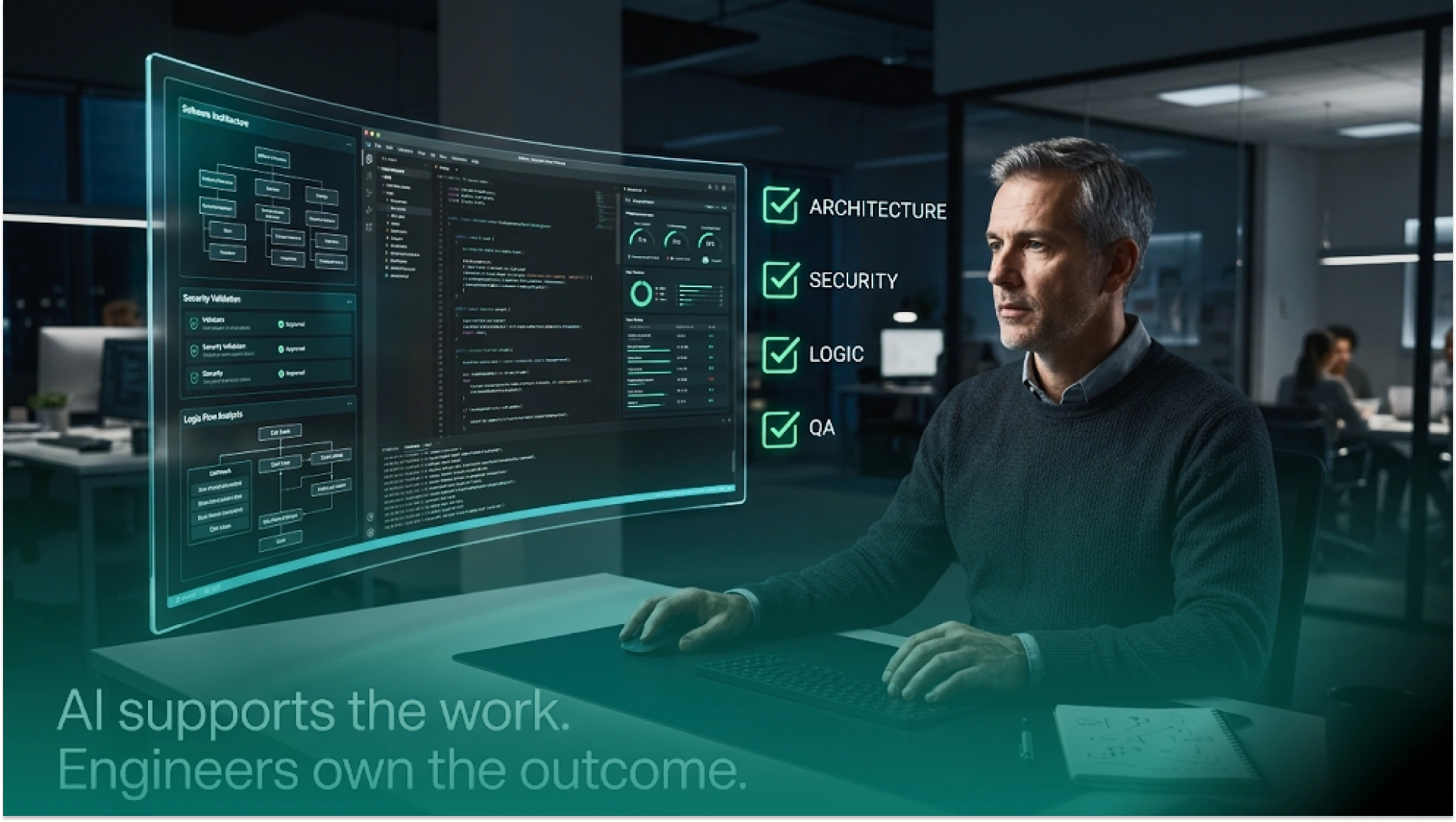
AI can generate a form validation function in seconds. But deciding whether that function should handle international formats, accessibility requirements, fraud detection logic, or specific compliance rules — that still requires a skilled engineer who understands the product.
That's why AI-assisted coding doesn't reduce your need for developers. It changes where their time goes.
A useful way to think about it: AI works like a capable junior developer. It produces useful output quickly. But a senior engineer still sets direction, checks the logic, catches edge cases, and owns the final product. The senior doesn't disappear — they just stop spending most of their time on slow, mechanical tasks.
For businesses, this translates directly to:
This is what human-led AI development actually looks like in practice. AI-powered software delivery gets faster. The product — and the engineering standards behind it — stays protected.
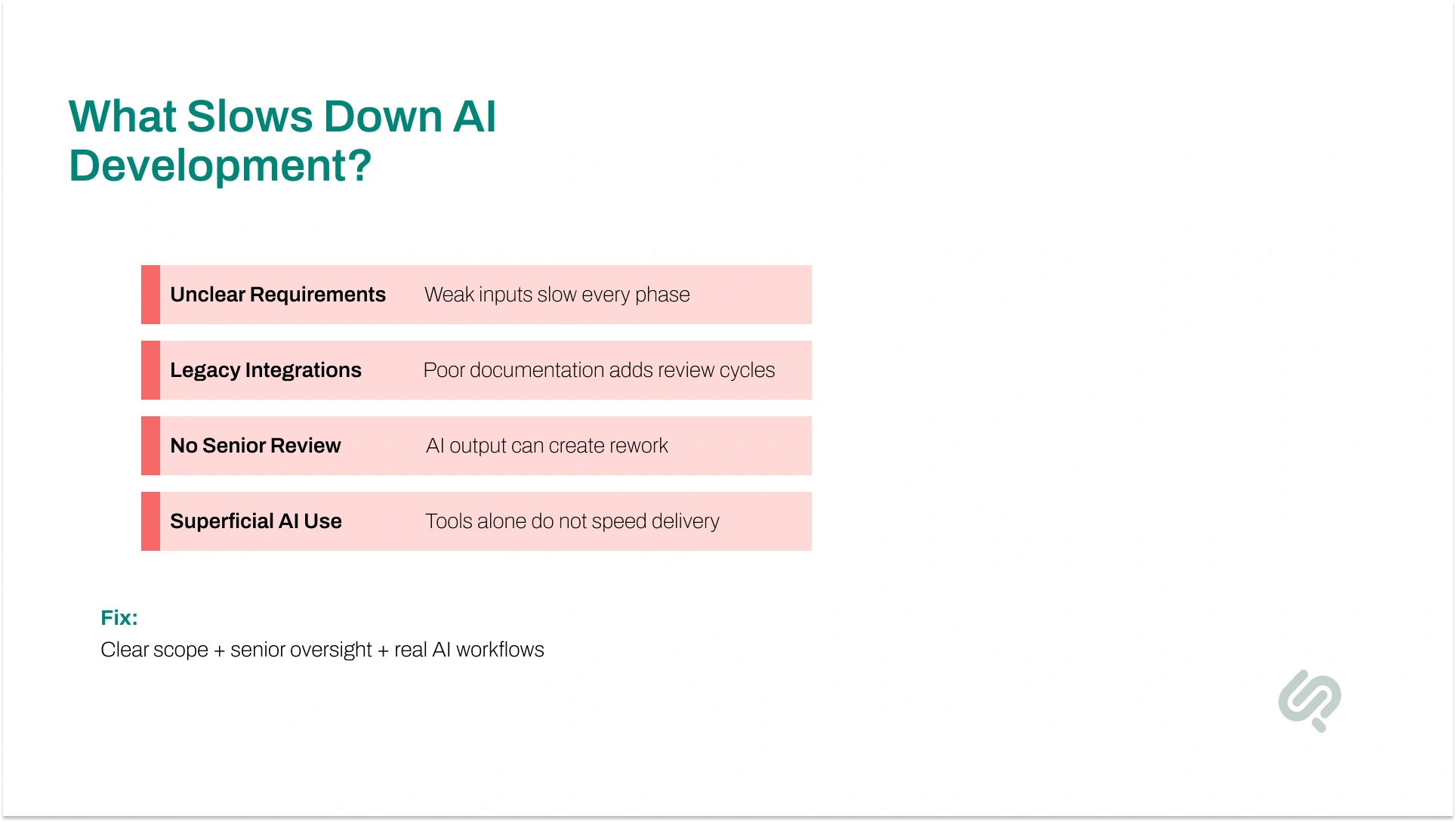
AI tools don't automatically guarantee a faster build. In most cases, the biggest timeline delays in AI-powered projects come from outside the code, and most are avoidable with the right planning and partner.
AI tools produce better, faster outputs when given precise inputs.
Vague product briefs, shifting stakeholder priorities, or undefined user flows slow every phase that follows. A strong AI-first development partner will spend real time on requirement clarity before writing a single line of code — because fixing scope mid-sprint costs more than the time it saves.
Connecting to legacy infrastructure, third-party APIs, or internal systems with poor documentation requires more manual engineering oversight and reduces how much AI tooling can assist.
This adds review cycles that extend the timeline — especially if the existing system has no clear data structure or API contract.
Teams that ship AI-generated code without proper senior engineer validation tend to catch logic errors, edge cases, and security gaps late — creating rework that costs more time than was saved upfront.
The right model is always AI-assisted, human-led. Speed and quality move together, not in opposition.
Many agencies describe themselves as AI-enabled. Few have actually restructured their delivery process around it. The difference shows up in sprint velocity, defect rates, and how early in the project you see working software.
Before committing to a custom AI app development engagement, ask specifically:
Vague answers are a red flag. A genuine AI-first team will have clear, specific responses to all three.
If you're evaluating AI app development services or considering a new development partner, here's what reasonable expectations look like:
A 30–50% reduction in total project time is achievable for most standard app builds — mobile apps, SaaS platforms, internal tools, MVPs.
Highly custom or research-intensive projects will see smaller gains because AI saves the most time on routine implementation, not on novel problem-solving.
Faster development typically means lower total project cost. AI-first workflows reduce total build hours — fewer sprint weeks, leaner team structures, and less rework from late-stage bug detection.
At Phaedra Solutions, depending on project complexity, this translates to 30–80% efficiency gains that flow directly into project economics.
That said, how partners price this varies. Some pass time savings through in lower quotes; others deliver more scope within the same budget period. Always ask your partner explicitly how AI productivity gains affect your estimate — and get that answer in writing before you start.
AI-assisted development, when done well, tends to improve code quality — more consistent patterns, better test coverage, fewer manual errors.
When done poorly (over-relying on AI output without review), it can introduce subtle bugs at scale. This is why the human oversight model matters.
At Phaedra Solutions, we've rebuilt our engineering model around AI-first development — not as a trend, but as the standard for how we deliver. The result is consistently better outcomes for our clients: shorter timelines, tighter budgets, and higher quality at launch.
AI is embedded from day one — in requirements analysis, system design, coding, testing, documentation, and deployment. You see working software sooner. Sprint velocity stays high. Every AI-generated output is reviewed and validated by senior engineers before it ships.
What this looks like in practice for development services:
Depending on project complexity, our AI-first workflows have reduced development timelines and team overhead by 30–80% — while maintaining the engineering standards your product needs to perform and scale.
Ready to see what a faster AI software development timeline looks like for your project? Book a Free AI Development Consultation.



Ameena is a content writer with a background in International Relations, blending academic insight with SEO-driven writing experience. She has written extensively in the academic space and contributed blog content for various platforms.
Her interests lie in human rights, conflict resolution, and emerging technologies in global policy. Outside of work, she enjoys reading fiction, exploring AI as a hobby, and learning how digital systems shape society.