


.webp)


.webp)
.webp)







AI-first software development is how the fastest-growing companies are building software today, faster, with leaner teams, and at lower cost.
If you're a business leader evaluating whether to adopt this approach, this guide covers what it means, what it delivers, what risks to expect, and what to look for in an AI-first development partner.
In an AI-first model, artificial intelligence is built into every stage of the software delivery lifecycle, from planning and coding to testing, deployment, and optimization.
It's not about adding AI tools on top of your existing process. It's about redesigning that process with AI at the center, enabling faster software delivery using AI while reducing team size requirements and overall development cost.
AI-first software development means building AI into every stage of the development process, coding, testing, code review, and deployment, from day one. AI is a core part of how the product is built, not a tool added later. The result is faster delivery, smaller team requirements, and better code quality.
Reducing development costs with AI happens in three ways: AI automates repetitive coding tasks, automated testing catches bugs earlier (before production, where fixes cost 4–5x more), and smaller teams can deliver the same output. Most businesses see 30–70% cost reduction on qualifying projects.
Common AI coding tools include GitHub Copilot, Cursor, Tabnine, and Amazon CodeWhisperer for code generation. For testing, Diffblue Cover and Testim are widely used. AI agents like Devin and AutoGen handle complex, multi-step development tasks autonomously.
No. Small and mid-sized businesses often benefit more. AI-first development lets lean teams deliver what previously required much larger engineering departments, making it ideal for startups, SaaS companies, and growing businesses.
Most businesses start using AI coding assistants within days. A fully redesigned AI-driven development process, covering workflows, governance, and tooling, typically takes 4–12 weeks with the right partner.
Look for documented experience using AI agents (not just AI tools), a clear code review and quality control process, transparent reporting on time and cost savings, and relevant experience with your industry and tech stack.
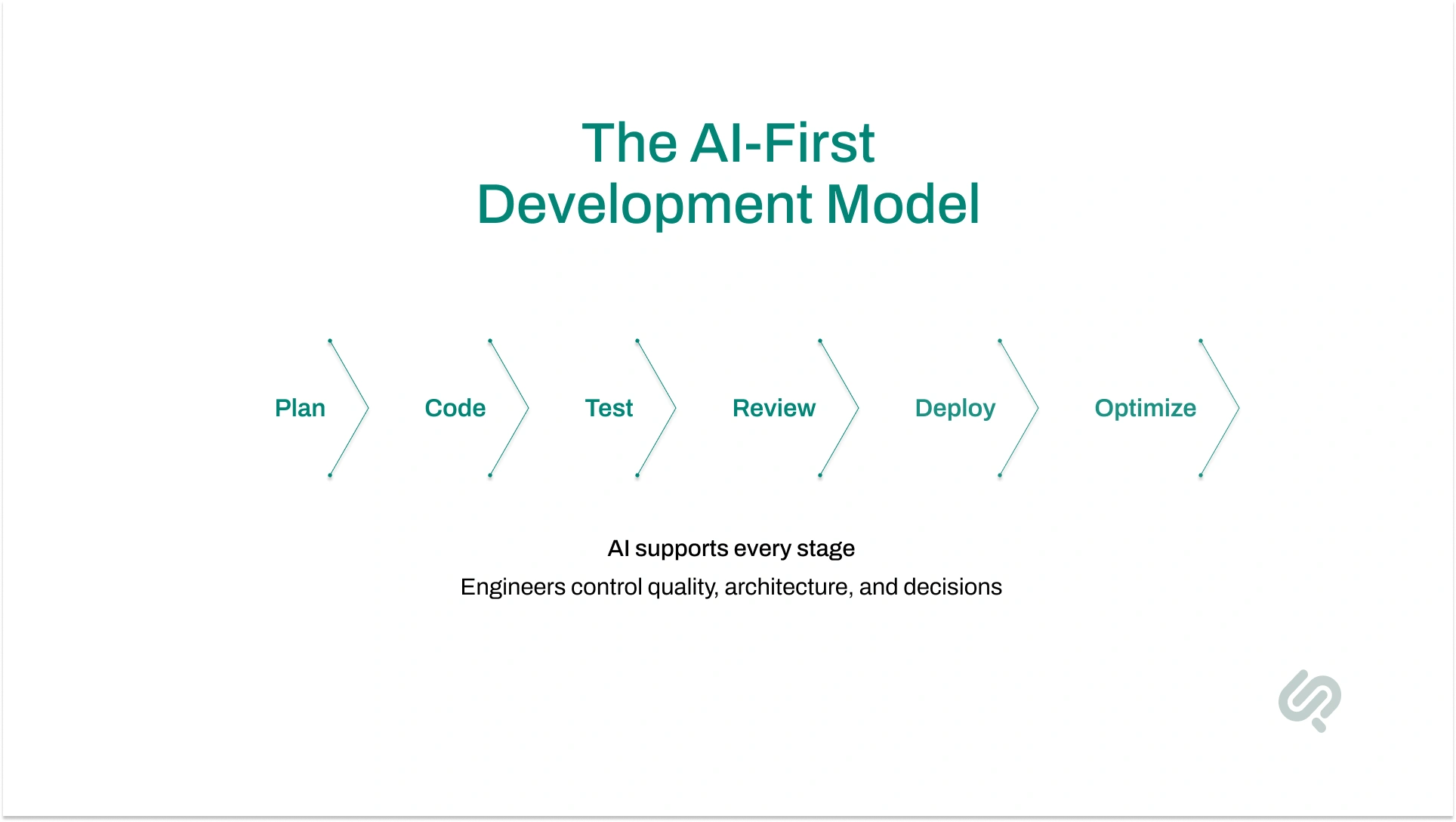
AI-first software development means using artificial intelligence as a core part of the entire development process, not just for writing code, but for planning, testing, reviewing, deploying, and maintaining software.
The key difference from traditional development is structural.
This is also meaningfully different from using a coding plugin.
AI-enabled development redesigns how your whole team operates, which tools are used, how work is reviewed, what gets automated versus what stays in human hands. The term "next-gen software development" is increasingly used to describe this shift because it's not an evolution of the old model, it's a structural replacement of it.

Before getting into benefits, it's worth addressing what AI-first development is commonly confused with. These misconceptions lead to poor adoption decisions, wrong vendor choices, and unmet expectations. Understanding the true capabilities of AI solutions is essential for making informed business decisions and accurately measuring outcomes, including how to calculate ROAS (Return on Ad Spend) to evaluate whether AI-driven initiatives are delivering a positive return on investment.
AI-first software development is not:
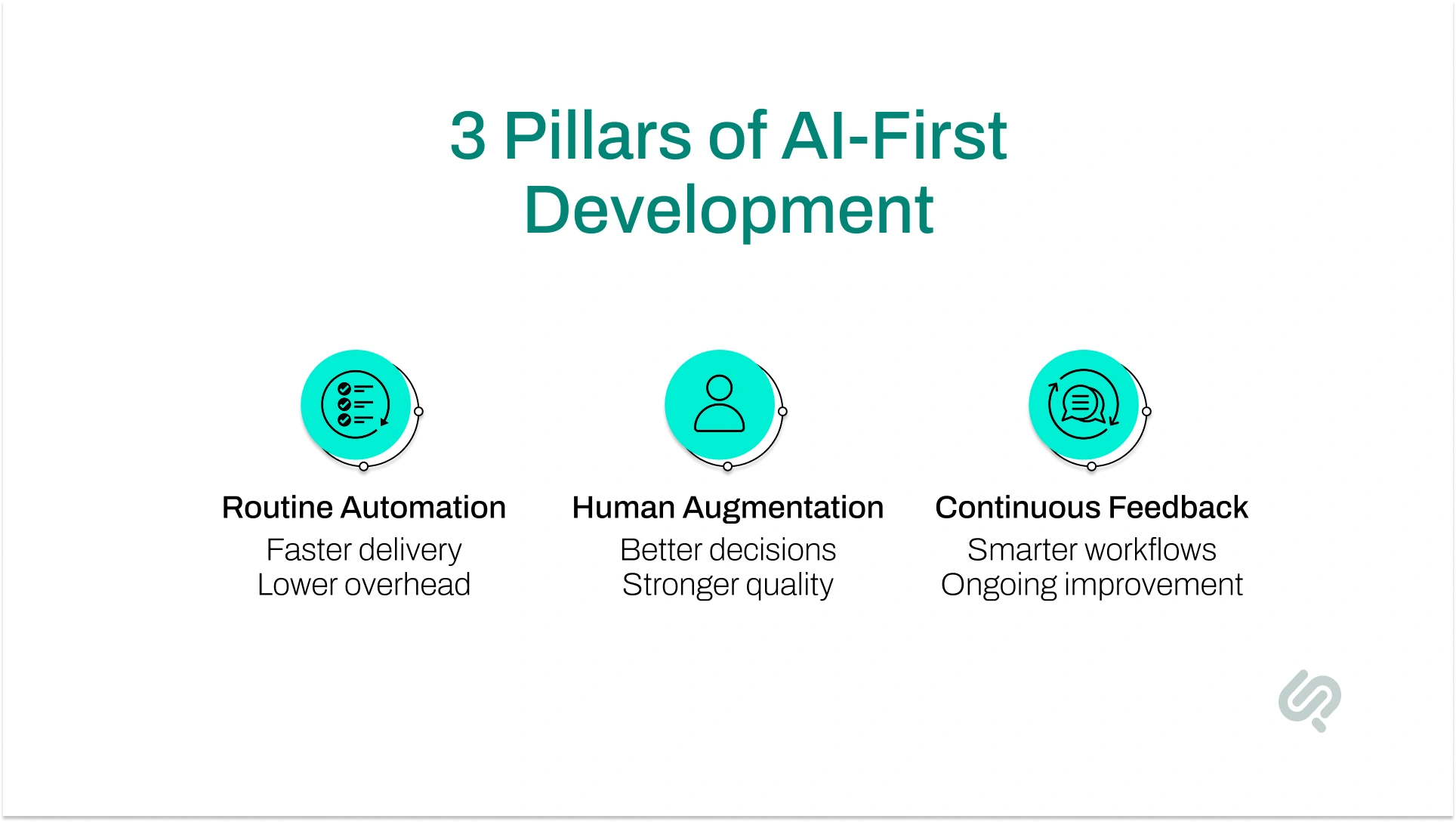
So what actually makes a development process "AI-first"?
AI becomes the structural core of how your team plans, codes, tests, and ships, not an optional add-on. Engineers shift from doing repetitive execution work to focusing on architecture, quality control, and complex problem-solving.
The AI handles volume. The engineers handle judgment.
A mature AI-first approach is an acceleration layer with clear governance, not a black box. The outcome is faster delivery, leaner teams, and better code quality. But those results only follow when the right process and the right people are in place.
AI-first development isn't just something your IT team is excited about. It has direct implications for speed, cost, and competitive position, and the gap between companies that have adopted it and those that haven't is widening quickly.
Software projects are famously late and over budget. AI-first development compresses timelines significantly.
McKinsey research estimates that generative AI tools can improve developer productivity by 20–45%, depending on task type, with the biggest gains in writing new code and refactoring. (1)
When AI handles repetitive tasks, fewer developer hours are needed for the same output. More importantly, catching bugs earlier reduces the total cost of fixing them.
Research shows bugs found in production cost 4–5x more to fix than those caught during development, and AI-powered testing catches far more issues before they ship. (2)
AI tools apply quality rules consistently, don't skip steps under pressure, and flag security issues that manual reviewers miss. This is especially valuable for enterprise software that needs to scale reliably over time.
"Acceleration can impact not just the development of software, but the whole software feedback loop, including putting things into production, learning from that, and changing the business's growth trajectory. In that sense, the effects of AI-first development can be dramatic."
— Martin Fowler, Chief Development Scientist
AI for business software solutions isn't just a cost play. It changes the pace at which your business can learn, adapt, and improve its products.
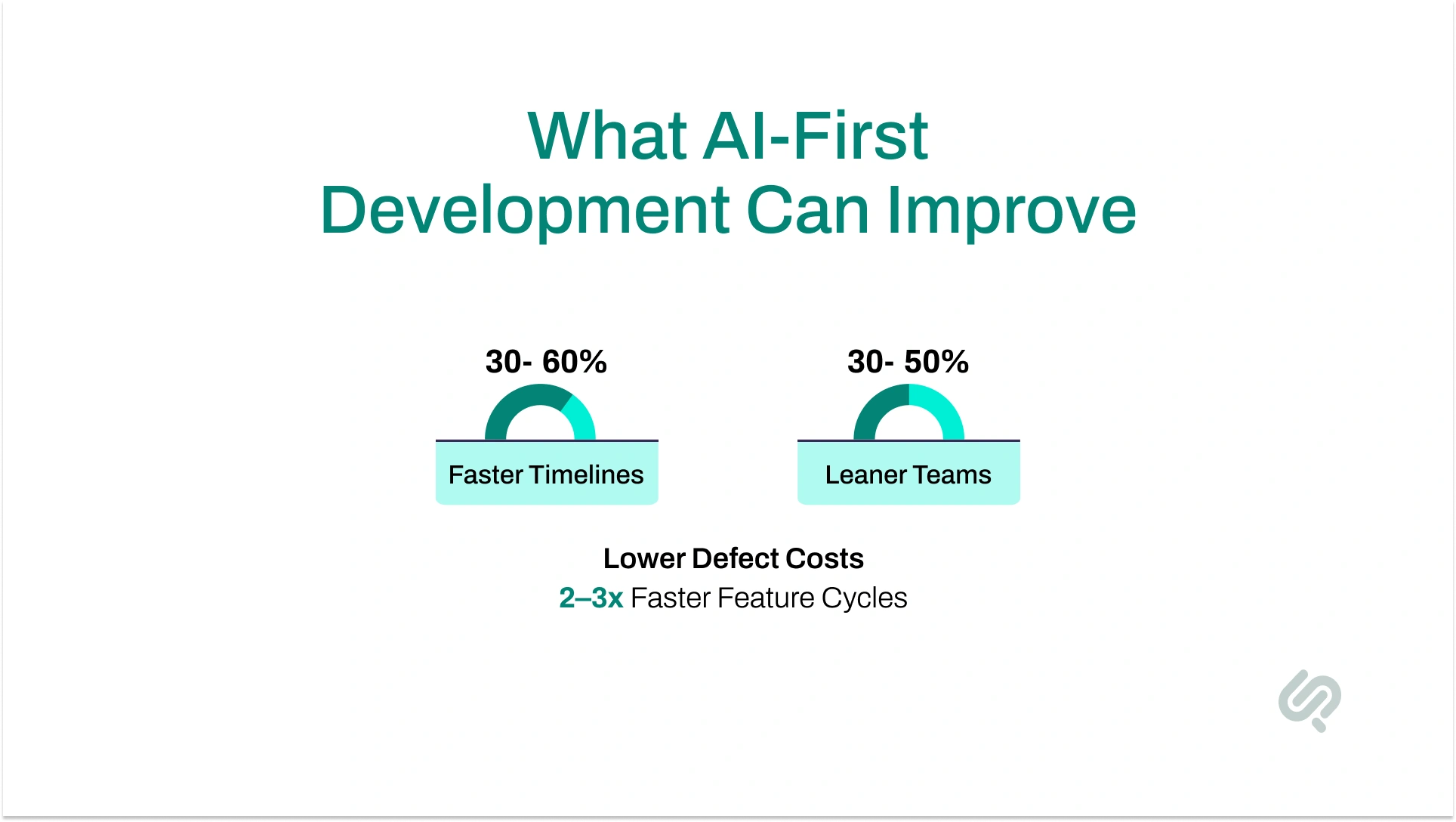
When AI is properly embedded into the development lifecycle, the results go beyond incremental speed gains. Here's what businesses consistently see:
The 30–80% efficiency range we quote reflects real project variance.
A straightforward web app and a complex enterprise platform with legacy integrations are different problems. Project complexity, your current process maturity, and your tech stack all affect the outcome.
"With AI-first development, a well-structured team of five can now deliver what previously required ten or more engineers. The key is combining the right AI development frameworks with strong engineering oversight. Without that oversight, you don't have AI-first development — you just have risk."
— Mujtaba Sheikh, Head of Development, Phaedra Solutions
What this means practically: faster software delivery using AI is a process outcome, not a tool outcome. It follows from redesigning how your team works — not from buying better software.
AI-first software development helps businesses build faster, reduce costs, improve quality, and scale engineering output without adding unnecessary team overhead.
AI code generation, automated testing, and smarter deployment workflows help teams move from idea to launch much faster.
According to the Stack Overflow Developer Survey, 62% of developers using AI tools said AI improved their productivity. This speed advantage translates directly into a competitive market position. (3)
AI tools eliminate repetitive work — boilerplate coding, documentation, test writing, and basic debugging.
Teams deliver more with the same resources. For startups and growing businesses, this is often the difference between staying lean and over-hiring.
AI-enhanced coding development includes AI-assisted code reviews, automated testing, and security checks that catch bugs, performance issues, and vulnerabilities earlier in the cycle.
Fewer production problems mean a more reliable product and significantly lower maintenance costs.
AI doesn't replace developers — it removes the low-value work that slows them down.
Developers focus on architecture, product logic, and problem-solving. Every engineer on your team becomes measurably more output-efficient.
AI-first workflows support both small and large engineering teams without proportional overhead increases.
A team of five with the right AI tools can deliver what a team of ten delivered without them.
AI-first development increases in value over time.
Teams learn from project data, bug patterns, and delivery performance, creating a structural advantage that builds with every release cycle.
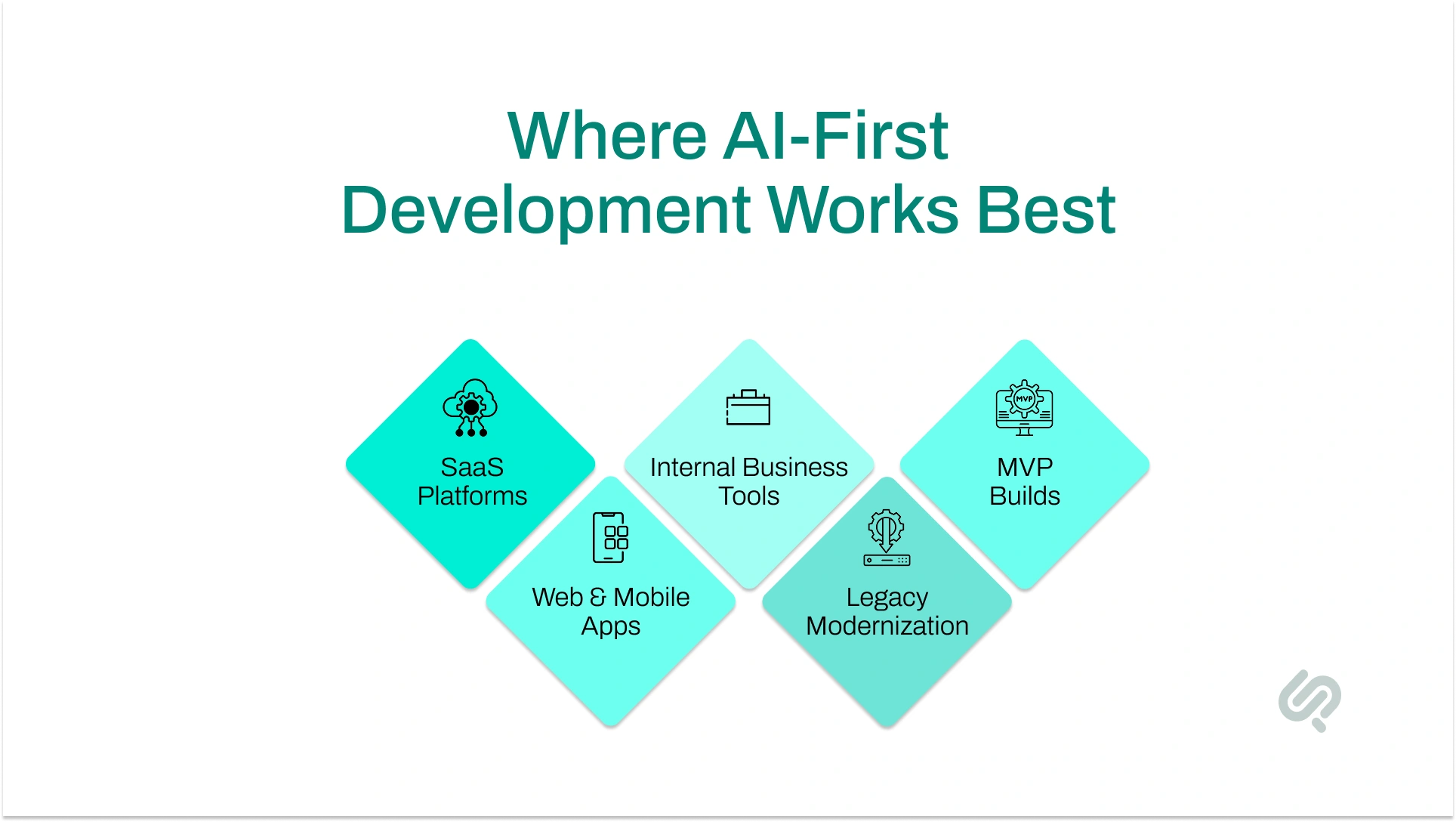
AI-first development works best when a project has clear goals, repeatable patterns, and defined business logic. Not every project type benefits equally.
Here's where businesses consistently see the strongest return:
Dashboards, admin panels, API integrations, reporting modules, and user workflow features all involve significant repetitive architecture.
AI code generation handles the bulk of this work, freeing engineers for the product logic that actually differentiates your platform. SaaS companies using AI-first workflows typically see 40–60% faster feature delivery cycles.
Frontend components, API layers, reusable UI elements, and release pipelines are well-suited to AI code generation and AI-assisted testing.
Teams building web and mobile apps with an AI-first model consistently reduce delivery timelines and QA overhead, without reducing code quality.
Phaedra Solutions applied this approach in a recent project for a government digital platform, delivering a Next.js web portal and React Native mobile Super App that unified 30+ public services across web, mobile, and AI-assisted channels, all within a single structured delivery program.
CRMs, client portals, workflow automation tools, and operational dashboards involve highly repetitive development patterns.
AI-driven development reduces that repetitive effort significantly, letting businesses build and ship internal tools without committing large engineering resources.
This is where AI-first development can have the most dramatic impact of all.
Legacy systems are expensive to understand, document, and refactor manually. One company applied AI tooling to a global automaker's modernization program, a 15-million-line codebase where reverse engineering 10,000 lines previously took two engineers six weeks.
With AI-assisted tooling, equivalent documentation was generated in hours. Across the full program, the approach could have saved an estimated 60,000 days of effort.
For businesses with aging systems, this is no longer a "nice to have." AI is the only practical path to modernization at a viable cost and timeline.
Startups and product teams can prototype, validate, and ship a first version significantly faster with AI-first workflows without building a large engineering team from day one.
For teams planning custom AI application development, this approach helps turn early product ideas into usable software faster, without locking the business into unnecessary features too soon.
This reduces burn rate during the highest-risk phase of any product.
These terms are often used interchangeably, but they describe meaningfully different operating models.
For business leaders evaluating options, the differences directly affect your cost, speed, and outcomes.
If you're evaluating an AI software development company, ask them which model they actually operate. Many claim to be "AI-first" but run AI-assisted workflows at best, which deliver only a fraction of the efficiency gains.
Before hiring an AI development company, this distinction matters because an AI-assisted vendor may only speed up small tasks, while an AI-first partner can redesign the full delivery process for better cost, speed, and scalability.
Here's what teams in a modern AI-first stack are actually using:
The right AI development frameworks for your team will depend on your stack, team size, and project type. There's no single universal setup, a good partner helps you choose based on your specific situation.

One of the most under-discussed aspects of AI-first development is governance. The speed benefits are real, but without the right controls, AI can amplify problems as quickly as it accelerates delivery.
Studies show that a majority of developers reported that AI tools increased the time they spent debugging or addressing security vulnerabilities (3).
Analysis of Git repositories shows that code "churn" code that gets changed, then changed again, often indicating accumulating quality issues, has risen significantly since AI coding tools became mainstream.
"The tagline we've used from the start is that generative AI amplifies indiscriminately. When you ask it to generate code, it doesn't distinguish between good and bad — and when you start with bad quality code, it amplifies that too."
— Birgitta Boeckeler, Global Lead for AI-Assisted Software Delivery, ThoughtWorks
What this means for business leaders: faster output without governance isn't a win. It's a compounding liability.
A responsible AI-first development process must include:
When evaluating an AI software development company, governance practices are as important as speed claims.
AI in digital product innovation is already in use at companies of all sizes. Here's what it looks like in practice.
Microsoft uses GitHub Copilot across developer workflows, helping engineers write code faster, reduce repetitive tasks, and focus on architecture and complex problem-solving.
Takeaway: AI improves developer productivity without removing human code ownership.
Google applies AI to code reviews, automated testing, and quality checks across large-scale engineering systems.
Takeaway: AI-first development improves release confidence and software quality, not just coding speed.
Shopify uses AI tools to maintain team productivity as the business scales, demonstrating how AI enables output growth without proportional headcount growth.
Takeaway: Smaller teams can move significantly faster when AI supports coding, documentation, testing, and deployment workflows.
For startups and mid-sized businesses, AI-first development levels the playing field. With AI code generation, automated testing, faster prototyping, and smarter deployment, lean teams compete with engineering departments five times their size.
Takeaway: AI-first software development isn't reserved for enterprises. For leaner teams, the ROI often comes faster.
The most common concern business leaders raise: Will AI replace our developers?
The short answer is no. But it does change what great engineers do, and what you should expect from them.
1. Developers shift from repetitive coding to higher-value work.
AI handles boilerplate, test drafts, documentation, and routine fixes. Developers spend more time on system architecture, product logic, and security, the work that shapes real business outcomes.
2. Senior engineers become more strategic.
AI-generated code still needs expert review. It can include bugs, weak logic, or security gaps without proper oversight. That makes senior engineers more important, not less, their role shifts toward validation, architecture guidance, and quality control. The role of the AI software engineer today is as much about reviewing and improving AI output as it is about writing code.
3. Junior developers need stronger technical fundamentals.
The ability to understand and evaluate AI-generated code matters more than the ability to write boilerplate quickly. Strong foundations in debugging, testing, and security are now essential. Junior developers who treat AI as an acceleration tool rather than a shortcut will grow faster.
4. Teams need clear AI governance.
This means documented prompt standards, code review requirements, approved AI coding tools, privacy controls, and human approval gates before deployment. Without this structure, AI-first development creates inconsistency instead of efficiency.
AI-first software development delivers real results, but it comes with risks that require strong technical leadership, clear processes, and secure engineering practices.
AI-generated code isn't always production-ready.
It can include hidden bugs, weak logic, poor performance, or security gaps,. especially without proper oversight. This is why human review remains non-negotiable in any AI-driven development process.
AI coding tools can suggest insecure patterns, particularly around authentication, input validation, API access, and data handling.
AI-first workflows must include secure code reviews, automated testing, and compliance checks at every stage. This is especially important for AI automation for healthcare, where patient data, audit trails, access control, and regulatory compliance must be planned before any AI workflow goes live.
AI should support developer judgment, not replace it.
If teams accept AI-generated code without understanding it, they'll struggle to debug, maintain, and improve it later. Senior engineering oversight isn't optional.
Moving to AI-first development changes how teams plan, build, test, and release software.
Leaders need to position AI as a productivity partner, one that removes repetitive work and helps engineers make better decisions, not a threat to job security.
Many AI tools process code and prompts in the cloud.
For businesses with sensitive IP, regulated data, or proprietary systems, clear AI usage policies and private deployment options are essential. Verify this with any vendor before starting.
You don't have to overhaul everything at once. Here's a practical path forward:
Step 1: Assess your current process.
Identify where your team spends the most time on repetitive tasks. Code writing, testing, and documentation are typically the biggest opportunities.
Step 2: Start with AI coding assistants.
GitHub Copilot, Cursor, and similar tools are low-friction entry points. Most developers can begin using them within days, and productivity gains show up quickly.
Step 3: Add automated testing and code review.
AI-powered testing and review tools catch issues earlier. This directly reduces your cost of defects.
Step 4: Evaluate AI agents for complex tasks.
Once your team is comfortable, explore tools that handle multi-step tasks, like writing full features from specifications.
Step 5: Redesign your process around AI.
This is what defines a true AI-driven development process: rethinking workflows, team structure, and decision-making with AI as a core assumption, not an add-on. This step is where the 30–80% efficiency gains are realized.
If you're evaluating an AI software development company, the following questions separate genuinely AI-first firms from those that have added AI-sounding language to a traditional process:
AI coding assistants like Copilot are a starting point. AI agents that handle multi-step tasks (like Cursor and Devin) represent a significantly more capable and cost-efficient approach. Ask specifically which tools they use and how.
Any credible AI software development company should have documented standards for reviewing, testing, and approving AI-generated code before it ships. If they can't describe this process clearly, that's a red flag.
Ask for project-level data. Vague claims about "being AI-powered" aren't useful. Concrete metrics, delivery timelines, team size comparisons, defect rates — are what matter. At Phaedra Solutions, we benchmark every engagement.
If your project involves proprietary systems or regulated data, ask specifically about their AI tool policies, what gets processed in the cloud, and whether private or on-premises AI deployment is available.
AI-first development for a fintech platform looks different from a healthcare app or an e-commerce build. Industry context and stack familiarity reduce risk and onboarding time.
AI-first software development gives your business a real path to building faster, reducing development costs, improving software quality, and scaling output with a leaner team.
The companies that win with AI won't be the ones with the most tools. They'll be the ones who combine AI with the right engineering process, the right oversight, and clear quality controls.
Phaedra Solutions provides AI-first development services for startups, scale-ups, and enterprises. We assess your current process, identify where AI reduces time and cost, design AI-first workflows around your stack, and deliver with measurable efficiency, 30–80% improvement depending on project scope and complexity.
→ Book a free AI-first development consultation.
One conversation. No obligation. A clear picture of what AI-first development can deliver for your specific project and timeline.



Ameena is a content writer with a background in International Relations, blending academic insight with SEO-driven writing experience. She has written extensively in the academic space and contributed blog content for various platforms.
Her interests lie in human rights, conflict resolution, and emerging technologies in global policy. Outside of work, she enjoys reading fiction, exploring AI as a hobby, and learning how digital systems shape society.