















This report is written by Mujtaba Sheikh, AI-First Solution Architect and Fractional CTO at Phaedra Solutions. His 13+ years across IoT architecture, real-time monitoring, predictive maintenance, and connected product delivery inform the report’s focus on operational scalability rather than pilot-stage connectivity.
Connecting physical assets is no longer the primary challenge in an Internet of Things initiative. The more difficult task is converting device data into reliable operational decisions.
Phaedra Solutions reviewed current AIoT research alongside its experience delivering real-time monitoring, predictive maintenance, connected dashboards, and command-and-control systems. The evidence shows that AIoT systems scale when they support a specific operational decision, have a named owner, and are designed for secure lifecycle management. They stall when connectivity, dashboards, or model development are treated as the final outcome.
To support clarity throughout this report, we define three related terms at the outset.
An AIoT system does not require every device to run an AI model. It requires AI to make a material contribution to the operational decision loop.
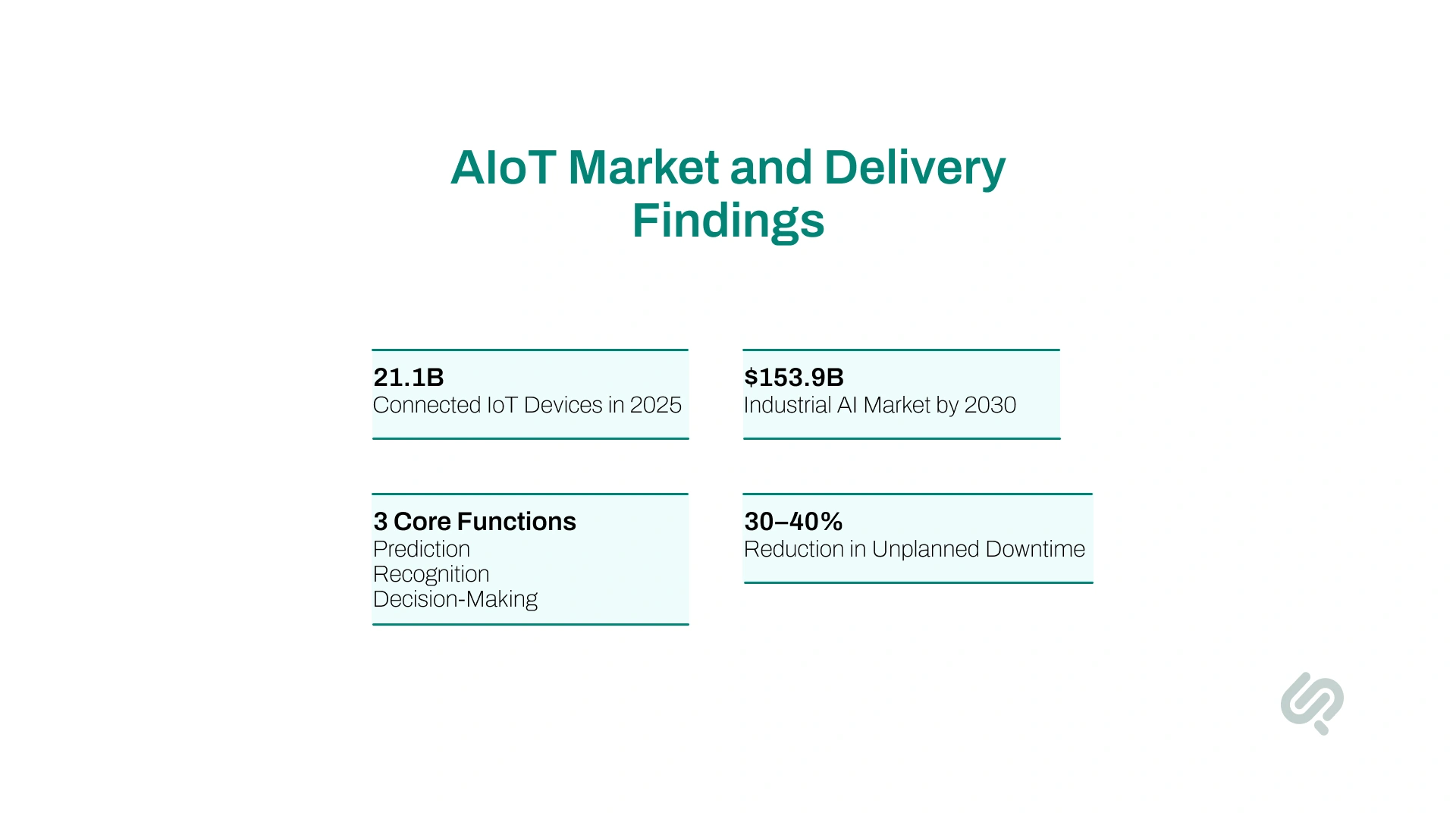
IoT Analytics estimated that the number of connected IoT devices worldwide reached 21.1 billion by the end of 2025 and could reach 39 billion by 2030. (1)
The global industrial AI market is forecast to grow from $43.6 billion in 2024 to $153.9 billion by 2030. (2)
A 2025 systematic review of 103 academic articles found that AIoT systems are primarily used for prediction, object and event recognition, and operational decision-making. (5)
Phaedra Solutions measured a 30% to 40% reduction in unplanned downtime across AIoT-enabled monitoring deployments compared with non-connected operating baselines.
The AIoT market has moved beyond the basic connectivity question. Independent forecasts differ in how they define devices and connections, but they consistently indicate that connected systems will expand into the tens of billions during the next decade. (1) (3) (4)
The more important question is whether organizations can convert that connectivity into measurable operational value.
The most scalable AIoT use cases are concentrated in a practical group of applications:
These use cases perform well because they support decisions that operations teams already need to make. They help determine when equipment should be serviced, whether a product meets quality standards, where an asset is located, whether an event requires escalation, or what action should follow an abnormal condition.
Across the research and Phaedra Solutions’ delivery experience, five conditions consistently influence whether an initiative progresses beyond a pilot:
In my experience, the most expensive AIoT failure is not always an inaccurate model. It is often an accurate prediction delivered into an operating process with no owner, response threshold, or authority to act. A prediction creates value only when the organization has defined what happens next.
IoT Analytics estimated that connected IoT devices reached 21.1 billion worldwide at the end of 2025, with the total expected to reach 39 billion by 2030 and exceed 50 billion after 2035. (1)
GSMA Intelligence separately forecasts 40.8 billion IoT connections by 2030 and 52.9 billion by 2035. The figures are not directly interchangeable because each organization applies different definitions, but both forecasts indicate sustained growth. (3)
Cellular IoT is also expanding. Ericsson reported approximately 4.5 billion cellular IoT connections at the end of 2025. It also reported that 5G Reduced Capability, or RedCap, had been launched by 14 service providers, with additional operators investing in the technology. (4)
RedCap supports mid-range IoT applications that require more capability than narrowband technologies but do not need full mobile-broadband performance. This expands the connectivity options available for industrial monitoring, wearables, video-based applications, and other moderate-bandwidth deployments. (4)
The industrial AI market is developing in parallel. IoT Analytics estimates that the market will grow from $43.6 billion in 2024 to $153.9 billion by 2030. Its research identifies quality inspection as a leading industrial AI use case and edge AI as an important area of future growth. (2)
These figures show that connectivity and AI adoption are expanding. They do not, however, confirm that organizations are extracting equivalent operational value.
Connected-device counts are infrastructure measures, not business outcomes. The more useful measures are how many failures were prevented, how quickly incidents were resolved, how much inspection effort was reduced, and whether operational decisions improved because the system existed.
IoT Analytics reports that the enterprise IoT market grew 13% in 2025 to approximately $324 billion and projects 14% growth in 2026, with AI among the main drivers. Its 2026 market framing describes a shift from isolated connectivity toward autonomous and cross-ecosystem connected operations. The relevant business trend is not simply more devices; it is tighter integration between device data, operational systems, AI, and controlled action. (10)
The 2026 smart-manufacturing roadmap identifies industrial data management, heterogeneous sensing and control integration, explainability, reliability, and trustworthy operation as core barriers to scale. These requirements support a hybrid model: time-sensitive inference can move closer to equipment, while model training, fleet-wide comparison, policy management, and historical analysis remain centralized. (11)
A 2026 review of AI, IoT, and robotics integration describes an emerging architecture in which smaller models operate near devices while larger cloud models support coordination and complex reasoning. This direction is still early, but it indicates that future connected systems will increasingly combine perception, local inference, workflow orchestration, and controlled physical action rather than stopping at alerts and dashboards. (12)
As deployments expand, the cost of provisioning, identity, firmware, credentials, model distribution, observability, incident response, and retirement becomes more important than the unit price of a sensor. For decision-makers, total lifecycle cost and the operational outcome supported by each device will be more useful measures than the number of connected endpoints.
The market is therefore moving toward platforms and delivery models that can manage devices, data, models, policies, and operational responses as one governed system. AIoT providers will increasingly be judged on secure fleet operations and measurable decision outcomes, not on connectivity demos.
This report combines published industry research with delivery observations from Phaedra Solutions’ AIoT and connected-systems work.
It is intended to identify recurring operational and architectural patterns rather than provide a statistically representative assessment of the entire AIoT market.
The report reviewed findings and forecasts from:
Deloitte’s 2026 research included responses from 3,235 business and technology leaders across 24 countries. (6)
Phaedra Solutions’ observations are based on connected-systems work involving:
The review considered the operational and technical conditions that influenced whether systems delivered measurable value or remained limited to monitoring and proof-of-concept use.
The systems and use cases reviewed were assessed against the following criteria:
Public case studies tend to represent successful deployments more often than failed pilots. Organizations are less likely to publish projects that delivered limited returns, experienced security problems, or did not progress beyond an initial trial.
Phaedra Solutions’ delivery experience is weighted toward monitoring, predictive maintenance, dashboards, and command-and-control applications. Findings for other AIoT applications should be interpreted in the context of their industry, operating environment, and risk profile.
Industry sources also use different definitions of an IoT device, IoT connection, cellular connection, and industrial AI market. Their forecasts demonstrate scale and direction but should not be compared as identical measures. (1) (3) (4)
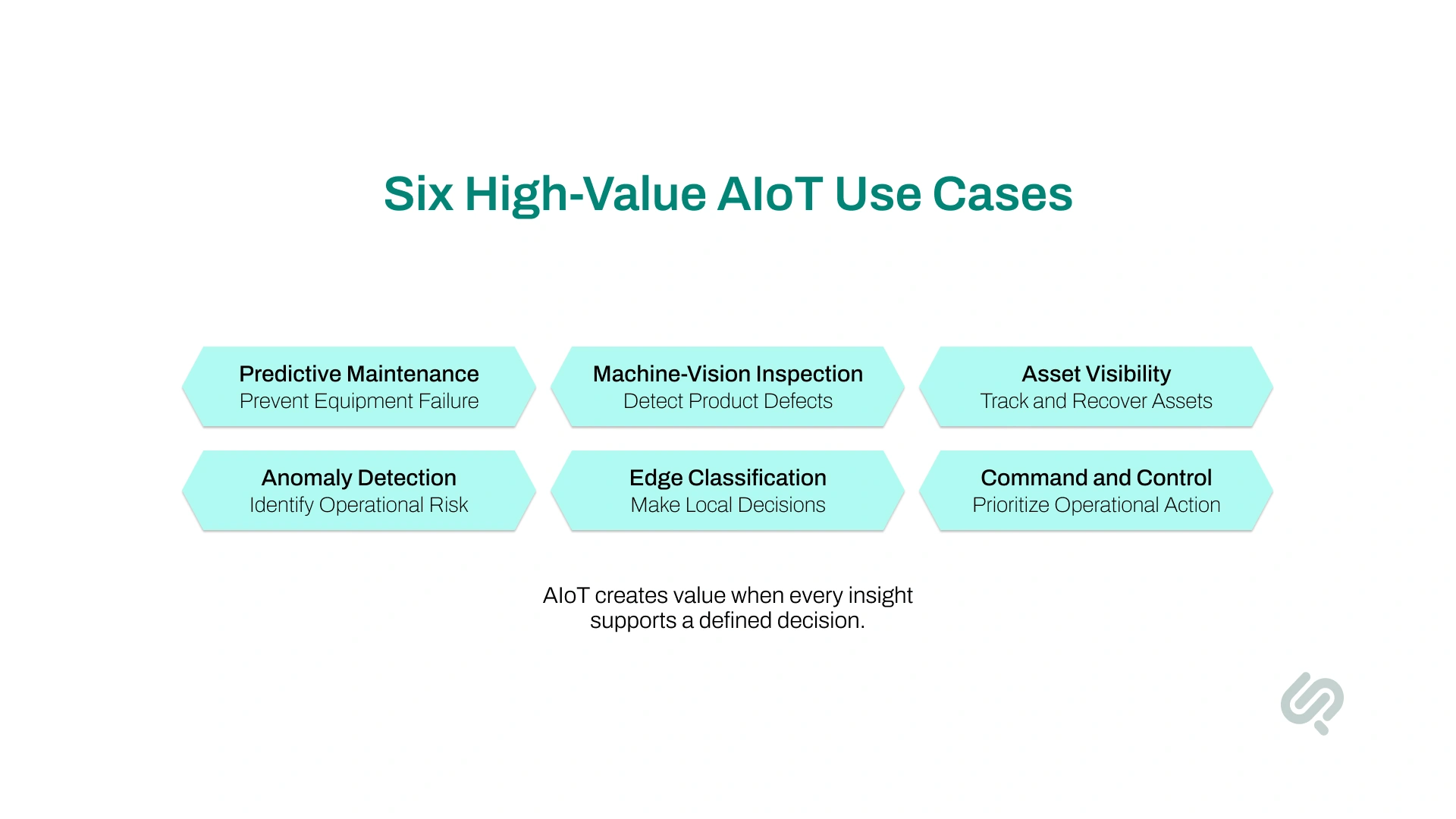
The strongest AIoT use cases typically involve narrow and repeated decisions supported by reliable data.
A systematic review of 103 AIoT studies found that prediction, object and event recognition, and operational decision-making were the most common AI functions. (5)
IoT Analytics also identifies quality inspection as a leading industrial AI application. (2)
Microsoft’s edge-AI guidance identifies image classification, object detection, and related visual-analysis tasks as common edge scenarios. It also notes that incremental model updates are important in narrow-bandwidth environments, where repeatedly transferring complete model packages can increase cost and deployment downtime. (7)
Predictive maintenance creates value when it enables intervention before an asset fails.
The model requires reliable historical data, suitable sensor placement, maintenance capacity, and a clear financial basis for acting on an alert. Model accuracy alone does not produce a maintenance outcome.
A complete implementation should connect predictions with:
Phaedra Solutions measured a 30% to 40% reduction in unplanned downtime across AIoT-enabled monitoring deployments where predictions were connected to defined maintenance processes.
Machine vision can reduce manual inspection effort and improve consistency, particularly on stable production lines.
Performance may decline when products, lighting, camera positions, materials, packaging, or defect definitions change. The system therefore requires a process for detecting model drift and collecting new labeled examples.
The operating process must also define the action that follows a detection. Depending on the environment, this may include rejecting an item, stopping equipment, notifying an operator, or routing the product for secondary inspection.
Visibility systems are most valuable when they support faster exception handling.
Knowing the location of an asset is useful, but operational value comes from determining whether it is delayed, misplaced, damaged, exposed to unsuitable conditions, or likely to disrupt a downstream process.
These systems should integrate with the operational platforms through which action is taken, such as:
A standalone tracking dashboard may improve visibility without materially improving operational performance.
A related example is Phaedra Solutions’ AI Inventory Management Software, which combines real-time inventory tracking, AI-driven reporting, and centralized web and mobile dashboards.
Anomaly detection can identify abnormal conditions before they develop into failures. It can also create excessive alerts if the system does not distinguish between unusual activity and operationally important activity.
A scalable anomaly-detection system requires:
A dashboard becomes operationally useful only when important signals have a threshold, an owner, a response window, and an action.
The evidence reviewed for this report indicates that most stalled AIoT initiatives fail because of operating-model and architecture weaknesses rather than hardware limitations.
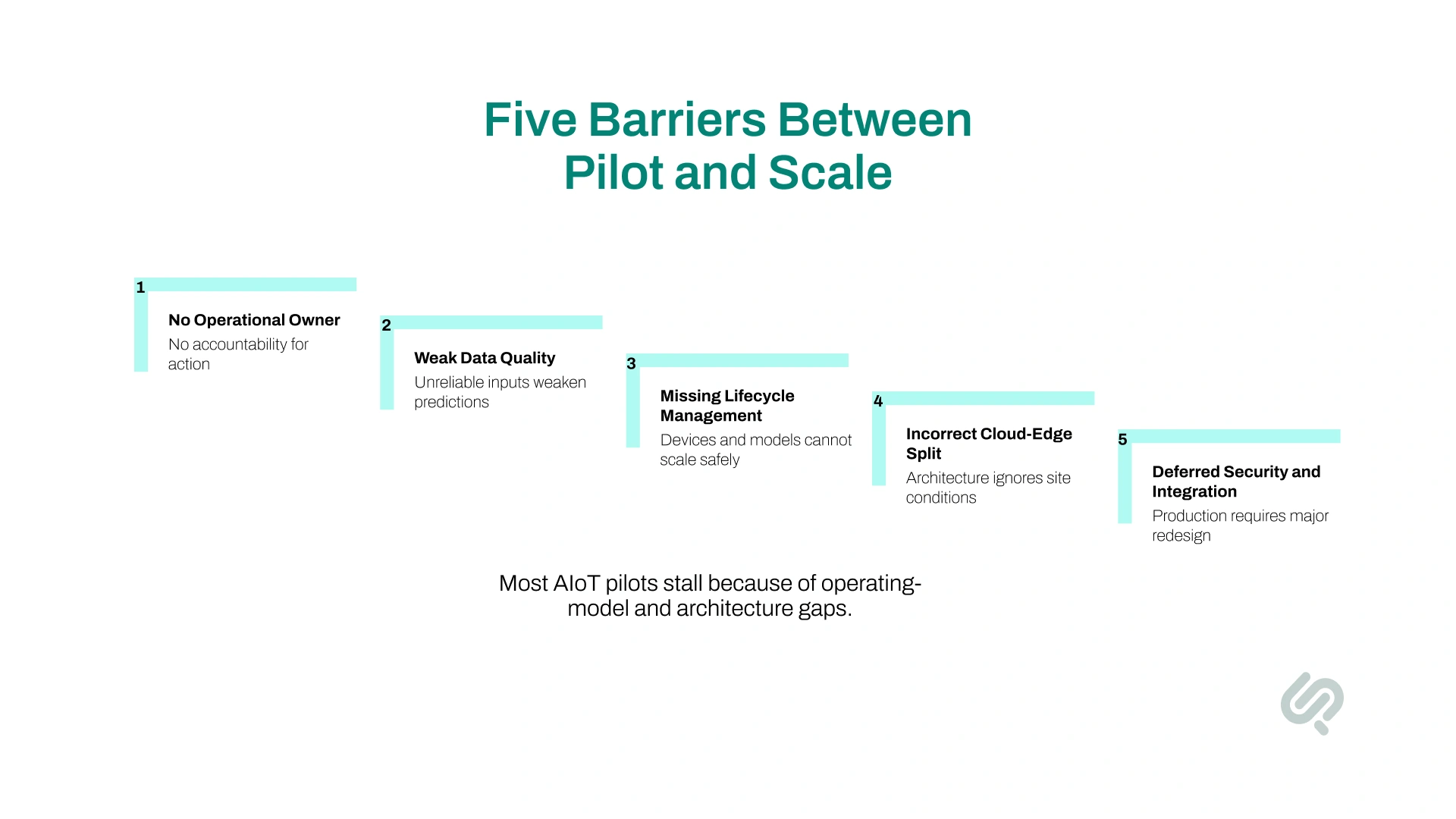
Many pilots have a technical sponsor but no operations leader accountable for the result.
The system may demonstrate that it can detect an anomaly or forecast a failure, but nobody owns the response time, downtime reduction, asset-loss rate, inspection cost, or maintenance outcome.
Without that accountability, there is no clear owner for operational adoption or further investment.
AI cannot compensate for unreliable measurements, incomplete maintenance records, inconsistent timestamps, changing sensor calibration, or labels that do not represent real operating conditions.
Data validation should assess:
A model trained on weak data may perform well during a controlled pilot and fail when operating conditions change.
A small pilot can be supported through manual configuration. A scaled deployment requires repeatable processes for:
NIST’s IoT cybersecurity baseline identifies device capabilities needed to support common security requirements across connected environments. (9)
Device and model lifecycle management must be included in the initial system design.
Sending all data to the cloud may be appropriate for centralized analysis, but it can create problems where latency, connectivity, bandwidth, privacy, or safety requirements demand local processing.
Running all functions at the edge creates other challenges, including limited computing capacity, fragmented observability, model-distribution complexity, and higher field-maintenance requirements.
The architecture should be based on operating conditions rather than a default cloud-first or edge-first approach.
Pilots are often built in controlled environments with temporary credentials, limited device counts, isolated datasets, and simplified integrations.
These assumptions do not remain valid at production scale.
Security requirements include:
Integration requirements may include operational technology, ERP, maintenance, logistics, identity, ticketing, and reporting systems.
Deferring these requirements frequently results in significant redesign before the system can be expanded.
The deployment model should reflect where the decision must occur and how quickly the system must respond.
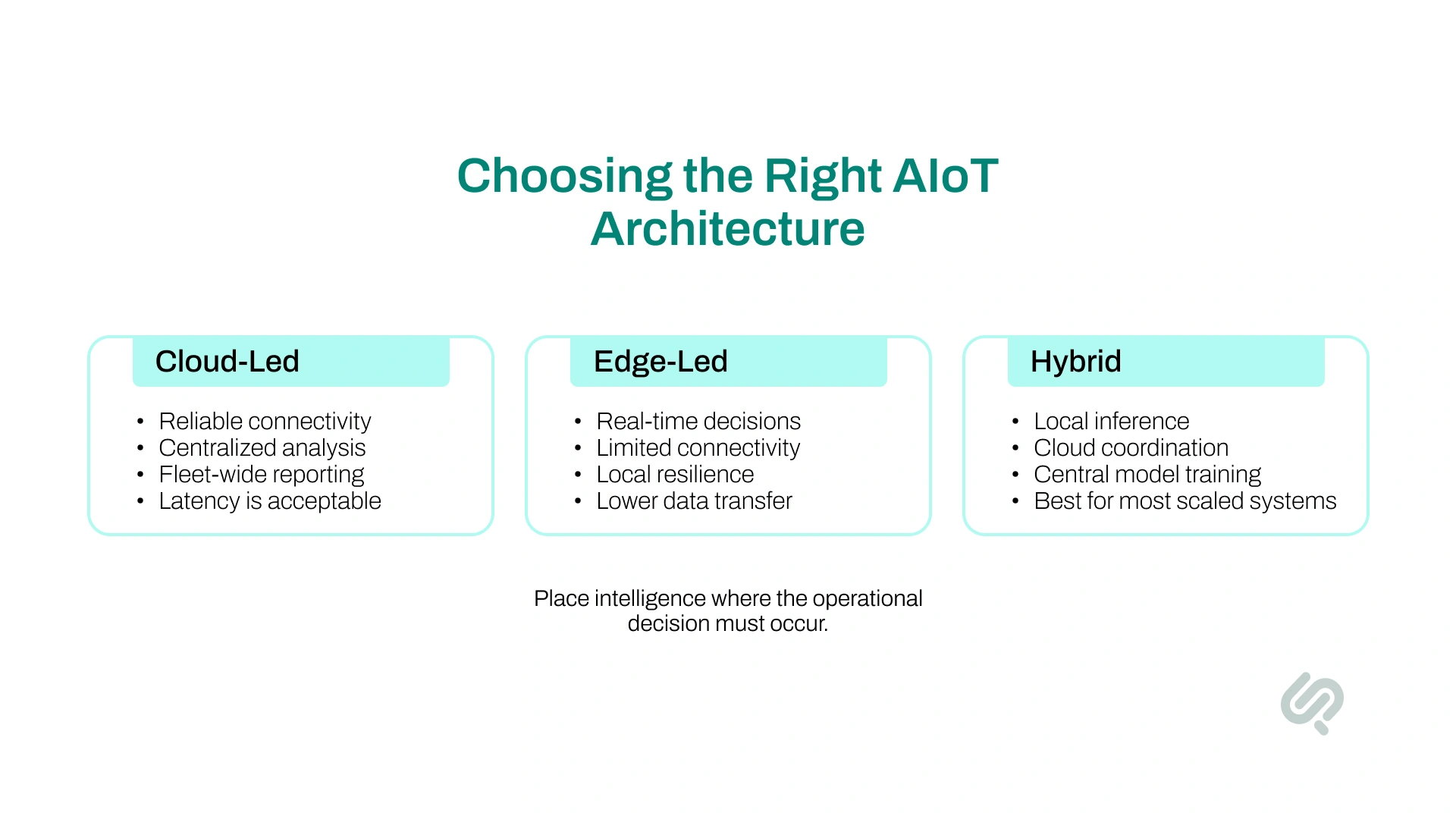
A cloud-led architecture is suitable when:
Typical applications include long-term asset-performance analysis, fleet reporting, energy analysis, and centralized monitoring.
An edge-led architecture is suitable when:
Microsoft identifies industrial and operational-technology environments as common candidates for edge-connected architectures, particularly where equipment cannot connect directly to the public internet. (8)
For many connected-operations systems, a hybrid architecture provides the most appropriate balance.
The edge can manage:
The cloud can manage:
Edge computing is not inherently more advanced than cloud computing. The design question is which intelligence must remain local to protect response time, resilience, safety, privacy, and cost. Functions that benefit from centralization should remain centralized.
Phaedra Solutions uses a four-stage model to evaluate whether a connected-operations initiative is prepared to progress beyond a limited pilot.
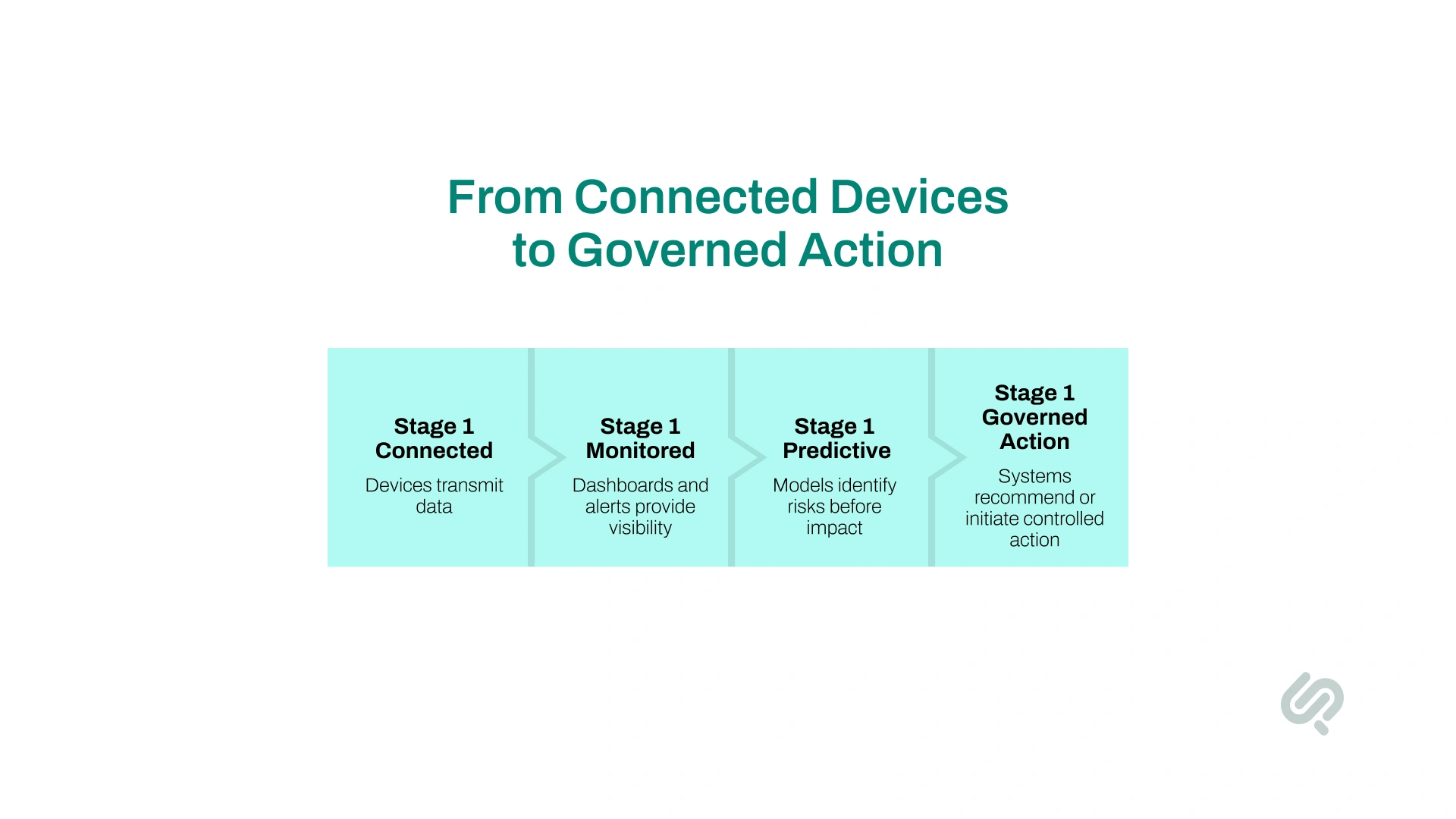
Devices transmit data reliably.
The organization can confirm whether an asset is online and collect basic telemetry, but there is no analytical or decision layer.
Primary Requirement: Reliable data collection and device identification.
Dashboards, thresholds, and alerts provide operational visibility.
Decisions remain reactive and human-led. Operators respond after an event becomes visible.
Primary Requirement: Reliable identification and escalation of abnormal conditions.
Models forecast failures, defects, delays, or anomalies before their full operational impact occurs.
A named owner is accountable for reviewing the output and acting within a defined response period.
Primary Requirement: Timely intervention based on validated predictions.
The system recommends or initiates actions within defined operational limits.
Actions may include:
The system also includes audit records, human override, rollback, model monitoring, and fallback procedures.
Stage 4 should not be interpreted as unrestricted autonomy. In most operational environments, the appropriate target is bounded automation. The system can act within narrow, tested limits and escalate decisions outside those limits to an accountable person.
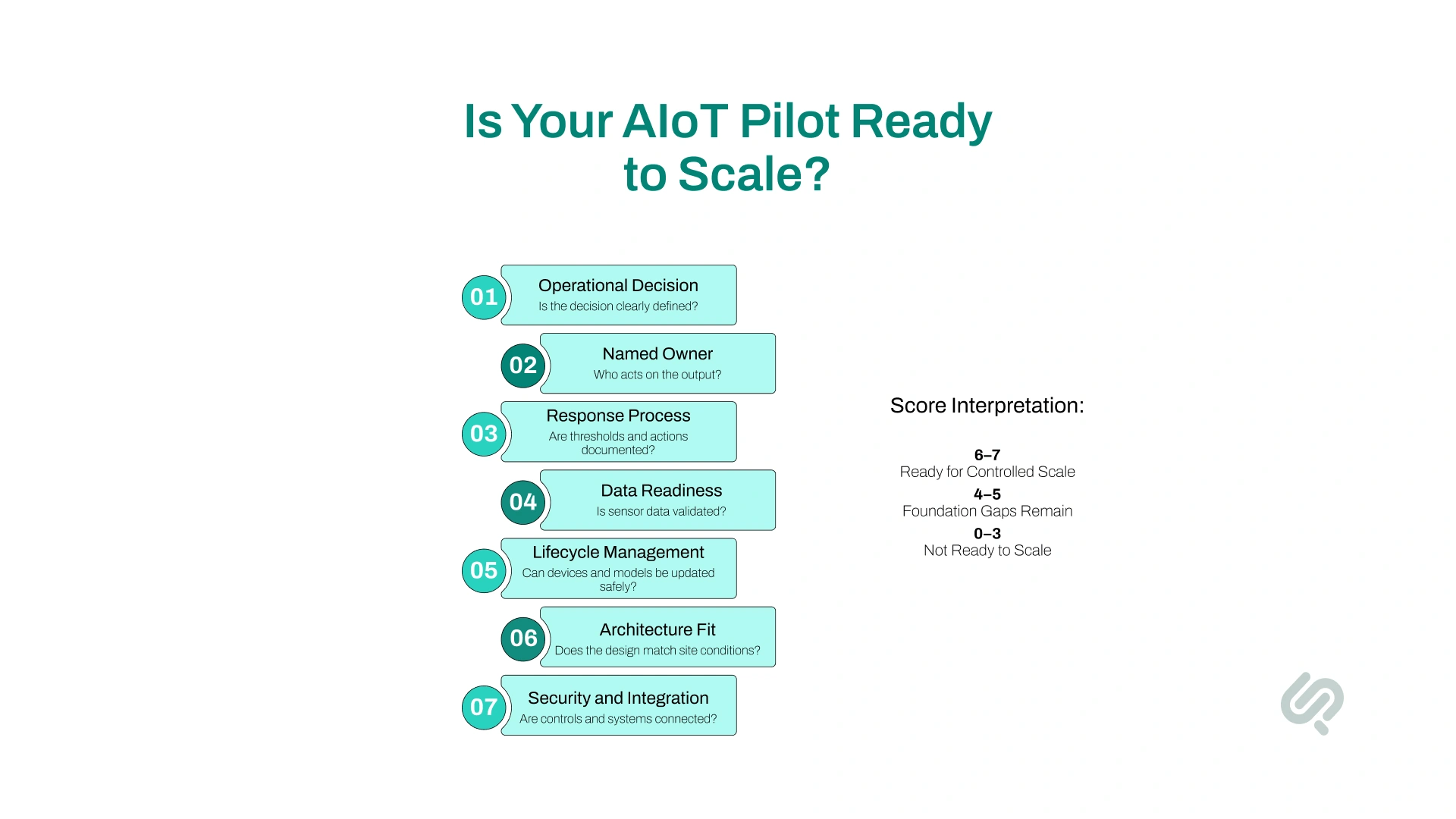
Before expanding an AIoT pilot, operations and engineering leaders should assess seven conditions.
Score each condition as:
Is the exact decision supported by the system clearly defined?
Is one role accountable for reviewing or acting on the output?
Are thresholds, escalation routes, response times, and fallback procedures documented?
Are sensor quality, calibration, completeness, labeling, and contextual data continuously validated?
Can devices, credentials, firmware, configurations, and models be securely updated, monitored, rolled back, and retired?
Does the cloud-edge design reflect the deployment’s latency, connectivity, bandwidth, privacy, and safety requirements?
Is the system integrated with the necessary operational platforms and protected by a defined security baseline?
Deloitte reports that physical AI adoption is most advanced in manufacturing, logistics, and defense. Its 2026 enterprise research also identifies substantial interest in agentic AI across supply chain management, research and development, knowledge management, and cybersecurity. (6)
AIoT systems that scale successfully will increasingly be hybrid, edge-aware, updateable, integrated, and governed by design.
Organizations will use edge inference where latency, resilience, privacy, safety, or bandwidth requirements justify local processing.
Training, historical analysis, fleet coordination, and central management will generally remain in cloud or data-center environments.
Organizations will need to manage model versions, device configurations, credentials, firmware, and operating policies as parts of one system lifecycle.
A model update should not be deployed without confirming device compatibility, network requirements, rollback behavior, and operational impact.
More systems will move from detecting events to recommending or initiating actions.
Automation should be expanded according to:
The appropriate objective is controlled authority rather than unrestricted autonomy.
IoT Analytics describes agentic AI as an emerging area within industrial AI but notes that practical deployment remains at an early stage. (2)
Organizations will increasingly evaluate AIoT systems according to operational outcomes rather than connectivity or dashboard activity.
Relevant measures include:
The next stage of AIoT will not be defined by the number of sensors deployed or the size of the underlying models. It will be defined by the quality of the decision architecture: clear ownership, reliable data, controlled automation, and systems that can be securely updated throughout their operating life.
The following predictions are my interpretation of the evidence in this report and the operating patterns I expect business and engineering leaders to encounter as AIoT deployments mature.
I expect procurement conversations to move away from the number of sensors, dashboards, or connected sites.
Buyers will ask how much downtime was avoided, how quickly exceptions were resolved, how inspection yield changed, and whether energy, labor, loss, or safety performance improved. A device without a measurable decision outcome will become difficult to justify.
Device identity, firmware, credentials, configuration, model versions, operating policies, and rollback will be managed as one lifecycle.
Organizations that keep IoT operations and machine-learning operations in separate teams and toolchains will face slower updates, weak accountability, and more production risk.
I expect smaller, specialized models to perform local classification, anomaly detection, and safety-sensitive inference, while larger cloud models handle training, fleet-wide comparison, root-cause exploration, and complex reasoning.
The winning architecture will not be edge-only or cloud-only; it will place each form of intelligence where it is operationally justified.
Passive dashboards that show every signal will lose value.
Future interfaces will rank the events that require action, explain why they matter, identify the responsible role, and show the response window and recommended next step. The best dashboard will contain less information and create faster action.
Organizations will automate narrow, reversible, observable actions first.
High-impact or difficult-to-reverse decisions will continue to require approval. This approach will let businesses gain speed without handing unrestricted authority to a model operating in a physical environment.
Contracts will increasingly define ownership of device data, labels, model outputs, event histories, and export formats.
Businesses will also require documented pathways for changing cloud providers, replacing hardware, or moving to a different operational platform. Vendor lock-in will be treated as an operating risk rather than a technical inconvenience.
Define the decision, accountable owner, response period, required action, and business measure before selecting devices or models.
Assess sensor health, missing data, timing, calibration, context, and label quality before optimizing model performance.
Include device provisioning, identity, credentials, firmware, model updates, monitoring, rollback, replacement, and retirement in the initial architecture.
Base cloud and edge responsibilities on actual latency, bandwidth, connectivity, privacy, resilience, and safety requirements.
Connect alerts and recommendations to the systems through which work is completed, including maintenance, logistics, ERP, identity, ticketing, and incident-management platforms.
Track downtime, response time, inspection effort, throughput, defect rates, asset losses, energy use, and service continuity. Dashboard views and alert volumes are not sufficient measures of value.
Begin with recommendations and human approvals. Automate only actions that are narrow, observable, reversible, and supported by tested fallback procedures.
AIoT systems create value when intelligence is connected to a defined operational decision.
The most effective system is not necessarily the one with the most devices, the newest model, or the most complex dashboard. It is the system that can reliably collect data, interpret it within the correct operating context, deliver it to an accountable owner, support an appropriate action, and remain secure and maintainable at scale.
For operations leaders, the central question is no longer: Can we connect the asset?
It is: Can we build a governed decision process that remains useful, secure, and maintainable after the pilot ends?
This report combines publicly available market forecasts, academic research, architecture guidance, cybersecurity frameworks, and Phaedra Solutions’ connected-systems delivery observations.
Assess Your Connected Operations Readiness.
Book a free call and let’s identify where AIoT can improve operational performance without creating unnecessary integration, lifecycle, or governance risk.


1.State of IoT 2025: Number of Connected IoT Devices Growing to 21.1 Billion Globally.
2.Industrial AI Market: 10 Insights on How AI Is Transforming Manufacturing. 2025.
3.IoT Market Outlook to 2035: Trends and Drivers Shaping Connections Growth. 2026.
4.IoT Connections Outlook. Ericsson Mobility Report.
5.A Systematic Literature Review on AI in IoT Systems. 2025.
6.The State of AI in the Enterprise: The Untapped Edge. 2026.
7.Enable Machine Learning Inference on an Azure IoT Edge Device.
9.NISTIR 8259A: IoT Device Cybersecurity Capability Core Baseline.

Mujtaba turns product ideas into working software — fast. As a Fractional CTO and solution architect with 13+ years of experience, he leads AI-first development teams that ship MVPs in under 10 days, cut product rework by 40%, and build digital infrastructure that holds up at scale.
His work spans UX design, full-stack development, blockchain integration, and IoT — all engineered with AI-assisted tooling to reduce build time and operational cost by 30–60%.