












The writer of this report is Mujtaba Sheikh, Fractional CTO and AI-First Solution Architect at Phaedra Solutions. Mujtaba has 13+ years of experience across blockchain integration, multi-party system architecture, and scalable digital product delivery.
Enterprise blockchain is no longer defined primarily by cryptocurrency or speculative digital assets. Its most credible applications now focus on tokenized finance, multi-party trade, supply-chain traceability, and shared records that no single participant should control.
Phaedra Solutions reviewed current institutional research alongside its experience assessing and delivering blockchain systems. The evidence indicates that blockchain creates value when multiple parties need a shared, independently verifiable record and cannot rely on one organization’s database as the sole source of truth. Outside those conditions, blockchain often adds governance, integration, and operational complexity without improving the outcome.
In my view, the first question should never be which blockchain protocol to use. It should be whether the business problem requires a blockchain at all.
To support clarity throughout this report, we define three terms at the outset.
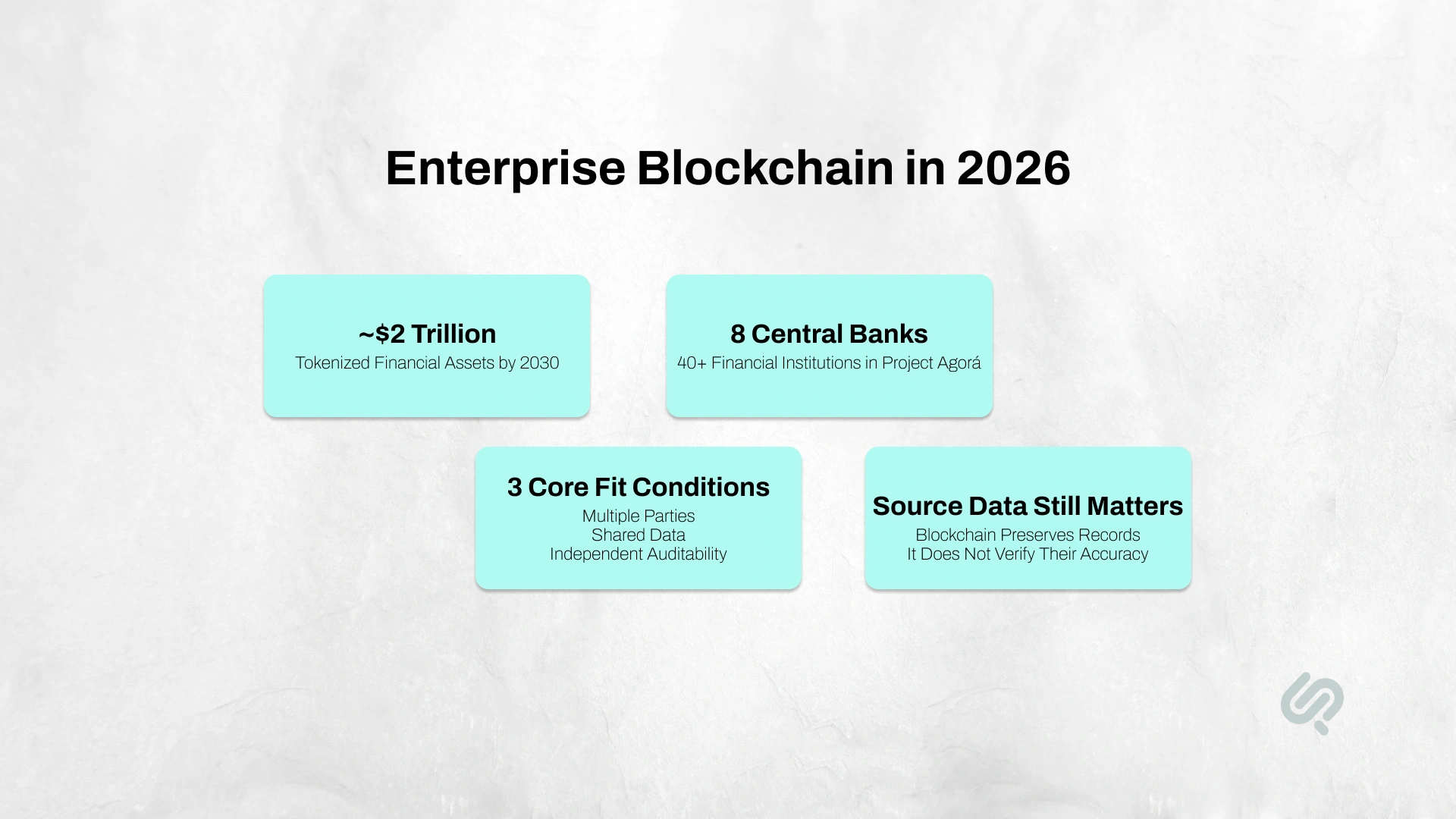
McKinsey estimates that tokenized financial assets could reach approximately $2 trillion in market capitalization by 2030, excluding cryptocurrencies and stablecoins. Its lower and upper scenarios range from approximately $1 trillion to $4 trillion. (1)
BIS Project Agorá brought together eight central banks and more than 40 regulated financial institutions to test tokenized wholesale cross-border payments. Its 2026 prototype demonstrated atomic, multi-currency settlement and is progressing toward real-value testing. (2)
Deloitte identifies three foundational questions: whether multiple non-trusting parties are involved, whether the same data must be accessible to multiple parties, and whether accountability or auditability is required. (3)
A blockchain can preserve and share a record, but it cannot confirm that the original information was accurate. Effective traceability systems still require data-quality controls, independent verification, secure data-sharing standards, and clear due-diligence objectives. (5)
Enterprise blockchain has moved beyond broad claims of disruption. Its strongest use cases are now concentrated in areas where multiple organizations must coordinate around a common record, transfer ownership, verify provenance, or apply shared transaction rules.
The most credible applications include:
These use cases share three characteristics. Several parties participate in the process, no single participant is universally accepted as the owner of the record, and an independently verifiable transaction history provides operational or regulatory value.
Blockchain is usually a poor fit when one organization controls the complete process, all users already accept a central database administrator, records require frequent deletion or unrestricted modification, or the system must process very high data volumes with no multi-party trust requirement.
The technical ledger is only one part of a production blockchain system. Governance, participant incentives, identity, privacy, source-data verification, integration, legal enforceability, and upgrade authority determine whether the network can operate at scale.
In my experience, an enterprise blockchain project rarely fails because the team cannot write a smart contract. They fail because the participants have not agreed on who can join, who can write data, who pays to operate the network, who resolves disputes, and what happens when a rule must change.
This report provides a practical framework for determining whether blockchain is justified before an organization commits to architecture, protocol selection, or implementation.
Tokenization has become a serious area of institutional investment. McKinsey estimates that tokenized financial assets could reach approximately $2 trillion by 2030, excluding cryptocurrencies and stablecoins. The asset classes expected to develop most quickly include cash and deposits, bonds, exchange-traded products, mutual funds, loans, and securitized assets. (1)
The Bank for International Settlements has also moved from conceptual research toward large-scale technical testing. Project Agorá has developed a shared programmable platform combining tokenized commercial bank deposits with tokenized central bank reserves. The project includes eight central banks and more than 40 regulated financial institutions. (2)
The prototype demonstrated that tokenized deposits and central bank reserves could support atomic, multi-currency settlement. It also showed how compliance rules, workflow logic, and conditional payment requirements could be embedded into transactions. The next phase is expected to include selected real-value transactions. (2)
This does not mean that every financial process should move onto a blockchain. The BIS states that tokenization may improve efficiency, reduce costs, increase transparency, and broaden access, but it also notes that many benefits remain unproven and may introduce operational complexity, liquidity pressures, and regulatory uncertainty. (4)
The institutional direction is therefore clear, but selective. Blockchain is gaining traction as infrastructure for specific settlement, ownership, provenance, and coordination problems. It is not becoming a universal replacement for enterprise databases.
The relevant shift is not that blockchain has “won.” It is that serious adoption is narrowing toward use cases where shared ownership, programmable transactions, and independent verification materially improve an existing process.
In July 2026, DTCC processed production trades using DTC-tokenized assets, ahead of the planned October 2026 launch of its tokenization service. The significance is not simply that securities were represented on a blockchain. The initiative connects tokenized assets with established custody, market infrastructure, operational safeguards, and multi-chain interoperability. This is the clearest current signal that institutional tokenization is moving from isolated pilots toward controlled production workflows. (9)
The European Central Bank plans to launch Pontes in the third quarter of 2026 to connect distributed-ledger platforms with TARGET Services for settlement in central bank money. BIS Project Agorá has also progressed to a working prototype and intends to test selected real-value transactions. Together, these developments indicate that financial institutions are designing DLT systems to connect with regulated money and existing institutions rather than replace them. (2) (10) (11)
A 2026 taxonomy of 20 major real-world asset systems found that current implementations are predominantly hybrid. Tokens support representation, transfer control, redemption workflows, pricing, and composability, while legal rights remain anchored in off-chain contracts, custody, compliance, dispute mechanisms, and verification processes. For enterprises, this means token architecture cannot be separated from the legal and operating model. (12)
As institutional platforms move closer to production, buyers will focus less on protocol throughput in isolation and more on whether assets can move across networks, settle in recognized money, preserve legal rights, support corporate actions, and remain operable when rules or participants change. Governance and interoperability are becoming part of the product rather than implementation details.
The market direction is therefore toward controlled, interoperable infrastructure that combines blockchain with established identity, custody, compliance, settlement, and enterprise systems. The strongest opportunities will be those where this combined architecture reduces reconciliation, settlement time, disputes, or working-capital friction.
This report combines current institutional research with practitioner observations from Phaedra Solutions’ blockchain assessment and delivery work.
It is intended to identify recurring fit, architecture, governance, and implementation patterns rather than provide a statistical assessment of the entire blockchain market.
The report reviewed research and guidance from:
Phaedra Solutions’ observations are based on work involving:
The review focused on the conditions that determine whether blockchain creates a measurable coordination or trust advantage over a conventional architecture.
Each use case was assessed against the following criteria:
Published blockchain case studies tend to emphasize successful pilots and technical milestones. They often provide less detail about operating costs, participant dropout, governance disputes, failed integrations, or long-term commercial outcomes.
Outcomes also differ significantly by jurisdiction, asset class, network design, and regulatory environment. Findings for tokenized finance, trade documentation, supply-chain traceability, and regulated data exchange should therefore be applied within the context of the specific market and use case.
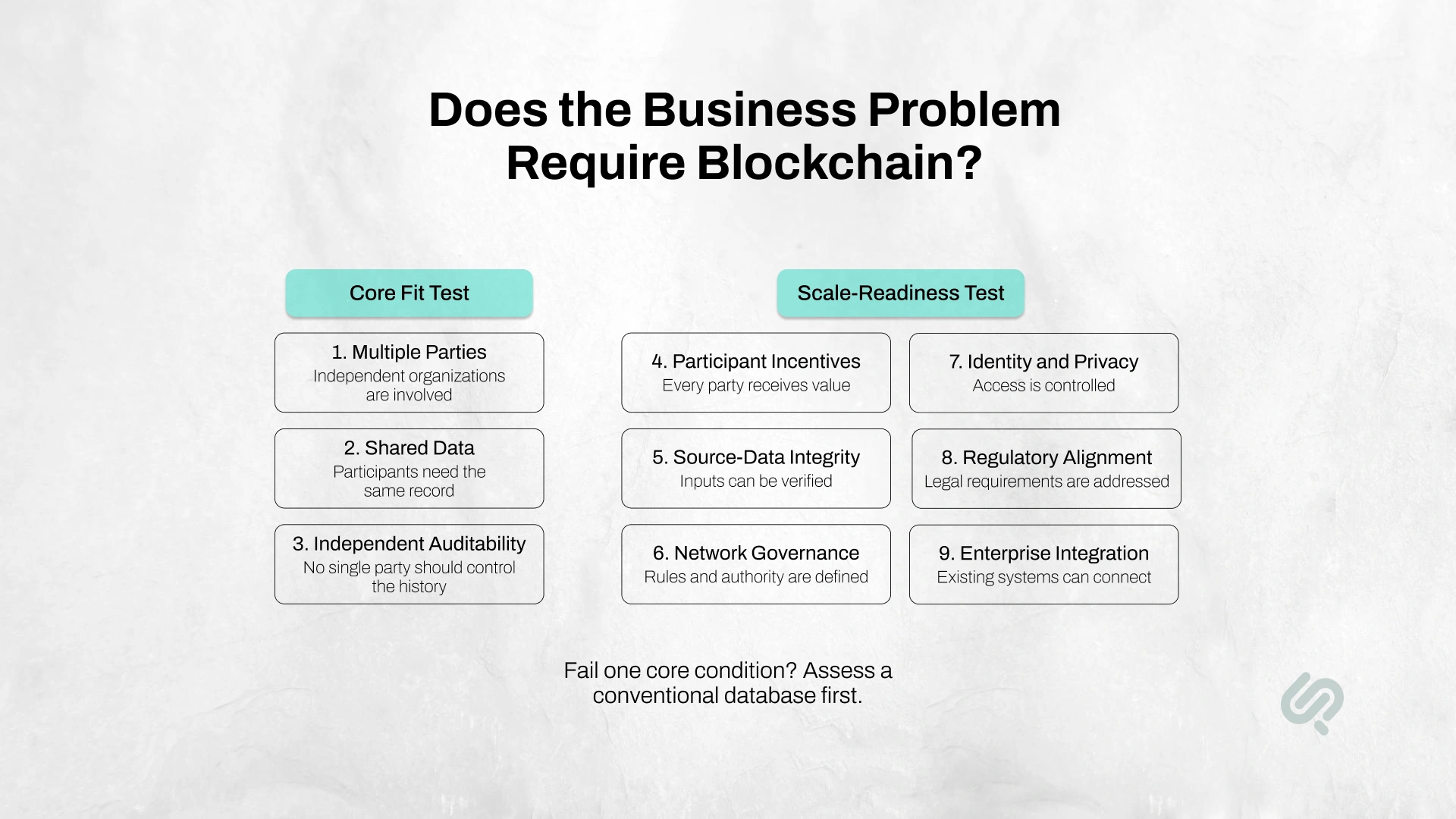
Deloitte’s enterprise blockchain guidance provides three foundational questions for determining whether blockchain is appropriate. (3)
Phaedra Solutions extends those questions into a two-part assessment: the core fit test and the scale-readiness test.
A project should not proceed to blockchain architecture unless it passes all three core conditions.
The process must involve two or more independent organizations that need to exchange records, assets, or approvals.
“Non-trusting” does not necessarily mean that the parties are hostile. It means they cannot rely entirely on one participant to control the authoritative record.
A single organization coordinating its own departments is usually not a blockchain use case.
Participants must require access to the same transaction state, ownership record, provenance history, or contractual event.
Blockchain is less useful when information only needs to be reported periodically or distributed through standard APIs and exports.
The question is not whether several parties need information. It is whether they need a synchronized and independently verifiable version of the same information.
The use case must benefit from a tamper-evident record of what occurred, when it occurred, and which participant authorized it.
This requirement is strongest in processes involving:
Where all three conditions are present, blockchain may provide a structural advantage. Where one or more are absent, a conventional database should be assessed first.
Passing the core fit test confirms that blockchain may be appropriate. It does not confirm that the proposed network is ready to operate.
Every participant must receive enough value to justify integration, process change, data sharing, and ongoing operating costs.
A blockchain network cannot scale if one organization receives most of the benefit while other participants carry most of the implementation burden.
The system must establish how off-chain events and physical-world data are confirmed before they are written to the ledger.
Possible controls include:
Blockchain can make an incorrect record difficult to alter. It cannot make that record accurate.
The participants must agree on:
Governance must be designed before the network is deployed.
Enterprise participants may need different levels of visibility.
The architecture must define:
A shared ledger does not require all information to be visible to every participant.
The system must operate within the legal requirements of every relevant jurisdiction.
For tokenized assets and settlement systems, this may include:
BIS Project Agorá is examining settlement finality, financial-crime controls, and data privacy alongside its technical design, demonstrating that legal and regulatory questions are part of the architecture rather than a later compliance exercise. (2)
Most enterprise blockchains do not replace ERP, banking, logistics, identity, compliance, or document-management systems.
They provide a shared coordination layer between them.
The business case must account for:
In my view, protocol selection before governance and integration design is the wrong sequence. The network should be designed around its participants, rules, and operating environment. The protocol should then be selected to support that design.
A project is a strong fit when:
A project is a conditional fit when:
A project is a poor fit when:
A project that fails the core fit test should not receive a higher score because it has an advanced token design or sophisticated smart contracts.
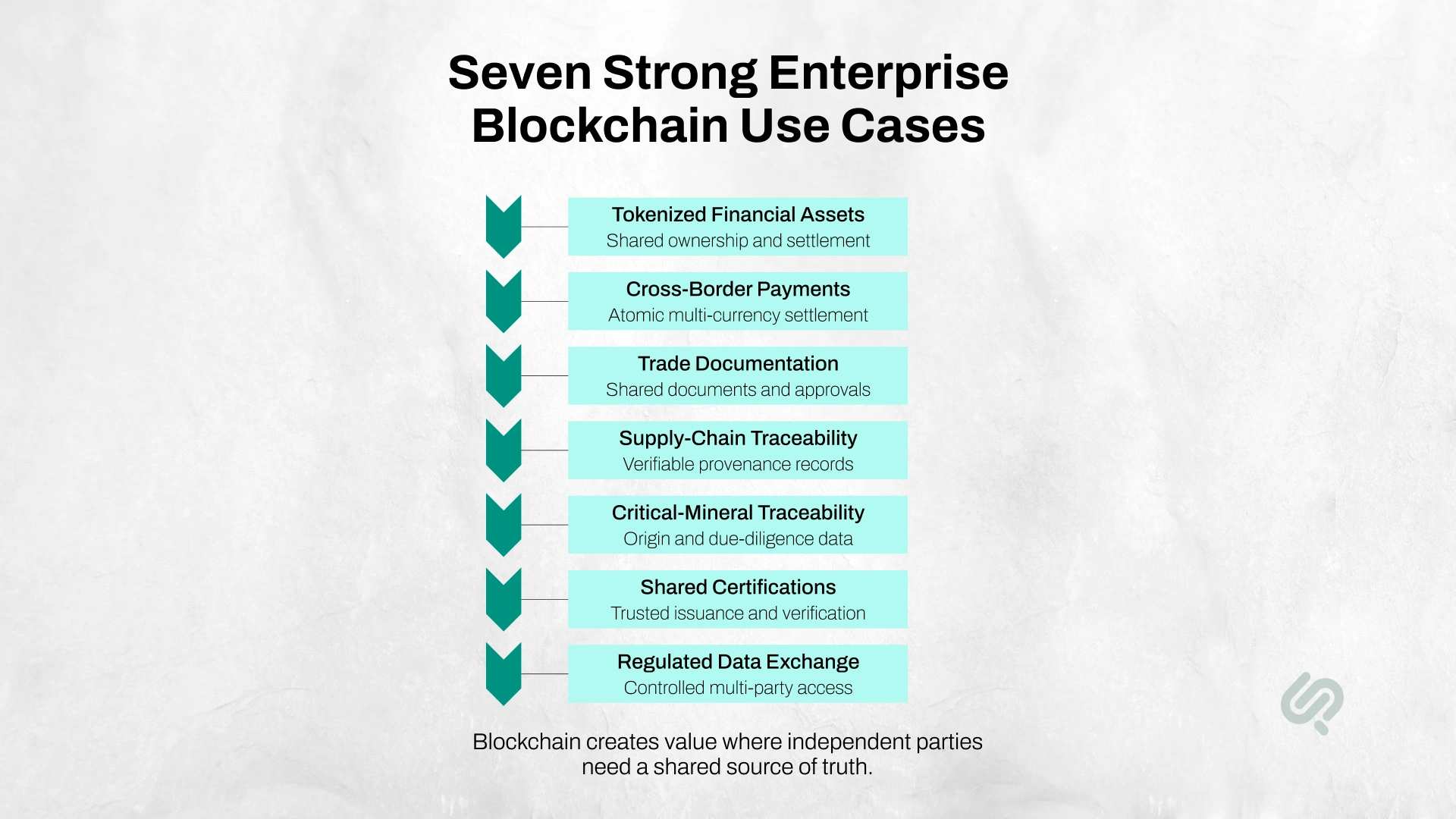
Tokenization can combine ownership records, transaction rules, and settlement logic on programmable platforms.
McKinsey estimates that tokenized financial assets could reach approximately $2 trillion by 2030. Cash and deposits, bonds, exchange-traded products, mutual funds, loans, and securitized assets are expected to be among the leading asset classes. (1)
Potential benefits include:
These benefits depend on regulation, custody, liquidity, interoperability, and reliable settlement assets. Tokenizing an illiquid or poorly governed asset does not automatically create a liquid market.
Cross-border payments involve several institutions, sequential processing, separate ledgers, compliance checks, currency conversion, and liquidity management.
BIS Project Agorá demonstrated a prototype that combined tokenized commercial bank deposits and tokenized central bank reserves to support atomic, multi-currency settlement. The platform also allowed compliance requirements and conditional payment logic to be embedded into the transaction process. (2)
This is a strong blockchain fit because:
The institutional structure is as important as the technology. The platform preserves the role of central bank money and regulated commercial banks rather than attempting to remove them.
International trade involves exporters, importers, customs authorities, banks, carriers, ports, insurers, and inspection bodies.
These parties often maintain separate records and reconcile documents manually. This creates delays, duplicated checks, inconsistent information, and limited transaction visibility.
UN Trade and Development identifies blockchain as a potential tool for improving trade facilitation and modernizing legacy trade systems and processes. It also emphasizes the need to consider policy, governance, and implementation constraints rather than treating the technology as an objective in itself. (6)
Blockchain is most relevant when it provides:
A blockchain cannot resolve inconsistent document standards or legal recognition by itself. Those issues require institutional agreement.
Supply chains involve multiple organizations that create, transform, transport, certify, finance, and sell products.
Deloitte identifies transparency, traceability, reduced administrative costs, provenance, compliance, and trust among participants as potential blockchain benefits. It also notes that blockchain can operate alongside existing ERP platforms and connect with IoT, smart contracts, and AI. (4)
The OECD and IEA state that traceability systems can support due diligence by integrating information about the origin, evolution, and ownership of minerals. They also emphasize that effective systems require data quality, reliable verification, secure data-sharing protocols, collaboration, cost sharing, and clearly defined objectives. (5)
Blockchain is therefore only one component of traceability. The complete system may also require:
A ledger can confirm that a record has not been altered after submission. It cannot confirm that a supplier, sensor, inspector, or certification body submitted accurate information.
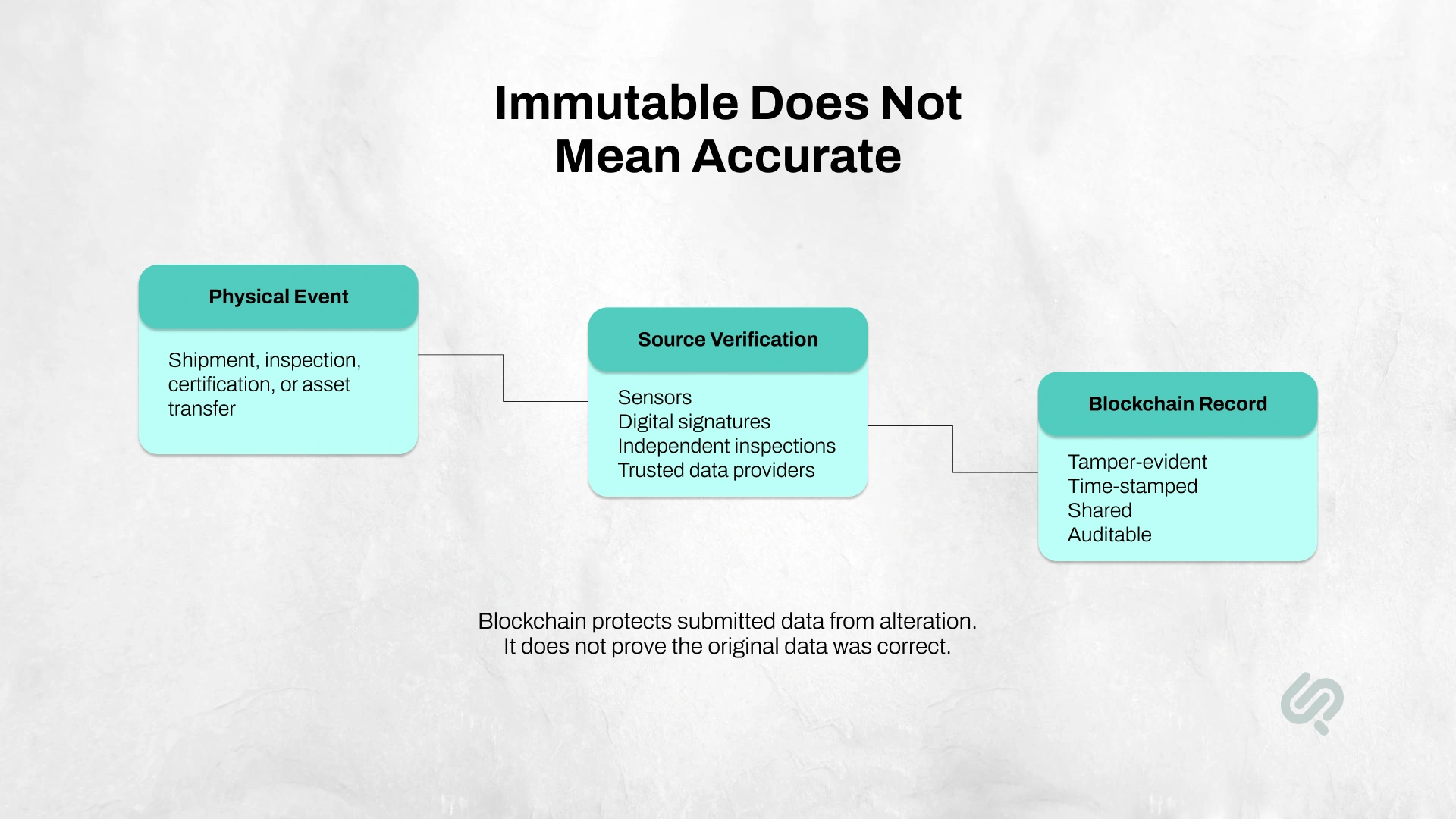
Blockchain is frequently described as a trust technology. That description can be misleading.
Blockchain reduces the need to trust one party’s control over a record. It does not remove the need to trust the process through which information enters the system.
For example, a ledger may record that:
The blockchain can preserve the submitted statement. It cannot independently verify that the underlying event occurred.
The system still requires a trusted connection between the physical event and the digital record. This is sometimes described as the source-data or oracle problem.
In my view, this is the most overlooked issue in enterprise blockchain design. Making incorrect information permanent is not an improvement. The system must establish why the original input should be trusted before it protects that input from alteration.
A single organization does not usually need a distributed ledger to maintain an internal audit history.
A conventional database can provide:
Blockchain becomes relevant only when independent parties need to verify the record without accepting one organization as the sole controller.
Deloitte notes that conventional databases may be more appropriate when a use case requires centralized processing of very high data volumes at high speed. (3)
A blockchain should not replace a high-performance transactional system unless shared consensus and independent verification justify the additional processing and coordination.
Blockchain is designed to preserve transaction history.
It may be unsuitable as the primary storage layer for information that must be frequently corrected, deleted, or kept confidential. In these cases, sensitive data may need to remain off-chain while the ledger stores hashes, permissions, or verification events.
A token is not a business model.
A credible tokenized system must define:
Without these conditions, token issuance adds complexity without solving a coordination or ownership problem.
When all participants already trust an existing authority to operate the record, a distributed network may offer little additional value.
A regulated registry, bank, exchange, government body, or industry platform may already provide the required governance and accountability.
A well-governed database is not a less innovative answer when it solves the problem more directly. It is the correct architecture.
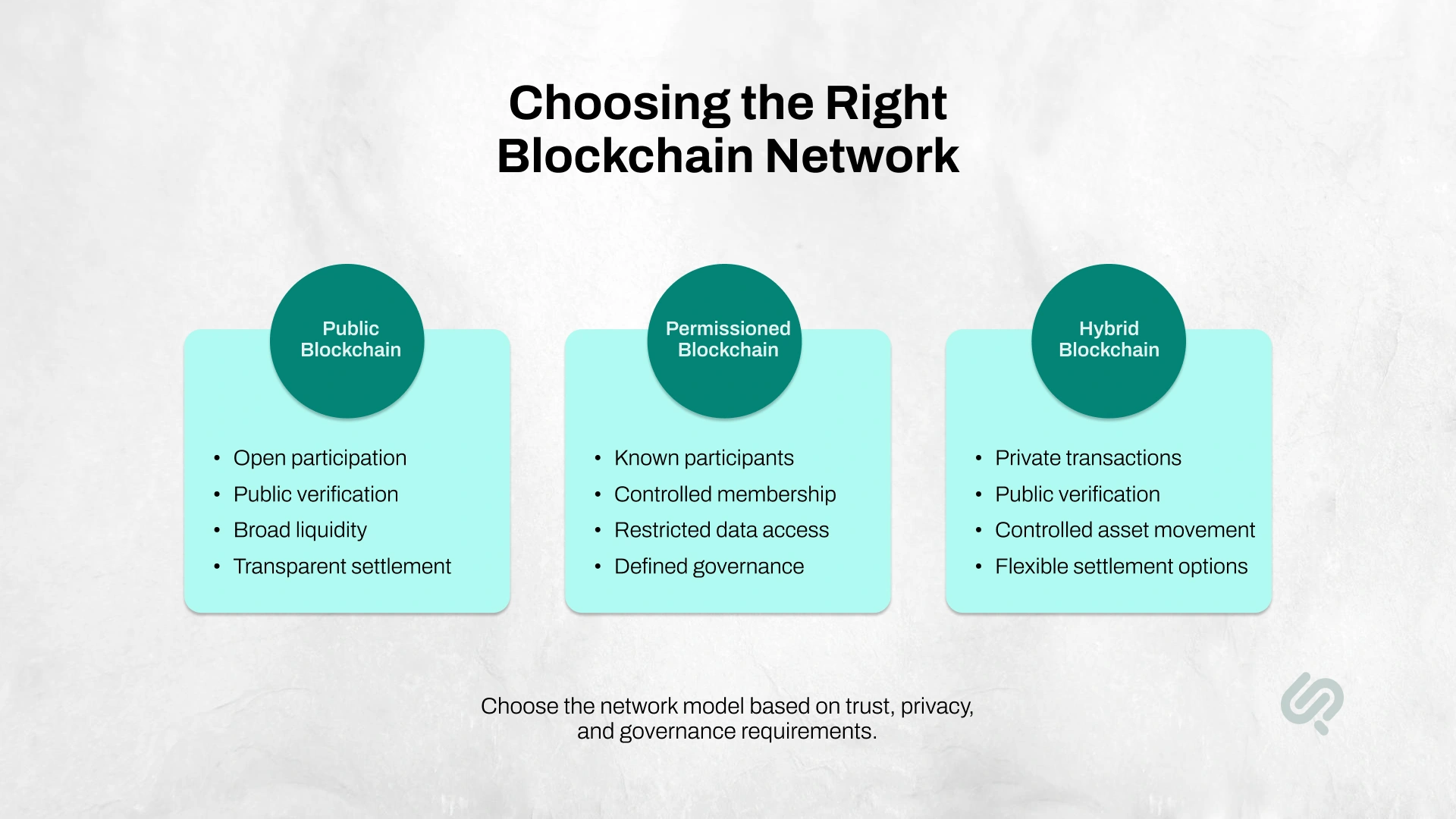
The appropriate network model depends on participation, privacy, governance, settlement, and interoperability requirements.
A public network may be appropriate when:
Challenges may include privacy, transaction costs, throughput, governance, regulatory exposure, and integration with enterprise identity systems.
A permissioned network may be appropriate when:
This model is common in trade, supply chain, banking, healthcare, and other regulated multi-party environments.
A hybrid model combines controlled enterprise workflows with selected public-network functions.
For example:
The network model should follow the trust and governance requirements. It should not be chosen because one architecture is currently more popular.
The project does not involve multiple non-trusting parties, shared data, and independent auditability.
Blockchain is selected before the business problem is assessed.
Participants have not agreed on membership, decision rights, costs, upgrades, disputes, or network ownership.
The technology is deployed before the operating institution exists.
One participant receives most of the benefit while others absorb integration costs, process changes, or additional transparency.
The network cannot scale without a balanced value proposition.
The ledger preserves records, but the data-entry, sensor, certification, or inspection processes remain weak.
The system creates immutable uncertainty rather than trusted information.
The blockchain is not properly connected to ERP, banking, logistics, custody, compliance, identity, or reporting systems.
Manual processes remain around the ledger, limiting operational value.
The pilot proves that transactions can be recorded but does not establish whether they are legally recognized, final, private, compliant, or enforceable.
Resolving these questions after implementation may require material redesign.
Phaedra Solutions uses a four-stage maturity model to assess whether a blockchain initiative has progressed beyond a technical pilot.
Several participants can access and verify a common transaction history.
The system provides transparency but remains largely separate from operational workflows.
Primary requirement: Reliable shared records and participant identity.
The blockchain is integrated with approvals, documents, enterprise systems, and participant processes.
The network reduces reconciliation and coordinates work across organizations.
Primary requirement: Operational integration and agreed governance.
Smart contracts apply agreed rules to ownership transfers, payments, approvals, or compliance events.
Exceptions, overrides, and disputes remain subject to defined human governance.
Primary requirement: Tested rules, legal alignment, monitoring, and controlled upgrades.
The network supports production transactions across a stable ecosystem of participants.
It includes established governance, interoperable systems, regulatory alignment, reliable settlement, security controls, and measurable operating value.
Primary requirement: Sustainable network economics and institutional trust.
Stage 4 does not mean that governance has been removed. It means governance has become explicit, shared, and operational.
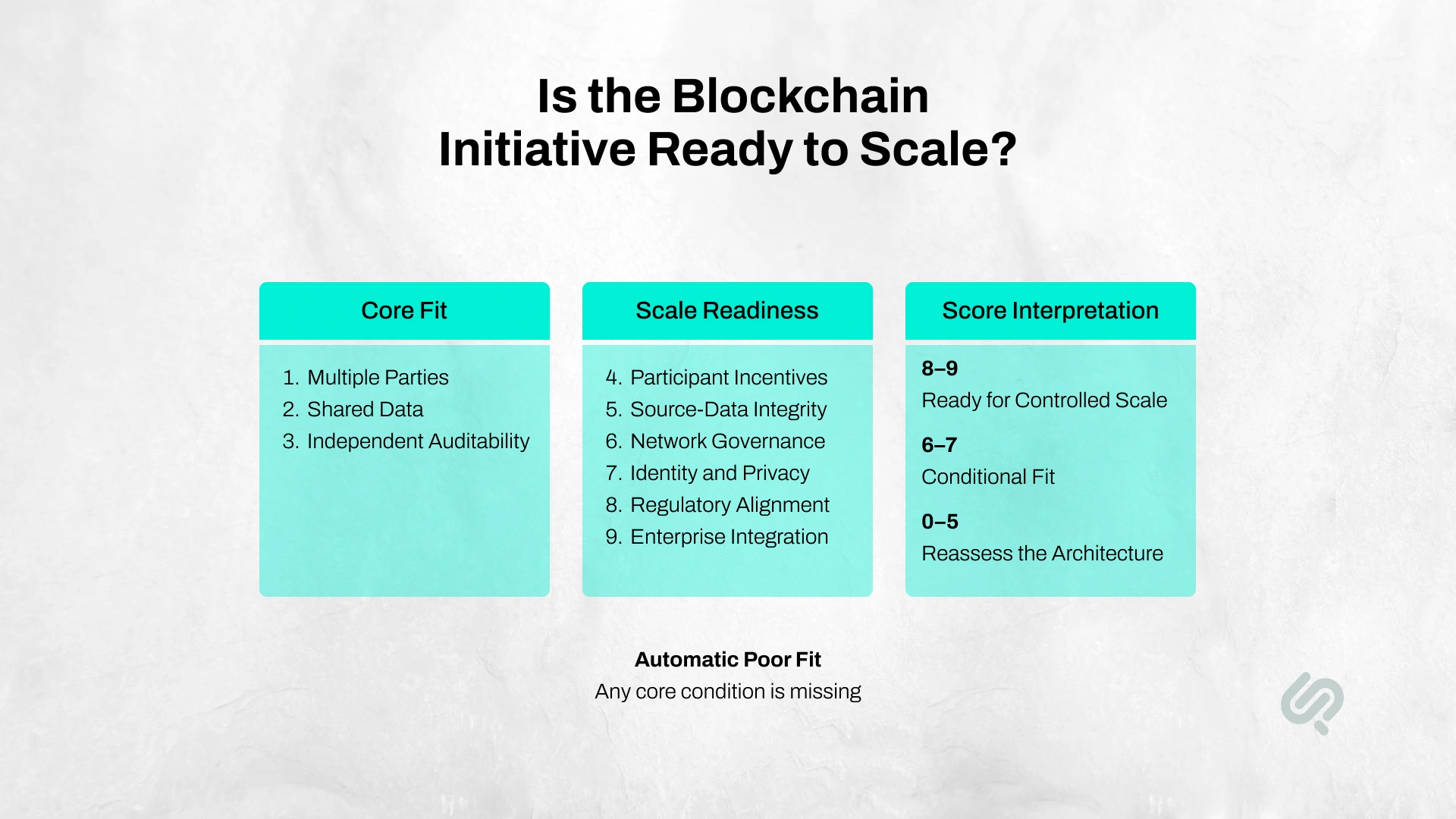
Score each condition as:
8–9: Ready for Controlled Scale
All core fit conditions are met, and the network has strong operational foundations.
6–7: Conditional Fit
The use case is valid, but governance, regulation, integration, or participant readiness requires further work.
0–5: Reassess the Architecture
The project is not ready to scale. A conventional database or centralized platform should be evaluated before further blockchain investment.
Automatic Poor Fit: A project that fails any core-fit condition should be reassessed regardless of its total score.
Enterprise blockchain will increasingly operate as specialized trust and settlement infrastructure rather than a standalone innovation category.
Tokenized cash, deposits, bonds, funds, loans, and securitized assets are positioned for faster adoption than many other asset classes. However, progress will depend on liquidity, custody, regulation, interoperability, and reliable settlement. (1)
BIS Project Agorá has progressed from design to a working prototype and is expected to advance toward selected real-value transactions. Its development indicates that tokenized wholesale settlement is becoming an institutional infrastructure question rather than a theoretical blockchain experiment. (2)
Traceability networks will increasingly be evaluated on data quality, verification, interoperability, cost sharing, and their contribution to broader risk-based due diligence. Blockchain alone will not be treated as evidence that a supply chain is responsible or compliant. (5)
Enterprises will continue to require privacy, known identities, controlled membership, regulatory access, and defined governance. These requirements make permissioned and hybrid architectures more practical for many institutional use cases than fully public networks.
Protocols will continue to improve, but the long-term performance of enterprise networks will depend on participant adoption, common standards, upgrade processes, legal enforceability, and sustainable network economics.
The most successful enterprise blockchain systems may eventually stop being marketed as blockchain products. They will operate as trusted infrastructure within trade, finance, supply chains, certification, and other multi-party processes.
The following predictions are my interpretation of the report’s evidence and the operating patterns I expect enterprise decision-makers to face as blockchain infrastructure matures.
I expect successful systems to be sold as settlement, traceability, certification, collateral, or shared-workflow infrastructure rather than as blockchain products.
Business buyers will care about reduced reconciliation, faster ownership transfer, lower dispute rates, and stronger auditability. The ledger will become an architectural component rather than the headline.
Creating a token will become increasingly easy.
The difficult and valuable work will remain legal ownership, custody, redemption, valuation, settlement, compliance, and reliable asset data. Assets with clear rights and operating institutions will scale faster than assets that rely mainly on a token narrative.
Public networks will remain useful for open verification, liquidity, anchoring, and cross-network access.
Permissioned components will remain necessary for identity, privacy, regulated participation, and governance. Most production systems will combine these properties rather than choose a purely public or purely private model.
Smart-contract development will become more standardized and tool-assisted.
The scarce expertise will be the ability to design membership, voting, upgrades, cost allocation, liability, dispute resolution, and exit mechanisms across independent organizations. Enterprise networks will fail or scale based on those decisions.
Traceability and tokenization projects will budget explicitly for sensors, inspections, certification, identity, oracle design, reconciliation, and independent verification.
Businesses will recognize that immutability protects a record after submission but does not establish whether the original event or asset claim was true.
Many pilots will close, merge, or remain limited because participant incentives and operating economics are weak.
The networks that scale will usually have a credible anchor institution, balanced participant value, clear cost sharing, interoperable standards, and a defined authority for change.
Decision-makers will move away from token volume, wallet counts, and transaction counts as primary success measures.
They will evaluate settlement time, reconciliation effort, working-capital release, fraud and dispute rates, compliance effort, provenance coverage, and the cost of operating the network.
Confirm the multi-party trust problem, shared-data requirement, and auditability need before architecture work begins.
Document the specific outcome that blockchain provides and a centralized architecture cannot provide as effectively.
Agree on membership, authority, cost allocation, upgrades, disputes, and exit processes before automating transaction rules.
Define how physical events, documents, certifications, and external information will be verified before entering the ledger.
Ensure that every major participant receives enough operational, financial, regulatory, or risk-reduction value to justify participation.
Address ownership, settlement, licensing, privacy, custody, and legal enforceability before scaling the network.
Design the blockchain as a shared coordination layer connected to ERP, banking, logistics, identity, compliance, and reporting systems.
Where participants are known and privacy matters, begin with a limited permissioned network before expanding participation or public-network exposure.
Plan how contracts, permissions, protocols, participants, and data will be migrated if the system changes or the network closes.
Enterprise blockchain creates value when several independent parties need a shared record, no single participant should control that record, and verifiable accountability is central to the process.
It is not the correct solution for every audit trail, internal workflow, database, or digital product.
The most effective blockchain system is not necessarily the most decentralized or technically complex. It is the one that establishes the right balance between shared trust, governance, privacy, integration, programmability, and operational control.
For decision-makers, the central question is not: How can we use blockchain?
It is: What coordination or trust problem exists that a conventional architecture cannot solve as effectively?
This report combines institutional market research, enterprise blockchain guidance, financial-infrastructure research, supply-chain analysis, trade-facilitation guidance, and Phaedra Solutions’ blockchain delivery observations.
Assess Your Enterprise Blockchain Fit.
Book a free call and let’s determine whether blockchain provides a genuine coordination, ownership, or auditability advantage before committing to implementation.


1.From Ripples to Waves: The Transformational Power of Tokenizing Assets. 2024.
2.Project Agorá: A Shared Programmable Platform for Wholesale Cross-Border Payments. 2026.
3.Blockchain and Web3 Adoption for Enterprises.
4.Financial Stability Implications of Tokenisation. 2025.
5.The Role of Traceability in Critical Mineral Supply Chains. 2025.
6.Global Report on Blockchain and Its Implications on Trade Facilitation Performance. 2023.
7.Using Blockchain to Drive Supply Chain Transparency.
. 10European Central Bank. (2026). Pontes: The Eurosystem’s DLT Solution for Wholesale Settlement.

Mujtaba turns product ideas into working software — fast. As a Fractional CTO and solution architect with 13+ years of experience, he leads AI-first development teams that ship MVPs in under 10 days, cut product rework by 40%, and build digital infrastructure that holds up at scale.
His work spans UX design, full-stack development, blockchain integration, and IoT — all engineered with AI-assisted tooling to reduce build time and operational cost by 30–60%.