














This report is written by Mujtaba Sheikh, AI-First Solution Architect and Fractional CTO at Phaedra Solutions. With 13+ years of experience leading software architecture, full-stack delivery, and AI-first engineering teams, he brings a practitioner’s view of how AI changes delivery speed, team design, and quality control.
Every engineering team now claims to be AI-first. Almost none can show the workflow that makes that claim true. Phaedra Solutions benchmarked its own delivery data against the two most rigorous public studies available and found the same pattern twice: AI makes specific, well-governed phases of delivery dramatically faster, and makes ungoverned ones quietly more expensive.
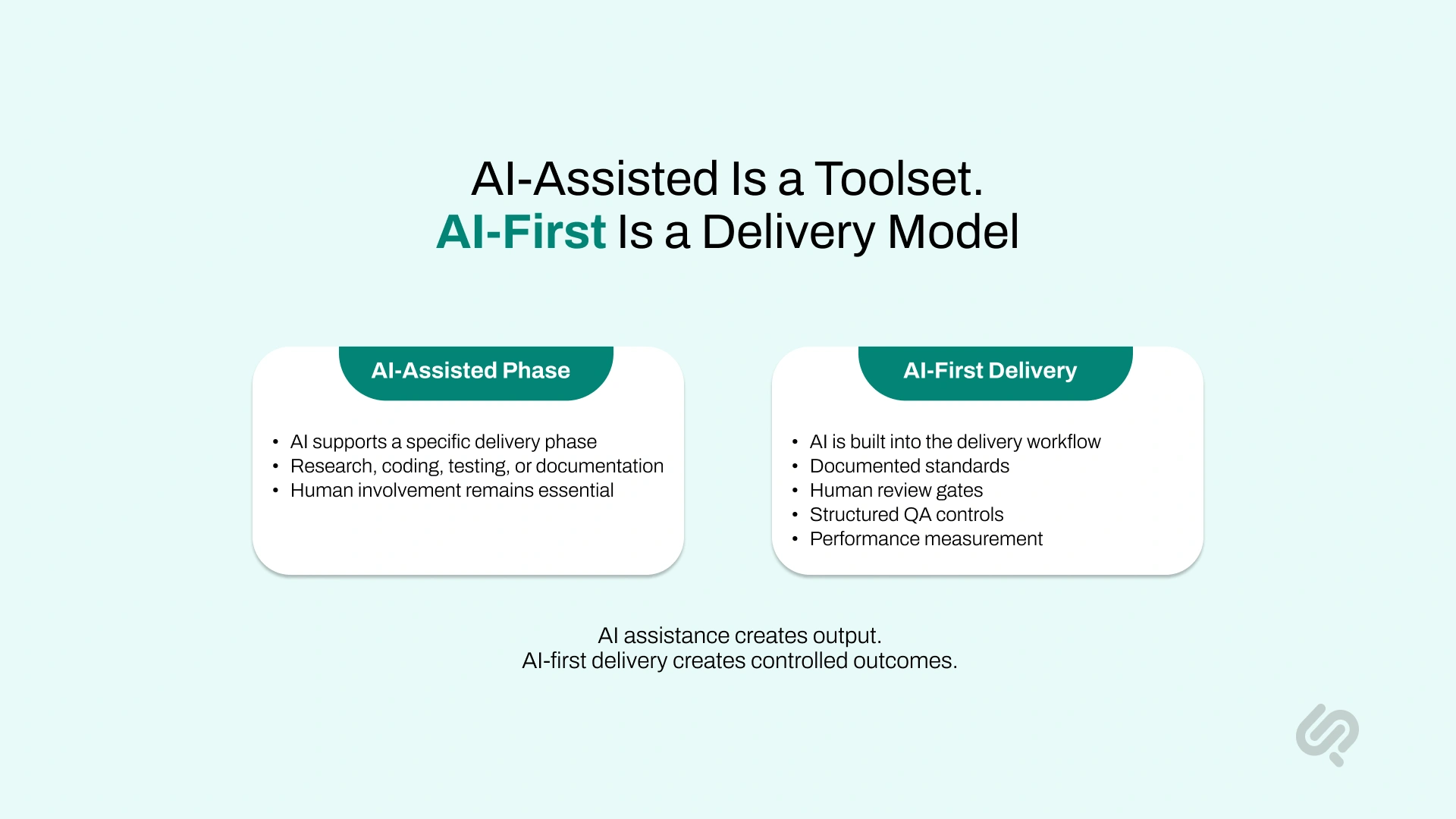
To support clarity throughout this report, we define the distinction between the following two terms right from the start:
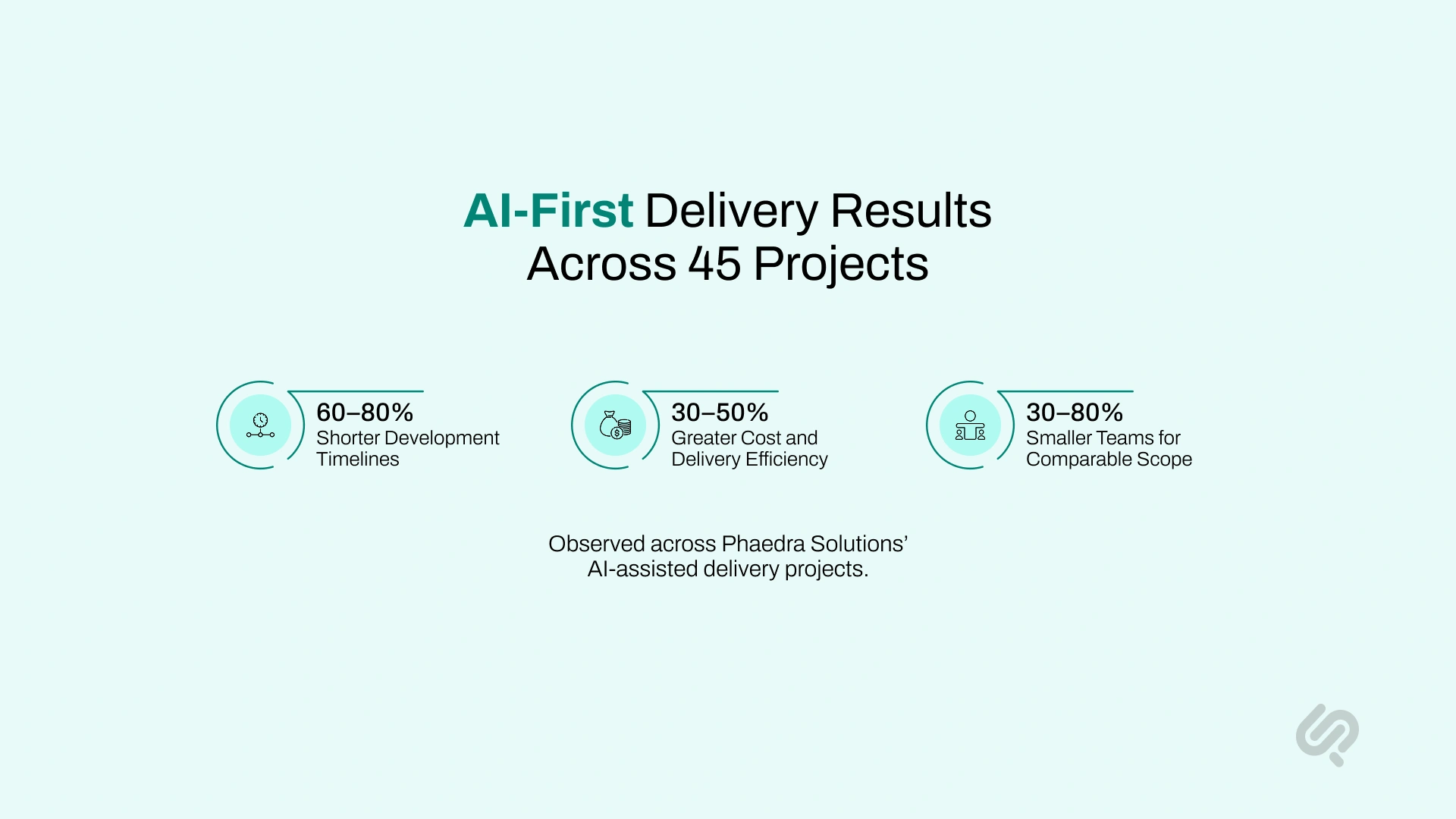
60-80%
Reduction in overall development timeline across AI-assisted delivery projects.
30-50%
Improvement in cost and delivery efficiency across AI-assisted projects.
30-80%
Reduction in required team size for comparable project scope.
AI-assisted development has moved from experiment to default practice. Adoption, however, is not the same thing as advantage. This report separates the two, benchmarking how AI-assisted workflows performed across Phaedra Solutions delivery phases against non-AI-assisted phases on comparable work, then checking those findings against Microsoft Research's controlled Copilot study and Google's 2025 DORA report.
Projects using Phaedra Solutions’ AI-first delivery approach recorded 60% to 80% shorter overall development timelines, improved cost and delivery efficiency by 30% to 50%, and reduced the team size required for comparable scope by 30% to 80% compared to conventional delivery comparisons.
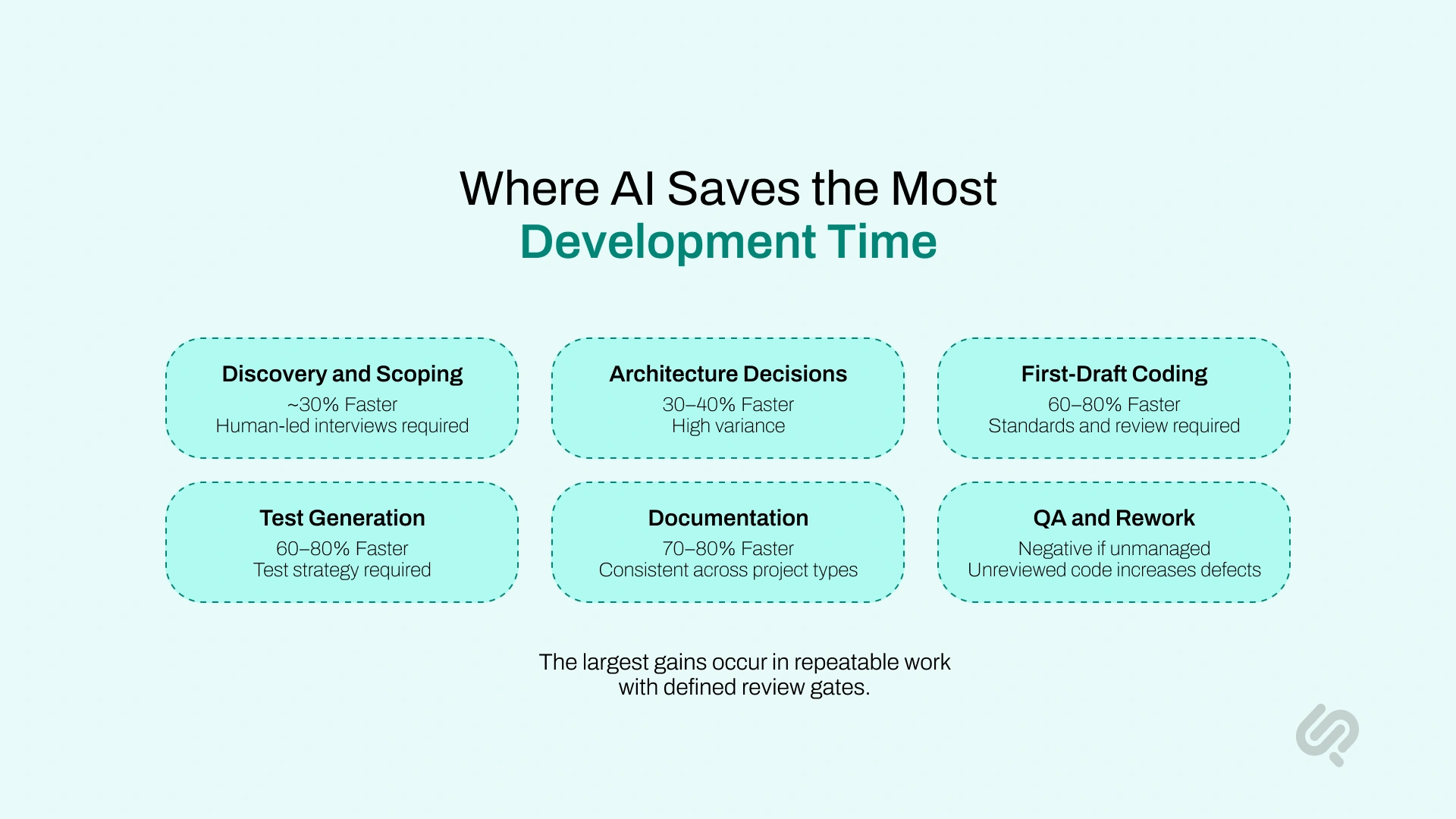
At the individual delivery-phase level, the size of the gain varies more: the lower end shows up in phases with more human judgment, such as discovery and architecture, while the upper end shows up in phases with clear standards and a defined review step, such as documentation and first-draft coding.
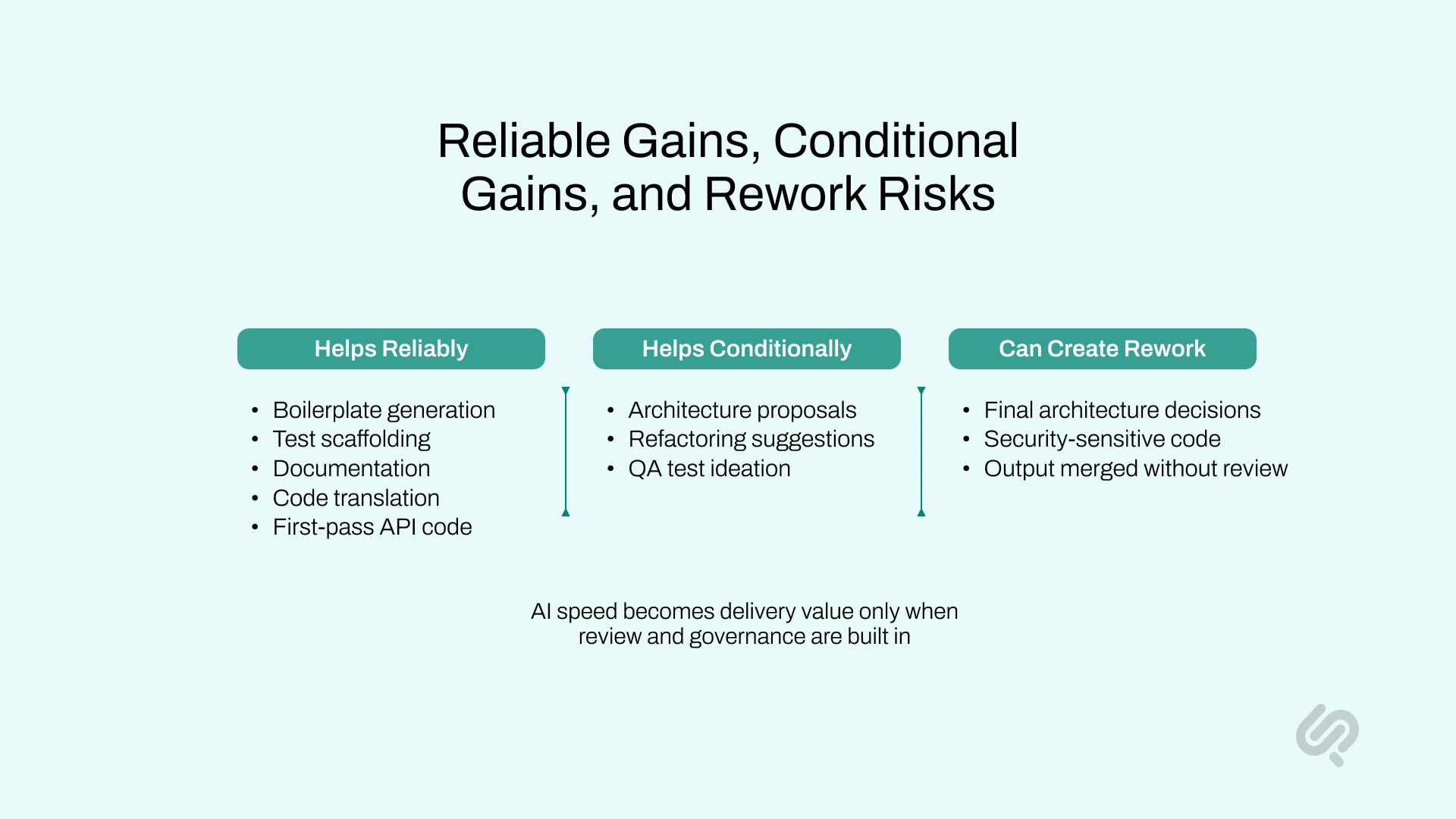
The conclusion is that AI shortens specific phases of delivery in a predictable way, but only when paired with architecture discipline, structured QA, and clear human checkpoints. Teams that skip those guardrails see faster typing and slower shipping, because unreviewed AI output creates rework downstream.
This report shows where the gains are real, where they are not, and gives a scorecard for telling the difference before a team commits a delivery timeline to a client.
Google's 2025 DORA research found that AI adoption among software development professionals has reached 90%, with more than 80% of respondents reporting productivity gains and 59% reporting a positive effect on code quality (2) (3). Microsoft Research separately measured a 55.8% reduction in task completion time for developers using GitHub Copilot on a controlled programming task, against a control group working without it. (6)
Those numbers are frequently quoted in isolation, which is misleading. Google Cloud's own DORA guidance is explicit that coding-speed gains do not automatically translate into business ROI unless an organization can connect engineering metrics to financial outcomes, manage the learning curve that comes with new tooling, and reinvest recovered capacity into higher-value work rather than treating it as a headcount cut. (5)
Phaedra Solutions' own delivery data sits inside that gap. Across the projects reviewed for this report, an AI-first delivery approach cut overall development timelines by 60% to 80%, improved cost and delivery efficiency by 30% to 50%, and reduced the team size needed for comparable scope by 30% to 80%, relative to a conventional, non-AI-assisted approach. That range, not a single headline number, is the finding worth publishing, because it makes clear that the size of the gain depends on phase type and governance, not on the tool alone.
The first wave of AI-assisted development focused on giving individual developers access to coding assistants. The 2026 market shift is toward redesigning the full software delivery workflow around generation, verification, integration, and release. DORA’s March 2026 analysis describes the same tension: AI reduces start-up friction and accelerates initial code generation, but can introduce verification overhead, integration challenges, and skill erosion when review practices and team training do not evolve with the tools. (7)
A 2026 longitudinal study of professional software engineers found that 82% of participants reported spending less time writing code, while their work moved toward directing, evaluating, and correcting AI output. The researchers describe this as “supervisory engineering work.” For businesses, this means that faster generation does not remove engineering effort; it redistributes effort toward review, testing, architecture control, and correction. (8)
Independent evidence continues to show that AI productivity is not a universal multiplier. METR’s randomized study of experienced open-source developers found that early-2025 AI tools increased task completion time by 19% in the tested environment. Its February 2026 follow-up found signs of improvement with newer tools and returning participants, but the estimates remained uncertain. The practical market insight is that familiarity with the codebase, task type, tool quality, and review burden materially affect the result. (9) (10)
A 2026 large-scale study examined more than 304,000 verified AI-authored commits across 6,275 repositories and found that AI-generated changes could introduce issues that persist over time. This does not mean AI-generated code is inherently low quality. It means organizations need measurable controls for code review, testing, security scanning, ownership, and maintainability before speed gains can be treated as business value. (11)
The commercial distinction is therefore shifting from access to AI tools toward operating maturity. Buyers will increasingly evaluate whether a delivery partner can show review ownership, defect and rework controls, architecture accountability, traceable QA gates, and a clear plan for reinvesting recovered capacity.
This report is based on a phase-level review of 45 Phaedra Solutions projects completed between January 2025 and June 2026. The dataset includes web, mobile, blockchain, and IoT development projects.
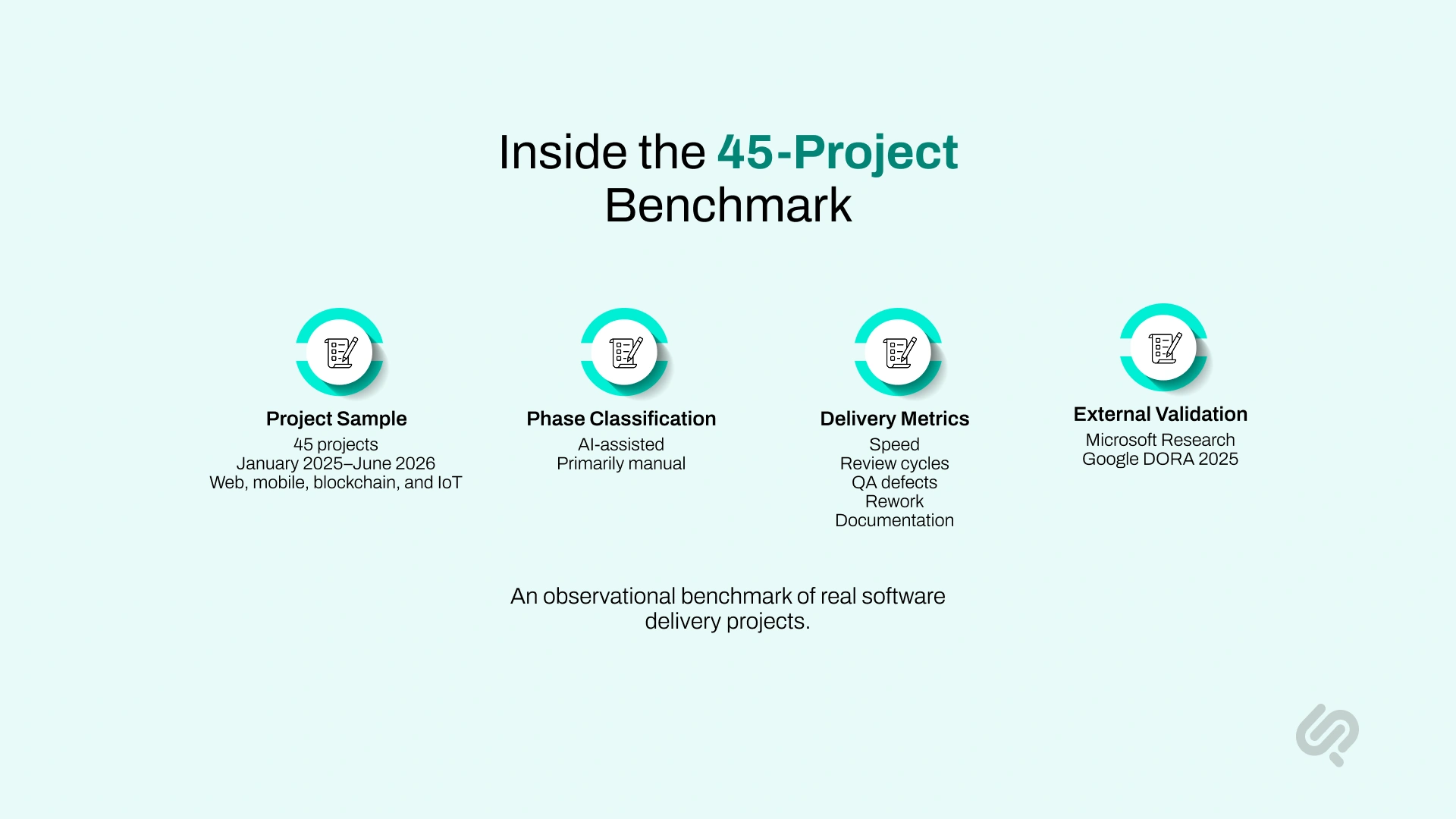
Each project was divided into seven core delivery phases:
Each phase was classified as either primarily AI-assisted or primarily manual. Classification was based on available tooling records and confirmation from the relevant engineering lead.
An AI-assisted classification indicates that AI tools made a material contribution to activities such as research synthesis, code generation, test creation, documentation, analysis, or review. It does not mean that the phase was completed without human involvement.
The review considered the following delivery indicators:
The report presents observed performance ranges rather than precise averages. This reflects the variation in project scope, technical complexity, stakeholder requirements, and the extent to which AI was used within each delivery phase.
AI-assisted phases were compared with primarily manual phases involving comparable delivery activities. The analysis focused on differences in delivery time, resource requirements, review effort, and downstream rework.
The benchmark does not assume that AI tooling alone caused every observed improvement. Project governance, engineering experience, coding standards, test strategy, architecture maturity, and human review practices also influenced the results.
Phaedra Solutions compared the direction and scale of its internal findings with two established public research sources:
These studies were used to validate whether the broader patterns observed in Phaedra Solutions’ delivery data were consistent with independent research. They were not treated as direct substitutes for the internal benchmark.
The findings should be interpreted as representative ranges from Phaedra Solutions’ delivery environment rather than universal performance guarantees.
The sample includes more web and mobile projects than blockchain and IoT projects. Findings relating specifically to blockchain and IoT delivery should therefore be treated as directional until a larger project sample is available.
The projects also varied in scope, complexity, team composition, client responsiveness, technical requirements, and AI adoption maturity. These factors may have influenced delivery performance alongside AI assistance.
This review was not a randomized controlled experiment. It is an observational benchmark intended to identify recurring delivery patterns across real client projects.
Phaedra Solutions plans to update the report semi-annually as the internal dataset expands and its project records are further reconciled.
In the software development lifecycle, AI assistance produced the largest and most consistent time reductions in three areas:
It produced smaller, more variable gains in architecture decisions and design handoff, closer to the low end of that range, where the bottleneck is usually stakeholder alignment rather than production speed. It produced no measurable gain, and in some cases a net cost, in unreviewed rework: code generated quickly but merged without adequate review created defects that consumed more QA time than they saved in authoring time.
Two recent Phaedra Solutions projects illustrate this pattern directly, at the scale of a real client engagement rather than a phase-level test.
It was delivered end-to-end, including authentication, a multi-page dashboard, resume and email-template management, and AI-driven job matching, by a five-person team (one designer, one full-stack developer, one AI developer, one QA engineer, and one project manager) in under three months
The build met a resume-parsing accuracy target above 90% and an AI-generated resume turnaround under 30 seconds, consistent with the lean-team, compressed-timeline pattern this report measures at the aggregate level.
Core development ran roughly seven months, with three pilot ministries onboarded in the first phase, a scope and stakeholder complexity that would typically call for a substantially larger delivery team and a longer timeline under a conventional, non-AI-assisted approach.
With 90% of professional developers now using AI tools in some form, the differentiator is no longer whether a firm uses AI, but whether it has built the workflow, governance, and review structure that turns raw speed into shipped, defect-light software. Firms that have not done this work are exposed to a specific risk: they adopt the tools, see early velocity gains, and then absorb a rework cost later that erases the advantage.
We even saw this pattern directly in an AI-powered customer retention platform we created for a client in the ecommerce industry.
This mirrors earlier waves of engineering tooling, where the organizations that benefited most were not the earliest adopters but the ones that paired adoption with process redesign. The DORA research reinforces this directly, tying AI's positive effect on code quality to organizational practices, not to the tools in isolation.
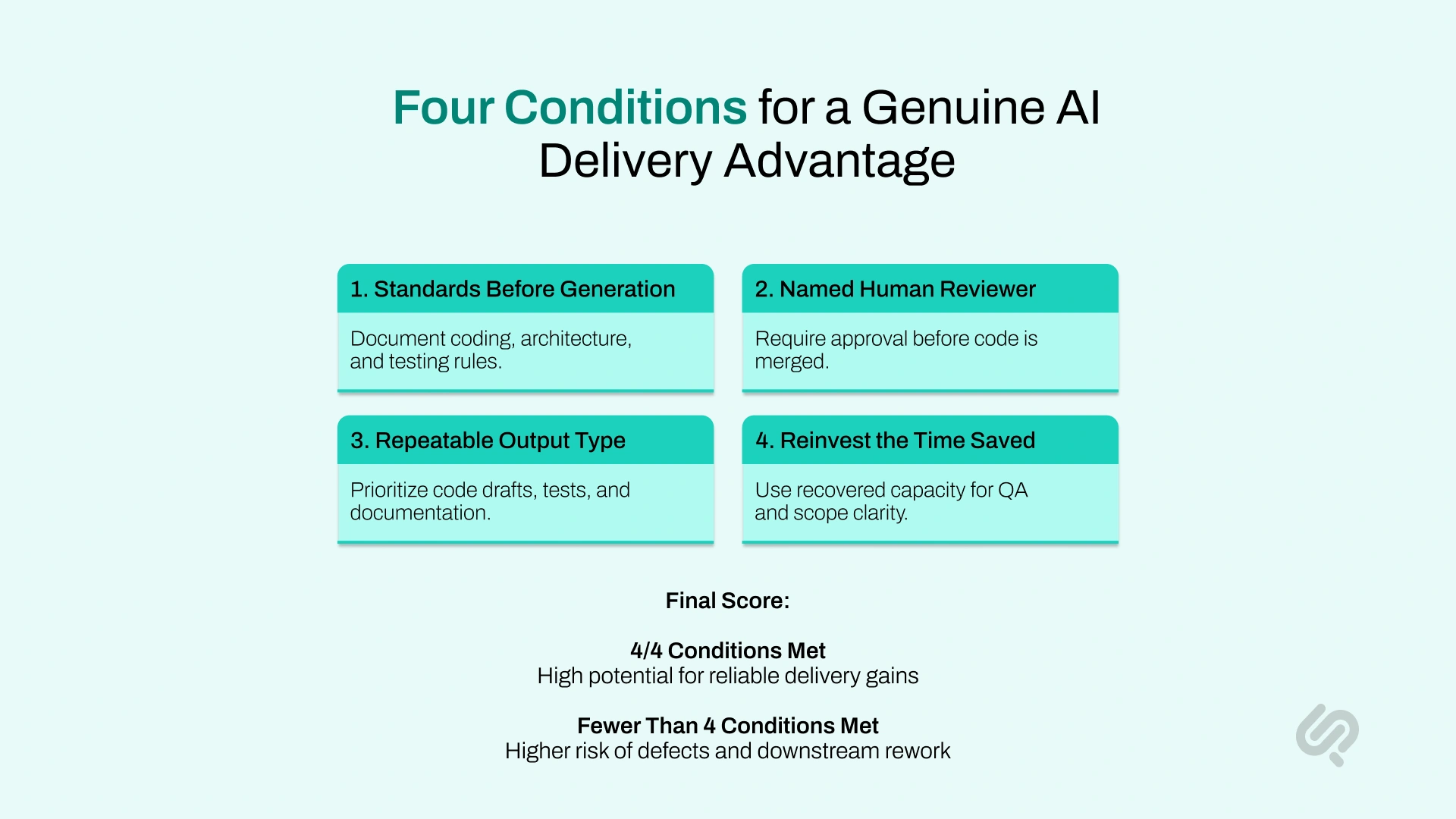
Phaedra Solutions uses a four-part scorecard to evaluate whether an AI-assisted workflow on a given project phase is likely to produce a genuine speed advantage or a hidden rework cost. A phase scores well when it meets these four conditions:
AI-assisted development is on track to become a baseline expectation rather than a competitive edge, in the same way version control and automated testing did in earlier decades. The durable advantage will shift to firms that can operationalize AI with architecture discipline, QA rigor, explicit workflow design, and human oversight built in by default, not bolted on after a client complaint.
Firms that market "we use AI" without being able to show the governance behind it will find that claim loses commercial value within the next one to two years, simply because it will no longer be a differentiator.
For Phaedra Solutions specifically, the 30% to 80% range observed across delivery phases is likely to hold as a rough band even as tooling improves, because the ceiling on any given phase is set less by model capability and more by how repeatable that phase's output is and how disciplined the review process around it remains. Phases with more human judgment will keep landing near the lower end of that range regardless of which model or tool sits underneath them.
The following predictions are my interpretation of the benchmark and the current research. They reflect how I expect software delivery roles, buying decisions, and operating models to change as AI-assisted development matures.
I expect smaller delivery teams to be anchored by more senior engineers.
AI will produce a growing share of first drafts, but experienced people will remain responsible for architecture, cybersecurity, integration, maintainability, and final review. The market will place less value on the number of people who can produce code and more value on the people who can determine whether that code belongs in a production system.
Feature drafts will become easier to produce, but review queues, test execution, integration decisions, and release confidence will become the limiting factors.
Engineering leaders will need to measure review time, defect escape, rework per AI-assisted change, and the percentage of generated output that reaches production without material correction.
I expect more projects to be delivered by smaller cross-functional teams with fewer handoffs between planning, architecture, development, QA, and documentation.
This will not eliminate specialist roles. It will increase the value of people who can work across boundaries, understand the business context, and make decisions without passing every issue through several layers.
Business owners will become less willing to pay for large teams when comparable scope can be delivered by a leaner group.
Pricing will gradually move toward milestones, measurable outcomes, managed capacity, and clearly defined risk ownership. Vendors will need to show the governance and quality controls behind their speed claims rather than using team size as a proxy for value.
Entry-level engineers will spend less time producing repetitive code and more time validating tests, tracing defects, reviewing documentation, and completing tightly scoped changes under senior oversight.
Companies that rely on AI without redesigning apprenticeship and feedback loops may create a future shortage of engineers who can independently review complex systems.
Clients will increasingly ask how generated code is reviewed, which tools and models are permitted, how sensitive data are handled, how code provenance is recorded, and who owns maintainability after handover.
Delivery partners that cannot answer those questions clearly will struggle to convert AI speed into buyer confidence.
This report combines a first-party review of Phaedra Solutions delivery data with two independently published studies: Microsoft Research's controlled evaluation of GitHub Copilot's effect on developer task completion time, and Google Cloud's 2025 DORA (DevOps Research and Assessment) report on AI adoption and its relationship to code quality and organizational performance.


2.Google Cloud. (2025, September 23). Announcing the 2025 DORA Report.
3.Google Cloud. (n.d.). How Test-Driven Development Amplifies AI Success.
4.Google Cloud. (n.d.). DORA: ROI of AI-Assisted Software Development.
6.DORA. (2026, March 10). Balancing AI Tensions: Moving From AI Adoption to Effective SDLC Use.
9.METR. (2026, February 24). We Are Changing Our Developer Productivity Experiment.

Mujtaba turns product ideas into working software — fast. As a Fractional CTO and solution architect with 13+ years of experience, he leads AI-first development teams that ship MVPs in under 10 days, cut product rework by 40%, and build digital infrastructure that holds up at scale.
His work spans UX design, full-stack development, blockchain integration, and IoT — all engineered with AI-assisted tooling to reduce build time and operational cost by 30–60%.