









A forward deployed engineer (FDE) is a customer-embedded software engineer who combines hands-on development, solution architecture, and technical consulting to make complex software or AI work inside a company's real systems.
FDEs help define the problem, write production code, integrate data and APIs, deploy the solution, and iterate with users until it delivers a measurable outcome.
Companies use the model when an AI pilot, enterprise integration, or modernization initiative is blocked by unclear requirements, legacy systems, security constraints, or too many handoffs.
The role is especially useful when the question is no longer “Can we build it?” but “Can we make it work in production?”
An FDE is a customer-embedded software engineer who combines coding, architecture, integration, and technical delivery. They work with the client's real systems and users until the solution is working in production.
An FDE turns business problems into working software. They scope requirements, write code, connect systems and data, handle deployment issues, and improve the solution using real user feedback.
Use an FDE when a high-value AI or software initiative has unclear requirements, difficult integrations, production blockers, or no single technical owner responsible for the end result.
A software engineer usually builds against a product roadmap, while a solutions engineer often validates technical fit. An FDE stays closer to one customer's problem and takes hands-on ownership through production.
Hire internally when the need is permanent and one engineer can cover it. Use an external FDE team when you need to start quickly or require AI, data, integration, DevOps, QA, and other skills at different stages.
Forward deployed engineering is a delivery model where senior engineers work directly with a customer’s team, systems, and workflows to solve complex technical problems and get software into production.
FDEs do more than write code. They help define the problem, integrate systems, support deployment, and improve the solution based on real-world use.
For example: if a company has built an AI support assistant but cannot connect it securely to its CRM, customer data, and approval workflows, a forward deployed engineer can work with the internal team to handle those integrations, fix production issues, and move the system from pilot to live use.
The model was popularized by Palantir, where engineers worked directly with customers to adapt technology to difficult operational problems. The recent rise of enterprise AI has increased demand for the approach because deploying AI often requires far more than model development: data access, integrations, security, evaluations, workflow design, infrastructure, and user adoption all have to work together.
Modern FDE teams at AI companies increasingly sit between product engineering and real-world implementation. They solve customer-specific problems while also turning repeated lessons from the field into reusable tools, architecture patterns, and product improvements.
The model is now expanding at enterprise scale. In 2026, AWS announced a $1 billion investment in Forward Deployed Engineering, with plans to embed thousands of AI experts directly with customers to build and deploy agentic AI systems. (1)
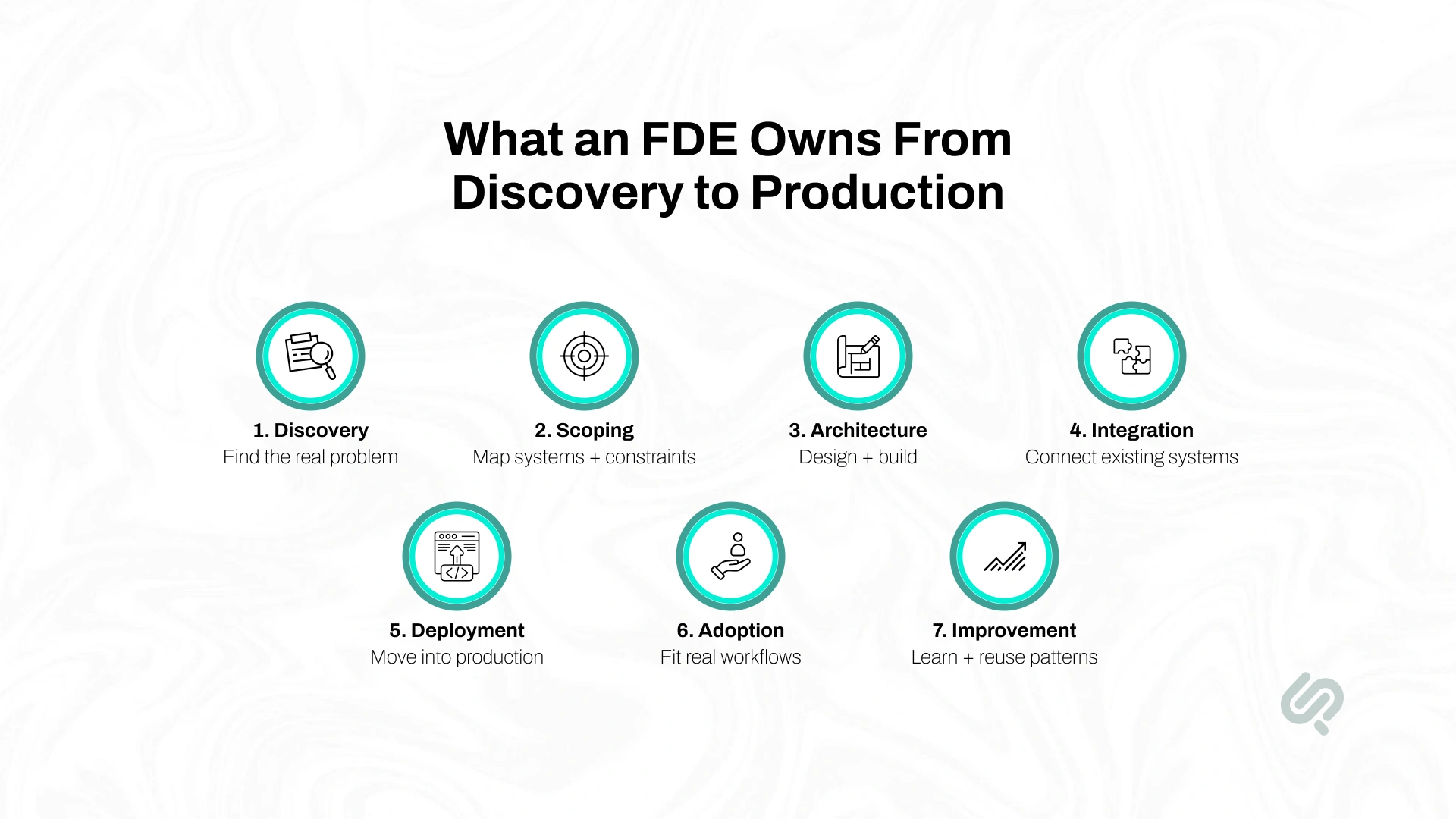
A forward deployed engineer owns more than code. The role connects business discovery, technical execution, system integration, deployment, and adoption so a complex initiative reaches a measurable production outcome.
The FDE works with users, operators, managers, and technical teams to identify what is slowing the business down. This may include manual work, missing data, approval delays, broken integrations, or legacy systems.
The engineer maps the systems, APIs, data, infrastructure, security requirements, and dependencies involved. The goal is to decide what should be built, integrated, or simplified before development begins.
The FDE helps design the solution and contributes directly to implementation. This can include backend services, AI workflows, APIs, frontend interfaces, automation, data pipelines, and cloud infrastructure.
A major part of the forward-deployed engineer role is connecting new technology with existing business systems. That may include CRM, ERP, databases, internal tools, AI models, identity systems, and third-party platforms.
The FDE helps move the solution from prototype to live use. This includes testing, security, permissions, monitoring, infrastructure, performance, and production readiness.
The job is not complete when the software goes live. The engineer checks whether users are actually adopting the new workflow and fixes issues that reduce usability or business value.
After launch, the FDE uses production data and user feedback to improve the system.
Good field engineering should also identify patterns that can be reused. If the same integration problem, workflow requirement, or failure mode appears repeatedly, the team can turn that learning into reusable components, documentation, automation, or product improvements instead of creating another one-off fix.
This feedback loop is one of the differences between mature forward deployed engineering and conventional custom development.
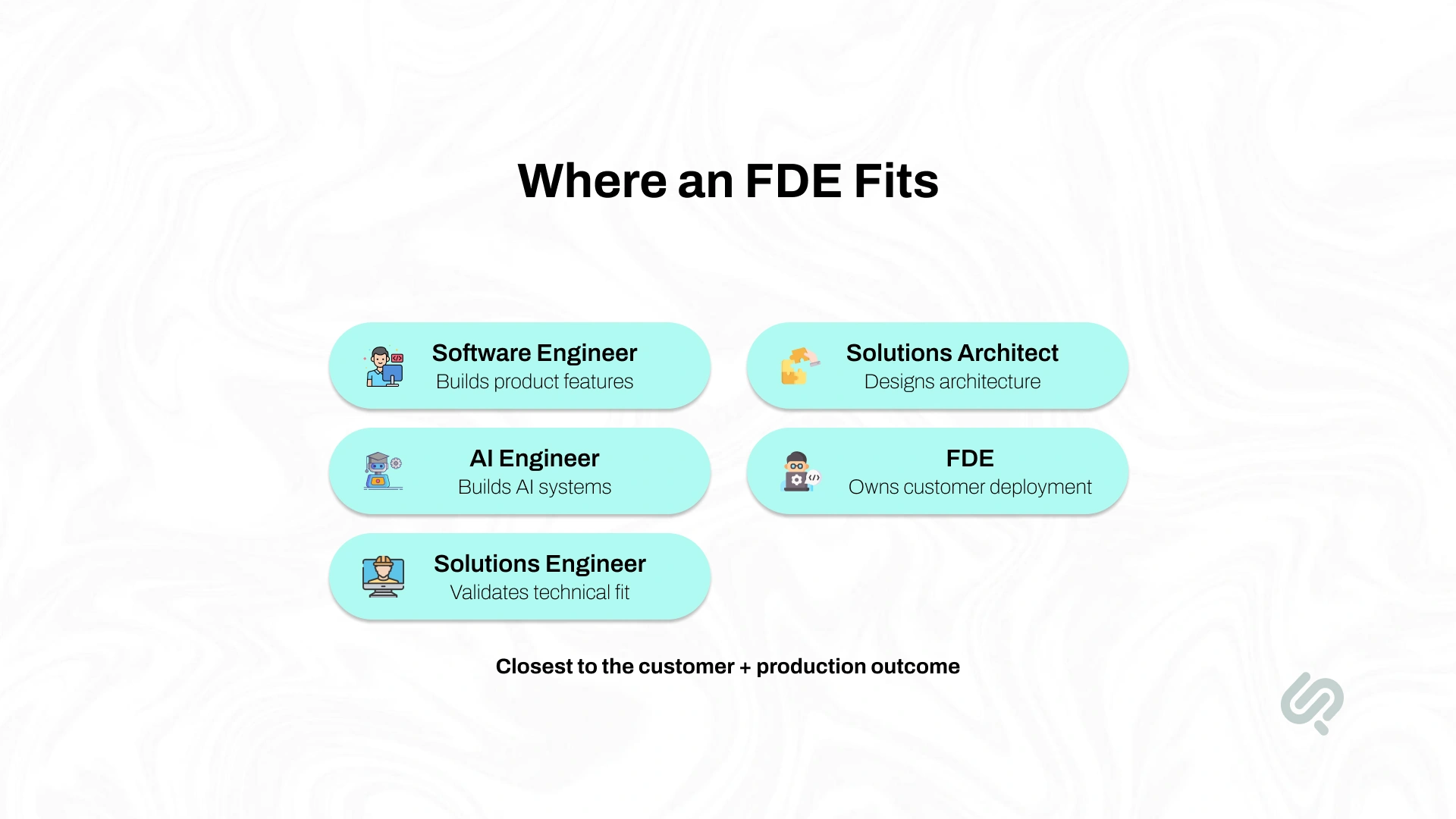
These roles overlap, but the main difference is what they are expected to own.
Choose a software engineer when requirements are reasonably clear and the work belongs to an ongoing product roadmap.
Choose an AI engineer when the main job is building AI capabilities, models, agents, retrieval systems, or AI product infrastructure.
Choose a solutions engineer when you are evaluating whether a technology fits your needs, or a solutions architect when the main challenge is defining the architecture.
Use an FDE when execution crosses all of these boundaries. This is usually the better fit when someone needs to understand the business problem, work with existing systems, write code, handle integrations, solve production blockers, and stay accountable until the solution works in the real environment.
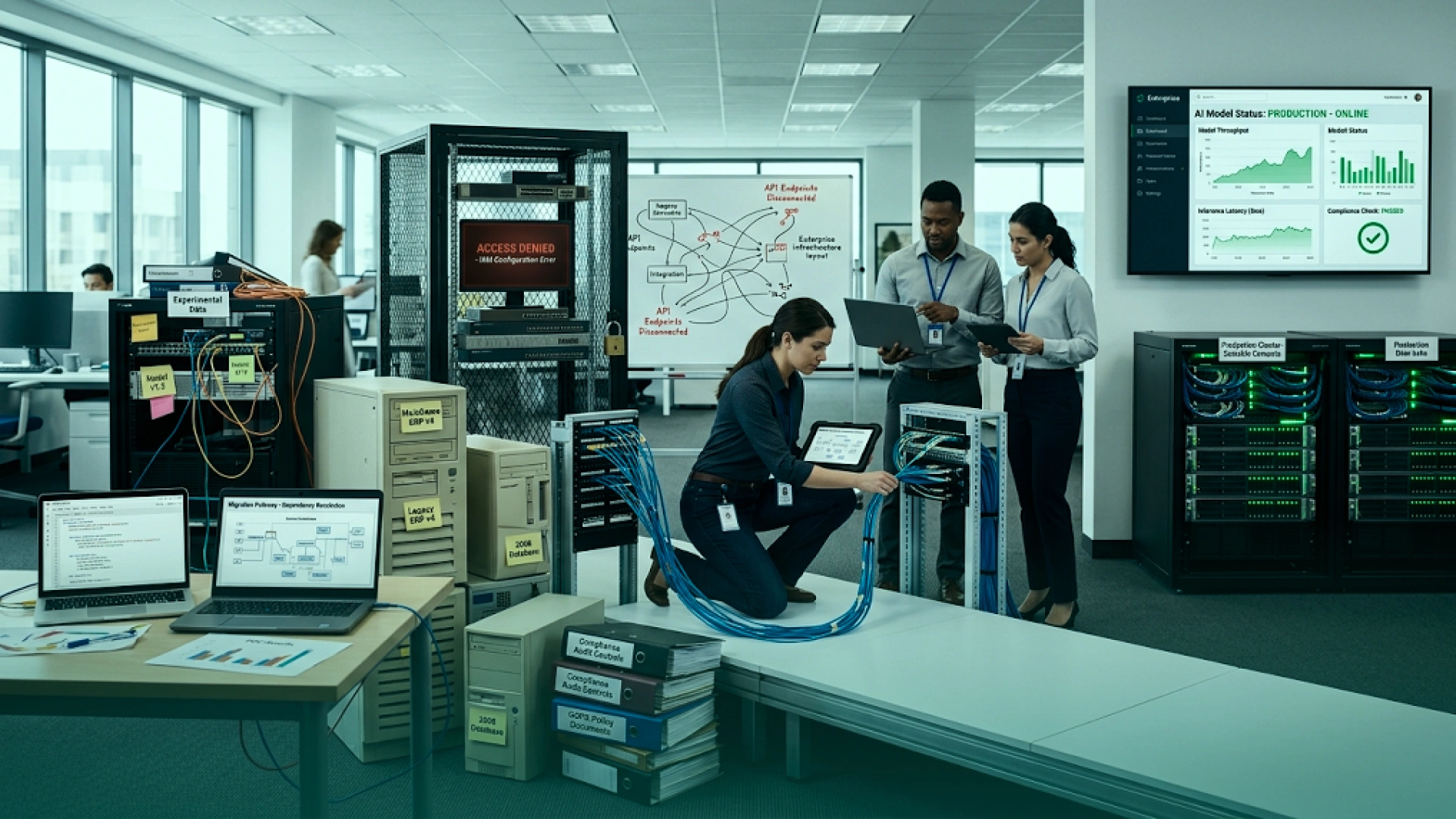
Knowing when to hire a forward deployed engineer comes down to one question: does your project need senior technical ownership across business, product, and production?
If an AI prototype or PoC works but deployment is blocked by data, security, integrations, infrastructure, or user workflows, an AI forward deployed engineer can own the path to production.
When engineering, IT, security, vendors, and operations each own separate pieces, delivery slows down. An FDE connects those teams around one production outcome.
Complex projects often need CRM, ERP, databases, APIs, AI models, and internal tools to work together. A customer-embedded engineer can manage those dependencies as one system.
If users only discover what they need after testing a working version, an FDE supports faster build, test, learn, and improve cycles.
An FDE can add expertise across AI, integrations, DevOps, cloud, data, full-stack development, and QA without replacing your internal team.
Manual processes in support, compliance, claims, internal search, security, or operations are strong candidates for forward deployed engineering when automation requires custom systems and integrations.
A prototype may work technically but still fail security review because of data access, user permissions, audit requirements, regulatory controls, or missing human oversight.
An FDE can work with engineering, security, compliance, and business teams to build these requirements into the system instead of treating them as a final approval step.
If the outcome is clear (such as automating support or reducing processing time), but the architecture is not, an FDE can turn that business goal into a practical production roadmap.
Hiring an FDE for every software problem adds unnecessary cost.
You probably do not need one when:
In those situations, a conventional software team or staff augmentation model may be more economical.
FDE work is most valuable where technical complexity, business ambiguity, and production importance are all high.
Forward deployed engineers are most useful when new software or AI must work inside existing business systems, workflows, data, and security requirements.
As AI becomes part of more business applications, companies need engineers who can connect models with real data, permissions, workflows, integrations, and production systems. That is where forward deployed engineering adds the most value.
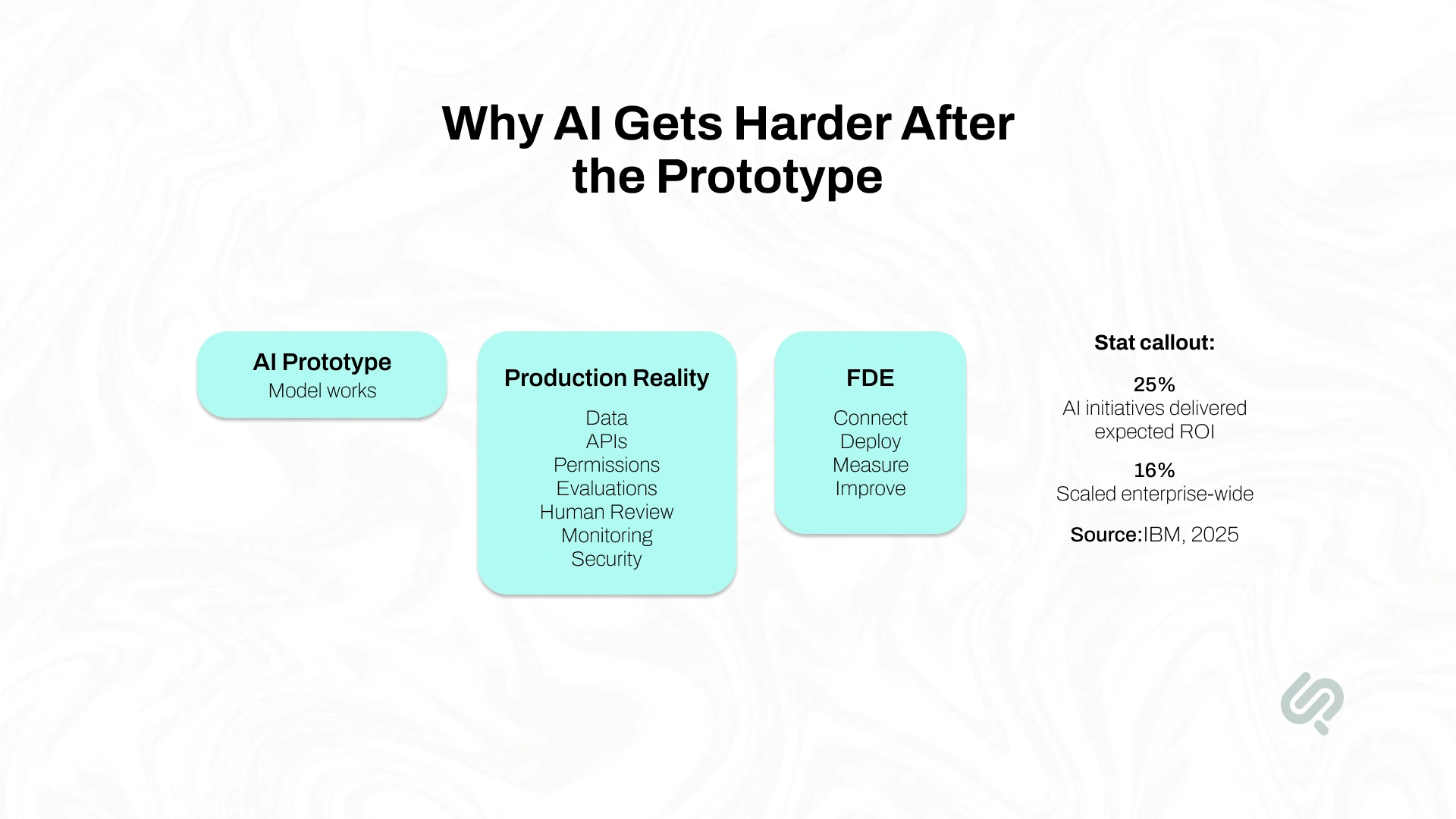
AI projects often become harder after the prototype works.
A model may perform well in a controlled demonstration, but enterprise AI deployment requires it to operate with real business data, permissions, APIs, users, security policies, and workflows. Teams also need to manage variable model outputs, evaluations, monitoring, human review, cost, latency, and failure cases.
IBM reported in 2025 that only 25% of surveyed AI initiatives had delivered their expected ROI, while just 16% had scaled enterprise-wide. The implementation gap is one reason companies are putting more engineering capacity closer to business operations. (2)
An AI forward deployed engineer can help by owning work such as:
This approach reduces the number of handoffs between AI teams, software engineers, IT, security, operations, and business stakeholders. Decisions can be made closer to the system being built.
As Hammad Maqbool, Head of AI & Machine Learning at Phaedra Solutions, explains:
“AI automation only works when it is designed around a real business workflow. The model is one layer. The bigger job is connecting systems, defining rules, setting human review points, and measuring what changed after launch.”
For buyers, that distinction matters. The value of an FDE is not access to an AI model. It is the ability to turn that model into a production system that works inside the business.
A forward deployed software engineer needs more than strong coding skills. Buyers should look for someone who can take an unclear operational problem, understand the technical environment, and turn it into a maintainable production system.
Important capabilities include:
The engineer should be comfortable writing and reviewing production code, debugging real systems, testing changes, and dealing with reliability and performance issues.
Enterprise projects rarely operate in isolation. An FDE may need to connect APIs, databases, identity systems, cloud services, legacy platforms, and third-party tools.
For AI projects, useful skills can include LLM APIs, AI agents, RAG, vector search, model evaluations, prompt design, data pipelines, and AI observability.
The engineer should understand infrastructure, authentication, permissions, secrets, CI/CD, monitoring, logging, and production-readiness requirements.
Good FDEs can ask users how a workflow operates today, identify the real bottleneck, and translate a business objective into technical scope.
The role involves working with engineers, operators, product leaders, executives, and security teams. The engineer should be able to explain tradeoffs in plain language and push back when a requested solution creates unnecessary complexity or risk.
Requirements are often incomplete. Strong FDEs investigate blockers, find the right stakeholders, test assumptions, and move the project forward without waiting for every task to be fully specified.
For a buyer, the best test is simple: Can this person understand the business problem and still go deep enough technically to own the production outcome?
Choosing between a full-time forward-deployed engineer and an external forward-deployed engineering partner depends on how long you need the capability, how complex the project is, and how quickly you need to start.
A full-time FDE is usually the better option when the role will remain important after the current project and you want long-term product and company knowledge to stay with one employee.
An FDE services partner is often better for complex AI, integration, or modernization projects where different skills are needed at different stages.
Instead of hiring separate AI, full-stack, DevOps, data, QA, and security specialists, businesses can access an embedded engineering team around one production goal.
For companies that need to move a high-priority project from discovery to production quickly, forward-deployed engineering services can provide more flexibility and broader technical coverage than a single permanent hire.
An embedded engineering model can accelerate implementation, but buyers should also ask what happens when the engagement ends or when the company wants to change technology providers.
This matters even more in AI because model quality, pricing, context limits, latency, and capabilities can change quickly. An architecture that works well with one provider today should not create unnecessary barriers to using another provider later.
When evaluating forward deployed engineering services, ask:
A strong engagement should leave your company with more capability than it had at the start.
By the end, your team should understand:
For AI systems, model portability does not mean every provider can be swapped with one click. It means the architecture avoids unnecessary coupling so future technology choices remain possible.
An FDE engagement that only makes the external provider indispensable has solved one delivery problem while creating another.
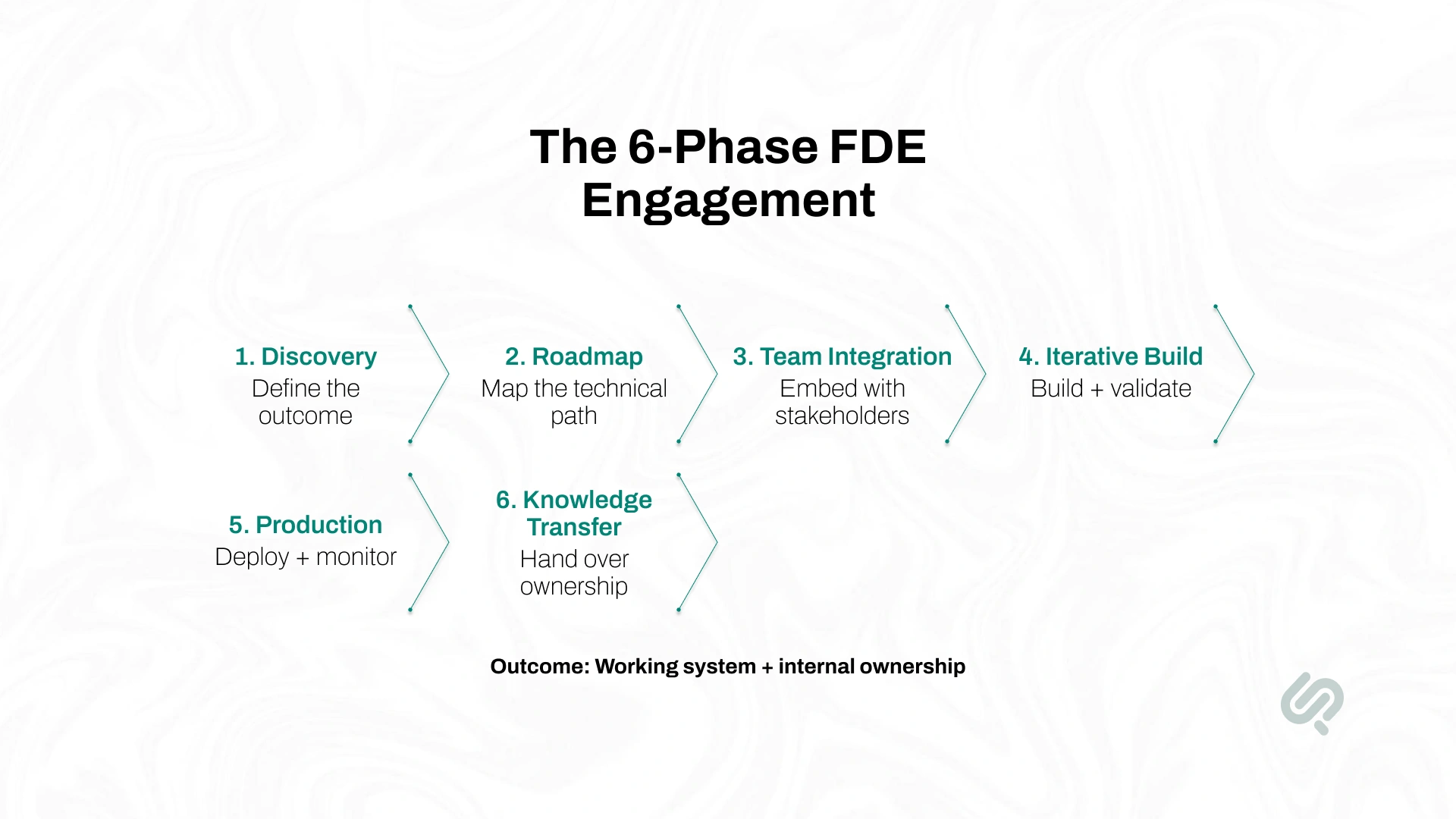
A good FDE engagement model is organized around a production outcome rather than a backlog of disconnected tasks.
Review the business problem, current workflow, users, systems, constraints, and success metrics.
Output: prioritized use case and measurable success criteria.
Map architecture, data, integrations, access requirements, dependencies, risks, and delivery priorities.
Output: clear technical path from the current state to production.
Connect the FDE with the business, engineering, product, IT, security, and operations teams involved in the outcome.
Output: faster decisions and clear ownership.
Build the smallest useful version, test it with real users and data, and improve it in short cycles.
Output: working software validated against actual workflows.
Complete security, infrastructure, QA, monitoring, permissions, performance testing, and release preparation.
Output: production-ready system with defined operating controls.
Document the architecture, deployment process, monitoring, code ownership, operating procedures, and major technical decisions.
Output: an internal team that can operate and improve the system after handover.
The engagement should reduce dependency over time. The client should finish with working software, clear ownership, documentation, and the knowledge required to maintain it.
Be cautious if a provider:
The main question is whether the provider is taking ownership of the outcome or simply supplying engineering capacity.
Do not measure the engagement primarily by tickets closed or hours billed.
Measure what changes in production. Possible KPIs include:
OpenAI’s own FDE description emphasizes production adoption and measurable workflow impact as success criteria. (3)
That is a useful standard for buyers too. Agree on the business metric before agreeing on the backlog.
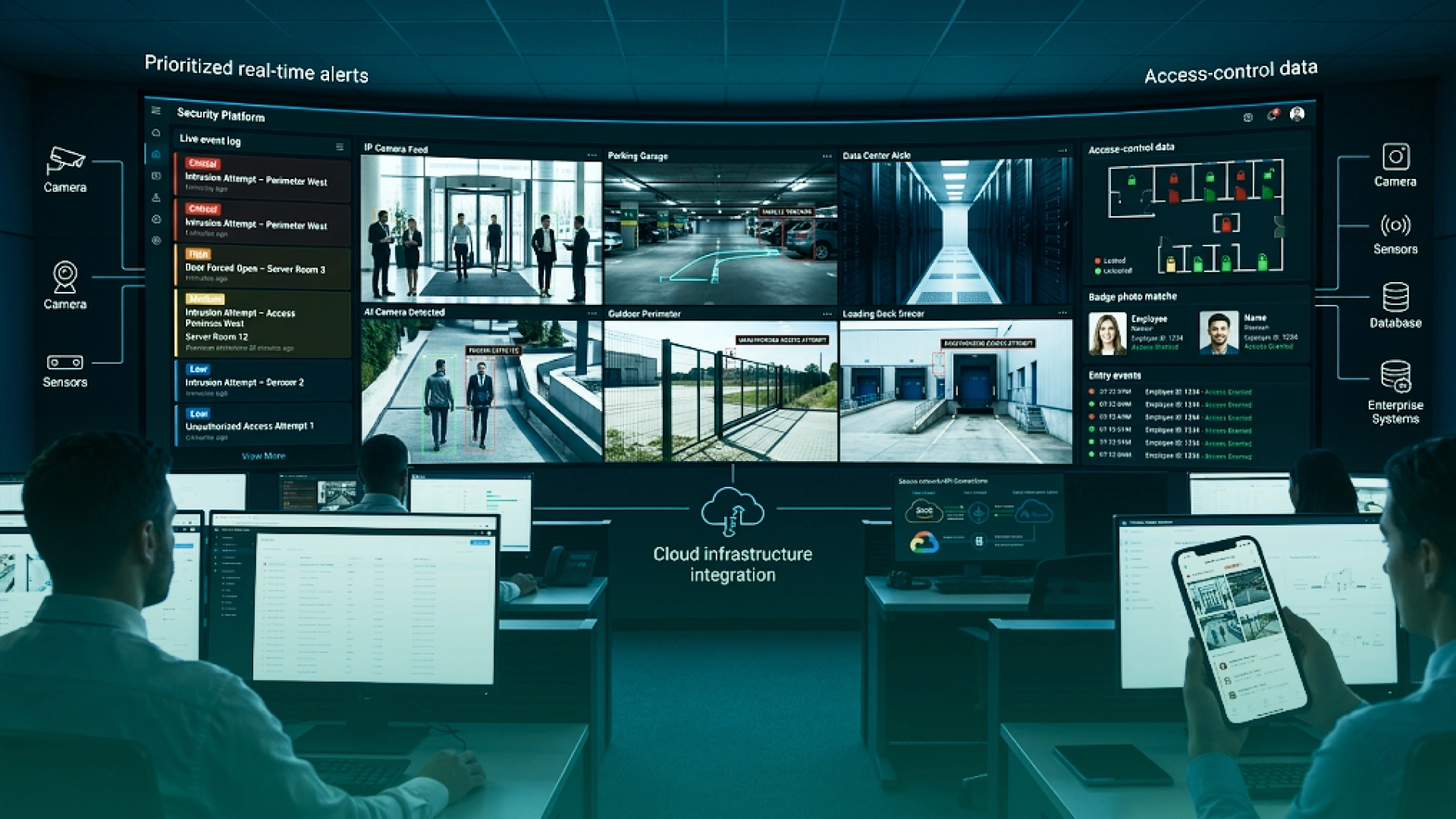
A security technology client needed an AI surveillance platform that could work with existing IP cameras, access-control systems, distributed locations, and live security operations. The challenge involved far more than adding AI: cloud architecture, device integration, web and mobile interfaces, monitoring, security, deployment, and testing all had to work together.
Phaedra Solutions built a cloud platform with real-time monitoring, AI-powered analytics, face detection and historical tracking, access logs, device integrations, AWS infrastructure, Docker, CI/CD, and production testing. It is a strong example of the FDE delivery model because value came from making AI, software, infrastructure, and existing systems operate together in the client's real environment rather than delivering an isolated prototype.
Phaedra Solutions' AI services help companies turn stalled pilots and complex AI initiatives into production systems connected to real data, workflows, APIs, security controls, and users.
Our team can support discovery, architecture, AI implementation, integration, evaluation, deployment, monitoring, and handover through one accountable delivery model. Phaedra's current AI offering specifically covers AI development, integration and deployment, agents, automation, security, and production scaling.
As an AI-first engineering partner, Phaedra Solutions uses AI-assisted research, prototyping, coding, testing, QA, and documentation while senior engineers remain responsible for architecture, security, and production quality. If your AI project works in a demo but is struggling with integration, reliability, or rollout, book a free AI consultation to identify the blockers and define the shortest practical path to production.



Ameena is a content writer with a background in International Relations, blending academic insight with SEO-driven writing experience. She has written extensively in the academic space and contributed blog content for various platforms.
Her interests lie in human rights, conflict resolution, and emerging technologies in global policy. Outside of work, she enjoys reading fiction, exploring AI as a hobby, and learning how digital systems shape society.