






.webp)






.webp)
An AI readiness checklist helps an enterprise determine whether a specific AI use case is ready for investment. It evaluates business value, data, infrastructure, integration, security, governance, skills, workflow fit, ownership, and success measures before the organization selects a model, purchases a platform, or commits a significant development budget.
In practical terms, AI readiness means knowing what can start now, what must be fixed first, and whether the next step should be a controlled proof of concept, an MVP, or production planning.
This guide provides a 2026 enterprise AI readiness assessment framework, scoring model, and implementation roadmap for moving from an initial idea to measurable business value.
An AI readiness checklist is a structured set of questions used to determine whether a specific AI use case can be implemented safely and successfully. It evaluates strategy, data, infrastructure, governance, skills, workflows, ownership, risk, and measurement.
Start with one clearly defined business use case. Review its expected value, required data, system integrations, security risks, regulatory requirements, workforce impact, delivery skills, success metrics, and production support needs.
A focused assessment for one use case or business unit commonly takes two to four weeks. A wider enterprise assessment may take longer when it involves several departments, systems, data owners, regulations, or decision-makers.
A strong score means the use case is documented, owned, technically feasible, measurable, and supported by appropriate controls. However, a critical gap in data rights, privacy, security, integration, or accountability should block the project even when the total score is high.
Start with a PoC when data suitability, model performance, technical feasibility, or integration risk remains uncertain. Move to an MVP after the core approach has been validated and real users need a limited but functional system.
Use a partner when the first use case is unclear, internal delivery skills are missing, a pilot has stalled, or the project involves complex data, integrations, regulations, or production risks. A credible partner should be willing to recommend a smaller PoC, corrective work, or a no-go decision when necessary.
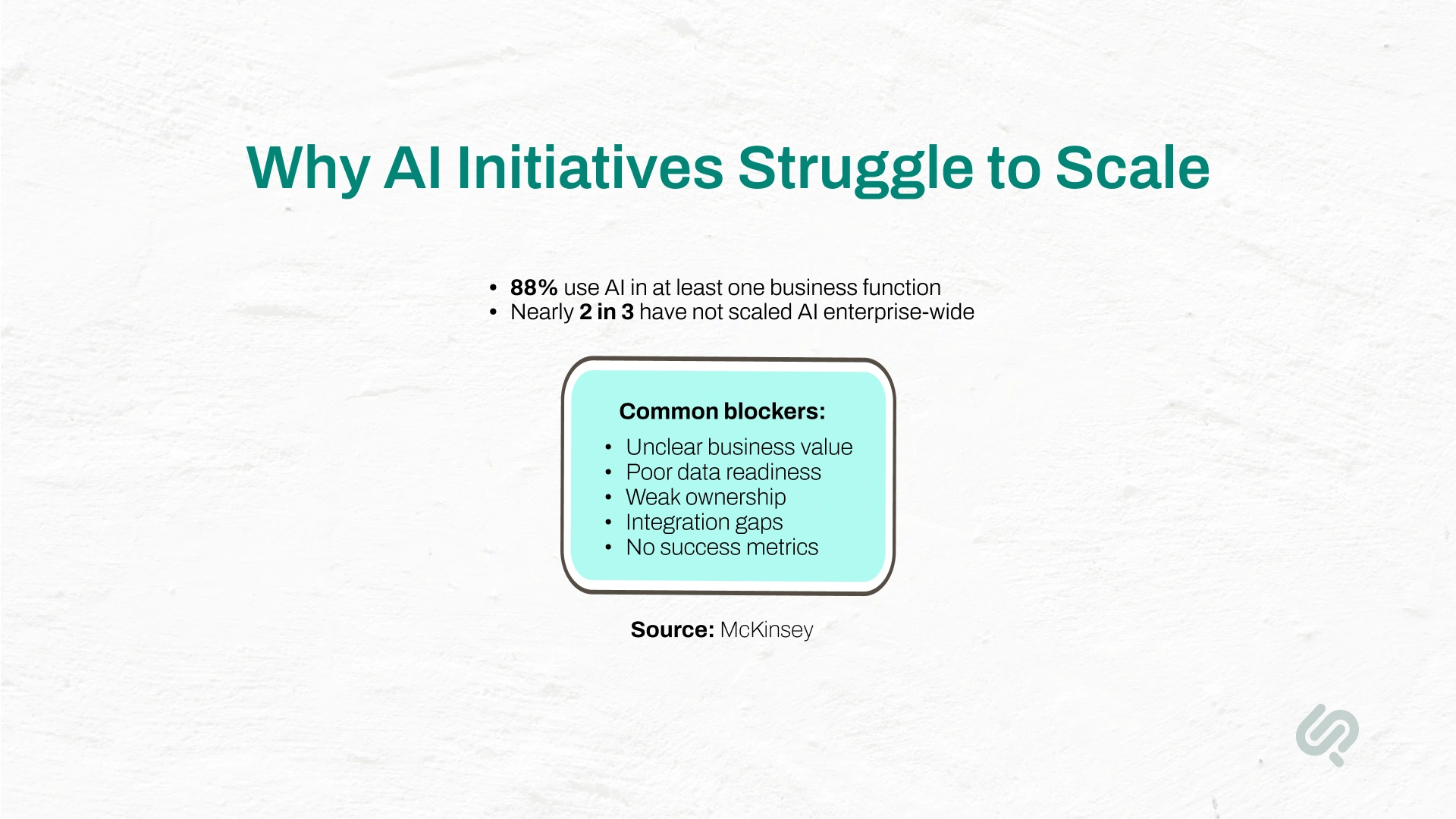
Enterprise AI adoption is widespread, but scaled business value remains limited. McKinsey found that 88% of organizations use AI in at least one business function, yet nearly two-thirds have not started scaling AI across the enterprise. (1)
The gap is rarely caused by model performance alone. AI initiatives usually slow down because basic delivery questions remain unanswered:
“Most AI projects become difficult when the business decision, data ownership, integration path, and success measures are unclear. Readiness begins by turning each unknown into an owned and testable decision.”
— Hammad Maqbool, AI Transformation & Prompt Lead, Phaedra Solutions.
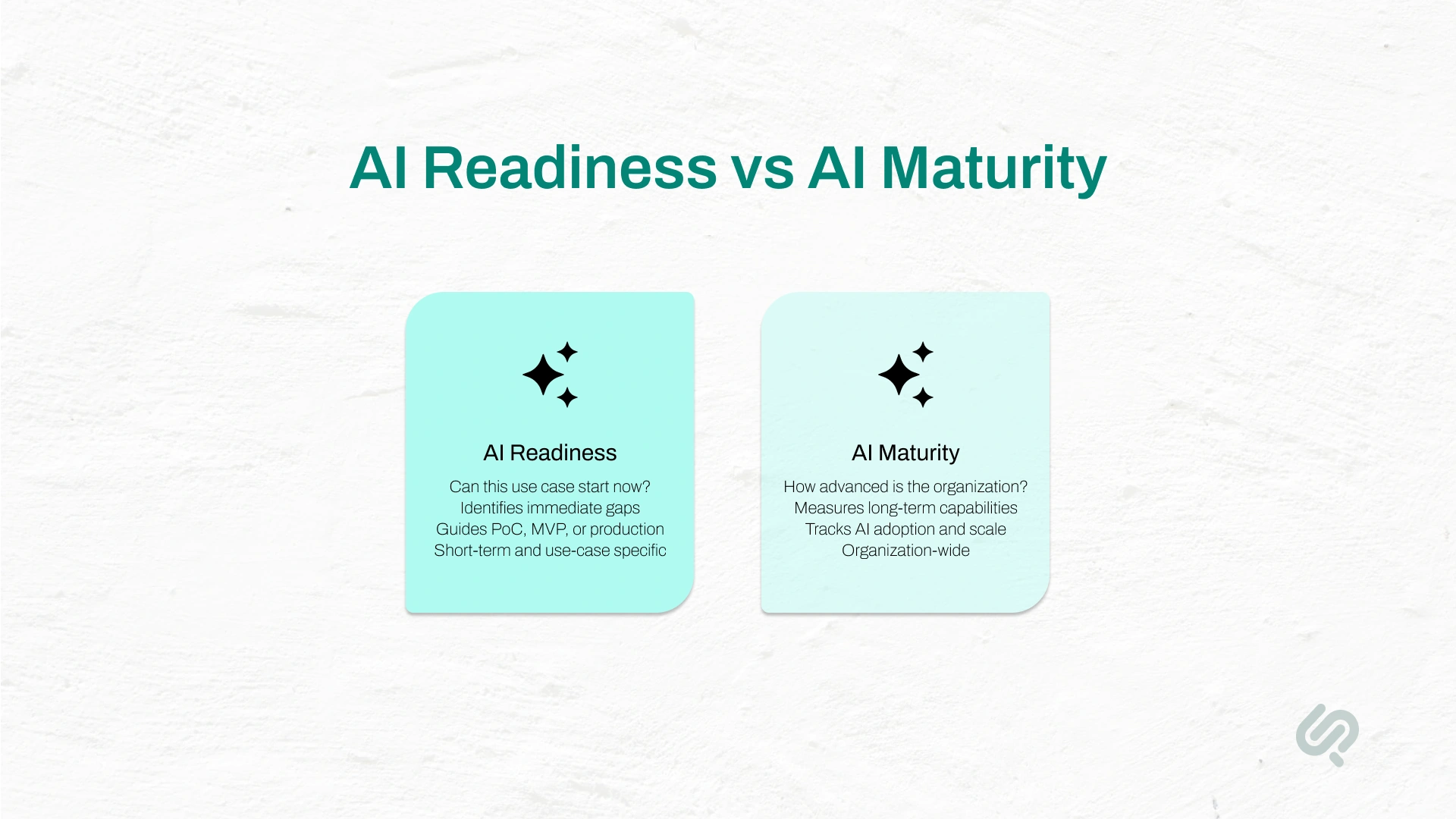
An AI maturity assessment measures how advanced an organization is across its long-term AI capabilities. It may examine whether AI is isolated, repeatable, scaled, or embedded across the business.
A readiness review is narrower and more immediate. It asks whether the organization can support a specific use case now, what is missing, and what must happen before funding a PoC, MVP, or production rollout. An enterprise can have low overall maturity but still be ready for a focused, low-risk use case.
.webp)
Most readiness frameworks examine future AI plans but overlook how employees and workflows operate today. Before assessing a new system, the enterprise should identify existing AI use, manual workarounds, hidden data movement, and undocumented decisions.
Employees may already be using personal AI accounts, browser extensions, shared prompts, spreadsheets, or unofficial connectors. These tools can expose business data or create inconsistent processes without appearing in formal IT records.
The documented workflow may also differ from the real one. Employees may correct system errors manually, move information through email or Slack, or depend on knowledge held by one experienced employee.
Check for the following before assigning a readiness score:
The assessment should also define the AI system’s permitted level of autonomy. A system that recommends an action does not require the same controls as an agent that updates records, sends messages, approves transactions, or changes business data.
Document what the AI may:
Also name the person who can stop, reverse, or override an AI-assisted action.
A client needed to reduce the time employees spent reviewing surveillance footage across multiple cameras and locations. The project required more than face detection or video search. The team first had to define supported camera systems, user access, real-time performance requirements, security controls, cloud infrastructure, and how employees would investigate detected events.
Phaedra Solutions developed a cloud-based surveillance platform with live monitoring, face detection and tracking, OpenAI-powered footage search, access logs, and integrations with IP cameras and access-control systems. The solution was deployed through AWS and Docker using phased releases, CI/CD, security testing, performance testing, and real-world test data. The project shows that production AI readiness depends on integrations, workflow design, infrastructure, testing, security, and operational ownership—not only on model performance.
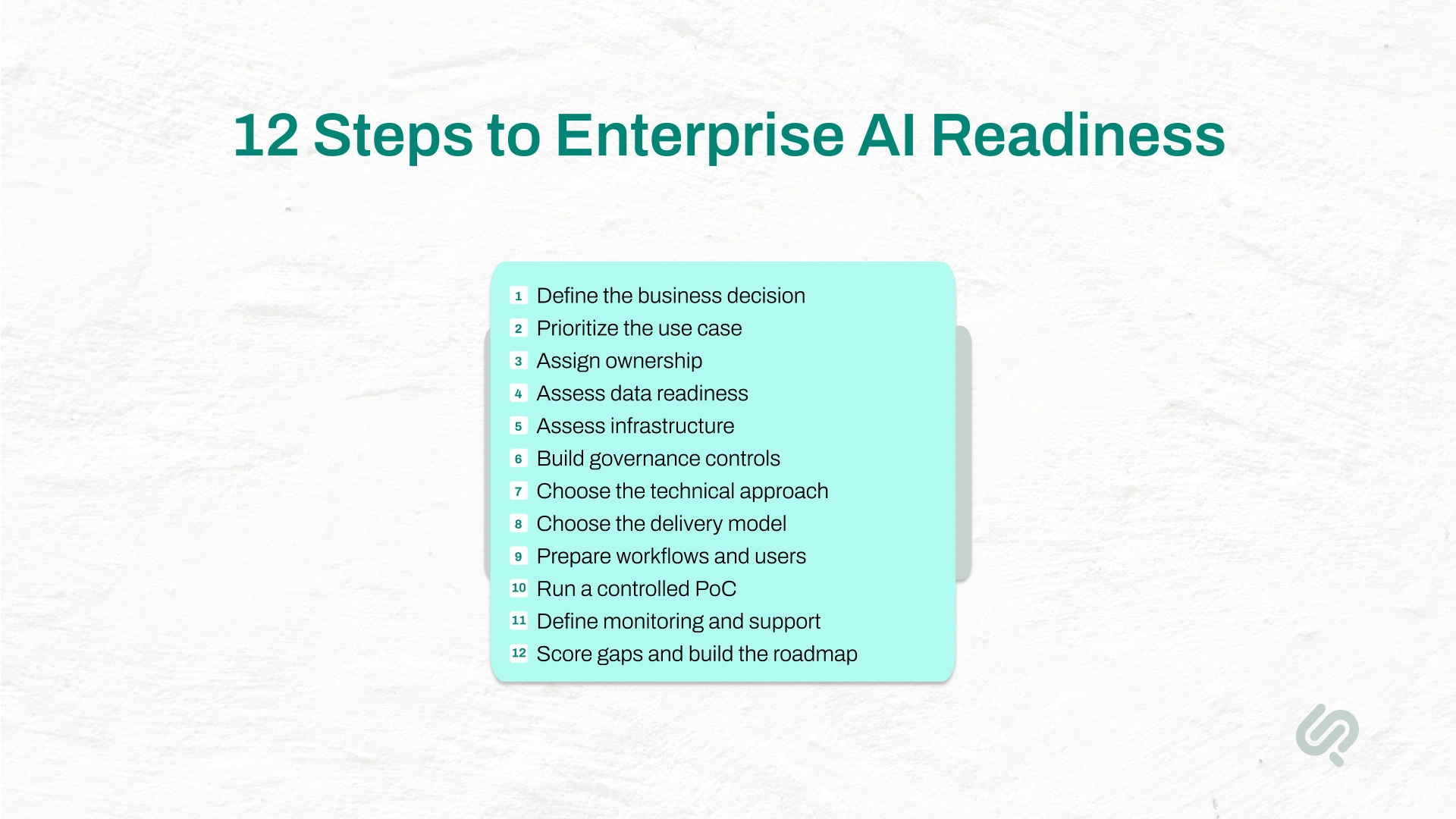
Use the following 12 steps as an AI implementation checklist. Answer each step for one clearly defined use case rather than rating the entire company in broad terms.
Start with the exact decision, task, or workflow the AI system will support. State who will use the output, what input is required, how quickly the result is needed, what error level is acceptable, and where a person must review the result.
For example, replace “use AI in customer service” with “help support agents retrieve the correct refund policy and draft a response within 30 seconds.”
This creates a boundary for the enterprise AI strategy and shows which data, systems, and controls matter.
Readiness questions:
Score candidate use cases by business value, feasibility, risk, data availability, integration effort, and time to evidence. The first project should matter enough to earn support but remain narrow enough to test safely.
Good first projects often involve a repeated workflow, a measurable delay or cost, accessible historical data, and output that a person can verify. Avoid beginning with a company-wide assistant that needs access to every system and policy.
Name one executive sponsor and one operational owner. The sponsor removes budget and policy barriers.
The operational owner defines requirements, supplies subject knowledge, reviews outputs, and remains accountable after launch.
A steering group can support the work, but shared oversight should not replace named accountability. Organizational AI readiness is weak when every department is involved, but no one owns the final decision.
List the exact data needed for the use case and where it lives. Then check quality, completeness, freshness, ownership, access rights, format consistency, lineage, retention, and whether important decisions are recorded in the data.
Data readiness should be evaluated against the intended business outcome, not by how much data the enterprise owns. Large datasets are not useful when important fields are incomplete, definitions are inconsistent, access is restricted, or the records do not represent real production conditions.
The assessment should identify:
Also test whether the available data represents the real production environment. A clean sample may prove that a model can run while hiding missing fields, inconsistent definitions, rare cases, or historical bias that will affect live performance.
Minimum data checks:
Review whether current systems, including legacy systems, can supply data, call models, store outputs, manage identities, log activity, and support the required response time.
The choice is not simply cloud versus on-premises. It is whether the full operating environment can support the expected volume, latency, security, availability, and cost.
Document required APIs, data pipelines, cloud services, model providers, access controls, fallback behavior, and monitoring.
AI implementation readiness is low when the model works in a test environment but cannot connect safely to the workflow where employees need it.
Governance should be designed for the specific use case before development begins. Define who approves the system, what information it may access, which outputs require human review, and who responds when something goes wrong.
The governance plan should cover:
The NIST AI Risk Management Framework groups AI risk work into four functions: Govern, Map, Measure, and Manage (3). These activities should continue throughout design, development, deployment, and operation rather than appearing only as a final compliance review.
Generative AI systems require additional checks for inaccurate output, prompt injection, sensitive-data exposure, copyright concerns, unverified responses, and vendor retention policies.
AI agents require stricter controls because they can act through business systems. Define:
Higher-risk use cases should receive stronger testing, documentation, human review, and approval.
Choose the technical approach based on the business requirement, not on which AI tool is currently popular.
The use case may require:
Compare the options using output quality, explainability, privacy, integration effort, response time, expected volume, operating cost, and maintenance requirements.
Then decide whether the enterprise should build, buy, customize, or work with an AI implementation partner.
Evaluate each option against:
Calculate the expected AI total cost of ownership for at least the first 12 to 24 months. Include model usage, cloud infrastructure, software licenses, integrations, testing, monitoring, human review, maintenance, support, and future migration costs.
The lowest initial price is not always the lowest long-term cost.
Identify the skills required to assess, build, launch, and operate the system. Readiness depends on more than hiring an AI engineer.
Common responsibilities include:
Decide which capabilities must remain internal and which can be provided by external specialists.
Businesses choosing between an internal team and an external AI company should also compare specialist coverage, delivery speed, ownership, cost, and long-term maintenance.
Internal teams should retain ownership of:
An external team can support discovery, architecture, development, integration, testing, deployment, and monitoring. However, it should not replace the internal people responsible for deciding whether the system is useful and safe.
The delivery model should also define who will maintain prompts, models, integrations, evaluation datasets, monitoring rules, and user documentation after launch.
AI should not simply be added on top of an existing process. The surrounding workflow must be redesigned so employees know when to use the system, how to review its output, and what to do when it fails.
Document:
Training should be specific to each role. Employees need to understand:
BCG reported that only 5% of companies were achieving AI value at scale. (2) This suggests that successful adoption depends on changes to workflows, responsibilities, and employee behavior—not only on deploying new technology.
Measure adoption through operational evidence rather than course completion. Useful measures include:

Use a PoC to test the riskiest assumptions with limited data, users, and system access. Define pass and fail thresholds before the experiment begins.
These may include accuracy, response time, task completion, review effort, cost per transaction, or reduction in manual steps.
A PoC is not a small production launch. It is a controlled test that should lead to one of three decisions: proceed, revise, or stop.
When the concept is viable, AI proof of concept development can move into an MVP with real workflow integration and user feedback.
Production monitoring should cover business value, model quality, system performance, adoption, risk, and cost.
Business metrics may include:
Model and output metrics may include:
Operational monitoring should include:
Every metric needs an owner, an acceptable range, and a review schedule.
Production readiness also requires a clear support model. Name:
For AI agents, record model calls, tool actions, approvals, data sources, policy versions, exceptions, and human overrides. The organization should be able to reconstruct what happened if an agent makes an incorrect or unauthorized decision.
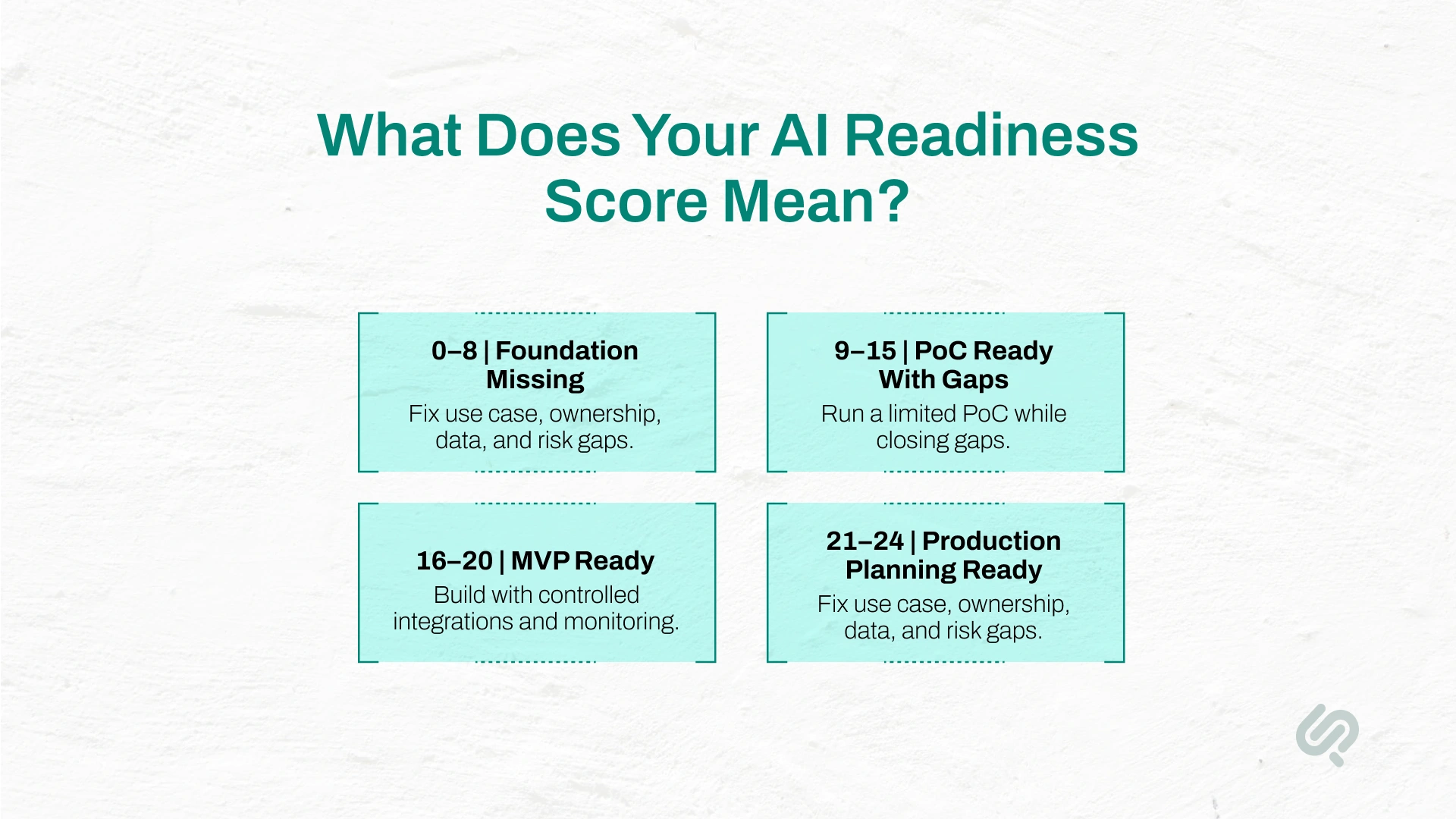
Give each checklist area a score:
With 12 areas, the maximum score is 24. A low score does not mean the organization should abandon AI. It means the scope, controls, or foundations need work before a larger commitment.
This AI readiness framework is a planning tool, not a guarantee. A critical gap in privacy, data rights, safety, or integration can block a project even when the total score is high.
An internal assessment can work when the enterprise already has experienced product, data, AI, security, infrastructure, legal, and operational leaders. These teams must also have enough authority to resolve ownership, access, budget, workflow, and risk decisions.
Consider external support when:
An enterprise AI readiness assessment should not end with a generic maturity rating. It should produce a clear decision, named gap owners, delivery estimates, a prioritized roadmap, and one recommended next step.
A capable partner should also be willing to recommend:
The assessment should end with documents that leaders can act on:
Avoid reports that only rate the organization as “beginner,” “intermediate,” or “advanced.” Leaders need to know what can start now, what must be fixed first, who owns each action, and what evidence will support the next investment decision.
Once the AI readiness checklist identifies a viable use case, Phaedra Solutions’ AI development services can turn it into a controlled PoC, usable MVP, or production-ready AI system. The engagement connects business requirements, enterprise data, integrations, security, testing, deployment, and monitoring through one delivery process.
As an AI-first development partner, Phaedra Solutions’ uses AI-assisted research, rapid prototyping, code generation, automated test writing, AI-powered QA, and structured documentation under senior review. Depending on project size, complexity, and automation potential, this approach can reduce delivery timelines by 60–80%, improve cost efficiency by 30–50%, and reduce team requirements by 30–80%, with the highest reductions in highly automated implementations.
Senior specialists remain responsible for architecture, security, maintainability, and final quality.



Ameena is a content writer with a background in International Relations, blending academic insight with SEO-driven writing experience. She has written extensively in the academic space and contributed blog content for various platforms.
Her interests lie in human rights, conflict resolution, and emerging technologies in global policy. Outside of work, she enjoys reading fiction, exploring AI as a hobby, and learning how digital systems shape society.