














Forward deployed engineer cost in 2026 depends heavily on how you engage the engineer. Across current US job postings, disclosed forward deployed engineer (FDE) base salaries commonly fall around $152,000 to $240,000, while published external embedded-FDE pricing ranges from roughly $8,000 to $30,000+ per month. Highly specialized AI roles can cost considerably more.
For businesses, salary versus monthly rate is only part of the comparison. The real cost includes recruiting, benefits, specialist support, deployment time, cloud and AI usage, production support, and how long the company actually needs FDE-level ownership.
Current US FDE job postings commonly disclose base salaries around $152,000 to $240,000. Published external FDE engagements range from roughly $8,000 to $30,000+ per month, depending on seniority, scope, location, and ownership.
Published provider pricing generally ranges from about $8,000 to $30,000+ per month per embedded engineer. Senior AI specialists, on-site requirements, or access to additional engineering disciplines can push the cost higher.
Published contractor benchmarks range broadly from around $60 to $250 per hour. Highly specialized architecture, AI, security, or production-critical work may cost more.
An external FDE is often more economical for temporary or uncertain demand because the company avoids permanent salary, benefits, recruiting, and unused capacity. An internal hire can make more financial sense when FDE work will remain continuous for several years.
AI-focused FDEs often sit toward the higher end of the market because projects may involve LLMs, RAG, AI agents, data pipelines, evaluation, MLOps, security, and production monitoring. Budget for the level of technical ownership required, not simply the job title.
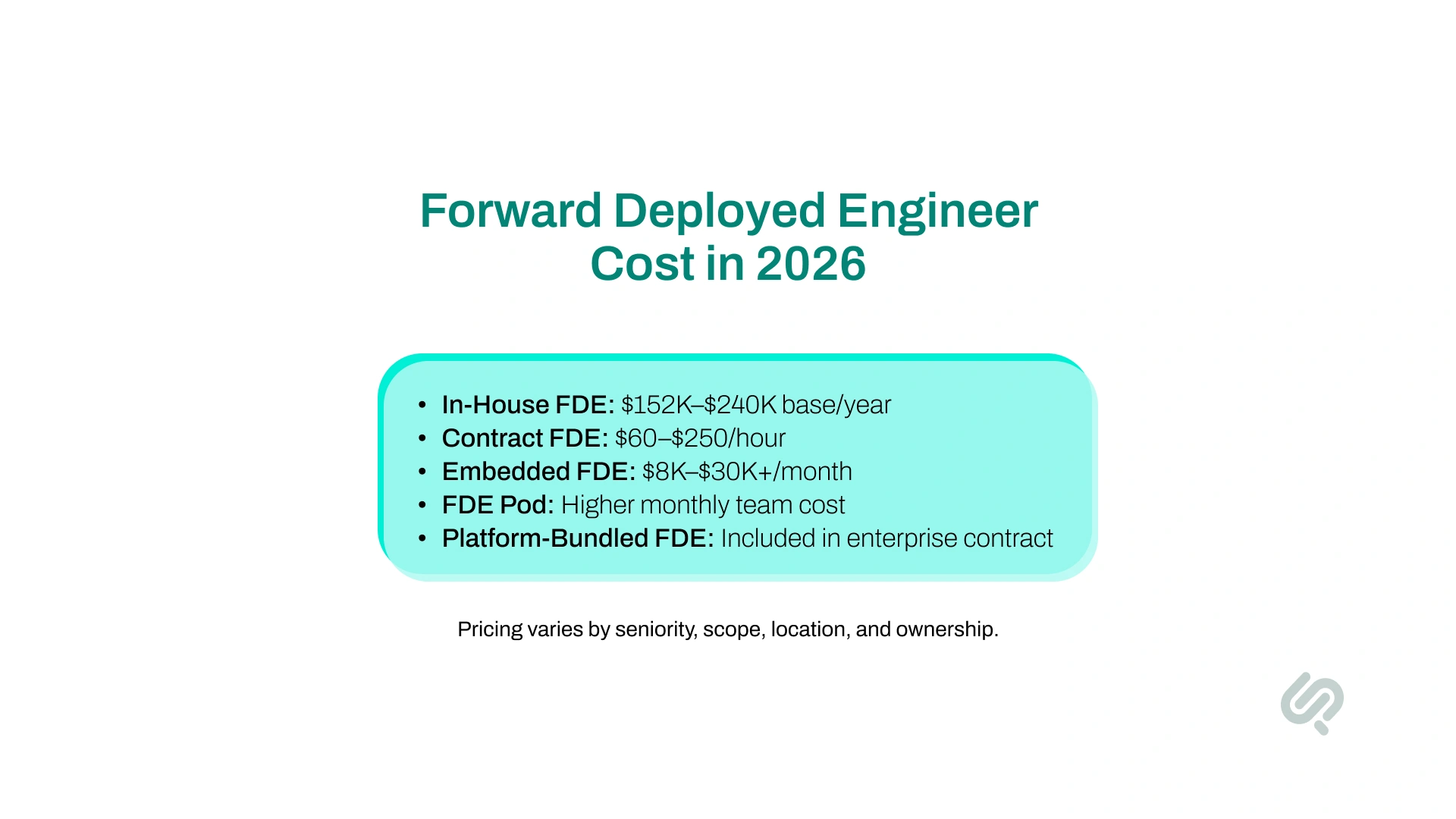
FDE pricing can look confusing because salary figures, contractor rates, monthly retainers, and enterprise service fees measure different things.
A useful starting point is to separate the main commercial structures.
FDE Pulse analyzed 214 active FDE job postings and found a typical disclosed US base salary range of $152,000 to $240,000, with a midpoint near $199,000. The full sample ranged much more widely because company type, specialization, and seniority can change compensation significantly. (1)
For external delivery, providers such as ILMTEC publish embedded FDE pricing of roughly $8,000 to $30,000 per engineer per month (2). Rocketlane cites contract FDE rates of roughly $60 to $250 per hour. (3)
These figures are useful benchmarks, not universal FDE rate cards. Region, seniority, AI expertise, production responsibility, supporting specialists, and engagement length can all materially change the final quote.
A forward deployed engineer salary is only the starting point when calculating the cost of building FDE capability internally.
Current salary research based on active FDE job postings places typical disclosed US base compensation around $152,000 to $240,000. Senior and highly specialized roles can go significantly higher, particularly where the engineer needs both advanced software engineering skills and experience deploying AI inside enterprise environments.
When comparing forward deployed engineer cost, employers also need to account for:
The US Bureau of Labor Statistics reported that benefits represented 30.1% of total private-industry employer compensation in March 2026, while wages and salaries represented 69.9%. (4)
That does not mean businesses should simply add 30% to an FDE's salary. It shows why base salary and total employer cost are different numbers.
An internal FDE usually makes sense when the business expects continuous deployment work for several years. For a six-month AI implementation, enterprise integration, or modernization project, paying for permanent capacity may be harder to justify.
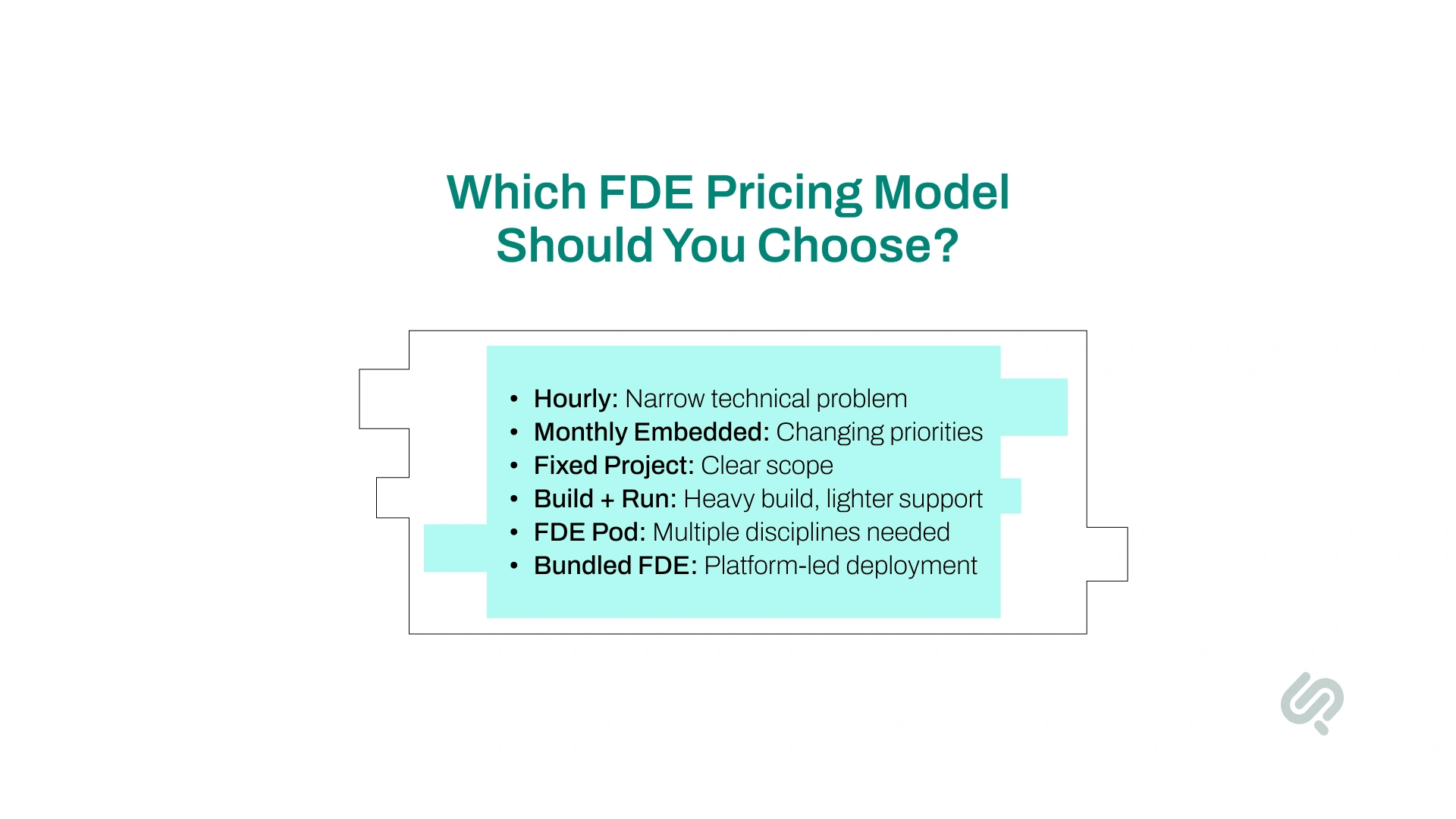
There is no single best FDE pricing model. The right commercial structure depends on how clearly the problem is defined and how much ongoing ownership the engineer needs to provide.
Hourly pricing works best when the problem is narrow and time-boxed.
Typical examples include:
Published contractor benchmarks range broadly from around $60 to $250 per hour, although highly specialized work can cost more.
Hourly pricing becomes less attractive when the engineer needs to stay involved from discovery through production because the buyer carries most of the scope and duration risk.
A forward deployed engineer retainer is usually a stronger fit when priorities will change during the project.
The FDE works inside the client's communication channels, codebase, workflows, and engineering process for an agreed amount of capacity each month.
Published monthly FDE pricing commonly ranges from roughly $8,000 to $30,000+ per engineer, depending on seniority, region, specialization, and scope.
Before comparing retainers, check whether the price covers only the engineer or also includes access to:
The scope behind the monthly fee can matter more than the headline rate.
Fixed pricing works when the outcome can be defined before engineering begins.
It can make sense for:
The advantage is budget certainty.
The disadvantage is that FDE projects often involve uncertainty. Once engineers begin working inside real systems, they may uncover legacy dependencies, data problems, security constraints, integration issues, or workflow requirements that were not visible during initial scoping.
If requirements are likely to keep changing, an embedded engagement may be more practical than repeatedly negotiating change requests.
Some FDE and AI implementation engagements separate the work into two commercial phases.
The business first pays for discovery, architecture, and implementation. After the system reaches production, the engagement moves to a smaller ongoing fee for monitoring, optimization, edge cases, maintenance, and production improvements.
This structure can make sense when engineering demand is high before launch but falls significantly once the system stabilizes.
It also avoids paying full implementation capacity indefinitely when the business only needs lighter production support.
An FDE pod cost is higher than a single-engineer retainer because the business gets several technical capabilities inside one delivery unit.
A pod may include:
This model is useful when one FDE would otherwise spend much of their time coordinating with multiple client-side specialists.
The buyer should not ask only:
“How many engineers do we get?”
A better question is:
“What is the smallest team that can take this project from discovery to production without unnecessary handoffs?”
For complicated AI and enterprise projects, a smaller senior pod can sometimes reduce total project cost compared with coordinating several cheaper independent resources.
Some enterprise software companies include forward deployed engineering within a larger platform or annual software contract.
The FDE may appear to be included at no additional charge, but the engineering cost is effectively part of the broader commercial relationship.
Businesses should therefore compare:
A bundled FDE is not automatically the cheapest option if accessing that engineer requires a large multi-year software commitment.
One reason FDE agency pricing varies so widely is that “forward deployed engineer” does not describe a standardized service package.
One provider may supply a senior engineer who writes production code, designs the architecture, works with stakeholders, and owns implementation.
Another may provide someone focused primarily on configuration, support, or implementation coordination.
As FDE hiring grows, the title is increasingly being applied to roles with very different levels of responsibility.
For buyers, the rule should be simple: Price the capability, not the title.
“The FDE title tells you very little about what you’re actually buying. The real value is whether that engineer can make decisions, solve problems in your environment, and stay accountable until the solution works in production.”
— Abubakar Shams, CEO & Business Strategy Lead, Phaedra Solutions
Before comparing quotes, ask whether the FDE will own:
An engineer who owns all of these responsibilities should not be compared directly with someone providing implementation support or additional development hours.
The lowest FDE rate can therefore produce the highest project cost if the client's own team still has to provide architecture, QA, DevOps, management, and production support.

The cheaper option depends primarily on how long the business needs FDE capacity and how predictable that demand is.
Hiring speed also belongs in the cost calculation.
Business Insider reported a 729% year-over-year increase in US FDE job postings between April 2025 and April 2026, showing how quickly demand for this skill set has increased. (5)
The market is expanding at an enterprise level too. In June 2026, AWS announced a $1 billion Forward Deployed Engineering organization designed to embed thousands of engineers with customers to deploy agentic AI systems. (6)
For buyers, recruitment delay has a financial cost.
Saving money on annual salary is not particularly useful if a business-critical AI rollout or integration waits several months for the right permanent hire.
A forward deployed engineer and staff augmentation are not direct opposites.
Forward deployed engineer describes how the engineer works. Staff augmentation describes how the company gains access to that engineer.
Traditional staff augmentation generally adds engineering capacity to an existing team. The client already controls the backlog, architecture, priorities, and delivery process.
An FDE-style staff augmentation engagement provides a greater level of technical ownership.
The engineer may help:
A company can therefore hire a forward deployed engineer through staff augmentation.
If the project is already fully defined and the business simply needs another developer to execute tickets, traditional staff augmentation may be more cost-effective.
If the company needs someone to help determine what should be built, solve ambiguity during implementation, and own the path to production, an FDE is the stronger fit.

Phaedra Solutions developed an AI-powered cloud surveillance platform combining IP-camera and access-control integrations, OpenAI-powered search, AI video analytics, web and mobile applications, AWS infrastructure, deployment, performance testing, and security testing. The challenge crossed several technical disciplines rather than sitting inside one isolated AI feature.
This is the type of project where a forward deployed engineer model can simplify delivery. An embedded senior engineer can own the problem across business workflows, architecture, integrations, and production while bringing in AI, backend, QA, cloud, or DevOps specialists only when required. Instead of the client coordinating multiple disconnected resources, one technical owner remains accountable for moving the solution toward production.
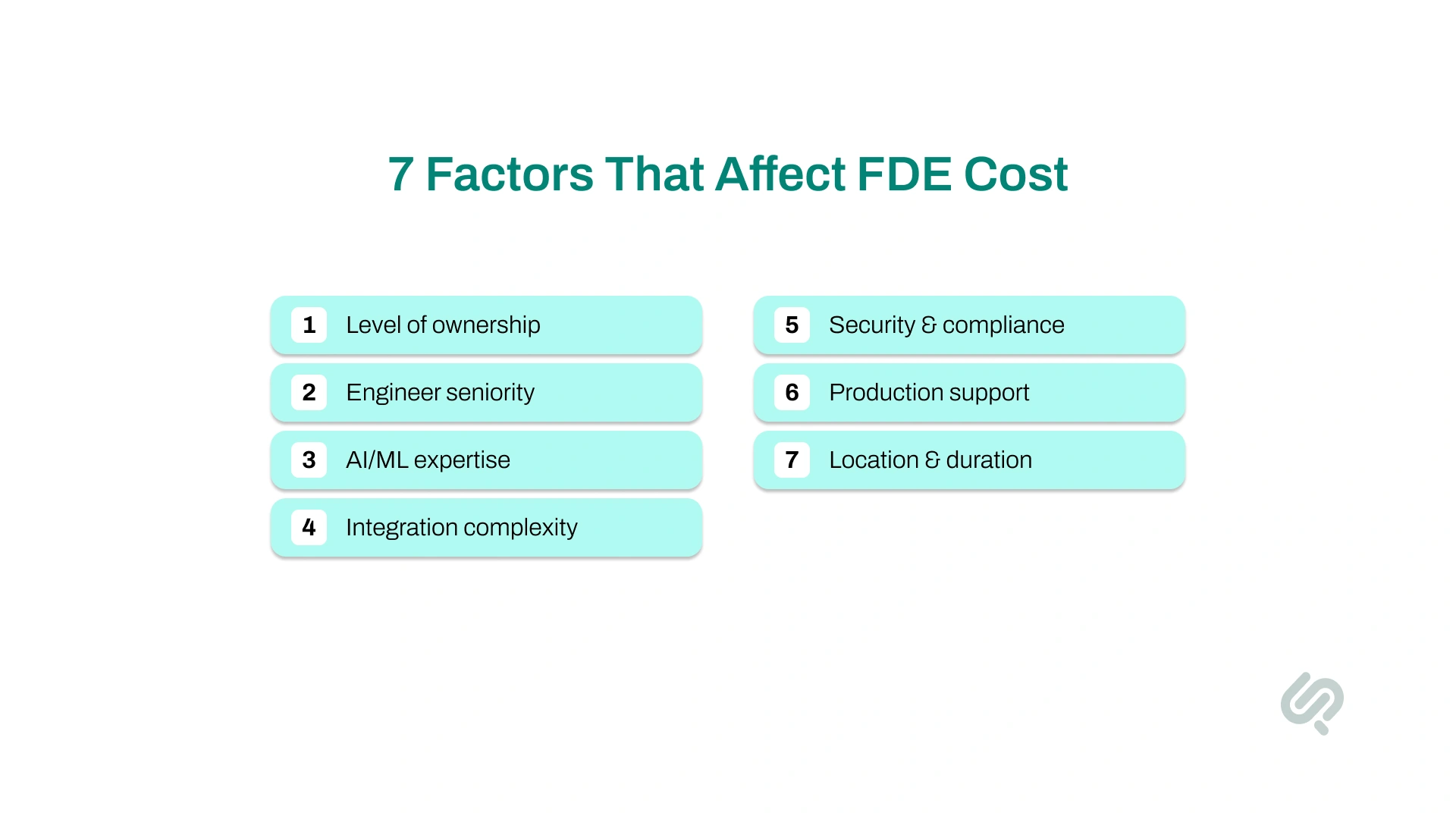
The final price depends less on the FDE title and more on what the engineer is expected to own.
An engineer responsible only for implementation will usually cost less than an FDE expected to handle discovery, architecture, stakeholder communication, production deployment, and ongoing troubleshooting.
Ownership is one of the most important factors to clarify before comparing providers.
Senior and staff-level FDEs cost more because they can make architecture decisions, work across business and technical teams, and operate with less supervision.
A more expensive senior engineer can still reduce total project cost if the alternative requires multiple people to provide the same level of decision-making and coordination.
A forward deployed AI engineer cost may be higher when the project involves:
The premium comes from combining traditional software engineering with AI implementation and production knowledge.
Connecting a new system to multiple APIs, ERPs, CRMs, databases, legacy applications, identity systems, or cloud environments increases implementation time and risk.
Integration-heavy projects often benefit more from FDE ownership because technical decisions frequently depend on what engineers discover inside the existing environment.
Healthcare, fintech, government, insurance, and other regulated industries may require additional access controls, testing, documentation, governance, and security reviews.
These requirements can increase both project duration and specialist involvement.
A project that ends after deployment is different from an engagement where the FDE must remain available for production incidents, monitoring, optimization, or after-hours support.
Buyers should clarify support expectations before signing the contract.
Remote engineers generally provide more pricing flexibility.
On-site requirements, travel, customer visits, overlapping working hours, or round-the-clock production coverage can increase the rate.
Short engagements may carry more ramp-up cost per month because the engineer has less time to spread discovery and onboarding effort across the project.
Longer engagements may offer better commercial terms but create a larger overall commitment.
The right duration depends on when the company expects the need for FDE-level ownership to decrease.
Two providers can both quote $20,000 per month while delivering very different total value.
Before comparing rates, determine whether the quote includes:
For example, one provider may include QA, DevOps, architecture support, and replacement cover inside the monthly engagement while another bills each capability separately.
There is another hidden cost buyers often miss: their own team's time.
If an external engineer requires constant architecture decisions, project management, QA coordination, and debugging support from your internal staff, those hours belong in the cost calculation too.
That is why businesses should compare total expected project cost, not only the engineer's headline rate.
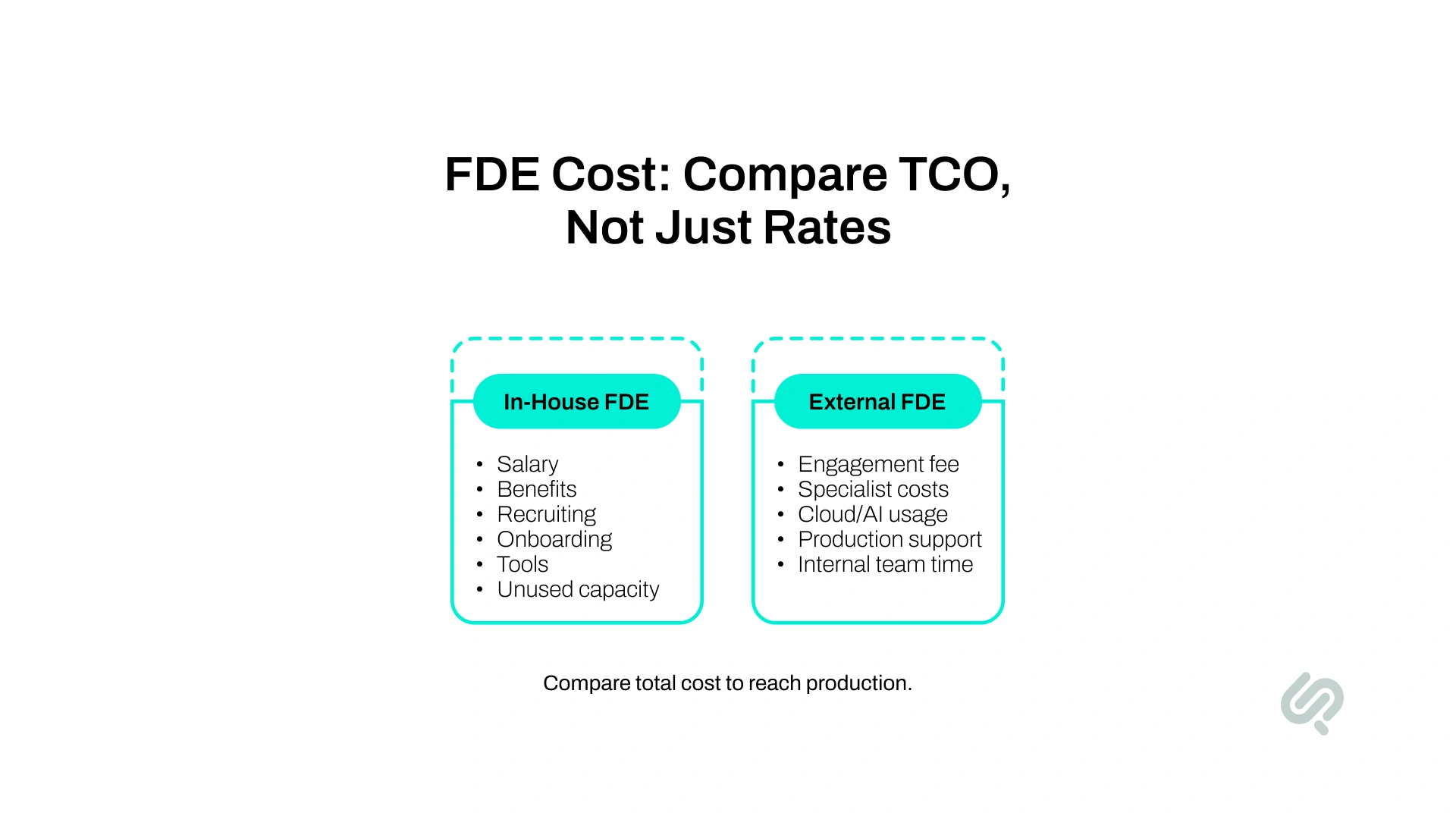
The best way to compare an internal hire with an external FDE is to calculate total cost of ownership rather than salary versus monthly invoice.
Salary + benefits/payroll + bonus/equity + recruiting + onboarding + tools + travel + management + unused capacity
Engagement fee + specialist costs not included in the contract + cloud/AI usage + travel + additional production support + internal team time
Contract duration matters too.
If a company needs senior FDE ownership for only four to eight months, comparing an external monthly engagement against one month of employee salary is misleading.
The company would normally be committing to:
The opposite is also true.
If the business expects to require forward deployed engineering continuously for several years, repeatedly purchasing external capacity may eventually cost more than building the capability internally.
Businesses can also evaluate the value created by the engagement:
FDE ROI = labor savings + new revenue + avoided errors + infrastructure savings + faster delivery − engineering and operating costs
Possible value can include:
The objective is not to find the lowest rate.
It is to find the engagement that reaches a reliable production outcome at the lowest acceptable combination of cost, time, and delivery risk.
If your project needs senior engineering ownership but you do not want the cost, recruiting delay, or long-term commitment of building an internal FDE team, Phaedra Solutions can provide forward deployed engineers through its IT Staff Augmentation Services.
The engineer can embed into your existing team and work across discovery, architecture, development, integrations, deployment, and production support, with access to AI, backend, QA, cloud, and DevOps expertise when the project requires it.
Book a free consultation to discuss your project, required level of ownership, and the engagement model that makes the most financial sense.


1. FDE Pulse: Forward Deployed Engineer Salary Report 2026
2. US Bureau of Labor Statistics: Employer Costs for Employee Compensation
3. ILMTEC: Forward-Deployed Engineering as a Service Cost & Model
4. Rocketlane: Forward Deployed Engineer Guide
5. Business Insider: Forward Deployed Engineer Jobs in Demand
6. AWS: Introducing Forward Deployed Engineering for Partners

Ameena is a content writer with a background in International Relations, blending academic insight with SEO-driven writing experience. She has written extensively in the academic space and contributed blog content for various platforms.
Her interests lie in human rights, conflict resolution, and emerging technologies in global policy. Outside of work, she enjoys reading fiction, exploring AI as a hobby, and learning how digital systems shape society.