
.webp)
.webp)
.webp)
.webp)








Vibe coding technical debt is the hidden maintenance, security, and architecture cost created when AI-generated code reaches production faster than teams can properly review and govern it.
A product may launch in days, yet duplicated logic, weak access controls, fragile integrations, and missing tests can turn later releases into expensive repair work.
For business leaders, the issue is not whether AI wrote the code. It is whether the product can be secured, scaled, changed, and operated reliably over the next 12 months. This guide explains where the debt builds, what it can cost, and when to repair, modernize, or rebuild the application.
Vibe coding technical debt is the maintenance, security, testing, and architecture burden created when AI-generated code is released without sufficient engineering control. It can lead to recurring bugs, unstable releases, security weaknesses, and expensive refactoring.
Warning signs can appear within weeks as integrations, users, and features are added. The wider business cost often becomes clearer over three to twelve months through slower releases, growing support demands, security remediation, and delayed product plans.
The cost can include engineering rework, incidents, customer support, security fixes, delayed features, infrastructure problems, and partial modernization. The largest cost is often not the refactoring itself, but the product work the team cannot deliver while repairing the codebase.
Yes. Many applications can be stabilized through a codebase audit, automated tests, security fixes, dependency cleanup, and phased refactoring. A full rewrite is usually justified only when the core architecture, data model, or security foundation cannot support the product safely.
External support becomes valuable when releases repeatedly break, no engineer fully understands the system, security-sensitive workflows are unreliable, or technical problems are blocking the roadmap. The first step should be determining whether the product needs targeted repairs, partial modernization, or a rebuild.
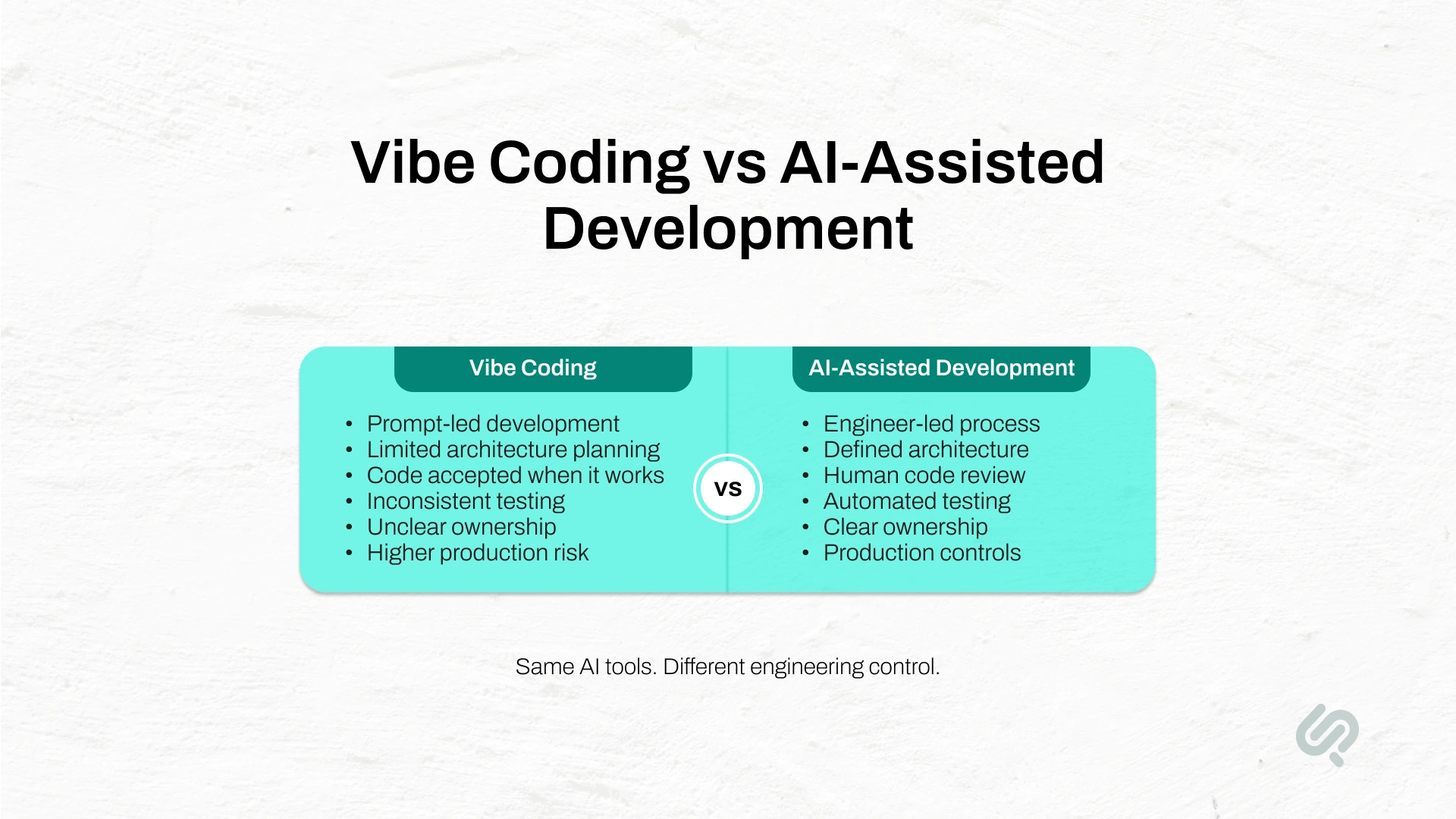
Vibe coding is a prompt-led development method in which a person describes a feature, screen, integration, or workflow and an AI tool generates the code.
The user may continue prompting until the feature appears to work, without fully reviewing the code or understanding how it connects with the wider application.
AI-assisted development uses similar tools, but the engineering process remains controlled. Developers still define:
The difference is not whether AI is used. The difference is whether the generated code passes through a professional software delivery process before reaching production.
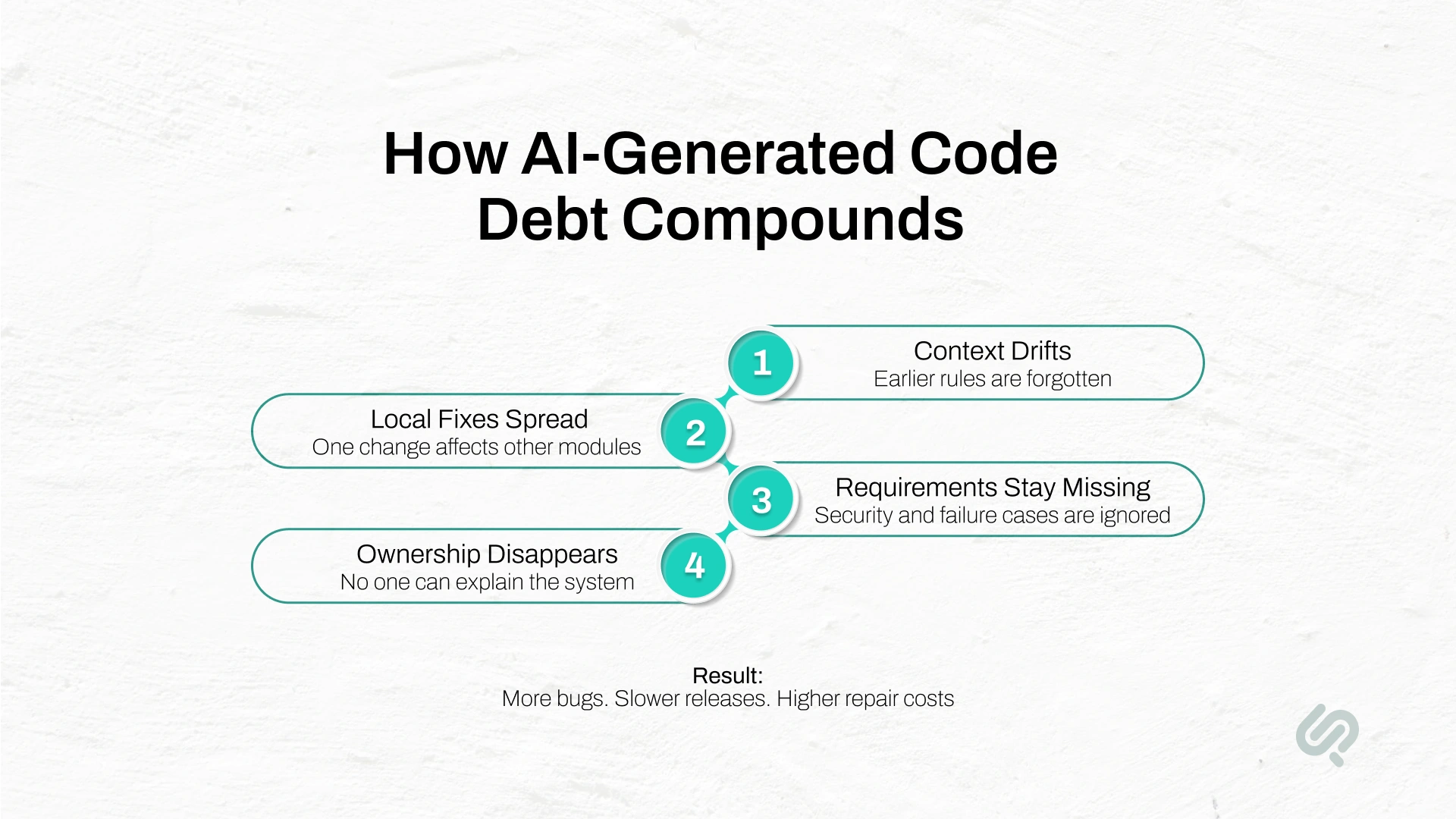
AI-generated code debt rarely comes from one completely unusable response. It develops when many locally acceptable changes stop working together as one reliable system.
Research into sustainable vibe coding identifies architectural inconsistencies, security weaknesses, missing design reasoning, and growing maintenance effort as major risks when fast code generation replaces structured software delivery.
As a prompt conversation grows, the AI may lose track of earlier architecture decisions, coding standards, and business rules.
A newly generated feature may work by itself but use different patterns from the rest of the application.
AI tools often solve the file, function, or error currently in front of them. They may not recognise how the change affects:
This creates code that works locally but causes problems elsewhere. Teams then need to debug AI code across connected modules rather than fixing only the visible error.
Prompts often describe visible functionality but leave out important production requirements such as:
The feature may pass a demo while remaining unsuitable for real users.
When teams do not record the requirements, prompts, model outputs, and architecture decisions behind a change, future engineers cannot easily explain why the code exists.
Preventing this requires more than better prompts. Teams need context engineering, small change sets, documented requirements, automated tests, and human ownership of production decisions.
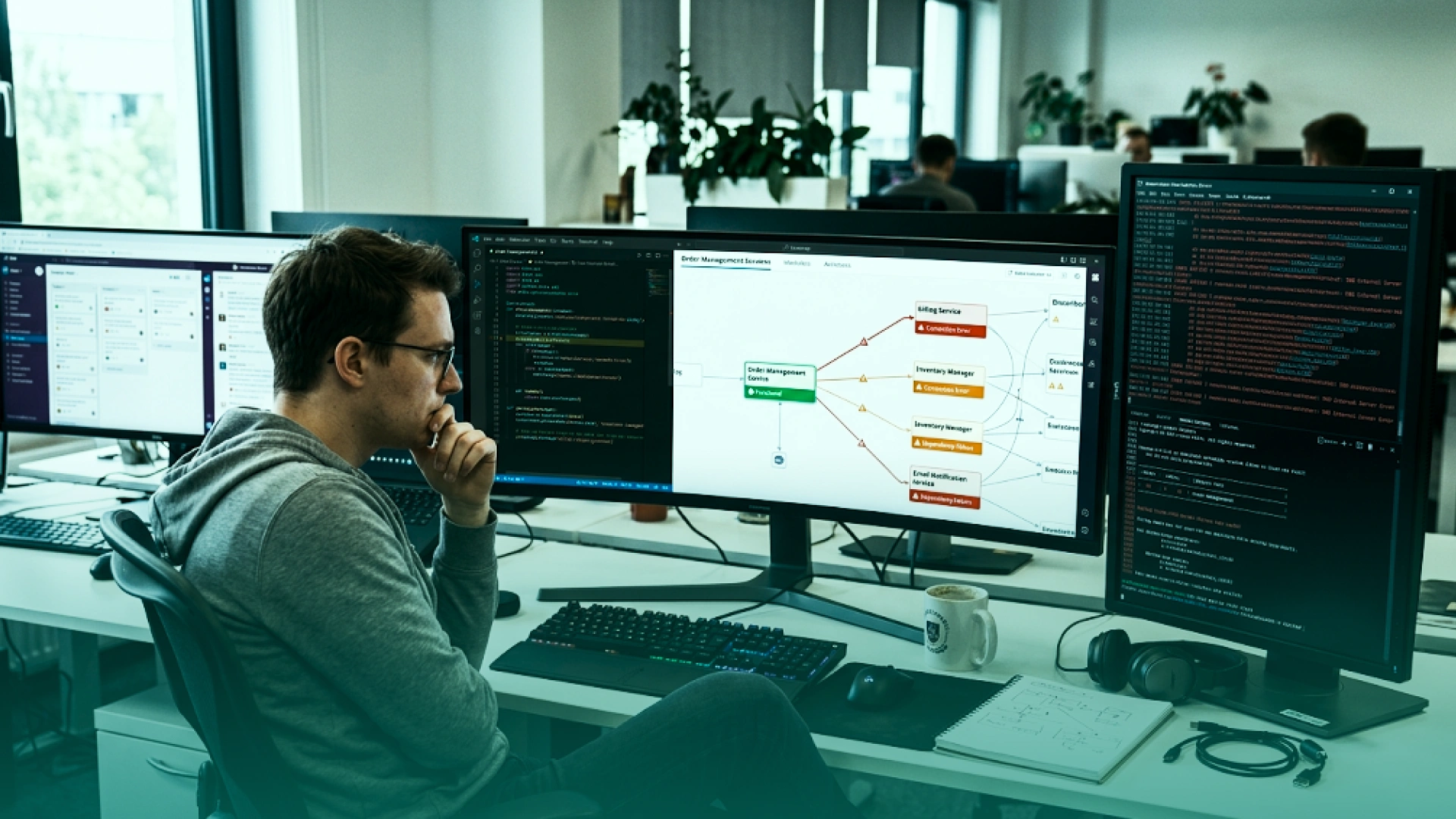
Technical debt rarely creates one immediate bill. It gradually consumes development time, support capacity, security effort, and product opportunities.
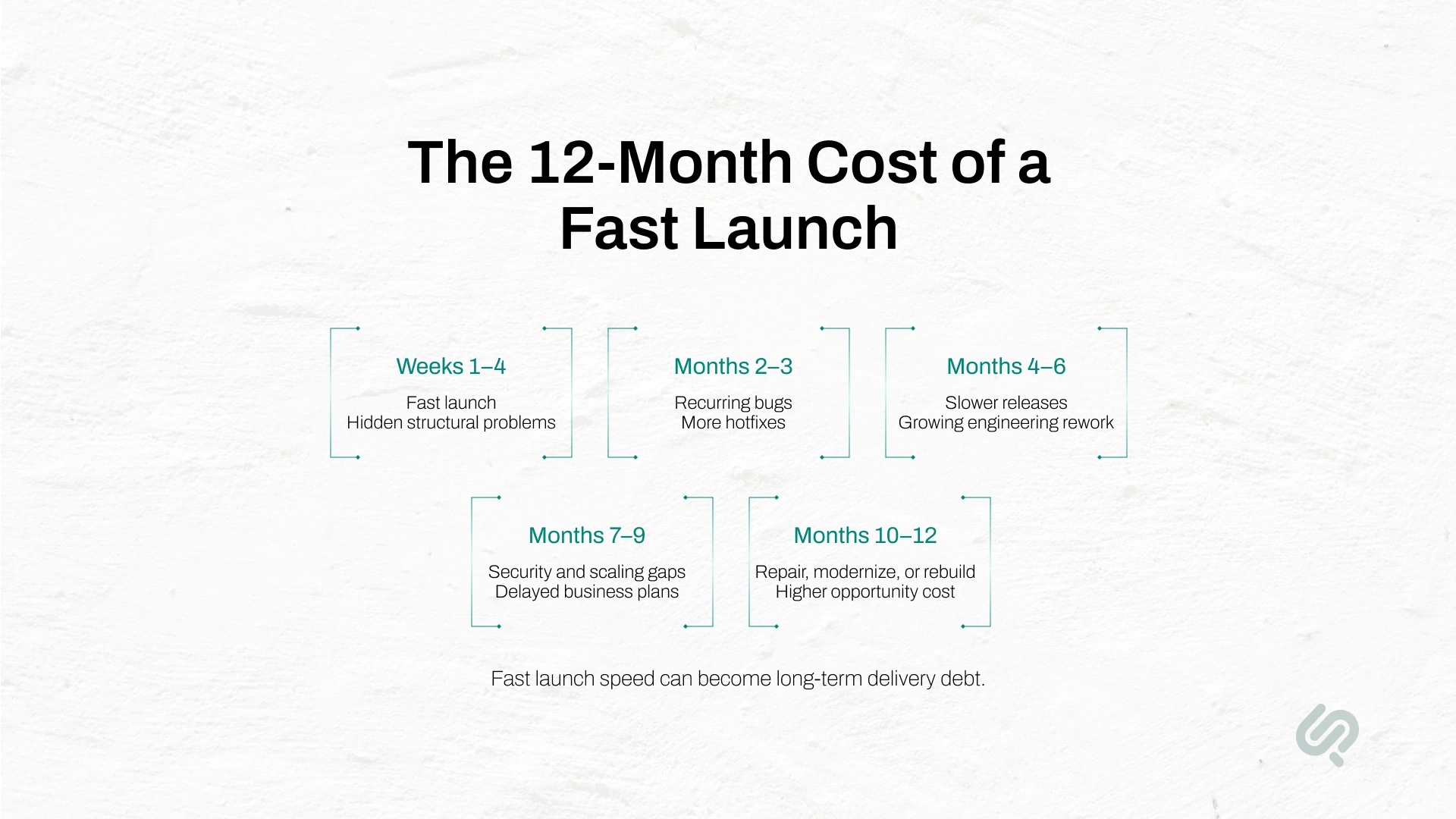
A practical first-year cost model is:
First-year debt cost = engineering rework + production incidents + support costs + security remediation + delayed feature value + modernization costs
The financial impact depends on the application. A temporary internal prototype carries less risk than a customer-facing platform handling payments, personal data, or regulated workflows.
The most expensive part is often opportunity cost. Every week spent repairing preventable defects is a week not spent improving the product, onboarding customers, or increasing revenue.
There is no single percentage that measures every form of debt created by AI-generated software. However, recent security and code-quality research shows why increased coding speed must be matched by stronger review, testing, and governance.
These findings do not mean every AI-generated application will become insecure or difficult to maintain. They show that faster code production must be supported by stronger security review, testing, and engineering oversight.
Businesses should measure production bugs, security findings, failed deployments, test coverage, code duplication, rework, and release stability alongside development speed.
A vibe-coded application may continue working while structural problems grow below the surface.
These issues are connected. A weak data model can create permission problems. Missing tests can make architecture changes unsafe. Poor documentation can turn a manageable defect into weeks of investigation.
A feature can work correctly during a demo while still containing serious security weaknesses.
The application may check whether a user is logged in without confirming whether that user can access a specific record or action.
This can allow:
API keys, database passwords, and cloud tokens may be stored in source code, configuration files, or logs.
Credentials should be stored in a secure secrets-management system, removed from repositories, and rotated when exposure is suspected.
Forms, file uploads, APIs, and webhooks may accept data without checking its type, format, size, or source.
This can create injection risks, malicious uploads, corrupted data, and unauthorized actions.
AI tools may add outdated, overlapping, or poorly maintained packages without explaining why they are needed.
Every new dependency should be reviewed for:
Security rules may exist only in the user interface instead of the API and database layers.
Hiding an admin button does not prevent a user from directly calling an unprotected administrative API.
A vibe-coded application may have technical debt even when its main features still work. The clearest warning signs appear in maintainability, testing, security, and release performance.
Use this checklist to assess your codebase:
One warning sign may be manageable. A repeated pattern across architecture, security, testing, and ownership usually indicates structural technical debt.
Not every AI-generated application immediately requires external support. A specialist becomes valuable when technical problems begin affecting security, revenue, delivery, or business decisions.
Consider a specialist assessment when:
A qualified specialist should not begin by recommending a complete rewrite. The assessment should identify:
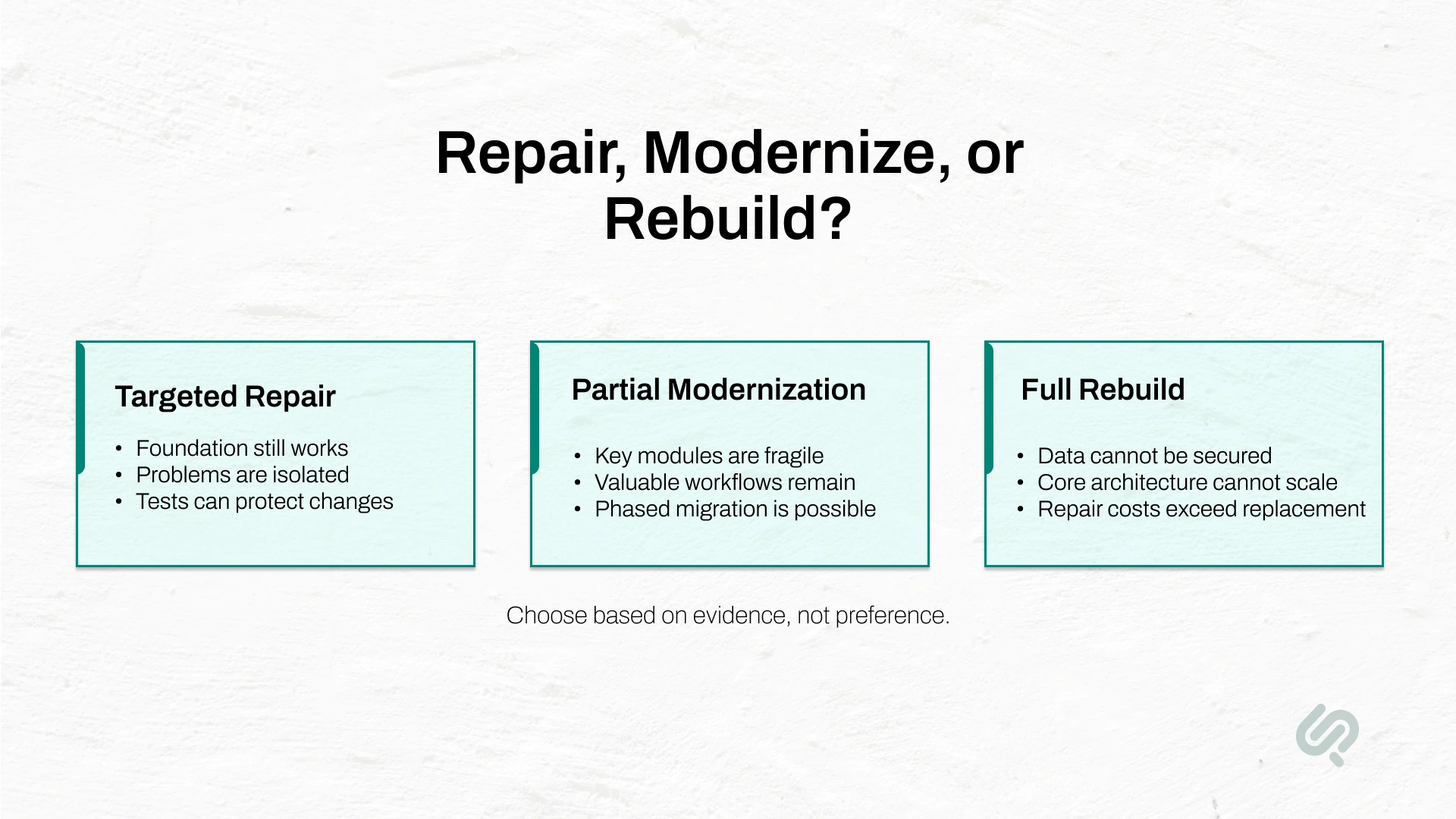
A technical audit should lead to one of three decisions.
The decision should be based on architecture, security, testing, data, and operational evidence. It should not be based only on an engineer’s personal preference for rewriting the code.
Many vibe-coded applications can be repaired through controlled technical debt remediation. The safest process is to stabilize critical workflows first and refactor the application in stages.
Review:
The codebase audit should separate urgent security and operational risks from lower-priority code-quality issues.
Start with the areas where failure could affect revenue, customers, or sensitive information.
Priority workflows usually include:
Pause unnecessary changes to these areas until they are properly tested.
Before major refactoring, add tests that document how the application currently behaves.
Use:
Testing current behaviour helps teams avoid removing hidden business rules during cleanup.
Address high-risk security weaknesses before general code cleanup.
This includes:
Repair one module, workflow, or service at a time.
A phased approach allows the business to:
For example, the team may stabilize authentication first, followed by payments, reporting, and integrations.
Every critical component should have a named technical owner.
Documentation should cover:
AI code review services and automated scanners can support this process, but experienced engineers must make the final architectural and security decisions.
A US healthcare company operated a legacy laboratory management application used for test bookings, doctor requests, progress tracking, and result delivery. The platform had become slow, fragile, and difficult to release.
Phaedra Solutions used a phased legacy system modernization approach to improve the database and backend, strengthen laboratory workflows, rebuild the web experience with React and Next.js, and introduce a more reliable CI/CD process. The modernization improved application performance by approximately 40%, reduced release-related issues by 50%, and lowered support tickets connected with slowness, timeouts, and regressions by 25%.
Although the platform was a legacy system rather than a newly vibe-coded product, the recovery principle was the same: preserve valuable workflows, stabilize critical systems, introduce stronger delivery controls, and replace high-risk components gradually instead of rebuilding everything at once.

AI coding tools can accelerate delivery when every generated change passes through a controlled production process.
Define:
Do not begin with a vague prompt for a complete feature.
Give the AI clear system context, including:
Generated code should follow the existing architecture rather than create a new pattern for every feature.
Treat generated code as a proposed implementation, not an automatically approved solution.
An experienced engineer should review:
Keep change sets small enough for reviewers to understand fully.
Require tests before merging changes into critical workflows.
These should include:
Testing should cover failures and edge cases, not only the expected user journey.
Use automated and manual controls such as:
AI agents should not receive unrestricted access to production systems, customer data, or deployment credentials.
Before deployment, require:
Measure code quality alongside development speed by tracking bugs, failed releases, security findings, duplication, rework, and test coverage.
“Vibe coding should reduce delivery time, not transfer cost into the next 12 months. At Phaedra Solutions, we use AI agents and tools such as Claude and Cursor within an engineer-led process that includes defined architecture, automated testing, security checks, and clear code ownership. Depending on the project’s size, nature, and complexity, this approach can improve delivery efficiency by 30% to 80% without treating production quality as optional.”
Abubakar Shams, CEO & Head of Vibe Coding at Phaedra Solutions
Phaedra Solutions’ vibe coding services help businesses audit, stabilize, and improve AI-generated applications without automatically recommending a full rewrite. Our AI-first process uses tools and agents such as Claude and Cursor for code analysis, documentation, testing, and refactoring, while experienced engineers retain control of architecture, security, DevOps, and production decisions.
Depending on the product’s size, complexity, and technical condition, this process can improve delivery efficiency by 30% to 80% while reducing the vibe coding technical debt carried into future releases.
Book a vibe coding consultation to identify the highest-risk parts of your application and determine whether it needs targeted repairs, partial modernization, or a rebuild.



Ameena is a content writer with a background in International Relations, blending academic insight with SEO-driven writing experience. She has written extensively in the academic space and contributed blog content for various platforms.
Her interests lie in human rights, conflict resolution, and emerging technologies in global policy. Outside of work, she enjoys reading fiction, exploring AI as a hobby, and learning how digital systems shape society.