

.webp)
.webp)
.webp)






.webp)
The main vibe coding security risk is that code can appear functional before it is secure, understood, or ready for production. AI coding tools can accelerate prototypes, features, and internal tools, but they may also introduce broken access control, exposed secrets, unsafe dependencies, weak input validation, and misconfigured infrastructure.
Vibe coding is not safe for production by default. It becomes safer when qualified engineers review and own the code, secure the AI tools and prompts, test runtime behavior, scan dependencies and secrets, and approve every production release.
This guide shows CTOs where vibe coding is appropriate, where it should be restricted, and which governance controls protect customer data, product reliability, and delivery speed.
Not by default. It can support production development only when engineers review and own the code, automated security checks run before merge, and high-risk changes receive senior approval.
The biggest risk is unreviewed code reaching production. A feature may work while still containing broken authorization, exposed secrets, unsafe dependencies, weak validation, or insecure configuration.
Treat AI-generated code as untrusted input. Use approved AI tools, restrict agent permissions, scan code and dependencies, test runtime behavior, keep pull requests small, and require human approval.
Authentication, permissions, payments, encryption, customer-data workflows, production migrations, infrastructure changes, regulated logic, and sensitive third-party integrations all require senior review.
Yes, when it handles real users, confidential data, payments, public APIs, or production infrastructure. The review should cover code, dependencies, secrets, access control, deployment settings, and runtime behavior.
Yes. Automated controls and risk-based reviews allow low-risk work to move quickly while sensitive changes receive deeper scrutiny. The goal is controlled speed, not slower development.
Vibe coding is a software development approach where a person describes a feature in natural language and an AI coding tool generates much of the code.
Instead of writing every line manually, the developer prompts the tool, reviews its output, tests the feature, requests changes, and continues refining the result.
Vibe coding is not exactly the same as AI-assisted development.
In a structured AI-assisted development process, qualified engineers use AI for specific tasks such as:
Vibe coding may rely more heavily on prompts to generate complete features or larger parts of an application, sometimes with less direct code authorship.
The problem is not that AI generated the code. The risk appears when no qualified engineer understands, tests, reviews, and owns that code before it reaches production.
Vibe coding security is not just about whether AI-generated code works. It is about whether that code can be trusted inside real production systems.
For CTOs, the challenge is to keep the speed advantage of AI-assisted development while protecting product quality, customer data, and business continuity.
AI coding tools are becoming part of everyday engineering workflows. Developers are using them to write more code, faster. But many organizations still do not have clear rules for how AI-generated code should be reviewed, tested, approved, and monitored.
That creates a governance gap.
When code volume increases but review discipline does not, security risk increases with it.
One of the biggest dangers of vibe coding is that the output often looks complete. The feature may run locally.
The UI may load. The API may respond. The test case may pass. But that does not mean the code is secure, scalable, or production-ready.
AI-generated code often optimizes for the happy path. It may not fully account for edge cases, malicious inputs, permission checks, error handling, logging, secrets, or long-term maintainability.
Veracode found that around 45% of AI-generated code samples contained security weaknesses, with some common issues including poor protection against cross-site scripting and log injection (1)
An insecure AI-generated feature can create more than a technical problem. It can expose customer data, interrupt operations, delay enterprise sales, increase compliance costs, and damage trust.
For CTOs, the real issue is not who wrote the code. The issue is whether the organization can prove that the code was reviewed, tested, approved, and monitored before it reached users.
That is why vibe coding governance should be owned at the engineering leadership level rather than left to individual developer habits.
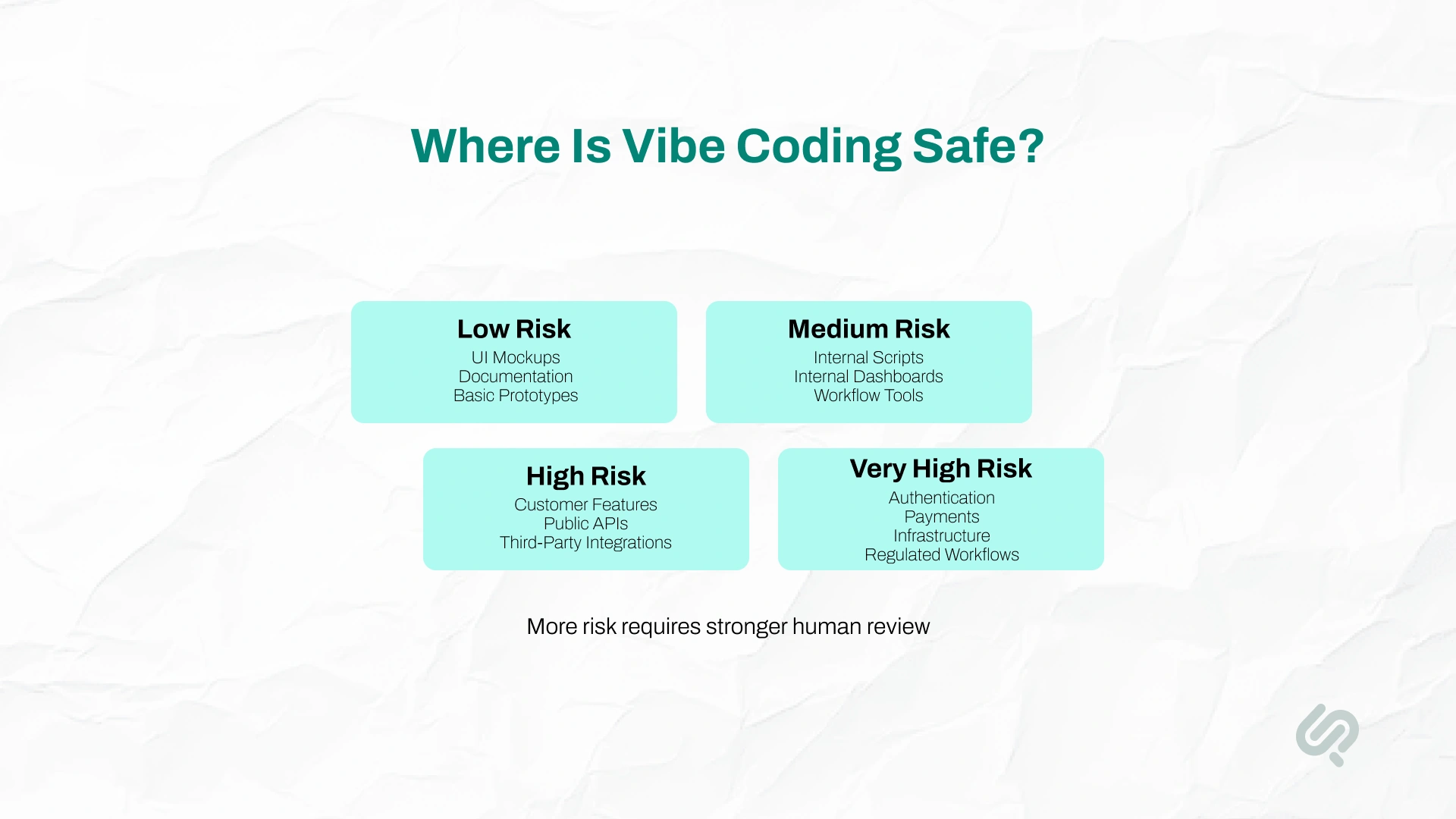
Vibe coding should not be governed by a simple allowed or banned policy.
The right level of control depends on what the code can access, what could happen if it fails, and whether the change can affect customers, money, sensitive data, or production infrastructure.
AI can support high-risk development, but it should not independently approve or deploy these changes.
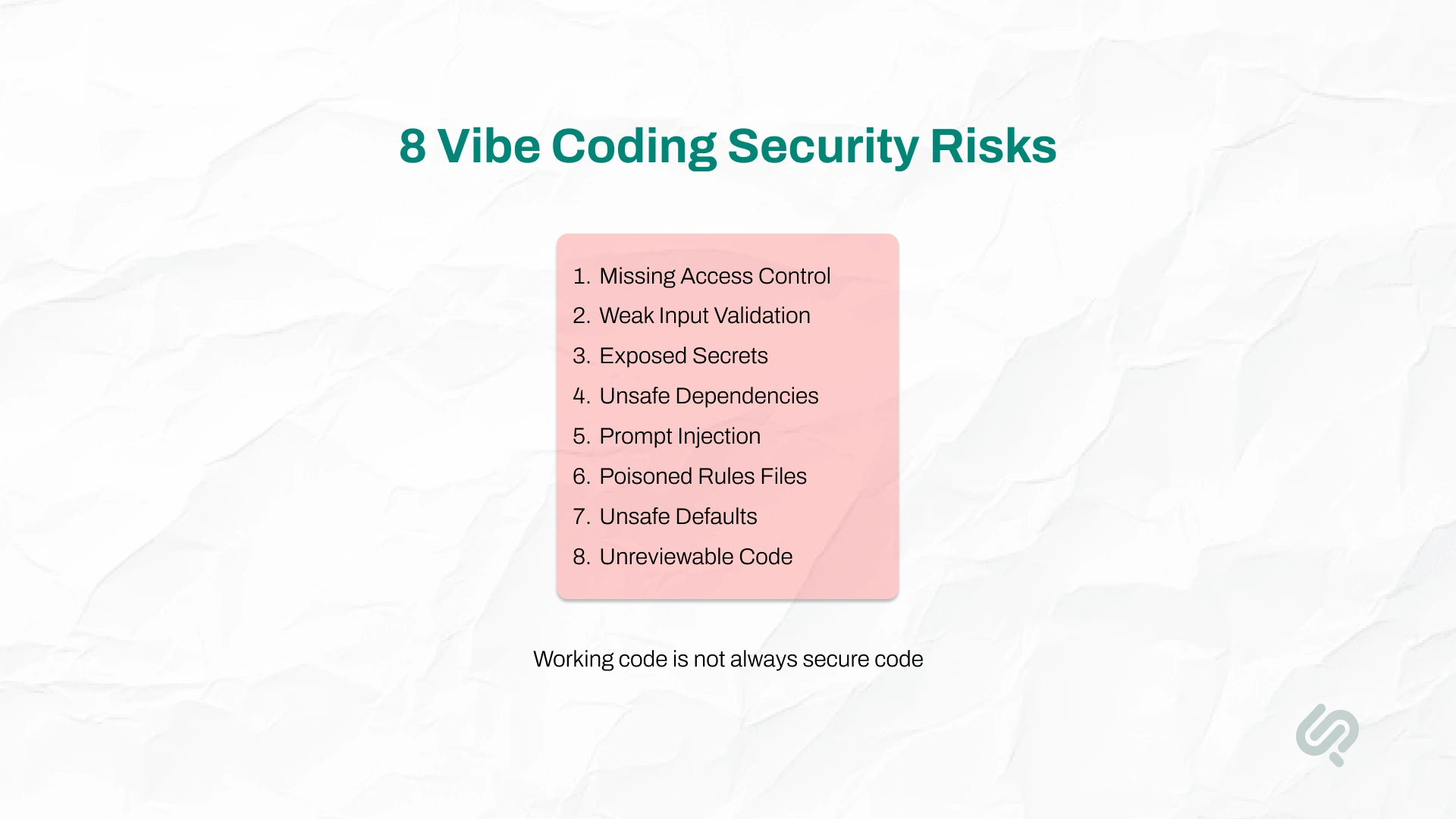
AI-generated code can look complete because it often works for the basic use case.
The real risk is what it misses: security checks, edge cases, safe defaults, access control, and long-term code ownership.
AI-generated code may check whether a user is logged in, but fail to check whether that user has the right role or permission.
For example, an AI-generated admin endpoint may work correctly during testing, but allow unauthorized users to access sensitive actions because role-based access control was implemented weakly or skipped entirely.
This is one of the most serious production risks because the feature can appear functional while still being unsafe.
Stack Overflow reported that around 80% of developers use AI tools, but only 29% trust AI-generated content, showing a clear gap between adoption and confidence. (2)
AI coding tools often generate forms, APIs, and backend logic that work for normal inputs.
But production systems need to handle malicious inputs too.
Weak input validation can create risks such as:
A feature that works for a normal user is not automatically safe against an attacker.
AI-generated code may contain hardcoded API keys, test credentials, access tokens, database passwords, or unsafe environment variable examples.
The risk is not limited to generated code. Developers may also paste confidential information into an AI coding tool to receive a better answer. This can expose:
CTOs should approve which AI coding tools can be used and define what information developers may share with them. Teams should use enterprise accounts with appropriate data controls, keep secrets out of prompts, and prevent customer or production data from entering unapproved tools.
Secret scanning should also run before every commit and merge. Once a credential appears in a repository, removing the visible value may not be enough. The credential should be revoked and replaced.
AI coding tools can sometimes suggest packages that sound real but do not actually exist.
This creates supply chain risk.
If an attacker registers a hallucinated package name in a public registry, a developer may install malicious code without realizing it.
That is why every AI-suggested dependency should be verified before installation.
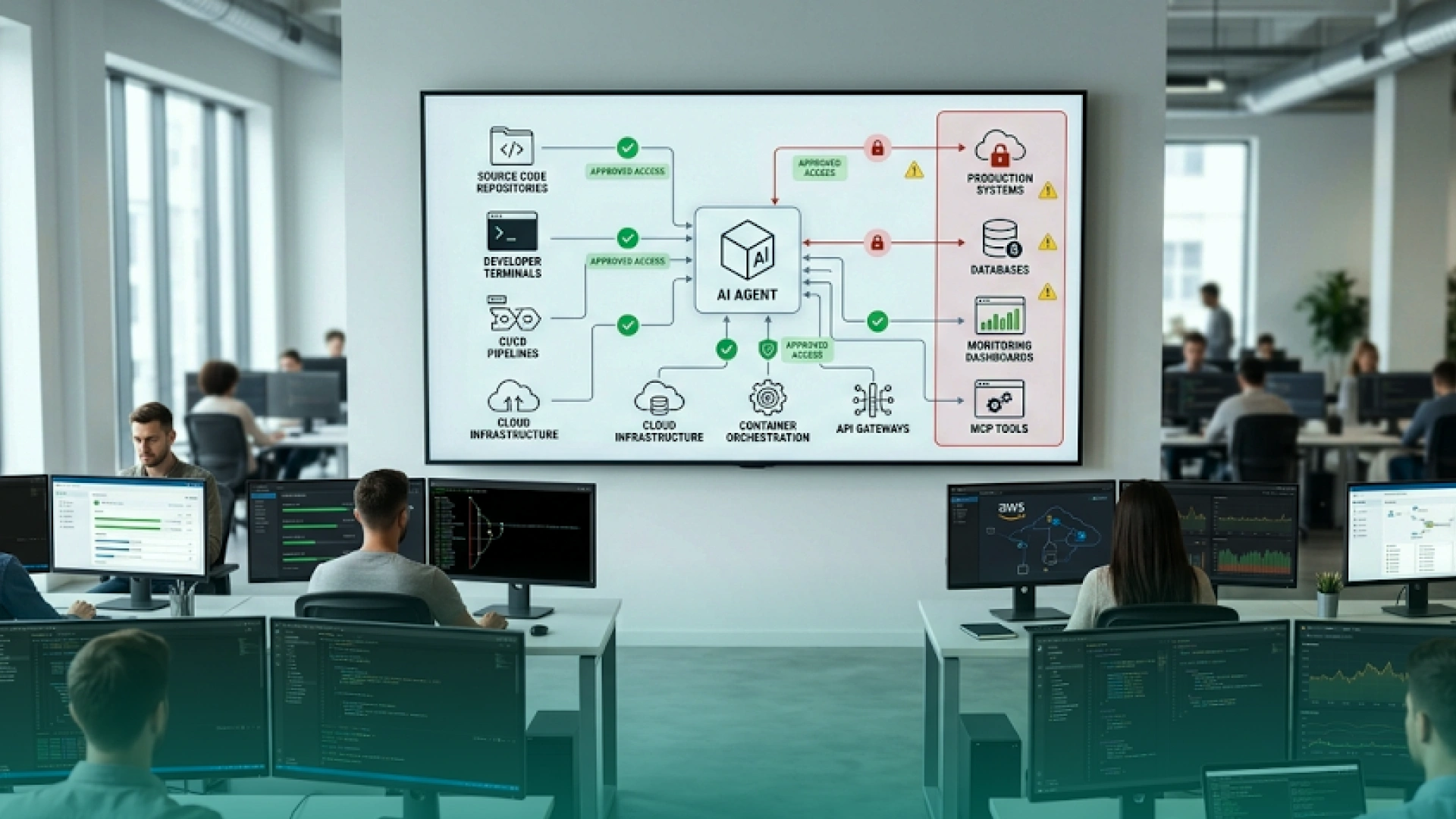
The risk increases when an AI coding tool can do more than suggest code.
Modern coding agents may be able to:
A malicious instruction hidden inside a repository, documentation file, package, or external data source may influence the agent. This is known as prompt injection.
The agent could be instructed to expose data, weaken a security control, install an unsafe dependency, or execute an unauthorized command.
AI coding agents should follow least-privilege access. They should work inside controlled development environments and should not receive direct access to production databases, customer data, cloud administrator accounts, or deployment credentials.
High-impact actions should always require human approval.
AI coding assistants often follow project-level instructions stored in files such as Claude configuration documents, Cursor rules, agent instructions, or imported development templates.
These files can influence how the AI writes code, selects dependencies, handles security checks, and executes commands.
A poisoned instruction file may tell the agent to:
All AI instruction files should be version-controlled, reviewed, and approved like production code. Teams should not copy rules files or agent configurations from unknown repositories without checking every instruction.
Changes to these files should also require pull-request review because one unsafe rule can influence many future code changes.
AI-generated code often chooses defaults that make the feature work quickly.
But fast defaults are not always safe defaults.
Examples include:
These settings may be acceptable in a local demo. They are not acceptable in production.
Production software needs clear human ownership.
A developer should be able to explain:
Vibe coding can also create changes that are too large to review properly. An AI tool may modify dozens of files, add multiple dependencies, and refactor unrelated code in one request.
Large AI-generated pull requests make it easier for security problems and unexpected changes to go unnoticed.
Teams should keep AI-generated changes small and focused. Feature work, dependency changes, infrastructure updates, and refactoring should be separated where possible.
A pull request should not be approved unless the author and reviewer understand the change well enough to maintain and troubleshoot it without relying on the original AI conversation.
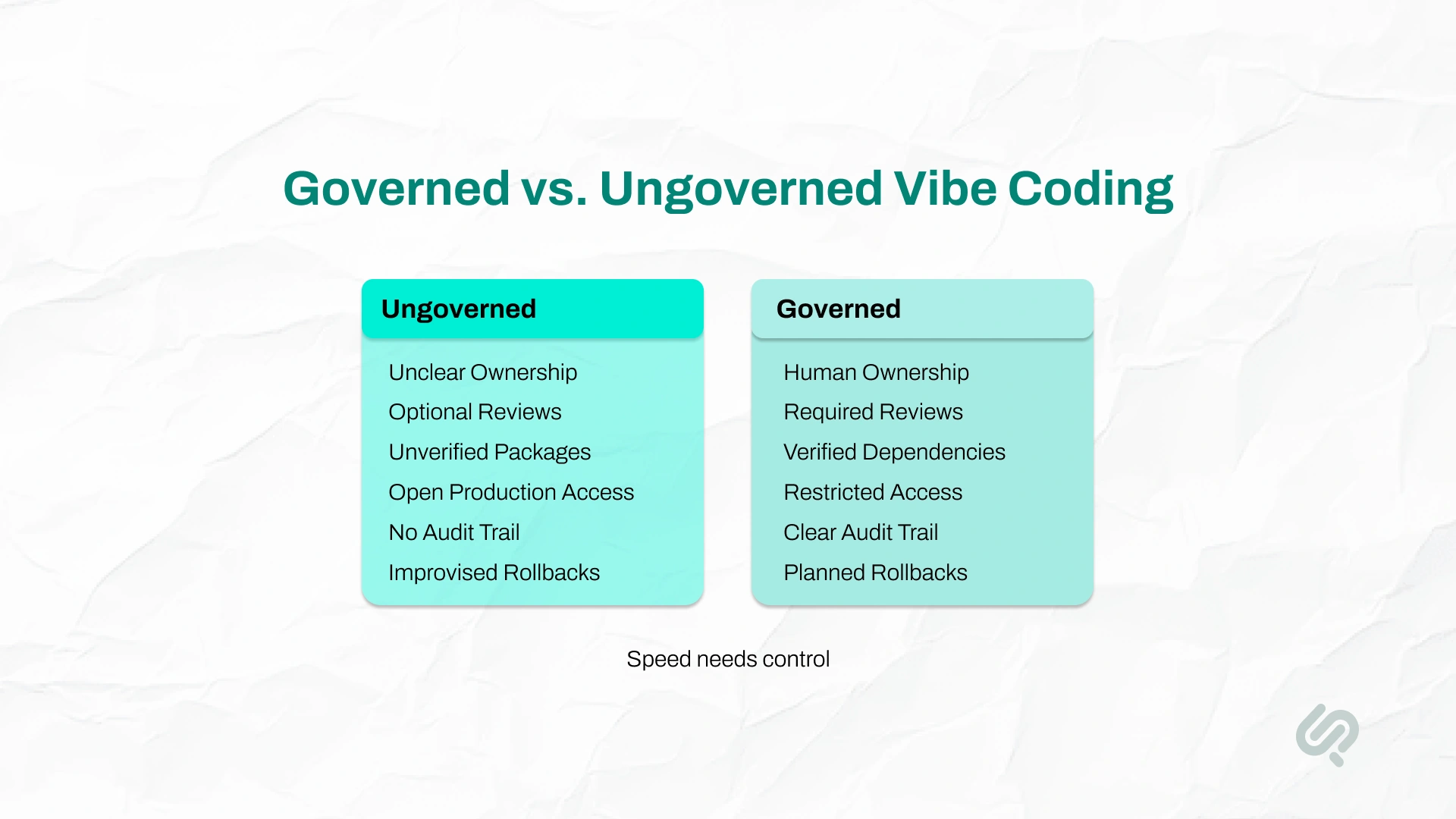
Governed vibe coding gives teams speed with control. Ungoverned vibe coding creates hidden risks because no one is fully responsible for what reaches production.
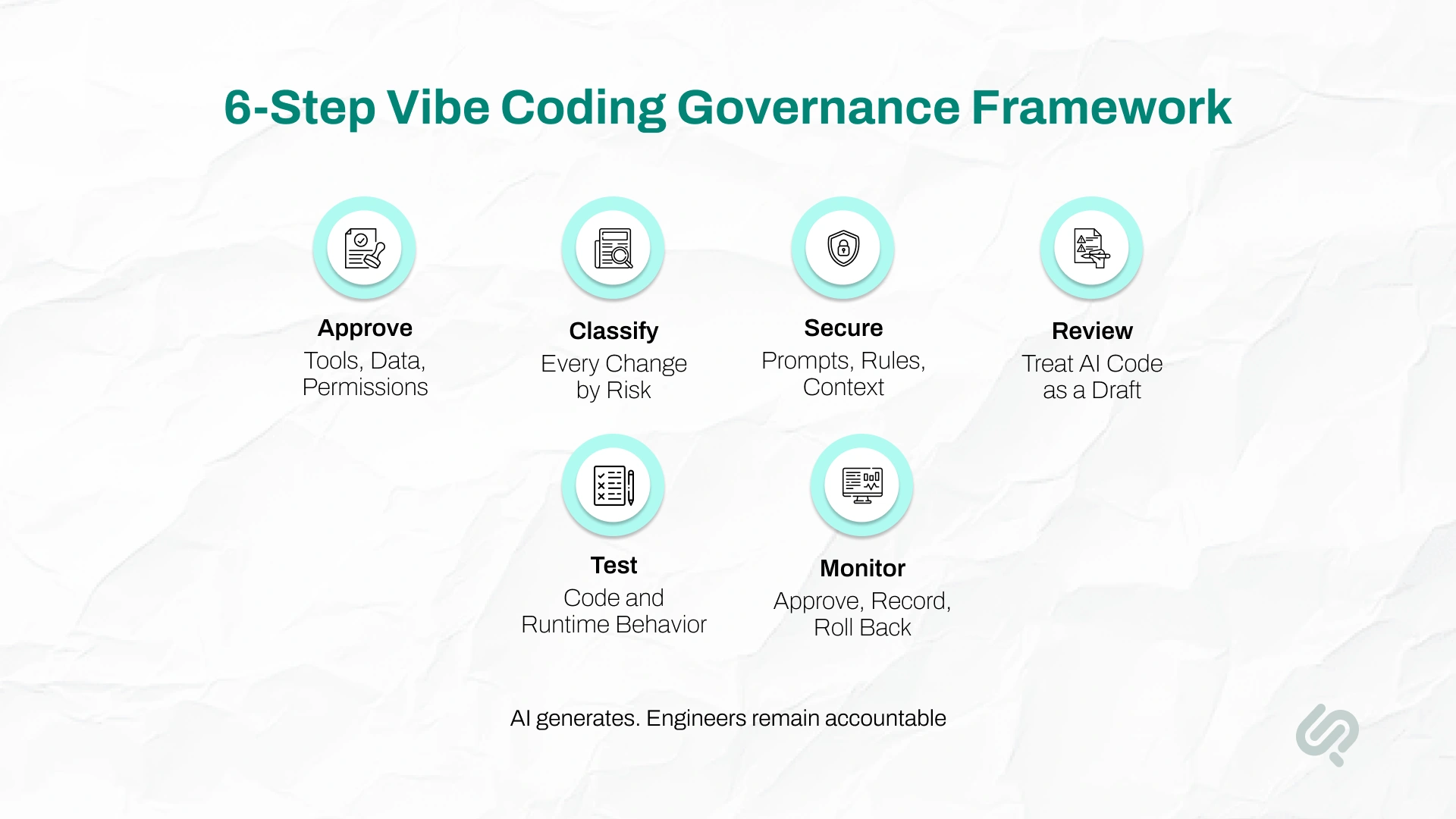
Vibe coding governance should be part of the development workflow. It should control which tools teams use, what those tools can access, how generated code is reviewed, and what must happen before deployment.
Define which AI coding tools developers may use and what information may be shared with them.
The policy should cover:
AI agents should receive only the access required for the current task.
Apply controls according to the possible business impact.
Low-risk changes may move through automated checks and peer review. High-risk changes involving authentication, payments, customer data, infrastructure, or regulated logic should require senior engineering and security approval.
The risk level should be assigned before development begins, not after the code has already been generated.
Security requirements should be included in AI instructions from the start.
Prompts and project rules should define:
Rules files and imported configurations should be reviewed and version-controlled. Teams should not trust third-party AI instructions automatically.
AI-generated code should enter the workflow as a draft.
Before approval, a human engineer should:
Pull requests should remain small enough for a reviewer to evaluate properly.
Static analysis alone cannot confirm that an application behaves securely when it is running.
Production-bound AI-generated code should go through:
Teams should prioritize vulnerabilities that are reachable and exploitable rather than treating every finding as equally urgent.
Every production release should have a clear human owner and approval record.
The team should record:
After launch, teams should monitor errors, access logs, security alerts, unusual behavior, dependency updates, and infrastructure changes.
Governance continues throughout the life of the software. It does not end when the first version is deployed.
According to Abubakar Shams of Phaedra Solutions, AI-first development should accelerate delivery without removing engineering accountability.
“AI can reduce repetitive development work and help teams move from an idea to working software much faster. But production code still needs human ownership. Engineers must remain responsible for architecture, security, testing, and every decision that affects users or production systems.”
AI output is not peer-reviewed because it looks clean or passes a basic test.
It remains a draft until a qualified engineer understands, tests, and approves it.
A landing-page component does not require the same review as a payment workflow.
Classify the risk first, then apply the appropriate level of review, testing, and approval.
Coding agents can install packages, change files, run migrations, and modify infrastructure.
Sensitive commands should require approval, and agents should not receive unrestricted access to production environments.
A governance document has little value when developers can bypass it.
Required controls should be built into pull requests, branch protection, CI/CD pipelines, access permissions, staging, and deployment approvals.
Poorly designed governance can create delays. Clear, automated governance usually reduces them.
Without shared rules, developers do not know where AI is allowed, reviewers do not know how deeply to inspect changes, and security teams discover problems late.
A risk-based process is faster:
Low-risk work can continue quickly, while sensitive changes receive the stronger controls they need.
The goal is not to review every line with the same intensity. It is to apply the right control before a risk becomes an incident.
Before AI-generated code goes live, CTOs and engineering leads should check a few key areas.
A human engineer should review the code, understand how it works, and be responsible for maintaining it after launch.
The team should confirm that the code handles customer data, authentication, authorization, inputs, errors, logs, and access controls safely.
Any new package should be verified before use. It should be real, maintained, secure, properly licensed, and approved for the project.
The code should pass unit tests, integration tests, staging checks, static analysis, secret scanning, and dependency scanning.
The team should have approval, logs, alerts, an audit trail, and a rollback plan before pushing the code to production.
If any critical answer is unclear, the code is not ready for production.

A prototype may work correctly during a demo and still be unsafe for real users.
Professional engineering and security review becomes important when the product:
A professional review should assess the architecture, source code, dependencies, secrets, data flows, access controls, infrastructure, tests, deployment process, and runtime behavior.
The outcome may involve targeted fixes, dependency replacement, test automation, architecture improvements, code refactoring, stronger DevOps controls, or a controlled rebuild of unsafe components.
The goal is not to rewrite everything automatically. It is to identify which parts are safe to keep and which parts create unacceptable production risk.
Vibe coding can shorten development cycles, but production software still requires secure architecture, controlled AI tooling, human code ownership, automated testing, and disciplined deployment.
Phaedra Solutions provides vibe coding services for companies that want to reduce vibe coding security risk without giving up the speed of AI-first delivery. We use AI agents, ecosystems, and tools such as Claude and Cursor while experienced engineers retain responsibility for architecture, security, QA, DevOps, documentation, and deployment.
Depending on the project’s size, complexity, and nature, our AI-first process can target a 30% to 80% improvement in delivery efficiency or reduction in development timeline, cost, or team effort. The appropriate target should be assessed during project discovery rather than treated as a universal guarantee.
Whether you are planning a new AI-enabled product or preparing an existing vibe-coded application for production, Phaedra can help you identify critical risks and establish a safer path to launch.



Ameena is a content writer with a background in International Relations, blending academic insight with SEO-driven writing experience. She has written extensively in the academic space and contributed blog content for various platforms.
Her interests lie in human rights, conflict resolution, and emerging technologies in global policy. Outside of work, she enjoys reading fiction, exploring AI as a hobby, and learning how digital systems shape society.