














Choosing between a forward deployed engineer vs consultant depends mainly on what is blocking the project.
Neither model is better for every project. Consultants help businesses decide what should happen and may support implementation depending on the engagement. Forward deployed engineers work more closely with customer teams and technical systems, making them a stronger fit when complex software, AI, integrations, or modernization work must adapt as it is being built.
A consultant typically helps assess a problem, evaluate options, or define what should happen next. A forward deployed engineer combines technical discovery with hands-on engineering and usually stays involved through implementation, integration, and production.
Hire a consultant when your main problem is deciding what to build, buy, change, or prioritize. Hire a forward deployed engineer when the direction is reasonably clear but difficult technical execution still needs an owner.
Usually, yes. Forward deployed engineers are expected to work directly with technical systems and may design architecture, build integrations, write or modify production code, troubleshoot issues, and support deployment.
A technology consultant is a good fit for technical assessments, architecture planning, vendor evaluation, build-vs-buy decisions, transformation roadmaps, governance, or specialist advice before implementation begins.
The rate alone does not answer this. A consultant may cost less when your internal team can execute the recommendations. An FDE may reduce total delivery cost when the alternative creates repeated handoffs, rework, or additional engineering effort.
A forward deployed engineer vs consultant comparison is only useful when the type of consultant is clearly defined. Consulting covers several different delivery models, and some consultants are much more involved in implementation than others.
The distinction between forward deployed engineering and consulting therefore depends heavily on implementation ownership.
When comparing the two models, ask:
A forward deployed engineer is generally more embedded in the engineering process and carries greater responsibility for hands-on technical delivery.
Consultants can provide deeper strategic or specialist expertise in areas where an FDE may not be the right resource. Their level of implementation responsibility depends on the engagement.
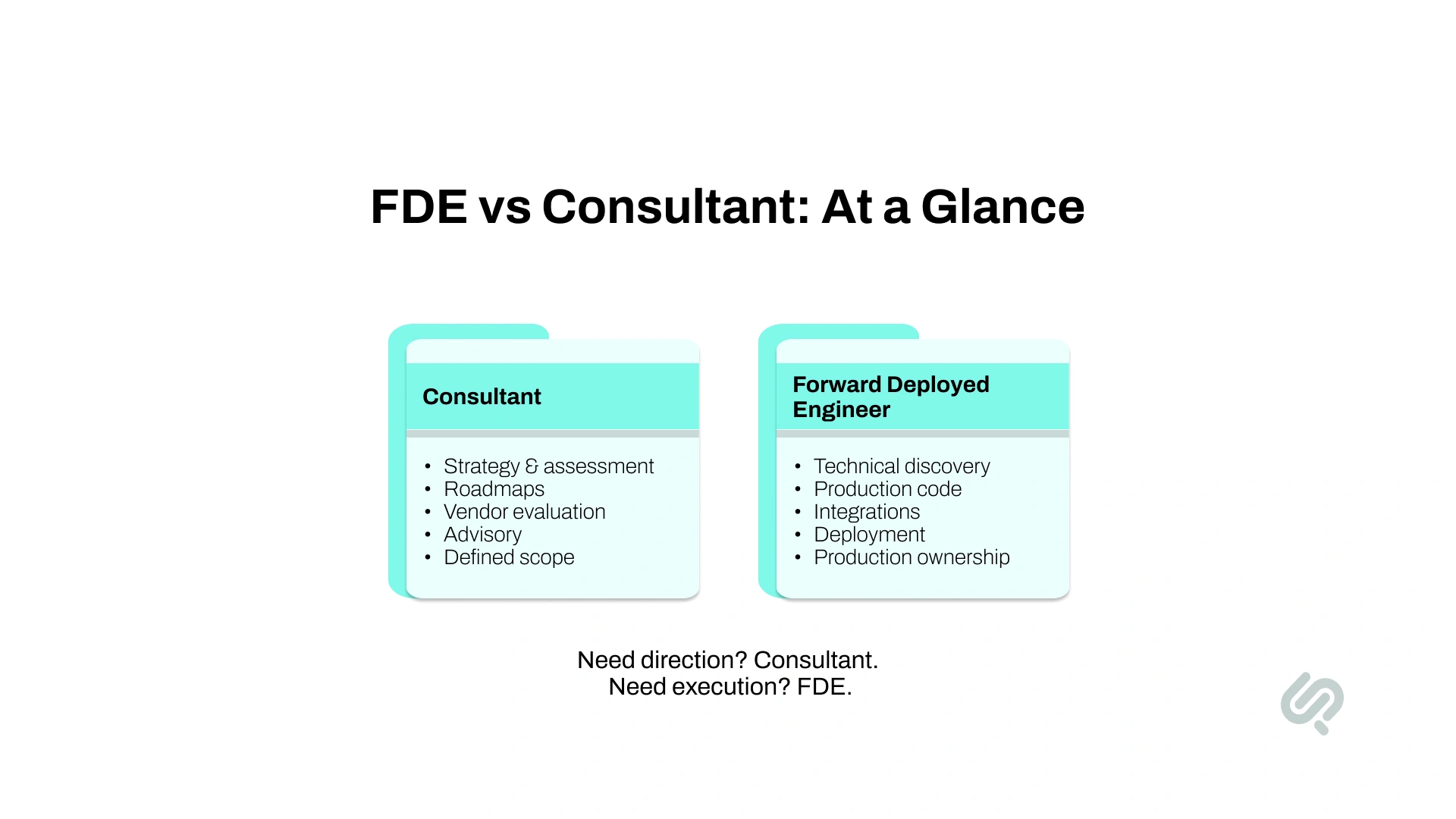
This forward deployed engineer vs consultant comparison shows how the two models typically operate on complex technology projects.
Palantir, one of the companies most associated with the forward deployed model, describes Forward Deployed Engineering around placing engineers close to real customer problems and using what they learn to improve the software being delivered.
That feedback loop is an important distinction. In an embedded model, information uncovered during implementation does not need to travel through several layers before it affects engineering decisions.
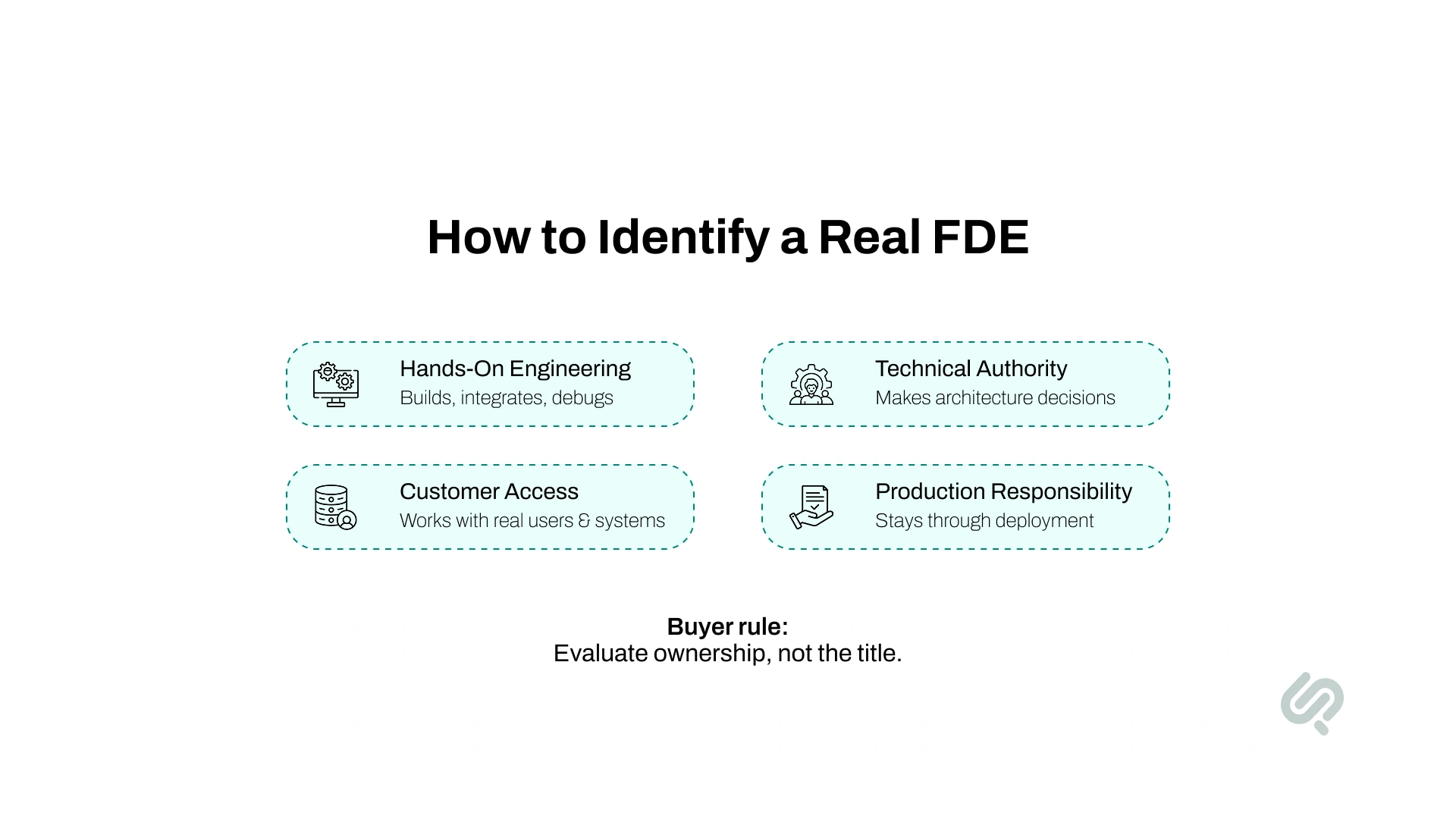
There can be overlap. Businesses should evaluate the engagement rather than rely on the job title.
Some forward deployed roles look similar to technical or implementation consulting. Others give engineers much more responsibility for architecture, code, integrations, deployment, and production outcomes.
The better question for a buyer is:
What does this person actually own?
Look for four things:
OpenAI's current Forward Deployed Engineer role, for example, includes customer discovery, technical scoping, system design, hands-on building, rollout, production adoption, and feedback into the broader product. (4)
The FDE title is also being used across more companies and delivery models as demand grows. A customer-facing engineer who mainly gathers requirements and passes them to another development team operates differently from an engineer who remains responsible for solving the technical problem.
For buyers, responsibility matters more than the title.

Forward deployed engineering is not limited to AI.
The model can also fit:
AI has accelerated demand because AI projects often create several of these implementation problems at the same time.
A working AI prototype may still need:
McKinsey's 2025 State of AI research found that 88% of respondents said their organizations regularly used AI in at least one business function, while only about one-third had begun scaling AI programs and just 7% reported fully scaling AI across their organizations. (1)
That gap helps explain why implementation is getting more attention.
In June 2026, Reuters reported that AWS committed $1 billion to a new organization centered on embedded AI engineers. The engineers were expected to work directly with customers in intensive engagements and write production-level code.
Reuters also reported that demand for forward deployed roles grew 42-fold between 2023 and 2025, based on LinkedIn data. (2)
For enterprise AI, proving that a model or agent can work is only one part of the project. Someone still has to connect it to real data, applications, permissions, workflows, users, and production infrastructure.
The same delivery problem exists outside AI. Legacy modernization, enterprise integration, data platforms, and high-ambiguity software projects also expose requirements that are difficult to understand fully before implementation begins.
A consultant is usually the stronger choice when the organization still has an important decision to make before implementation begins.
Typical situations include:
Consulting can also work well when the company already has an engineering team with enough capacity and technical depth to implement the recommendations.
For example, a company may need an outside expert to evaluate three ERP platforms or determine whether an AI use case justifies custom development. Once the decision is made, its internal team may already have everything required to execute.
In that situation, the missing capability is guidance rather than another implementation owner.
Technology and implementation consultants can also participate directly in delivery, so businesses should check the scope of the actual engagement instead of assuming every consultant stops at recommendations.
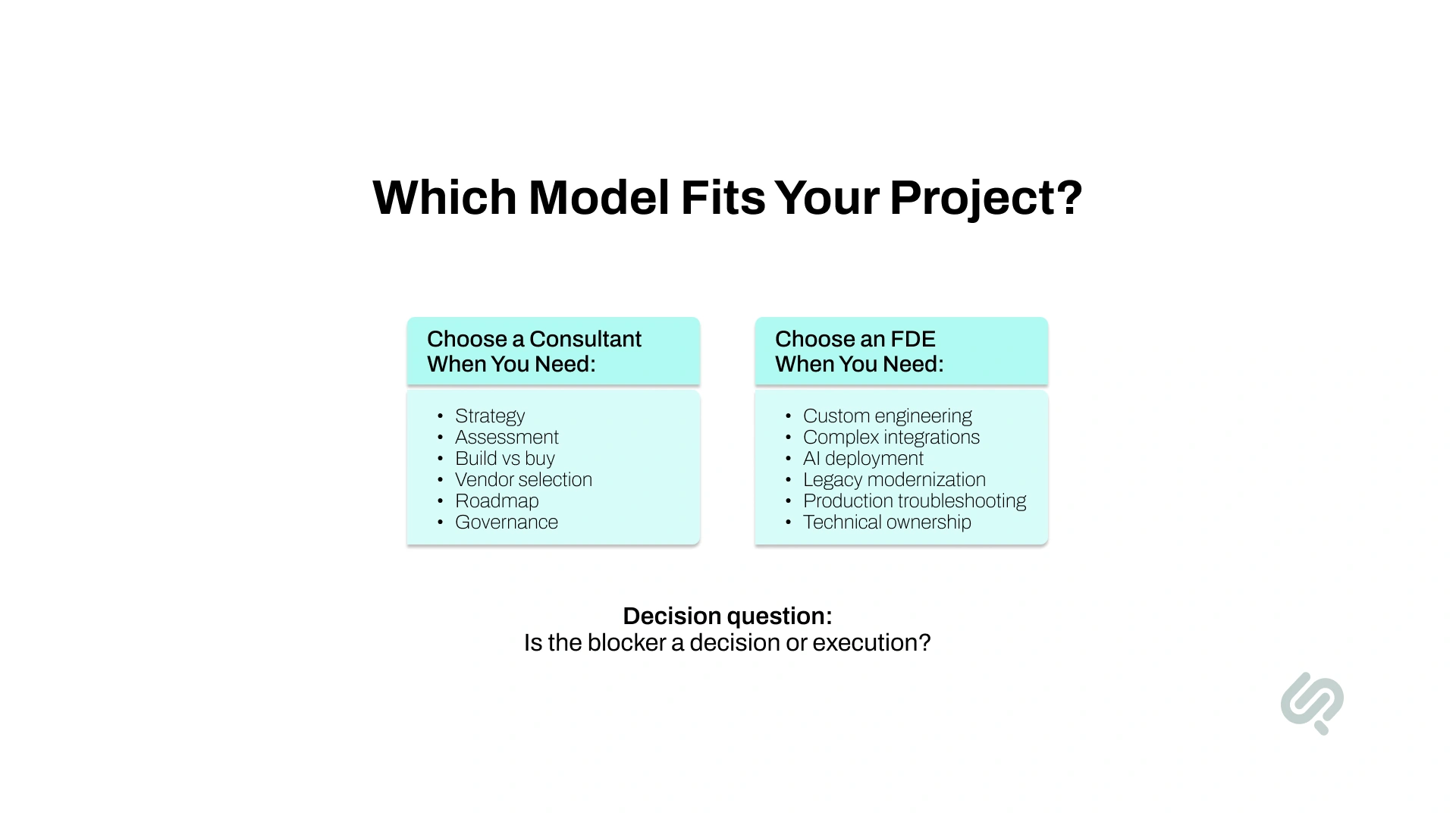
A forward deployed engineer is generally a better fit when the project has moved beyond planning but still contains technical uncertainty.
The business may know the outcome it wants while the exact architecture, integrations, workflows, or production requirements still need to be worked out during implementation.
An FDE can work across APIs, databases, identity systems, SaaS platforms, internal applications, and legacy technology when no single team currently owns the full integration.
This is particularly useful when a failure in one system affects several others and solving the issue requires understanding the complete workflow.
A successful AI prototype still needs evaluations, security, monitoring, data integration, workflow design, scalability, and failure handling before it can operate reliably in production.
An FDE can work through these production requirements while staying close to the business workflow the AI system is supposed to improve.
Modernization projects often expose dependencies that were never properly documented.
An embedded engineer can adjust architecture, migration, and release decisions as those dependencies appear while keeping existing systems operational.
Some requirements become clear only after engineers work with real users, data, workflows, and technical constraints.
FDEs allow technical discovery and implementation to happen together rather than requiring every requirement to be finalized before development begins.
Performance issues can cross application code, infrastructure, databases, APIs, queues, observability systems, and deployment processes.
These problems often need someone who can investigate the system, make changes, measure the result, and continue until performance reaches an acceptable level.
The common pattern is technical uncertainty during execution.
If your main challenge is still deciding what the company should do, consulting may be the better starting point.
An implementation consultant and a forward deployed engineer can both help deliver technology, making this comparison closer than FDE vs strategy consulting.
The main difference is usually how much of the solution is already known.
A simple question can help: are we implementing a known solution, or discovering parts of the solution while building it?
Implementation consultants fit well when a CRM, ERP, HRIS, cloud platform, or another enterprise product has already been selected and the implementation path is reasonably understood.
For example, an implementation consultant may help:
A forward deployed engineer becomes more useful when custom code, undocumented dependencies, changing requirements, complex integrations, or production issues make the implementation difficult to predict upfront.
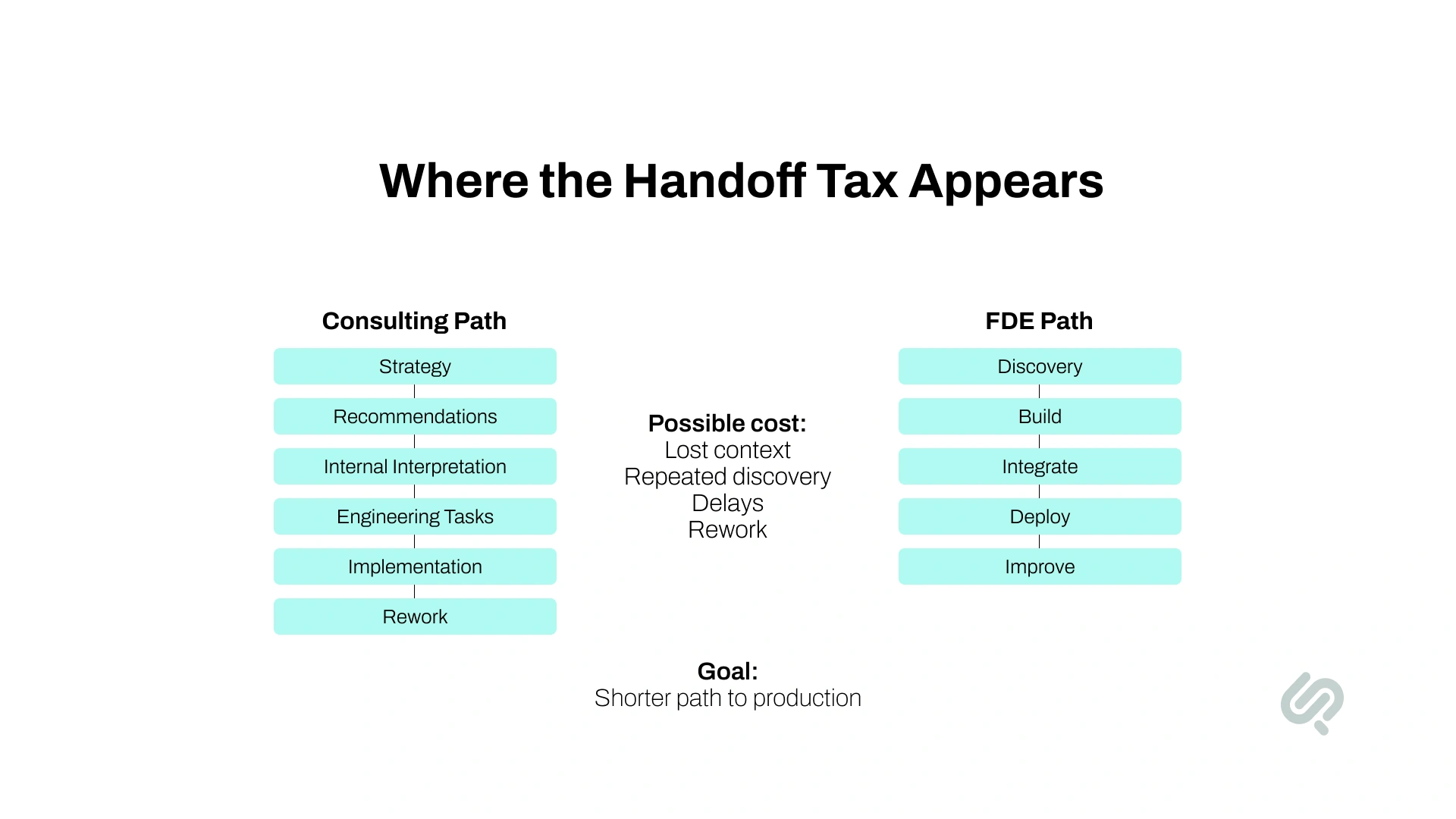
Comparing a consultant's rate with a forward deployed engineer's rate does not show the full project cost.
The more useful metric is the total cost of getting the solution into reliable production.
Consider a consulting engagement that produces a detailed architecture and implementation roadmap.
The internal engineering team may still need to:
Each transition can add engineering time, repeated discovery, context loss, and rework.
A forward deployed engineer does not automatically cost less. An experienced embedded engineer may carry a high rate because the role requires software engineering depth, customer communication, architecture judgment, and production responsibility.
The commercial benefit appears when keeping technical discovery and implementation together reduces extra handoffs and shortens the route to a working system.
This matters more as enterprise technology becomes increasingly connected.
Salesforce's 2026 Connectivity Benchmark reported that only 27% of enterprise applications were integrated, while 96% of IT leaders agreed that AI agent success depends on effective integration across systems. (3)
That integration gap can turn a good strategy into a difficult implementation project.
For buyers, the better question is:
What will it cost to reach a working production outcome, including the internal effort required after the engagement?
“Once the strategy is clear, another advisory handoff can slow execution. A forward deployed engineer keeps senior technical ownership close to the problem, from the decisions being made to the system being delivered.”
— Abubakar Shams, Phaedra Solutions
Phaedra Solutions worked on an AI-first digital government platform designed to bring more than 30 public services into one connected web portal and mobile super app. The platform included centralized identity and access management, secure ministry integrations, real-time service tracking, analytics, and an AI assistant. Three pilot ministries were connected through secure APIs.
A project like this shows where forward deployed engineering can add value. If structured through an FDE model, an embedded engineer could work directly with government stakeholders and technical teams while owning technical discovery, integration decisions, implementation, and issues uncovered during deployment. With multiple systems, workflows, security requirements, and stakeholders involved, some technical constraints only become clear once engineering reaches the real environment.
Knowledge transfer can happen in both models, but the process is often different.
A consulting engagement may include documentation, recommendations, training, and a formal handoff once the agreed scope is complete.
With embedded engineering, knowledge transfer can happen throughout delivery because internal engineers work closely with the person solving the problem.
They can see:
A good forward deployed engagement should not create permanent dependency on the external engineer.
By the end of the engagement, the internal team should understand enough of the architecture, implementation decisions, operational requirements, and known risks to maintain and extend the system.
The right engagement model depends on where the real bottleneck sits.
Before hiring either one, answer these six questions.
If you are still deciding which problem to solve, which technology to choose, or whether the investment makes business sense, a consultant may be the better starting point.
If the direction is understood but implementation is stalled, embedded engineering ownership becomes more useful.
Define the expected outcome before choosing the role.
If the deliverable is an assessment, architecture recommendation, vendor evaluation, governance framework, or technology roadmap, consulting may fit.
If the expected outcome is a production system, the engagement needs people who can build, integrate, deploy, and support it.
Consulting works well when an internal engineering team has the skills and capacity to execute the plan.
If that team is already stretched, lacks specialist expertise, or has no clear implementation owner, adding another advisory layer may leave the delivery problem unresolved.
Consider how much the work depends on:
The more dependencies involved, the more useful direct access to the technical environment becomes.
This is especially relevant for AI and integration-heavy software because unexpected behavior often appears at the boundaries between systems.
Some projects can be specified almost completely before work begins.
Others cannot.
Enterprise AI, legacy modernization, custom integrations, workflow automation, and complex software systems often uncover new requirements once engineers work with real users, data, APIs, and production environments.
If significant change is expected, an engagement model that keeps technical discovery close to implementation can reduce repeated handoffs.
Make this responsibility clear before signing an engagement.
Ask:
If responsibility becomes unclear after the roadmap or initial implementation has been delivered, the project may have an ownership gap.
Yes. Some complex projects benefit from both models at different stages.
A consultant may first help with:
A forward deployed engineer can then take greater ownership of:
For example, an organization considering an enterprise AI initiative may use a consultant to identify the highest-value use case, assess data readiness, and decide whether to build or buy.
Once those decisions are made, an FDE can work with the internal team to connect data, build the required integrations, implement the application, test it against real workflows, and move it into production.
The boundary between the models should be clear.
Once the main strategic decisions have been made, responsibility for implementation should move to people with the authority and technical ability to deliver it.
Large programs may also use consultants and FDEs at the same time, provided decision-making and delivery ownership are clearly assigned.
If your team already knows what needs to be achieved but execution is blocked by complex integrations, AI deployment, legacy systems, production issues, or missing senior engineering ownership, Phaedra Solutions can embed a forward deployed engineer through our staff augmentation services.
Our engineers work directly with your existing team across technical discovery, architecture, implementation, integration, and production delivery.
Phaedra also follows an AI-first engineering approach. Where appropriate, our teams use AI-assisted research, prototyping, development, testing, documentation, and QA while senior engineers remain responsible for architecture, security, production decisions, and delivery quality.
If your strategy is already clear and the missing piece is senior technical execution, book a free FDE consultation and find out what our forward deployed engineers can offer you.



Ameena is a content writer with a background in International Relations, blending academic insight with SEO-driven writing experience. She has written extensively in the academic space and contributed blog content for various platforms.
Her interests lie in human rights, conflict resolution, and emerging technologies in global policy. Outside of work, she enjoys reading fiction, exploring AI as a hobby, and learning how digital systems shape society.