














Forward deployed engineering use cases usually appear when a high-value AI or software project cannot be solved by off-the-shelf software, standard ticket-based development, or advice alone. FDEs work inside the customer environment to solve problems such as complex integrations, stalled pilots, private deployments, data migrations, production failures, workflow automation, scaling, compliance, and enterprise customization.
The best FDE use cases combine meaningful business value with technical uncertainty. The engineer helps define the problem, builds inside the real environment, works across teams, and stays involved through production.
The 10 examples below show where this model works best and when a standard engineering team may be the better choice.
Common forward deployed engineering use cases include enterprise integrations, AI pilot-to-production work, legacy modernization, private deployments, data migrations, production troubleshooting, workflow automation, scaling problems, compliance requirements, and customer-specific enterprise deployments.
FDEs are best for high-value problems where requirements are still developing, several systems or teams are involved, and implementation decisions depend on what engineers learn inside the real environment.
No. FDEs can work on enterprise software, cloud infrastructure, integrations, migrations, modernization, automation, security, and production systems. AI has increased demand for the role because many companies need help moving AI from pilots into real operations.
Hire a forward deployed engineer when discovery and implementation need to happen together. If requirements, architecture, and acceptance criteria are already clear, a traditional senior software engineer or development team will usually be more appropriate.
Yes. An FDE can connect production data and APIs, add security and permissions, build monitoring and evaluation, resolve infrastructure issues, test edge cases, and support the system as real users and workloads are introduced.
Enterprise technology has become easier to prototype, especially with AI. Getting those systems to work inside a real business remains much harder.
A team can build a convincing AI assistant, agent, automation, or proof of concept quickly. Production introduces a different set of problems: real permissions, legacy applications, security reviews, unreliable data, infrastructure limits, edge cases, cost controls, and workflows that behave differently from the original requirements.
Recent industry data shows the gap:
The role also applies well beyond AI. Businesses use forward deployed engineering services when customer-specific integrations, infrastructure, data, security, legacy systems, or production constraints make normal feature development too disconnected from the real problem.
FDEs are valuable in these situations because the engineer can learn from the operating environment while building rather than waiting for every requirement to be defined upfront.
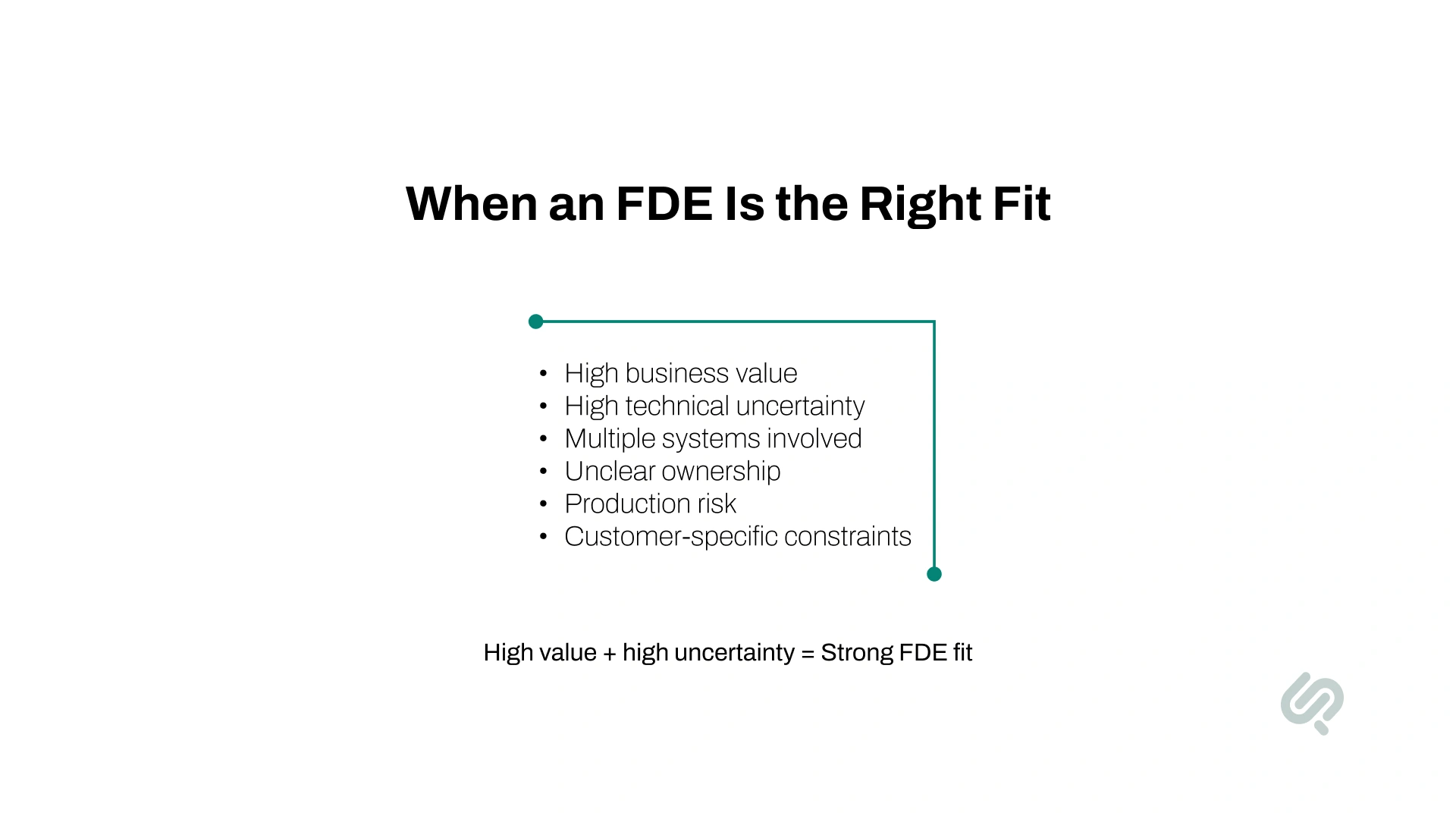
A forward deployed engineer should not be the default solution for every engineering project.
The model works best when the business problem matters, but part of the technical solution still needs to be discovered through implementation.
A strong FDE candidate usually has several of these characteristics:
A) High value + high uncertainty
Use an FDE. The outcome matters, but engineers will need to learn from the environment before the final solution becomes clear.
B) High value + low uncertainty
Use a senior software or product engineering team. The project matters, but the technical path is already understood.
C) Low value + high uncertainty
Validate the business problem first. Senior forward deployed engineering capacity may cost more than the problem justifies.
D) Low value + low uncertainty
Use the normal development backlog, internal automation tools, or standard engineering resources.
There is one more question worth asking before commissioning custom FDE work:
Could an existing product solve most of this problem through configuration?
If the answer is yes, buying or configuring the existing product may be faster and cheaper.
“Forward deployed engineering creates the most value when a business has an expensive problem but no clean technical path to solving it. That is where senior engineers need enough ownership to learn from the environment, make decisions, build, and keep moving until the outcome works in production.”
— Abubakar Shams, CEO & Business Strategy Lead, Phaedra Solutions
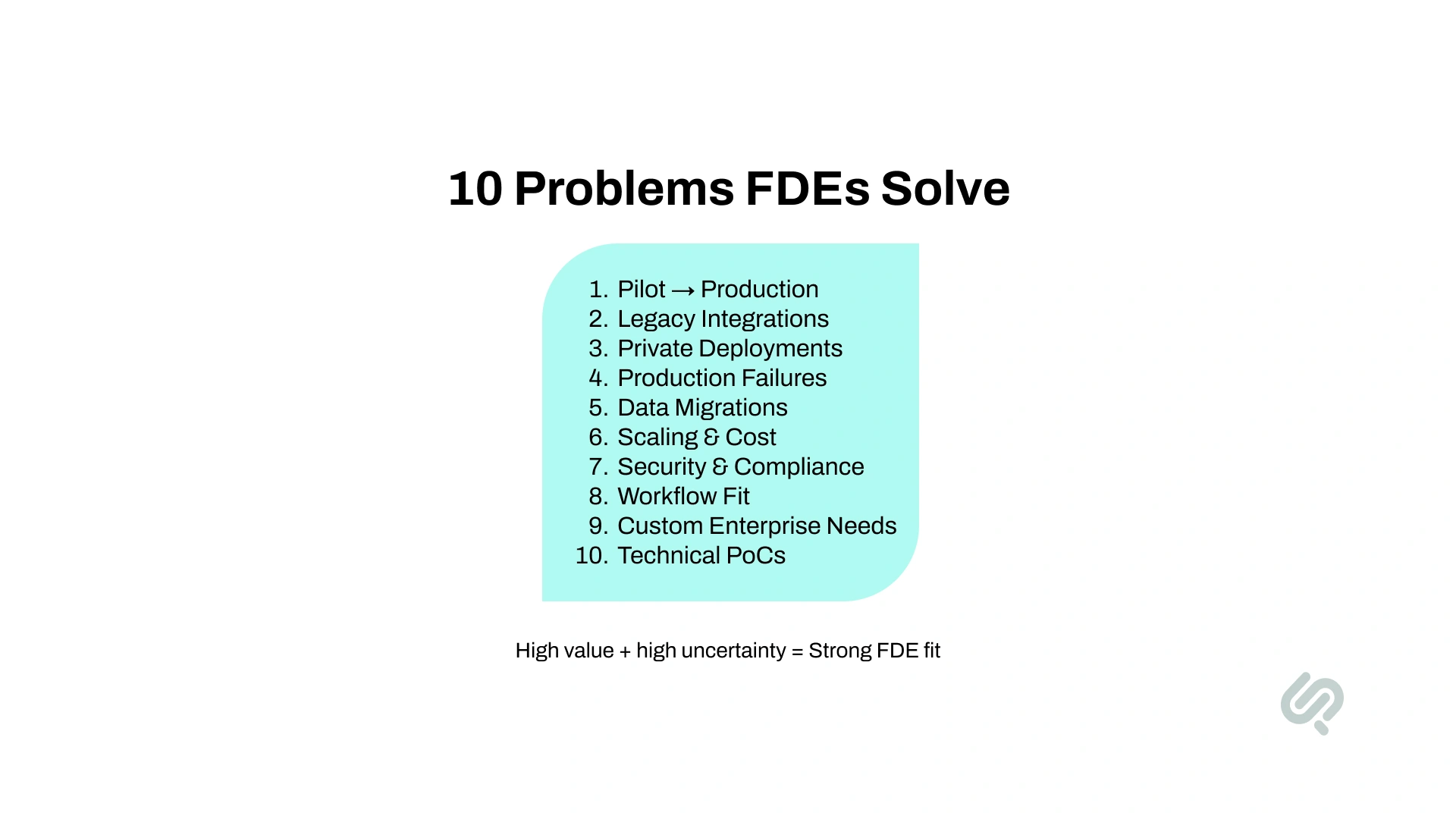
These forward deployed engineering use cases start with the business problem rather than assuming which technology should solve it.
That matters because an FDE often discovers part of the solution only after working with real systems, users, data, and operating constraints.
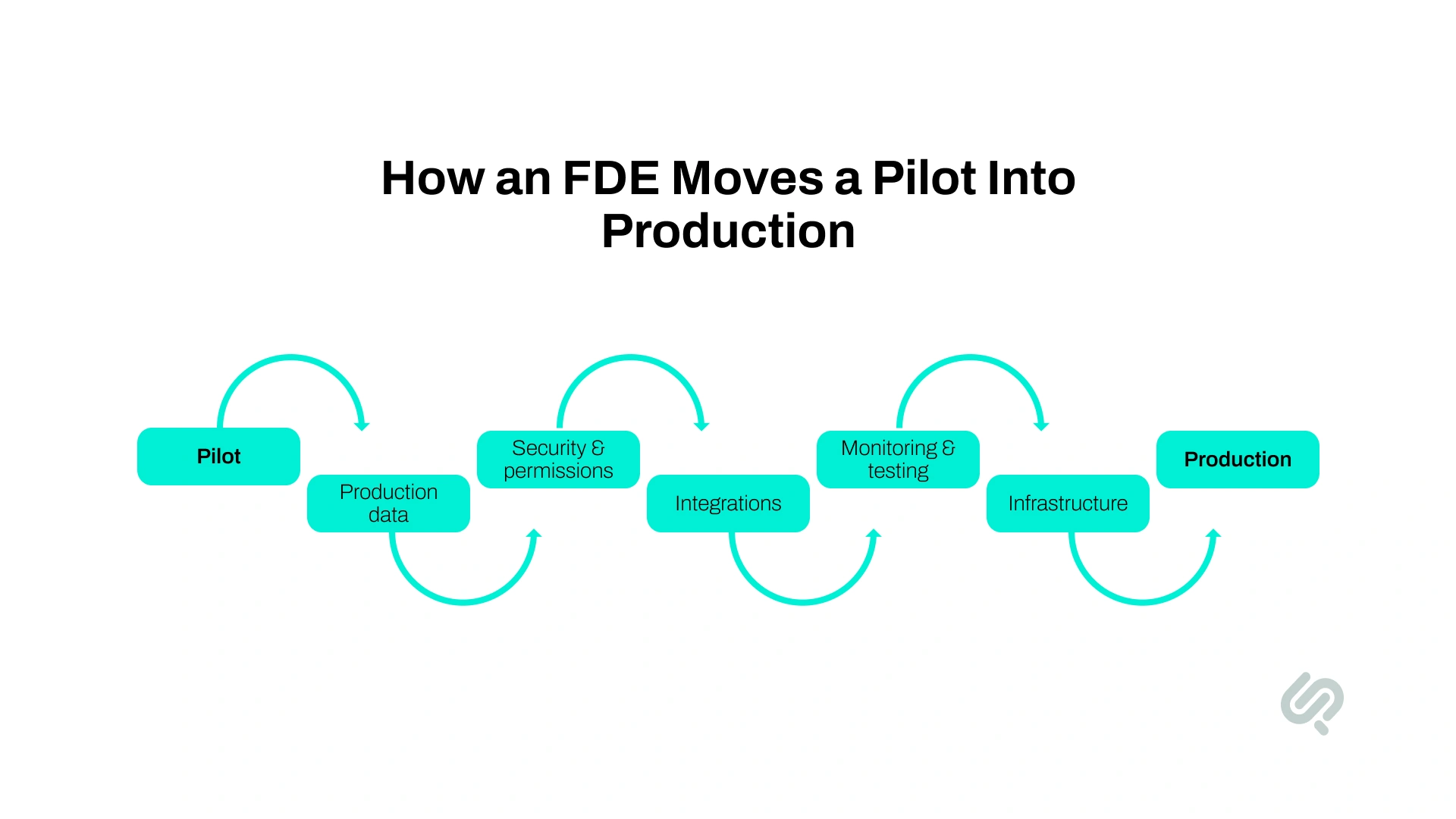
A prototype can perform well in a controlled environment and still fail when it meets production data, users, security policies, infrastructure, and real workloads.
This is common in enterprise AI deployment, but the same problem affects conventional software proofs of concept.
How an FDE helps:
Example: An AI support assistant works in a demo but cannot safely access customer records from the live CRM. The FDE can implement identity controls, CRM integration, monitoring, fallback logic, and production testing before rollout.
A forward deployed AI engineer is particularly useful when the model already works but the surrounding production system does not.

Enterprise environments rarely contain one clean technology stack.
A new application may need to communicate with an old ERP, CRM, custom databases, identity systems, payment services, internal APIs, and software that was never designed for modern integration.
How an FDE helps:
Example: A new sales platform requires Salesforce data, billing information from a legacy ERP, and authentication through an existing identity provider. An FDE can own the integration across all three instead of splitting the problem into disconnected tickets.
This is one of the clearest uses for embedded engineering services because the engineer needs access to the actual systems and the people who operate them.

Some organizations cannot run sensitive systems in a standard public cloud environment.
Defense, healthcare, financial services, government, manufacturing, and other regulated businesses may require on-premise infrastructure, private cloud deployments, restricted networks, or completely air-gapped environments.
How an FDE helps:
Example: An enterprise AI application normally depends on public cloud APIs, but a customer requires all processing to remain inside its own network. An FDE can redesign the deployment around approved local infrastructure and services.
These projects are difficult to solve through a generic product roadmap because the constraints belong to a specific operating environment.
Some production failures cannot be resolved through standard customer support.
The problem may appear only under a specific customer's workload, data, configuration, infrastructure, or integration pattern.
How an FDE helps:
Example: A major enterprise customer experiences intermittent transaction failures during peak usage, but the problem cannot be reproduced in standard testing. An FDE can investigate the customer's environment, trace the complete workflow, and fix the production-specific failure.
This type of problem needs deeper engineering access and ownership than a normal support escalation.
Large migrations become risky when historical data is inconsistent, schemas have changed, records are incomplete, or the existing platform cannot tolerate long periods of downtime.
Moving the data is only part of the work. The business also needs evidence that records arrived correctly and relationships between them were preserved.
How an FDE helps:
Example: A business needs to move millions of customer records from a legacy database into a new platform. Years of schema changes have created duplicates, inconsistent fields, and missing relationships. An FDE can build a controlled migration process instead of depending on one large import.
The same skills apply to AI projects where enterprise data must first be cleaned, connected, permissioned, and made available for retrieval.
Production traffic exposes problems that may never appear during development.
AI applications can see rapidly increasing inference costs. Traditional platforms may hit database, API, memory, networking, or cloud infrastructure bottlenecks.
How an FDE helps:
Example: An AI support agent becomes expensive after usage grows because every request goes to the largest available model. An FDE can introduce model routing, remove unnecessary agent steps, optimize retrieval, and track the cost of completing each task.
For enterprise systems, scaling should be measured in reliability and economics as well as raw traffic capacity.
Many enterprise projects reach a stage where the technology works but security or compliance teams will not approve deployment.
The missing requirements may involve encryption, audit logs, identity controls, data isolation, human approvals, retention policies, or restrictions on external services.
How an FDE helps:
Example: A financial organization has a working AI document assistant but cannot deploy it until security teams can verify who accesses sensitive information and how that activity is recorded. The FDE can build those controls into the application and deployment process.
Handling these requirements during engineering keeps compliance from becoming a final-stage blocker.
AI agents, RAG systems, and workflow automation can perform well in demos while failing during day-to-day use.
Real business processes include exceptions, approval chains, different user permissions, informal steps, multiple applications, and situations where a human still needs to make the decision.
How an FDE helps:
Example: An invoice-processing agent can extract invoice data correctly but does not know that invoices above a certain value require finance-manager approval. An FDE can build that rule and approval path into the workflow.
For AI integration services, understanding the operating process can matter as much as choosing the underlying model.
Large enterprise customers often have requirements that fall outside a standard SaaS product.
They may request custom SSO, private hosting, unusual integrations, different reporting, additional security controls, or support for internal systems other customers do not use.
How an FDE helps:
Example: A large customer will only adopt a SaaS platform if it supports SAML SSO, private hosting, and an internal reporting system. An FDE can own that deployment without forcing the core product team to reorganize its whole roadmap around one account.
This work can also improve the core product.
If several customers need the same connector, permission model, reporting capability, or deployment pattern, the FDE should bring that information back to the product team.
Enterprise buyers sometimes need more than a polished sales demo before committing to a platform.
They may need proof that the product works with their own data, infrastructure, security requirements, integrations, or workloads.
How an FDE helps:
Example: A large prospect likes an AI platform but will not approve it until the technology works with its own document repository and identity system. An FDE can build a limited implementation against those constraints and give both sides a clearer view of production feasibility.
This is where technical sales enablement and engineering overlap. The FDE can demonstrate what the product can actually support under the customer's conditions.
The right delivery model depends largely on how well the problem and technical path are already understood.
Phaedra Solutions built an AI-powered cloud surveillance platform that connected IP cameras and access-control systems with web and mobile monitoring, AI-powered search, face detection, tracking, analytics, cloud infrastructure, and production testing. The engineering challenge crossed AI, devices, backend systems, security, infrastructure, and operational workflows.
If the same project were structured as a forward deployed engineering engagement, the FDE could operate as the senior technical owner inside that environment. The engineer would work with stakeholders to understand surveillance workflows, resolve device and access-control integrations, coordinate AI and infrastructure requirements, validate production behavior, and bring in AI, backend, DevOps, QA, or security specialists where deeper expertise was required.
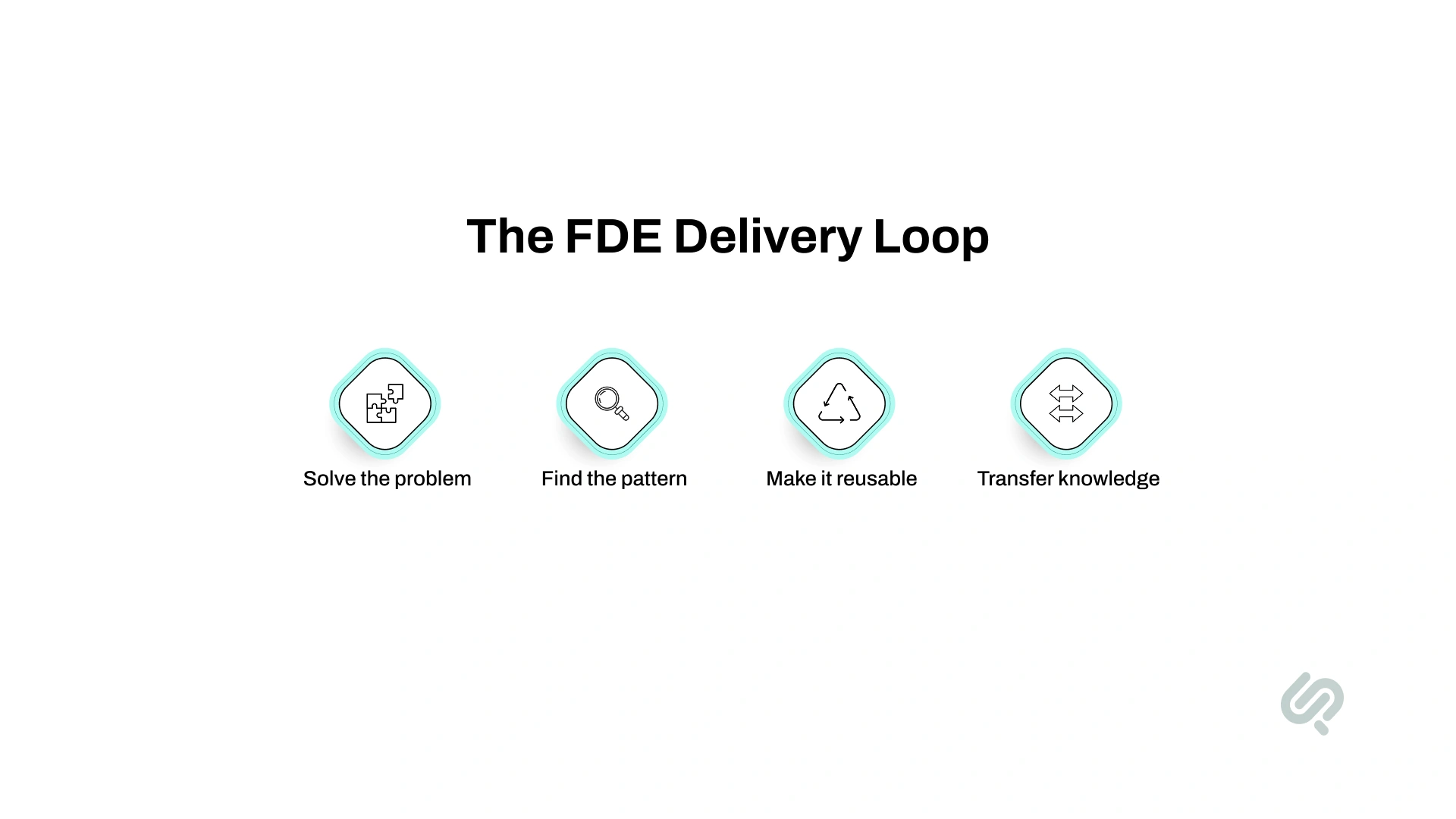
Forward deployed engineering can become expensive when every customer deployment turns into permanent bespoke development.
A strong FDE should solve the current problem while identifying what can be reused in future deployments.
That means watching for patterns such as:
A healthy delivery loop looks like this:
Learn from the customer → solve the immediate problem → identify the reusable pattern → improve the product or platform → document and transfer the knowledge
This field-to-product feedback loop matters because repeated customer work often reveals missing capabilities in the core product.
If every new customer requires engineers to rebuild the same connector or workflow manually, adding more FDE capacity will not solve the underlying issue. That repeated work may need to become a product feature, reusable service, template, API, or deployment pattern.
The customer's dependency on the FDE should also decrease over time. Documentation, runbooks, architecture decisions, deployment knowledge, monitoring, and code ownership should be transferred to the people who will operate the system after the engagement.
Start with the problem where technical uncertainty is blocking meaningful business value.
A practical shortlist can be scored against six questions:
Then apply a build vs buy check.
If existing software can solve most of the problem at an acceptable cost and quality level, buying or configuring that product should be considered before custom engineering.
The strongest reason to hire a forward deployed engineer is usually a high-value problem where the solution is still uncertain and learning from the real environment will materially change what gets built.
If your project matches one of these patterns but you do not want to spend months recruiting permanent senior engineering talent, Phaedra Solutions can embed a forward deployed engineer through its staff augmentation services.
The engineer works alongside your existing team and can take ownership across discovery, architecture, implementation, integration, deployment, and production iteration. AI, backend, cloud, DevOps, QA, data, or integration specialists can support the engagement when the problem requires more than one discipline.
Have a deployment problem that may need an FDE?
Book a free consultation with Phaedra Solutions to assess the problem, required technical ownership, and the right Staff Augmentation setup.



Ameena is a content writer with a background in International Relations, blending academic insight with SEO-driven writing experience. She has written extensively in the academic space and contributed blog content for various platforms.
Her interests lie in human rights, conflict resolution, and emerging technologies in global policy. Outside of work, she enjoys reading fiction, exploring AI as a hobby, and learning how digital systems shape society.