




.webp)
.webp)
.webp)







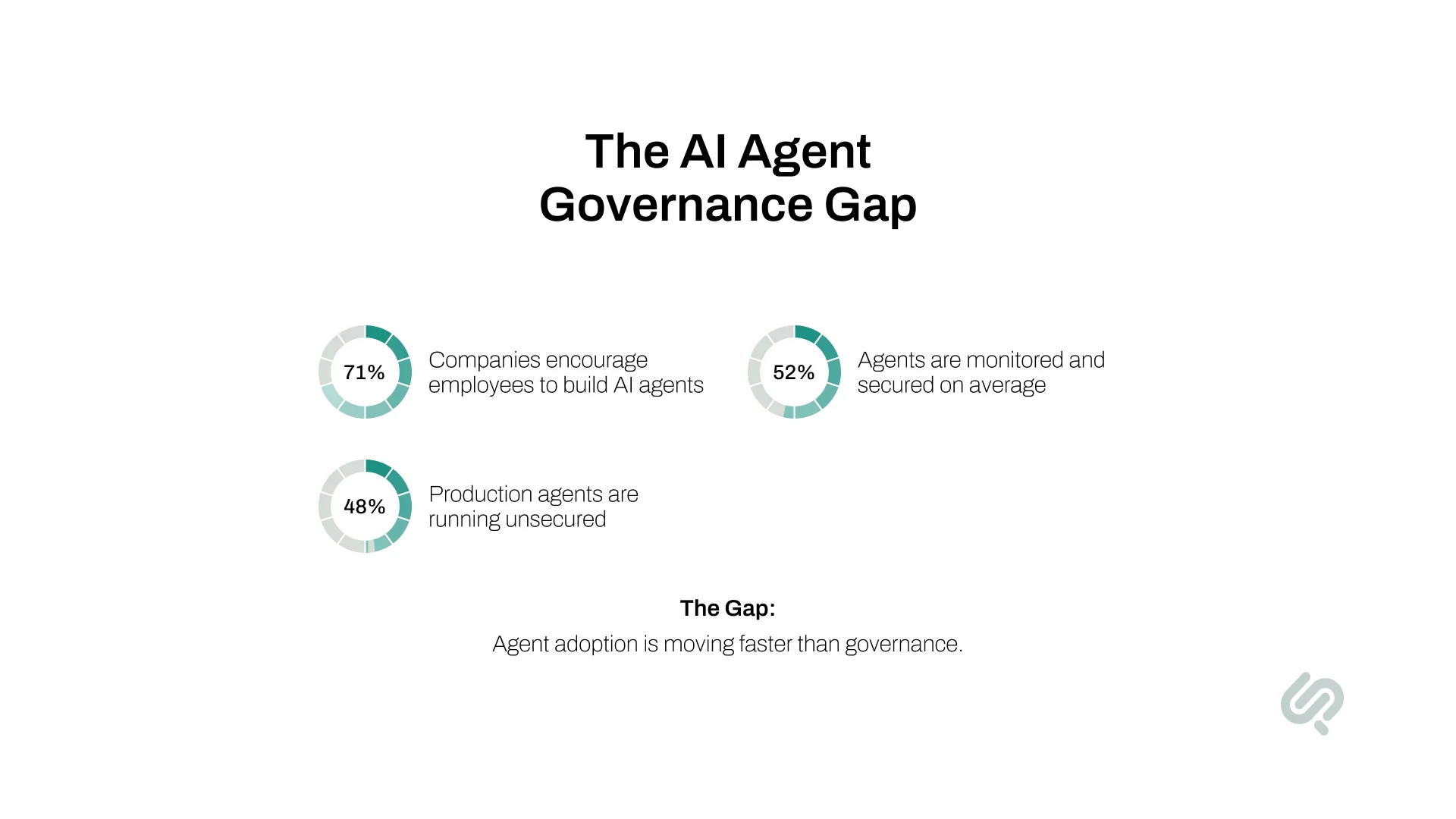
From customer service to internal operations, AI agents are becoming more common in the workplace. A 2026 Clutch survey found that 71% of respondents said their companies actively encourage employees to build agents, but many organizations still lack the infrastructure to deploy and safely oversee them.
When employees are left to make AI agent safety and compliance decisions on their own, they effectively determine company policy. Leaders need to understand who owns each agent, what it can access, what actions it can take, and how it is monitored. Without those safeguards, agents with broad access can put sensitive data at risk.
A closer look at unmanaged agent adoption reveals where those risks come from, why they shouldn't deter organizations from building agents, and what effective oversight can look like.
Thanks to no-code platforms and AI coding tools, it’s easier than ever for employees to build agents that connect AI to their existing workflows and apps.
But employees often build these agents for convenience without considering their company’s security and compliance requirements. Without review from IT or security teams, an agent may gain access to sensitive data without anyone assessing the risk.
Gravitee’s 2026 State of AI Agent Security survey of senior technology leaders found that enterprise agent fleets roughly doubled between December 2025 and April 2026. Meanwhile, security coverage lagged behind. Respondents reported monitoring and securing an average of 52% of deployed agents. This means nearly half of production AI agents are running without any security or governance.
Too many companies are trying to stay ahead of the competition by promoting speed over safety and compliance. Treating guardrails as a speed bump on the road to innovation may help automate tasks more quickly in the short term, but it risks future data exposure and compliance failures. When a company finally decides to put controls in place, an AI agent may already have accessed or shared sensitive information.
Ultimately, a company culture that celebrates velocity without controls isn’t innovative. It’s just unmonitored.
When a company values quick innovation over safety, the employees who build its AI agents become the security policy. An employee-created agent often inherits the permissions and access patterns of the employee who created it.
For example, to better manage their workload, a sales representative decides to build an AI agent that will automate some of their tasks. They connect it to the customer relationship management (CRM) system through their own account, allow it to search the entire Slack workspace, and grant it broad access to the customer database to complete the assigned tasks.
While the creator might assume their agent is safe because it uses their approved accounts, those accounts may give it far more access than its tasks require. The agent now has access to the same sensitive information as the employee who built it, even though no one has reviewed or approved those permissions.
Gravitee reports that of the organizations surveyed, 48% of the production agents were running unsecured. It also found that 54% of those organizations have already confirmed or suspected security incidents with AI agents. Those figures show why clear ownership and accountability matter if organizations want to reduce breaches and resolve issues quickly.
When a new AI agent goes to work, the company should know exactly who is in charge of it and what its purpose is. If there is no named owner and the agent breaks, makes a mistake, or exposes data, teams can spend valuable time trying to figure out who should take action or who has the authority to shut it down, instead of resolving the issue immediately. By the time they determine who is responsible, irreparable damage could have occurred.
Some companies may be skeptical or shrug off risks because they haven’t had any problems to date. However, the danger of data exposure isn’t theoretical. In fact, incidents are already happening at scale.
According to Clutch’s survey, 11% of workers said their AI agent had exposed or mishandled sensitive data at some point. It’s also important to keep in mind that this figure is self-reported. The actual rate of breaches across all companies is likely higher.
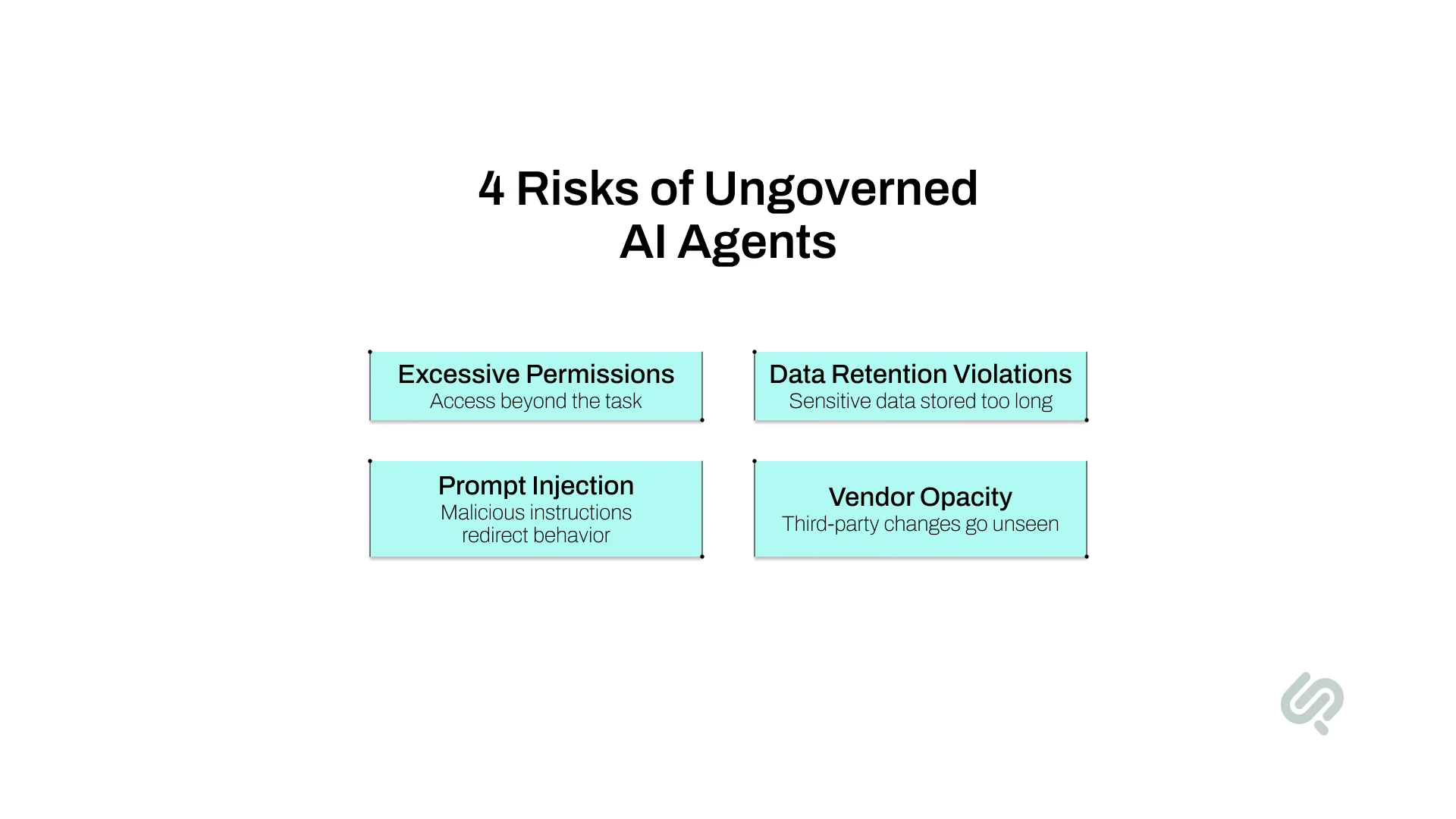
By understanding what the actual risks look like, companies can put more effective safeguards in place. These are four common ways ungoverned agents can create risk:
In the survey, Gravitee identifies these four risk patterns along with shadow deployments and harmful output errors. To manage these risks, companies must assign clear accountability structures.
Gravitee found that only 7.2% of organizations have a designated individual formally accountable for AI agent behavior. Without a clear accountability structure, no individual is responsible for identifying and resolving these risks before they cause harm.
After learning about the potential risks, some executives may be put off by the idea of AI agents. However, the risks aren’t from the agents themselves. AI agents are and will continue to be valuable tools for automating tasks. The risks come from a lack of governance.
By putting the right safety controls and accountability structure in place, organizations can reduce each of these risks while still benefiting from the technology.

The advantages of AI and agents in the workplace are clear. Employees can focus on work that needs human judgment, while AI agents handle repetitive tasks and simple requests. Clutch found that 80% of respondents said their AI agent helps them complete tasks faster, and 58% said it helps them increase their output.
Improving productivity through AI agents should be a priority for companies seeking a competitive advantage. However, organizations that also figure out how to govern their agents safely will be in a better position to scale faster in the long term than those that delay or ignore oversight.
For example, when engineers write new code, most organizations understand that they shouldn’t push it directly to production without a CI/CD pipeline and review process. Ignoring these processes could mean releasing software with bugs or security issues. In the end, the pipeline and review don’t slow down production. They make releases safe and sustainable.
Agent governance works in the same way. The companies that are getting this right aren’t telling their employees to slow down or stop building agents. Instead, they’re putting parameters in place and establishing accountability first. Once a set structure is in place, employees can build and use agents without creating unnecessary security risks.
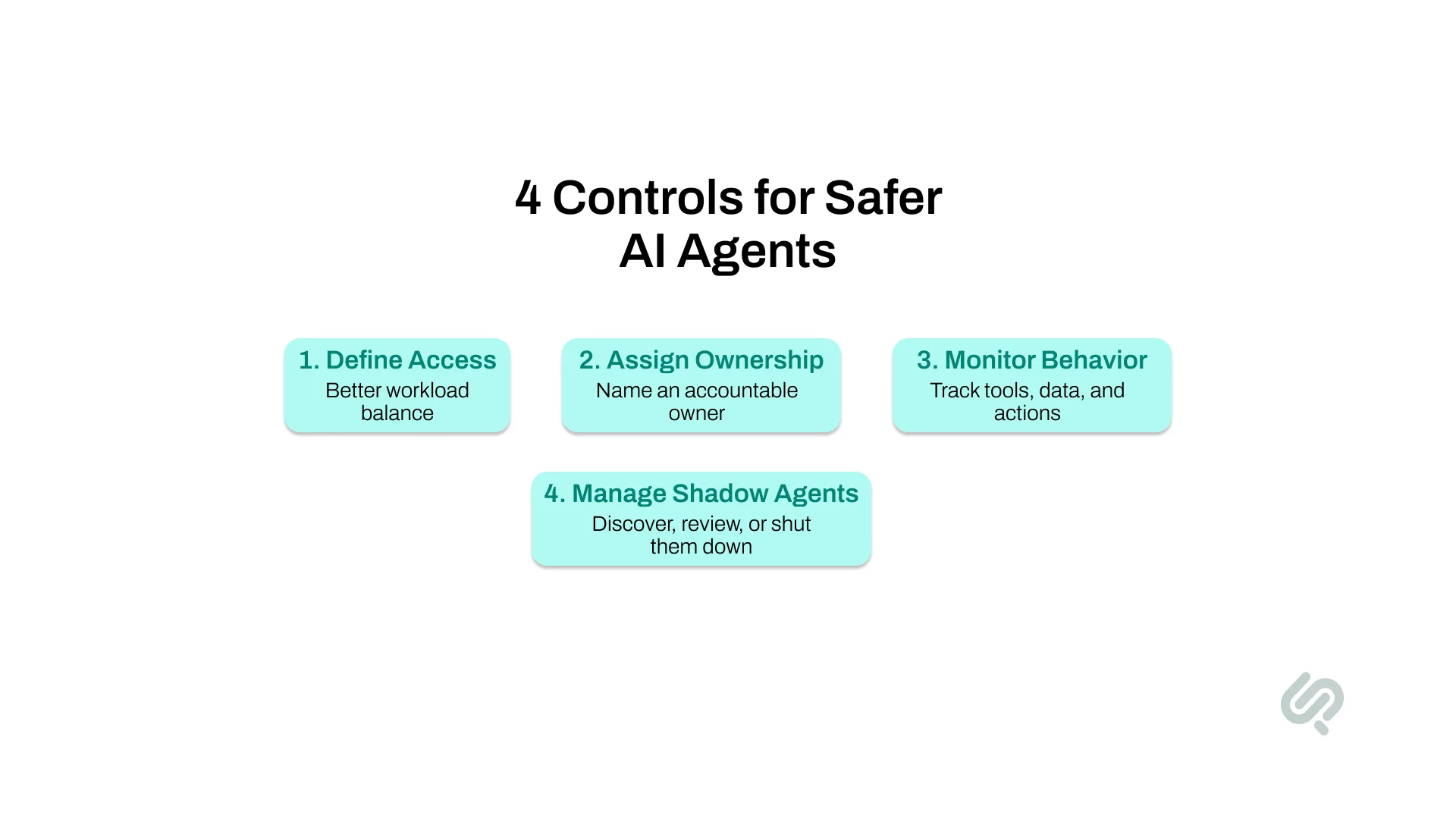
Effective agent governance doesn't require leadership to micromanage employees or approve every technical decision themselves. Rather, they must put a framework in place so employees can build agents safely. To create the foundation for a reliable control environment, organizations must focus on four things.
Begin shaping your control environment by defining access. AI agents should never be able to access everything. Determining which systems, data, and tools an agent can connect to limits the damage it can cause if it makes mistakes or is compromised.
Employees shouldn’t be making access decisions for each agent as they build it. Instead, they should follow a clear company policy.
In most organizations, IT teams grant employees access to systems and data depending on their role and needs. They should treat AI agents the same way. Role-based access control frameworks ensure every agent can access what they need without overstepping their role.
Employees are more likely to follow established controls when they know they will be held accountable for the agent’s actions. Every agent that touches production data or systems should have a named owner. This individual or team will be responsible for the agent’s behavior and access permissions.
Agent ownership doesn’t end after deployment, either. Throughout the agent’s entire lifespan, there should be a designated individual responsible for reviewing and maintaining it. Whenever someone makes changes to an agent, when it fails, or when it produces an unexpected result, someone at the top of the accountability structure should investigate and resolve the issue.
Monitoring agent behavior is where oversight often falls short. This involves more than simply looking at what the agent produces. Checking an agent’s final response allows teams or individuals to flag output errors and respond appropriately. However, even if the agent’s output looks correct, that doesn’t guarantee that the result came from approved data or the correct process.
Hammad Maqbool, Head of AI & LLM Engineering at Phaedra Solutions, says teams should look past the final answer: "An agent can give you a perfectly correct answer built on data it should never have touched. If you only review the output, you'll miss that. Watch which tools it calls and which records it reads, because that's where the risk shows up."
Companies must keep an eye on what systems agents access, what data agents touch, and what decisions they make autonomously, as well as the result of those actions. This allows responsible parties to detect unusual behavior and suspend or correct it before a small error causes wider harm or repeats across hundreds of transactions.
When an employee uses software or a service without approval from the IT or security department, it’s called shadow IT. Shadow IT creates risks because the company may not know what data the tool can access or if it meets security requirements. Because this problem predates AI agents, organizations can use their approach to shadow IT as a playbook to protect against shadow agents.
When employees build their own agents to automate parts of their work without telling IT or security teams, they may put company data at risk. To identify and manage shadow agents, organizations can adapt their existing processes for discovery, inventory, and classification, then bring each agent under formal oversight or shut it down.
Organizations should always assume there are more agents running than they know about. Instead of waiting for incidents to occur to discover them, they should use shadow IT prevention tactics to be proactive. Employees will be more likely to disclose a useful agent if they know the organization is willing to review it and help them use it safely, rather than automatically banning it.
The fact that nearly three-fourths of the companies in Clutch’s survey are actively encouraging employees to build AI agents is a clear sign of how quickly companies are adopting artificial intelligence in all its forms. The growing use of AI agents to automate work and improve productivity isn’t a problem. The issue is keeping the data and systems that agents can access safe and secure.
Encouragement without the appropriate architecture to support it produces a security policy written by whoever moves the fastest. In the short term, this might produce impressive results. However, any gains come with the risk of data exposure, compliance failures, and agents that no one can control. Organizations must set boundaries for agent access and behavior that reflect their actual risk tolerance, compliance requests, or governance standards.
It’s essential not to stop encouraging employees to build new agents that can make their work more efficient. As long as companies create a clear control environment first, employees can innovate within the boundaries. The organizations that govern well aren't slowing their automation efforts. Instead, they’ll move faster with fewer incidents, a better compliance posture, and AI agents that their security team can actually stand behind.
If your teams are already building agents, the next step is putting structure around them.
Phaedra Solutions' AI agent development service designs agents with role-based access, named ownership, and behavior monitoring built in from the start, so your people keep building, and you always know what's running and what it can reach.



Musa is a senior technical content writer with 7+ years of experience turning technical topics into clear, high-performing content.
His articles have helped companies boost website traffic by 3x and increase conversion rates through well-structured, SEO-friendly guides. He specializes in making complex ideas easy to understand and act on.