





.webp)






.webp)
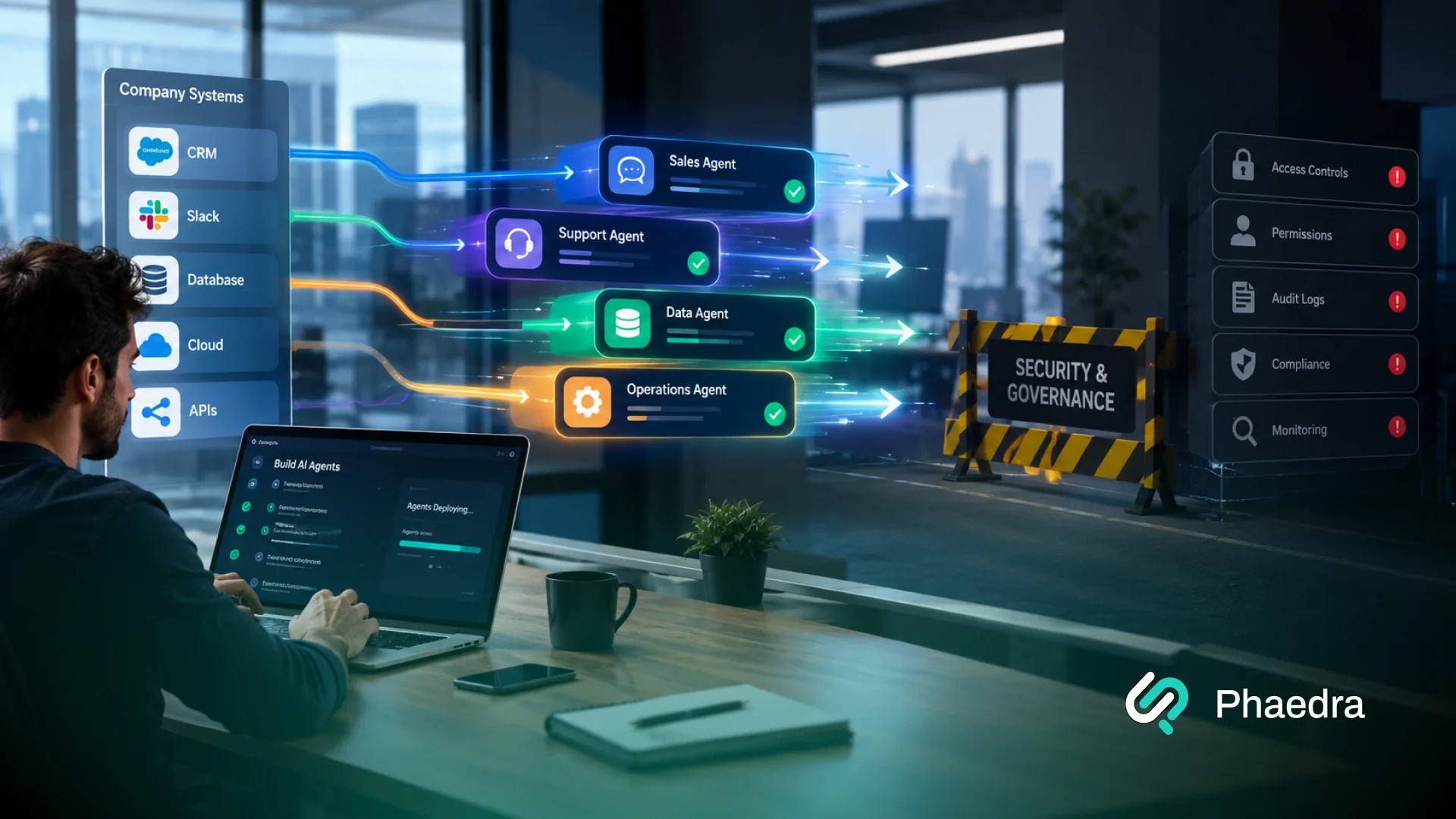
AI agent governance is the system of policies, technical controls, and ownership rules used to manage how enterprise agents access data, call tools, make decisions, and take action.
It helps organisations discover shadow agents, limit permissions, monitor runtime behaviour, require approval for high-risk actions, and maintain reliable audit trails.
These controls are becoming essential because AI agents can connect to business applications, databases, APIs, customer records, and operational workflows. Without clear identities, owners, access boundaries, and shutdown procedures, an agent may expose sensitive data, change records, or trigger actions without effective oversight.
AI agent governance is the process of controlling who owns an agent, which data and tools it can access, what actions it may perform, and how its behaviour is monitored. It combines business policies, security controls, technical testing, and human oversight across the agent’s lifecycle.
Enterprise agents can access information, call APIs, communicate with other systems, and complete tasks without continuous human direction. Governance reduces the risk of excessive permissions, unauthorised actions, data exposure, compliance failures, and untraceable decisions.
Every production agent should have a named owner, unique identity, limited permissions, risk classification, approved tools, activity logs, runtime monitoring, human approval rules, and a tested shutdown process.
Companies should review procurement records, cloud environments, identity systems, API gateways, expense reports, endpoint activity, developer platforms, and vendor software. Each discovered agent should be registered with its purpose, owner, permissions, integrations, risk level, and deployment status.
Outside support is useful when agents already access production systems, customer data, financial processes, or regulated workflows, but the organisation lacks a reliable inventory, secure identities, runtime monitoring, or specialists who can implement the necessary controls.
Traditional AI governance commonly focuses on model selection, training data, privacy, fairness, explainability, accuracy, and acceptable use. These controls remain important, but autonomous agents introduce another layer of operational risk.
An agent may interpret a goal, select tools, retain memory, call multiple systems, communicate with other agents, and complete a sequence of actions that was not fully scripted in advance.
Agentic AI governance must therefore control:
A policy that only governs model outputs is not enough when the system can also take action.
Enterprise agents are moving from controlled experiments into everyday business systems. They may support customer service, sales, finance, development, procurement, cybersecurity, data analysis, or internal operations.
This creates risks that extend beyond the engineering team. An uncontrolled agent can cause financial loss, expose sensitive information, interrupt operations, affect customers, or create regulatory and reputational consequences.
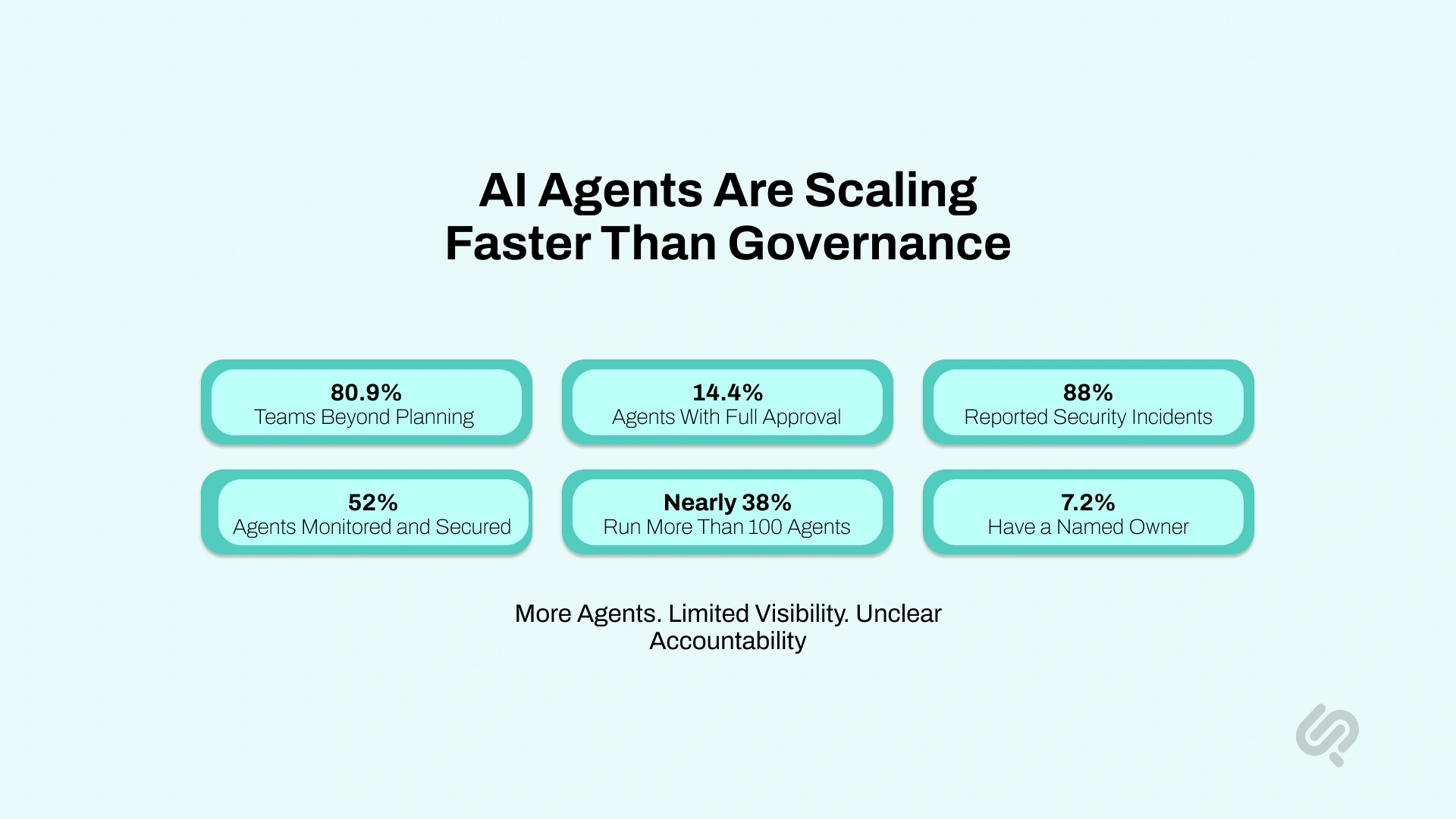
Gravitee’s February 2026 report found that 80.9% of surveyed technical teams had progressed beyond planning into agent testing or production. However, only 14.4% said every agent received complete security or IT approval before launch, while 88% reported a confirmed or suspected agent-related security incident during the previous year. (1)
Gravitee’s April 2026 follow-up showed that the challenge had expanded further. Enterprise agent fleets had roughly doubled since December 2025, nearly 38% of surveyed organisations reported more than 100 deployed agents, and average security and monitoring coverage remained at approximately 52%. (2)
Boards do not need to approve every individual agent. They should define the organisation’s risk appetite and require evidence that accountable owners, production controls, monitoring, and escalation procedures are in place.
Leadership reporting should cover:
The board-level question is not simply whether the organisation uses agents. It is whether the organisation knows where they are, what they can access, and what they are allowed to do.
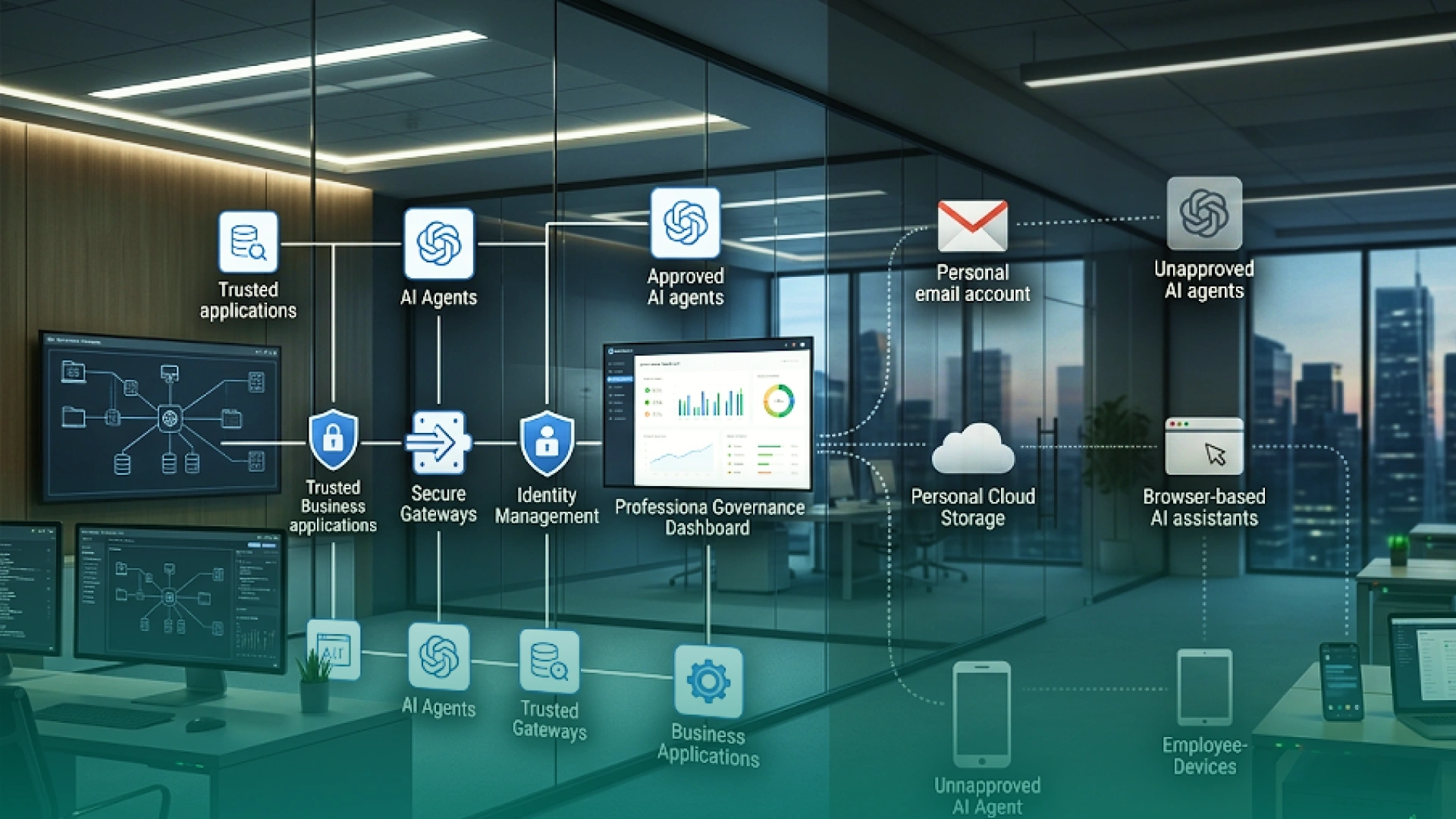
Shadow AI begins when employees, developers, vendors, or business units introduce AI tools outside established approval and oversight processes.
With a basic chatbot, the main risk may be an employee entering sensitive information into an unapproved application. With an agent, the exposure is wider because the system may retrieve documents, call APIs, update databases, send messages, trigger workflows, or create additional agents.
An agent may remain invisible to central teams when:
Okta and Apprize360 found a significant difference between leadership confidence and employee behaviour. Although 90% of surveyed executives believed they had visibility into workplace AI tools, 52% of knowledge workers admitted using unapproved AI applications. The research also found that 58% of executives had experienced an AI-related security incident or close call, while 57% of workers considered their organisation’s AI policies unclear, difficult to locate, or nonexistent. (3)
Traditional shadow IT introduces an unsanctioned application. A shadow agent can introduce unsanctioned decisions and actions.
Policies fail when the approved route is slow, difficult, or unable to meet the employee’s needs. Blocking every unapproved tool without providing a practical alternative may push usage further outside the organisation’s visibility.
A stronger approach combines policy with:
The secure path should also be the easiest practical path for employees and business teams.
Most enterprise security systems were designed for human users, conventional applications, and predictable service accounts. Agents behave differently because they can interpret context, select actions, and interact with several systems during one workflow.
Traditional software normally follows predefined logic. An agent may receive an objective, decide which tools to use, evaluate the result, and choose the next step.
This creates important oversight questions:
A standard software review may confirm that an application works as designed. Agent testing must also evaluate what happens when the system encounters unexpected instructions, incomplete information, malicious content, or a tool failure.
Identity is one of the most important weaknesses in current agent security practices.
Gravitee found that only 21.9% of surveyed teams treated agents as independent identities. Another 45.6% relied on shared API keys for agent-to-agent authentication.
When agents share credentials, security teams may not be able to identify which agent performed an action. Shared access also makes containment harder because revoking one credential may disable several agents, integrations, or business processes.
Each production agent should have:
Identity allows teams to answer a basic incident question: which agent did what, using whose authority, through which connection?
An agent should not be trusted simply because its model provider, software vendor, or human user has already been approved.
Anthropic’s May 2026 Zero Trust framework highlights the need for tiered safeguards around autonomous agents, including controlled identities, limited permissions, protected environments, validation, and operational controls.
Google DeepMind’s AI Control Roadmap recommends treating highly capable, untrusted agents as potential insider threats. Its approach combines behavioural detection, preventive controls, trusted supervision, incident response, and exercises that test whether safeguards work under pressure.
In practice, a Zero Trust approach means:
Approval should establish the conditions under which an agent can operate. It should not create permanent trust.
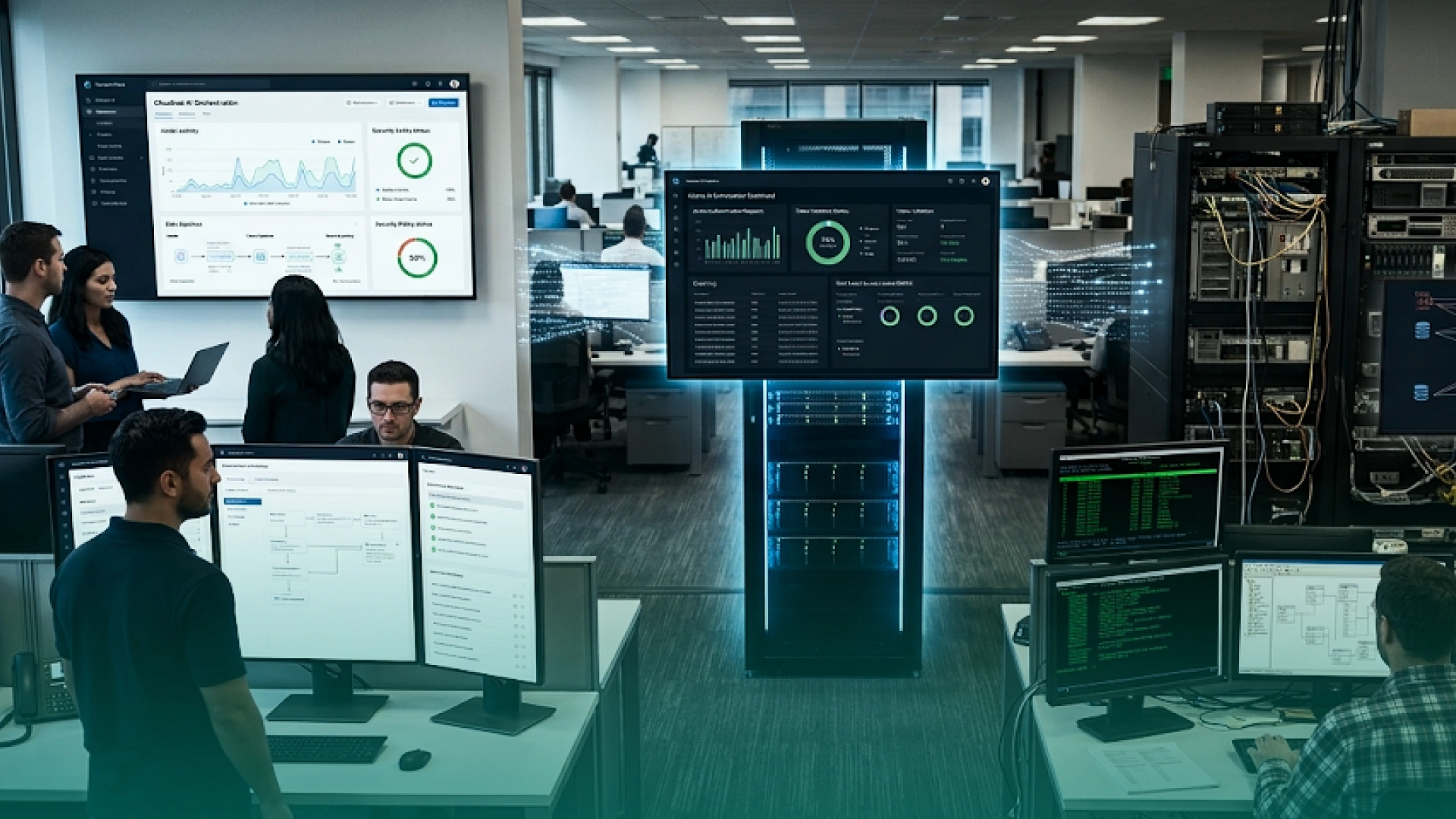
Legacy systems often rely on shared service accounts, broad database access, brittle point-to-point integrations, incomplete logs, and permissions created for workflows that are no longer documented.
These weaknesses become more serious when an autonomous agent can call the same systems repeatedly and at machine speed.
For example, a legacy application may allow a service account to read and modify an entire customer database because the original integration could not support granular permissions. Connecting an agent through that account gives the agent the same broad authority.
Before connecting agents to legacy infrastructure, organisations should assess:
Where complete replacement is not practical, the organisation may introduce a secure API layer, identity broker, policy-enforcement gateway, or modern integration service between the agent and the legacy system.
Governance should therefore be assessed at two levels: the behaviour of the agent and the readiness of every system the agent can reach.
A practical AI agent security framework should control what an agent is, what it can access, what it can do, and how unsafe behaviour will be detected and stopped.
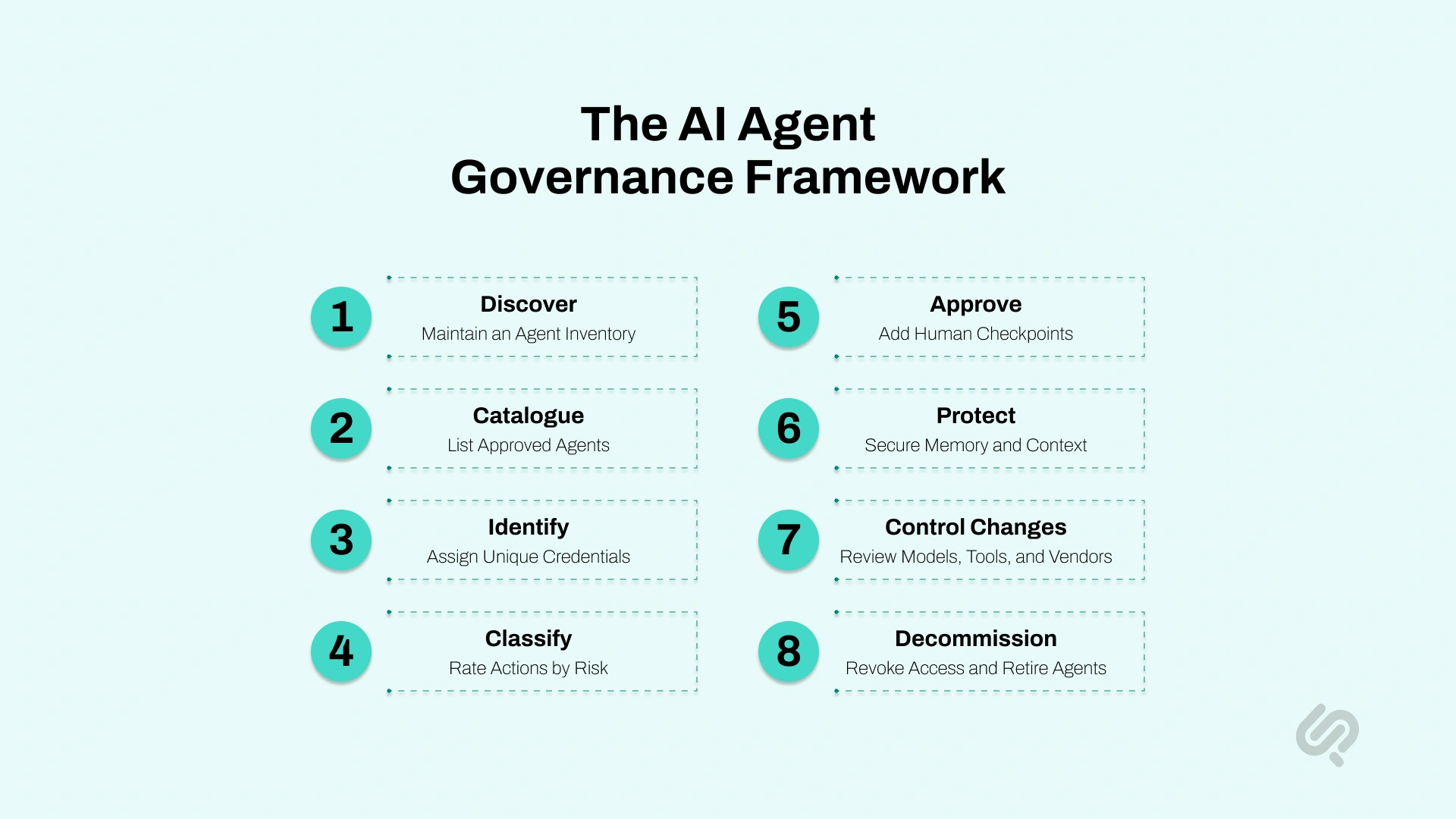
Create a central inventory covering:
For each agent, record:
Discovery should use procurement records, cloud logs, identity systems, API gateways, endpoint tools, expenses, code repositories, and development platforms.
An annual spreadsheet review is not sufficient for an environment that changes every week.
The security inventory and employee catalogue can share data, but they serve different purposes.
Security and compliance teams need technical information about permissions, risks, and controls. Employees need to understand which approved agent should be used for a specific task.
The catalogue should show:
An accessible catalogue reduces duplicate development, makes approved tools easier to find, and helps employees avoid unapproved alternatives.
Each production agent should use a unique non-human identity rather than a shared API key or generic service account.
Permissions should be:
Persistent access should not be granted simply because it is easier to implement.
Not every action requires the same level of control.
Low-risk actions may include:
Medium-risk actions may include:
High-risk actions may include:
Risk classification should focus on the consequence of the action, not only the sophistication of the model.
Human review is most useful when placed before a consequential action, not after the outcome has already occurred.
High-risk workflows may require:
The organisation should also define when human intervention is mandatory. Vague instructions such as “keep a person involved” do not create an enforceable control.
“The biggest governance mistake is treating an AI agent like another software integration. An integration waits for a request. An agent can interpret, decide, call tools, retain context, and act repeatedly. Identity, permissions, monitoring, and rollback therefore need to be designed before production, not added after an incident.”
Hammad Maqbool, Head of AI & Prompt Engineering, Phaedra Solutions
Agent memory may contain customer information, internal decisions, credentials, business rules, or previous task results.
Teams should define:
Memory should not become a hidden database outside established privacy and retention policies.
A previously approved agent may develop a different risk profile after a model upgrade, prompt revision, new integration, permission change, or vendor release.
Material changes should trigger:
Third-party agents should also be reviewed when their providers change data processing, retention, autonomous capabilities, or integration behaviour.
An agent should not remain active because a pilot ended quietly or its original owner left the company.
Decommissioning should include:
An inactive agent with valid credentials remains an access path. Retirement is part of security and lifecycle management, not an administrative afterthought.
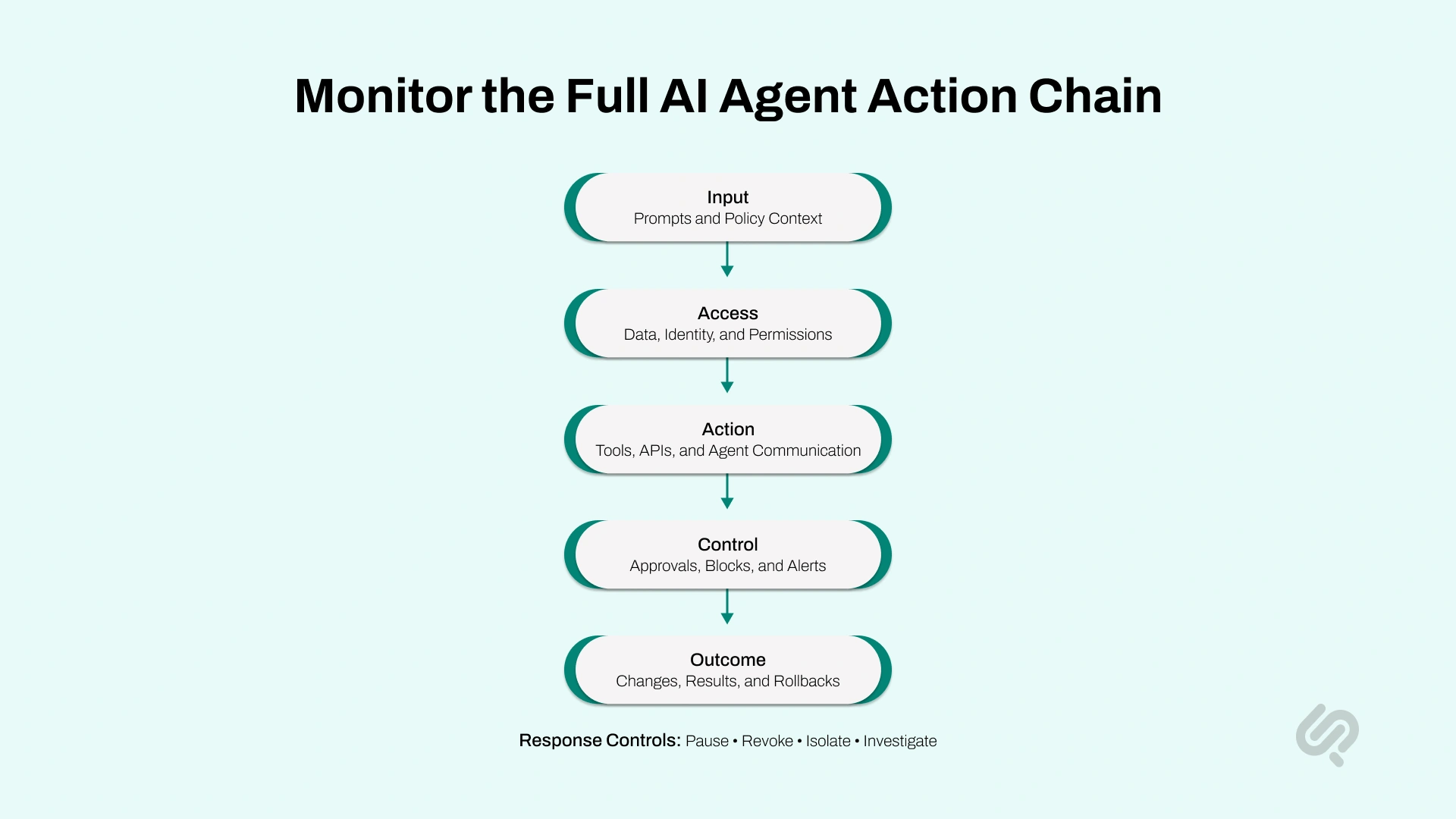
Enterprise AI agent monitoring should track more than uptime, latency, token usage, or model availability. It must show how agents behave across data, tools, permissions, and workflows.
Teams should monitor:
Logs show what happened. Behavioural monitoring helps identify when an agent moves outside its normal operating pattern.
Alerts may be triggered when an agent:
Behavioural baselines should be specific to each agent. A data-analysis agent and a payment-processing agent will have very different normal activity.
Monitoring is useful only when the organisation can act on what it detects.
Teams should be able to:
Response thresholds should reflect business impact. An agent might process low-value refunds automatically but require approval when an amount exceeds a defined limit.
Enterprise AI agent oversight cannot sit entirely with the security team, engineering department, or one governance committee. It requires shared ownership across business, technical, legal, and risk functions.
Every production agent should have one clearly accountable business owner and one technical owner. Shared participation does not remove individual accountability.
Governance should become part of the development lifecycle rather than a final review before launch.
A production release gate should confirm that the following are complete:
This approach turns governance into a delivery requirement rather than optional documentation.
An autonomous agent is not automatically classified as high-risk under the EU AI Act. Its obligations depend on its intended purpose, deployment context, users, provider or deployer role, and whether it affects decisions in regulated areas.
The Act’s transparency requirements come into effect in August 2026. These include obligations that may require people to be informed when they interact with certain AI systems and requirements covering specified AI-generated or manipulated content.
Under the current implementation timeline:
High-risk areas may include employment, education, critical infrastructure, essential services, biometrics, law enforcement, migration, and the administration of justice. High-risk systems can face requirements covering risk management, data quality, logging, documentation, human oversight, accuracy, robustness, and cybersecurity.
Enterprise teams should document each agent’s:
Legal counsel should confirm how the Act applies to each system, market, and use case. Technical teams should not wait for a final compliance deadline before creating the required inventory and evidence. (4)
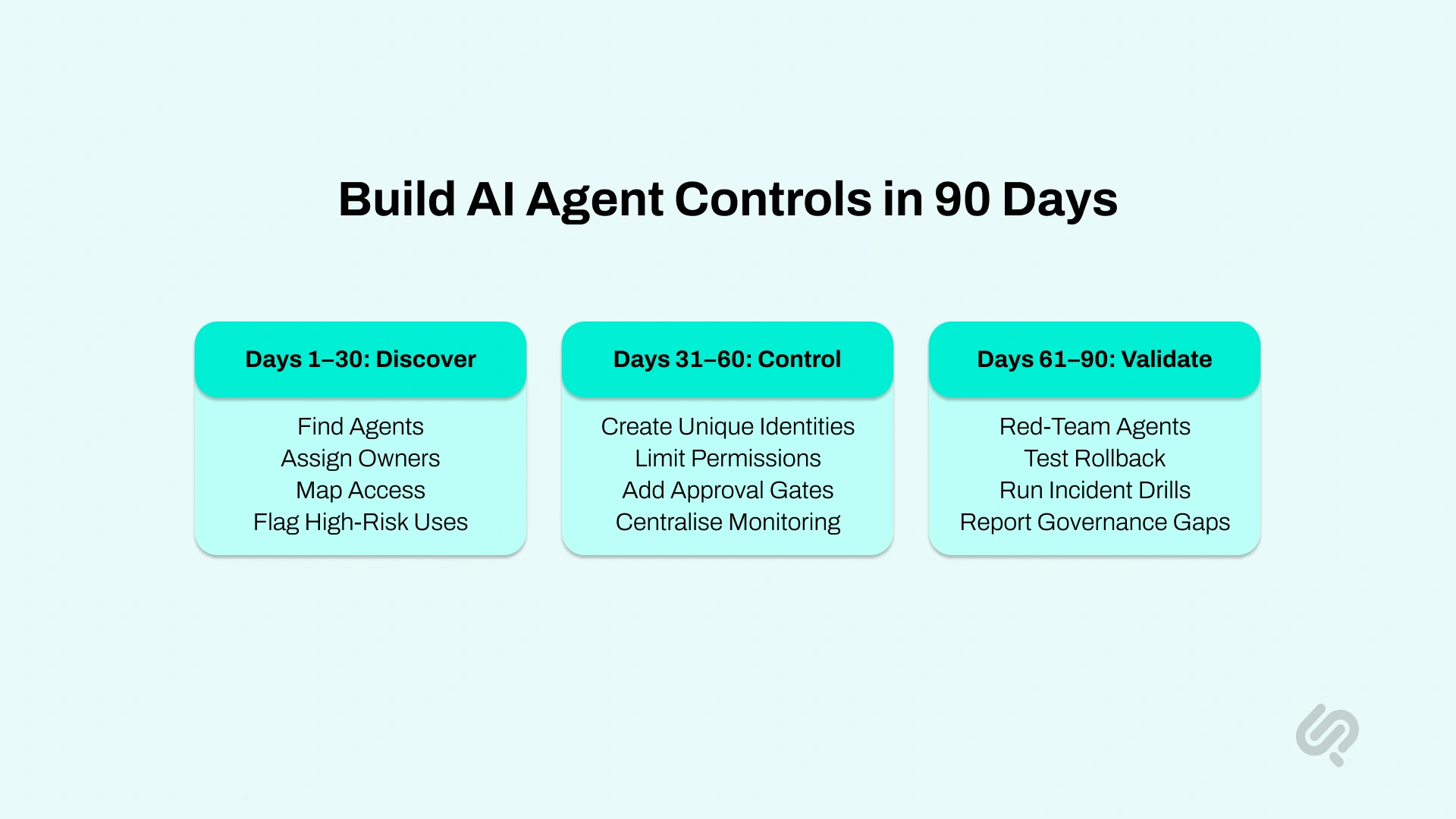
Organisations do not need to stop every agent project while developing a complete governance programme. They do need minimum controls before agents gain wider access to data, systems, and business processes.
Use procurement, cloud, identity, API, endpoint, expense, and development records to identify active agents.
For each agent, document:
Agents that cannot be identified, owned, or monitored should be restricted until minimum controls are added.
Focus first on the controls that reduce immediate operational risk:
Do not attempt to solve every governance question at once. Start with visibility, accountability, and control over consequential actions.
Test whether the controls work under real operating conditions.
Activities should include:
Track metrics such as monitoring coverage, blocked actions, approval response time, number of unidentified agents, permission-review completion, and time required to contain an incident.
Material ownership gaps, unresolved control failures, and high-risk exceptions should be reported to senior leadership.
Responsible AI agent deployment does not eliminate autonomy. It ensures autonomy remains limited, observable, accountable, and reversible.
Internal policies may be sufficient while agents remain in controlled experiments. Specialist support becomes more valuable when agents begin interacting with production systems, customers, employees, financial processes, or regulated data.
Common buying triggers include:
An AI agent risk assessment should identify the most urgent gaps. Implementation should then convert those findings into identities, access boundaries, guardrails, evaluation workflows, monitoring, and response controls.
A governance platform may improve visibility and enforcement, but technology alone cannot define business ownership, acceptable risk, approval responsibilities, or the correct operating model.
Some consulting engagements end with policies, risk registers, and presentation decks. A development partner should also be able to implement those requirements within the agent, its integrations, and the surrounding infrastructure.
Evaluate potential partners against the following criteria.
The partner should have experience moving agents beyond demonstrations into live business workflows.
Ask for evidence covering:
The team should be able to connect agents to APIs, databases, SaaS platforms, and legacy systems without giving them unnecessary access.
Look for experience with:
Ownership, risk classification, permissions, approvals, and monitoring should be defined during architecture and development.
They should not be postponed until the final security review.
The testing process should cover:
The solution should provide enough visibility to understand what the agent accessed, decided, and changed.
The team should also define:
Your internal team should receive:
The right partner should help the organisation move faster without separating delivery from security, compliance, and operational control.
A government authority needed to consolidate more than 30 public services into a unified web portal and mobile Super App supported by an AI assistant. The platform required centralised identity and access management, real-time request tracking, analytics, and integrations with several government systems.
Because it supported citizen-facing workflows, secure access, integration boundaries, and delivery oversight had to be designed into the platform.
Phaedra Solutions delivered the platform through more than 24 sprints and integrated three pilot ministries through secure APIs. The implementation combined the AI assistant with centralised authentication, web and mobile development, backend services, QA, DevOps, and project management.
Although the programme covered more than agent oversight alone, it demonstrates the foundations needed for governed deployment: controlled identities, secure integrations, accountable delivery, and observable business workflows.
Phaedra Solutions’ AI agent development services help enterprises build secure production agents with limited permissions, human approval points, runtime monitoring, audit trails, and shutdown controls.
Our AI-first process uses AI-assisted research, rapid prototyping, automated testing, and AI-powered QA to accelerate delivery while maintaining security and oversight.



Ameena is a content writer with a background in International Relations, blending academic insight with SEO-driven writing experience. She has written extensively in the academic space and contributed blog content for various platforms.
Her interests lie in human rights, conflict resolution, and emerging technologies in global policy. Outside of work, she enjoys reading fiction, exploring AI as a hobby, and learning how digital systems shape society.