






.webp)






.webp)
An LLM evaluation framework gives teams a repeatable way to determine whether a generative AI application is accurate, grounded, safe, reliable, fast, and cost-effective enough to ship. It combines representative test datasets, task-specific metrics, automated scoring, human review, release thresholds, regression testing, and production monitoring.
For production AI, evaluation should cover the entire system, not only the foundation model. Prompts, RAG retrieval, tool calls, AI agent workflows, guardrails, latency, cost, and final outputs can all introduce failures.
The goal is to replace “this looks good” with measurable evidence that a release is ready for real users.
It is a repeatable system for testing whether an LLM application meets defined quality, safety, reliability, latency, and cost requirements before and after release.
Evaluate the end-to-end task and the components that can fail, including prompts, retrieval, grounding, tools, agent steps, safety controls, latency, cost, and final outputs.
The right metrics depend on the use case. Common measures include correctness, relevance, faithfulness, task success, tool accuracy, safety, latency, and cost per successful task.
LLM testing checks individual cases or behaviors. Evaluation combines datasets, graders, metrics, thresholds, and repeated runs to determine whether the system is improving and whether a release should ship.
No. LLM judges can scale subjective scoring, but teams should calibrate them against human-reviewed examples and route uncertain or high-risk cases to experts.
Popular options include DeepEval, Ragas, Promptfoo, LangSmith, Arize Phoenix, Evidently, Braintrust, and TruLens. The best choice depends on your application type, CI/CD workflow, tracing requirements, security needs, and production monitoring requirements.
A generative AI system can produce excellent answers during a product demo and still fail badly in production.
Real users introduce ambiguous requests, incomplete information, unusual language, adversarial prompts, conflicting instructions, unexpected tool calls, and edge cases that a development team may never test manually.
The cost of discovering those failures after launch can be substantial. Gartner reported in January 2026 that at least 50% of generative AI projects had been abandoned after proof of concept by the end of 2025, (1) citing factors including poor data quality, inadequate risk controls, rising costs, and unclear business value.
An evaluation framework does not solve every one of those problems. What it does provide is measurable evidence that the AI system meets its expected quality, risk, performance, and cost requirements before the team increases its exposure to real users.
Instead of asking:
“Does the AI seem good?”
You can ask:
That is the difference between subjective AI testing and repeatable AI quality assurance.
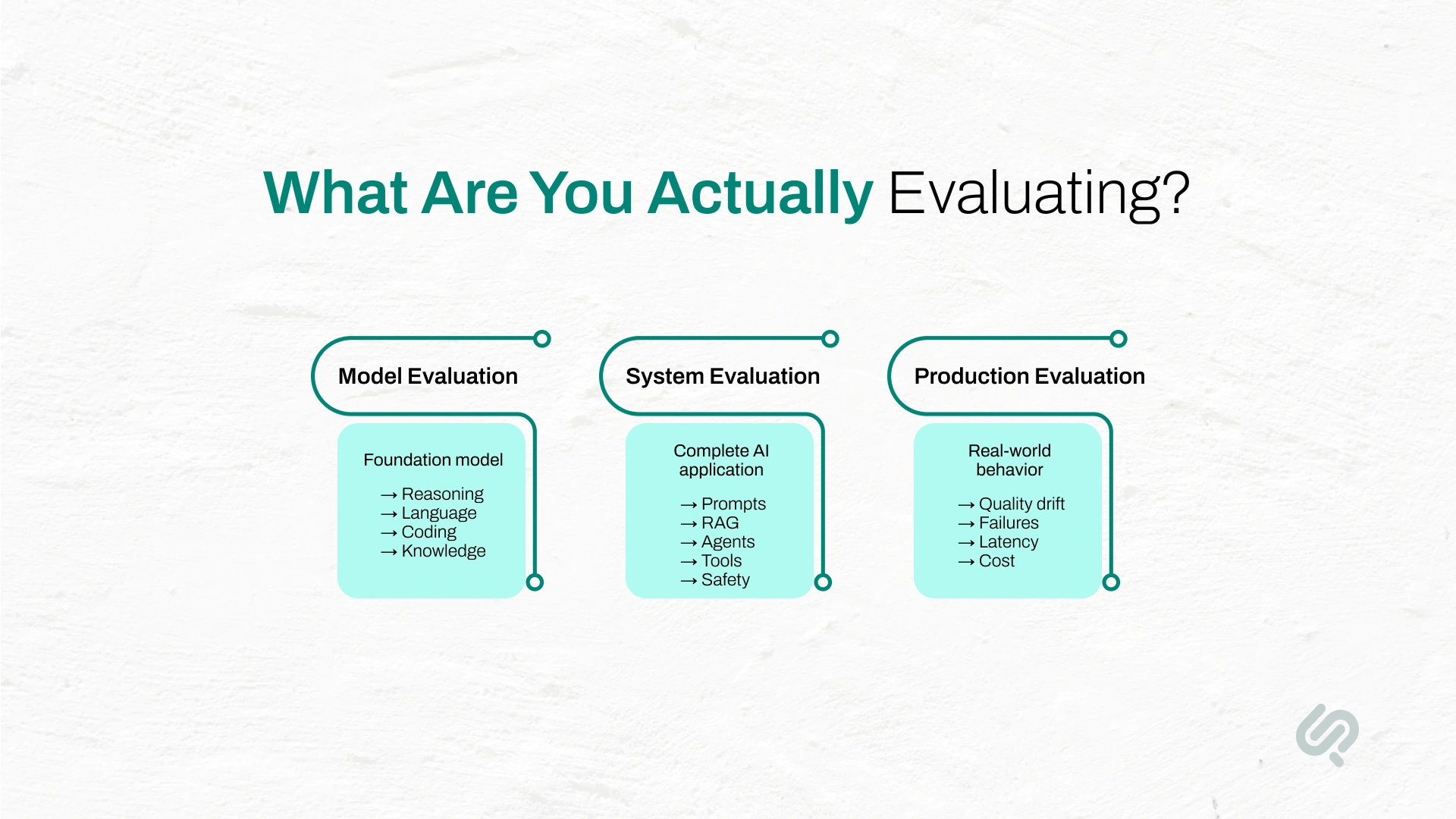
One of the most important distinctions in LLM evaluation is what you are actually testing.
Public benchmarks such as MMLU can help compare foundation models, but they cannot tell you whether your customer-support assistant follows your refund policy correctly or whether your RAG system retrieves the right internal documents.
For most businesses building AI products, system-level evaluation matters more than benchmark scores.
Stanford’s 2026 AI Index reports that, on one accuracy benchmark covering 26 leading models, hallucination rates ranged from 22% to 94%. This strongly supports the need for continuous LLM evaluation rather than relying on model reputation alone (2).
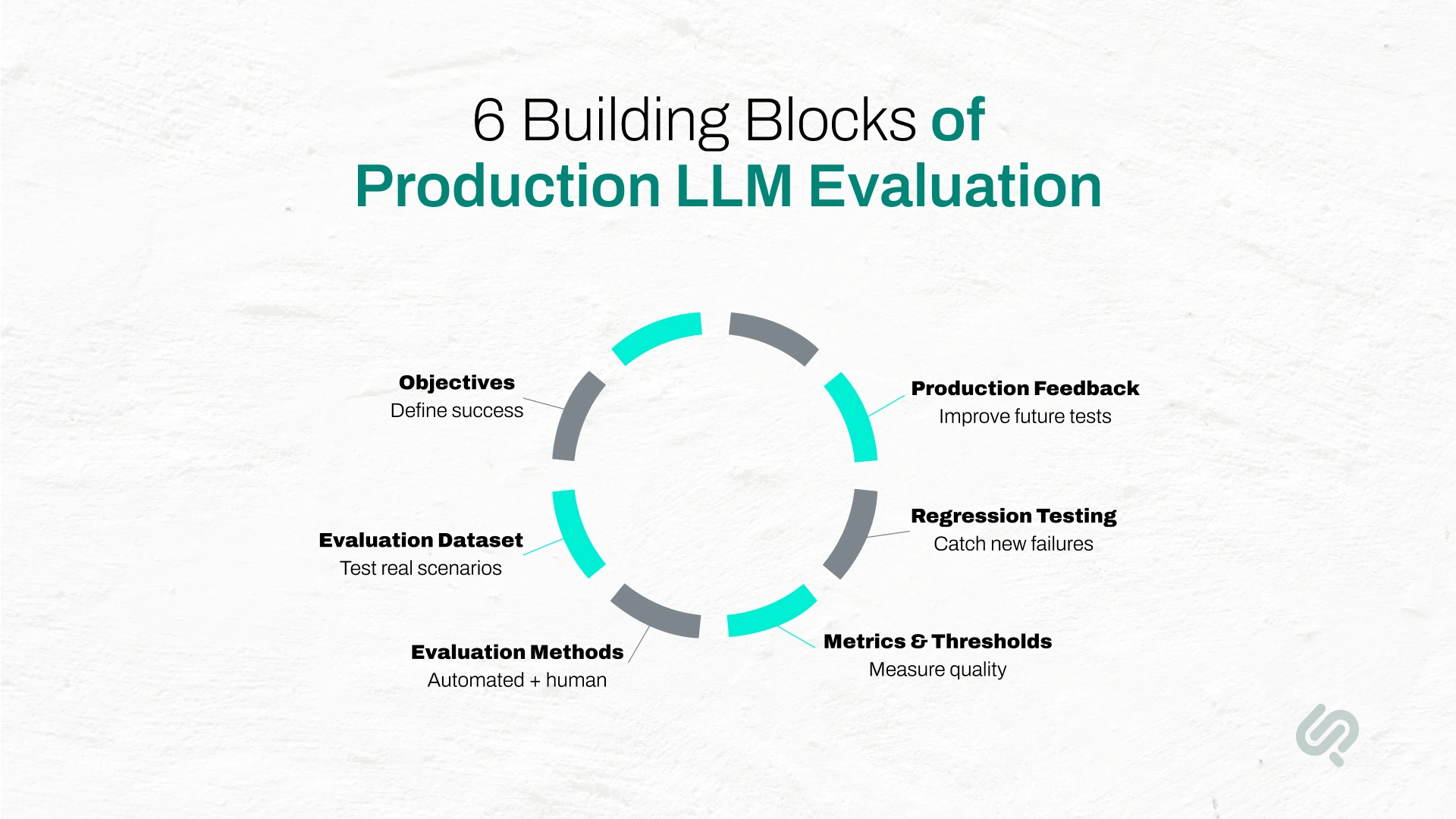
Production LLM evaluation usually combines six components. Together, they create a repeatable way to decide whether an AI application is improving and whether it is ready to release.
These components should be designed around the application's actual business task and risk level.
A customer-support assistant, for example, may prioritize grounded answers and policy compliance. An AI agent may require stronger testing around task completion, tool selection, permissions, and workflow accuracy.
Building an LLM evaluation framework starts with defining what good performance looks like and ends with continuously testing real production behavior.
The seven steps below help teams create a repeatable process for evaluating LLM applications, RAG systems, and AI agents before and after deployment.
Start by defining the exact business task the LLM application must perform and the quality standards it must meet. Include expected accuracy, response time, safety requirements, and when human review is required.
Example: A customer-support assistant must answer refund questions using approved policies, avoid unsupported claims, escalate exceptions, and respond within five seconds.
List the ways the LLM application could fail during real use. These failure scenarios should directly shape your test cases and LLM evaluation dataset.
Example: A RAG assistant might retrieve the wrong document, generate an unsupported answer, or use outdated information. An AI agent might select the wrong tool, skip a required step, or fail to complete the task.
Create a dataset that reflects how real users will interact with the system. Include normal requests as well as edge cases, adversarial prompts, ambiguous inputs, and previously discovered failures.
Example: A support chatbot dataset could include common refund questions, incomplete requests, unusual customer situations, prompt-injection attempts, and real queries that previously produced incorrect answers.
Choose LLM evaluation metrics based on the application's purpose rather than measuring everything available. Focus on metrics that reveal whether the system is accurate, reliable, safe, and completing its intended task.
Example: A RAG system may track context precision, context recall, faithfulness, and answer relevance, while an AI agent may prioritize task completion, tool accuracy, policy compliance, and step efficiency.
Use multiple evaluation methods because no single scoring approach works for every LLM output. Automated checks provide scale, while human reviewers add judgment for subjective, complex, or high-risk responses.
Example: Deterministic tests can validate structured outputs, LLM-as-a-judge can score relevance and quality at scale, and domain experts can review sensitive financial, healthcare, or legal responses.
Define clear pass/fail thresholds for your most important metrics and run the same evaluation suite whenever the system changes. LLM regression testing helps prevent improvements in one area from introducing failures elsewhere.
Example: A release may require at least 95% task completion, a minimum faithfulness score of 0.90, zero critical safety failures, and latency and cost within defined production limits.
Continue LLM evaluation after deployment because real users will reveal scenarios that offline testing cannot fully predict. Review important failures and add them to the evaluation dataset for future regression testing.
Example: If a production chatbot gives an incorrect answer to a new refund scenario, add that interaction as a test case, fix the issue, and verify that future releases pass the same test.
Continuous evaluation cycle:
Production failure → Review → New test case → Fix → Regression test → Deployment
A strong LLM evaluation framework measures more than whether an answer is correct. The right LLM evaluation metrics should reflect the application's quality, reliability, safety, performance, and business requirements.
The right metric set depends on the use case. A RAG application may prioritize faithfulness and retrieval quality, while an AI agent may focus more on task completion and tool accuracy.
Teams should prioritize a small set of metrics tied to real product outcomes rather than tracking dozens of scores that do not influence release decisions.
LLM evaluation methods can be divided into reference-based and reference-free approaches, depending on whether a correct answer or ground truth is available.
Reference-based evaluation compares the LLM output with a known correct answer.
Common methods include exact match, precision and recall, semantic similarity, BLEU, ROUGE, and LLM-based comparison.
Best for: Q&A, extraction, classification, and tasks with clear expected answers.
Reference-free evaluation is used when there is no single correct answer. Instead, the output is scored based on qualities such as relevance, helpfulness, coherence, safety, tone, and instruction adherence.
Best for: Chatbots, summarization, content generation, and open-ended tasks.
LLM-as-a-judge is commonly used for reference-free evaluation because it can score subjective outputs at scale.

LLM-as-a-judge uses a language model to evaluate another LLM’s output against defined criteria such as correctness, relevance, safety, or instruction adherence. It is especially useful for scoring large volumes of open-ended responses where exact-match metrics are not suitable.
A reliable LLM-as-a-judge setup should include:
“LLM-as-a-judge is useful when it helps teams make better release decisions, but the evaluator also needs to be tested. We calibrate automated scoring against human judgment instead of assuming the judge model is always right.”
— Hammad Maqbool, Head of AI & ML, Phaedra Solutions
Example: A judge model can score whether a customer-support response answers the question accurately using only approved company information.
LLM-as-a-judge can make LLM evaluation faster and more scalable, but it should not fully replace human review for high-risk or subjective decisions.
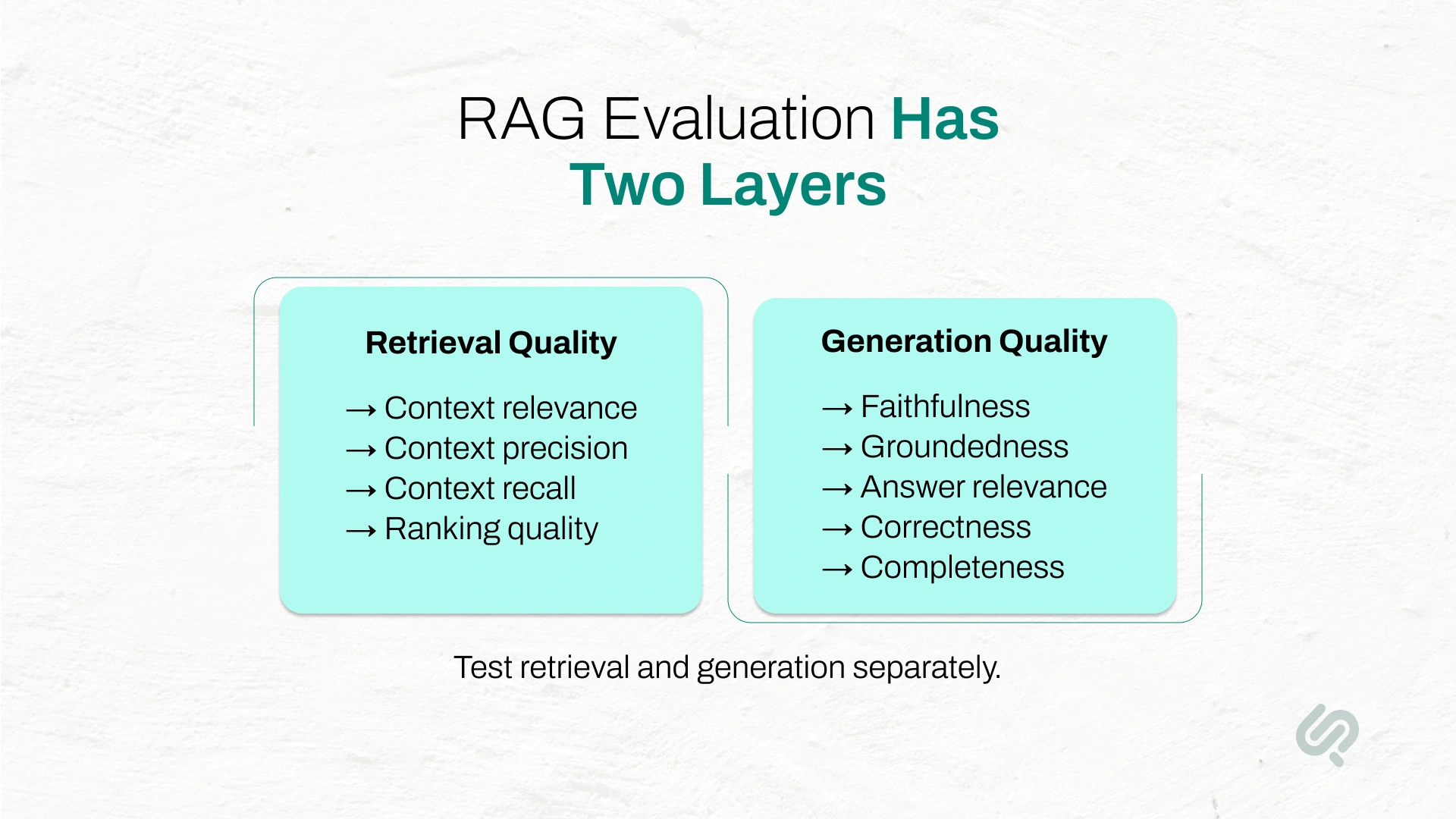
RAG evaluation measures both the quality of retrieved information and the accuracy of the final generated answer. Testing only the response can hide problems in the retrieval pipeline.
Retrieval metrics determine whether the RAG system finds the right information.
Common metrics include:
Generation metrics determine whether the LLM uses the retrieved information correctly.
Common metrics include:
Example: A RAG chatbot may retrieve the wrong policy document even if its final answer sounds convincing.
Testing retrieval and generation separately helps teams identify whether failures come from the search system or the language model.
Evaluating one response at a time is not enough for chatbots, copilots, and conversational AI applications.
A system may give good individual answers but still fail across a longer conversation.
Multi-turn LLM evaluation should test whether the application can:
Teams should also measure conversation-level latency and cost. Inference latency is especially critical when those conversations are happening in real time, because a noticeable delay before the first reply changes how users feel about the assistant's competence.
For example, an assistant that completes a support request in three turns may be more useful and cost-efficient than one that needs eight turns to reach the same result.
The evaluation should therefore measure the quality of the complete user journey, not only the final message.
AI agent evaluation measures both whether an agent completes a task and whether it follows the correct process. This is important because AI agents can retrieve data, call tools, use APIs, and make multiple decisions before producing a final result.
A strong LLM agent evaluation framework should assess:
Example: An AI support agent may complete a refund successfully but still fail evaluation if it skips a required identity-verification step.
For AI agents, evaluating the execution path is as important as checking the final output, especially in healthcare, finance, legal, and other high-risk workflows. Verifiers inside rl environments score every step so teams can see which tool calls, transitions, or escalations need to be retrained before release.
Quality evaluation asks whether an AI system works.
Safety evaluation asks whether it remains trustworthy when something goes wrong—or when a user intentionally tries to break it.
Important tests may include:
Red-team cases should be included in pre-launch evaluation, while production monitoring should look for emerging attacks and failure patterns.
Customer-facing and autonomous AI systems generally require broader safety coverage than low-risk internal tools with mandatory human review.

Phaedra Solutions built an AI-powered healthcare data intelligence solution that connects EHR extracts, scheduling information, claims, and financial data in one conversational interface. Healthcare teams can ask questions such as “Denials by payer last week?” and receive plain-English answers generated from the underlying data instead of relying on spreadsheets, static dashboards, or analyst-written queries.
For a multi-site outpatient network, the solution reduced analyst reporting requests by 70–80%, delivered answers in under 60 seconds, and enabled same-day scheduling and staffing adjustments. The result was faster operational decision-making, fewer unfilled appointment slots, and more predictable reimbursement across clinics.
Evaluation should operate throughout the product lifecycle.
Offline and online evaluation should not exist as separate systems.
The strongest approach connects them.
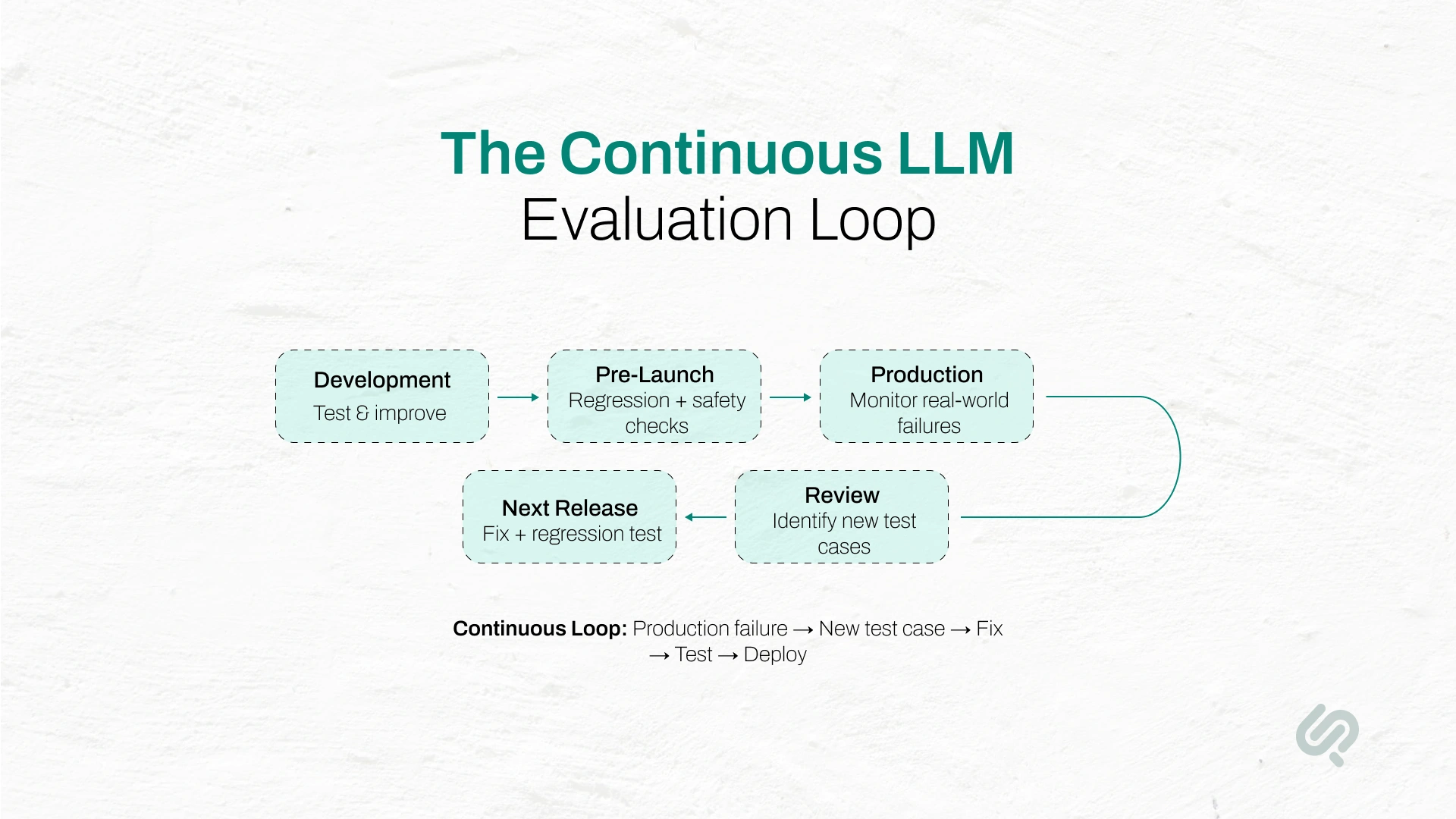
Production evaluation should be continuous, but that does not mean every interaction needs the same type of evaluation.
The right coverage depends on application risk, user volume, failure cost, evaluation cost, and compliance requirements.
A practical production evaluation strategy can combine:
You do not need to evaluate every production interaction with an expensive judge model.
The goal is to collect enough evidence to identify quality problems without making the evaluation process slower or more expensive than the application can support.
Important production failures should also become new test cases.
Production failure → Review → New test case → Fix → Regression test → Deployment
This keeps the evaluation dataset aligned with how users actually interact with the product.
These terms are often used together, but they solve different problems in production AI.
Most production AI applications need more than one.
Evaluation tells you whether the system meets your quality requirements. AI observability helps you understand why something failed. Guardrails can stop specific unsafe or invalid actions while the application is running.
The right combination depends on the application. A low-risk internal assistant may need basic evaluation and monitoring, while an AI agent connected to financial, healthcare, or customer systems may require evaluation, tracing, security testing, and strict runtime controls.
There is no single best LLM evaluation tool for every application.
The right option depends on whether you are evaluating RAG, AI agents, prompts, security, production behavior, or complete AI workflows.
Before selecting an evaluation platform or framework, ask:
For production systems, one platform may not cover every requirement.
For example, a team may use one tool for automated regression testing and another for production tracing and AI observability.
Choose the evaluation strategy first and the tool second. A powerful platform cannot compensate for weak test data, unclear quality requirements, or metrics that do not reflect real user outcomes.
Common mistakes can make LLM evaluation less reliable and hide important production risks.
Build internally when your organization already has experienced AI engineering, QA, data, security, and platform teams and expects evaluation infrastructure to become a permanent internal capability.
Consider an AI development and evaluation partner when:
The goal should not be to outsource judgment permanently. It should be to establish a repeatable process your product team can continue using as the system evolves.
LLM quality should be measurable before a product reaches real users—not discovered through support tickets after release.
Phaedra Solutions builds evaluation directly into its AI development services, helping teams develop and validate generative AI applications, RAG systems, and AI agents against real business, quality, safety, performance, and cost requirements.
Our AI-first delivery process uses tools such as Claude and Cursor alongside AI-assisted engineering, automated test generation, and AI-powered QA under senior engineering review.
Depending on project size, complexity, and implementation scope, this approach can improve development speed, cost efficiency, and resource utilization by 30% to 80%, including 60%–80% faster development timelines, 30%–50% cost-efficiency improvements, and 30%–80% reductions in required team size for highly automated implementations.
If you are moving an AI PoC into production or improving an existing AI product, the next step is to define what success looks like and build evaluation into the delivery process from the start.



Ameena is a content writer with a background in International Relations, blending academic insight with SEO-driven writing experience. She has written extensively in the academic space and contributed blog content for various platforms.
Her interests lie in human rights, conflict resolution, and emerging technologies in global policy. Outside of work, she enjoys reading fiction, exploring AI as a hobby, and learning how digital systems shape society.