










Forward deployed engineering services embed senior engineers directly with a company's business and technical teams to turn complex software or AI initiatives into production-ready systems.
Unlike consulting or staff augmentation, FDE (forward deployed engineering) teams combine discovery, architecture, hands-on development, integration, testing, deployment, and knowledge transfer, owning the last-mile execution gap between a promising idea and a working business outcome.
They are an embedded engineering model where senior technical specialists work directly with a company's teams, systems, data, and workflows. The goal is to take a difficult software or AI initiative from problem discovery through production deployment.
Companies typically get technical discovery, solution architecture, production code, system and data integrations, testing, deployment support, monitoring, documentation, and knowledge transfer. The exact deliverables should be tied to a defined business outcome.
There is no standard FDE price. Cost depends on team size, engagement length, system complexity, integrations, security requirements, and whether the work uses a fixed-scope pilot, dedicated engineer, cross-functional pod, or ongoing delivery model.
Use FDE when the problem still requires discovery and the team must also build and deploy the solution. Consulting is better when you mainly need advice, while staff augmentation is better when the requirements are already clear and you simply need additional capacity.
A focused deployment can often be structured in weeks, while complex enterprise programs may continue through several phases. The right timeline depends on integration complexity, approvals, data readiness, security requirements, and how much of the solution already exists.
Three characteristics make the model different from conventional outsourcing or implementation support:
This customer-embedded engineering model is particularly useful when an AI pilot, enterprise integration, or modernization initiative works technically but still cannot operate reliably inside the business.
The real value is therefore not simply having engineers closer to the customer. It is reducing the distance between discovering a production problem, making a technical decision, implementing the change, and validating whether it actually works.
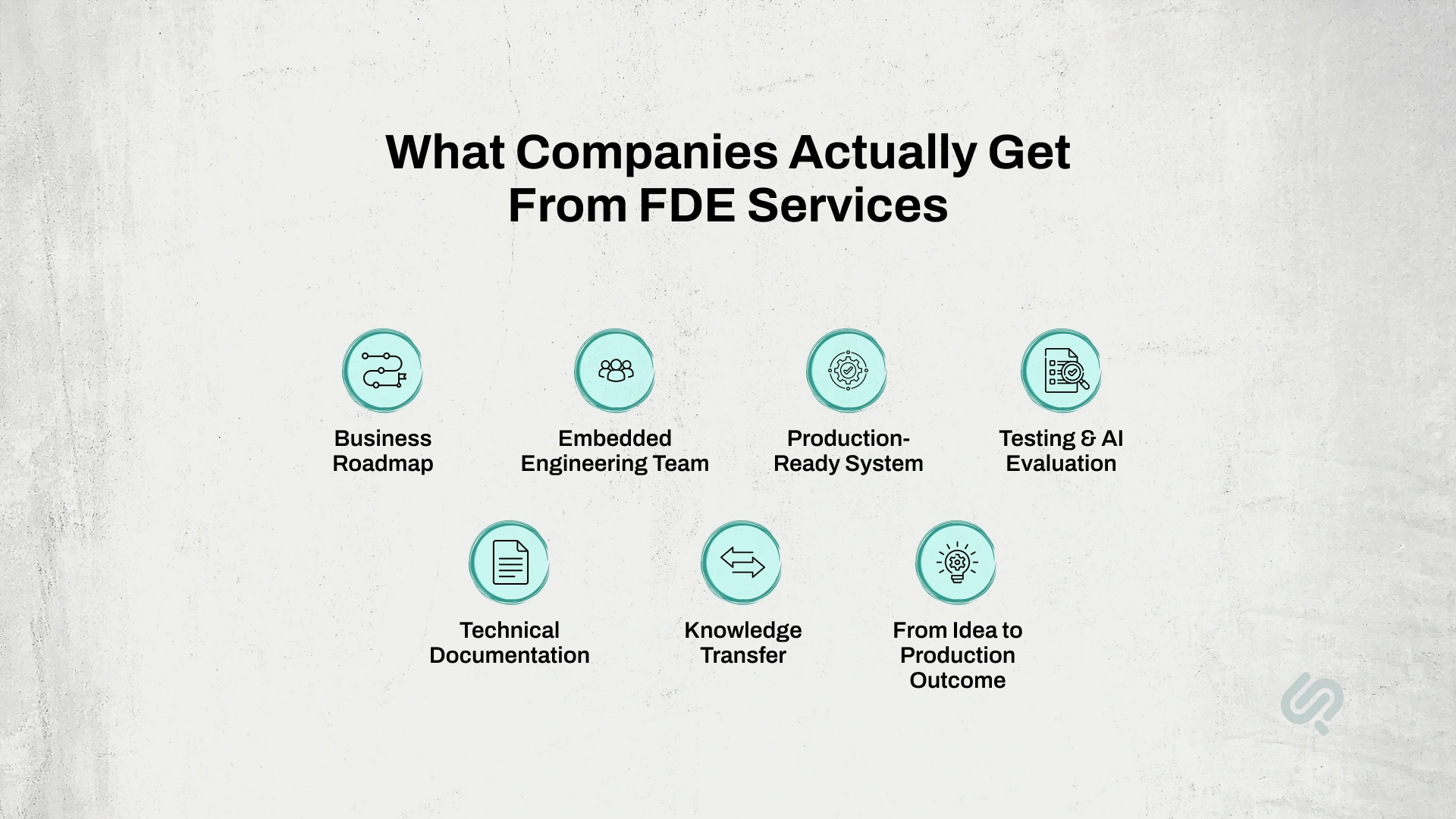
A strong engagement should leave the company with more than added engineering capacity. It should produce a working system, clear ownership, measurable performance, and enough documentation and knowledge transfer for the internal team to continue operating it.
The main value of FDE services is ownership of the gap between an idea and a production outcome.
Companies are not simply hiring engineers for extra capacity; they are bringing in a team that can connect business requirements, technical execution, deployment, and adoption.
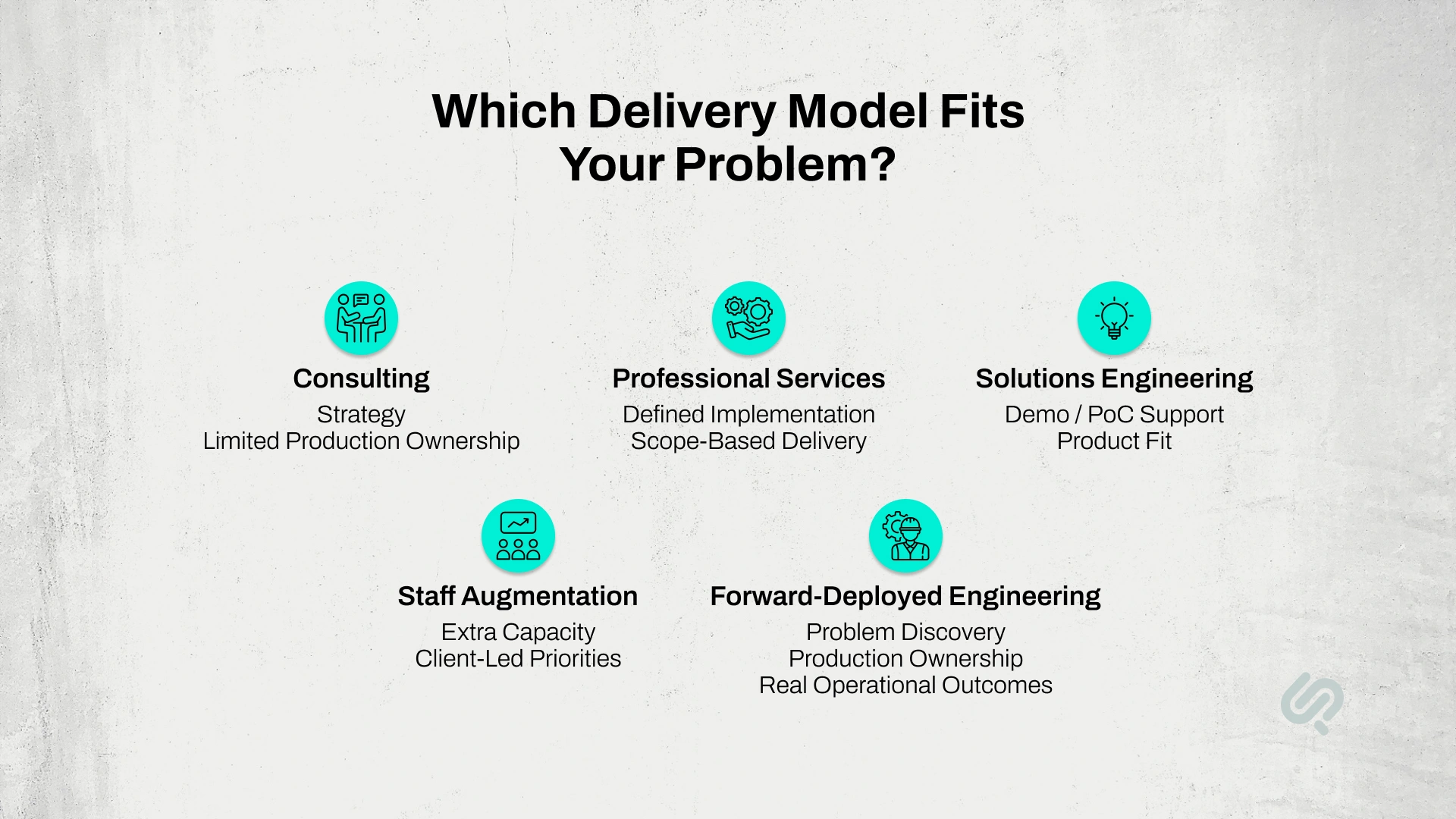
These models can overlap, but they solve different buying problems.
Hiring an FDE is therefore different from simply adding another developer. The buyer is purchasing technical depth, business context, rapid discovery, and execution ownership, not just engineering capacity.
Hiring internally makes sense when forward deployment will become a permanent capability, and the company has enough recurring work to justify dedicated hires.
An external FDE partner is often more practical when speed matters or the project requires multiple technical disciplines immediately.
Consider an external team when:
A dedicated engineer can work well when the internal team already has strong technical capability. A cross-functional pod is usually a better fit when the engagement crosses several systems, disciplines, or business functions.
FDE is valuable, but it is not automatically the best delivery model for every software project.
You probably do not need it when:
In these situations, staff augmentation, conventional implementation services, or an internal development team may provide better economics.
The important buying question is not “Would an FDE help?” It is “Does this problem contain enough operational ambiguity and cross-functional complexity to justify embedded senior engineering?”

A forward deployed team stays involved from the initial business problem through production rollout and handover. Instead of separating strategy, development, integration, and deployment across multiple teams, one embedded team maintains context as the solution moves toward production.
The stages overlap with the broader software development lifecycle, but FDE keeps business context and execution ownership with the same embedded team throughout.
The team first identifies the workflow being improved, the users affected, and the KPIs that will determine success. For an AI support system, this might include resolution rate, response time, escalation rate, cost per ticket, or customer satisfaction.
Engineers map APIs, databases, cloud infrastructure, identity systems, permissions, security requirements, and existing workflows. This often exposes production blockers such as poor data quality, undocumented processes, legacy integrations, or inconsistent access controls.
Before committing to a larger build, the team tests the areas most likely to fail. In AI deployments, this may include retrieval quality, model accuracy, tool calling, latency, cost, human approvals, and permissions.
The team connects live systems and adds the authentication, logging, monitoring, error handling, infrastructure, integrations, and CI/CD required for real users.
Testing covers more than the happy path. Engineers validate how the system behaves when data is missing, APIs fail, traffic increases, permissions are insufficient, or an AI system produces a low-confidence result.
After launch, the team measures real usage, fixes operational issues, documents architecture and known failure cases, and transfers knowledge to the internal team.
The result should be more than deployed code. A mature engagement leaves behind a measurable, maintainable system that the business understands how to operate and extend.
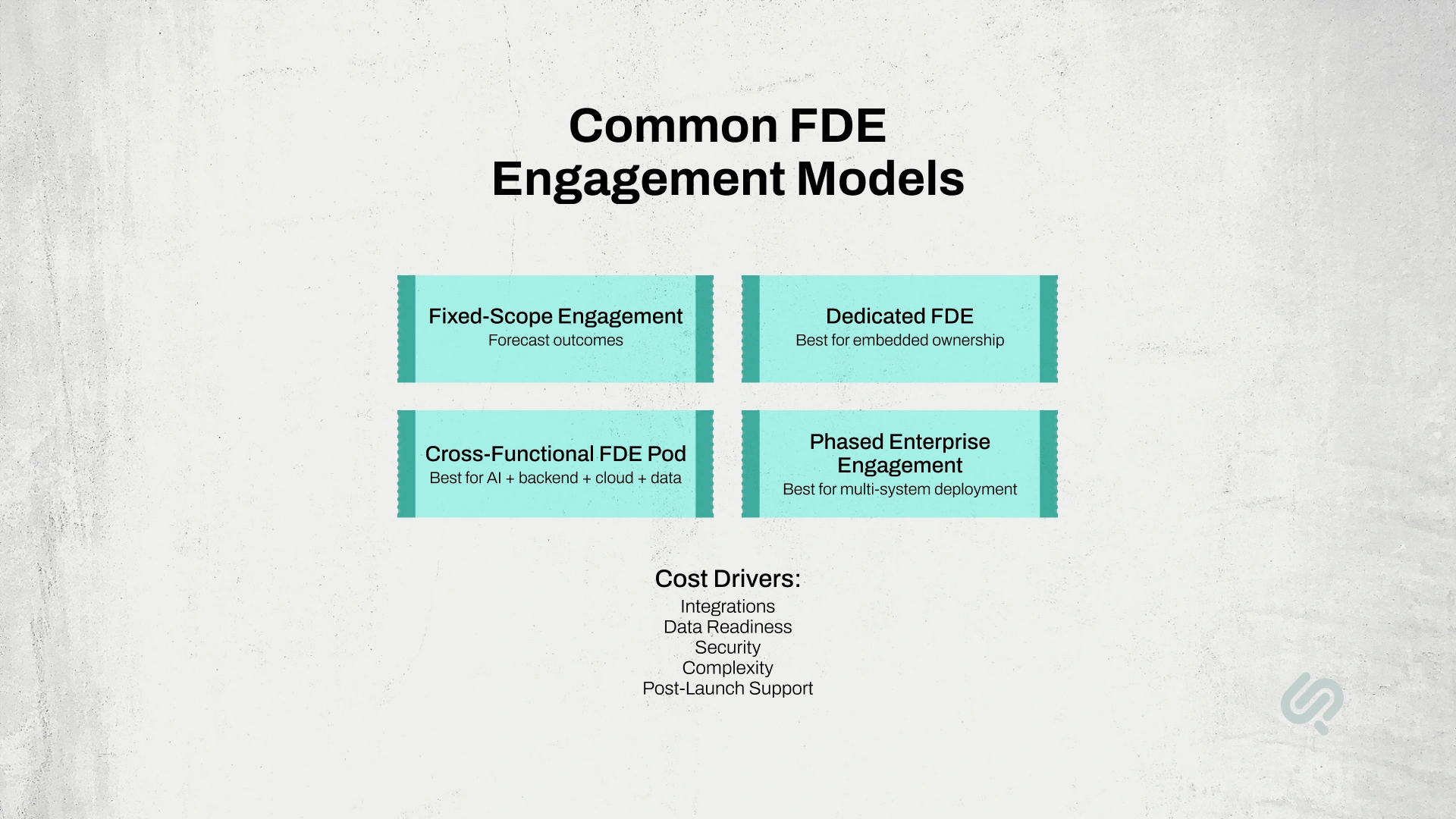
There is no universal FDE pricing model because the buyer is purchasing an outcome-oriented delivery model rather than a standardized job role.
Best for a specific workflow, integration, or stalled AI pilot.
Define:
Best when an internal engineering team already exists but needs one senior technical owner close to the business problem.
Define:
Best for AI and enterprise projects that require several skills at once, such as AI, backend, cloud, data, QA, and DevOps.
The pod works as one embedded unit rather than forcing the client to coordinate several disconnected specialists.
Best for complex enterprise AI deployment across multiple systems, workflows, or business units.
Each phase should have clear outcome gates so the business can decide whether to continue, change direction, or scale.
When evaluating FDE as a service, compare providers on outcomes and ownership—not merely hourly rates.
The largest cost drivers usually include:
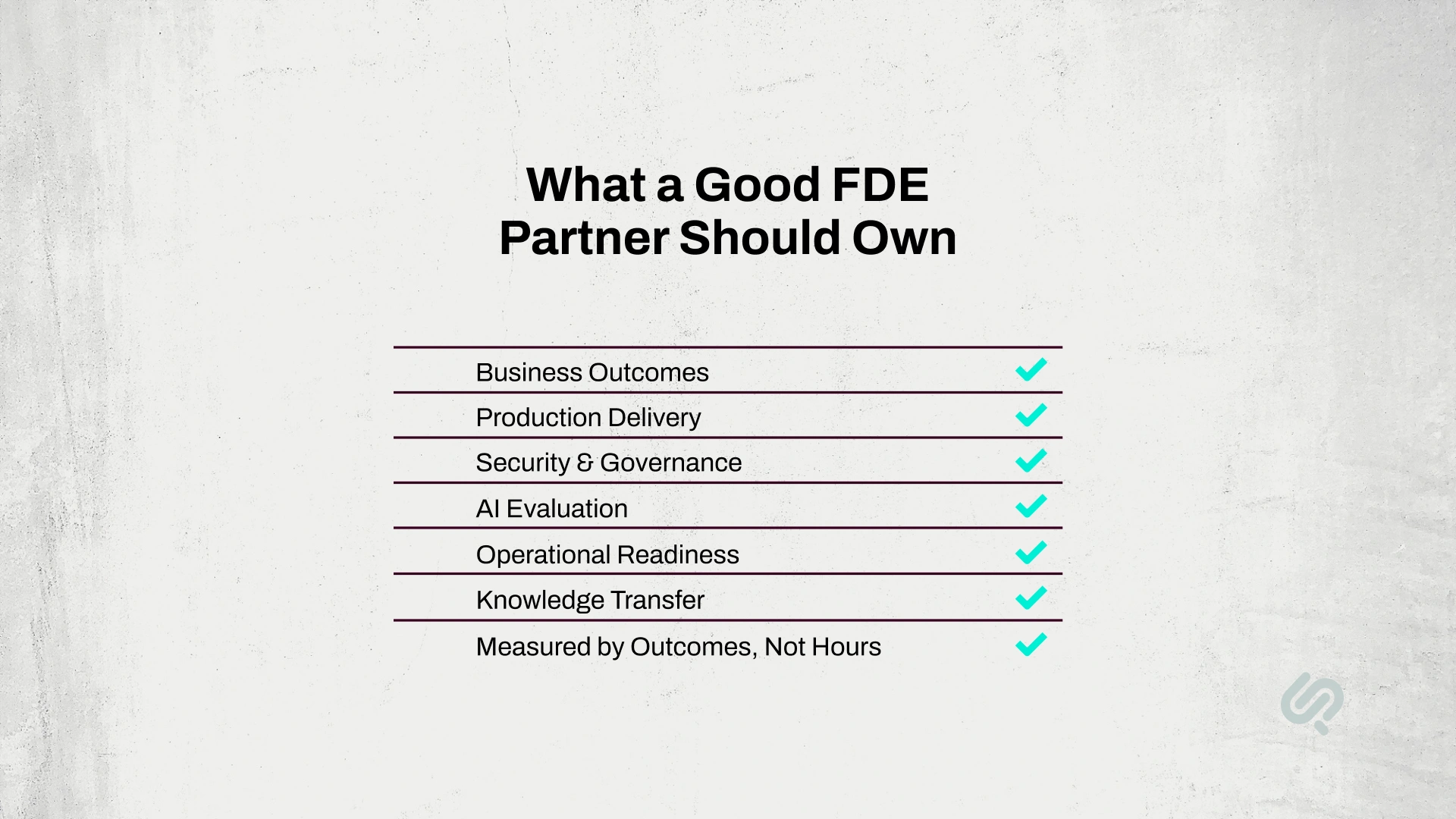
A strong FDE engagement should be judged by production outcomes, not by the number of engineering hours purchased. Before the work starts, both sides should agree on exactly what the team is responsible for delivering.
Gartner found that only 28% of AI use cases in infrastructure and operations fully succeeded and met ROI expectations. Among leaders with at least one successful AI use case, success was primarily attributed to integrating AI into existing workflows and systems and securing strong business support. (2)
A good partner should be accountable for:
This is especially important for AI forward deployed engineering, where technical performance alone does not determine success.
“Agentic AI does not reward companies with the biggest AI ambition. It rewards companies with clean data, connected systems, and clear workflows.”
— Hammad Maqbool, Head of AI & Machine Learning, Phaedra Solutions.
That principle captures the real job of an FDE partner. The engineer is not only improving a model or agent. The team is making the surrounding data, systems, workflows, controls, and operating processes ready for AI to perform reliably in production.
One of the biggest strengths of forward-deployed engineering is also one of its biggest risks: engineers can respond extremely quickly to what users and enterprise customers need.
But speed without product and architecture discipline can create technical debt: dozens of one-off integrations, prompts, scripts, workflows, and customer-specific features that become expensive to maintain.
A mature FDE team should separate field requests into three categories:
This distinction matters because the goal of an FDE is not to say yes to every request. It is to solve the operational problem without damaging the long-term product.
Field learning should also flow back into the wider engineering organization. If multiple customers face the same integration, data, workflow, or usability problem, that may be evidence of a reusable capability the core product should support.
Before choosing an FDE partner, ask:
A good engagement should leave behind more reusable knowledge and capability, not simply more custom code.
The rise of forward deployed engineering is closely tied to the gap between AI experimentation and production adoption.
McKinsey’s 2025 State of AI survey found that 88% of respondents said their organizations use AI in at least one business function, yet only about one-third said their companies had begun scaling AI programs. (3)
That gap usually appears when a successful prototype has to work with real data, internal systems, security controls, users, and business processes. This is where embedded AI engineers and FDE teams add the most value.
Common enterprise blockers include:
The market is responding to this need. AWS announced a $1 billion investment in June 2026 (4) to build a dedicated FDE organization with thousands of engineers working directly with customers.
For buyers, the important signal is not the title itself. It is the growing need for engineers who can connect AI to proprietary data, workflows, infrastructure, governance, and measurable business outcomes.

A security technology client needed more than an AI model. Existing surveillance required significant manual video review, cameras were distributed across locations, and the new system needed to work with IP cameras and access-control infrastructure while supporting real-time monitoring and secure remote access.
Phaedra Solutions built an AI cloud surveillance platform for web and mobile use with real-time camera monitoring, OpenAI-powered search, face detection, historical tracking, AI analytics and existing-system integrations. The platform used AWS and Docker for deployment and included CI/CD, performance testing, security testing and iterative user feedback.
The project illustrates the delivery pattern buyers should expect from an FDE-style AI engagement: understand the operating environment, connect the AI to real systems, test production conditions and keep iterating until the technology can be used reliably in day-to-day operations.
Choose a forward deployed engineering company based on its ability to own delivery from discovery through production—not simply its ability to provide engineers.
Look for:
If you plan to outsource forward-deployed engineering, ask one question early:
Who owns the outcome when the problem crosses multiple teams, technologies, or systems?
A strong provider should be able to answer without pointing responsibility back at the client.
Phaedra Solutions provides forward deployed engineering services that combine embedded senior engineers with an AI-first delivery approach. We support discovery, development, integration, testing, deployment, and knowledge transfer while using tools such as Claude and Cursor to reduce repetitive work and accelerate delivery.
Depending on project complexity and automation potential, this approach can support 60–80% shorter timelines, 30–50% better cost efficiency, and 30–80% smaller delivery teams.
If your AI or software initiative is stuck between a promising concept and reliable production use, book a free consultation with our forward deployed engineering team to define the clearest path forward.



Ameena is a content writer with a background in International Relations, blending academic insight with SEO-driven writing experience. She has written extensively in the academic space and contributed blog content for various platforms.
Her interests lie in human rights, conflict resolution, and emerging technologies in global policy. Outside of work, she enjoys reading fiction, exploring AI as a hobby, and learning how digital systems shape society.