

.webp)


.webp)
.webp)
.webp)






Custom AI application development in 2026 costs anywhere from $15,000 for a focused MVP to $1 million or more for a full enterprise AI system.
The range is wide because the scope behind each project is different a customer-facing AI chatbot, an AI-powered mobile app, and an enterprise predictive analytics platform each require a different level of data preparation, model integration, cloud infrastructure, and post-launch support.
Most pricing guides give you a number. This guide gives you the breakdown behind it.
You'll learn what drives your AI app development budget from AI data preparation expenses and cost of training AI models to AI infrastructure and cloud costs, integration, security, and AI deployment and maintenance costs.
Whether you're planning your first AI product or scaling an existing one, this guide helps you build a realistic budget before the first conversation with a development team.
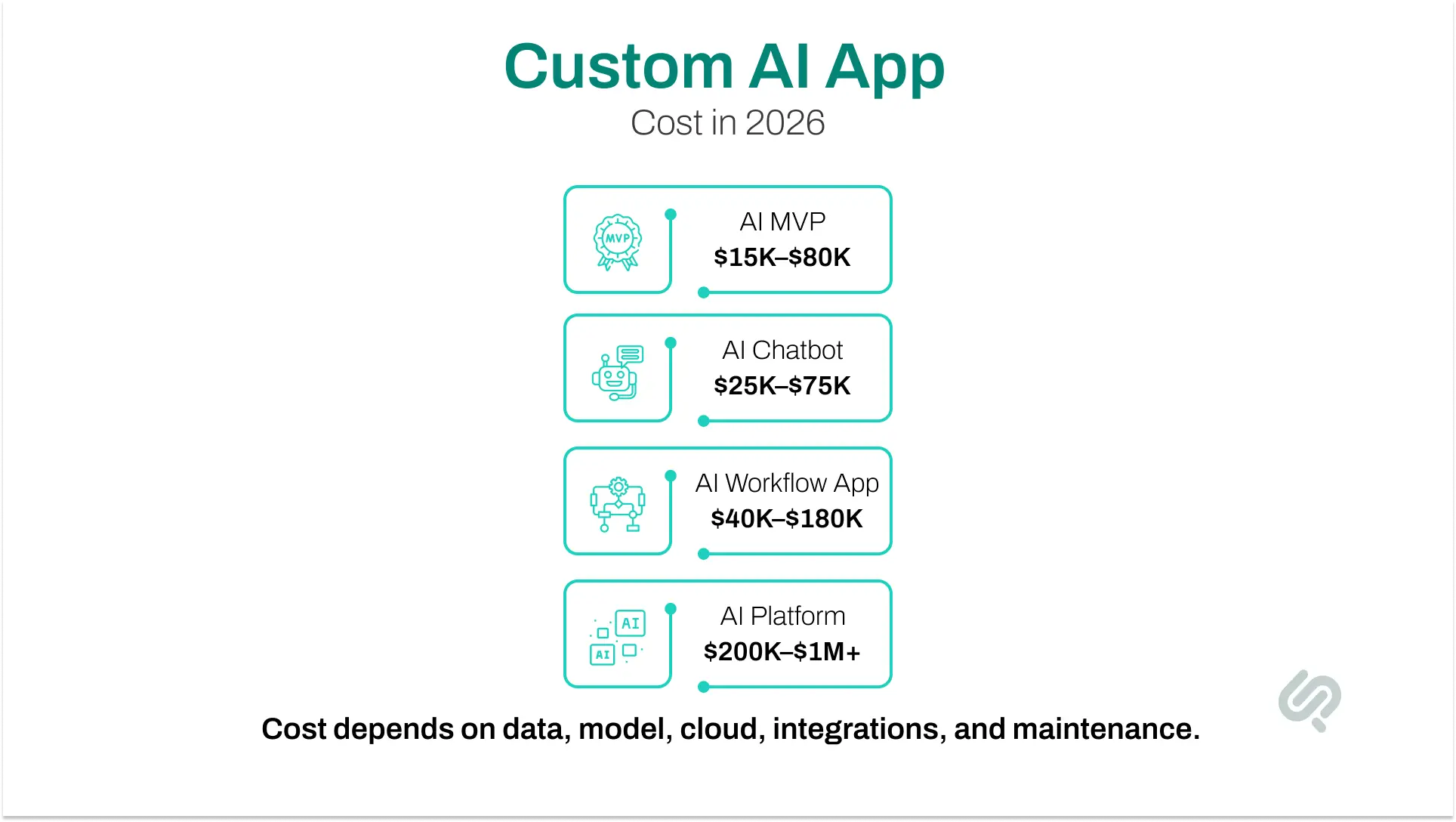
Most custom AI apps cost between $15,000 and $500,000+. A focused MVP or AI chatbot using existing APIs typically falls in the $15,000–$80,000 range. Enterprise AI platforms with custom models, integrations, and compliance requirements cost $200,000–$1 million or more.
Custom model training and data preparation. Preparing clean, labeled datasets and running GPU-intensive training can account for 40–60% of total project costs. Using pre-built AI APIs (OpenAI, Claude, Gemini) eliminates most of this cost.
Yes and for most businesses, this is the right starting point. Using a third-party AI API like OpenAI or Anthropic Claude, a production-ready AI app can be built for $10,000–$60,000. Custom model training only makes sense when existing models can't meet your accuracy or data control requirements.
The most commonly missed costs are cloud infrastructure, ongoing model monitoring, data licensing, prompt engineering, compliance audits, and post-launch retraining. These can add 20–35% to your annual budget after launch.
A focused AI MVP takes 3–6 months. A full-featured, production-grade AI application typically takes 8–18 months, depending on data complexity, model approach, integrations, and team size.
Fine-tuning adapts an existing model (like GPT or LLaMA) to your specific data, improving accuracy for your use case at a fraction of the cost of training from scratch. Custom training builds a model entirely on your data — necessary only when no existing model meets your requirements. Fine-tuning costs $40,000–$200,000; custom training starts at $200,000 and can exceed $1 million.
Before looking at pricing, the more important question is whether custom AI development is the right move at all. The answer depends on your business goals, your data, and how much competitive advantage the AI layer needs to deliver.

The honest reality: most businesses start with off-the-shelf tools and move to custom AI solutions once they know exactly where AI adds the most value. Starting custom from day one is only the right call when you already have clear data, a defined use case, and a business case that justifies the investment.
"The biggest mistake we see is businesses jumping straight into custom model development before they've validated the use case. An AI-first approach doesn't mean building the most complex thing first it means building the right thing, in the right order, with the right data."
— Hammad Maqbool, Head of AI, Phaedra Solutions
If you are unsure where you fall, a scoping session with an experienced AI app development company will clarify faster than any guide. The goal is to define the right scope before a single dollar is spent on development.
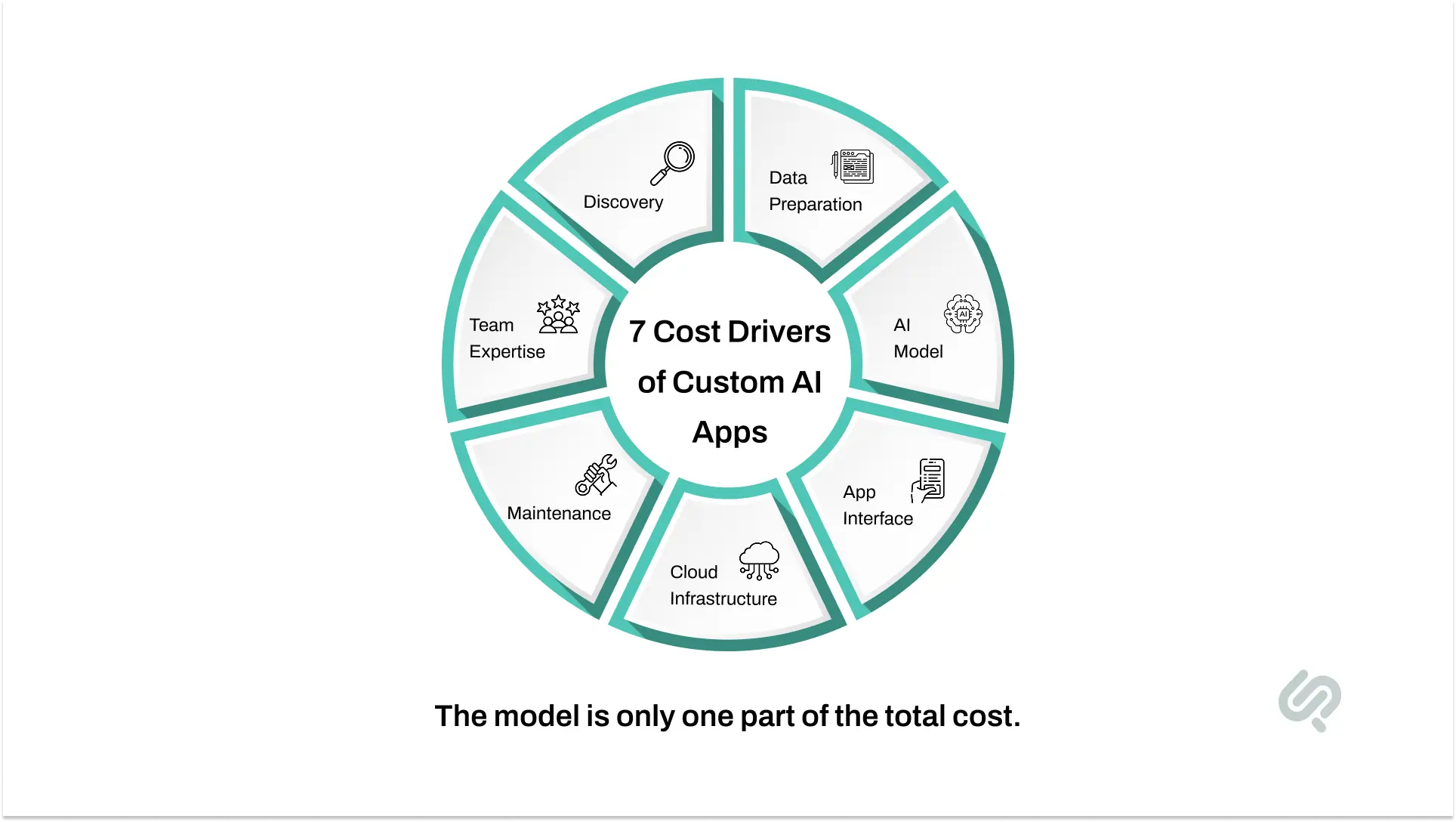
The cost of a custom AI app depends on more than the AI model. The business goal, data quality, app features, model approach, cloud setup, security needs, and post-launch maintenance shape your final budget.
That is why custom AI application development can range from a focused AI MVP to a full enterprise platform.
A simple chatbot may only need an AI API and a clean interface. A larger AI product may need data pipelines, model fine-tuning, mobile apps, dashboards, integrations, monitoring, and compliance.
Here are the main pricing factors in AI development that affect your total AI app development budget.
Before development starts, a good team defines what the AI app should do, who will use it, what data is available, and what version should be built first.
This phase usually includes:
Skipping discovery often leads to wrong features, poor model choices, unclear costs, and expensive rework. This is where smart teams reduce risk before the build begins.
Typical cost: $5,000–$25,000
Data is one of the highest hidden costs of AI projects. AI apps need clean, structured, and useful data to give reliable results.
AI data preparation expenses may include:
Data costs rise when your app uses large datasets, unstructured files, manual labeling, private customer data, or compliance-heavy information.
Cost-saving tip: Start with the cleanest internal data you already have, such as customer records, support tickets, order history, product data, or transaction logs.
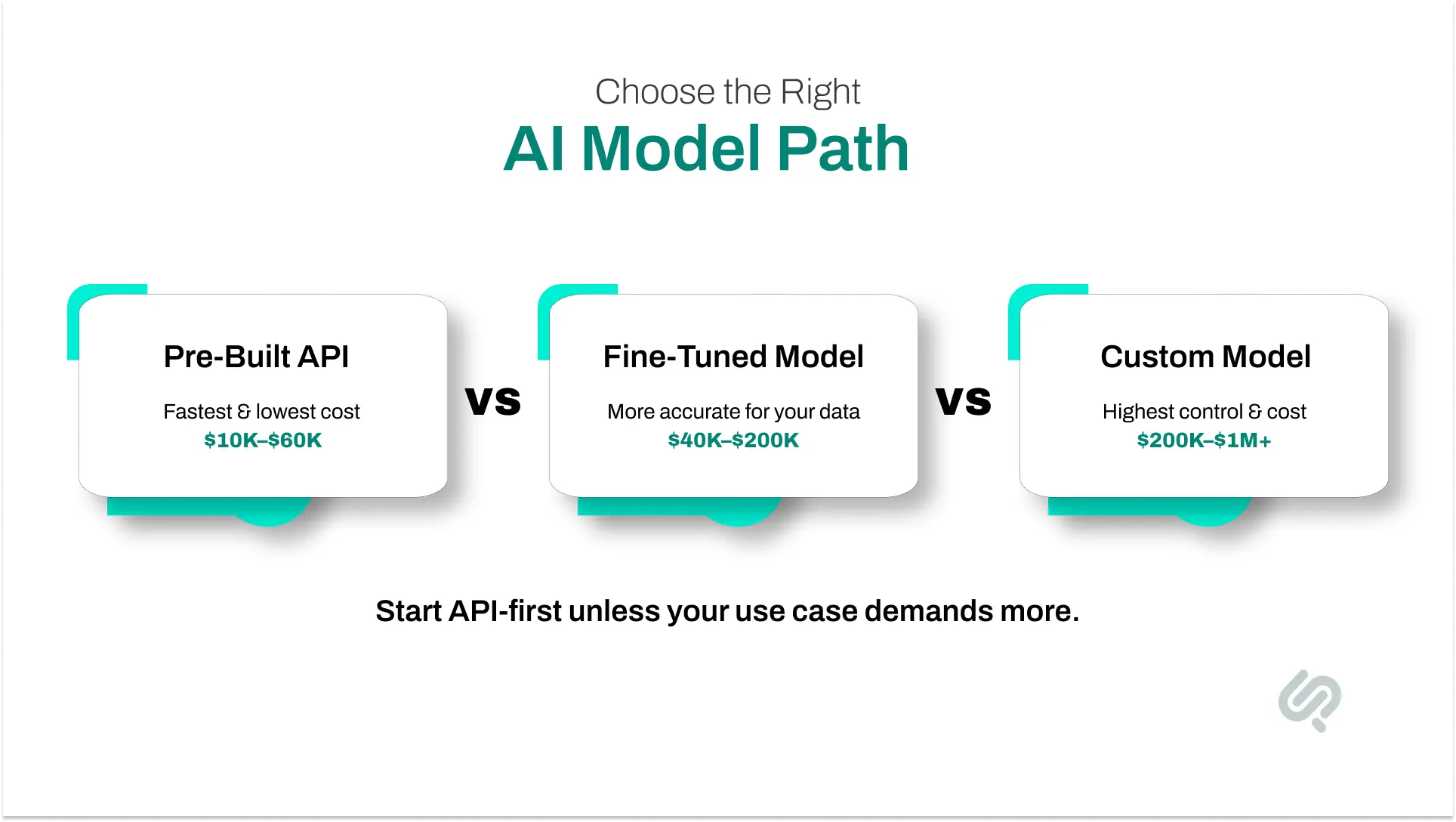
The AI model is the intelligence layer of the product. The cost of training AI models or integrating existing models depends on how custom the AI needs to be.
Option A: Pre-Built AI API
This is the fastest and most affordable option. Your app connects to an existing AI model through an API.
Best for:
This is usually the best first step if you want to reduce AI development costs and launch faster.
Option B: Fine-Tuned AI Model
Fine-tuning means training an existing model on your own business data to improve accuracy, tone, or output quality.
Best for:
Option C: Custom Model From Scratch
Training a custom model from zero is the most expensive path. It requires large datasets, ML engineers, cloud GPU resources, testing, and long-term monitoring.
Best for proprietary AI products where existing models cannot meet the required accuracy, control, or business value.
For most businesses, starting with an existing model is the smarter and more cost-effective path.
The AI model is only one part of the product. Users still need a web app, mobile app, dashboard, chatbot, admin panel, or workflow interface.
This part includes:
The mobile app development cost increases when the app needs real-time AI responses, camera access, voice input, file uploads, push notifications, offline access, or native device features.
App costs also rise with dashboards, payments, CRM/ERP integrations, multiple user roles, multi-language support, and advanced security.
Many businesses plan for development but forget the monthly cost of running the AI app.
AI infrastructure and cloud costs may include:
Typical Monthly Cloud Costs:
Costs rise with more users, longer prompts, larger files, real-time responses, heavy model usage, and high storage needs.
To control costs, use response caching, usage limits, smaller models for simple tasks, auto-scaling, prompt optimization, and monthly usage tracking.
AI apps need regular updates after launch. They are not “set and forget” products.
AI deployment and maintenance costs usually include:
A practical rule is to budget 15%–25% of the initial build cost per year for maintenance.
So, if your AI app costs $200,000 to build, plan around $30,000–$50,000 per year for support, updates, and optimization.

Your team has a major impact on the final price. A serious AI app may need:
Typical AI Development Team Rates:
A lower-cost team may reduce the first quote, but weak architecture, poor data handling, bad QA, or unstable infrastructure can increase the real cost later.
Here is what custom AI app development costs can look like for different business use cases in 2026.
These examples show why the cost of a custom AI app depends heavily on the use case. A customer support chatbot is usually faster and cheaper because it can use an existing AI API.
Most AI pricing guides focus on the build cost, but the real budget often grows after the project starts. These are the hidden costs of AI projects that business and tech teams should plan for early.
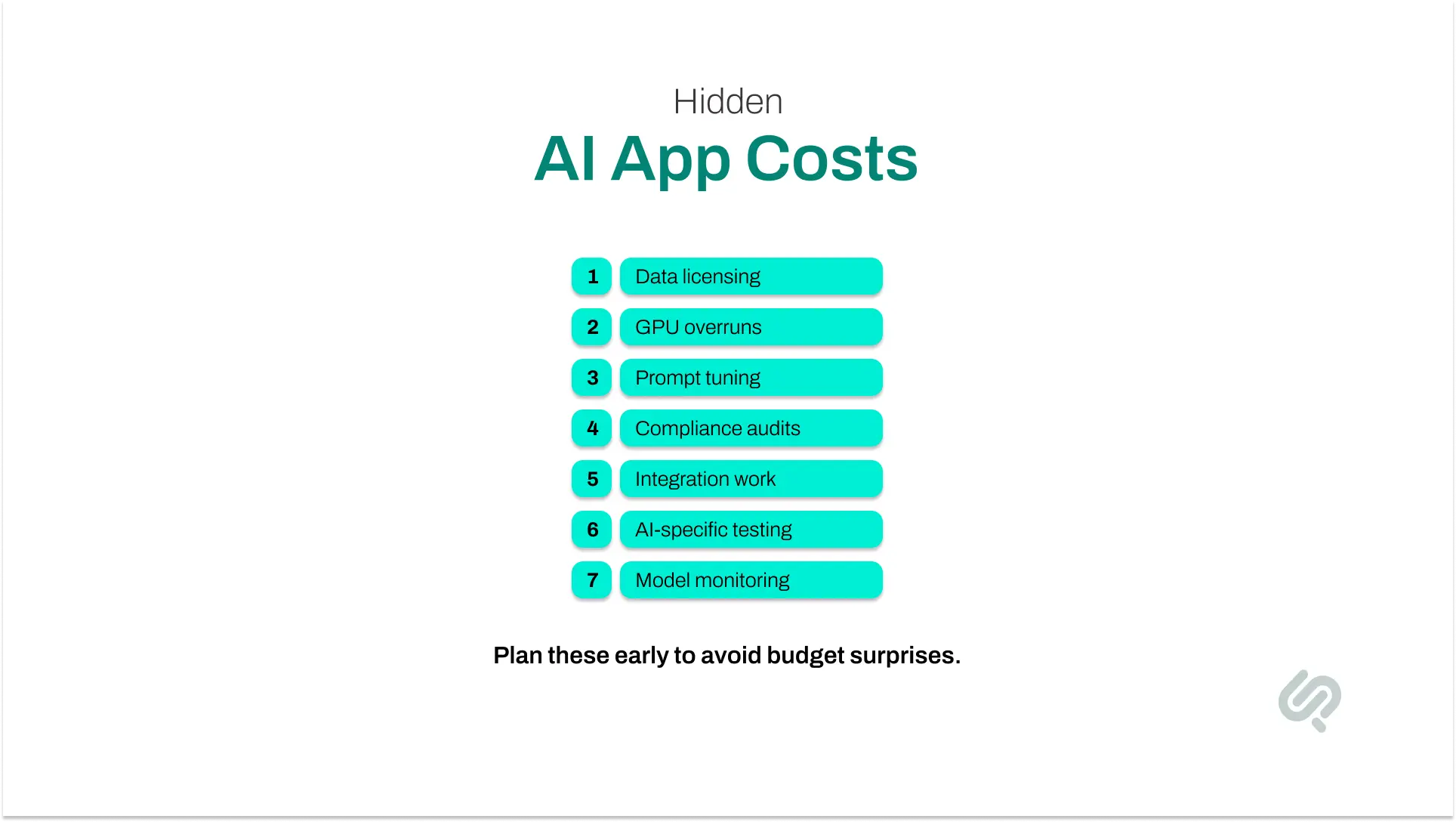
If your AI app needs external training data, you may need to pay for licensed datasets. Medical imaging data, financial data, legal databases, and industry-specific datasets can cost $5,000–$100,000+.
AI development often requires testing many model versions before one works well. These experiments can increase GPU and cloud bills by 30%–50%, especially during training, fine-tuning, or performance testing.
For API-based AI apps, prompt design is not a one-time task. Production-ready prompts usually need testing, refinement, guardrails, and output formatting. This can add 80–200 engineering hours to the project.
AI apps that handle personal, medical, financial, or business-sensitive data may need security audits, penetration testing, privacy reviews, and legal checks. Depending on the industry, this can add $10,000–$50,000.
Connecting an AI app with Salesforce, SAP, HubSpot, payment systems, CRMs, ERPs, or legacy databases often takes more time than expected. These integrations can increase the final AI app development cost if they are not scoped early.
AI apps need more than normal bug testing. Teams must test for inaccurate answers, hallucinations, bias, edge cases, unsafe outputs, and poor user experience. This adds specialized QA time and increases AI deployment and maintenance costs.
Reducing your AI app development budget does not mean cutting quality. It means making smarter technical and business decisions before the expensive work begins.
For most businesses, the best way to reduce AI development costs is to start with an existing AI API. Build the MVP, test real user demand, then decide whether fine-tuning or custom model development is worth the investment.
Open-source models like LLaMA, Mistral, and Falcon can reduce licensing costs. You still pay for compute, setup, hosting, and maintenance, but they can be more cost-effective than proprietary models for certain use cases.
Clean, well-labeled data lowers the risk of poor AI output, failed training runs, and expensive rework. Spending early on data quality can save far more later in debugging, retraining, and user complaints.
MLOps helps you monitor model performance, track errors, manage retraining, control versions, and keep AI systems stable after launch. This reduces long-term AI deployment and maintenance costs.
Do not build every AI feature in version one. Start with one clear business use case, one user group, and one measurable outcome. A focused MVP keeps your custom AI application development cost under control.
If the idea is still risky, start with an AI PoC before building the MVP.
A general software team may underestimate data, model testing, AI infrastructure, and cloud costs. A specialized AI app development company can help you choose the right model, avoid overbuilding, and create a more realistic budget from the start.
Not every software development agency can build a production-grade AI product. The gap between a team that can call an API and a team that can architect a full AI system — with clean data pipelines, model monitoring, MLOps, and scalable infrastructure — is significant.
Here is what to evaluate before you hire.
A serious AI development team will spend the first conversation understanding your data — what you have, how clean it is, where it lives, and whether it is enough to support the AI approach you want.
If a team goes straight to UI mockups or feature lists without asking about data, that is a warning sign.
Ask them: "Why would you use RAG instead of fine-tuning for this use case?" or "What's your approach to prompt engineering in production?"
A team with real AI experience will answer clearly. A team wrapping generic software development as "AI" will not.
Vague estimates that balloon after signing are the most common source of AI project failure.
Look for a team that offers fixed-scope phases, clear change-order policies, and honest ranges upfront. If their first quote has no breakdown, ask for one.
AI apps are not "set and forget." Models drift, data changes, outputs degrade, and users find edge cases.
A good AI partner includes model monitoring, retraining plans, and cloud cost reviews as part of their ongoing engagement — not as afterthoughts.
A chatbot built on a third-party API is not the same as a fine-tuned domain-specific model or a computer vision system.
Ask for case studies at your complexity level. If they have built AI products with real data pipelines, compliance requirements, and post-launch monitoring, that is a meaningful signal.
There is a meaningful difference between a web development agency that recently added an "AI service" and a team that designs every product with AI architecture in mind from day one.
The latter builds faster, costs less over time, and avoids expensive structural rework later.
An AI-first development approach — where AI agents, tools, and ecosystems are part of the build process itself — typically delivers 30–80% faster development timelines compared to traditional methods, depending on project size and complexity.
Questions to ask any AI development partner before signing:
One of the most common blockers in AI projects is not budget — it is internal approval. Business leaders need to make the case to boards, finance teams, or executive committees before development starts. Here is how to frame it.
AI's most persuasive business case is operational efficiency. If your AI app saves 10 hours of manual work per employee per week across a team of 50, that is 500 hours per week returned to the business — measurable, defensible, and directly tied to payroll cost.
At Phaedra Solutions, our AI-first development model consistently delivers 30–80% reductions in development timelines, team size, and operational overhead, depending on project complexity.
These are the numbers that get budget approved.
Frame your ROI case around three questions:
For API-based AI apps, payback typically happens within 6–12 months. For custom model builds, expect 12–24 months before full ROI — but the competitive moat is significantly larger.
Real-world data makes internal pitches more credible:
Most stakeholders are not objecting to AI. They are objecting to unclear scope, unclear cost, and unclear return. Come prepared with:
A well-scoped AI application development services proposal answers all five before anyone asks.
The market is moving in two directions at once — some costs are falling, others are rising. Here is what that means for your budget.
Costs that are coming down:
Costs that are going up:
What this means for your budget: Use the falling costs (cheaper inference, open-source models, better tooling) to reduce your build cost. Plan for the rising costs (compliance, talent, cloud) in your long-term maintenance budget.
AI app budgets fail when the scope is unclear from the start. The wrong model choice, unplanned data work, or underestimated cloud costs can quietly double your budget before launch.
Phaedra Solutions specializes in AI application development services for businesses that want a clear scope, realistic pricing, and a development partner who plans for the costs most teams miss.
We work with you to define what to build, what it will cost honestly, and where you can save — before development begins.
Book a free scoping call. We'll review your idea, map your data requirements, and give you a realistic budget range — no commitment required.



Ameena is a content writer with a background in International Relations, blending academic insight with SEO-driven writing experience. She has written extensively in the academic space and contributed blog content for various platforms.
Her interests lie in human rights, conflict resolution, and emerging technologies in global policy. Outside of work, she enjoys reading fiction, exploring AI as a hobby, and learning how digital systems shape society.