
.webp)


.webp)
.webp)
.webp)





.webp)
Building an MVP should help you test an idea quickly. But for many founders, it still takes months to move from concept to launch. By then, competitors may have shipped, customer needs may have changed, and investor interest may have slowed.
An AI-first MVP development company approach helps founders launch faster by using AI across research, scope planning, prototyping, UI design, development, QA, documentation, and feedback analysis.
The goal is not to let AI build everything. The goal is to use AI to reduce manual work while experienced product and engineering teams control strategy, architecture, security, and code quality.
That is where MVP development with AI becomes valuable. It helps teams validate ideas faster, avoid overbuilding, reduce development delays, and reach real user feedback sooner without cutting corners.
MVP development with AI means using AI tools to speed up product research, feature planning, prototyping, design, coding, QA, documentation, and feedback analysis. Human experts still control product strategy, architecture, security, and final code quality.
AI can help build parts of an MVP, including wireframes, UI components, code drafts, test cases, and documentation. But a real MVP still needs human review, secure architecture, product decisions, and real user validation.
AI reduces manual work across research, planning, design, development, testing, and documentation. A GitHub Copilot study found developers completed a coding task 55.8% faster with AI assistance, which supports why AI can shorten repetitive development work.
Use AI tools for early demos, prototypes, or internal experiments. Hire an MVP development company AI partner when you need a secure, scalable, production-ready MVP with APIs, databases, payments, cloud deployment, QA, and post-launch support.
No. An AI prototype shows the idea, user flow, or interface. An MVP is a working product that real users can use to complete a core task and provide meaningful feedback.
AI-assisted MVP development can often reduce timelines by 40% to 50%, depending on product complexity, integrations, security needs, and team experience. For Phaedra’s AI-first process, delivery efficiency can improve by 30% to 80%, depending on scope, complexity, and project nature.
MVP development with AI means using AI tools to plan, design, build, test, and improve a minimum viable product faster. AI speeds up product research, feature planning, wireframing, code generation, QA testing, documentation, and feedback analysis.
But AI MVP development does not mean AI builds the full product alone. AI reduces manual work, while product managers, designers, engineers, and founders still make the important decisions around strategy, architecture, security, and user experience.
In a study, developers completed a coding task 55.8% faster with AI assistance, showing why AI can shorten repetitive parts of MVP development. (1)
A slow MVP increases business risk. Every extra month gives competitors more time to launch, test, learn, and win early users. It also burns more budget before you know if the market actually wants your product.
CB Insights found that poor product-market fit caused 43% of startup failures, while bad timing caused 29%. That is why faster MVP validation matters: founders need to test demand before spending months building the wrong product. (2)
With MVP development with AI, startups can reduce manual effort, shorten development cycles, and launch a focused MVP faster.
The goal is not to build a bigger MVP. The goal is to build a smarter MVP faster, with AI handling repetitive work and human experts guiding strategy, architecture, security, and product decisions.
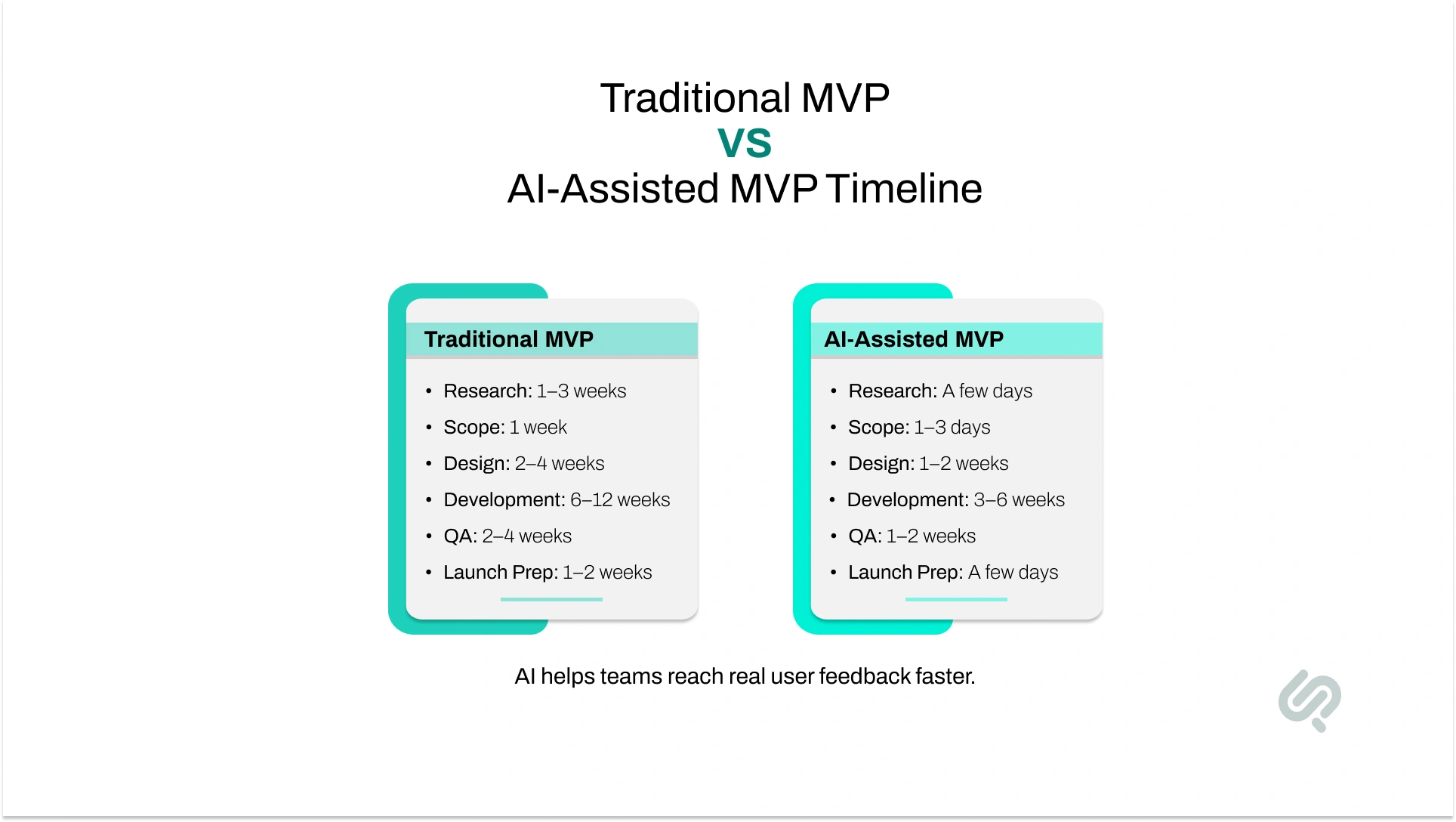
This is why startups use MVP development with AI: it shortens the time between idea and real user feedback.
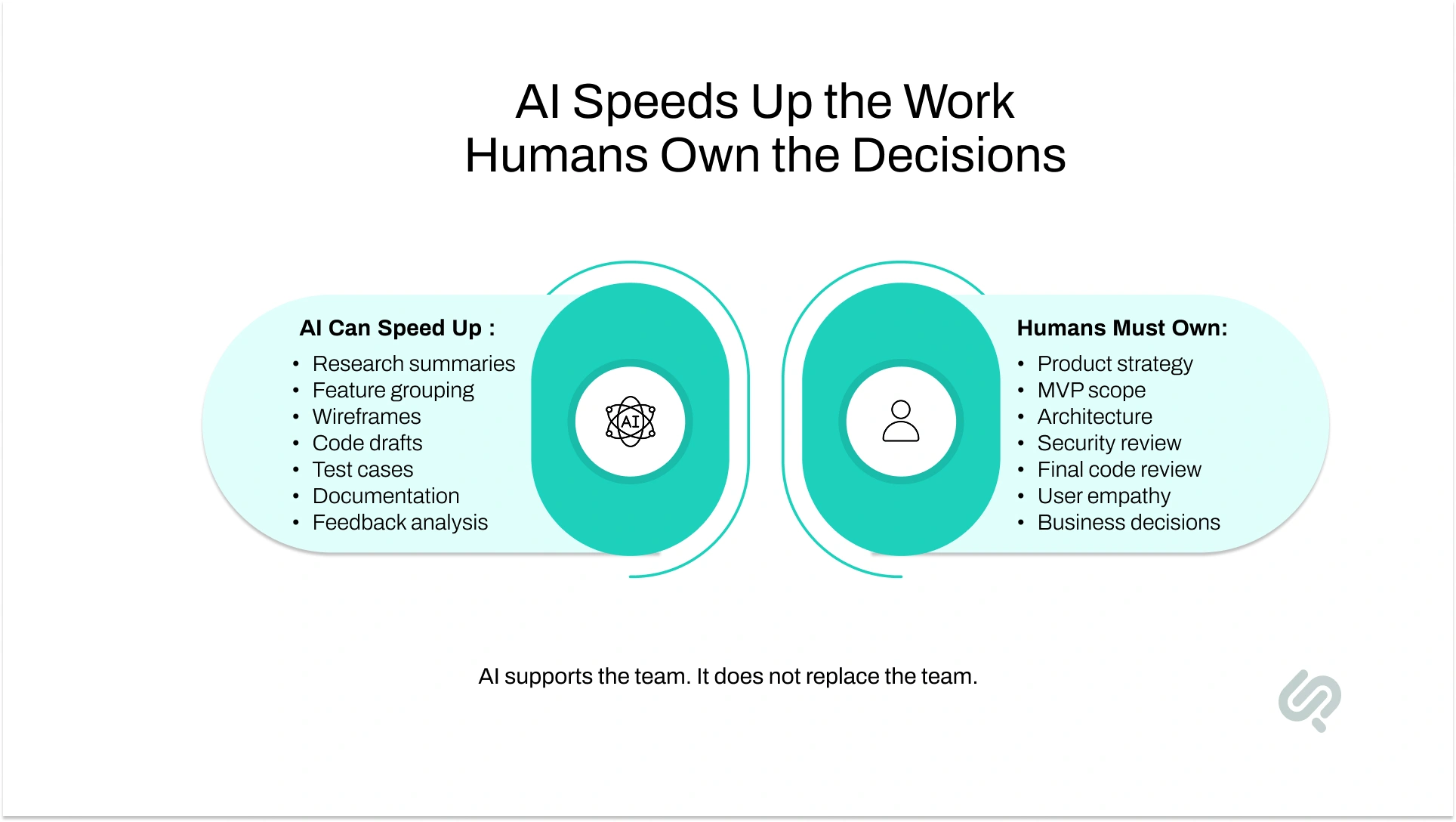
AI can speed up many parts of MVP development, but it should not own the full product. The best results come when AI handles repetitive work and experienced product, design, and engineering teams make the important decisions.
AI is useful for speed, but it cannot replace product strategy, customer empathy, software architecture, security review, final code review, or business decision-making.
For example, AI can help generate a login flow, but senior engineers still need to review authentication, permissions, data handling, and security risks. AI can help organize feature ideas, but product leaders still need to decide which features matter for real users.
That is why AI-powered MVP development works best when AI supports the team instead of replacing the team. The product still needs human judgment to become secure, useful, scalable, and ready for real users.
AI MVP development cost depends on product complexity, AI features, integrations, design depth, data requirements, security needs, and launch support.
A simple AI-assisted MVP will usually cost less than a custom AI product with advanced workflows, dashboards, integrations, or compliance requirements.
The biggest cost drivers are:
The main goal is not to build everything in version one. The goal is to build the smallest product that proves demand.
For example, a marketplace MVP may not need chat, reviews, subscriptions, disputes, advanced analytics, and automation from day one. It may only need seller signup, product listings, search, checkout, and a basic admin panel.
That is where an MVP development company's AI approach helps. It keeps the first version focused, reduces manual work, and helps your team reach real user feedback faster.
A clear MVP scope can protect your budget better than any tool. AI can speed up delivery, but smart product decisions decide what should be built first.
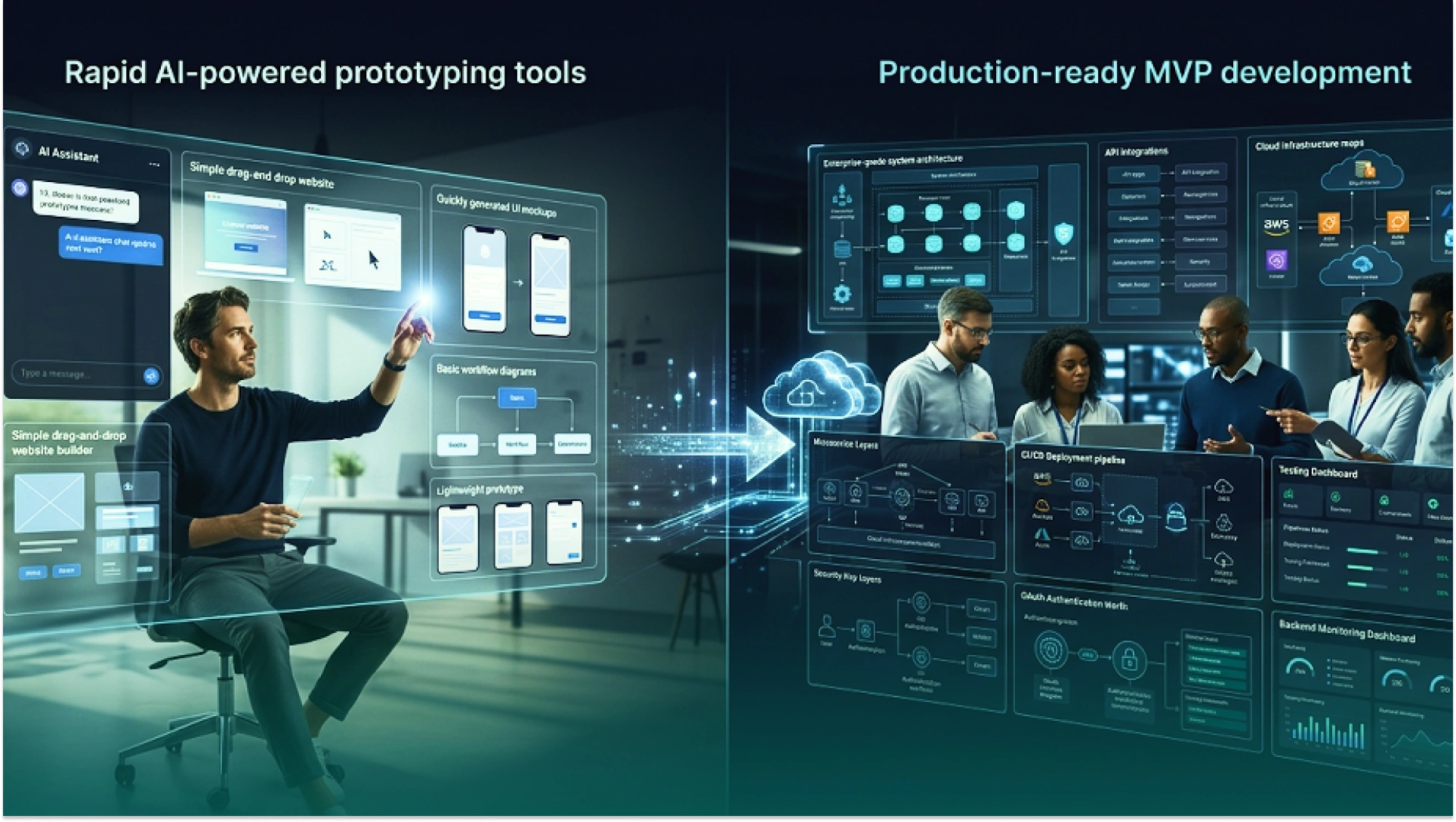
AI tools can help you move faster, but they do not replace a product and engineering team. The right choice depends on what you are trying to build.
Use AI tools if you only need a quick prototype or clickable demo.
Work with an AI MVP development company if your product needs user accounts, payments, APIs, databases, integrations, cloud deployment, analytics, security, or a scalable architecture.
This is the difference between “something that looks like a product” and a production-ready MVP that real users can test.
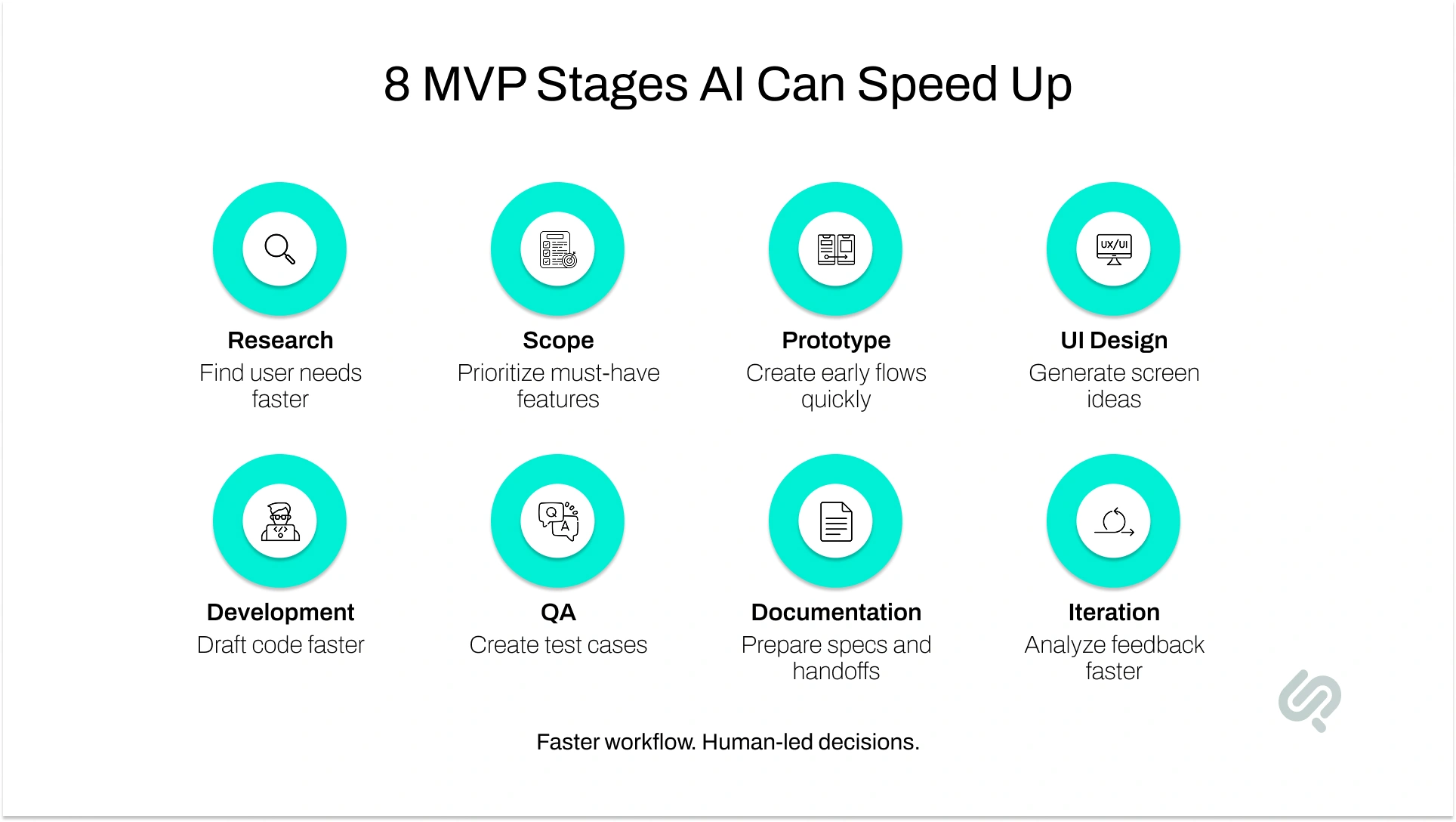
The real value of MVP development with AI is not one tool or one shortcut. It is the way AI reduces manual work across the full MVP build cycle.
AI can help teams move faster through research, planning, prototyping, design, development, QA, documentation, and post-launch feedback analysis. But each stage still needs human judgment, especially when the MVP will be used by real customers.
AI can summarize competitors, app reviews, user complaints, market trends, Reddit discussions, and customer pain points faster than manual research.
This helps founders understand what users are already asking for, what competitors are missing, and where the product may have a real market opportunity.
Human role: Your team still decides which problem is worth solving, which audience matters most, and whether users are likely to pay for the solution.
One of the biggest reasons MVPs fail is overbuilding. AI can help organize product ideas into must-have, nice-to-have, and future roadmap features.
This makes it easier to focus on the smallest version of the product that can deliver value and collect real feedback.
Human role: Product leaders still decide what belongs in version one and what should wait until after validation.
AI prototype tools can turn a product idea into early screens, user flows, and clickable concepts in less time.
This helps founders test the product direction, explain the idea to stakeholders, and collect feedback before full design or development begins.
Human role: Designers still need to refine usability, branding, accessibility, and the overall user experience.
AI can generate interface layouts, reusable components, responsive screens, and front-end code for common MVP pages.
For example, it can help create login screens, dashboards, booking flows, profile pages, forms, and admin panels faster.
Human role: Developers still need to make the interface clean, accessible, responsive, reusable, and production-ready.
AI coding assistants can help developers write boilerplate code, generate functions, create database queries, debug issues, and draft tests.
This can reduce repetitive development work and help teams move through early sprint tasks faster.
Human role: Senior engineers must still review code quality, architecture, security, scalability, and long-term maintainability.
AI can create test cases, edge-case checklists, regression tests, and bug reports faster than manual planning alone.
For example, in a payment flow, AI can help generate test scenarios for failed payments, expired cards, duplicate charges, refunds, and webhook errors.
Human role: QA teams still need to validate real workflows, user behavior, security risks, and release readiness.
AI can draft API documentation, product specs, release notes, onboarding guides, and developer handoff notes.
This improves alignment between founders, product managers, designers, developers, and QA teams.
Human role: Engineers and product leads still need to review the details so that the documentation matches the actual product.
After launch, AI can analyze user feedback, surveys, support tickets, session recordings, and product analytics to find repeated patterns.
This helps teams spot issues like confusing onboarding, missing features, pricing concerns, technical bugs, or weak value messaging.
Human role: Product teams still decide what to improve, what to ignore, and what to build next.
AI tools can support different parts of MVP development. But not every tool is right for every product stage.
For non-technical founders, AI app builders can be useful for early validation. They can help you create a demo, investor walkthrough, or simple internal workflow before investing in full MVP software development.
But if the MVP needs real users, secure accounts, payments, integrations, databases, or cloud deployment, AI-generated output should not go live without engineering review.
A better approach is to use AI tools for speed and a product team for control.
Use AI to move faster through:
Use experienced engineers for:
The smartest AI-powered MVP development process uses both. AI handles repetitive work. Product and engineering experts protect the MVP from becoming fragile.

AI-assisted MVP development can help startups move faster, but speed without structure can create serious technical and product risks.
The goal is not to avoid AI. The goal is to use AI with the right human review, especially when your MVP involves real users, payments, sensitive data, or scalable architecture.
AI coding assistants can generate code quickly, but fast code is not always clean code. Sometimes the output works for one feature but creates problems later, such as duplicated logic, inconsistent error handling, missing edge cases, weak structure, or tightly connected components.
These issues may not appear in the first demo, but they can slow your team down after launch and make future development more expensive.
How to manage it: Treat AI-generated code like junior developer code. It should go through senior engineering review before it becomes part of the main codebase. Every pull request needs review. No exceptions.
Asking AI to “build authentication” is not the same as building secure authentication. AI does not fully understand your threat model, compliance needs, data structure, user permissions, or long-term scaling plan.
Important areas like authentication, payments, data storage, access control, API security, and compliance should always be handled or reviewed by senior engineers.
How to manage it: Use AI to speed up implementation, but keep architecture, security, and compliance decisions in human hands.
The biggest risk in AI-powered MVP development is building fast without technical checkpoints. A product may look complete on the surface, but if the codebase is messy, security is weak, or the architecture is not reviewed, the MVP can become fragile after launch.
Fast is only useful when the product is still stable, secure, and easy to improve.
How to manage it: Add an engineering review checkpoint every two weeks during AI-assisted development. This review should focus on architecture, code quality, security, scalability, and technical debt — not just feature completion.
Choosing the right AI MVP development company is not just about speed. Fast delivery only matters if the MVP is usable, secure, scalable, and built around real user validation.
Look for a partner that can show:
The wrong partner may help you launch fast but leave you with messy code, weak architecture, poor security, or a product that becomes expensive to improve.
The right partner helps you answer three important questions:
Hammad Maqbool, AI Head at Phaedra Solutions, explains it clearly:
“AI can make MVP development faster, but speed only helps when the foundation is right. The real value comes from combining AI-assisted delivery with senior product, design, and engineering judgment.”
Phaedra Solutions used an AI-first development approach to build a tourism data intelligence system for hotels, OTAs, and destination marketing teams. The platform replaced static dashboards and manual reports with a conversational analytics interface where teams could ask questions like “Which routes are underperforming?”, “RevPAR by property this week?”, or “Cancellation rate by OTA?” and get real-time answers in seconds.
The system connected fragmented PMS, CRS, OTA, and marketing data into one intelligence pipeline, helping teams reduce manual reporting by up to 80%, make faster pricing and allocation decisions, and keep performance data aligned across channels. This is the value of AI-powered MVP development: not just faster delivery, but faster decisions, clearer workflows, and a product that solves a real business problem from day one.
AI tools make it easy to create something that looks finished before it is actually ready. That is why founders need to understand the difference between a prototype and an MVP.
A prototype shows how the product might work. It helps you test the concept quickly.
An MVP, or minimum viable product, is a usable product with the smallest feature set needed to deliver real value and collect real learning.
Use AI to create the prototype fast. Then be deliberate about what needs to become a production-ready MVP. The smartest founders do not use AI to skip validation. They use AI to reach validation faster.
MVP validation means testing whether real users will use, pay for, or meaningfully engage with your product before you build the full version.
This is the core idea behind the lean startup methodology: build a focused version, collect real feedback, and learn before spending too much time or budget.
AI can speed up product validation with AI, but it cannot replace real user behavior.
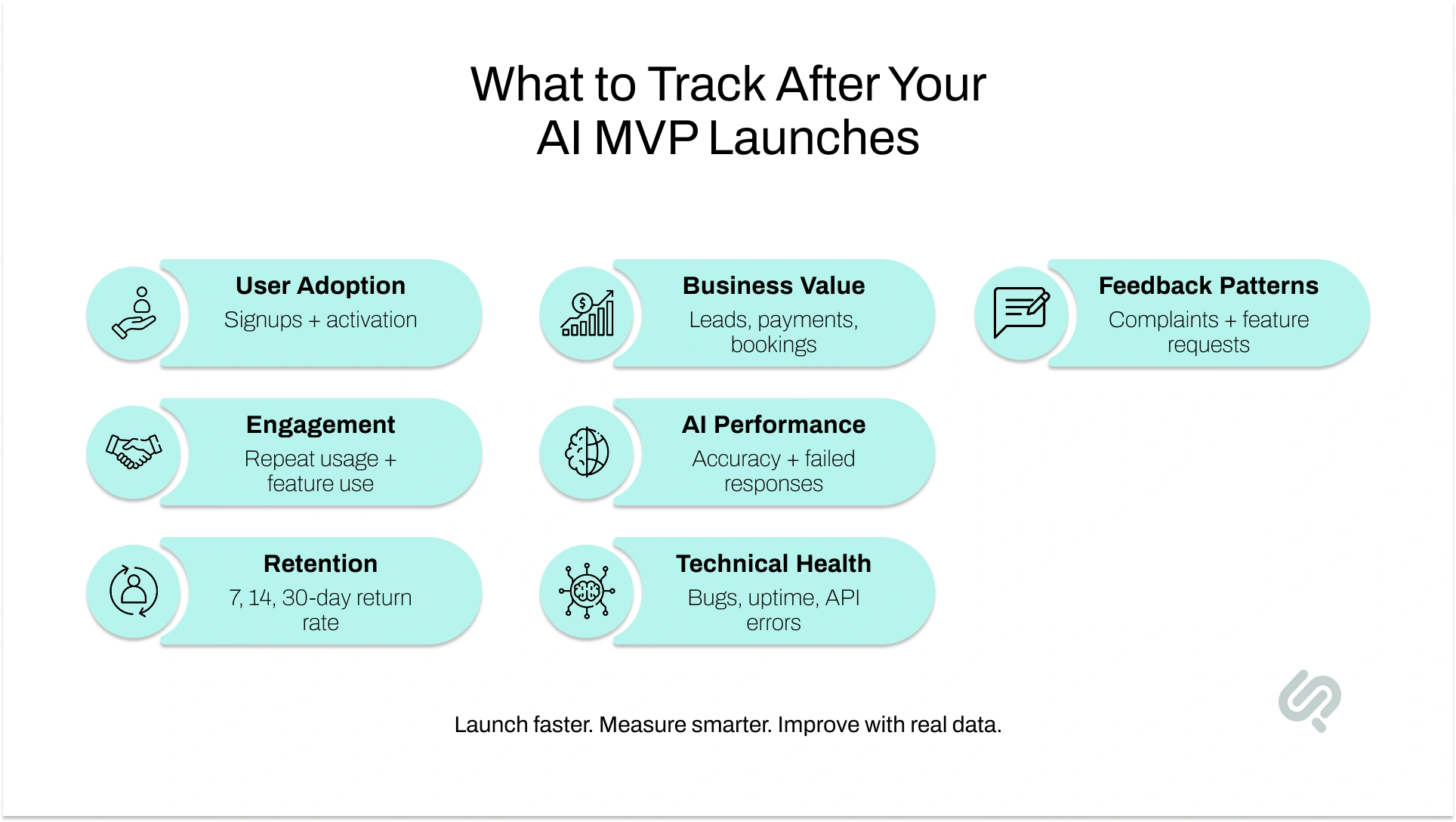
Launching faster is useful only if you learn faster.
After your MVP goes live, track product, business, AI, and technical signals. This helps your team decide what to improve, what to remove, and what to build next.
Do not measure everything at once. Start with the metrics that connect directly to your MVP goal.
For example:
AI can help group feedback, summarize user issues, and find repeated behavior patterns faster. But your team still needs to decide what those signals mean.
The goal is not just to launch. The goal is to launch, measure, learn, and improve the product based on real user behavior.
AI can help you move faster, but a real MVP still needs product direction, secure architecture, clean code, QA, launch planning, and post-launch learning.
Phaedra Solutions helps founders and product teams build MVPs faster using an AI-first delivery process. We use AI agents, Claude, Cursor, AI-assisted coding, automated QA support, and senior engineering review to reduce manual work without losing control of quality.
With our AI MVP development services, you can:
Depending on scope, complexity, and project nature, our AI-first process can help reduce delivery time, cost, or team effort by 30% to 80%.
Ready to launch your MVP faster without cutting corners? Book a free MVP strategy call with Phaedra Solutions.



Ameena is a content writer with a background in International Relations, blending academic insight with SEO-driven writing experience. She has written extensively in the academic space and contributed blog content for various platforms.
Her interests lie in human rights, conflict resolution, and emerging technologies in global policy. Outside of work, she enjoys reading fiction, exploring AI as a hobby, and learning how digital systems shape society.