











For buyers evaluating forward deployed engineer AI support, the role is straightforward. An FDE (forward deployed engineer) embeds with your business and technical teams to turn an AI pilot into a secure, production-ready system.
Unlike a consultant or pre-sales engineer, an AI FDE writes production code, connects models to real data and workflows, adds evaluation and security controls, and stays accountable until the system works reliably in production.
For business leaders, the value is end-to-end ownership across discovery, integration, deployment, adoption, and handoff. This is especially useful when fragmented data, legacy systems, governance requirements, complex integrations, or unclear technical ownership block an AI pilot.
A forward-deployed AI engineer works inside the customer's real environment to take AI from prototype to production. They handle discovery, integrations, evaluation, security, deployment, monitoring, and production improvement.
Hire one when an AI pilot works technically but is blocked by data, integrations, security, changing requirements, or unclear production ownership. FDEs are most valuable when several teams and systems must work together.
An AI engineer usually focuses on models, pipelines, or AI features. An AI FDE works closer to users and business operations and owns whether the complete system actually works in production.
The engagement should leave behind a working production system, evaluation criteria, monitoring, documentation, runbooks, security controls, operating procedures, and an internal team that knows how to maintain it.
Yes. AI staff augmentation can give companies an embedded FDE without requiring a permanent hire. This works well when the engineer needs to join an existing product, AI, or enterprise technology team for a defined deployment.
The AI pilot to production gap is rarely caused by model quality alone. A pilot can work well on a clean test set and still fail once it meets live systems, incomplete data, user permissions, latency requirements, security controls, operational edge cases, and people who must change how they work.
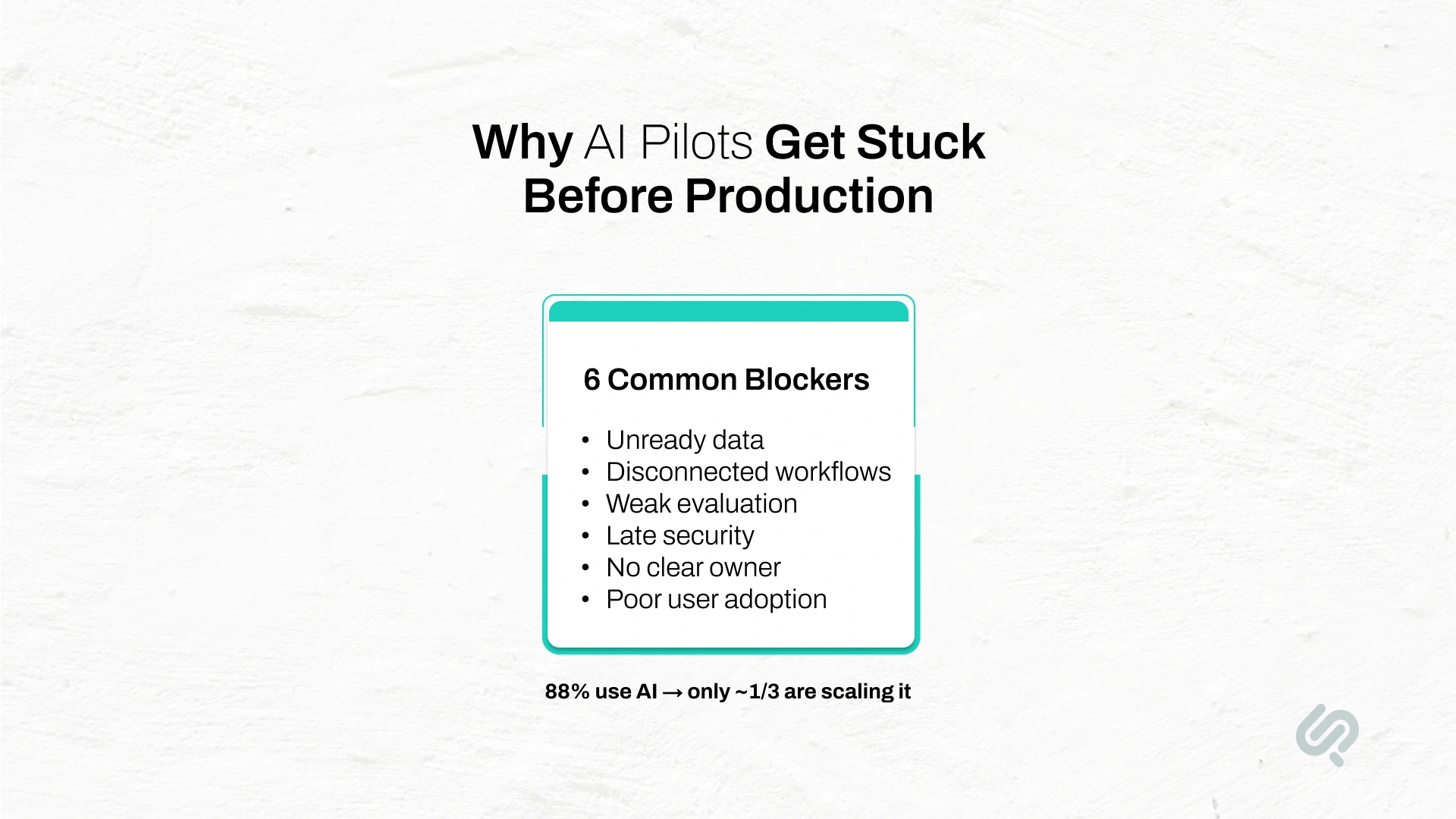
McKinsey's 2025 State of AI survey found that 88% of respondents said their organizations regularly used AI in at least one business function, but only about one-third said their companies had begun scaling AI programs across the enterprise. (1)
That gap shows why enterprise AI deployment is now an execution problem as much as a technology problem.
The most common blockers are:

AI systems introduce production problems that normal software testing does not fully cover.
Traditional software usually follows defined rules. An AI system can behave differently when its model, prompt, retrieved information, user context, or connected tools change. A system can therefore stay technically online while the quality of its answers or actions gets worse.
An embedded AI engineer may need to monitor:
This makes AI evaluation and observability a continuous production responsibility rather than a one-time QA task.
AI deployment can also require changing the workflow itself. Instead of simply adding a chatbot or AI feature to an existing process, teams may need to redesign which steps AI handles, which decisions still require people, how exceptions are escalated, and how information moves between systems.
McKinsey has also identified workflow redesign as an important pattern among organizations getting more value from AI. That matters because production AI often requires changing how work is performed, not simply adding an AI feature to an existing process.
The market is responding to this execution gap. AWS announced a $1 billion Forward Deployed Engineering organization in 2026 to place engineers directly with customers building production AI systems. (2)
The lesson for buyers is simple: getting access to a capable model is increasingly easy. Making that model work safely inside a real business remains the difficult part.
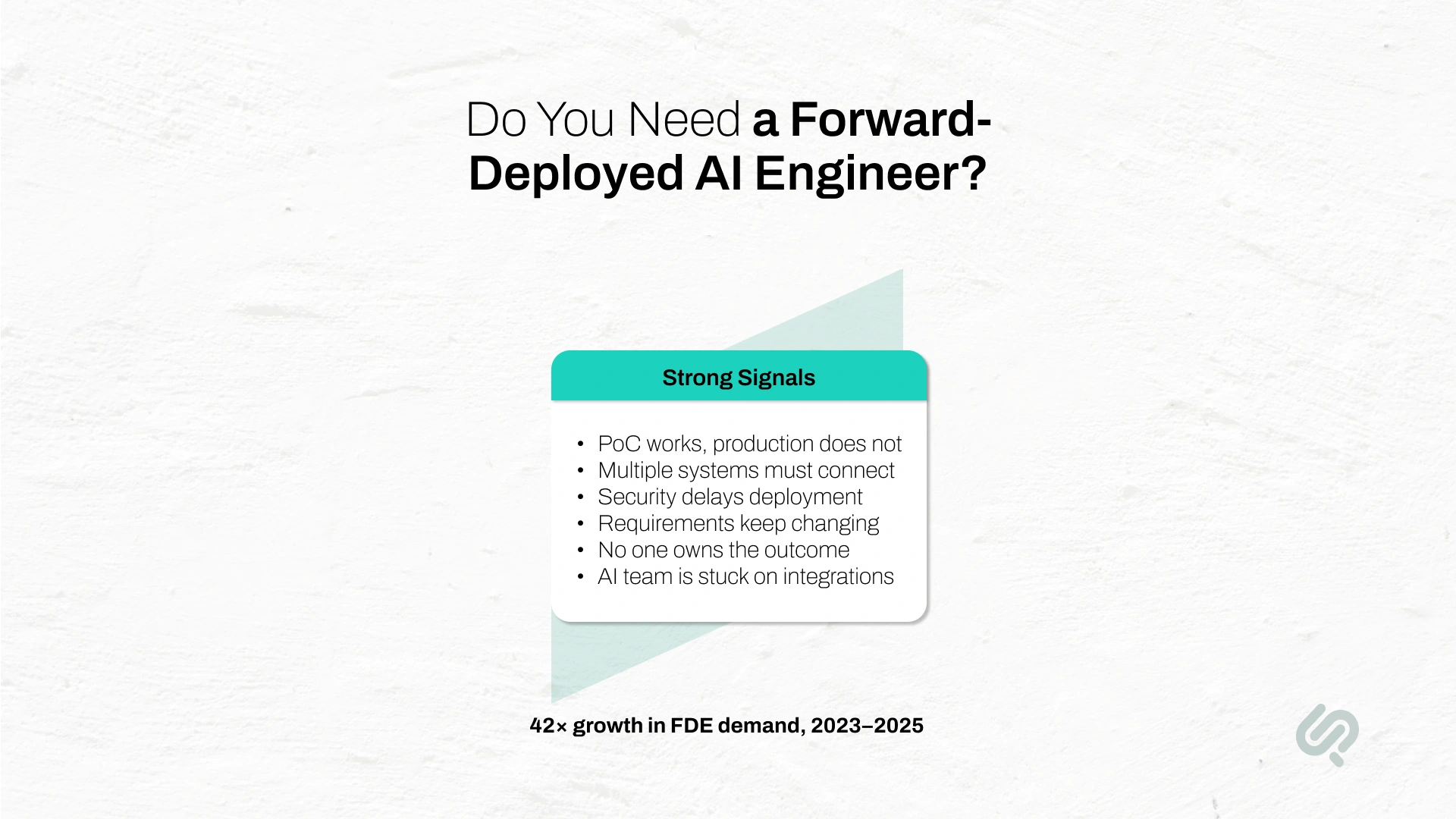
Companies usually look for forward deployed engineer AI support when the AI itself is promising but getting it into production has become the harder problem.
Strong buying signals include:
An FDE becomes especially useful when the problem cannot be handed cleanly from strategy to engineering to deployment. The same engineer stays close enough to the problem to learn, build, test, and adjust as real constraints appear.
Demand reflects that shift. Reuters reported that demand for forward deployed engineers and similar roles grew 42-fold from 2023 to 2025, with roughly 9,000 roles created globally. (3)
Not every AI project needs forward-deployed engineering.
You may be better served by a regular AI engineer, software engineer, or integration specialist when:
For example, adding a well-defined AI summarization feature to an existing application may not justify an FDE.
Forward-deployed engineering creates the most value when the difficult part is the messy gap between technical feasibility and reliable production use.
This distinction also matters commercially. Hiring an embedded specialist for a straightforward integration can add unnecessary cost and coordination. Use the FDE model when production complexity actually requires it.
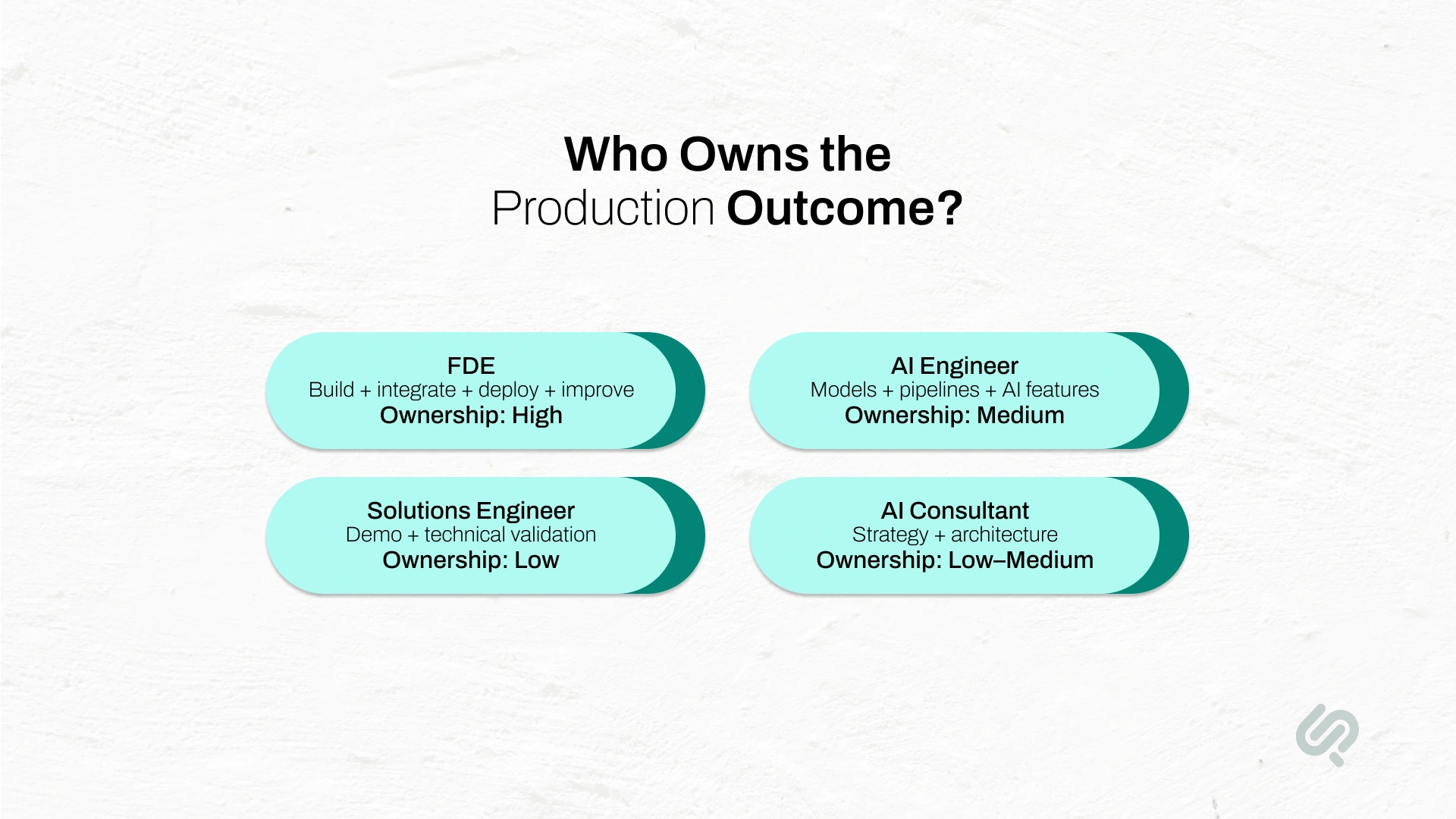
The difference between these roles is mainly where their responsibility ends.
A solutions engineer may prove that an AI product can solve the problem. An AI consultant may recommend the architecture. An AI engineer may build the model or feature.
The FDE is different because the role crosses those boundaries and stays responsible for making the system work inside the customer's real environment.
That is especially valuable when requirements are still changing, several systems must be integrated, or nobody else owns the full path from prototype to production.
For buyers, the simplest question is:
Do you need advice or additional engineering capacity, or do you need someone to own the production outcome?
If production ownership is the problem, an FDE is usually the more relevant role.
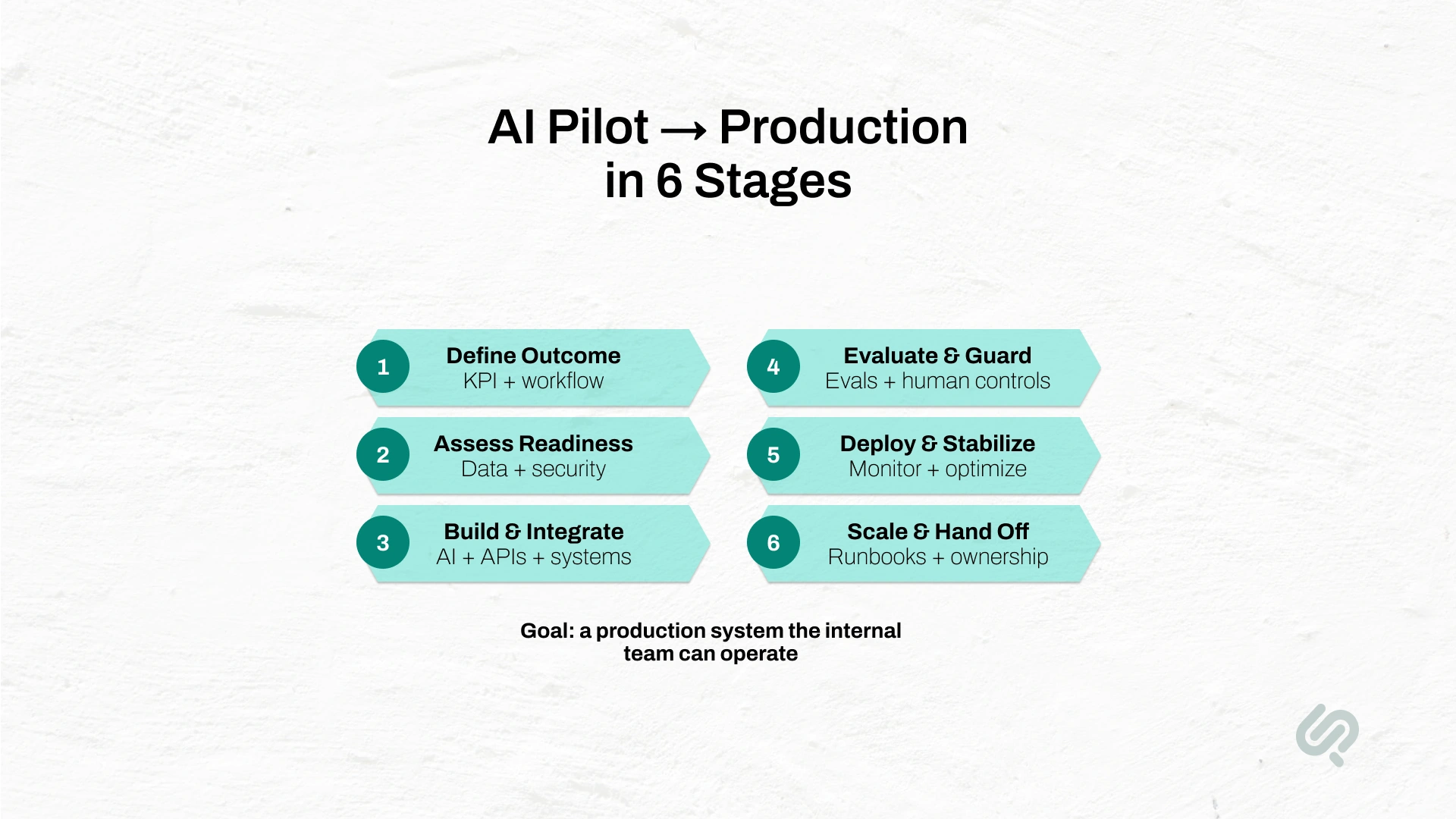
A strong forward-deployed AI engagement reduces different production risks at each stage. The engineer does more than implement requirements. They stay close to the workflow, users, and technical environment while discovering what must change for the system to work under real conditions.
Start with one workflow, a clear user group, a measurable KPI, and defined risk boundaries.
The FDE works with business and technical stakeholders to answer questions such as:
Evidence before moving forward: agreed success metrics and a clearly scoped production use case.
A pilot may work with manually prepared data. Production has to work with the company's real systems.
The engineer checks data quality, permissions, ownership, freshness, infrastructure, security requirements, APIs, legacy systems, and other dependencies that could block the rollout.
For RAG systems, this can include checking whether documents are current, correctly permissioned, searchable, and reliable enough for retrieval.
Evidence before moving forward: known production gaps, required integrations, security requirements, and a realistic implementation plan.
The next step is connecting AI to the applications and workflows where work actually happens.
Depending on the use case, this may involve:
The goal is not to make employees leave their normal workflow to use AI. Good AI integration services put the capability inside the tools and processes they already rely on.
Evidence before moving forward: a working end-to-end workflow using real systems and representative data.
A successful demo is not enough evidence that an AI system is production-ready.
The FDE defines how the team will detect incorrect, unsafe, or low-quality behavior before and after launch.
Controls may include:
For an agentic AI deployment, autonomy should usually expand only after the system proves it can operate reliably within narrower boundaries.
Evidence before moving forward: agreed acceptance thresholds and a clear process for handling failures.
The FDE then moves the system into real production use.
That includes infrastructure, access controls, observability, scaling, latency, inference cost, secrets management, rollback procedures, release management, and failure handling.
A controlled rollout is usually safer than launching to the entire organization immediately. Early users expose problems that test environments cannot fully reproduce.
Evidence before moving forward: stable production performance with acceptable quality, cost, security, and user adoption.
Production data now becomes the feedback loop.
The engineer tracks where users struggle, when humans override AI outputs, which tasks fail, how much time the system saves, and whether the original KPI is improving.
Successful workflows can then expand to more users, departments, regions, languages, or use cases.
Before leaving, the FDE should transfer:
Evidence that the engagement is complete: the system works reliably, and the customer's internal team can operate it without depending on the FDE.
A strong FDE engagement should therefore be designed to end. The goal is not permanent dependence on an external engineer, but a production system your internal team can operate confidently. Buyers should agree on handoff criteria, documentation, monitoring, ownership, and knowledge transfer early in the engagement.
A production system should be measured against business and operational outcomes, not only model benchmarks.
Useful measures include:
The exact scorecard depends on the use case. What matters is setting it before rollout so leadership can decide whether to improve, expand, or stop the deployment based on evidence.
For an FDE engagement, these metrics should be agreed early because production success should be measured by workflow impact and business results, not by how many AI features were shipped.

A government client needed to bring more than 30 public services into one connected digital platform. The challenge went far beyond adding an AI assistant. The system needed secure identity, web and mobile access, ministry integrations, real-time tracking, AI-powered guidance, role-based permissions, analytics, auditability, and governance across several stakeholder groups.
Phaedra Solutions moved the platform from prototype into full development through 24+ sprint cycles, combining product, web, mobile, backend, AI, cloud, QA, security, and integration work. The team implemented AI assistance alongside IAM, MFA, RBAC, secure APIs, observability, audit logging, and phased ministry onboarding. It is a practical example of the cross-functional production ownership that forward-deployed AI delivery requires.
When comparing forward deployed engineer AI providers, look beyond how many models, AI tools, or cloud certifications appear on their website.
A strong partner should be able to show that it can:
The most important question is not: “Can this company build AI?”
It is: “Can this company take responsibility for making AI work inside our business and leave our team able to operate it afterward?”
“The value of an FDE is not simply adding another engineer to the team. It is giving the deployment one technical owner who can understand the workflow, make the engineering trade-offs, and stay accountable until the system works in production.”
—- Abubakar Shams, CEO & Staff Augmentation Head, Phaedra Solutions
If you need forward deployed engineer AI expertise to take a pilot through integration, evaluation, security, deployment, and handoff, Phaedra can provide embedded engineering talent through its IT staff augmentation services.
The engineer joins your existing team, stack, tools, and delivery workflow instead of creating another external delivery silo. This can be useful when you need production ownership now but do not want to recruit a permanent specialist before knowing how long the requirement will last.
Book a free consultation to discuss your AI use case, current production blockers, required technical stack, and whether a forward-deployed engineer is the right fit.



Ameena is a content writer with a background in International Relations, blending academic insight with SEO-driven writing experience. She has written extensively in the academic space and contributed blog content for various platforms.
Her interests lie in human rights, conflict resolution, and emerging technologies in global policy. Outside of work, she enjoys reading fiction, exploring AI as a hobby, and learning how digital systems shape society.