






.webp)






.webp)
AI data readiness is the process of making business data accurate, accessible, secure, governed, and usable for a specific AI system. It confirms that the right records, documents, permissions, context, and pipelines are in place before development begins.
A business does not need to clean every dataset before using AI. It needs to identify the information required for the selected use case, fix the gaps that could affect accuracy or risk, and test the real data path from source to output.
This guide explains what to assess, what to repair first, and when to proceed.
It means your data can reliably support a defined AI use case. The required information must be relevant, accessible, sufficiently accurate, properly governed, and supported by systems that keep it secure and current.
Choose one business use case and trace the information it requires. Your data is ready when approved users can access reliable sources, understand their meaning, test their quality, and connect AI outputs back to the original records.
Yes, provided the project uses a controlled data scope. You do not need to repair every company system, but you must fix the issues that could invalidate the selected use case, expose sensitive information, or prevent accurate evaluation.
Fix missing access, unclear ownership, unreliable source data, conflicting definitions, outdated documents, weak permissions, and any issue that prevents the system from being tested. Monitoring and long-term governance can then be expanded before production.
A focused assessment for one workflow can usually be completed faster than a company-wide review. The timeline depends on the number of sources, stakeholders, integrations, data types, security requirements, and use cases being evaluated.
It should provide a source and ownership map, quality findings, security and governance gaps, architecture recommendations, evaluation criteria, and a prioritized remediation roadmap. It should also produce a clear decision to proceed, narrow the scope, fix specific gaps, or stop.
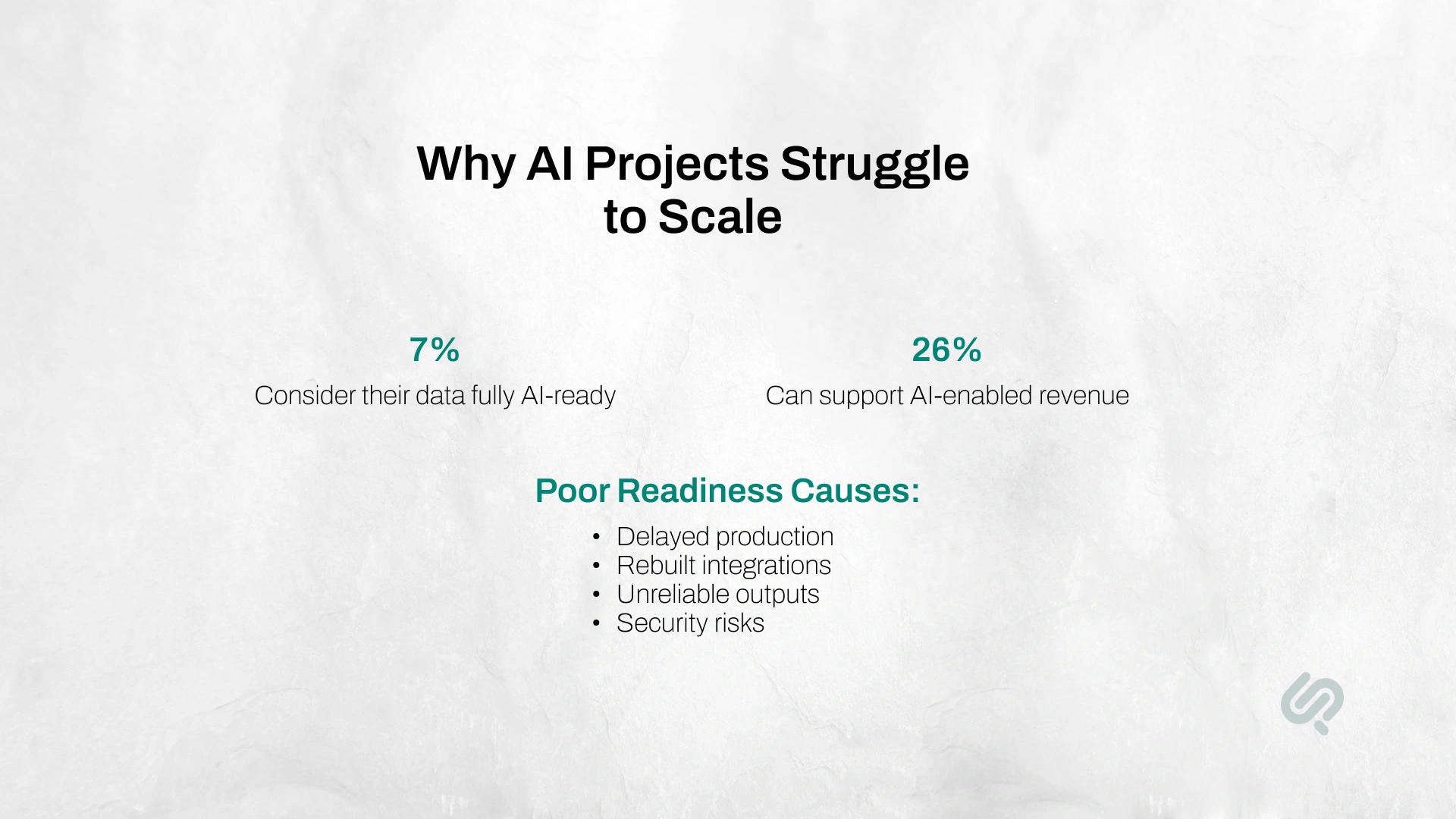
Only 7% of surveyed enterprises considered their data completely ready for AI. More than one-quarter said their data was either not very ready or not ready at all. (1)
The problem is rarely limited to missing fields or duplicate records. AI systems may depend on databases, contracts, emails, policies, images, transcripts, customer records, and internal documents. These sources often have different owners, formats, definitions, permissions, and update schedules.
Poor readiness creates measurable business problems:
IBM’s study of 1,700 data leaders found that only 26% were confident their data capabilities could support new AI-enabled revenue streams. The same percentage were confident they could use unstructured data to create business value. (2)
Data readiness should therefore be treated as part of implementation, not as a separate company-wide cleanup exercise. The required data should be assessed against one defined use case, its risks, and whether the project is at the proof-of-concept, pilot, or production stage.
“Most data problems are not discovered while testing the model. They appear when the system connects to real business tools, applies user permissions, retrieves changing information, and has to explain why it produced a particular answer.”
— Hammad Maqbool, Head of AI & Machine Learning, Phaedra Solutions.
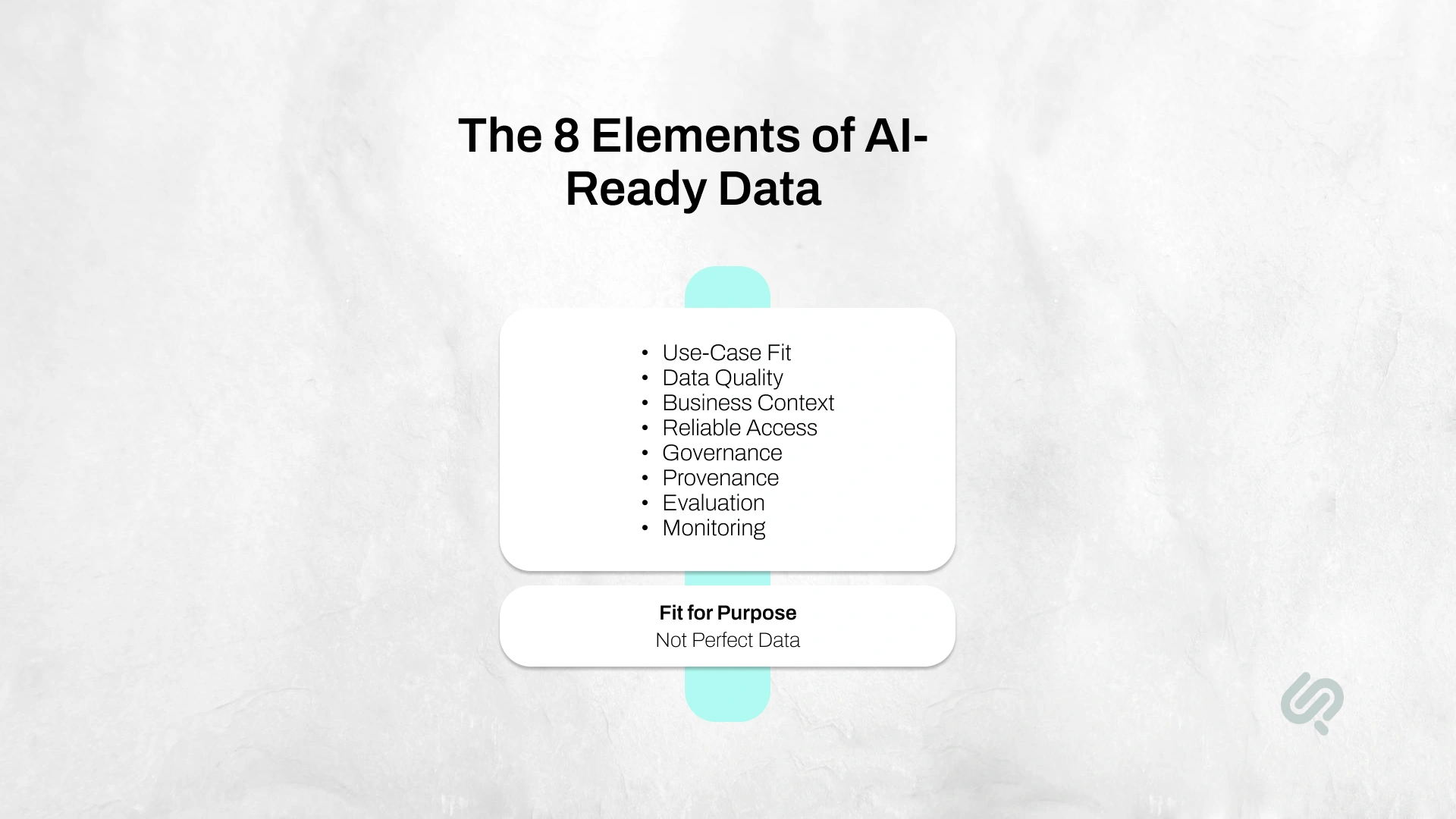
AI-ready data is not perfect data. It is information that is fit for a defined purpose, controlled at the right risk level, and dependable enough for the system’s intended decisions.
An effective AI data foundation connects these areas rather than treating them as separate checks. It gives business teams a shared understanding of the data and gives the AI system enough context to retrieve, interpret, and use information correctly.

The same dataset can be ready for one application and unsuitable for another. Current guidance separates predictive AI, generative systems, and agents because each depends on different evidence, controls, and operating conditions.
A generative AI readiness assessment should therefore test more than document availability. It should prove that the system can find the right source, respect access rules, preserve context, cite evidence, and avoid relying on outdated material.
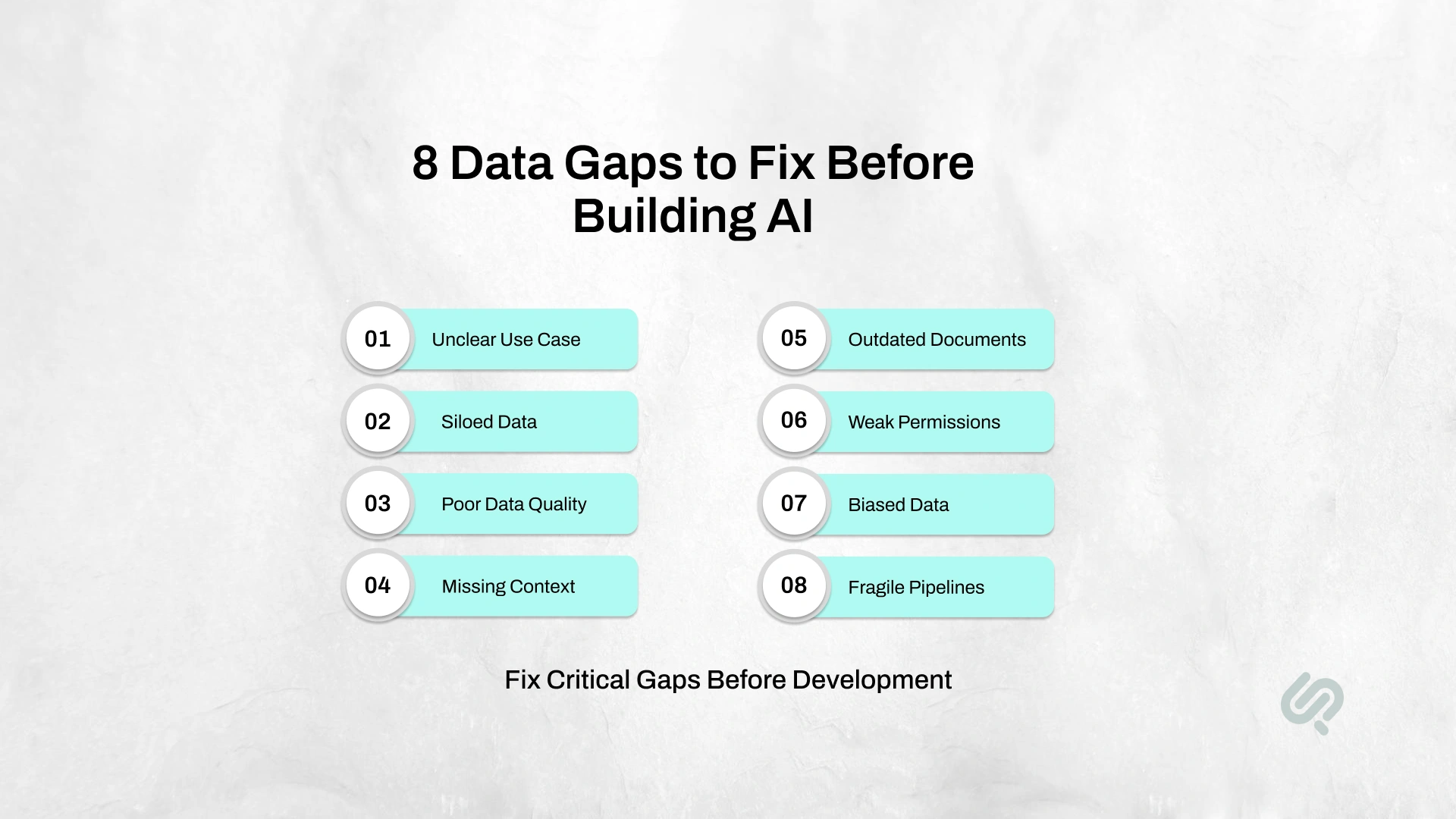
Before building an AI system, businesses must identify the data issues that could reduce accuracy, increase risk, or delay deployment. Fixing these gaps early creates a stronger AI data foundation and prevents expensive rework later.
The first problem is often not the data itself. It is an unclear goal such as “add AI,” “build a chatbot,” or “automate operations.”
These goals do not define which data is required, what an acceptable output looks like, or how success will be measured.
Without a specific business objective, teams may spend time preparing large datasets that do not support a useful outcome.
Start your AI data strategy with one workflow and one measurable result. Define:
Business data is often spread across CRM platforms, finance systems, support tools, spreadsheets, cloud storage, emails, and legacy applications. The information may exist, but teams may not be able to access or combine it reliably.
Create a complete inventory of the data sources required for the AI use case. For each source, record:
Where access is unreliable, AI data engineering services may be required to create governed pipelines, shared identifiers, APIs, or integration layers before development begins.
Data quality for AI should be measured against the decision the system will support. Not every missing value creates the same level of risk.
For example, a missing delivery date may have little effect on a product recommendation engine but could make a logistics forecasting system unreliable.
Duplicate customer records may distort churn predictions, while inconsistent product names may weaken search and retrieval results.
Profile the relevant fields, records, and documents for:
Set an acceptable quality threshold for each issue and document what the system should do when the data falls below that standard.
AI can process a value without understanding what it means in a business context. A field named “active customer,” for example, may have different definitions across sales, finance, and customer support.
Documents can create similar problems when they do not include an owner, version, effective date, region, product type, or approval status.
Without this context, an AI system may retrieve information that is technically related but incorrect for the user’s situation.
Data preparation for AI should include:
Strong metadata helps AI systems interpret, retrieve, and apply information more accurately.
Generative AI systems rely heavily on unstructured data such as policies, contracts, emails, manuals, transcripts, presentations, and internal documents.
These repositories often contain duplicate files, expired guidance, conflicting versions, and content that should not be available to every employee.
Before building a retrieval-augmented generation system, identify which sources are authoritative. Remove or exclude outdated files and apply:
Removing a document from a file repository may not automatically remove its extracted text, chunks, metadata, or embeddings from an AI index. The deletion and update process must cover every derived version of the source.
Test retrieval with real user questions. Confirm that the system finds the correct passage from the correct document, applies the user’s permissions, and cites the original source. Similar-looking content should not be treated as authoritative when a newer or approved version exists.
Data governance for AI must work inside the system, not only exist as a written policy. A governance document cannot prevent an AI assistant from exposing confidential information if access controls are not enforced during retrieval.
Assign clear responsibility for each AI use case, including:
Define who can access each source, what the AI system can display, what actions it can take, and how long prompts and outputs will be stored. Human approval should be required before high-risk actions or decisions.
Test permissions using real user roles before deployment to confirm that restricted data cannot be viewed or changed by unauthorized users.
AI training data quality determines which patterns a model learns and which users it serves accurately. Historical data may reflect outdated policies, missing customer groups, process changes, manual exceptions, or previous human bias.
Adding more records does not automatically fix these problems. The dataset must represent the environment in which the AI system will operate.
Review:
AI systems used for hiring, lending, healthcare, insurance, or other high-risk decisions may also require fairness testing, explainability controls, and documented human oversight.
Data infrastructure for AI must support more than a successful demonstration. A production system needs reliable data updates, monitoring, error handling, access logs, version control, and sufficient capacity for increased usage.
Test how the system responds when:
Set clear freshness targets and alerts for critical sources. Decide whether the AI system should pause, use the last verified record, lower its confidence, or route the request to a person when reliable data is unavailable.
Strong pipelines help keep AI outputs accurate and dependable after launch.
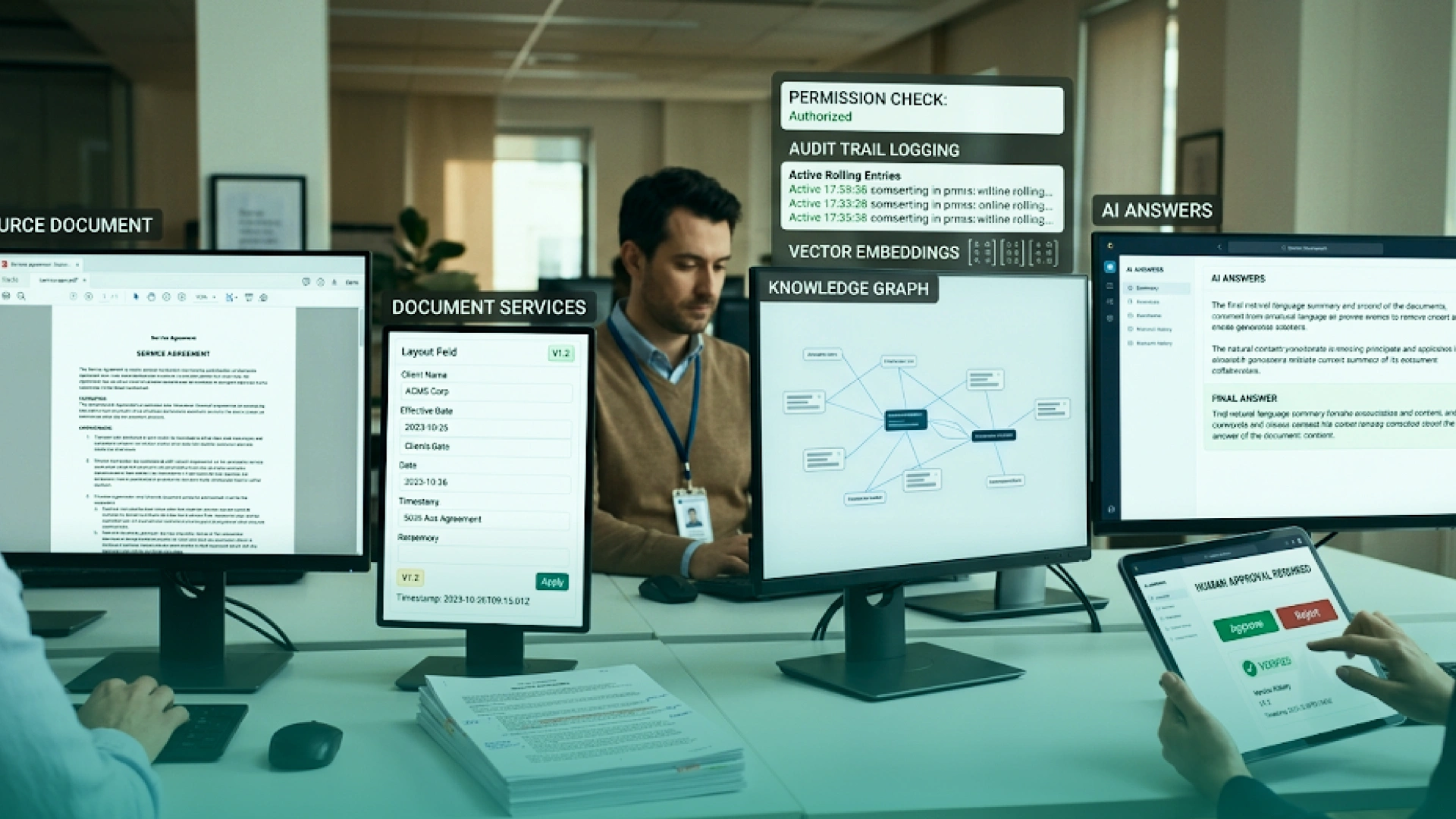
Accurate source data is not enough for production AI. Your business must also be able to explain how an answer, prediction, recommendation, or automated action was produced.
For an important AI output, your team should be able to identify:
This traceability matters because AI systems do not always use source information directly. A document may be parsed, divided into chunks, converted into embeddings, added to an index, retrieved, and then combined with instructions from a prompt.
McKinsey identifies artifact-level traceability as an important part of scaling enterprise AI. Without it, businesses may be unable to reproduce an answer, measure the effect of changing a source, or determine which derived artifact needs to be corrected.
Select one important output from the proposed AI system and ask:
If the team cannot answer these questions, the system may be suitable for controlled testing but is not ready for production.
This is especially important for:
The goal is not to explain every mathematical step inside a model. The goal is to maintain enough evidence to investigate errors, enforce access rules, correct information, and defend important business decisions.
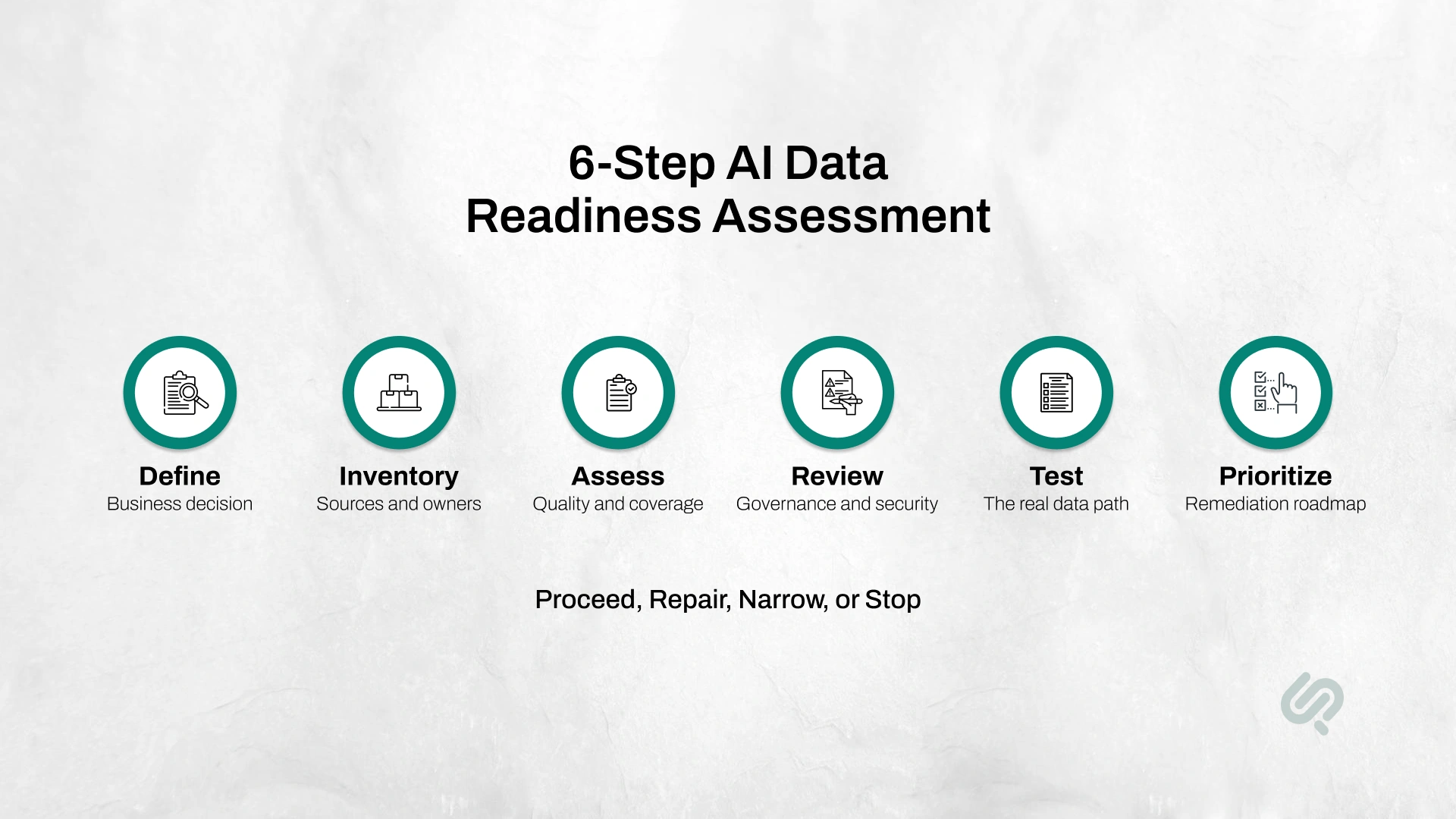
An AI data readiness assessment shows whether your data, systems, and governance can support a real AI use case. The goal is to identify critical gaps before development begins and create a clear path from assessment to pilot and production.
Start by defining the exact task the AI system will perform and the business decision it will support. The team should agree on the intended user, required inputs, expected output, response time, acceptable error level, and where human review is needed.
For example, instead of setting a broad goal such as “use AI in customer service,” define the use case as “help support agents find the correct refund policy and draft a response within 30 seconds.”
This gives the assessment a clear boundary and makes it easier to identify which data matters, which risks require controls, and how the result will be measured.
McKinsey reports that roughly 79% of organizations skip workflow redesign, even though workflow redesign is the organizational factor most strongly associated with enterprise-level EBIT impact from AI. (3)
The assessment should therefore define the complete workflow, not only the model’s task. Teams must decide what AI will perform, what people will review, where information will come from, and what should happen when the output cannot be trusted.
List every database, application, document repository, API, spreadsheet, data stream, and external source needed for the use case.
Record who owns each source, how it can be accessed, how often it is updated, and whether any legal or privacy restrictions apply.
For example, a customer support assistant may need data from the CRM, help desk platform, product documentation, billing system, and refund policy library.
For every important data source, also record:
Data can be technically accessible but still be unsuitable for the intended AI use. For example, a business may have permission to store third-party information without having permission to use it for model training or automated decisions.
Add provenance and usage-right issues to the remediation roadmap before development begins.
Review whether the available data is complete, accurate, consistent, current, and representative of the real operating environment.
Check for missing values, duplicate records, inconsistent labels, outdated information, weak historical coverage, and gaps across important customer or user groups.
For example, a churn prediction model may appear accurate overall but fail for new customers if most of the training data comes from long-term accounts. The assessment should identify this imbalance before the model is built.
Identify sensitive fields, confidential documents, regulated information, and restricted content before connecting data to an AI system. Review access controls, consent, retention, residency, masking, audit logging, and approval requirements.
For example, an internal HR assistant may need access to employee policies but should not retrieve salary records, medical information, or performance reviews for unauthorized users. Role-based permissions must be tested before deployment.
Run a small technical test using actual data from the selected workflow. This helps uncover problems that may not appear in planning documents or stakeholder interviews.
For example, a generative AI assistant may perform well during a demo but retrieve an outdated policy when tested against the full document library. A real data-path test would check document parsing, chunking, retrieval accuracy, citations, permissions, and answer quality before wider development begins.
For predictive AI, the test should examine labels, leakage, baseline performance, bias, and drift risk. For AI agents, it should test tool calls, failed actions, approval points, reversals, and logs.
Rank each gap based on its business impact, risk, effort, and dependencies. Assign an owner to every issue and separate the work required before a proof of concept from the controls required before production.
For example, missing customer identifiers may need to be corrected before a pilot because the AI system cannot connect records reliably. Automated monitoring, stronger audit logs, and long-term governance may be introduced before production.
The assessment should then recommend one of five actions:
Each gap should include:
The roadmap should leave the business with a clear next decision, not only a general readiness score.
A digital health vendor had limited visibility into hospitals adopting new technology and payers funding innovation programs. Its team manually researched prospects and sent only 15–20 emails per week, slowing partnership development and deal cycles.
Phaedra Solutions built an AI-powered outreach workflow that tracks market updates, researches and verifies healthcare organizations, performs compliance checks, and uses RAG to create personalized emails and LinkedIn messages. The system increased output to 45–50 compliance-checked emails per day, delivered a 30% higher response rate, and helped accelerate deal cycles by four times.
A useful assessment should provide evidence, priorities, and a clear build decision. A general maturity score is not enough.
Your business should receive:
The report should document the workflow, intended users, required inputs and outputs, acceptable error levels, human-review points, and measurable success criteria.
It should identify the databases, applications, documents, APIs, external sources, owners, access methods, update schedules, and usage restrictions required for the use case.
The assessment should show which gaps could affect accuracy, coverage, privacy, permissions, compliance, or production reliability.
Recommendations may include data pipelines, integrations, metadata controls, retrieval architecture, monitoring, hosting, security, and failure-handling requirements.
The final report should define how the system will be tested and list each required improvement with its priority, owner, effort, dependencies, delivery stage, and acceptance criteria.
It should conclude whether the business should proceed, begin a controlled pilot, fix critical gaps, reduce the project scope, or select another use case.
Knowing where the problems are is useful only when the findings lead to a working system. Phaedra Solutions’ AI development services help businesses define the right use case, assess the real data path, prioritize remediation, build the pilot, and move the solution into production with governance, testing, and monitoring built in.
Phaedra uses an AI-first delivery process across research, prototyping, development, documentation, automated testing, and quality assurance. Our teams use AI agents and tools such as Claude and Cursor under senior technical review.
Depending on project size, complexity, and automation scope, suitable implementations can achieve 30% to 80% improvement across development speed, cost efficiency, and resource utilization. This can include 60% to 80% shorter timelines, 30% to 50% cost-efficiency improvements, and 30% to 80% smaller delivery teams. These ranges depend on the project and are not guaranteed outcomes.



Ameena is a content writer with a background in International Relations, blending academic insight with SEO-driven writing experience. She has written extensively in the academic space and contributed blog content for various platforms.
Her interests lie in human rights, conflict resolution, and emerging technologies in global policy. Outside of work, she enjoys reading fiction, exploring AI as a hobby, and learning how digital systems shape society.