

.webp)
.webp)
.webp)
.webp)








Human-in-the-loop examples show how businesses can automate AI workflows while keeping people responsible for high-risk decisions. Human-in-the-loop AI allows AI to handle routine analysis and actions, while people review, approve, correct, or override decisions involving financial, legal, safety, security, compliance, or customer risk.
In practice, the best HITL workflows do not send everything to a person. They use risk, confidence, policy, permissions, and business impact to decide when AI can continue automatically and when human judgment is required.
This guide covers real-world examples, review triggers, oversight models, implementation patterns, metrics, and how businesses can design HITL workflows without creating approval bottlenecks.
Human-in-the-loop AI means people review, approve, correct, or override selected AI decisions. Human intervention is usually triggered when a decision is high-risk, uncertain, sensitive, or difficult to reverse.
Common human-in-the-loop examples include clinicians reviewing AI recommendations, fraud analysts checking suspicious transactions, recruiters validating employment decisions, security teams approving account lockouts, and managers approving high-value AI-agent actions.
AI should require human approval when an action could create significant financial, legal, safety, security, privacy, compliance, or customer consequences. Approval is especially important for actions that cannot easily be reversed.
Human-in-the-loop pauses the workflow for human input at defined decision points. Human-on-the-loop allows the AI to act within approved boundaries while people monitor the system and intervene when exceptions occur.
Use risk-based routing instead of reviewing every AI decision. Escalate only cases that cross confidence, impact, policy, anomaly, permission, or reversibility thresholds.
Custom development is usually needed when human approval must work across AI agents, internal systems, sensitive data, role-based permissions, complex escalation rules, or regulated workflows.
Human-in-the-loop AI is an approach where AI handles part of a workflow while people remain responsible for selected decisions.
The AI may analyze information, recommend an action, generate content, or complete routine tasks. A person steps in when the case crosses a defined risk boundary.
For example, an AI fraud system could approve normal transactions automatically but send a suspicious high-value payment to an analyst before blocking it.
The goal is not to make every AI action manual. It is to keep human judgment involved where mistakes would have meaningful consequences.
A human-in-the-loop workflow usually combines automation, risk rules, human approval, and decision logging.
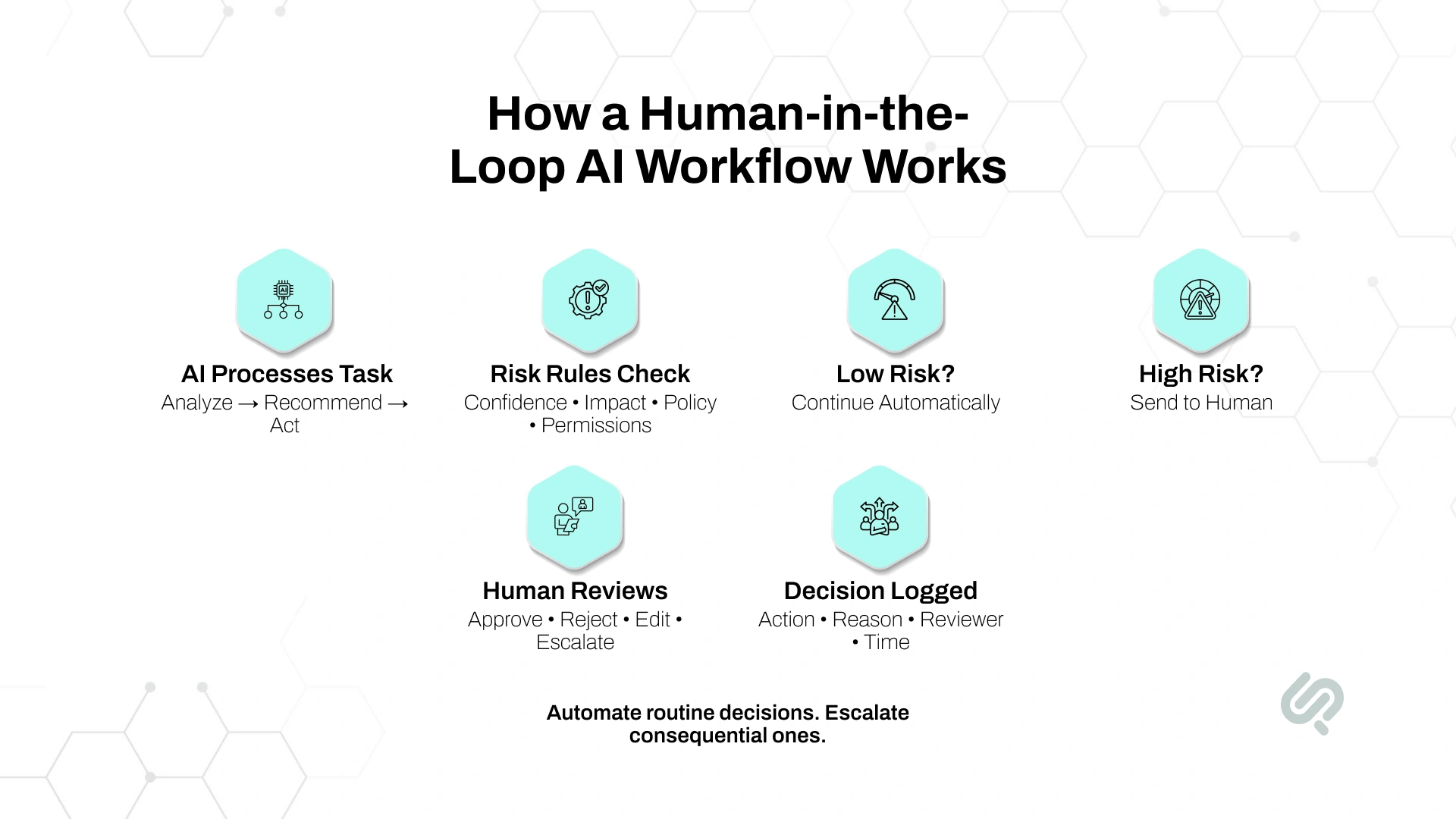
A simple HITL workflow looks like this:
The most important part is the routing logic.
A human review should happen because the decision crosses a defined risk boundary, not simply because AI was used.
For example, an AI customer service agent might issue refunds below $50 automatically, require manager approval from $50 to $500, and escalate anything above $500 to a senior reviewer.
That creates controlled automation without forcing people to review every case.
The best human-in-the-loop workflows do not require people to review every AI action. Human approval is added only where an incorrect decision could create serious financial, legal, safety, security, or compliance risk.
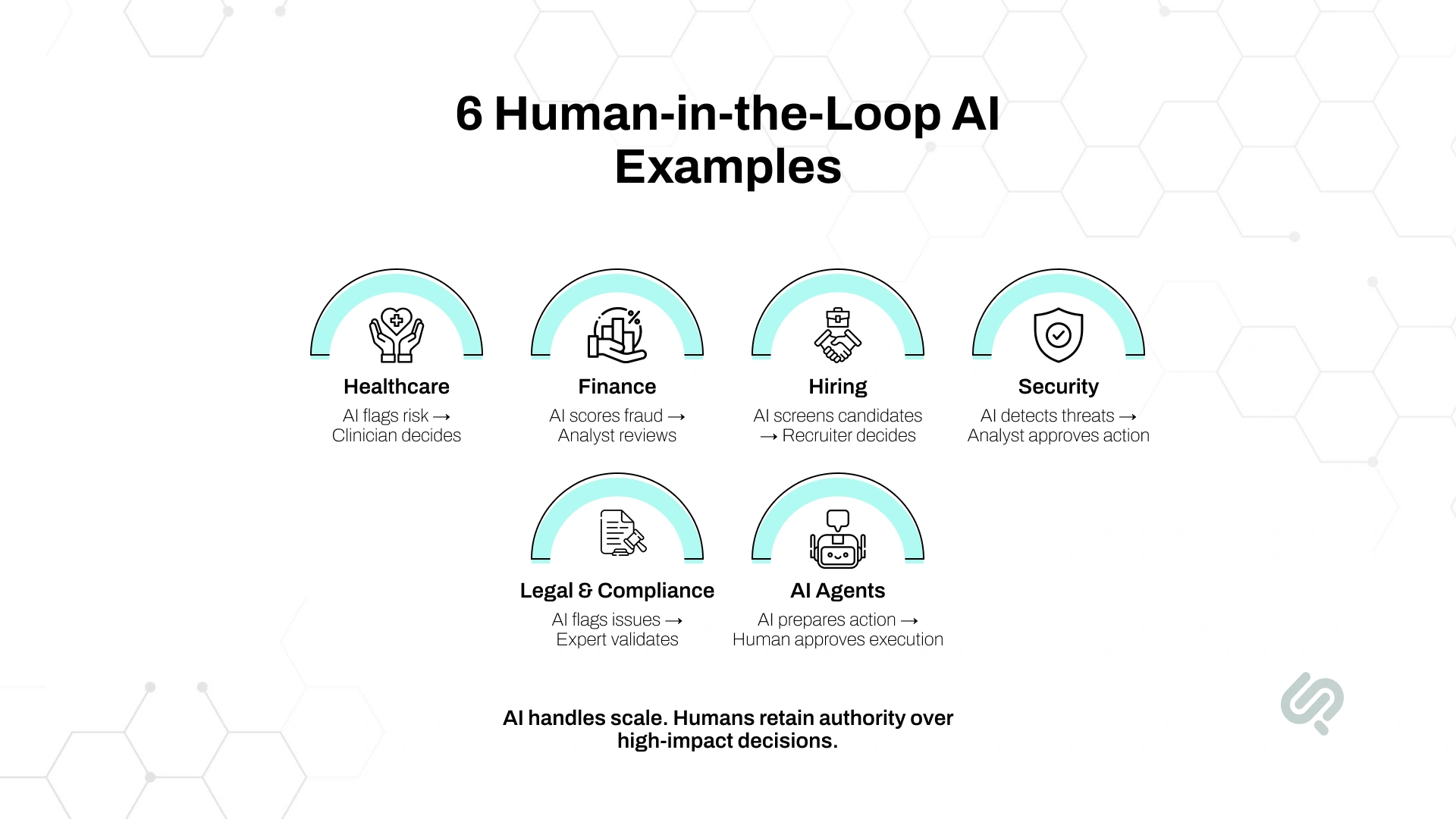
AI can summarize patient records, identify abnormal results, and suggest possible next steps. Human review remains important when the recommendation could affect diagnosis, treatment, or patient safety.
Example: An AI system flags a scan as high risk, but a clinician reviews the image and patient history before recommending further treatment.
AI can evaluate transactions, detect unusual behavior, and assign fraud scores at scale. High-value or uncertain cases should be sent to an analyst before an account is frozen or a payment is blocked.
Example: A bank's AI flags a $15,000 international transfer as suspicious. Instead of blocking it automatically, the system sends the case to a fraud analyst for approval.
AI can summarize resumes, compare skills with job requirements, and help recruiters prioritize applicants. It should not make sensitive employment decisions without appropriate human review.
Example: AI ranks an applicant below the interview threshold, but a recruiter reviews the profile and identifies relevant experience the system did not properly recognize.
AI can detect suspicious behavior and prioritize security incidents faster than manual monitoring. Human oversight becomes important when the proposed response could disrupt systems, users, or critical operations.
Example: AI detects unusual administrator activity and recommends disabling the account. A security analyst checks the evidence before approving the lockout.
AI can review contracts, extract clauses, classify documents, and flag compliance risks. Qualified reviewers should validate material interpretations, regulatory submissions, and other decisions with legal consequences.
Example: AI detects a potentially non-compliant clause in a supplier contract. A legal reviewer checks the clause before requesting a contract change.
AI agents can plan tasks, call business tools, update systems, and complete multi-step workflows. Human approval should be added before actions involving money, permissions, sensitive data, deletion, or contractual commitments.
Example: An AI customer-service agent prepares a $1,500 refund after reviewing a complaint. The refund is sent to a manager for approval before the payment is issued.
As AI moves from pilots into real business operations, human oversight becomes more important. McKinsey's 2025 State of AI survey found that 88% of respondents said their organizations regularly used AI in at least one business function (1) while only about one-third had started scaling AI programs across their organizations.

Greater adoption also increases the impact of AI errors. Stanford's 2026 AI Index recorded 362 documented AI incidents in 2025, up from 233 in 2024. (2)
For high-stakes AI systems, human oversight creates a control point before an incorrect or unsafe output becomes a real-world action.
Regulation is also moving in the same direction. The EU AI Act also makes human oversight an explicit requirement for high-risk AI systems, requiring systems to be designed so that natural persons can effectively oversee their use and help prevent or minimize risks. (3)
For businesses, the goal is not to add manual approval to every AI task. It is to identify the decisions where human judgment reduces risk without creating unnecessary delays.
For businesses, human-in-the-loop AI provides a middle ground between fully manual operations and unrestricted AI automation.
The main benefits include:
The business goal should therefore be controlled autonomy, not maximum human review.
Human-in-the-loop AI is not automatically safer simply because a reviewer exists. If reviewers do not understand the system, lack time to investigate cases, or are expected to approve almost every recommendation, the control can become little more than a rubber stamp.
A production AI system should define its escalation logic before launch. Human review can be triggered by several conditions:
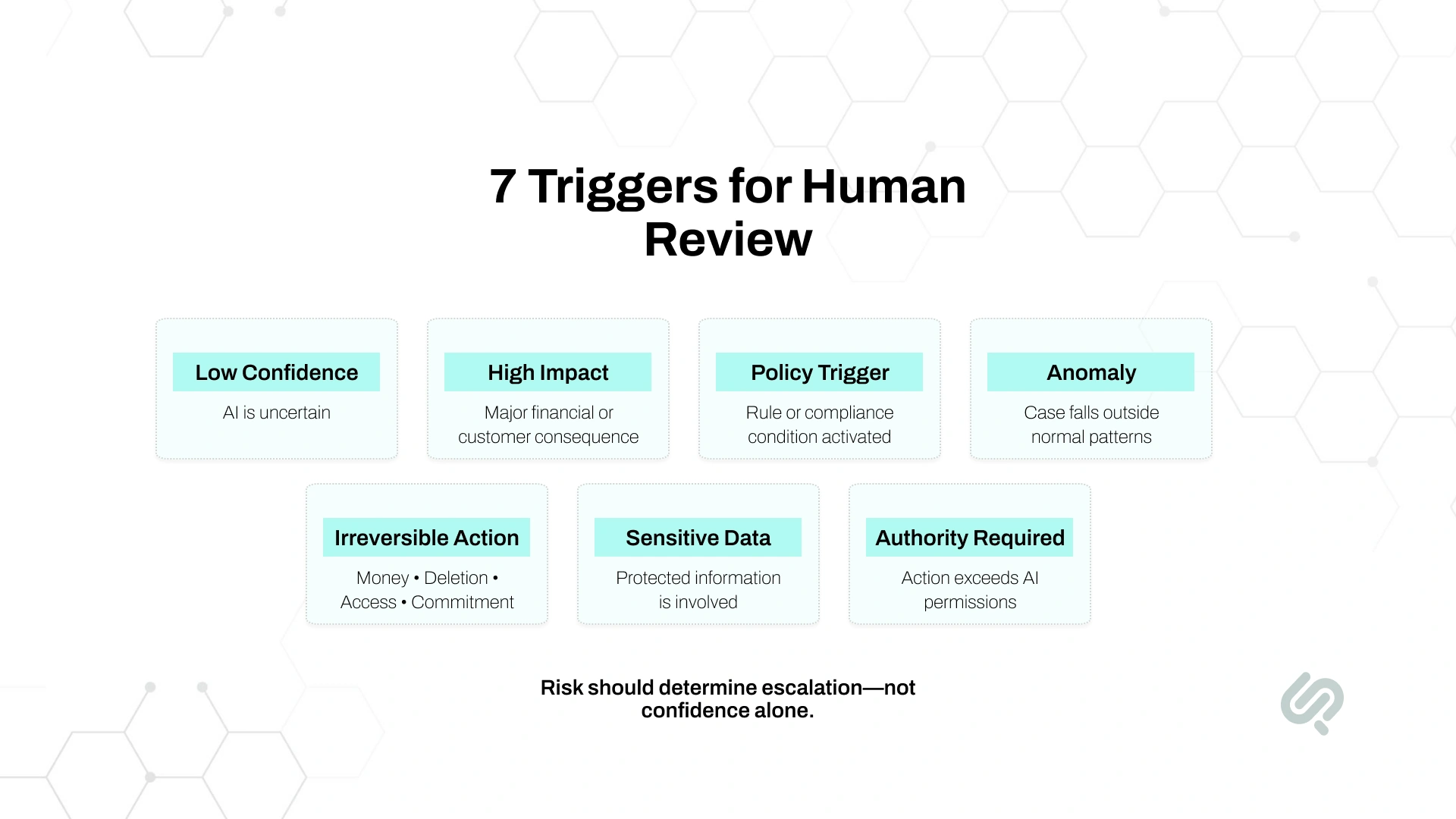
These rules should be based on business risk rather than model confidence alone.
For example, an AI agent may be highly confident that a customer qualifies for a large refund. The workflow may still require human approval because the action crosses a financial threshold.
Thresholds also need testing after launch. If they are too strict, reviewers become overloaded. If they are too loose, risky actions may avoid review.
“Human review only creates control when the reviewer understands why the AI stopped, what evidence matters, and what authority they have. An approval button without that context is just another workflow step.”
— Hammad Maqbool, AI Transformation & Prompt Lead, Phaedra Solutions.
There is no useful universal percentage of AI decisions that people should review. The right level of human oversight in AI depends on what happens if the system is wrong.
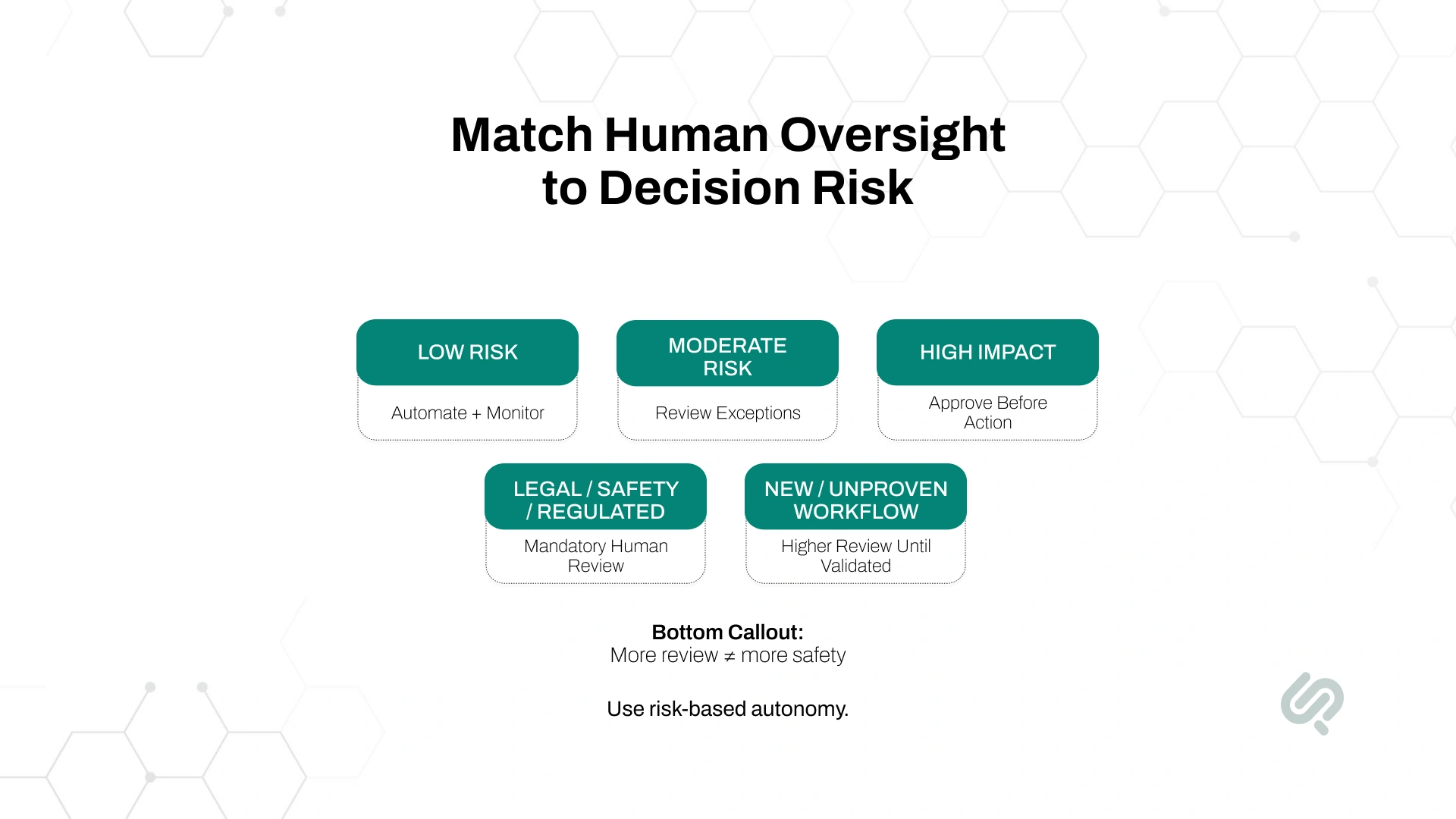
More human review does not automatically mean more safety.
If reviewers receive hundreds of low-value approval requests, they may develop approval fatigue and start treating reviews as routine. At that point, a human approval step can become a rubber stamp rather than a meaningful control.
A better approach is risk-based autonomy:
This means the best human-in-the-loop examples are not workflows where people approve everything. They are workflows where the right decisions reach the right person at the right time.
Start with the business decision, not the AI model.
Ask:
Then design the AI approval workflow around those answers.
Separate low-risk automated actions from decisions that require human authority.
For example, an AI support agent may draft a response automatically but require approval before issuing a large refund or changing an account.
Use more than model confidence.
Useful conditions include:
Define who can approve, reject, edit, or escalate each type of decision.
Role-based access controls become especially important when different actions require different levels of authority.
Do not show reviewers only the AI recommendation.
Provide relevant source information, risk indicators, supporting evidence, and the exact action the AI wants to take.
A useful audit trail should capture:
Human corrections should improve the system.
Repeated overrides may indicate that prompts, models, data, thresholds, or business rules need to change.
Track how many cases are escalated and how long decisions take.
If too many routine cases require approval, the workflow needs better confidence-based routing or risk rules.
The goal is not to remove people completely. It is to use human judgment where it adds the most value.
Four groups of metrics usually matter most:
Teams should also look for large differences between reviewers handling similar cases. High inconsistency may indicate that the policy is unclear or that reviewers are not being given enough context.
If most AI actions still need approval, the business has not meaningfully automated the process. Use human attention for exceptions and consequential decisions rather than routine work.
Confidence does not measure business consequence. Escalation should also consider financial impact, policy requirements, sensitive data, user vulnerability, permissions, anomalies, and whether the action can be reversed.
An Approve button is not meaningful oversight. Reviewers need the AI recommendation, relevant evidence, source data, risk indicators, and enough authority to reject or escalate the action.
Human oversight should also be measured. Track override rates, review times, missed escalations, reviewer disagreement, and repeated approval patterns that may indicate automation bias or reviewer fatigue.
A Phaedra Solutions client needed a cloud surveillance platform that could continuously analyze video from IP cameras and access-control systems without forcing security teams to manually monitor every feed. Phaedra Solutions developed a semi-autonomous platform with real-time face detection and tracking, access logs, AI-powered analytics, and OpenAI-assisted video search.

AI handles continuous monitoring, detection, and information retrieval, while security teams remain responsible for investigating threats and making consequential security decisions. Built on AWS and Docker and tested for security, performance, compatibility, and usability, the platform shows how AI can reduce manual monitoring without removing human control from high-impact actions.
Not every human approval workflow requires custom AI development.
An off-the-shelf automation tool may be enough when the process is simple and low-risk. For example, a business may only need a person to approve AI-generated content before it is published.
Custom development becomes more useful when the AI workflow needs to enforce complex operating rules or connect with important business systems.
Custom AI workflow automation is particularly useful when AI agents can move money, update records, change permissions, communicate externally, or trigger actions across multiple business systems.
The implementation choice should therefore depend on workflow complexity, business risk, integrations, and accountability requirements, not simply on whether a platform includes an approval button.
Phaedra Solutions' AI development services help businesses build AI systems that automate routine work while keeping people in control of decisions that carry real financial, legal, safety, security, or operational consequences.
We can design the complete workflow around the decision itself: what AI can execute automatically, what triggers human review, who has authority to approve or override an action, what evidence reviewers see, and how every decision is logged. This can include AI agents, approval and escalation logic, role-based permissions, business-system integrations, audit trails, monitoring, testing, and fallback controls.
The objective is not to put a human behind every AI decision. It is to build the controls that allow AI to automate as much as the business can safely support.
Planning a high-stakes AI workflow?
Book a free AI development consultation with Phaedra Solutions to identify what should be automated, where human approval belongs, and what it would take to move the system into production.



Ameena is a content writer with a background in International Relations, blending academic insight with SEO-driven writing experience. She has written extensively in the academic space and contributed blog content for various platforms.
Her interests lie in human rights, conflict resolution, and emerging technologies in global policy. Outside of work, she enjoys reading fiction, exploring AI as a hobby, and learning how digital systems shape society.