Here’s what was at risk:




Phaedra Solutions modernized a legacy lab management web app into a faster, more reliable enterprise web application for a US-based healthcare company.
Outcome: Better performance, stronger backend foundation, and smoother releases.


This is a legacy system modernization case study where a rapidly growing healthcare provider faced system slowdowns, unstable releases, and scaling limits that required legacy system modernization without downtime or risk. Phaedra Solutions delivered enterprise modernization services by modernizing the web application with React/Next.js, rebuilding the database and backend, improving key lab workflows, and implementing DevOps so the platform could run faster, release more reliably, and scale with enterprise demand.
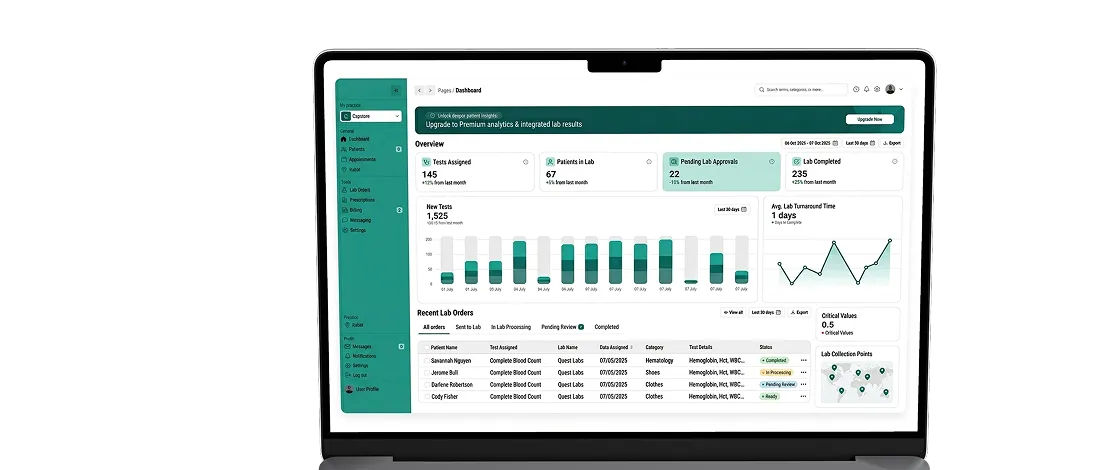
This is a medical lab management system built around lab information system software workflows. In it:
Patients book lab tests and track progress (medical test tracking and reporting).
Doctors request tests for patients and view results inside the system
This platform covers essential LIS software features required for reliable operations.
As usage grew, the system felt slower and harder to trust.
Updates became high-risk because the legacy foundation was fragile.
The business needed better performance, but “quick fixes” would not last.
This is the classic legacy trap: the system still works, but it fights you every time you try to improve it, and application performance optimization becomes risky.

The system was “too old to trust” and “too critical to break.” They needed better performance fast, but quick patches would only create more issues later. The real fix required legacy system modernization, focusing on what mattered most, without disrupting daily lab workflows.
Patient impact risk from slower lab workflows
Compliance exposure in a regulated healthcare environment
Operational bottlenecks that grew as usage increased
Scaling limitations from legacy architecture and data design
We addressed this with a structured software risk assessment before making foundational changes.

Phaedra Solutions led the legacy healthcare software modernization, owning delivery and performance engineering across the database, backend, and web app to improve performance.
Where helpful, we used AI-assisted modernization to accelerate review and documentation tasks.

To keep the modernization on track and avoid surprises, we ran delivery with clear scope and weekly visibility. A fixed-price model plus Kanban helped us prioritize the highest-impact work first and ship steadily.

.svg)
.svg)

.svg)
This kept priorities clear, work visible, and delivery predictable.
This is the phased plan we followed to modernize the legacy healthcare system without disrupting operations.

A modernized web application built with React/Next.js
A rebuilt database and backend designed for performance
Improved existing lab workflows (patients + doctors)
DevOps setup for smoother deployments and stability
Delivery leadership through IT project management (scope, priorities, execution)
To keep the modernization on track and avoid surprises, we ran delivery with clear scope and weekly visibility. A fixed-price model plus Kanban helped us prioritize the highest-impact work first and ship steadily.
The enterprise system modernization efforts improved performance, release reliability, and scalability.


.svg)

.svg)

Many teams assume modernization means a full rebuild. It doesn’t.
This project did not require a complete rebuild. We preserved business-critical workflows and modernized only what created the biggest performance and risk bottlenecks.
This reduced cost, timeline, and operational disruption while still delivering measurable speed, stability, and release reliability.
If your LIS software/clinical lab software is slowing growth, delaying releases, or making every change feel risky, modernization does not have to mean rebuilding everything.
Our healthcare software consulting team helps you prioritize what to fix first (database, backend, workflows, DevOps) as part of a risk-controlled healthcare IT modernization plan — including clear tech stack recommendations and a practical path for legacy code modernization.
Get a quick expert review and a clear plan for what to fix first.
Tell us what you're building — and we'll take it from there.
Fill out the form to schedule a free 30-minute discovery call where we understand your idea, offer early advice, and suggest the best next steps.