





.webp)






The custom ERP software development price in 2026 is best treated as a range rather than a fixed market rate. For early budgeting, a focused single-module ERP can fall around $30,000–$80,000, a connected multi-module system around $80,000–$250,000, and a broader enterprise build around $250,000–$600,000+. Highly complex enterprise programs can go well beyond that.
Market estimates vary because companies define “ERP” very differently. Appinventiv currently estimates ERP development at roughly $40,000–$400,000, while Itransition says a full-scale custom ERP for a midsized company can start at $1 million.
The useful question is therefore not just “How much does an ERP cost?” but “What scope, integrations, migration, rollout, and long-term operating costs are included in that number?”
A focused ERP module can start around $30,000–$80,000. A multi-module system for a growing or midsized company may fall around $80,000–$250,000, while larger enterprise builds can reach $250,000–$600,000 or more. Highly complex, multi-entity implementations can exceed $1 million.
A complete quote should account for discovery, architecture, UX, development, integrations, data migration, testing, security, deployment, training, documentation, and initial support. Check what is excluded as carefully as what is included. Two ERP quotes with different inclusions cannot be compared fairly.
A focused module can often be delivered in roughly 8–16 weeks. A multi-module ERP can take 6–18 months, depending on integrations, data migration, user roles, testing, and rollout complexity. Itransition also estimates that developing and implementing a full custom ERP can take 12 months or more.
Buy or configure an existing ERP when your processes are relatively standard and the platform already covers most requirements. Consider custom development when your workflows, integrations, reporting, or operating model require extensive workarounds in packaged software. Compare the options over several years rather than comparing only first-year costs.
The biggest drivers are functional scope, integrations, data migration, customization, user roles, security and compliance requirements, organizational complexity, and rollout across multiple locations or business units. Training and change management can also add significant work.
Bring in an ERP development partner when your team knows the operational problem but does not have the product, architecture, integration, data, QA, and deployment expertise required to scope and build the system safely. A partner is particularly useful when several departments or legacy systems need to be connected. The first job should be defining the scope, not starting development.
A custom enterprise resource planning system connects the operational functions your business needs into one software environment. Instead of buying a large package and adapting your business to it, the system is designed around your workflows, users, approvals, data, and reporting needs.
A custom ERP might include:
You do not necessarily need every module in phase one. For many growing companies, building the one or two workflows creating the greatest operational cost is a lower-risk starting point than replacing everything at once.
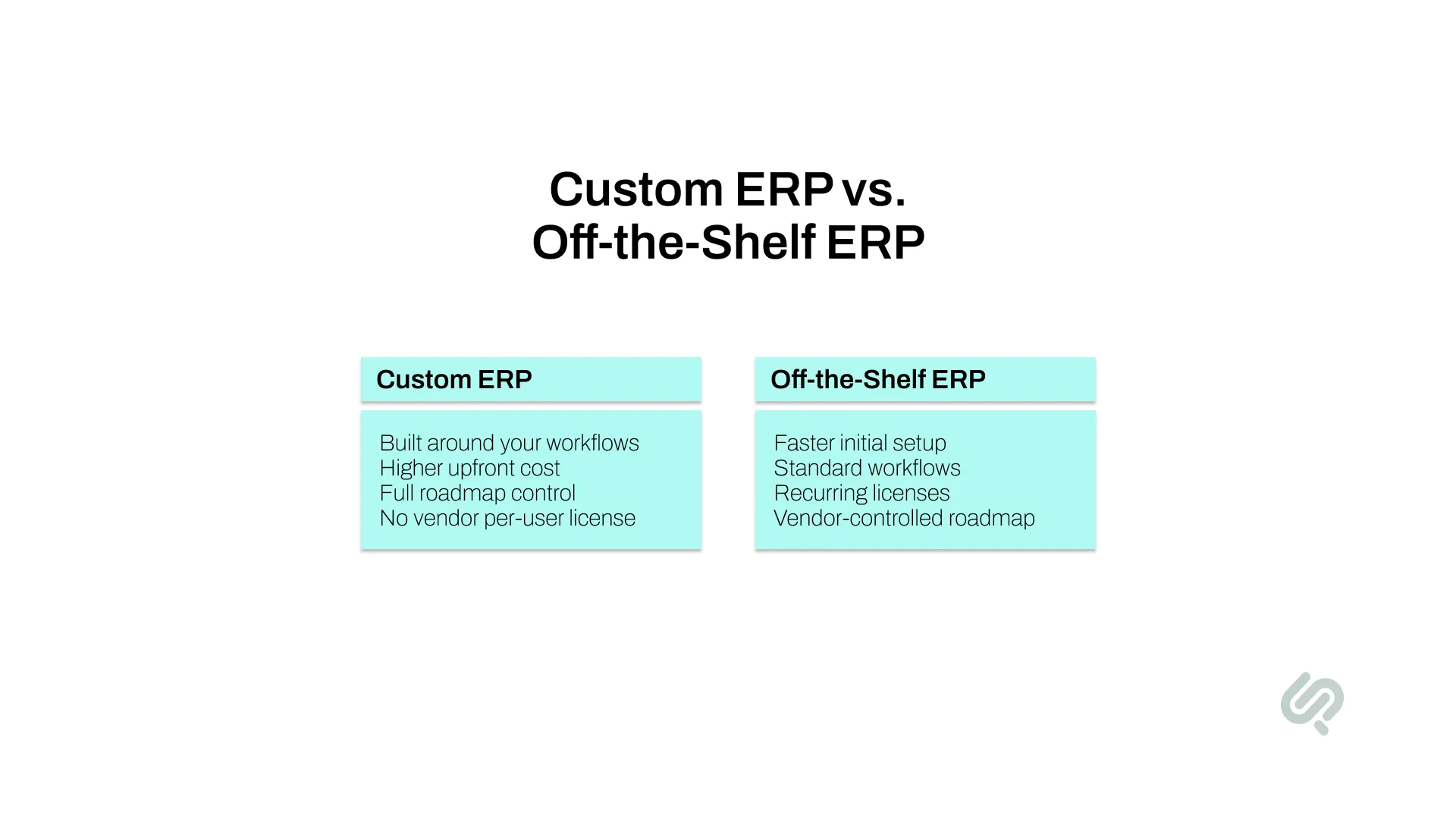
This decision should happen before a company asks development vendors for estimates.
A packaged ERP is usually the better choice when your processes are close to common industry workflows and the platform already solves most of the problem.
A custom system becomes more attractive when the gaps are significant enough that you would otherwise spend heavily on configuration, extensions, integrations, and manual workarounds.
Do not make the decision on license price alone. Itransition notes that subscription costs, infrastructure, personnel, ongoing support, and hidden implementation expenses all affect ERP total cost.
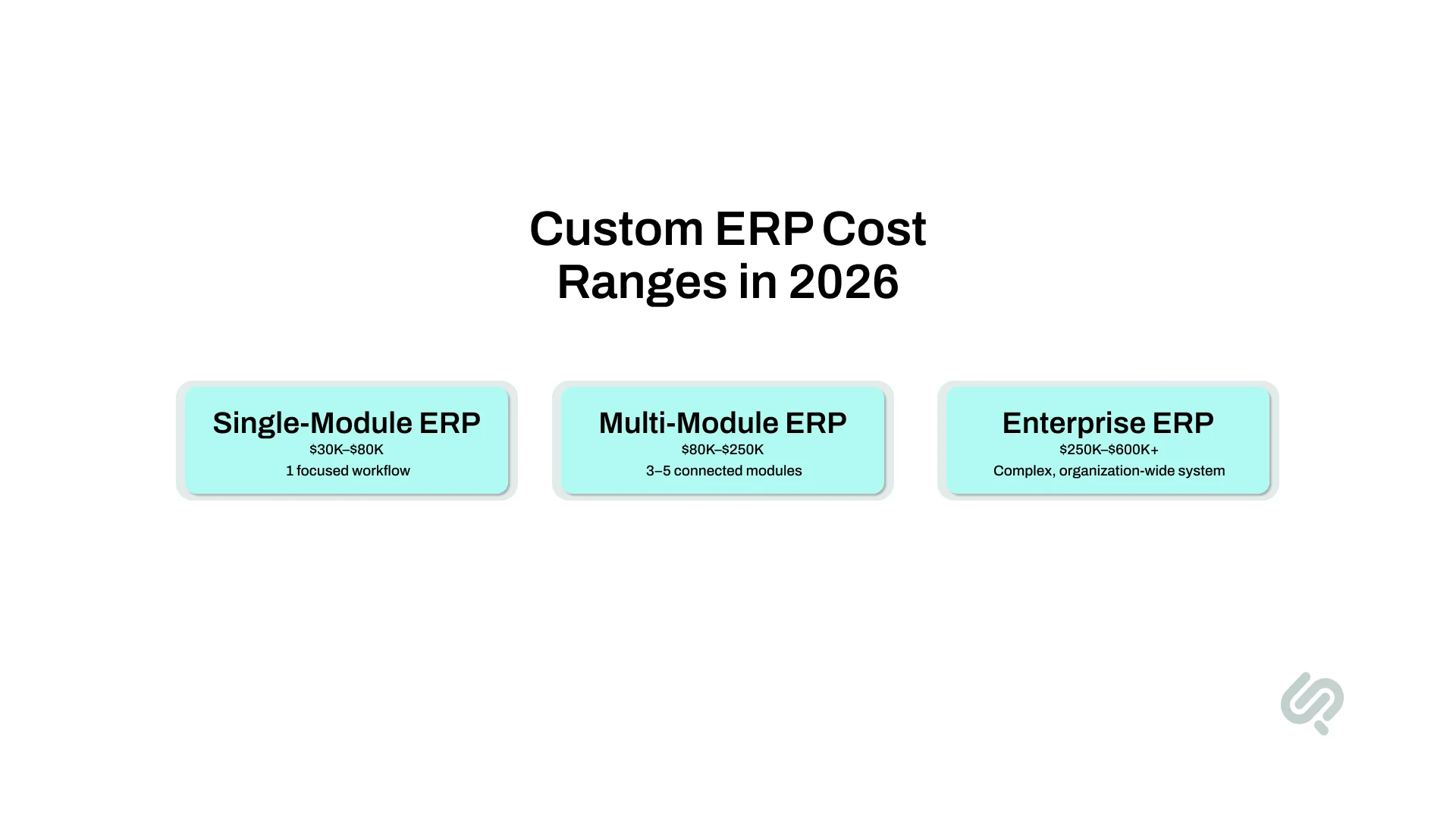
The following are useful planning bands, not fixed market prices.
At the highest end, the range can rise substantially. Itransition’s May 2026 guide says full-scale custom ERP implementation for a midsized company can start at $1 million, demonstrating how quickly budgets move once “custom ERP” means a large organization-wide program rather than several focused modules. (1)
The custom ERP development cost you should use internally is therefore the cost of your defined scope, not a market average.
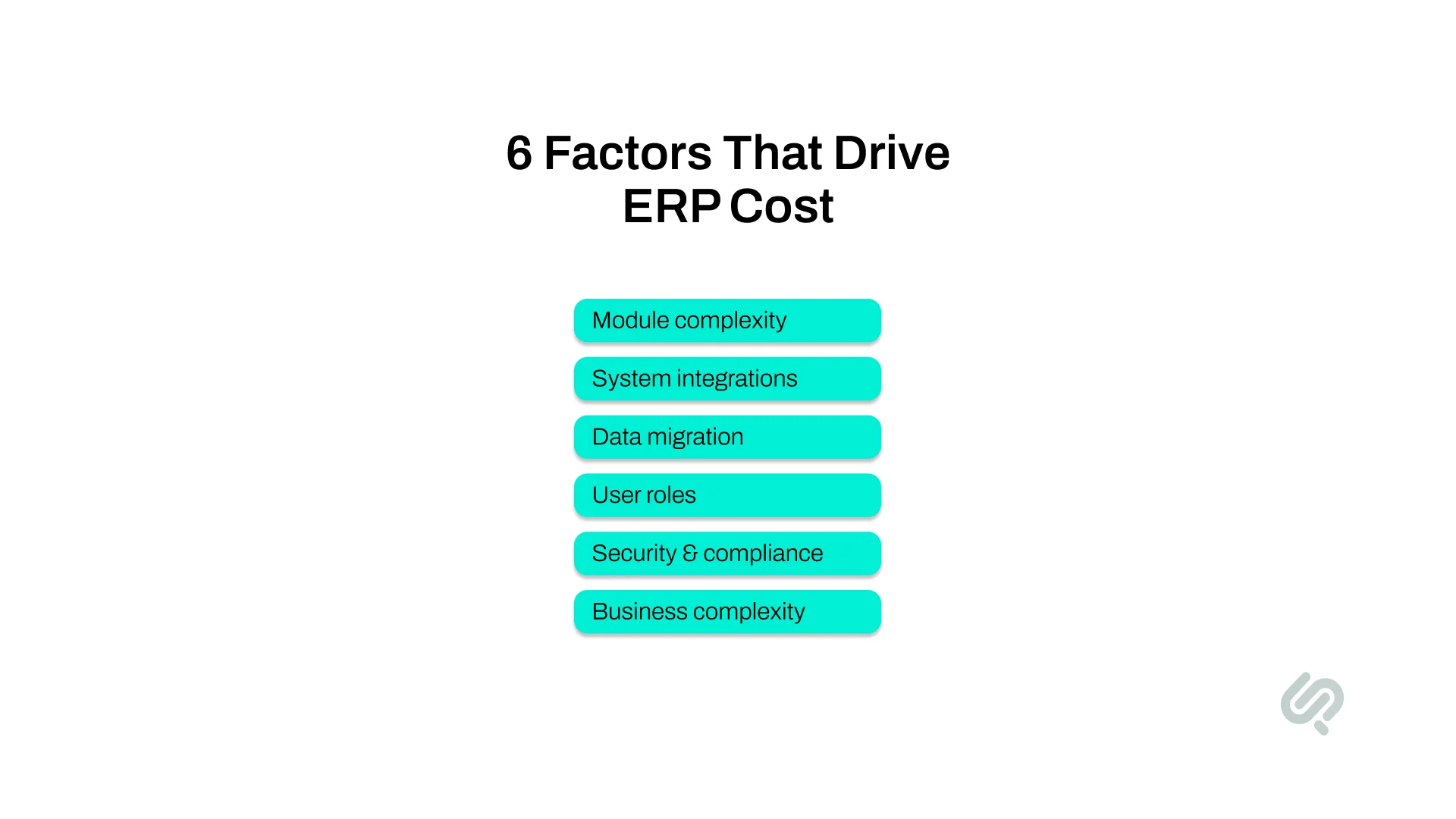
Five simple modules are not necessarily more expensive than two highly specialized ones.
A basic inventory module may track items, quantities, and locations. A more complex version may need multiple warehouses, barcode workflows, replenishment logic, supplier management, forecasting, batch tracking, and mobile access.
Scope depth matters as much as module count.
Every external system adds another dependency.
Common ERP integrations include accounting software, CRMs, eCommerce stores, payment systems, shipping platforms, warehouse tools, identity providers, BI platforms, and industry-specific applications.
Older systems without clean APIs usually require more engineering and testing.
Data rarely moves directly from an old system into a new ERP.
Duplicates, missing values, inconsistent product IDs, outdated customer records, and conflicting formats have to be resolved first. Itransition specifically identifies data management among hidden ERP costs, while current ERP practitioners continue to describe migration as a frequently underestimated workstream.
A system with administrators and normal users is simpler than one with regional managers, finance teams, warehouse operators, suppliers, executives, auditors, and department-specific permissions.
More roles mean more workflow logic, security rules, and test cases.
Finance, employee, customer, health, or regulated operational data may require additional access controls, logging, encryption, audit trails, testing, and documentation.
Those requirements should be defined during discovery instead of appearing late in development.
Multiple companies, currencies, countries, warehouses, business units, languages, tax rules, or approval hierarchies all add complexity.
This is why employee count alone is a poor way to estimate an ERP.
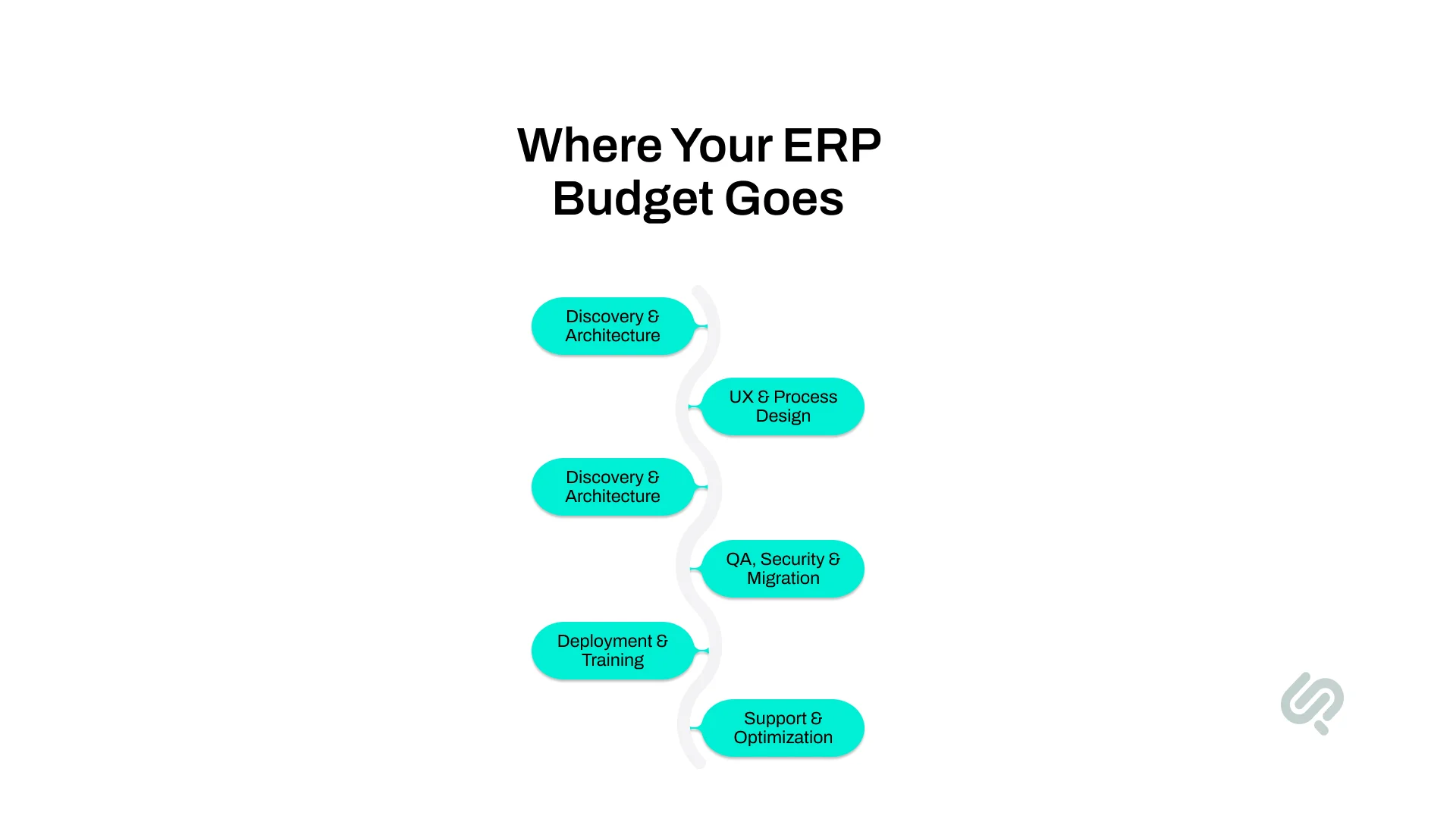
A serious ERP quote is more than a development-hours estimate.
Appinventiv’s current ERP guide similarly separates analysis, design, development, testing, deployment, and ongoing support rather than treating ERP implementation as one coding phase.
That distinction matters when comparing vendors. A quote that appears 20% cheaper may simply leave migration, training, security testing, or post-launch support outside the price.
For initial planning, calculate the budget in layers:
ERP implementation budget = discovery + design + development + integrations + data migration + QA/security + deployment/training + contingency
Then calculate ownership separately:
ERP total cost of ownership = implementation budget + hosting + support + third-party services + future enhancements + internal administration
For packaged software, add recurring user, module, and platform licensing as applicable.
This approach is more useful than estimating ERP solely by development hours because it exposes costs that may otherwise appear after the project starts.
One of the most useful lessons from current ERP practitioner discussions is that companies often budget for the new system but not for the period between the old and new systems.
ERP users discussing real migrations describe painful data moves, contract lock-in, unexpected implementation spend, and the importance of choosing the right implementation partner.
LinkedIn practitioners also repeatedly flag temporary productivity loss, data cleanup, scope ambiguity, and change orders as costs that rarely appear in the headline software price. These are practitioner experiences rather than industry benchmarks, but they highlight risks buyers should ask about before signing.
Budget for:
There is another question worth adding to every ERP procurement checklist:
How do we get our data and code out if this relationship ends?
For custom software, clarify source-code ownership, documentation, infrastructure access, database ownership, data export, third-party credentials, and handover terms before development begins.
The right contract model depends on how certain you are about the scope.
For many ERP projects, phased fixed scope is a practical middle ground.
Instead of trying to define a two-year program down to every screen, define one valuable operational release tightly, launch it, and then scope the next phase using what you learned.
The initial implementation quote tells you what it costs to reach launch. It does not tell you what the system costs to own.
Itransition groups ERP spending into software licensing, infrastructure, personnel, ongoing expenses, and hidden costs. It also recommends planning a contingency budget for less visible implementation expenses.
Compare these areas when deciding between custom and packaged ERP:
A cheaper year-one system can become the more expensive five-year system. The reverse can also be true.
Model both before choosing.
A focused custom module can often take around 8–16 weeks. A multi-module ERP can require 6–18 months, depending on migration, integrations, departments, and rollout strategy.
A typical project moves through:
Large programs can take longer. Itransition currently estimates 12 months or more for developing and implementing a full custom ERP. (2)
A shorter timeline is only useful if the project reaches a stable go-live. Removing discovery, migration validation, UAT, or security testing to make the schedule look faster usually moves the cost into rework later.
“ERP budgets usually become difficult to control when workflows, integrations, data ownership, and scope boundaries are still unclear after development starts. The more ambiguity you remove during discovery, the fewer expensive decisions you have to make halfway through the build.”
— Mujtaba Sheikh, Head of Development, Phaedra Solutions
Gartner’s research makes that business alignment especially important. It predicts that by 2027, more than 70% of recently implemented ERP initiatives will fail to fully meet their original business goals, with technology-centric approaches that ignore stakeholder engagement contributing to poor outcomes. (3)
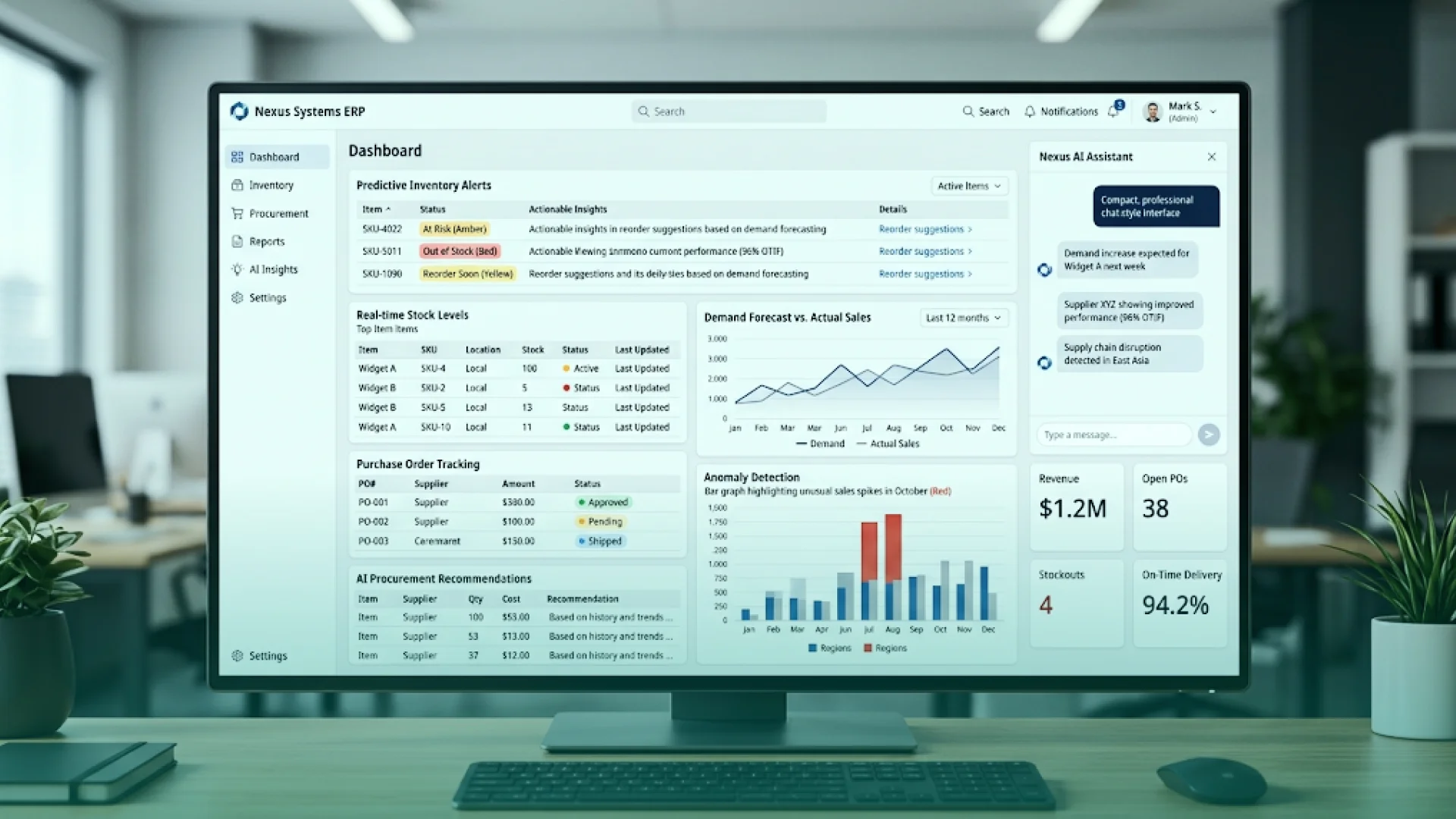
ERP is increasingly becoming a foundation for AI-driven operational workflows, not simply a database and reporting system.
Useful AI capabilities include:
Gartner predicts that 70% of large organizations will adopt AI-based supply-chain forecasting to predict future demand by 2030. (4)
But AI features only work when the ERP data underneath them is dependable. Gartner also predicts that through 2026, organizations will abandon 60% of AI projects unsupported by AI-ready data.
That makes data structure, governance, permissions, and integration architecture part of the AI plan from the start.

For Phaedra Solutions, AI-first development applies both to what can be built into the ERP and how the software itself is delivered.
Our engineering teams use AI-assisted workflows for requirements synthesis, rapid prototyping, repetitive code generation, test-case creation, QA review, documentation, debugging, and release preparation. Senior engineers remain responsible for architecture, security, code quality, scalability, and final release decisions. Phaedra’s current custom software process also uses AI during planning, prototyping, coding, QA, documentation, and DevOps.
Depending on project size, complexity, and implementation scope, Phaedra’s AI-first delivery model targets improvements across three areas:
These are project-dependent delivery targets, not fixed guarantees. The goal is not to push unreviewed AI-generated code into an ERP. It is to remove repetitive delivery work while senior engineers keep control of the system.
Do not build seven modules because an ERP can contain seven modules.
If inventory accuracy is costing the company money, solve inventory first. If procurement approvals are the bottleneck, start there.
Define what users genuinely need for the first production release.
Move desirable but nonessential dashboards, automation, integrations, and admin features into later phases.
Identify duplicate, outdated, incomplete, and conflicting records early.
Data cleanup performed under deadline pressure becomes expensive.
Give vendors a complete list of the systems the ERP must exchange data with.
For each one, clarify whether an API exists, what data moves, in which direction, how often, and who controls access.
Custom development is useful when a workflow genuinely differentiates how your business operates.
Rebuilding every habit from an old system creates unnecessary engineering work and future maintenance. ERP practitioners also warn that heavy customization can increase upgrade and integration complexity over time.
Do not compare the totals until the vendors are pricing the same outcome.
Ask each ERP vendor or development company to make these areas explicit:
Pay close attention to assumptions.
“Integration included” means little unless the proposal names the systems and responsibilities. “Migration included” means little unless it explains what data will be cleaned, mapped, validated, and moved.
A $120,000 proposal that includes migration, integrations, QA, launch support, and training may be lower risk than a $90,000 proposal that turns those items into change requests later.
The best ERP quote is not automatically the lowest quote. It is the one that gives you the clearest picture of the cost of reaching a stable production system.
A client came to Phaedra Solutions with manual inventory processes that made accurate stock tracking difficult. Limited visibility was contributing to overstocking and shortages, while the business lacked reliable forecasting. Instead of forcing a full ERP replacement, the project focused on the operational area creating the immediate problem: inventory.
Phaedra delivered an AI-powered inventory management system as web and mobile applications in 10 weeks across five sprints. It included real-time inventory tracking, barcode scanning and generation, low-stock reminders, analytics, and AI-driven reporting to forecast future stock needs. It shows why a focused ERP-adjacent module can sometimes create value faster than committing to an organization-wide rollout on day one.
Phaedra Solutions provides Custom Software Development for businesses that need ERP systems built around their real workflows, data, users, integrations, and operational priorities.
Our AI-first delivery process uses AI-assisted planning, development, testing, QA, and documentation to reduce repetitive effort while senior engineers retain technical control.
Depending on project scope and complexity, this model is designed to improve delivery speed, cost efficiency, and team utilization rather than simply adding more developers to the project.



Musa is a senior technical content writer with 7+ years of experience turning technical topics into clear, high-performing content.
His articles have helped companies boost website traffic by 3x and increase conversion rates through well-structured, SEO-friendly guides. He specializes in making complex ideas easy to understand and act on.