






.webp)
Time and Material Contract in Software Development is a pricing model where you pay for the actual hours worked and resources used, instead of one fixed total price upfront. It usually works best when the scope is still evolving, features may change, or the product will be built in phases with ongoing feedback.
A fixed-price contract is different. It works better when the scope, budget, and timeline are clear from the start. If requirements are likely to change, though, it can become harder to manage.
This choice matters because software projects still often face delays and budget overruns, while more teams are now using flexible delivery models for changing work. This guide will help you understand how a Time and Material Contract in Software Development works, when it fits best, and when a fixed-price model may be the better option.
A time and material contract means you pay for the actual hours worked, agreed team roles, and approved costs used during delivery. It works best when scope is still changing or the product will be shaped in phases.
Use T&M when requirements are not fully locked, priorities may shift, or you plan to build through sprints, discovery, MVP releases, or ongoing improvements.
Fixed price is usually better when scope, timeline, deliverables, and acceptance criteria are already clear and unlikely to change.
Not always. T&M can cost less than fixed price when change is expected, because you avoid padded estimates, frequent renegotiation, and paying for assumptions that never get used. The risk comes when there is no backlog control or approval process.
Use one prioritized backlog, approve meaningful changes before work starts, review hours and spend weekly, and set a monthly budget cap or not-to-exceed limit.
At minimum, include role-based rates, billing cadence, reporting format, time-tracking rules, approval flow, change handling, budget cap, review cadence, and termination terms.
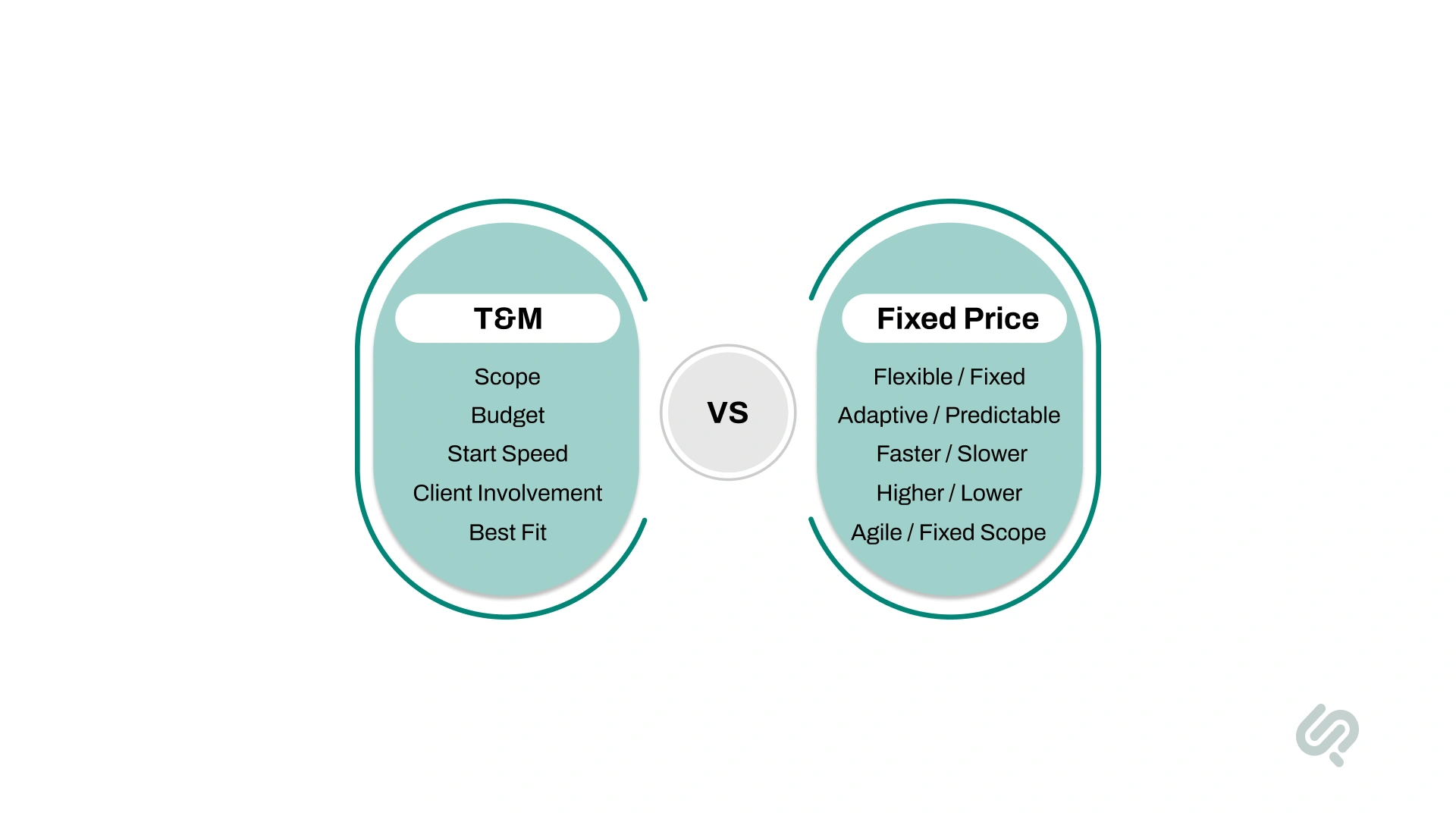
The main difference between time and material vs fixed price is simple: fixed price gives you more budget certainty upfront, while T&M gives you more flexibility during delivery.
A time and material contract in software development is usually better when requirements may change, priorities may shift, or the product will be shaped during development.
A fixed-price contract works better when the scope, timeline, and deliverables are already clear. The right model depends on what matters most to you:

A time and material contract is flexible, but it should never feel vague. In software development, it works best when both sides agree early on how work will be planned, tracked, reviewed, and billed.
Instead of paying one locked project total upfront, you pay for the actual time spent by the agreed team roles and any approved delivery costs. That gives you more room to adjust scope as the project becomes clearer.
In practice, a T&M software project usually works like this:
The contract defines the team roles involved, such as developers, designers, QA engineers, project managers, or DevOps support, along with their hourly or daily rates.
Most T&M projects run in sprints, weekly work cycles, or monthly delivery windows. This makes it easier to review progress and change priorities without disrupting the whole project.
Hours are logged against tasks, tickets, features, fixes, or sprint goals. This gives the client visibility into where time is going.
New requests can be added, delayed, or replaced based on current business priorities. That is one of the biggest reasons T&M works well for evolving products.
Invoices are usually sent weekly, biweekly, monthly, or by sprint. The best setup depends on how closely the client wants to review progress and spend.
Flexibility does not mean unlimited work. A good T&M setup includes clear approval rules for extra work, budget thresholds, or major scope shifts.
Time logs alone are not enough. Strong T&M projects also include demos, sprint reviews, backlog updates, and delivery summaries so the client can see what was achieved.
A good way to think about T&M is this: you are not buying a fixed list of tasks. You are buying controlled delivery capacity that can adapt as the project becomes clearer.
A time and material contract in software development works best when the end goal is clear, but the exact scope, feature list, or delivery path is still evolving. In these cases, trying to lock everything into a fixed-price model too early can create more friction than clarity.
Here are the project types that usually get the most value from T&M:
If you know what problem you want to solve but do not yet know every feature, workflow, or technical requirement, T&M is often the better fit.
This is common when:
Some software projects are not one-time builds. They grow over time through feature updates, UX improvements, bug fixes, performance work, and customer-driven enhancements.
In these cases, T&M makes more sense because:
This is especially common in software development outsourcing engagements where the product roadmap continues after the initial release.
Longer software builds usually benefit more from flexibility than rigid upfront estimates. The longer the timeline, the more likely it is that business priorities, technical constraints, or market needs will change.
T&M is a strong fit for long-term product development because it allows you to:
That makes it well suited for SaaS products, custom platforms, and digital products that will continue evolving after version one.
Projects involving AI, automation, advanced integrations, or other emerging technologies often carry more uncertainty than standard feature development.
In these projects:
A fixed-price model can become risky here because early estimates are more likely to be wrong. T&M gives you room to test, adjust, and improve without pretending the unknowns are already known.
A time and material contract is often the smarter option for MVPs, proofs of concept, and phased launches because these projects are designed to learn quickly, validate assumptions, and improve after feedback.
This is one of the clearest T&M use cases because:
You can also add a supporting internal link in this section to a relevant MVP or product development blog if available.
T&M naturally fits agile delivery because agile teams work in cycles, review progress regularly, and adjust priorities based on what they learn.
This works well when:
PMI reports that hybrid delivery approaches have increased by 57%, which supports the shift toward more flexible delivery structures for changing work. That makes T&M even more relevant for modern software teams.
Maintenance and support are hard to price accurately as fixed-scope work because the volume and complexity of tasks can change from month to month.
T&M is often a better fit for:
In these cases, the value comes from having flexible access to the right team capacity when needed, not from trying to define a perfect fixed scope in advance.
A fixed-price software development contract is usually the better option when the work can be clearly defined before development starts and there is little reason to expect major change during delivery.
While a time and material contract in software development gives you more flexibility, fixed price gives you stronger upfront cost certainty. That makes it a better fit for projects where predictability matters more than ongoing adaptation.
PMI found that inaccurate requirements gathering was a primary cause of project failure for 37% of projects. That is why a fixed-price software development contract works best when scope, deliverables, and acceptance criteria can be clearly defined before work starts. (2)
Here are the situations where fixed price usually makes more sense:
If the project is small, straightforward, and unlikely to change much, a fixed-price model is often the simpler choice.
This works well for:
Fixed price is a strong fit when the scope is already documented in enough detail to estimate cost, timeline, and deliverables with confidence.
That usually means:
If your team does not expect regular changes once development begins, fixed price can be more efficient.
This is a better fit when:
Some projects need to hit a specific date tied to a launch, contract requirement, or internal milestone. If the scope is also well defined, fixed price may be the safer commercial model.
This is common when:
Fixed price works best when there is a clear way to judge whether the work is complete.
That includes:
A T&M model usually works best when the client can stay involved and guide changing priorities. If that level of involvement is not practical, fixed price may be the better fit.
Choose fixed price when:
Fixed price works best when the project is already clear. T&M works best when the project becomes clearer through delivery.
A time and material contract can be a very strong fit for software development, but only when the project actually needs flexibility. The model is useful because it matches how many digital products are really built: in phases, with feedback, and with changing priorities.
You can adjust priorities, scope, and backlog items without rebuilding the whole contract every time something changes.
You do not need to define every feature in full detail before work begins.
T&M supports sprint-based development, testing, iteration, and staged releases.
You avoid pretending that every requirement, dependency, and effort estimate is already known.
Total spend is harder to predict if the backlog keeps growing.
Someone on the client side usually needs to review progress, approve changes, and help guide priorities.
Without a clear backlog, review cadence, and approval process, flexibility can turn into uncontrolled scope growth.
If the project is short, stable, and already well defined, fixed price may be simpler.
T&M is not risky because it is flexible. It becomes risky when flexibility is not paired with structure, visibility, and decision-making.
A time and material contract in software development is usually a strong fit when the work is difficult to define with full accuracy upfront and the project is likely to evolve as delivery moves forward.
Instead of trying to force a fixed estimate too early, this model gives you more flexibility to adjust scope, priorities, and team effort based on real progress.
Use this quick checklist to assess whether T&M is the right model for your project:
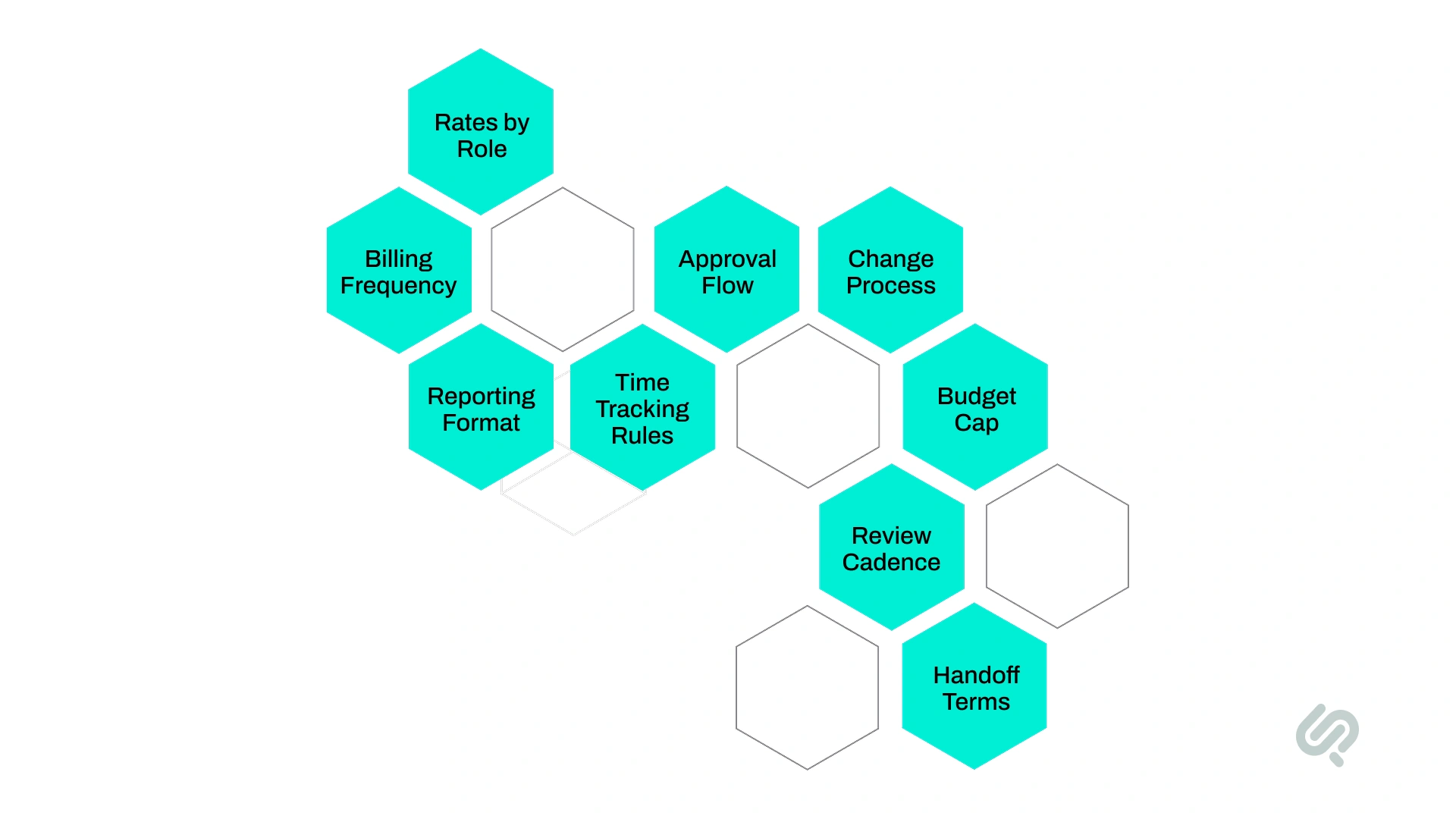
A time and material contract in software development should do more than explain hourly billing. It should show exactly how the work will be tracked, reviewed, approved, and controlled.
This is what turns a flexible model into a manageable software development contract instead of an open-ended arrangement.
At minimum, a strong T&M agreement should include these elements:
The contract should clearly show how the T&M pricing model works for each role involved in delivery. That usually includes rates for:
This gives the client better visibility into cost structure and helps avoid confusion when the role mix changes during the project.
The agreement should explain how often invoices will be issued. Common options include:
This matters for budget control because the shorter the billing cycle, the easier it is to catch issues early and review spend against progress.
A good T&M contract should define what reporting the client will receive along with invoices or delivery updates. This may include:
Without reporting, the client sees cost but not enough delivery context.
The contract should explain how time is recorded and what counts as billable work. This should clarify:
This helps reduce disputes later and keeps the project scope tied to visible effort.
A T&M model is flexible, but that does not mean extra work should start without approval. The contract should state:
This is one of the most important controls in any time and material software contract.
Even in a flexible model, the change request process should still be clear. That does not always need a heavy formal workflow, but the contract should explain:
This keeps flexibility from turning into uncontrolled scope expansion.
One of the smartest ways to manage a T&M engagement is to set a spending guardrail. This can be:
This does not remove flexibility. It adds financial control while still allowing the team to work in an agile way.
The contract should also define how often progress will be reviewed. This may include:
A clear review cadence helps the client stay involved without micromanaging the work.
A strong software development contract should explain what happens if the project pauses, ends, or changes direction. This should cover:
These terms matter because they protect both sides and make the engagement easier to manage if priorities shift.
Many buyers understand the idea of T&M, but still want to know what it looks like in practice. A simple sprint example makes the model easier to evaluate.
Here is what a 2-week T&M billing window might look like:
The invoice would show:
This is why T&M works well for evolving software projects. You are not paying for a rough promise. You are paying for visible work, role-based effort, and approved progress over a defined period.
A time and material contract in software development gives you flexibility, but it needs active management. Without clear controls, costs can drift. With the right governance, T&M can be a practical way to manage evolving software work while still protecting budget and delivery quality.
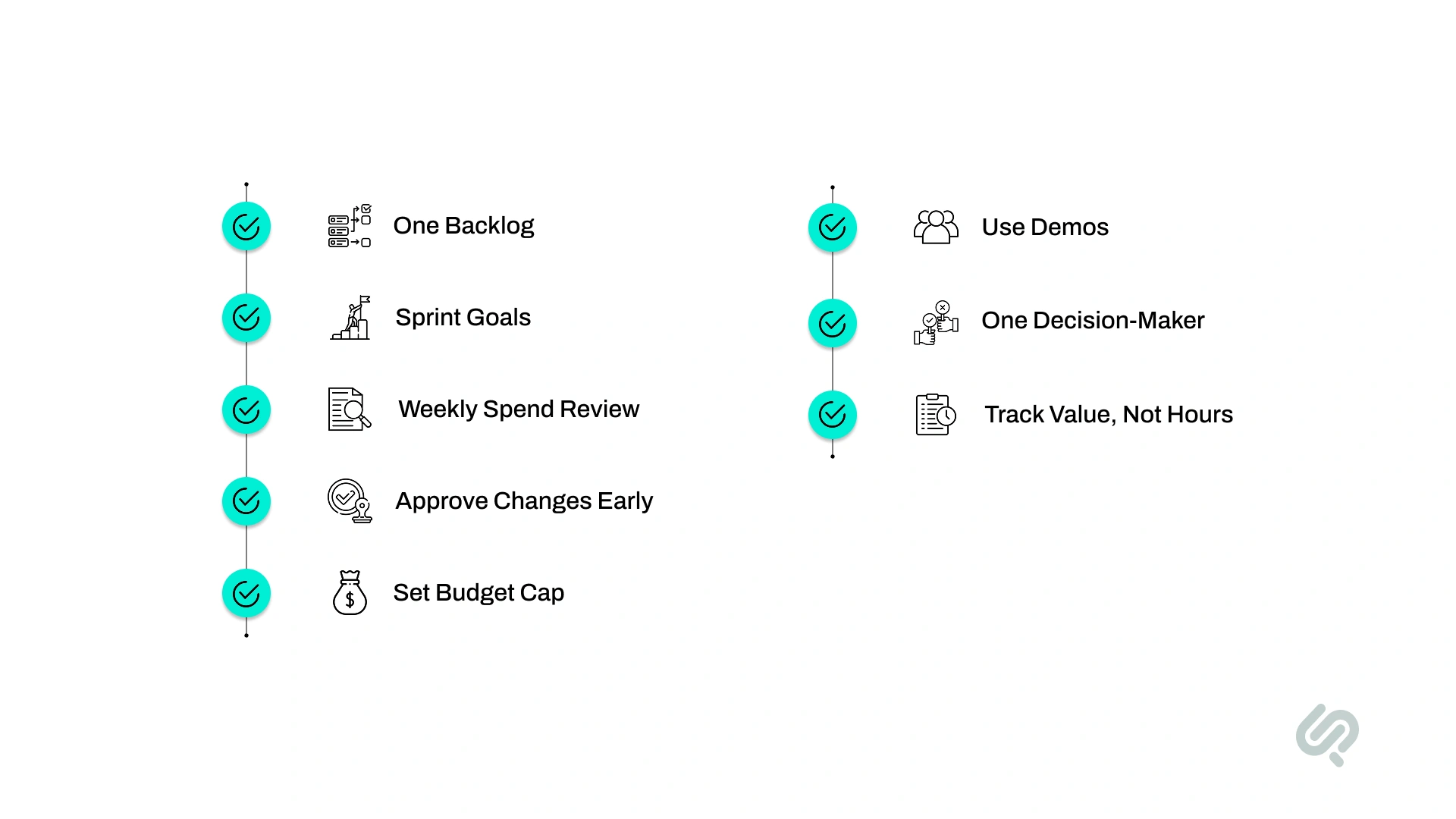
Use these controls to keep a T&M project on budget:
Use one shared backlog instead of scattered requests across calls, chat, and email. This helps you see what is approved, what is pending, and what should be done next. A prioritized backlog helps you:
Before each sprint or work cycle, agree on the main goal. This keeps the team aligned and reduces effort spent on lower-priority work. Clear sprint goals help you:
Do not wait until month-end to review costs. Weekly visibility is one of the best ways to control a T&M project. Review:
T&M is flexible, but new requests should still be reviewed before development begins. Any meaningful scope change should be approved with clarity on cost, timing, and priority.
Agree on a spending limit for each month, sprint, or phase. This gives you:
Do not review invoices alone. Regular demos and sprint reviews help connect spend to actual output and show whether the work is still worth funding.
T&M projects run better when one person owns approvals and priorities on the client side. This reduces delays, mixed signals, and unnecessary changes.
Hours matter, but the real question is whether the work is moving the product forward. Measure progress by outcomes, not activity alone. That is what keeps a T&M engagement useful instead of just busy.
A time and material contract in software development is often a better fit for long-term projects because these projects rarely stay fixed from start to finish. Priorities change, new requirements appear, and the product often grows in stages after the first release.
T&M works well here because:
Long-term projects are usually built step by step, not all at once. T&M supports phased delivery without forcing the full scope to be locked upfront.
What matters most early in the project may change later. T&M lets you adjust backlog priorities and respond to new needs without constant contract renegotiation.
Some technical and product decisions only become clear once delivery starts. T&M gives room for that learning process.
In sustained development, the backlog keeps changing. T&M makes it easier to keep refining the work based on business value and feedback.
T&M does not mean uncontrolled spend. With regular reviews, approvals, and budget checks, it gives flexibility while keeping the project manageable.
In short, T&M is usually the stronger choice when the project will keep evolving during development and after launch.

Phaedra Solutions built a custom Command and Control Center in 9 weeks across 5 sprints with a cross-functional team covering development, UI/UX, QA, and project management. The project used Agile delivery, ongoing user feedback, Jira/ClickUp, and scrum-based coordination to keep work moving in small, visible increments.
That is what makes a time and material contract work well in software development: not loose scope, but controlled iteration with regular reviews and clear priorities.
A time and material contract in software development can work very well, but only when the client treats it as a managed delivery model, not just a flexible billing setup.
Most problems with T&M do not come from the pricing model itself. They come from weak oversight, unclear approval rules, or poor prioritization during the project.
Here are the most common mistakes buyers make:
T&M works best when someone on the client side can review progress, approve priorities, and make timely decisions. If no one is available to guide the backlog, the project can lose focus even if the team is working efficiently.
This is one of the biggest reasons T&M underperforms. Flexibility only creates value when someone is actively using it.
A growing backlog is normal in software projects. The problem starts when tasks keep getting added without reviewing cost impact, timing, or tradeoffs. This usually leads to:
A backlog should stay dynamic, but it should not grow without control.
A lower hourly rate does not always mean lower project cost. If the team works slowly, builds the wrong thing, or needs more rework, the cheaper rate can become the more expensive outcome. Buyers should evaluate:
Not just hourly pricing.
Not every software project needs the flexibility of a T&M pricing model. If the project is short, stable, and clearly defined, fixed price may be the better choice.
Using T&M for work that is already well scoped can create unnecessary management overhead and make the commercial model less efficient than it needs to be.
Invoices show cost, but they do not always show whether the right work is being done. Buyers should not review billing in isolation.
They should also check:
This is where demos, sprint reviews, and reporting become essential.
T&M projects need clear rules for who can approve extra work, scope changes, or budget increases. Without this, teams can end up moving forward on tasks that were mentioned informally but never properly approved.

These terms are often used together, but they do not mean the same thing. This matters because buyers sometimes compare them as if they are direct alternatives.
T&M is a pricing model. You pay for the actual time worked and resources used during delivery. It is best when scope may change and the work needs flexibility.
A dedicated team is a delivery model. A team works on your product continuously over time, often under a T&M-style commercial setup. It is a strong fit for long-term product development, ongoing releases, and evolving roadmaps.
Staff augmentation is a resourcing model. You add specific people, such as developers, QA engineers, or designers, into your existing workflow. It works best when your internal team already has delivery structure in place and needs extra capacity or specialist skills.
Here is the simple difference:
They can overlap, but they solve different problems. The right choice depends on whether you need pricing flexibility, delivery ownership, or extra capacity inside your current team.
If your scope will change, your backlog will evolve, or you plan to build in sprints, a time and material contract is usually the better fit.
If your scope is already locked, a fixed-price model may be easier to manage.
Need help deciding before you commit?
Explore our Custom Software Development Services to see how we scope, build, and manage evolving software projects.
Or book a consultation call with our team to review your scope, budget controls, and best-fit engagement model.



Nabeela is a content writer with 5+ years of experience in digital content and marketing strategy. Her articles have helped brands improve engagement by 2x and rank higher on search engines.
Her writing turns complex ideas into engaging content that resonates with the right audience. She focuses on creating articles that inform, inspire action, and support business growth.