













A fractional CTO is the right choice when your product decisions are stalling, your developers lack senior technical direction, or your business needs expert oversight for AI, cloud, scaling, security, or platform changes. They give you strategic technical leadership on a part-time or flexible basis, without the cost and commitment of a full-time CTO.
A good fractional CTO helps with roadmap decisions, architecture, team planning, vendor evaluation, delivery oversight, and technical risk. They are usually most valuable for startups, scaling companies, non-technical founders, and businesses going through product, platform, or AI-related change.
This guide shows you how to hire a fractional CTO, when to bring one in, what to expect on cost and scope, how to evaluate candidates, and how to decide whether a fractional CTO is the right fit for your stage.
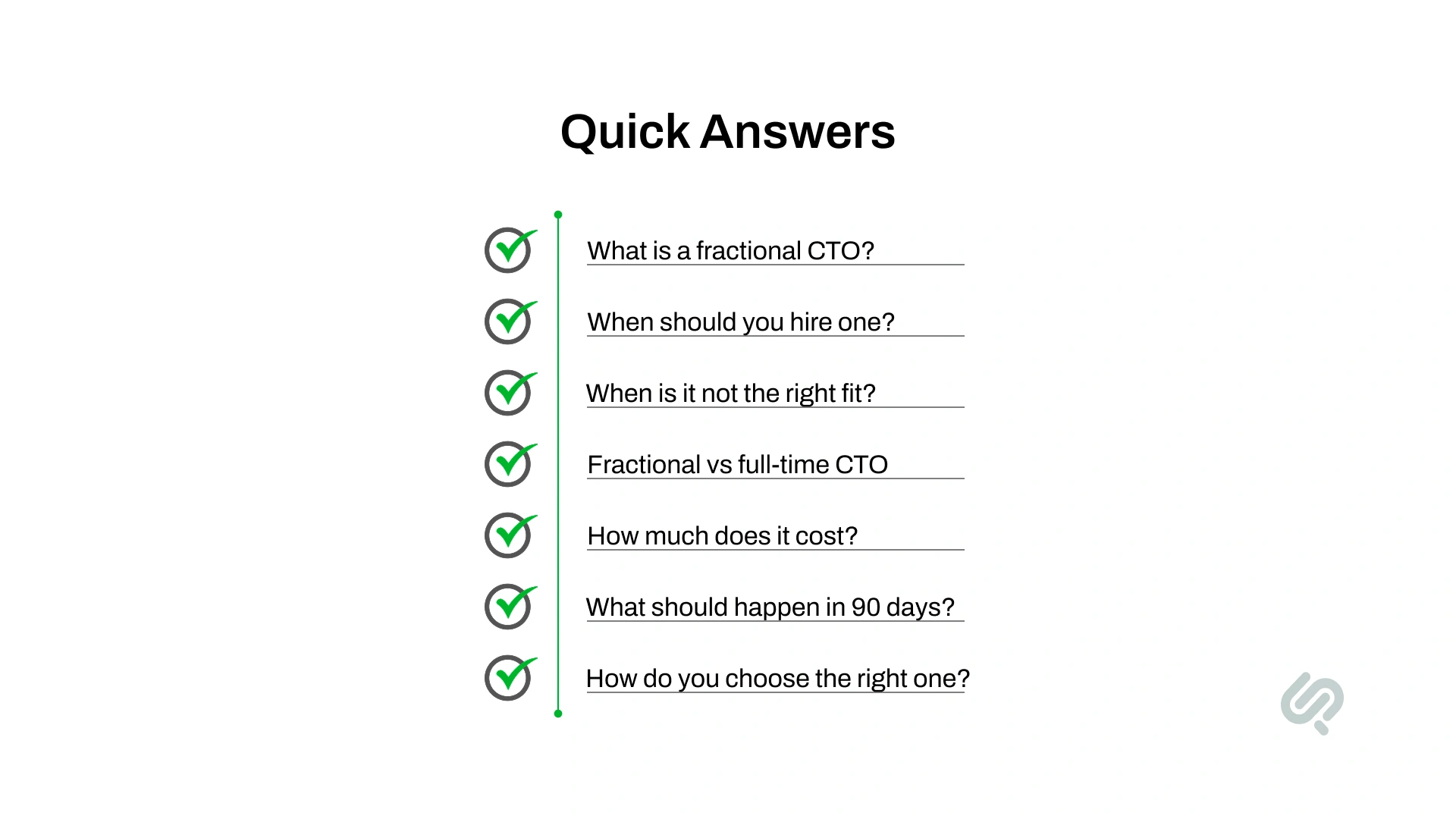
A fractional CTO is a senior technology leader who works with your company on a part-time, flexible, or project-based basis. They help with roadmap decisions, architecture, hiring, delivery oversight, technical risk, and growth planning without the cost of a full-time CTO.
Hire a fractional CTO when product decisions are slowing down, your team lacks senior technical direction, or you need expert oversight for AI, cloud, platform, security, or scaling work.
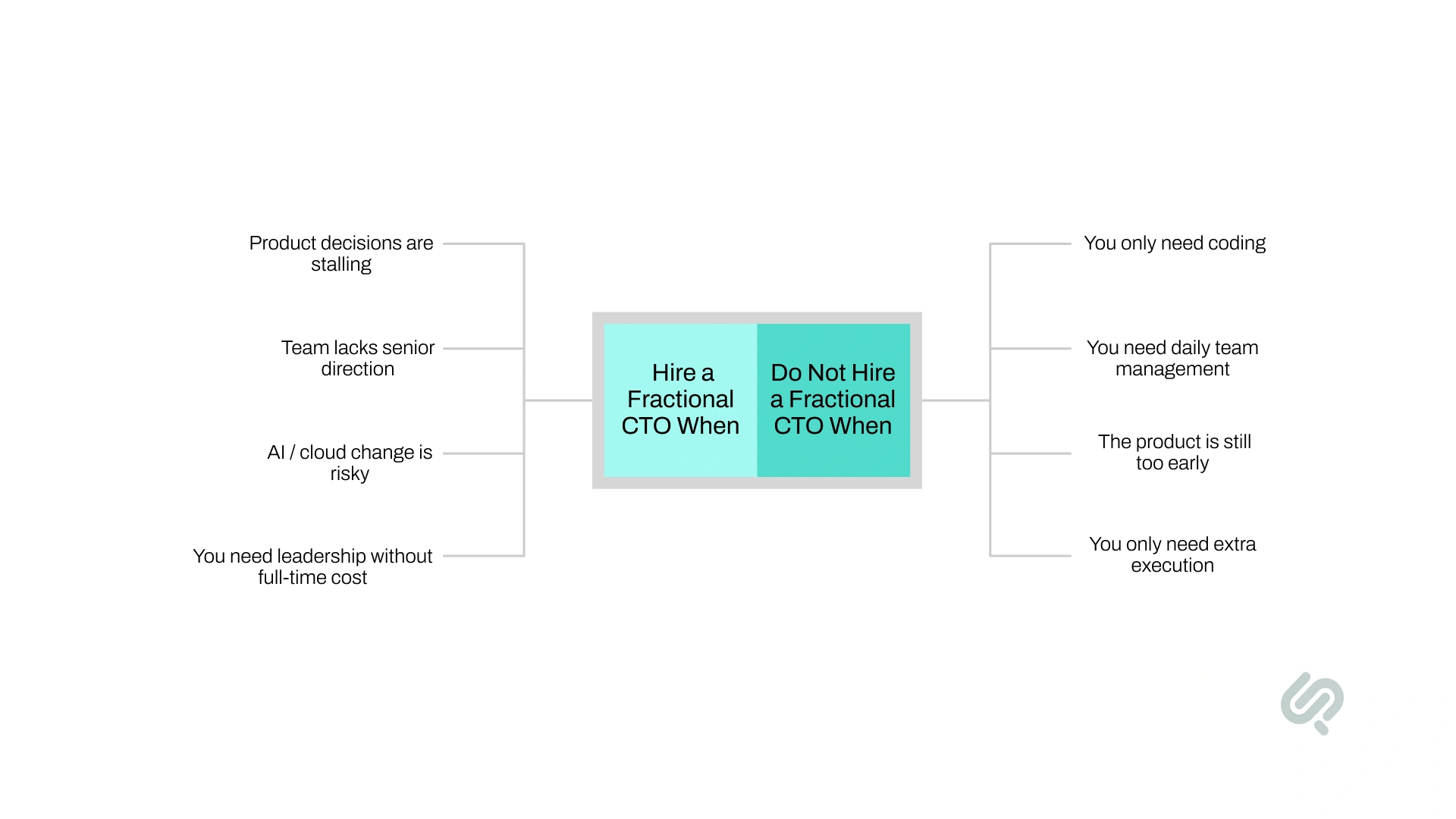
A fractional CTO is usually not the right fit when your main need is hands-on coding, daily engineering management, or very early idea-stage validation before product direction is clear.
A fractional CTO gives you senior technical leadership on a limited, flexible basis. A full-time CTO is a permanent executive hire who owns technology leadership every day across the business.
A fractional CTO is usually hired on an hourly, monthly, or project basis. The right pricing model depends on whether you need light advisory support, active delivery oversight, or interim executive leadership.
In the first 90 days, a strong fractional CTO should assess your product, team, and tech stack, identify risks and bottlenecks, align priorities with business goals, and create visible progress in the areas slowing growth.
Choose a fractional CTO based on stage fit, strategic thinking, communication clarity, relevant experience, and the ability to explain tradeoffs in plain English, not just technical depth.
Hire a fractional CTO to lead your AI strategy.
A fractional CTO is a senior tech leader who works with your business part-time, offering executive-level guidance without the cost or commitment of a full-time hire.
They help you make smart, strategic decisions around technology. This includes what to build, what to prioritize, how to scale, and how to do it all without burning your budget or your team.
Unlike a full-time CTO, they work on a flexible basis. Often, a few days a month. And unlike an interim CTO, they’re not just holding the fort. They’re driving growth.
So why hire one?
Because if you're serious about AI initiatives, modernizing your tech stack, or building a technology roadmap that aligns with real business goals, you need more than just developers.
You need strategic tech leadership (just not full-time). That’s where a fractional CTO fits in.
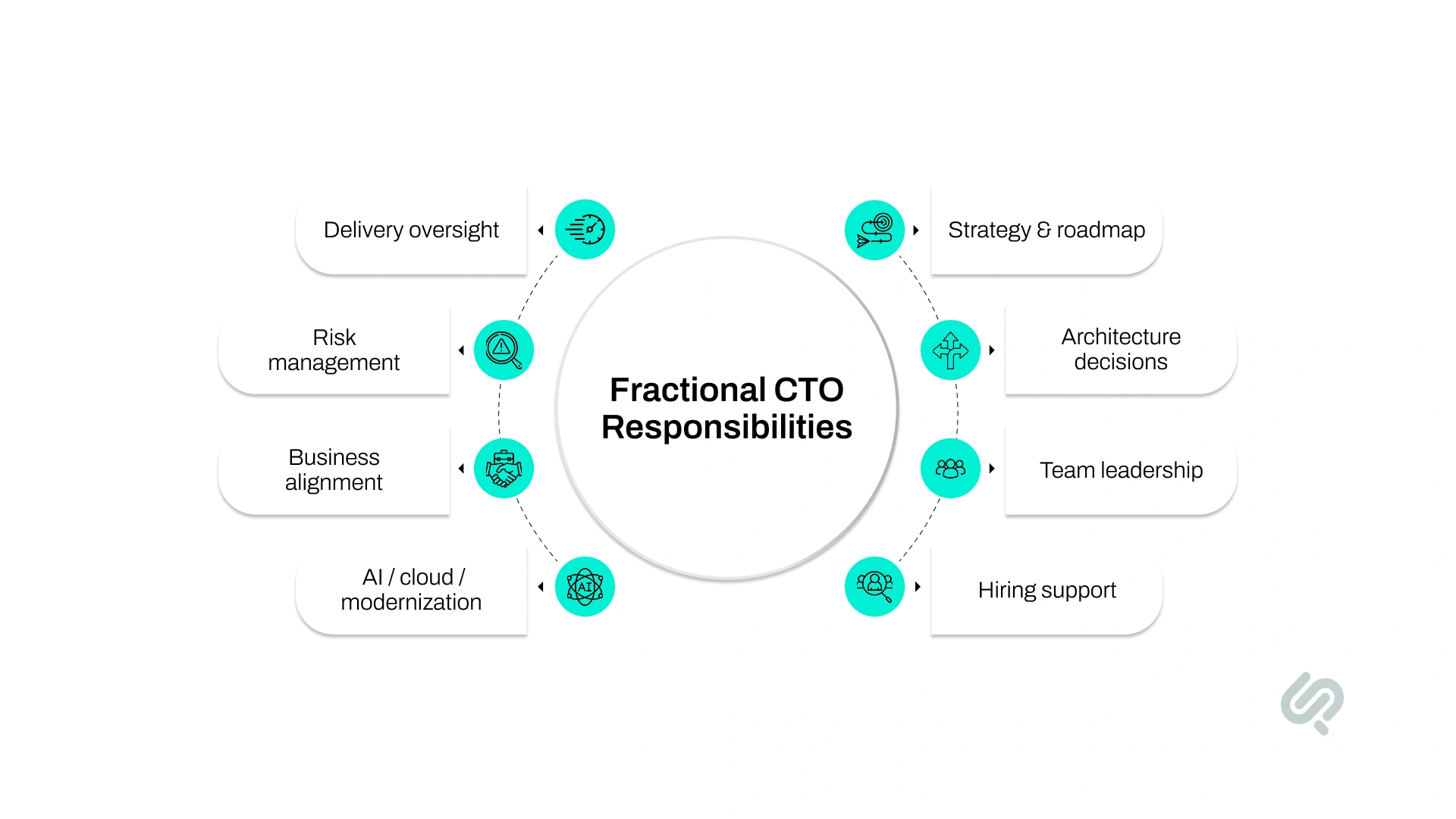
A fractional CTO helps bring technical direction, better decision-making, and stronger execution without the cost of a full-time executive.
Here are the main responsibilities:
They define technical priorities based on business goals, product plans, and growth needs.
They review your systems, identify scale or reliability risks, and guide better technical choices.
They support developers with better standards, clearer direction, and stronger technical accountability.
They help define hiring needs, assess technical candidates, and build the right team structure for your stage.
They reduce delays, improve prioritization, and help the team focus on the work that matters most.
They identify technical debt, security issues, vendor risk, and scalability concerns before they become bigger problems.
They make sure product, engineering, and leadership are working toward the same priorities.
They help you evaluate complex initiatives like AI adoption, cloud migration, or platform modernization with less risk and better planning.
You don’t always need a full-time executive to make full-time progress.
But there are specific moments in your company’s journey when hiring a fractional CTO isn’t just smart, it’s essential. Here’s how to know it’s time:
If you're building a tech product, especially something AI-driven, but don’t have technical leadership, you're flying blind.
A fractional CTO can step in to make critical architecture decisions, evaluate vendors, and guide your technology strategy while you focus on growing the business.
Early-stage startup, tight runway, or self-funded? We get it.
Hiring a full-time CTO can set you back $150,000 to $300,000 a year (1), not counting bonuses or equity. That’s a tough pill for most startups to swallow when every dollar counts.
A fractional CTO gives you strategic insight at a startup-friendly cost, often 60-70% less than a full-time hire, helping you scale smarter, not just faster.
Your CTO just left. Or maybe you're still searching for the right full-time fit.
Don’t let key projects stall. A fractional CTO can step in immediately, keep momentum going, and make sure your engineering team stays focused while you find a long-term hire.
Launching an AI initiative, migrating to the cloud, or overhauling legacy systems?
These aren’t plug-and-play projects. They need someone who’s done it before. Who knows the tech, the team dynamics, and the risks? A fractional CTO brings targeted expertise to help you execute without guesswork.
Maybe your developers are talented, but they’re stuck in reactive mode.
Deadlines slip. Priorities shift. Projects get half-finished. A fractional CTO provides technical oversight, sets performance metrics, and aligns your team with a clear technology roadmap tied to business goals.
Investors don’t just look at your product. They look at your tech leadership.
A fractional CTO can help you build a story around your technology stack, define a growth-ready roadmap, and ensure your infrastructure can scale. That’s the kind of detail investors want to see (and will ask about).
A fractional CTO can be a smart hire when you need senior technical direction, but it is not the right fit for every business problem.
In some cases, another role will give you better value, better execution, or better timing.
Here are a few situations where hiring a fractional CTO may not be the best choice:
If your main need is someone to write code, build features, fix bugs, or speed up delivery, a fractional CTO may be too senior for the job.
In that case, a strong developer, tech lead, or engineering contractor is usually the better hire.
A fractional CTO helps with strategy, technical direction, and high-level decision-making.
But if you need someone to manage engineers every day, run delivery, handle standups, and stay fully involved in execution, a full-time engineering manager or VP of Engineering may be a better fit.
If you are still figuring out what to build, who it is for, or whether the idea is worth pursuing, it may be too early to bring in a fractional CTO. At that stage, product clarity and market validation matter more than executive-level technical leadership.
If you already have a capable CTO, VP of Engineering, or senior technical lead who owns architecture, delivery, and roadmap decisions well, bringing in a fractional CTO may create overlap instead of value.
A fractional CTO is most useful when the business needs guidance on roadmap, hiring, architecture, scaling, vendors, or technical risk.
If the strategy is already clear and the only issue is execution capacity, it may make more sense to invest in engineers instead.
A fractional CTO works best when you need senior technical leadership without a full-time executive hire. But if your real gap is coding, daily team management, or early product discovery, another role may be a better and more cost-effective choice.
These titles sound similar, but they are not always used in the same way.
A fractional CTO usually works with your company on a structured, limited basis. The focus is strategic leadership: roadmap direction, architecture decisions, hiring support, delivery oversight, and technical risk reduction.
A part-time CTO is a broader label. In some cases, it means the same thing as fractional CTO. In others, it simply means a CTO who works reduced hours without a clearly defined advisory or engagement model.
An interim CTO is usually brought in during a transition. For example, when a previous CTO has left, fundraising is underway, or the business needs temporary executive coverage before hiring a permanent leader.
Here’s the easiest way to think about it:
If your business needs senior technical direction but not daily executive ownership, a fractional CTO is usually the better fit. If your CTO just left and someone needs to step in immediately, interim leadership may make more sense.
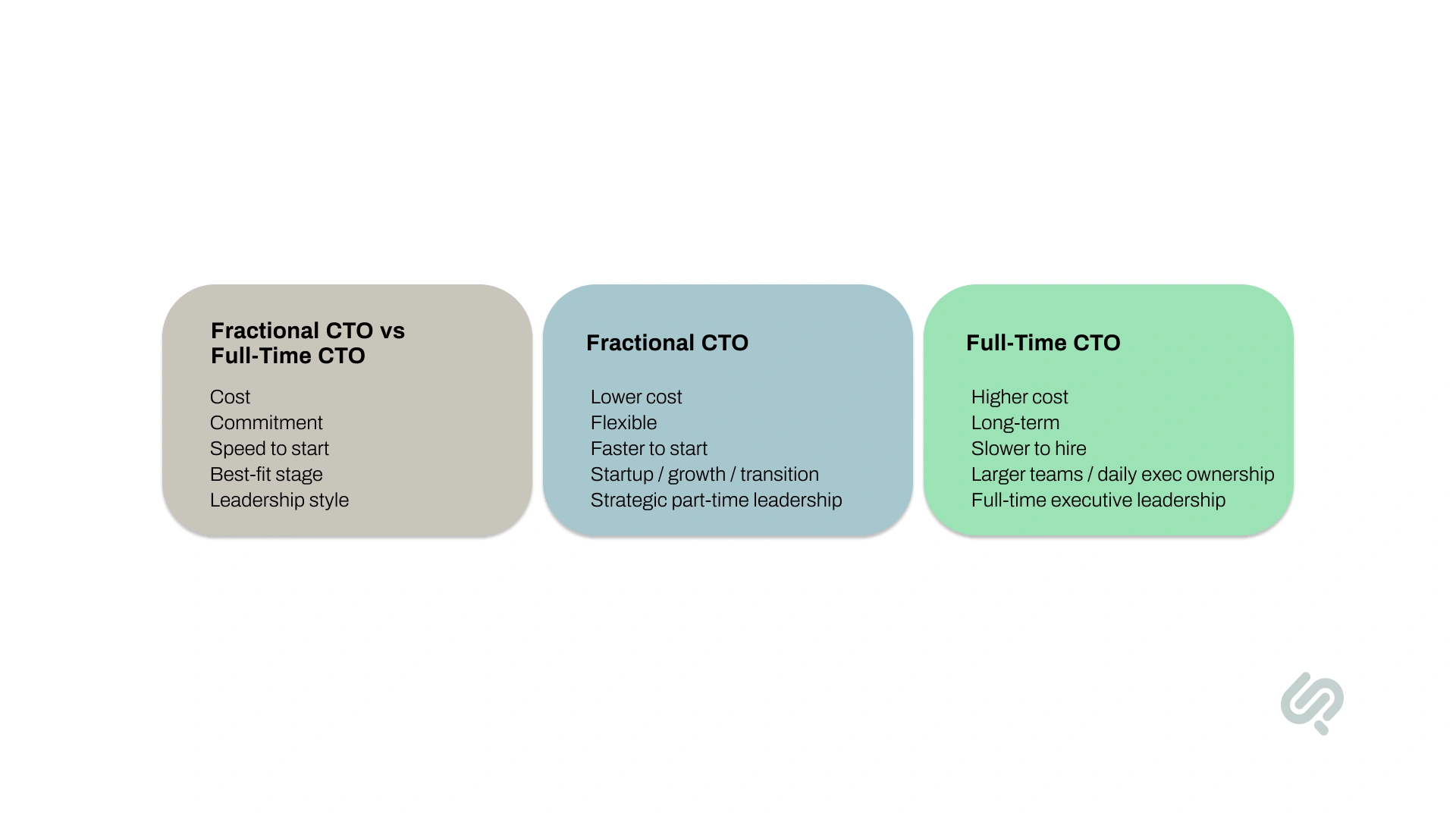
Both roles can provide strong technical leadership, but they solve different business needs.
A fractional CTO is usually the better fit when you need senior guidance on product, architecture, hiring, delivery, or scaling, but do not yet need a full-time executive.
A full-time CTO makes more sense when technology is already central to daily operations and the business needs constant leadership across teams, roadmap, and long-term execution.
Here is a simple side-by-side view:
A fractional CTO is often the right choice when you need senior technical leadership without the cost or commitment of a full-time CTO.
It works especially well for startups, scaling teams, and businesses going through change.
A full-time CTO is usually the better fit when your company needs someone fully embedded in the business every day, leading engineering at scale, managing teams closely, and owning technology as a core executive function.
The right choice depends on your stage, your budget, and how much day-to-day leadership your business actually needs.
Not every company needs the same level of CTO involvement. The right amount of time depends on how complex your product, team, and decisions are.
For lighter needs, a few hours each month may be enough. That works well when you need roadmap input, vendor review, architecture feedback, or investor-facing technical guidance.
For growing teams, one day a week is often the better fit. That gives your business enough senior support for roadmap reviews, technical leadership, hiring input, delivery check-ins, and clearer engineering priorities.
For companies going through major change, deeper involvement makes more sense. Two or more days a week may be needed if you are:
A good rule is simple: hire based on the size of your technical decisions, not just the size of your team.
A fractional CTO gives you access to senior technical leadership without the fixed cost of a full-time executive hire.
Most engagements are priced in one of four ways:
The right model depends on the complexity of your product, the scope of the role, and how involved the CTO needs to be.
If you need advisory help, pricing is usually lighter. If you need active leadership across roadmap, architecture, hiring, delivery, or AI strategy, the cost is usually higher because the scope is deeper.
What matters most is not just the hourly or monthly rate. It is whether the engagement has clear deliverables, clear ownership, and the right level of involvement for your stage.
That range depends on the CTO’s experience, the complexity of your product, how hands-on the role is, and whether the work includes specialized areas like AI strategy, cloud architecture, security, or scaling delivery.
Market references from CTO-focused providers and senior talent platforms commonly place fractional CTO rates around $150–$500+ per hour and $5,000–$25,000 per month for ongoing retainers.
For context, Salary.com lists the average US Chief Technology Officer salary at $309,418 per year as of March 1, 2026, while Built In reports average total compensation for a US CTO at $280,985.
That means a full-time CTO is usually a major fixed executive hire even before you factor in equity, recruiter fees, and benefits.
That is why many companies choose a fractional chief technology officer first. You are not paying for full-time executive overhead.
You are paying for the level of leadership you actually need: roadmap clarity, architecture decisions, hiring support, delivery oversight, technical due diligence, or AI planning.
The model is also easier to control. You can start with a lighter advisory scope, move into a monthly retainer, or use an interim setup during growth, fundraising, or a leadership gap.
The key is to define the engagement clearly from the start. Agree on:
When those expectations are clear, a fractional CTO can be a highly cost-effective way to get senior technical leadership without committing too early to a full-time CTO hire.
Once you know you need a fractional CTO, the next step is finding the right source.
This is often the fastest option if you want pre-vetted technical leaders and a more structured hiring process.
Investors, advisors, founders, and senior operators can sometimes recommend trusted CTO-level talent with relevant experience.
A recruiter can help when the role is high-stakes and you need a more structured search and evaluation process.
Founder groups, product communities, and tech networks can be useful if you want practical operators with startup experience.
These can work when you want flexibility, but screening matters more because not every strong engineer is a true CTO-level leader.
The best source depends on your urgency, budget, and how much vetting support you need.
Both options can work. The better choice depends on how much support, speed, and structure your business needs.
An independent fractional CTO can be a strong fit when you want a direct relationship, a flexible engagement, and one experienced leader guiding your roadmap, architecture, and team decisions.
A fractional CTO service is often a better fit when you need faster matching, lower screening risk, broader delivery support, or access to more than one area of expertise.
An independent hire is usually best when you:
A service model is usually best when you:
If your challenge is larger than hiring one person, a fractional CTO service usually gives you more coverage and less risk.
To lead part-time and still deliver full-impact results, a fractional CTO needs more than just technical know-how.
These skills make them effective from day one:

If you are a non-technical founder or operator, do not judge a fractional CTO by how many tools, acronyms, or trends they mention.
Judge them by how clearly they explain priorities, tradeoffs, and business impact.
A strong candidate should be able to tell you:
They should also be able to explain complex technical issues in plain English. If they cannot make the business case clear, they are probably not the right strategic hire.
“Most founders do not need more code first. They need clearer technical priorities. A strong fractional CTO helps you decide what to build now, what to delay, and what not to build at all, so your team moves faster with less waste.”
— Mujtaba Sheikh, Fractional CTO, Phaedra Solutions
At Phaedra Solutions, fractional CTO services are led by Mujtaba Sheikh, who is described as bringing over a decade of experience building and scaling AI-driven platforms, managing product development, and leading global engineering teams across industries.
Hiring a fractional CTO isn’t just about finding someone with a good résumé.
It’s about finding someone who can think like an owner, align technology strategy with business goals, and guide your team through pivotal tech decisions.
Follow this step-by-step approach to make the right hire:
Before anything else, get crystal clear on your needs.
Are you looking to build a tech roadmap? Overhaul legacy systems? Launch a new AI-powered product? Write it down.
Also define:
This clarity will shape everything, from the job post to interview questions.
Your role description should reflect both your needs and expectations.
Include:
And make it crystal clear this is a fractional CTO role — not full-time. That distinction saves you from sorting through misaligned applicants.
Now go hunting.
Use the channels we covered earlier. Specialized platforms, referrals, or vetted fractional CTO services. Look for candidates who’ve:
Shortlist those who not only check the tech boxes but also think like product strategists.
A good fractional CTO won’t just solve problems. They’ll spot problems you didn’t know existed.
In interviews, test their:
Pro Tip:
Ask them to share a 30/60/90-day plan. It’ll reveal how they approach your business, not just your codebase.
You’re trusting this person with your technical direction. Don’t skip this.
Ask former clients:
Also, ask to review past case studies or relevant AI initiatives they’ve led, if possible.
You’ve found the right fractional CTO for the job. Now lock it in.
Discuss and finalize:
Then get it in writing. Treat this like hiring a co-pilot for your growth.
Don’t just toss them the keys and hope for the best.
The faster they’re integrated, the faster they can add real value.
Need tips on evaluating fractional CTO candidates, including red flags and success metrics?
Check out this guide on how to choose the right fractional CTO for your AI startup.
Hiring a fractional CTO can create real momentum, but only if you choose someone who fits your stage, your goals, and the kind of leadership you actually need.
Before you make the hire, watch for these red flags:
A strong fractional CTO should be able to explain what they will help you achieve. If the conversation stays too broad and you do not get clear outcomes, priorities, or areas of ownership, that is a warning sign.
A candidate may have strong experience, but that does not always mean they are right for your business. Someone used to large enterprise teams may not be the best fit for an early-stage startup, and someone from a very early startup may not be right for a more complex scaling company.
Senior leaders should make technical decisions easier to understand, not harder. If a candidate speaks in trends, jargon, or vague innovation language without connecting it to your product, team, or business goals, be careful.
A fractional CTO does not need to be full-time, but they do need to be clear. You should know how often they will be involved, how they communicate, when they are available, and what level of support you can expect.
Be cautious of anyone who quickly pushes for a full rebuild before understanding the product, team, systems, and business priorities. A good fractional CTO should know how to improve what matters first, not create unnecessary cost and disruption.
A fractional CTO should do more than assess code or architecture. They should also understand delivery speed, hiring needs, technical risk, budget tradeoffs, and how technology supports growth.
The right hire should bring clear thinking, stage-relevant experience, practical leadership, and defined outcomes. If those things are missing early in the conversation, it is usually a sign to keep looking.
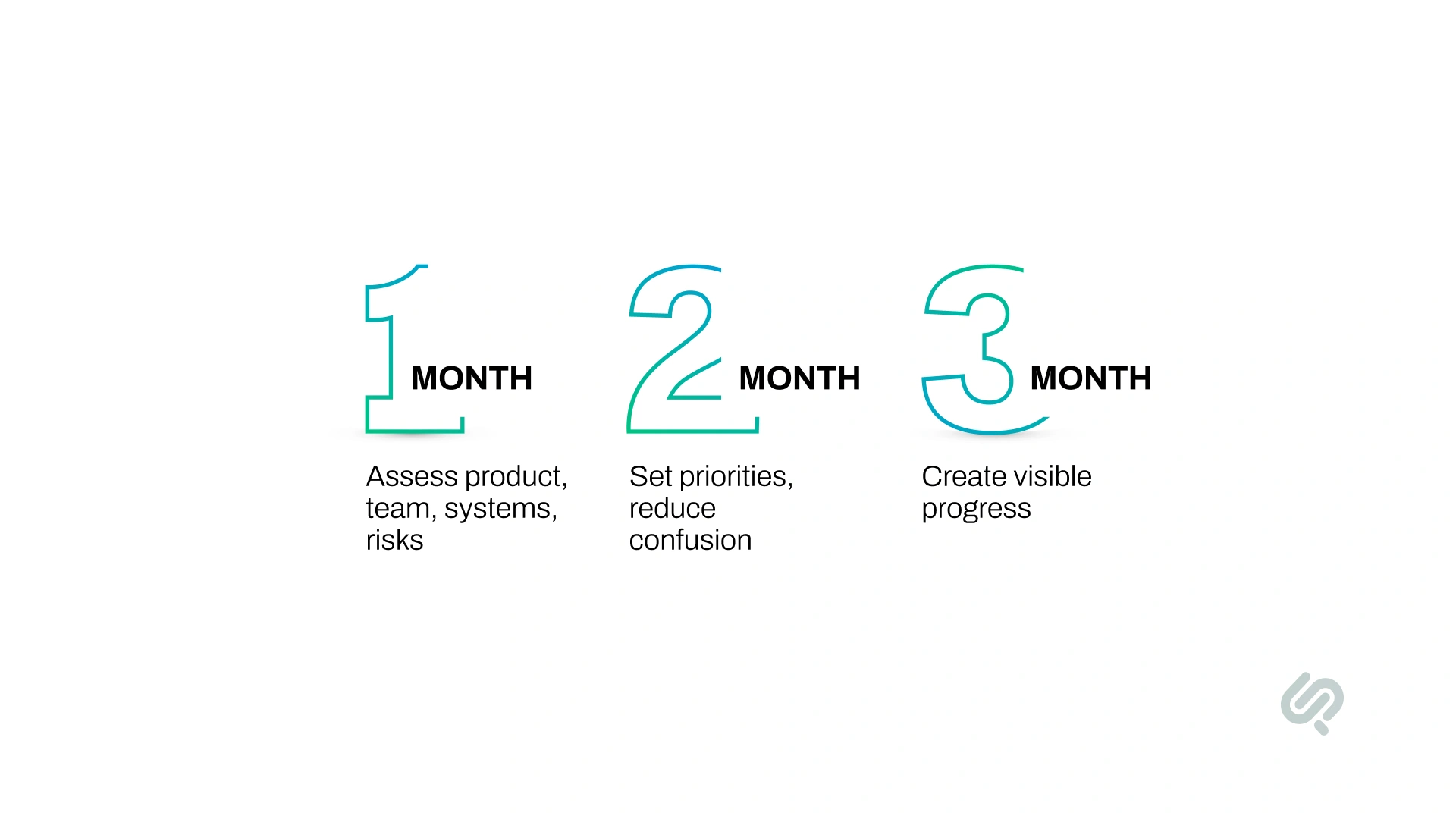
A fractional CTO should create clarity early. In the first 90 days, you should see better direction, better decisions, and visible progress.
The first month should focus on understanding the product, team, systems, and technical risks.
This usually includes:
Once the assessment is complete, the next step is turning that insight into a practical plan.
This often includes:
By this stage, the business should start seeing movement in the areas that matter most.
That may include:
A good fractional CTO should not spend the first 90 days giving only high-level advice. They should leave the business with more clarity, better priorities, and visible momentum.
Hiring the right person is only part of the equation. The engagement works best when the role is clear from the start.
To make the relationship effective:
A fractional CTO should not be treated like a vague advisor on the side. They should be tied to clear goals, clear ownership, and measurable progress.
When expectations are clear, the engagement moves faster and creates better outcomes.
A fractional CTO for AI brings the experience, strategic clarity, and technical knowledge needed to turn complex AI ideas into business-ready solutions.
Here’s how they help:
When innovation is moving fast, a fractional CTO offers the strategic planning and fractional tech leadership to keep your AI projects grounded, scalable, and focused on results.
If product decisions are slowing down, your team lacks senior technical direction, or your AI, cloud, or scaling plans feel risky, the right leadership can remove the guesswork.
Our Fractional CTO Services help you with roadmap planning, architecture decisions, delivery oversight, hiring support, and growth-stage technical strategy.
Explore Fractional CTO Services.
If you are still weighing your options, book a strategy call with our team, and we’ll help you assess your current stage, biggest technical risks, and the best next move.



Ameena is a content writer with a background in International Relations, blending academic insight with SEO-driven writing experience. She has written extensively in the academic space and contributed blog content for various platforms.
Her interests lie in human rights, conflict resolution, and emerging technologies in global policy. Outside of work, she enjoys reading fiction, exploring AI as a hobby, and learning how digital systems shape society.