














Tired of predicting what your customers want? Looking for a more efficient way to manage your stock? These are just two of many challenges faced by ecommerce store owners.
AI solutions for ecommerce are AI tools and workflows that help online stores sell better and run more efficiently.
They are used for personalized product recommendations, smarter site search, shopping assistants, dynamic pricing, fraud detection, and demand forecasting.
In simple terms, they help shoppers find the right products faster and help ecommerce teams reduce manual work.
The real question is not whether AI sounds impressive. It is whether it improves the numbers that matter in your store.
Right now, that shift is already happening: Adobe reported a sharp rise in AI-assisted retail traffic, NVIDIA found broad retailer adoption, and DHL found that 7 in 10 shoppers globally want AI-powered shopping features from retailers.
That means AI in e-commerce is no longer just hype, but it only becomes a real advantage when it is tied to a clear use case, clean data, and a measurable business goal.
AI solutions for ecommerce are tools, models, and workflows that help online stores improve product discovery, personalization, customer support, pricing, fraud prevention, inventory planning, and backend efficiency.
It becomes hype when it is added with no clear problem, no clean data, and no KPI. It becomes a real growth tool when it improves a number your store already tracks, such as conversion rate, average order value, stock accuracy, or support cost.
The best starting points are usually product recommendations, smarter search, support automation, demand forecasting, dynamic pricing, and fraud detection because they connect directly to revenue, efficiency, or customer experience.
Start with one painful bottleneck that already affects sales or operations every week. For many stores, that is search, support, inventory, or merchandising.
You need clean product data, useful customer behavior data, working integrations, one KPI for phase one, and a simple rollout plan. Without that foundation, even good AI tools underperform.
Measure one result only at first: conversion lift, average order value, ticket reduction, stockout reduction, fraud loss reduction, or hours saved. Set a baseline, run a pilot, compare before and after, then scale only if the gain is clear.
Use a tool when the problem is common and your workflows are simple. Build a custom solution when your catalog, pricing logic, customer journey, or backend workflows are too specific for generic software.
AI solutions for e-commerce are tools, models, and workflows that help online stores sell more effectively and operate more efficiently.
They are used to improve product recommendations, site search, customer support, fraud detection, pricing decisions, inventory planning, and other parts of the ecommerce journey.
In simple terms, ecommerce AI solutions help shoppers find the right products faster and help store teams reduce manual work behind the scenes.
The value is not in adding AI for the sake of it. The value is in using it to improve a specific business result, such as conversion rate, average order value, support speed, or stock accuracy.
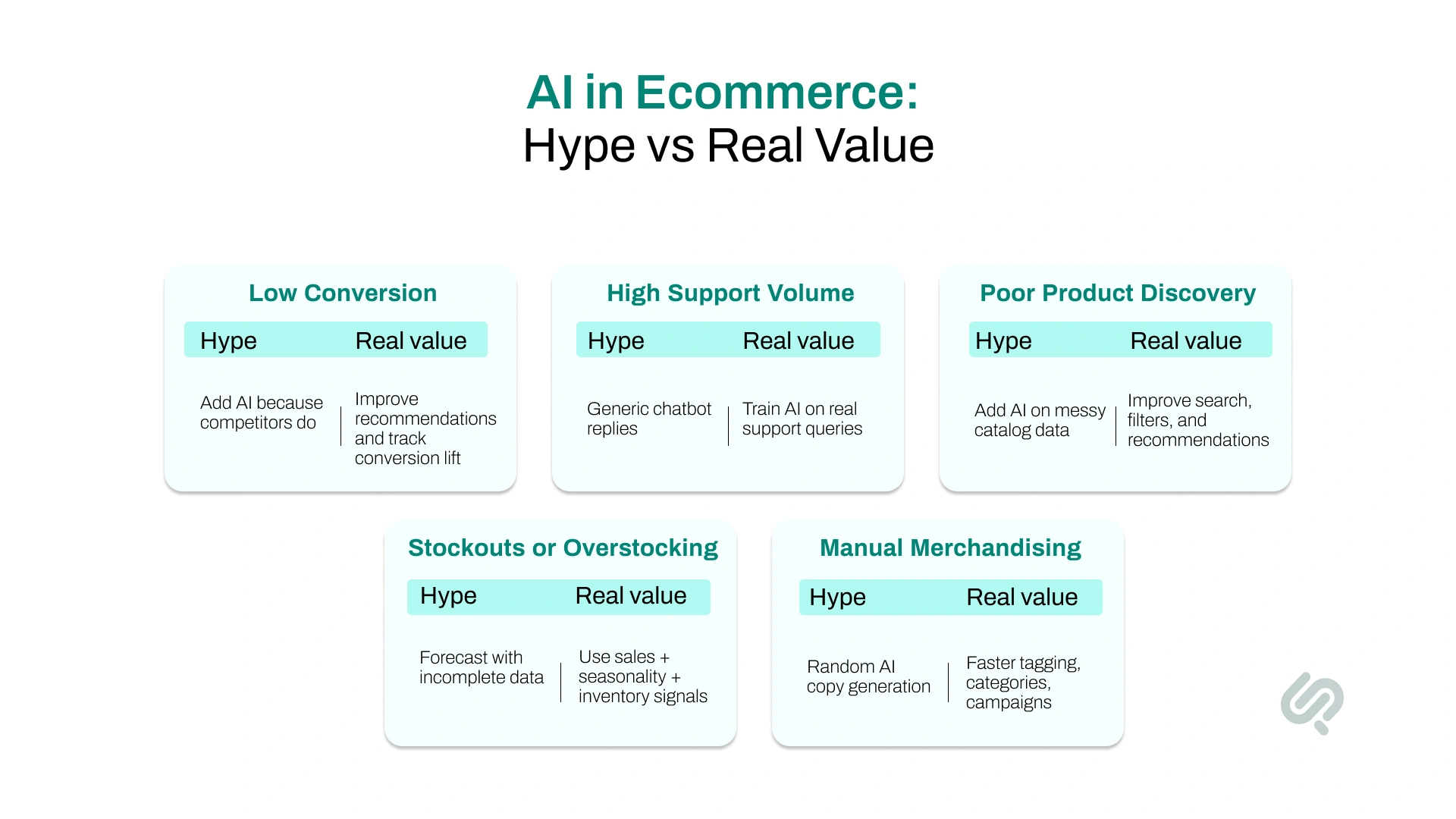
Not every AI feature adds real business value. In ecommerce, AI becomes hype when it is added without a clear problem to solve, no clean data behind it, and no KPI to measure success. It becomes worth the investment when it helps your store improve a specific result, such as conversion rate, support efficiency, product discovery, or inventory accuracy.
That is the real difference. If AI is only there to make the store sound more advanced, it is hype. If it helps solve a real ecommerce bottleneck and improves a number your team actually tracks, it becomes a practical growth tool.
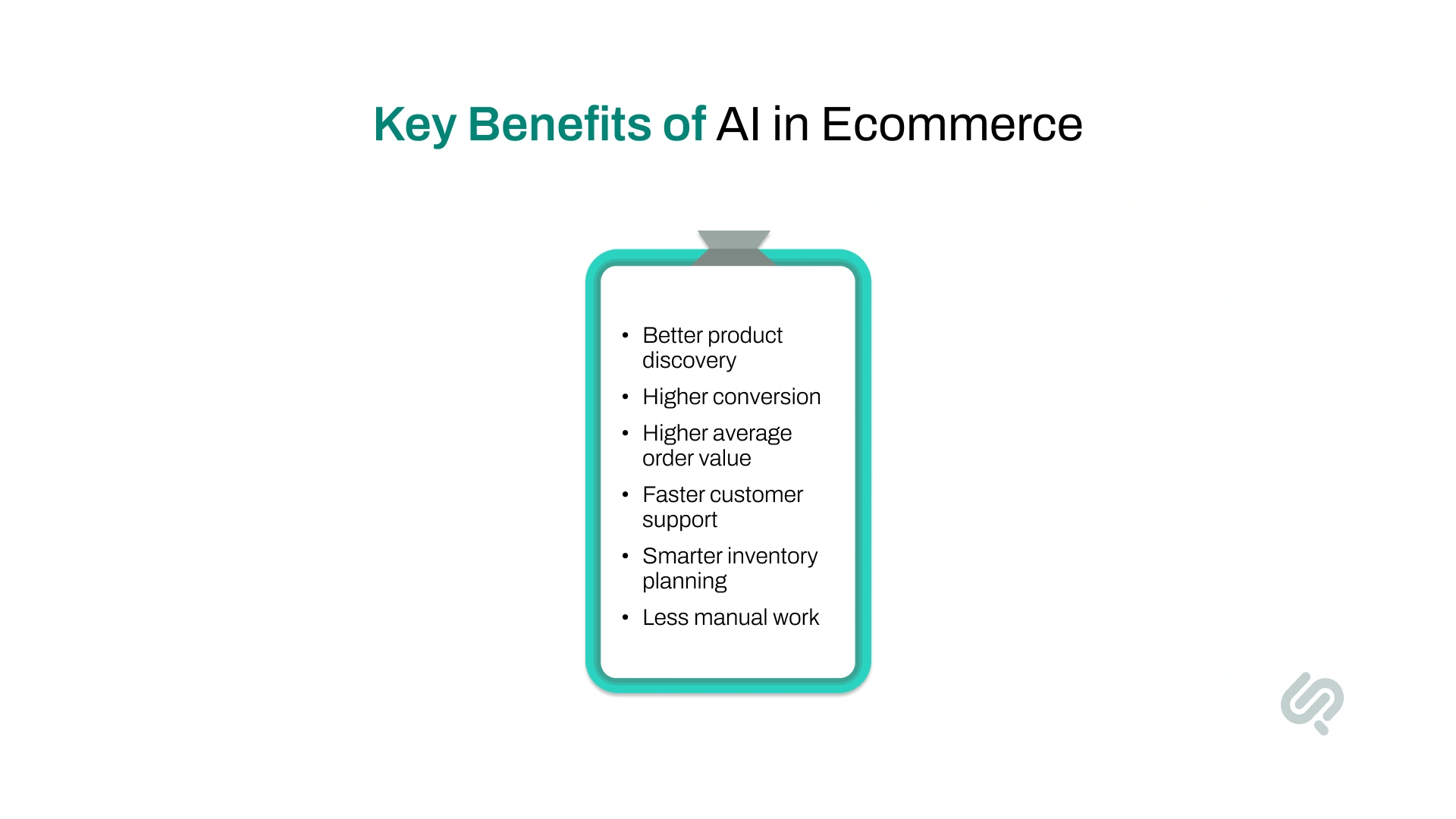
AI in ecommerce matters because it helps stores improve the results they already care about: better product discovery, higher conversion rates, faster support, smarter stock planning, and less manual work.
The real value is not that AI sounds advanced. The value is that it helps shoppers find what they want faster and helps ecommerce teams make better decisions with less effort.
Here are the main benefits of AI solutions for ecommerce:
AI helps shoppers find relevant products faster through smarter search, personalized recommendations, autocomplete, and intent-based results.
That means:
When shoppers see more relevant products, better recommendations, and less friction during the journey, they are more likely to buy and more likely to add extra items to cart.
AI can improve:
AI-powered chatbots and shopping assistants can answer common questions instantly, help with order tracking, and reduce the pressure on human agents.
This helps stores:
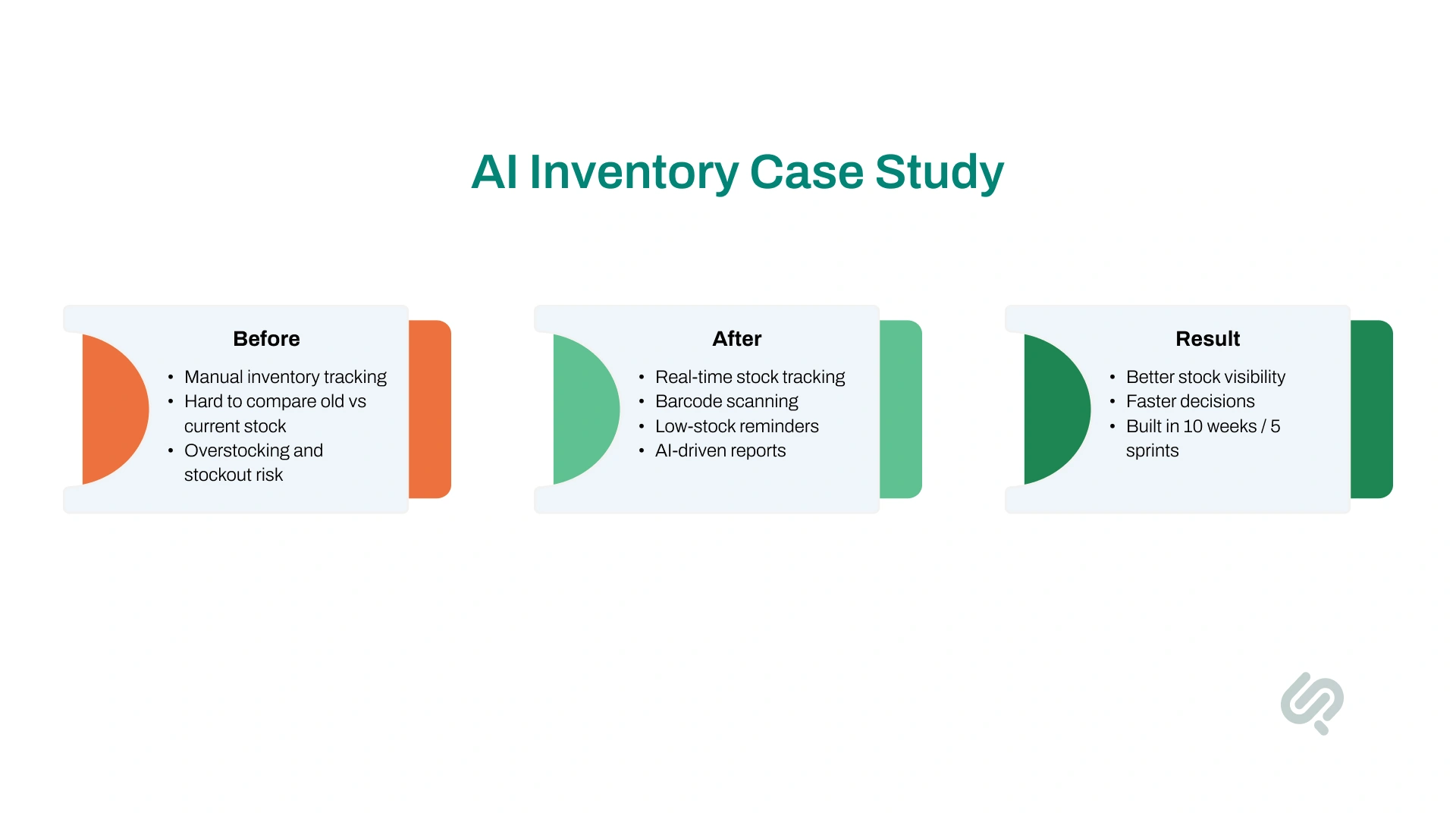
AI helps ecommerce teams forecast demand, track stock patterns, and reduce costly stockouts or overstocking.
This leads to:
AI can support merchandising, product tagging, campaign setup, customer segmentation, and reporting. That gives teams more time to focus on strategy instead of repetitive tasks.
For many stores, that is where AI creates value fastest: not by replacing the whole operation, but by helping the team move faster with better data.

From personalizing customer experiences to managing inventory more efficiently, AI in ecommerce is revolutionizing every aspect of online retail.
Let’s look at 10 ways AI is transforming the e-commerce industry.
AI-powered e-commerce platforms go through tons of customer data to provide personalized product recommendations to shoppers.
When shoppers browse online stores, AI algorithms track their behavior to understand their preferences. This allows the algorithm to generate suggestions of products these shoppers are likely to buy.
This leads to shoppers getting a more engaging shopping experience and also significantly increases the chances of sales. To make those recommendations convert, your eCommerce solutions for product pages also need the right structure, content, and UX.
AI-based e-commerce platforms include intelligent search functionality through Natural Language Processing (NLP) to deliver highly accurate search results.
Traditional search methods often fall short when it comes to understanding the intent behind user queries. Intelligent search functionality solves the problem by ensuring that only relevant products appear when a customer searches for a particular query.
For example, if a shopper searches for ‘comfortable black shoes’, the AI ecommerce platform will interpret this to show relevant products rather than products with matching keywords. This leads to an optimized user experience and higher conversion rates.
Since 2019, the usage of chatbots in ecommerce has seen a remarkable increase of over 92%. (1)
Chatbots are everywhere these days, and for a good reason. They provide instant responses to queries, manage basic tasks like order tracking, and handle returns. If support is your first AI use case, compare the best AI chatbots for e-commerce by platform, automation depth, and store fit before choosing one
Ecommerce AI solutions have upped the game by incorporating chatbots to provide customers with a more efficient and streamlined experience. This reduces the burden on human agents and enhances customer satisfaction.
Did you know that dynamic pricing strategies powered by AI can increase your business's profitability by up to 10%? (2)
That’s because AI analyzes factors such as competitive pricing, customer behavior, and demand to automatically adjust prices in real time. This enables retailers to stay competitive while maximizing profit margins.
Ecommerce businesses can face fraud which may result in significant financial losses. To avoid this, AI assists in detecting fraudulent activities by analyzing patterns in transaction data.
Any usual behavior (such as a sudden spike in orders from a certain location) would be flagged to help prevent potential fraud.
Big retailers like Amazon and Walmart have already implemented AI systems for enhanced security, reducing fraud-related losses by up to 30%. (3)
Voice search is growing rapidly, and using AI in e-commerce is helping optimize it.
Recent AI functionalities, such as Amazon Alexa and Google Home, allow shoppers to search for products by voice. This provides shoppers with a unique shopping experience that doesn’t even require them to use their hands!
AI ecommerce businesses are not just about text and voice; they’re also transforming how shoppers use images.
The use of AI in e-commerce platforms allows shoppers to use images for visual searches to find similar products. This feature especially comes in handy for fashion and home decor categories, where visual appearance is vital.
Inventory management and demand forecasting can seem like challenging tasks. However, with the help of AI, these tasks have become automated and simpler than ever.
AI predicts demands based on past sales data, current market trends, and seasonality. This allows businesses to keep optimal stock levels, reducing costs associated with overstocking.
AI helps ecommerce brands run email campaigns more intelligently by improving timing, segmentation, personalization, and message relevance.
Instead of sending the same email to everyone, AI can analyze customer behavior and identify:
This makes ecommerce email marketing more targeted and more efficient.
Used well, AI can help stores improve:
For ecommerce teams, this means less guesswork and more data-backed campaign decisions.
Logistics and supply chains have become more efficient thanks to AI. AI predicts demand, optimizes delivery routes, and manages warehouse inventory to streamline the process.
Machine learning models analyze weather conditions, traffic patterns, and other variables to determine the most efficient delivery routes. Companies like FedEx are using AI to optimize their logistics, saving millions in costs and ensuring faster delivery times.
Artificial intelligence in ecommerce is being actively used by some of the biggest brands to enhance customer experience and streamline operations.
Let’s look at 3 real-world AI use cases in ecommerce:
One of our favorite examples of personalized product recommendations is being done at Amazon.
This ecommerce giant uses machine learning algorithms to analyze purchase history, browsing behavior, and items in customer's wish lists. By doing this, Amazon is able to provide tailored product suggestions to each shopper. The best part is that as the system learns from user interactions, the relevancy of the suggestions increases.
Estimates suggest that AI-driven recommendations account for up to 35% of Amazon’s total sales. (4)
When it comes to dynamic pricing and inventory management, Walmart takes the top spot. Walmart integrated AI algorithms to analyze competitor prices, market demands, and local events that could potentially affect sales.
This process allows Walmart to adjust its prices in real time to stay competitive. Furthermore, their AI inventory management system predicts which products are high in demand and need restocking.
The success of Walmart is a prime example of how to use AI for ecommerce to maintain a competitive edge while maximizing operational efficiency.
No one does virtual assistants for customer service better than H&M, the global fashion retailer. They have successfully integrated AI-powered chatbots to improve the customer experience.
Their chatbot helps customers with a range of queries (like finding products and checking availability to provide personalized fashion advice).
By using AI and e-commerce together, H&M ensures its customers receive immediate support. This leads to high satisfaction levels as well as increased sales.
The best AI solution is not always the most advanced one. It is the one that solves a real ecommerce bottleneck first and gives you a result you can actually measure.
For most stores, that means starting where friction is already hurting conversion, support efficiency, inventory control, or team speed.
A simple way to decide is this: start with the problem that is already costing your store money or time every week. That is usually where AI creates the fastest and clearest business value.
Not every store needs a fully custom AI build from day one. In many cases, the best starting point is choosing the right type of AI tool for the problem you want to solve.
The key is to match the tool category to the business use case.
These tools help shoppers find products faster through better search results, autocomplete, filtering, recommendations, and intent-based product discovery.
Best for:
These tools help answer common customer questions, handle order-related queries, reduce ticket volume, and guide shoppers during the buying journey.
Best for:
These tools help with demand forecasting, stock planning, price optimization, replenishment support, and inventory visibility.
Best for:
These tools help ecommerce teams generate product copy, improve tagging, support category placement, speed up campaign setup, and reduce manual merchandising work.
Best for:
An off-the-shelf ecommerce AI tool is usually enough when:
This is often the right starting point for chatbots, product recommendations, search improvements, and email personalization.
A custom ecommerce AI solution makes more sense when:
That is usually the turning point: when generic AI tools start helping a little, but no longer fit how your store actually operates.
Before you invest in any AI solution, make sure the basics are in place. A lot of ecommerce AI projects fail not because the idea is wrong, but because the store is missing the data, systems, or setup needed to make that AI useful in the real world.
Your product titles, categories, attributes, images, and stock data need to be clear and structured. If the catalog is messy, AI search, recommendations, and automation will perform poorly.
Search queries, clicks, carts, purchases, returns, and support questions help AI understand what shoppers want and where friction exists in the journey.
Your AI tools should connect properly with your ecommerce platform, CRM, ERP, search tools, support systems, and any other workflows the team already relies on.
Start with one clear number to improve, such as conversion rate, average order value, ticket volume, or stock accuracy. That makes it easier to measure whether the AI is actually working.
If AI will touch customer data, pricing, support actions, or automated decisions, you need clear rules for access, review, and data handling from the start.
Do not try to apply AI everywhere at once. Start with one use case, test it, measure the result, and then expand once you know it is creating real value. That is also why AI business process automation matters: it helps you automate connected ecommerce workflows instead of creating one-off AI features that never scale.
This is the safest way to approach AI in ecommerce: get the foundation right first, then build around a use case that solves a real business problem.
AI in ecommerce can create real value, but implementation is where many stores struggle. The problem is usually not the idea. The problem is weak data, disconnected systems, or trying to do too much too early.
Here are the most common challenges and how smart stores deal with them:
If product titles, attributes, categories, images, or stock data are inconsistent, AI search and recommendations will perform poorly.
Fix: Clean and structure your catalog before rollout so AI has reliable product data to work with.
AI works best when it can connect with your ecommerce platform, CRM, ERP, support system, and analytics stack. If those systems are disconnected, implementation becomes harder and results become weaker.
Fix: Start with one use case and make sure the required integrations are stable before expanding further.
AI needs enough signal to understand shopper intent. If search, clicks, purchases, returns, and support interactions are not being tracked well, AI decisions become less useful.
Fix: Improve behavioral tracking first so your AI tools are learning from real customer actions.
If AI touches customer data, pricing logic, support workflows, or automated decisions, you need clear rules around access, oversight, and data handling.
Fix: Put governance in place early instead of treating compliance as an afterthought.
A lot of ecommerce teams make the mistake of applying AI across search, support, pricing, content, and forecasting all at once.
Fix: Start with one high-impact use case, measure the result, then scale from there.
That approach is slower at the start, but usually much safer and much more effective in the long run.

You do not need to rebuild your store or change everything at once to start using AI well. The safest approach is to roll it out in phases, starting with one clear business goal and one use case you can actually measure.
Start with the problem, not the tool. Be clear on what you want AI to improve, whether that is product discovery, customer support, average order value, inventory accuracy, or operational efficiency.
Choose the first AI use case based on where your store is already losing time, money, or conversions. Then link it to one KPI, such as conversion rate, ticket volume, stockout rate, or average order value, so you can measure the result properly.
Make sure the AI solution has access to the right product data, customer behavior data, and backend systems. It should connect smoothly with your ecommerce platform, CRM, ERP, search tools, support systems, or other workflows your team depends on.
Start with a controlled rollout, review the results, and expand only when you can see real value. If needed, this is the stage where experienced AI and ecommerce teams can help reduce implementation risk, speed up deployment, and make sure the solution fits your operations properly.
This phased approach helps you add AI in a practical way, without disrupting the systems, teams, and customer journeys your store already relies on.
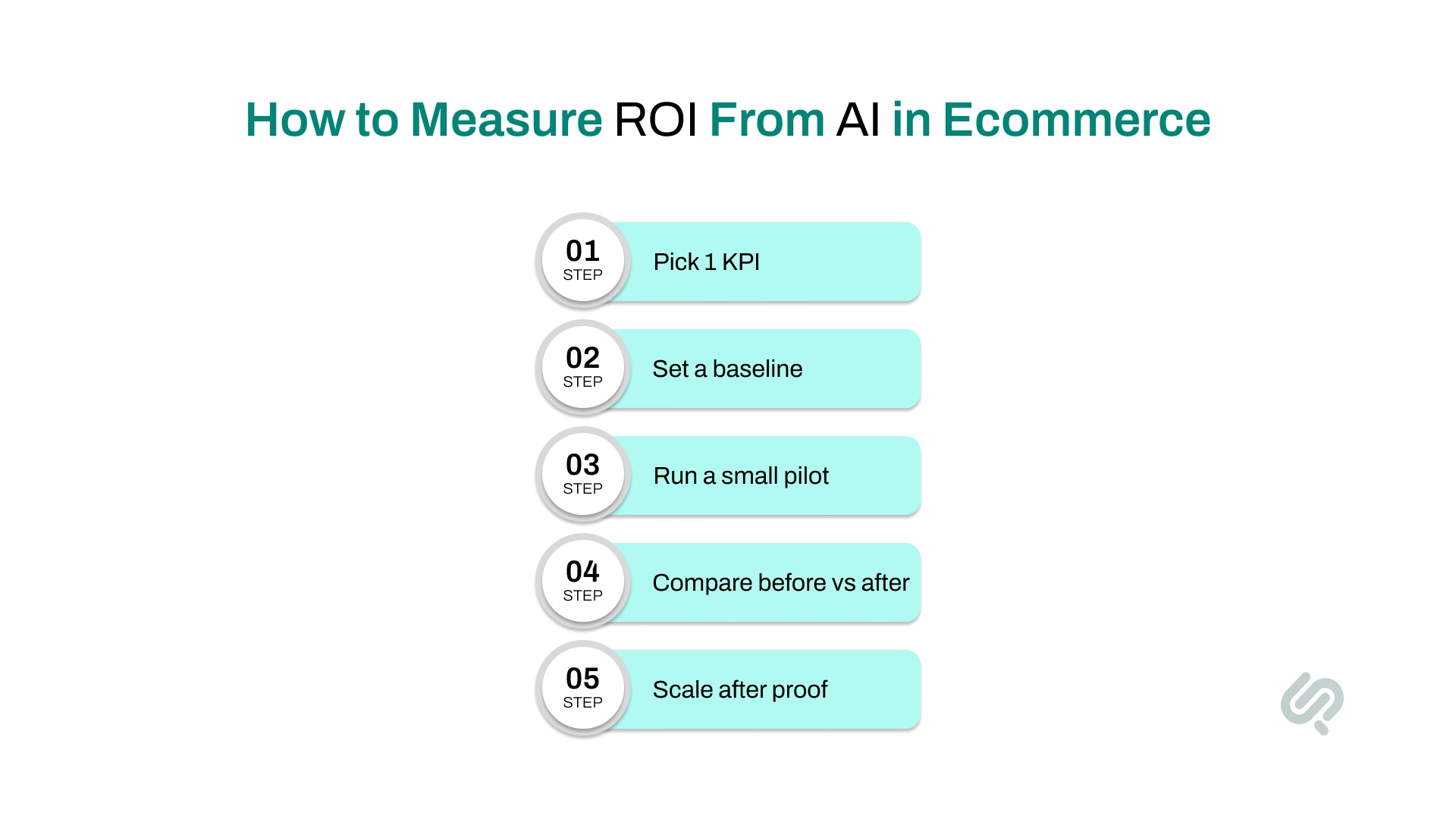
If you cannot measure the business result, it is very hard to know whether your AI investment is actually working.
That is why the best ecommerce AI projects start with one use case and one KPI, not a broad promise to “transform the store.”
Choose one number that clearly connects to the use case.
Examples:
Before rollout, record what performance looks like now. Without a baseline, it becomes difficult to prove improvement later.
Track:
Do not roll AI out everywhere at once. Start with one category, one workflow, one region, or one customer segment.
This makes it easier to:
Once the pilot runs long enough, compare the new performance against the baseline.
Look for:
The best time to expand AI is after the first use case already shows measurable value. That is how stores avoid overinvesting in features that sound promising but do not improve the numbers that matter.
The future of AI in e-commerce is already starting to show up in how people shop and how retailers operate.
Adobe reported that traffic from generative AI sources to U.S. retail websites increased 1,200% between July 2024 and February 2025, while DHL found that 7 in 10 shoppers globally want retailers to offer AI-powered shopping features. (5)
What is becoming clearer now:
1. AI shopping assistants are becoming part of the buying journey.
Retailers are moving beyond basic chatbots and building assistants that help shoppers compare products, plan purchases, and buy with more confidence.
Amazon’s Rufus and Walmart’s Sparky are clear signs that AI shopping companions are moving into the mainstream.
2. Search and recommendations are getting more conversational.
E-commerce search is shifting away from simple keyword matching toward intent-based discovery, guided suggestions, and AI-supported product recommendations.
Amazon’s AI features now help shoppers discover products through conversational prompts and personalized interests, which shows where search and discovery are heading.
3. AI is becoming more useful in merchandising and operations.
The next wave of ecommerce AI is not only customer-facing. Retailers are also using AI to support merchants, automate repetitive decisions, and improve backend workflows.
Walmart’s Wally assistant for merchants and NVIDIA’s retail AI research both point to stronger use of AI in operational and commercial decision-making.
4. Voice, visual, and conversational commerce will keep growing.
Shoppers increasingly want more natural ways to search and evaluate products, especially on mobile.
DHL’s 2025 report highlights strong demand for AI shopping assistants, virtual try-ons, and voice-enabled product search, while Amazon’s Lens Live shows how visual search and AI assistance are already being combined in live shopping flows.
The opportunity is real, but the direction is practical: ecommerce AI is moving toward better shopping guidance, better discovery, and better operational support.
The stores that benefit most will be the ones that apply it to a clear use case and measure the business result.
Reading about AI is useful. But real value comes from choosing the right use case, connecting the right data, and building it properly.
If you want recommendation engines, smarter search, forecasting, pricing logic, or shopping assistants tailored to your store, explore our machine learning development services.
If you want help choosing the best first use case for your ecommerce business, book a strategy call with our team.
We’ll help you find the fastest path to measurable ROI without overcomplicating your store stack.



Ameena is a content writer with a background in International Relations, blending academic insight with SEO-driven writing experience. She has written extensively in the academic space and contributed blog content for various platforms.
Her interests lie in human rights, conflict resolution, and emerging technologies in global policy. Outside of work, she enjoys reading fiction, exploring AI as a hobby, and learning how digital systems shape society.