








Businesses hire dedicated development team support when they need a stable external product team without the delay and overhead of recruiting every role in-house. The model provides developers, QA specialists, designers, DevOps engineers, and delivery leadership focused on one product or roadmap.
This guide covers dedicated team costs, structures, partner selection, onboarding, AI-first delivery, contracts, communication, performance measurement, and handoff.
A dedicated development team is an external group assigned to one product, platform, or development roadmap. The client controls priorities and product decisions, while the provider handles recruitment, contracts, retention, replacement, and team administration. The same specialists remain involved as requirements and priorities change.
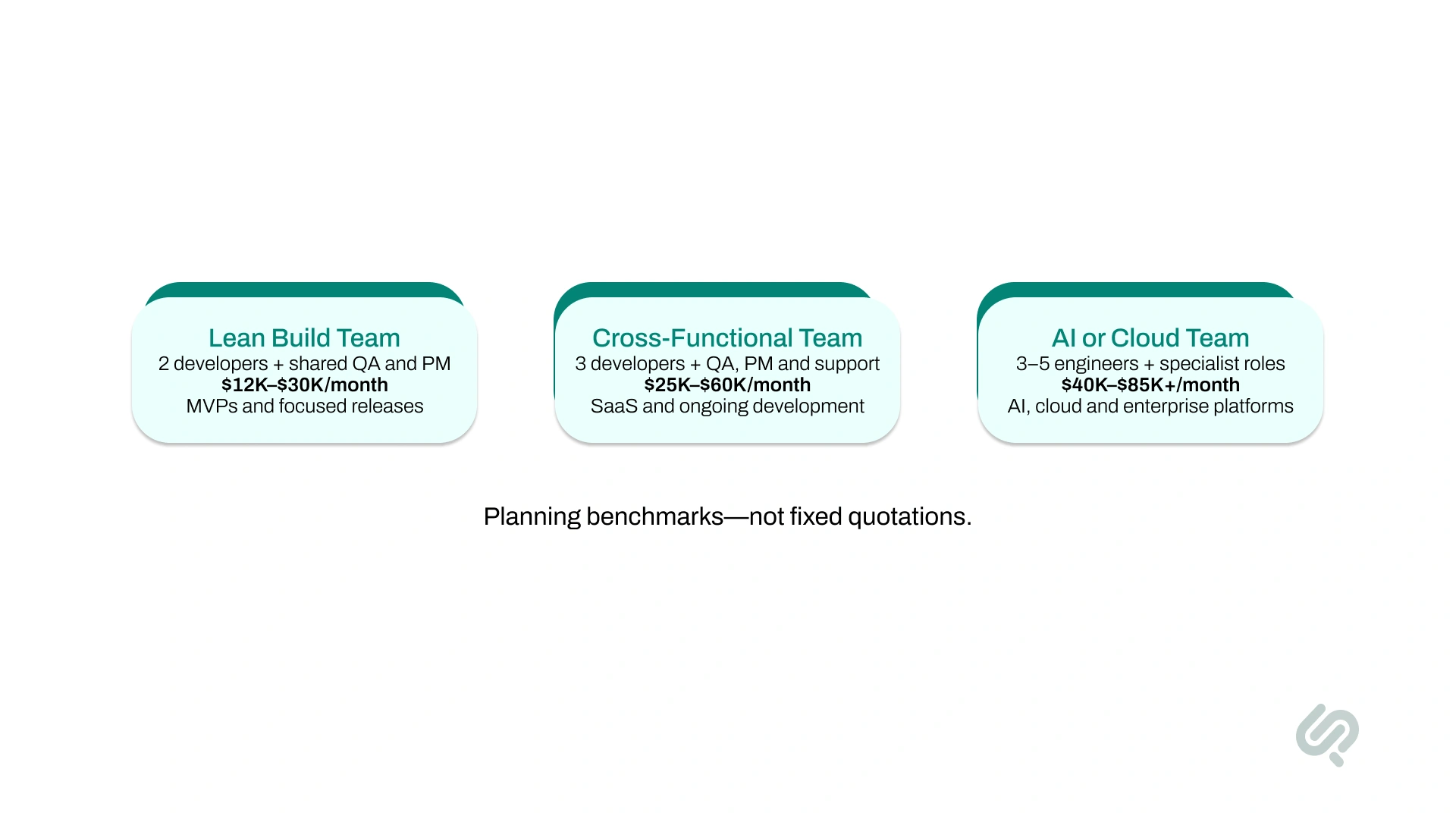
A small team may cost approximately $12,000 to $30,000 per month. A cross-functional product team may range from $25,000 to $60,000, while an AI, cloud, or enterprise team may cost $40,000 to $85,000 or more. Team size, seniority, location, specialist requirements, and management responsibility determine the final price.
Common development roles can often be assembled within several weeks. Specialist AI, cloud, security, data, or industry roles may take longer to source and approve. Security reviews, system access, notice periods, and internal onboarding can also affect the start date.
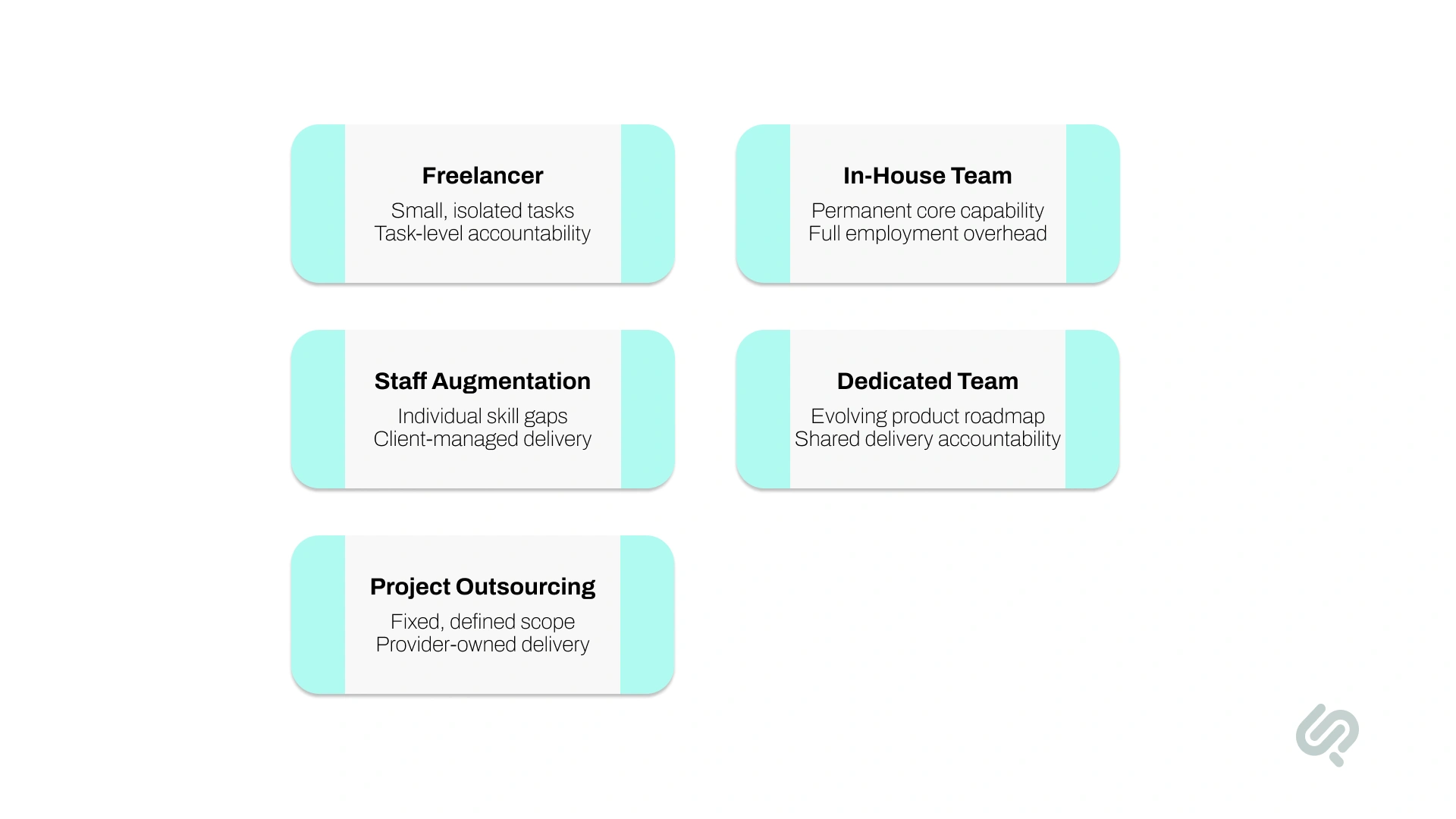
Staff augmentation usually adds individual specialists to a team managed by the client. A dedicated team provides a stable, cross-functional unit that may also include project management, QA, technical leadership, and provider-side delivery support. Staff augmentation suits companies with mature internal leadership, while a dedicated team suits products that need coordinated delivery.
Choose this model for an evolving product, post-MVP growth, legacy system modernization, AI integration, or a long-term development backlog. It works best when several technical roles must collaborate and product knowledge needs to remain within the same team. A named client-side product owner must still control business priorities.
Review relevant production case studies and interview the people who will work on your product. Confirm delivery ownership, security controls, intellectual property terms, replacement procedures, communication practices, and handoff requirements. The provider should also explain how AI-assisted work is reviewed before entering production.
Under the dedicated team model, a provider assigns a stable group of specialists to your product.
The team may work entirely under your product leadership, or the provider may also supply project management and technical oversight.
You continue to control the product roadmap, business priorities, feature decisions, and release goals. The provider handles sourcing, employment, retention, replacement support, and team administration.
This differs from traditional software development outsourcing, where a client may hand over a fixed scope and receive the finished work later. A partner-led team is integrated into regular planning, development, testing, demos, and release decisions.
The model is particularly useful when requirements will change. Instead of renegotiating the contract whenever priorities shift, you redirect the same team toward the highest-value work in the next sprint.
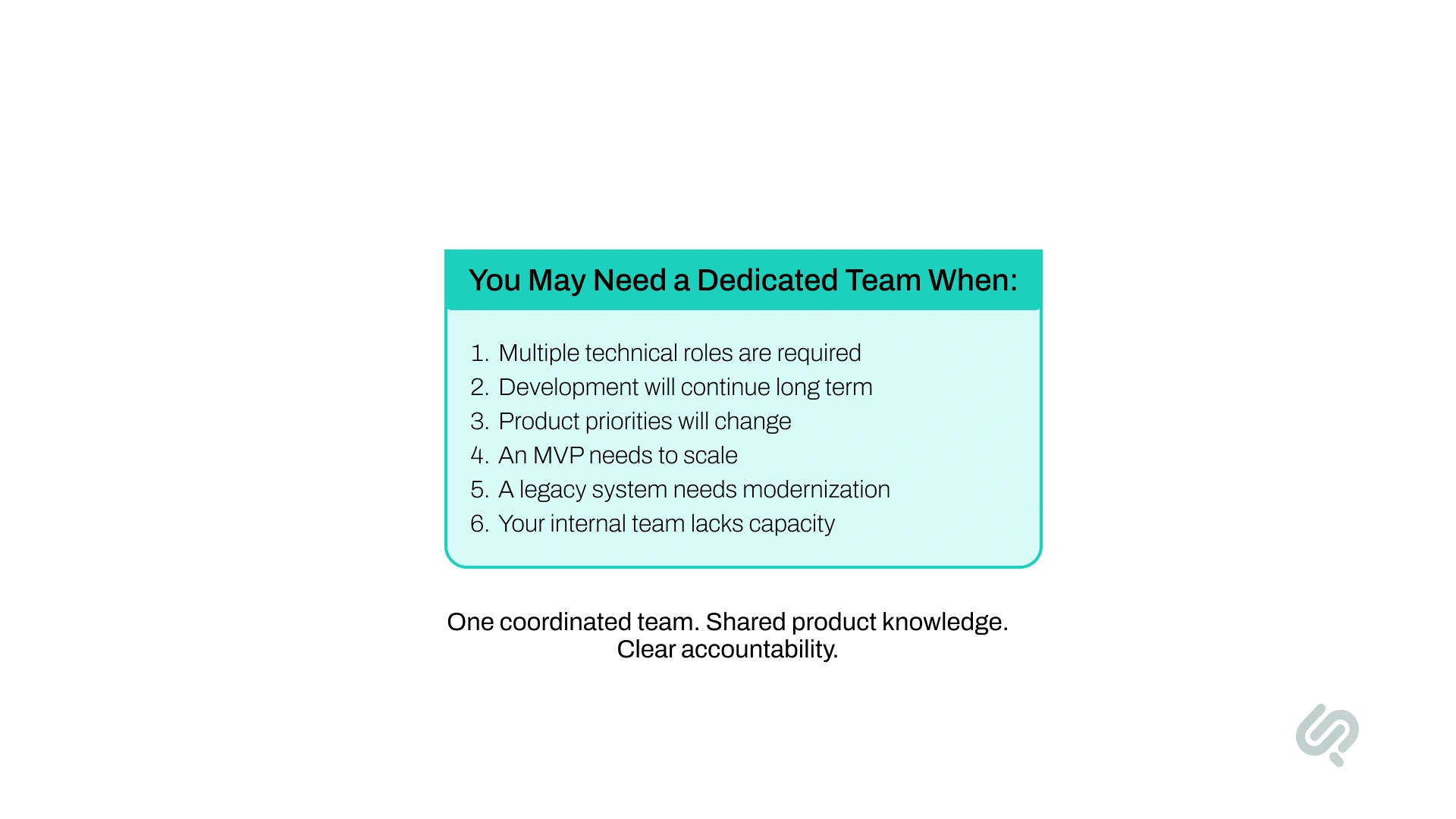
A freelancer may be suitable for a small task with a clear output. A coordinated development team is usually more appropriate when:
Talent availability can also affect the decision. The World Economic Forum reports that 63% of surveyed employers consider skills gaps a major barrier to business transformation. (1)
A dedicated development partner can provide several connected roles through one engagement. This reduces the need to source, interview, contract, onboard, and coordinate multiple independent specialists.
The World Economic Forum reports that 70% of employers expect to hire employees with new skills by 2030, while 85% plan to prioritise workforce upskilling (2). This supports the value of accessing specialised developers without waiting to build every capability internally

A dedicated team is not automatically the right choice for every software project. The model works best when there is an active roadmap, ongoing work, a client-side decision-maker, and a genuine need for several connected skills.
Choose a freelancer when the work is small, isolated, and easy to verify. A fixed-price project may be better when the scope is fully documented and unlikely to change.
Permanent internal hiring may be more suitable for executive engineering leadership, sensitive internal functions, or capabilities that must remain entirely within the company.
The provider can advise on delivery and manage execution, but the client still needs someone who can approve priorities, clarify business rules, and resolve stakeholder disagreements.
The monthly cost of a dedicated team depends on its size, seniority, location, specialist requirements, and delivery responsibilities.
Clutch’s July 2026 pricing guide reports that many listed software development companies charge approximately $24 to $49 per hour. Monthly team costs vary because some roles work full-time while architects, designers, DevOps engineers, and specialists may be shared.
The following ranges are planning benchmarks rather than fixed quotations.
The main cost drivers are:
An offshore development team may provide lower headline rates. A nearshore development team may provide more working-hour overlap and easier real-time communication.
Compare the total cost of delivery rather than the hourly rate alone. Weak QA, repeated rework, staff turnover, missing documentation, and management delays can make a low-cost provider more expensive over the full engagement.
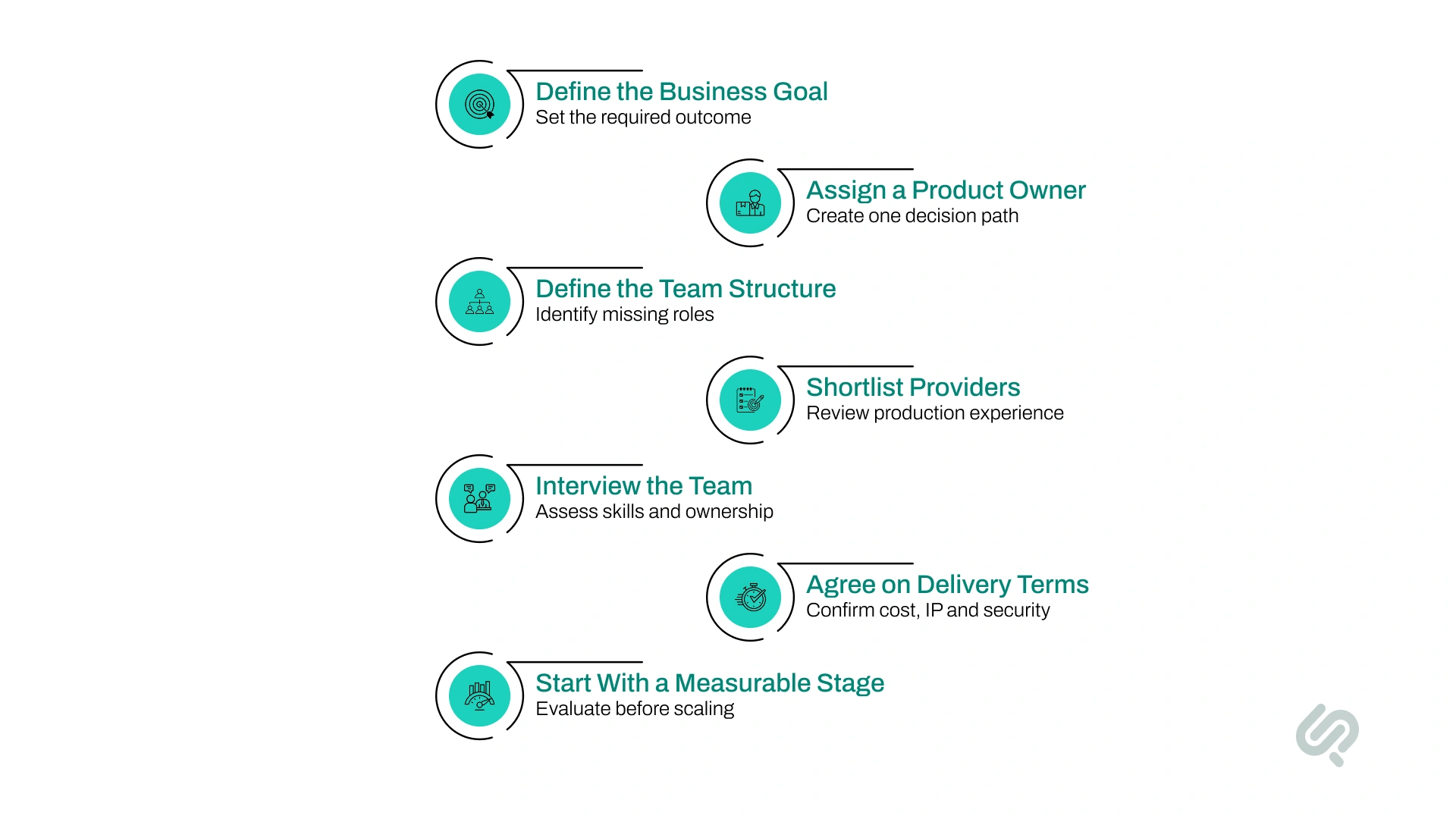
To hire a dedicated development team, define your business goal, identify the skills you need, compare experienced providers, interview the proposed team, and agree on clear delivery terms. The following seven steps help you choose the right team and reduce hiring, communication, and project risks.
Start by defining the result the team must deliver. This could include launching an MVP, modernizing an existing platform, adding AI features, reducing a development backlog, or preparing a product for more users.
Focus on the business outcome rather than creating a list of programming languages. Once the provider understands the goal, it can recommend the right roles, skills, and team size.
Choose one person to manage priorities, approve decisions, and answer business questions. This may be a founder, CTO, product manager, or internal product owner.
Other stakeholders can receive progress updates, but daily decisions should follow one clear approval path. Too many decision-makers can delay development and create conflicting priorities.
Review the technical and product skills already available inside your company. Then identify which roles the external team must provide, such as developers, designers, QA engineers, DevOps specialists, or AI engineers.
Decide whether you need individual specialists, a complete cross-functional team, or a combination of both. Build the initial team around the next product stage, with the option to add or remove roles later.
Review providers with case studies related to your industry, product type, technology, or level of complexity. Confirm that they have delivered and supported production software, not only prototypes or proof-of-concept projects.
Look for evidence of coordinated product design, development, testing, deployment, and ongoing support. Technical skills matter, but the provider must also show that it can manage full product delivery.
Ask to meet the developers and specialists who would work on your product. Discuss their technical experience, communication style, approach to delivery risks, and decisions they made on previous projects.
Do not evaluate candidates through coding questions alone. A long-term remote development team must communicate clearly, take ownership, document its work, and explain technical decisions to business stakeholders.
Document the team structure, monthly cost, expected start date, working-hour overlap, management responsibilities, notice periods, and staff replacement process.
The contract should also define confidentiality, intellectual property rights, source-code ownership, system access, invoicing, and the process for scaling the team up or down. Clear terms reduce operational and commercial disputes later.
Start with a clearly defined product stage that produces a useful result. This may be a validated architecture, working product flow, completed integration, MVP release, or production-ready feature.
Use this stage to evaluate communication, estimation accuracy, engineering quality, documentation, and decision speed. Set measurable expectations from the beginning before expanding the team or increasing the scope.
Ask these questions before signing an agreement:
The provider should give direct answers supported by its process, contract, and previous delivery experience.
Warning signs include:
Phaedra structures each team around the product roadmap, existing internal capabilities, and current delivery stage. The client does not need to pay for every possible role on a full-time basis.
A project manager or Scrum lead organises sprint planning, progress reporting, risk management, demonstrations, and stakeholder communication. A business analyst may help convert business requirements into clear product flows and acceptance criteria.
For complex platforms, a technical lead or solution architect guides architecture, engineering standards, integrations, security decisions, and technical reviews.
The engineering team may include:
The role mix depends on the product architecture and next delivery stage. Clients can interview the proposed specialists before the engagement begins.
Product and UI/UX designers support user flows, prototypes, interfaces, design systems, and usability testing.
QA specialists review acceptance criteria, prepare test cases, run regression tests, and validate releases. Quality assurance takes place throughout development rather than being left until the end.
DevOps engineers can manage cloud environments, deployment pipelines, system monitoring, access controls, and release automation.
Security, architecture, data, AI, and compliance specialists can join when their input is required. This gives the core team access to specialist knowledge without turning every role into a permanent full-time cost.
The team works through short delivery cycles with agreed priorities, deliverables, dependencies, and acceptance criteria. Progress can be tracked through the client’s existing tools, including Jira, ClickUp, Slack, Microsoft Teams, or another approved platform.
Most engagements include:
The client controls product priorities and business decisions. Phaedra’s delivery leadership coordinates the work across development, design, QA, DevOps, and specialist roles.
“Freelancers can be excellent at completing individual tasks, but complex products need more than task completion. A high-performing dedicated team shares context, follows one delivery process, owns quality together, and stays accountable for the outcome, not only the hours billed.”
— Abubakar Shams, CEO, Phaedra Solutions.
Do not judge a dedicated engineering team only by hours worked, completed tickets, or lines of code. Measure whether the team is increasing reliable delivery capacity.
Measure how quickly the team produces work that passes technical review and meets the agreed acceptance criteria. A slow start may indicate access problems, weak onboarding, unclear requirements, or an unfamiliar codebase.
Compare the work committed at the start of each sprint with the work accepted at the end. The goal is not perfect forecasting, but a consistent ability to plan and explain changes.
Track how long an item takes to move from active development to release. Falling cycle time usually indicates better coordination, clearer decisions, and fewer approval delays.
Monitor escaped defects, failed deployments, emergency fixes, and rollbacks. High output has limited value when releases repeatedly create production problems.
Check whether architecture decisions, setup instructions, APIs, release processes, and operating procedures remain understandable. Documentation should allow another qualified engineer to support the system.
Confirm that product knowledge is shared across the team instead of depending on one developer. Code reviews, shared ownership, recorded demonstrations, and technical notes reduce single-person dependency.
Review these measures at the end of the first delivery stage and again before increasing the team size, budget, or scope.
oogle Cloud’s DORA research found that high-quality documentation was associated with 25% higher team performance, while teams with faster code reviews achieved 50% better software delivery performance. (3)
These findings reinforce the importance of documentation, shared ownership, and continuous technical review in a dedicated team.
Clients should retain access to the repositories, deployment environments, design files, product backlog, documentation, test assets, architecture decisions, credentials, and monitoring systems used during delivery.
Knowledge transfer should happen throughout the engagement. Shared documentation, code reviews, recorded demonstrations, setup instructions, and release notes make it easier to onboard internal employees or another provider later.
When the engagement changes or ends, the team should review:
A professional handoff should allow another qualified team to continue the work without rebuilding product knowledge from the beginning.
Our client needed a production cloud surveillance platform that could connect with IP cameras and access-control systems. The scope included web and mobile access, real-time monitoring, advanced video search, personalised camera views, multi-location management, analytics, and AI-assisted threat detection. Delivering these connected capabilities required coordinated development, QA, Scrum delivery, and project management rather than separate freelancers working on isolated tasks.
Phaedra Solutions assigned a dedicated cross-functional team that built a progressive web application and supporting website, integrated cloud-based camera management, and added AI-supported monitoring capabilities for faster incident detection. The published AI Cloud Surveillance Platform case study reports that the platform generated more than $1 million in revenue.
Phaedra Solutions provides staff augmentation and dedicated development teams for businesses that need sustained delivery capacity without recruiting a complete internal department. Teams can support product development, AI integration, cloud delivery, and legacy system modernization, with roles selected around the client’s roadmap.
Phaedra Solutions also uses AI-assisted development, testing, documentation, and QA workflows to improve delivery speed and resource efficiency while maintaining human review and client ownership.
For companies ready to hire dedicated development team support, the next step is to define the required roles, delivery responsibilities, and first measurable product stage.
Build Your Dedicated Development Team with Phaedra Solutions.



Ameena is a content writer with a background in International Relations, blending academic insight with SEO-driven writing experience. She has written extensively in the academic space and contributed blog content for various platforms.
Her interests lie in human rights, conflict resolution, and emerging technologies in global policy. Outside of work, she enjoys reading fiction, exploring AI as a hobby, and learning how digital systems shape society.