








Full stack developer salary in 2026 can range from roughly $60,000 to $95,000 for entry-level US roles to $130,000 to $195,000 for senior talent, but salary is only part of what an employer actually pays.
Benefits, payroll costs, recruiting, equipment, and onboarding can significantly increase the actual hiring cost.
This guide compares salary, hourly rates, hiring models, locations, and 3-, 6-, and 12-month budgets so you can estimate what a full stack developer will actually cost your business and decide whether an in-house hire or flexible development capacity makes more sense.
Coursera, using Glassdoor data updated in July 2026, reports median total pay of about $119,000 in the US. Entry-level hiring ranges can fall around $60,000 to $95,000, while senior roles can reach roughly $130,000 to $195,000 depending on location, stack, and responsibilities.
Base salary is only part of the cost. In March 2026, wages and salaries represented 69.9% of private-industry employer compensation, while benefits accounted for 30.1%; recruiting, equipment, onboarding, and management add further costs.
Staff augmentation can cost less for short- and mid-term capacity because businesses avoid many recruiting, benefit, and permanent-headcount costs. In-house hiring can make more sense for a role that will remain permanently tied to the product roadmap. Compare fully loaded cost and time-to-start rather than salary against hourly rate alone.
One developer can work well for a defined MVP, internal tool, or limited feature set. If frontend, backend, QA, DevOps, security, and design need to move in parallel, a small cross-functional team is usually a better fit than one generalist.
HackerRank cites an average software-engineering time-to-hire of roughly 45 to 60 days. Staff augmentation removes much of the sourcing and screening work, although actual start time still depends on the stack, seniority, location, and talent availability.
Phaedra supports hourly and dedicated monthly engagements based on seniority, technology stack, and engagement length. If the current $25 to $75 hourly range and approximately $3,500 monthly starting price are still active, keep them here after confirming them with the sales team before publication.
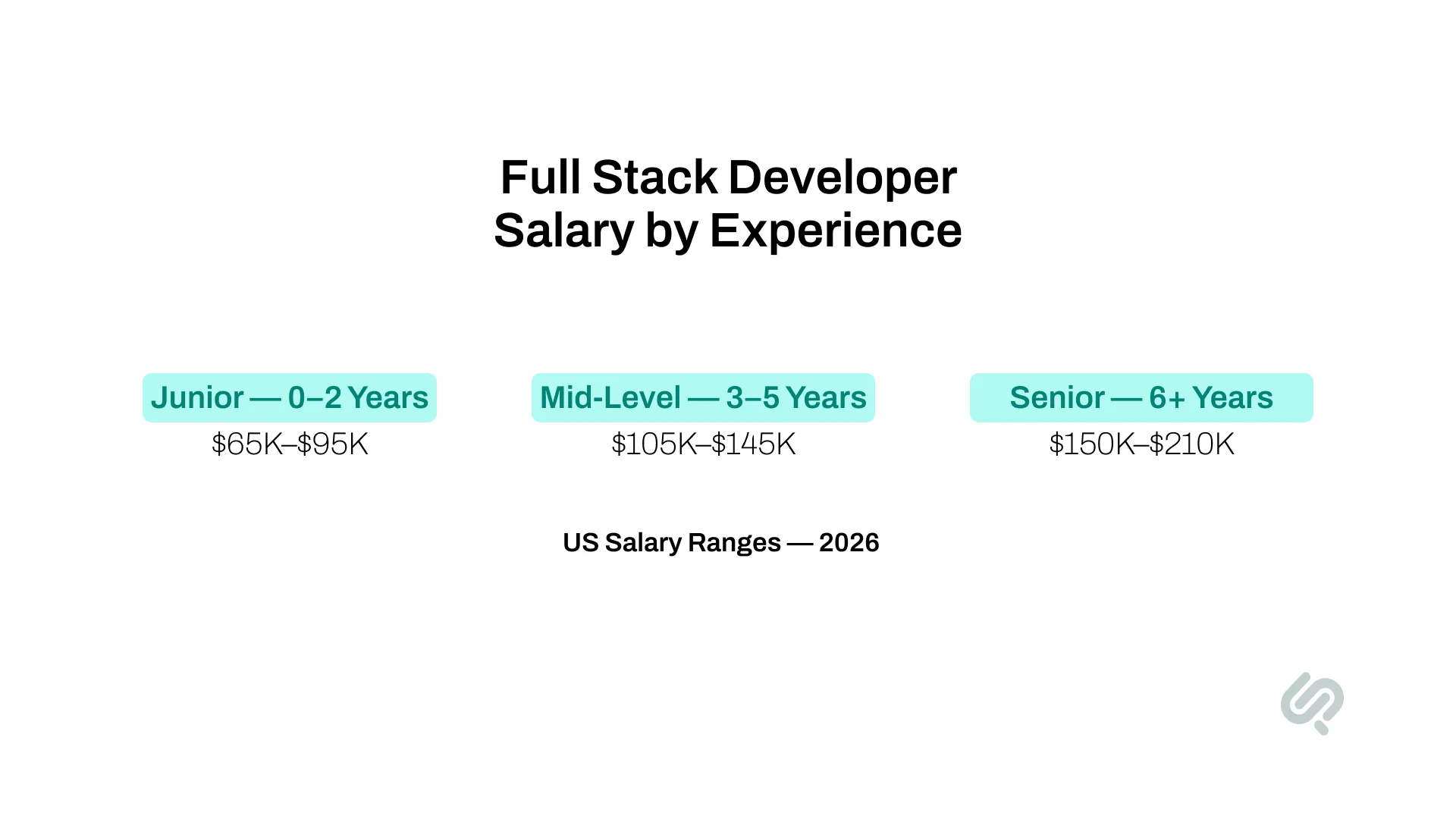
Pay changes significantly with experience. Workzil's July 2026 US salary guide (1) lists the following ranges:
Coursera's July 2026 guide provides another useful benchmark using Glassdoor data: median total pay rises from about $98,000 for developers with 0–1 years of experience to $139,000 for developers with 10–14 years of experience. (2)
Geography also changes the cost. FullStack's July 2026 software pricing guide places senior offshore development rates at roughly $20–$50 per hour and senior nearshore rates at approximately $50–$90 per hour. (3)
Rates alone do not determine which location is best. Time-zone overlap, communication, technical experience, and the amount of internal management required should also be part of the comparison.
Location can change the hiring budget significantly, even within the US. Current 2026 salary data shows some of the highest full stack developer pay in major technology and business hubs.
These figures are useful if you plan to hire locally. For remote hiring, compare them with nearshore and offshore rates alongside time-zone overlap, experience, and management requirements rather than location alone.
If you want the technical picture behind these numbers, what a full stack web developer actually does day to day explains the skill set that drives this range.
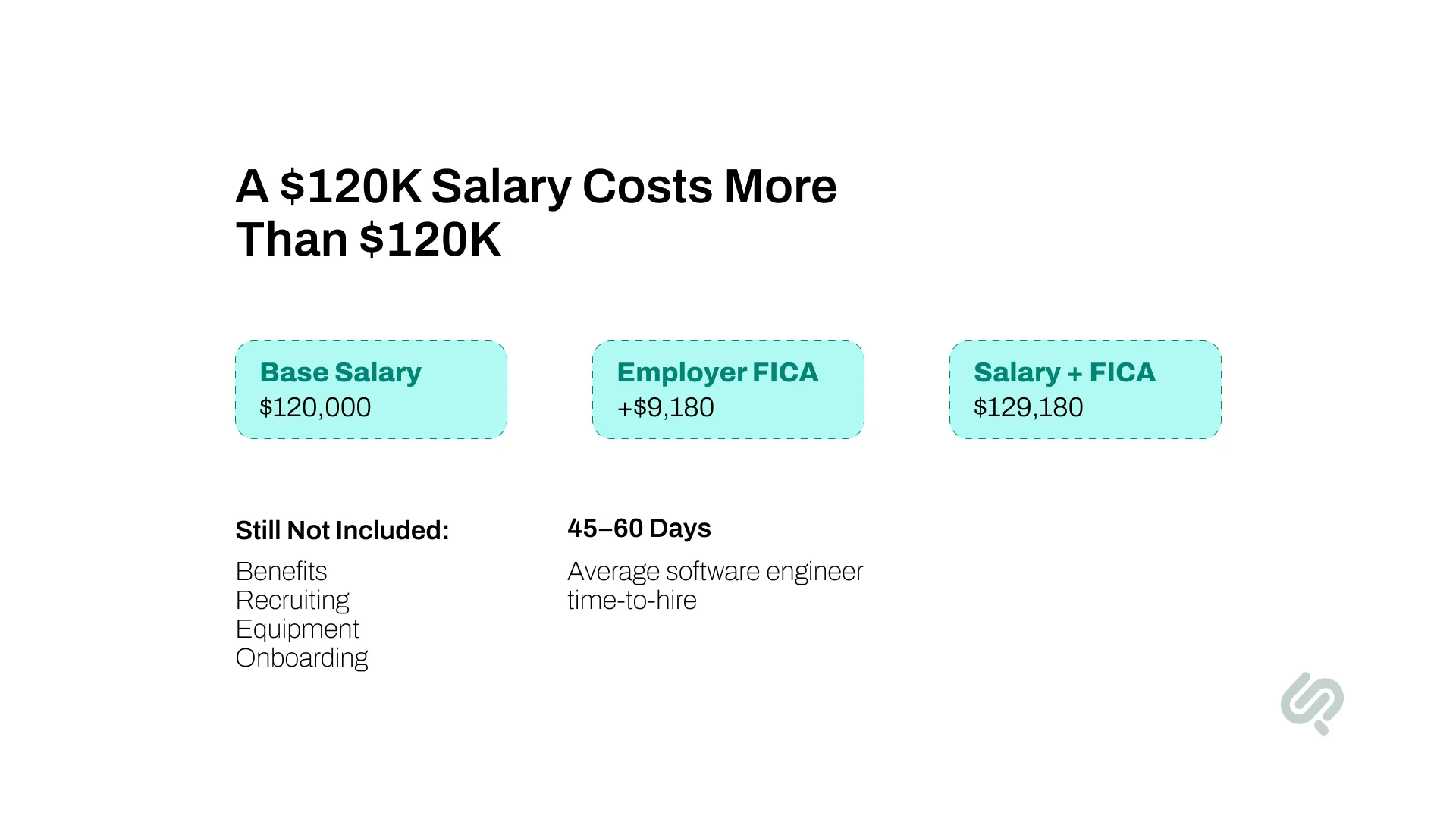
Base salary is not the full employer cost. In March 2026, wages and salaries represented 69.9% of private-industry employer compensation, while benefits represented 30.1%. (4)
Payroll taxes also sit on top of salary. For 2026, US employers generally pay a 6.2% Social Security tax and a 1.45% Medicare tax, making the employer FICA contribution 7.65% on wages subject to both taxes. The 2026 Social Security wage base is $184,500. (5)
For a developer earning $120,000, employer Social Security and Medicare contributions alone would therefore add about $9,180, bringing salary plus employer FICA to approximately $129,180 before health benefits, paid leave, retirement contributions, recruiting, equipment, and onboarding. (5)
Hiring also creates a time cost. HackerRank's 2026 hiring guide puts average software-engineer time-to-hire at roughly 45–60 days. (6)
For budgeting purposes, compare the developer's salary with the full cost of employing and hiring them rather than treating the salary figure as the complete annual expense.
Salary and hourly rates are not directly comparable.
A $120,000 annual salary works out to about $57.70 per paid hour when divided by 2,080 working hours. But that figure excludes benefits, payroll costs, recruiting, equipment, onboarding, and other employer expenses.
Using the $157,000 to $189,000 first-year cost calculated above, the effective cost becomes approximately:
That gives businesses a more useful starting point when comparing an employee with a freelancer, agency, or staff augmentation provider.
The comparison should still include time-to-hire, management effort, productive hours, flexibility, and the risk of replacing the developer later.
Hourly rate or salary is only the starting point. The final full stack developer cost changes based on the experience you need, the complexity of the product, the technology stack, where the developer is based, and how the engagement is structured.
Current software development pricing guides also identify scope, integrations, team composition, and post-launch requirements as major cost drivers.
Two developers can have the same job title and very different responsibilities.
One role may focus mainly on frontend and backend implementation. Another may also be expected to handle:
Those roles should not be priced against the same salary benchmark.
Before comparing candidates, define what the developer actually needs to own. A senior engineer responsible for architecture, cloud infrastructure, and production decisions will usually cost more than a developer focused mainly on feature implementation.
This also helps avoid overhiring. If you only need frontend and backend delivery for a defined product, you may not need to pay for a senior technical lead.

Businesses generally have four ways to add full stack development capacity. The right option depends on how long you need the developer, how much internal management you can provide, and whether the work requires other specialists.
An in-house hire can make sense when the role will remain permanent for years. Staff augmentation is usually more flexible when you need to fill a skill gap, increase capacity, or build for a defined period without adding permanent headcount.
Compare the total cost of delivery, not only the quoted hourly rate. Management time, QA, DevOps, hiring delays, replacement coverage, and rework can change which model is actually cheaper.
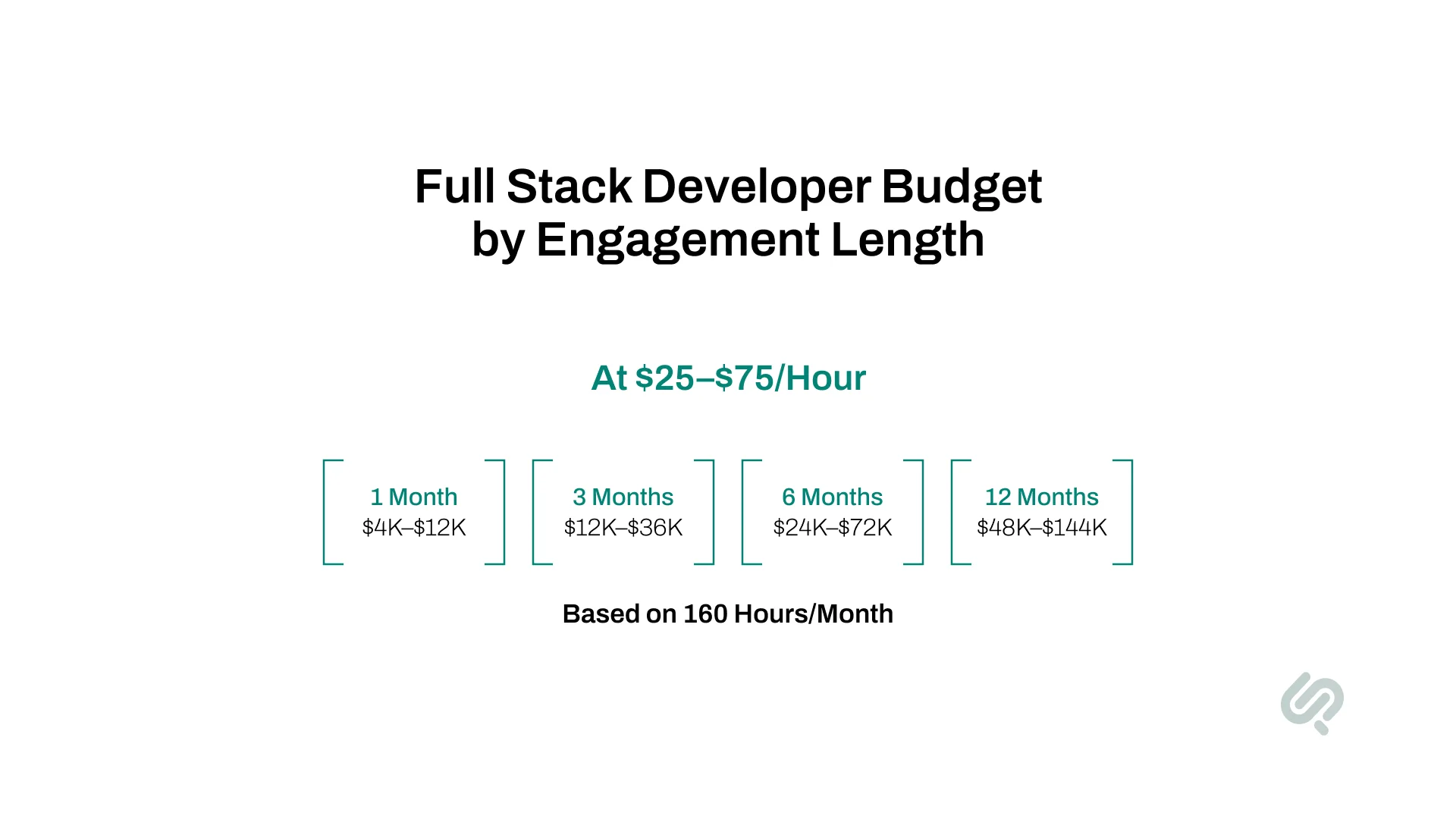
Using the existing Phaedra Solutions hourly range in this article of $25 to $75 per hour, the table below shows an illustrative full-time-equivalent budget at 160 hours per month. It is a planning example, not a fixed quote; dedicated monthly engagements may be priced differently.
This is why buyers should compare engagement length alongside hourly rate. A lower rate can still produce a higher total cost if the developer needs more time, requires more management, or creates rework later.
Paying for more seniority than the project requires increases cost. Hiring too junior for complex work can create the opposite problem: slower delivery, more supervision, and expensive rework.
A single developer is usually enough when the scope is contained and work can happen sequentially. When frontend, backend, infrastructure, QA, design, security, or AI work must happen at the same time, a small team is often more efficient.
“A single full stack developer can move fast on a prototype, but the moment you have real users and real uptime expectations, you need dedicated eyes on infrastructure, testing, and design. Trying to cover all of that with one person is where most early-stage products start accumulating technical debt they don't notice until it's expensive to fix.”
— Mujtaba Sheikh, Head of Design & Engineering, Phaedra Solutions
If your decision is between one generalist and broader engineering coverage, our guide to hiring a dedicated development team explains when a team structure makes more sense.
The engagement model can change how predictable your budget is and how easily the project can adapt. Current pricing guides commonly distinguish between fixed-price, time-and-material, and dedicated-team structures.
The right model depends less on which rate looks lowest and more on how predictable the scope is. A fixed price works best when the work can be defined upfront. Hourly or monthly models usually fit better when the roadmap is expected to change.
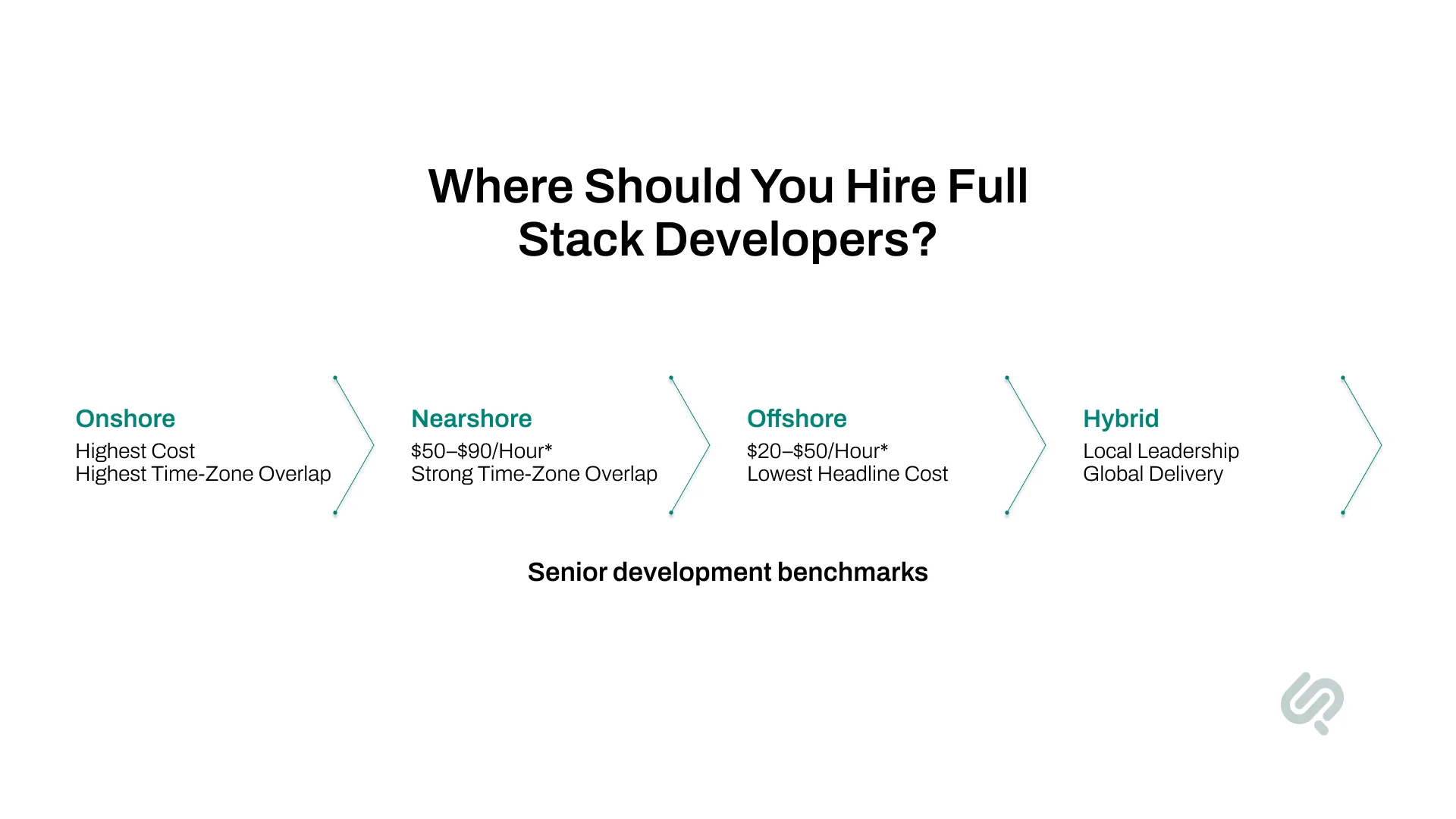
Geography affects more than the hourly rate. It can also change time-zone overlap, communication speed, access to talent, and how much coordination your internal team needs to provide.
FullStack's 2026 guide places senior offshore development around $20 to $50 per hour and senior nearshore development around $50 to $90 per hour, while onshore US agency rates can run significantly higher depending on firm size and specialization.
The practical comparison is total delivery efficiency, not geography alone. Lower rates can be offset by slower decision cycles or additional management effort, while a well-run hybrid model can combine senior oversight with lower-cost execution.

AI coding tools can reduce time spent on repetitive development tasks such as boilerplate, test generation, documentation, debugging assistance, and code suggestions.
They do not remove the need for senior engineering judgment. Surveys found that 84% of respondents use or plan to use AI tools, while 46% distrust the accuracy of AI-generated output.
For a buyer, the better questions are:
An AI-fluent developer may deliver more within the same engineering hours, but architecture, QA, security, integrations, and production accountability still require human oversight.
Once you know your budget, evaluate whether the developer can actually deliver the work your product requires.
Before hiring, check:
A developer with a higher rate can still be the cheaper option if they need less supervision, deliver faster, and create less rework.
Phaedra Solutions built an AI-powered cloud surveillance platform that brought IP cameras and access-control systems into a fast web and mobile experience.
The delivery required application development, AI-assisted footage analysis, cloud infrastructure, QA, and project management working together, scope that would be difficult to place entirely on one generalist developer.
Published case-study materials report 50% less time spent on manual video reviews and 3X greater threat-detection accuracy. The takeaway for a buyer is not simply to hire more people; it is to structure the engineering team around the work and use full stack developers where their breadth creates the most value.
Phaedra Solutions provides staff augmentation for businesses that need full stack developers without adding permanent headcount. Developers are matched to your technology stack and work inside your existing tools, sprints, and engineering processes.
We also use an AI-first delivery model. Tools and AI agents such as Claude and Cursor support coding, testing, code review, documentation, and other repetitive engineering work under senior review.
Depending on project scope and complexity, this approach can support:
These results vary by project and are not fixed guarantees.
If an in-house hire does not fit your budget, timeline, or current headcount plan, hire full stack developers through Phaedra Solutions or book a free staff augmentation consultation to discuss the role, seniority, engagement model, and monthly capacity you need.



Ameena is a content writer with a background in International Relations, blending academic insight with SEO-driven writing experience. She has written extensively in the academic space and contributed blog content for various platforms.
Her interests lie in human rights, conflict resolution, and emerging technologies in global policy. Outside of work, she enjoys reading fiction, exploring AI as a hobby, and learning how digital systems shape society.