<
logo

Legacy App Modernization: 50% Cost Cut & 500k+ Messages

Phaedra Solutions transformed an outdated event operations platform into a faster, more stable, and more scalable system through legacy application modernization.


The client’s old Ruby on Rails application had become a business risk (too slow, AWS infrastructure costs up to $22K/month, couldn’t handle mass communication). To fix this, Phaedra Solutions delivered a phased Ruby on Rails to NestJS migration and optimized the cloud infrastructure.


Outcome: 500K+ event messages delivered, cloud spend reduced from $22K to $9K, $132K in
annual savings,
and a stronger foundation built without a full rebuild in 14 days.

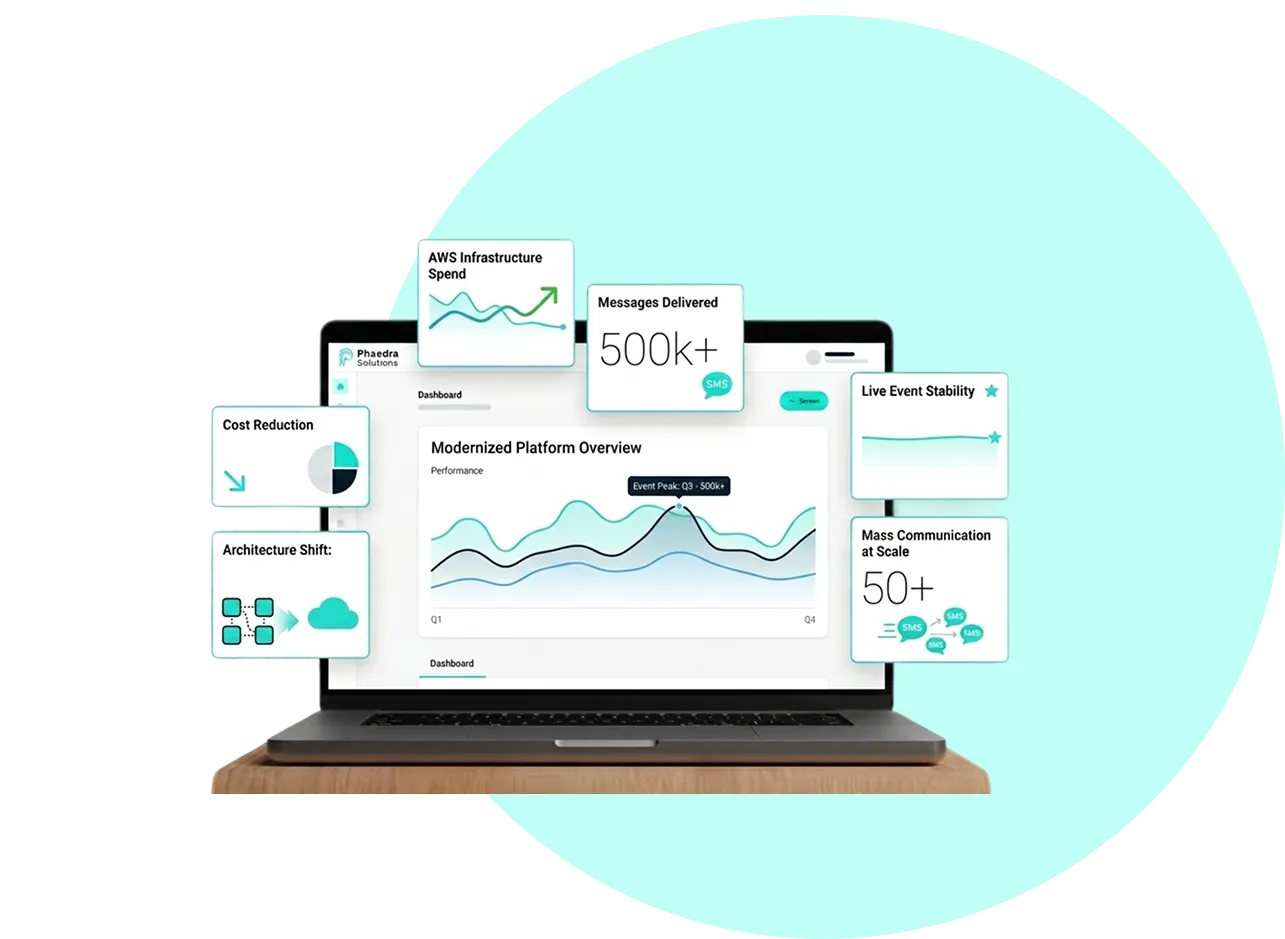
Legacy app dashboard showing cost savings and scalability gains in legacy application modernization

Summary

This legacy application modernization case study shows how Phaedra Solutions helped an event operations company replace an aging Ruby on Rails foundation that had become slow, buggy, and unreliable under pressure. Instead of a disruptive rebuild, we delivered a phased Ruby on Rails to NestJS migration and broader legacy system upgrade that improved stability, reduced bugs, lowered AWS spend, and created a stronger base for future scale.

The result was not just a technical refresh. It was a practical enterprise application transformation that made the platform easier to maintain, safer to release, and better prepared for high-volume event operations.

Key Stats

  • 500,000+ messages successfully delivered during a live event

  • 14 days to design, build, and deploy a custom high-throughput SMS system

  • $22K/month → $9K/month in initial infrastructure cost reduction

  • ~$132K annual savings after infrastructure optimization

  • 50 Twilio numbers provisioned to bypass SMS throughput bottlenecks

  • Phased modernization completed without forcing customers off the platform

What the Platform Does

The platform supports live event operations through a centralized command-and-control environment. It allows teams to log security, medical, site, and guest incidents, communicate in real time, upload media, notify staff, filter incident data, and generate PDF reports for post-event analysis.

In short, this was a business-critical operational system. When it slowed down or failed,
teams felt it immediately.

Futuristic cube with floating data points showing modular application architecture in a digital network

The Problem

The old application was built on an outdated Ruby on Rails framework. Over time, that created a serious business risk:

  • The platform became slow and buggy

  • It struggled during live events with heavy traffic

  • Crashes became harder to prevent as usage increased

  • Releases became more fragile

  • Infrastructure costs kept rising as the architecture became more complex

The client needed to improve application performance, but patching the old system was no longer enough. The product needed real modernization, not another round of short-term fixes.

Outdated app issues highlighted with bold text and exclamation mark showing urgency

Biggest Challenge

The system was already in active use, so the client could not afford a sudden cutover, major downtime, or customer disruption. At the same time, the architecture had become too rigid to support growth. The real challenge was balancing speed, risk, and continuity.

The deeper issue was architectural. The product needed careful software re-engineering, including a phased monolith to microservices migration, so the team could modernize the platform while keeping the business running.

What Phaedra Solutions Did

Phaedra Solutions approached the work as a phased transformation, not a big-bang replacement.

Replaced the outdated
backend gradually

We did not rip everything out at once. We planned a module-by-module migration from Ruby on Rails into NestJS so customers could keep using the platform while the foundation was modernized behind the scenes.

This Ruby on Rails to NestJS migration created a cleaner modular application architecture, reduced platform fragility, and made future releases easier to manage.

Solved high-volume messaging
limits during live events

In 2023, the platform hit a major bottleneck with Twilio. One number could only send 100 messages per
minute, which was far too low for large live events.
To solve that, we:
  • Procured 50 Twilio numbers to distribute traffic & built a custom SMS queue with AWS SQS

  • Added throughput controls and number rotation & optimized delivery pipeline for messaging

This system delivered 500,000+ messages during a live event, and the full solution was designed, built, and deployed within 14 days.

Modernized infrastructure and
cut cloud waste

By July 2025, infrastructure costs had climbed to $22,000 per month because each microservice had its own Elastic Beanstalk environment, EC2 resources, and load balancer.
We addressed this through focused AWS cost optimization and platform redesign:
  • Migrated workloads to Amazon EKS & implemented infrastructure as code with Terraform

  • Implemented Infrastructure as Code with Terraform & reduced Aurora from 3 clusters to 2

That work cut monthly costs from $22K to $9K initially, and even after service growth, the platform now runs at around
$11K per month, creating about $132K in annual savings.

Built a stronger modernization
base for future growth

This work went beyond isolated fixes. It gave the product better structure, cleaner service boundaries, and a stronger operational model. In practical terms, it delivered better release safety, more flexibility for new development, and stronger long-term backend modernization.

Why They Chose Phaedra Solutions

The client did not just need a team to ship features. They needed a partner who could modernize a fragile live system without creating new business risk.

They chose Phaedra Solutions because we offered:

  • A phased modernization approach instead of a risky rebuild

  • Strong backend development experience for complex business systems

  • Practical software modernization solutions tied to cost, stability, and scale

  • A team that could act as more than a typical NestJS development company by handling architecture, migration planning, cloud optimization, and release safety together

Large crowd shaped like a question mark beside Phaedra Solutions, backend modernization

How We Managed Delivery

To reduce risk, we delivered modernization in controlled phases.

Instead of shutting down the old system and replacing it all at once, we upgraded the platform module by module. That approach allowed the product to stay live while modernization moved forward in parallel.

Our delivery model focused on:
  • Incremental releases

  • Safe migration sequencing

  • Production stability during active customer use

  • Fast feedback between engineering and operations

  • Preserving the user experience while modernizing the foundation

That is what made this transformation practical. The business kept running while the system kept getting better.

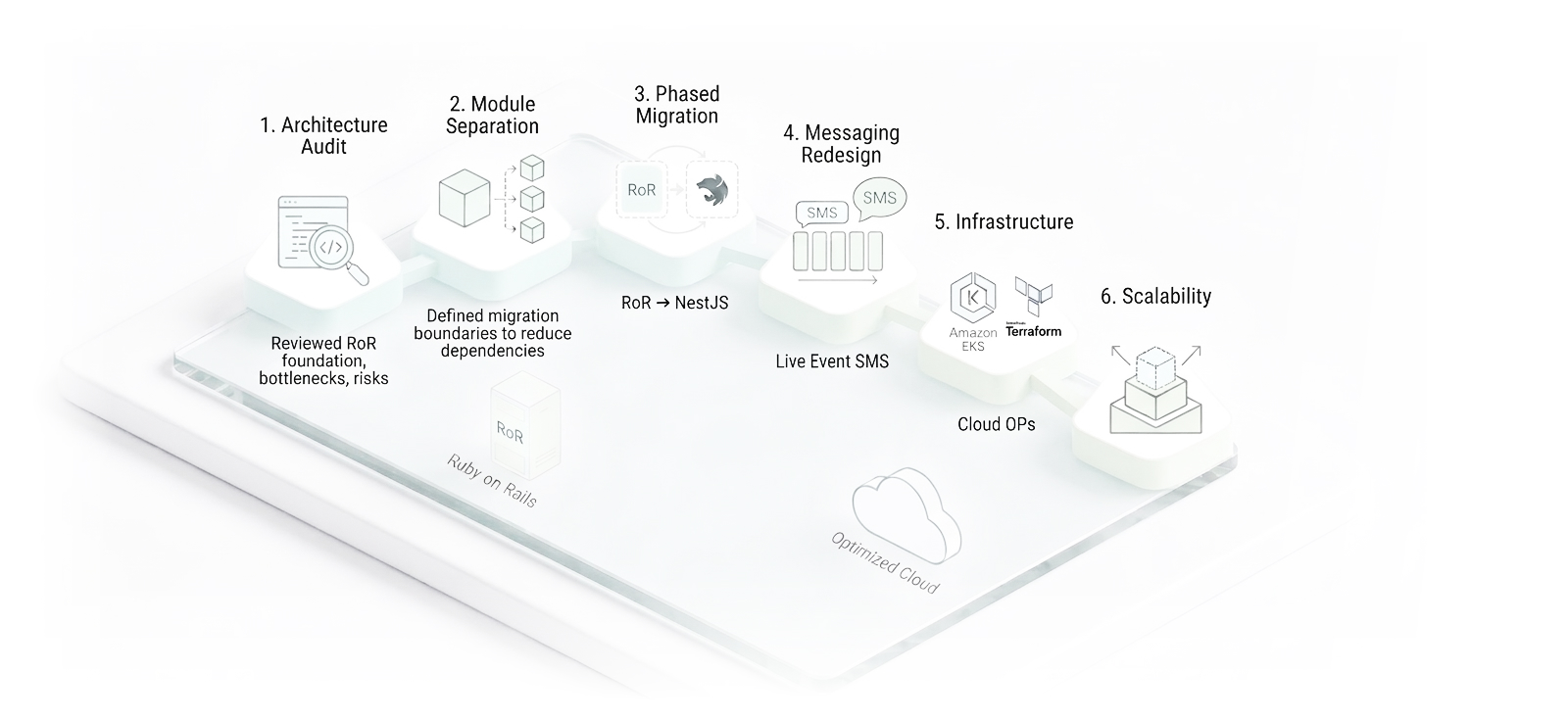
Modernization Strategy Snapshot

This is the path we followed:

Modernization flow from audit to scalability using ruby on rails to NestJS migration

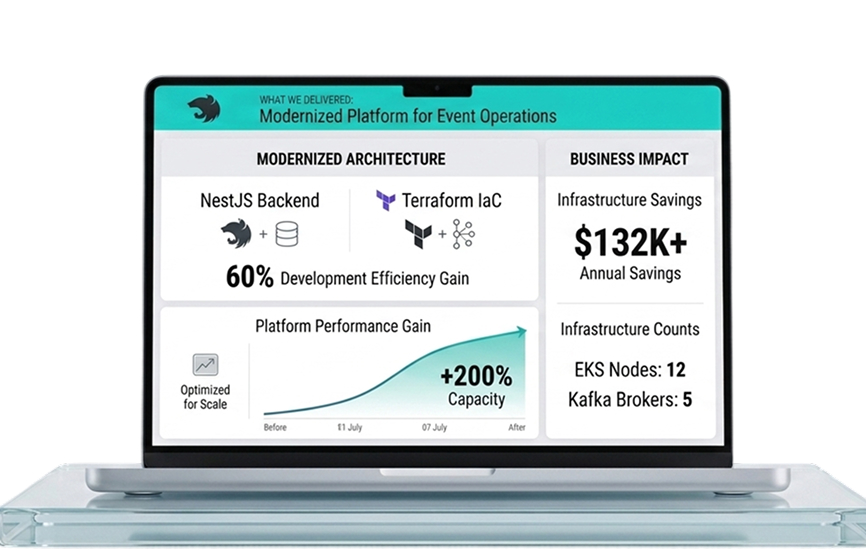
What We Delivered

  • A modernized web application for event operations and incident management, including real-time communication, staff notifications, filtering, media uploads, and reporting workflows already central to the product.

  • A phased backend rebuild using NestJS and TypeScript

  • Better-structured services designed for scalable backend systems

  • Infrastructure modernization across compute, database, Kafka, Redis, and non-prod environments

  • A staged deployment model on AWS to reduce rollout risk and support controlled release expansion.

  • A stronger technical base for future web application scalability

Event operations dashboard showing performance gains and scalable cloud backend on laptop

Impact

The business outcomes were clear:

Live
event stability improved
significantly
Major
crash and bug risks
were reduced
Messaging
capacity scaled to
event-level volume
Monthly
cloud spend dropped by
roughly 50% initially
Annual
infrastructure savings reached
about $132K
The platform
became easier to extend and
safer to operate

This is what effective legacy application modernization looks like when it is tied to business outcomes, not just code cleanup.

Before and After Modernization

Before
  • Outdated Ruby on Rails foundation

  • Slow, buggy behavior during daily use

  • Crashes during high-traffic live events

  • Messaging throughput limits during mass communication

  • Rising AWS costs from inefficient infrastructure

  • Hard-to-scale architecture that slowed future development

After
  • Stable, modular backend built for growth

  • Better release confidence and lower operational risk

  • High-volume messaging support during live events

  • Lower infrastructure spend through smart consolidation

  • Stronger foundation for future product modules

  • A more reliable platform that could support continued expansion

Metric

Cloud Spend
Mass Event Messaging
Platform Stability

Before

$22K/month
100 messages/minute per number
Frequent crashes during peak usage

After

$9K/month initially
500,000+ messages delivered during a live event
Stable, modular platform

Benefit

~$132K annual savings
Supported high-traffic event communication at scale
Safer releases and fewer disruptions

Tech Stack & Architecture

Front end
Back end
Cloud and deployment
Infrastructure
Messaging

Modernize Without Starting Over

Many teams assume modernization means a full rewrite. This project proves otherwise.

Phaedra Solutions used legacy application modernization to improve the system in place, protect live operations, and remove the highest-risk technical bottlenecks first. That approach lowered migration risk, reduced customer disruption, and created a smarter path to long-term growth.

For this client, the right answer was not rebuilding everything. It was targeted modernization with better sequencing, better architecture, and better business outcomes.

Your Next Step A Clear Modernization Roadmap

If your product is still running on an outdated framework, struggling under live traffic, or costing more every month to maintain, the answer is not more patchwork. It is a clear modernization plan backed by the right architecture, migration strategy, and delivery team.


Our legacy application modernization services help teams stabilize fragile products, plan safer migrations, reduce infrastructure waste, and build a stronger base for future development.

Let’s Talk About Your Project

Tell us what you're building — and we'll take it from there.
Fill out the form to schedule a free 30-minute discovery call where we understand your idea, offer early advice, and suggest the best next steps.